

|
 Support Science Not Superstition
|
|
|
|
www.sillybeliefs.com |

|

|
Stardate 26.036
Ascent out of Darkness ~ Armchair Philosophy |

|

|
| Religion's foolish war with science |
A few months back I watched the 2011 documentary series 'Bible's Buried Secrets' by British biblical scholar Francesca Stavrakopoulou, and then I 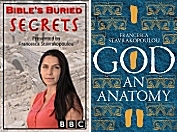 read her book, 'God: An Anatomy' (2021). As the book title implies, God, at least according to the Bible (but not according to modern Christians) has a body, and not some alien reptilian body, but a human-like body, even genitals, and many Bible passages make this very clear, as Francesca explains in her book. Think about it, there's a very good reason that Christians argue that humans didn't evolve from monkeys (and in fact science never said we did, that false claim is based on their ignorance of evolution). But that aside, Christians (and Jews and Muslims) say we were in fact made fully-formed in God's image. If you can't recall the Bible verse that informs all three religions, here it is: read her book, 'God: An Anatomy' (2021). As the book title implies, God, at least according to the Bible (but not according to modern Christians) has a body, and not some alien reptilian body, but a human-like body, even genitals, and many Bible passages make this very clear, as Francesca explains in her book. Think about it, there's a very good reason that Christians argue that humans didn't evolve from monkeys (and in fact science never said we did, that false claim is based on their ignorance of evolution). But that aside, Christians (and Jews and Muslims) say we were in fact made fully-formed in God's image. If you can't recall the Bible verse that informs all three religions, here it is:
'Then God said, "Let us make man in our image, in our likeness, and ... So God created man in his own image, in the image of God he created him; male and female he created them.' GE 1:26-27So the Bible tells us, and remember that the Bible is the only source of information we have about God, that we were made to resemble God, and therefore logically God must also resemble us, meaning that God is a person with a human-like appearance and characteristics. We humans have the look we do because our body shape was made to look like God, in miniature of course, and without the magical powers. Both the documentary series and book were very interesting and informative, revealing untold (and for Christians, quite embarrassing) facts about God, the Bible and the ancient religions that both the Bible and the character of God were based on. What will come as an utter surprise to most Christians is that God and many of the stories about God in the Bible were not original, not in the slightest, and were simply a rehash of older stories about other gods, with some names changed to try and hide that fact. That's why so much of the original Bible, meaning the first draft, ie the Old Testament, is so confusing and contradictory, since it purloins story elements of different gods from various cultures around the region with no thought to logical consistency. Think of a modern writer stealing story elements from the likes of Superman, Star Wars, The Smurfs and Casper the Friendly Ghost, and passing them off as a new and original story, and not only that, claiming that the book is based on true events. Of course modern believers in God are so far removed from the era thousands of years ago when the Bible was stitched together from even older sources that they have no hope of detecting this blatant plagiarism from simply reading the Bible (not that many do read the Bible). That said, since the Bible starts off by telling tall tales of an invisible sky fairy creating the entire universe in a mere six days, an account that doesn't make logical or scientific sense, and then goes on, in complete seriousness, to tell us of a talking serpent who cons a couple of nudists that the sky fairy had only recently brought to life as fully formed adults, then surely even modern believers of average intelligence should be able to sense that maybe this book is not based on true events after all. But surprisingly, no, billions of people of average intelligence and even higher are quite incapable of reading these utterly ridiculous stories of magical nonsense and realising that it's all bullshit. I mean, seriously, do we again need to mention the talking snake, or the less well-known, but equally silly, talking donkey, plus stories of a flat Earth resting on pillars, men rising from the dead, stars falling to Earth and snow kept in heavenly storehouses? It's just mind-boggling how much nonsense the typical person will believe, even with all the factual information their smartphone has access to (it's clear who the actual smart one is in that relationship, the clue is in the name), and apparently the deleterious affect religion has on society isn't going to end any day soon. I recently read this dire and depressing pronouncement: 'Religious and spiritual beliefs are incredibly wide-spread phenomena, with important influences on social behavior, cultural practices, and even societal functioning. Polls estimate that the vast majority of the population is religious believers, with 300 million Americans and over 5 billion globally (Pew, 2017). Further, although the number of religiously unaffiliated has been growing, the spiritual impulse has hardly receded. In fact, polls indicate that each of the world's major religions' populations (except Buddhism) is expected to grow over the coming decades (Pew, 2017). That is, as the population growth of believers outpaces that of unbelievers, the world is set to become more — not less — religious.'Anyway, after watching Francesca Stavrakopoulou's documentary series and reading her book, I was motivated to watch a few YouTube videos of various TV appearances she has made on talk shows and such. Francesca is something of a rarity in the biblical scholar field since she isn't a Christian or Jew but an atheist. And while a few biblical scholars have turned from committed Christians into atheists, like Bart D. Ehrman (and considering the research they do we're surprised the majority don't become atheists), but Francesca has always been an atheist. She knew it was bogus going in. People that meet her find it weird that an atheist would make a career of studying a book about a god she doesn't believe is real, unlike most of her fellow biblical scholars who do. But even though she is an atheist and very open about it, I was surprised to hear her say in one interview that she doesn't agree with the atheist views of another famous atheist, Richard Dawkins, or those of 'his crew', ie Christopher Hitchens, Sam Harris, Daniel Dennett and other so-called "new atheists". She has appeared on TV shows alongside Dawkins and other guests discussing religion, and is clearly not a fan of his. Concerning this difference of opinion, Francesca said that, 'Dawkins has set up this false dichotomy between science and religion, in which religion is trying to answer the question, "Where did life come from and how did we get here", and science answers that question much more persuasively and thoroughly and logically. Religion is not trying to do what science is trying to do at all, and I really think Dawkins misunderstands that ... I think he misunderstands religion'.Now I don't think Dawkins misunderstands religion at all, and would argue, quite correctly I believe, that religion is obviously competing with science, and losing badly. Religion (meaning all religions) essentially arose with the goal of answering the big questions concerning our existence, one being 'Where did life come from and how did we get here', and modern religion has in fact maintained for thousands of years that it has actually answered that question, and the answer is God. Obviously. End of story. Why are some people still skeptical? Have they not read the Bible? The answers are all in there! The very first book of the Bible — Genesis — explains quite clearly where life came from — God's intentional design — and how it arose — God's hard work over six days. For almost all of history religion (in numerous cultures worldwide) has been the only institution asking and answering the question concerning our origins, as well as what is our purpose in life, how should we behave, and should I mutilate my child's genitals. And when science eventually arose quite late in the scene, it had to fight religion every step of the way, and still is, over who had the right and ability to ask the big questions concerning our origins. For centuries religion even killed, persecuted or excommunicated anyone who had the arrogance to question the answers the Bible had already provided. Ask any religious person, from an ordinary guy on the street to a high ranking bishop, how the world and life arose and none will say, 'I don't know, that's not the sort of thing religion looks at, you need to ask a scientist'. All sincerely believe that religion has given them the answer, and will in essence say — God created life. None will ever defer to science, even though the obvious need for science really only came about when intelligent people started to realise that the answers religion had been providing for millennia concerning 'life, the universe and everything' were clearly quite wrong. Historically there is no denying that religion has been the only institution that served the role of answering those big questions, but it has now been convincingly dethroned by science, because as Francesca said, 'science answers that question much more persuasively and thoroughly and logically' than religion ever did. And realistically science won this war of ideas over a century ago, providing real answers and evidence that religion can't refute. Churches, synagogues, mosques and temples should have all been repurposed as restaurants or art galleries by now, and religion should have been consigned to history, joining other monumental mistakes like belief in witches, blood-letting and gremlins, but billions of people still keep consulting a single book written way back in the Bronze Age by people who thought the world was flat and snakes could talk. Religion, like Donald Trump and his 2020 election defeat, refuses to concede. Even though it's the answers provided by science (and history and philosophy) that built and maintains our modern society, the reality is that it's the ancient answers provided by religion that continues to severely hinder human progress (as it always has). Religion still flourishes in the minds of the majority because they are still raised on, and believe, the lies provided by ignorant priests, rabbis, imams, monks, gurus and shamans. Consider the war that's just erupted involving the US, Israel and Iran. Would this be happening in a world where invisible sky fairies weren't a thing people believed in? Recall how in centuries past Christians believed in, and feared, witchcraft, and consequently around 50,000 people (mainly women) were hunted down, accused of being witches and killed. Most Christians now don't believe in witchcraft (even though it's still in the Bible — 'Thou shalt not suffer a witch to live' Exodus 22:18), and thankfully witch hunts and trials no longer happen. But while religion has largely put witchcraft aside, not so the conflict as to whose god is the right god. It's not just a coincidence that the US, Israel and Iran are each deeply religious, and each follow opposing religions, Christianity, Judaism and Islam respectively. Their murderous actions are informed by a centuries old conflict over who has the right answers about God, who has the backing of God and who should be ruling the world as his proxy. And the irony is that each is using science to try and prove that their religion reigns supreme. Rather than calling on the power of the gods, they turn instead to science. To settle whose god is the most powerful they battle to see who best utilises advanced elements of science and technology (ie weapons, satellite surveillance etc). While religion provides the motivation for the conflict, it's science that will decide the outcome. And all the while their sky fairies are embarrassingly conspicuous by their absence, not even willing to throw a lightning bolt or two in the conflict. Clearly the US, Israel and Iran all believe that they must use science to settle their conflict, but that conflict only continues to fester because each side still believes that the answers their religion provided millennia ago about the nature of the universe are the correct ones, that God created the cosmos, not a random quantum fluctuation, and going to war against those who argue for different gods is a great way to show the real god that you still believe in him. But while religion is more than willing to use the discoveries of science to aid its indecent grasp for power, in no way has religion accepted that science should take over answering the big questions about the world and religion will now just concentrate on operating soup kitchens for the homeless and curing homosexuals. Another way to look at this is that every true Christian, Jew and Muslim talks of 'God the Creator', since the Old Testament of the Bible (the founding document of all three religions) begins with God creating the cosmos and life in less than a week, and everything that follows builds on that prodigious (albeit improbable) act of creation. To deny belief in God the Creator would cause the entire Bible to collapse, built as it is on that core foundation. Every true believer is a creationist, believing that every question about the world will lead back to and reveal God's creative handiwork, whereas science dismisses talk of gods as irrelevant and misleading, and in recent decades this conflict between creationism (aka religion) and science has been quite obvious. This nonsense view that science and religion are both looking at very different questions, that they operate in quite different spheres of knowledge with no overlap, and thus no conflict, is a modern invention. It was proposed and popularised in 1997 by Stephen Jay Gould, a paleontologist and agnostic Jew who gave it the pretentious name 'non-overlapping magisteria' (NOMA). As we've said, for much of history there was only one sphere of inquiry into 'life, the universe and everything' — religion — but in recent centuries a new sphere of inquiry — science — has not just occasionally stepped on religion's toes, its answers on everything from the origin of the universe and life to the causes of disease and earthquakes has made a mockery of religion's ancient answers and has brought both spheres into full blown conflict. And it wasn't just a war of words. It was a conflict that, for example, saw the Christian Church burn Italian philosopher Giordano Bruno at the stake in 1600 CE and then a few decades later threaten scientist Galileo Galilei with torture and death until he recanted his views, and then placed him under house arrest until his death. Their crime was that they held views that contradicted those of religion. So again, to argue that the differing views religion and science have concerning the world don't overlap and create no conflict is quite wrong. And yet in America many religious organisations along with many scientific and educational institutions have adopted this concept of 'non-overlapping magisteria' into the way they operate, each of them attempting to keep the peace by pretending that their particular worldview causes no controversies, that religious answers don't conflict with scientific answers and vice versa since both are asking very different questions about quite different mysteries. Of course that is blatantly false, the conflict continues, and in many countries, even in America, land of the free, people are still being persecuted and even killed for expressing views and lifestyles that contradict religion. That said, while the answers science now provides do indeed conflict with those religion has been pushing for eons, science isn't actually at war with religion these days, there are no violent confrontations or even angry debates where scientists try and convince theologians they are wrong and get them to defect. You don't see scientists protesting outside churches or creating an Index of Forbidden Books (such as the one the Church maintained for centuries on science books and that was only officially abandoned in 1966). Science essentially ignores religion and their talk of gods, in the same way that it ignores any talk that naive children might raise of Santa Claus and the Easter Bunny. Scientists don't lose sleep at night worrying about anything the Pope might have said about angels or immortal souls. But that's not the case with religion, true believers maintain a very active one-sided conflict with their opponent, science. The religious can be seen protesting at everything from abortion clinics (which have turned deadly) and movie theatres to nude beaches and climate change conventions, they fight to get the tale of God's miraculous creation taught in school science classes, they try to engage scientists in foolish debates around Noah's Ark and prayer curing cancer and they insist on giving interviews to challenge any scientific claim that explains natural events as due to natural causes (and by implication dismisses God's input entirely). Again, there is still a real conflict but it's very one-sided these days. Religion obsesses over every claim science makes, and expends considerable resources trying (always without success) to challenge it, whereas science simply pays religion no heed, and if pushed would explain that factoring gods into their scientific theories would be as foolish as testing for leprechauns. Science investigates reality, whereas religion merely creates fantasies woven around reality, so how could there not be major conflict when answers are compared, yet only religion gets upset and confrontational. One-sided it may now be, but to say that the core views of religion and science don't overlap is disingenuous. Some people might disagree, arguing, for example, that the Vatican has officially acknowledged evolution to be true, which surely shows that they have conceded defeat to science. But that is mere subterfuge, since if you ask any Catholic from the Pope on down how evolution came about, they all say God created it with the sole intent of having humans evolve and rule over the Earth in God's name. They have to say this since if the genetic mutations that drive evolution are random, if, as science states, there is no design or goal involved, then it was mere chance that humans evolved, meaning God played no part in us being here. Thus religion must change the scientific view of evolution and invent a process that still looks like random steps but is actually a carefully designed process created by God that he initiated, monitored and tweaked over billions of years to ensure humans eventually made a belated appearance. Religion hasn't relegated its authority over to science, it's merely stepped back into the shadows and asked a new question about our origins, changing the old question of 'Who created humans?' into 'Who created the process that created humans?' And as far as religion is concerned, in both cases the answer is still God. It's the same with cosmology and the Big Bang, even when the religious begrudgingly acknowledge that the universe is much, much older and bigger than they ever thought possible, they still come back with the claim that someone must have designed and then lit the fuse to the Big Bang, and their answer is again God (although as with all their claims, never with any supporting evidence). It is quite impossible to be a true believer in God the Creator and not insist that God is ultimately the answer to every question that science asks. The more questions science answers, the more detail it adds, all will eventually lead to one answer — God did it. Science, it is naively believed, will come to realise that religion was right all along. But if, according to Francesca, religion isn't competing with science and isn't trying to answer the big questions about our origins, what sort of questions might religion be asking? She goes on to say that for her religion questions '... what it is to be a human being and what human sociality is all about ... I think [Dawkins] adopts this perspective on the world in which rationality, logic, reason, scientific enquiry and argument can somehow defeat everything else and somehow trumps every other way of being in the world. But actually there are lots of other ways of being in the world, and what Dawkins and his crew have done is completely flatten any of that diversity for me, that amazing richness and texture and difference of what human beings are, both within ourselves, within different groups, across the globe, and I think that is a bit of a shame ... so yeah, he doesn't speak for me, I don't think he does atheism a service at all, I think he does atheism a disservice more than anything else, personally'.I'm not sure if Francesca is arguing that religion never sought answers to the big questions in the past (when clearly it did ... and wrote them down), or merely that religion in our modern world has finally realised its supernatural answers have been convincingly trumped by science, and so religion has retreated into now just offering relationship advice, like unmarried, celibate Catholic priests giving couples guidance on marriage and sex. Of course Francesca is right, 'there are lots of other ways of being in the world', there is great diversity in the human world, but unfortunately religion has created much of that diversity, and not in a good way. One 'way of being in the world' is to be a fundamentalist Christian, or Muslim or Jew or Hindu, and to be in conflict (often violent conflict) with every other religious 'way of being in the world'. Although sexual diversity has always been another 'way of being in the world', religion has made life hell for those that didn't rigidly conform to not just a religiously dictated heterosexual lifestyle, but a lifestyle that dictated what sex acts were permissible and when. Did you know that even heterosexual oral sex between a married couple is classed as sodomy and a sin by the Christian Church? The current belief that sodomy only covers anal sex between men is a falsehood spread by modern Christians who are ignorant of Church dogma. Even the answers to simple questions like what food can we eat, who can we dine with, what clothes must we wear, how must we cut our hair, what days can we work etc, have all served to create many more 'ways of being in the world', and so divide rather than unite people, and all have been served up by religion. I love human diversity, it would be a very boring world if we were all the same, and no doubt lacking much of the technology and art and innovation that we currently have, but the problem with the above diversity, that is, the different beliefs as to which god we should bow down to, how that god demands we have, or don't have, sex, whether we can eat pork or wear a bikini, all those diverse lifestyles are based on utterly bogus answers and demands dictated by religion. Those diverse lifestyles are all based on lies. People are not eating certain foods or dressing a certain way or socialising with certain people and not others because of choice, but because religion demands they live a certain lifestyle. Or else! Again, I love human diversity, but I believe the world would be just as interesting, possibly more so (and definitely safer), if the religious 'ways of being in the world' all vanished, and the answers that religion give in how we should live our lives were ignored. Let's look at this from another angle. Francesca argues that Dawkins implies that 'scientific enquiry and argument can somehow defeat everything else and somehow trumps every other way of being in the world', but since we've already dismissed the validity of the religious way of being and understanding the world, what 'other way of being in the world' is there, that is, what other systems of inquiry besides science have been trying to answer questions concerning various mysteries of nature. One that is often suggested is paranormal research. When confronted with unusual sightings, and science gives answers such as camera lens flare and the planet Venus, the paranormal offers ghosts and UFOs. There is no question that other diverse groups do offer answers that conflict with those of science, think also of the likes of witches, flat Earthers and alternative healers such as homeopaths, but equally there is no doubt that only science gives rational, evidence-based answers, indeed our modern technological world only exists due to the "truthfulness" of those answers, whereas paranormal, magical, alternative, conspiratorial (and religious) answers have never been shown to be correct. Never. Simply offering an answer with no evidential support is quite different to offering an answer well-supported by evidence. Also it's quite misleading to say that science 'can somehow defeat everything else and somehow trumps every other way of being in the world'. There are untold things in the world that science makes no comment on, like what does love feel like or what's the greatest movie ever made or is homosexuality a sin or is it wrong to lie to children about Santa, or God? Science investigates the natural, physical world, not supernatural, paranormal or magical worlds, nor things like human emotions or art or ethics. Due to the huge reach and impact of science in our modern advanced world, from medical scanners to probes landing on comets, it might seem that science has offered answers to every question, or will soon do, but there is much that science hasn't even attempted to answer and in fact can't answer. For example, the discipline of philosophy is much older than science but still thrives since it tackles questions that science can't. And as constrained as science is in what it investigates, atheism is far more narrow in what it comments on. Atheism by definition is simply the lack of belief in gods. Atheism at its most basic does not even attempt to answer the question, 'Where did life come from and how did we get here', all it asserts is that the answer to that question, whatever it might be, most certainly doesn't involve gods. There were atheists long before science even existed, so science isn't necessary for atheism to exist, but of course today informed atheists do embrace the reliable answers science has provided, along with those from history and philosophy. Atheism only talks of gods, and rejects them, and personally I don't see how atheism, or the acceptance of scientific origin theories like the Big Bang and evolution flattens human diversity. For nearly all of history we had thousands of different religions around the globe, each disagreeing with each other, with no two religions offering the same answers, but essentially no atheists (of course there were always a few atheists, but like homosexuals, they were hidden), whereas now we still (unfortunately) have a diverse religious world, but with the addition of a growing and obvious atheist component. So surely the world is now just a bit more diverse, not less. Atheists haven't flattened human diversity, we've added to it. Unlike most of history, you now have a good chance of meeting an atheist on the street or where you work. And in some enlightened countries you're not allowed to kill us anymore. Which is good. Of course we still need to work on those religiously diverse groups and countries where persecuting atheists is still considered a sacred duty. I think many religious people become annoyed, but unjustly so, when an atheist like Dawkins uses science to show that the universe is 13.8 billion years old, not 6,000 years as holy texts claim, that human life evolved from a bacteria-like organism, not dirt moulded by God, that the Earth is not flat nor the centre of a very small supernatural cosmos surrounded by Heaven, that disease and earthquakes are not punishments from a vengeful God, and that there are no angels strumming harps on the clouds. They shouldn't be angry with atheists like Dawkins, they shouldn't in effect "shoot the messenger" for delivering the truth, they should be angry at religion for promoting the lies in the first place. It must be frustrating to know that your revered source of "knowledge" has pushed answers that, without exception, have all proven to be false. And often laughably so. I could understand depression setting in, because even though science doesn't pontificate on matters like whether homosexuality or masturbation is an abomination (yes, according to religion) or whether having tattoos or wearing clothing made of two different fabrics will anger God (again, yes, according to religion), the fact that scientific (and historical and philosophical) arguments imply that gods are almost certainly false means that many religious people must eventually come to the realisation that they have been living a lie. Meaning they would have led a better life had they not been trying to follow God's unjust and contradictory moral code, an imaginary moral code as it turns out. But that said, I don't know why Francesca, as an atheist, is annoyed with Dawkins' scientific stance on the universe and life, since I gather she agrees with the scientific view. Maybe it's because informed atheists tend to expose all the many contradictions, errors, impossible claims and atrocities contained in the Bible, and as a Biblical scholar, Francesca may have interpreted this attack on the Bible as an attack on her personally, an implied criticism of her career choice. Or maybe one too many aggressive atheists mistook Francesca the Biblical scholar as their opponent rather than their ally, and she has grown defensive. But again, I don't know. She makes no secret of the fact that she's an atheist, even though she makes no mention of any of the scientific or philosophical arguments against the existence of gods, in fact she makes no argument for atheism at all, and this is not a criticism, since the goal of her documentary and book was, I believe, to explain how over the last two millennia western society has been badly misled, in that the Bible stories are mythology, not history, just like the religious stories from the likes of ancient Egypt and Greece. As interesting and fascinating as ancient history can be, even their mythologies, we must learn to separate fact from fantasy, since only the facts tell us how our ancestors helped make the world we now live in, the fantasies about gods being involved only mislead us and keep us ignorant. Francesca went on to say that because of her public criticism of Dawkins, some atheists now say that, 'I'm also the wrong sort of atheist to other atheists because apparently I'm not an atheist at all, I'm a feminist. You're not an atheist I've been told, you're a feminist. Like how are they different, I don't understand that. Yes I'm a feminist, I'm very proud to call myself a feminist, a feminist is all about wanting equality for all people. How does that kind of juxtapose awkwardly with atheism? I don't get it. ... For my mind, being a feminist and an atheist are completely complementary positions. And I think most atheists if they really think about what it is that makes someone an atheist, it's rejection of models of dynamism and power, this rejection of conventional models of authority, this willingness to have views that aren't historically founded, but to voice those views, that's exactly what feminism is about, that's exactly what it's about, and I don't understand why someone can accuse me of not being an atheist because I'm a feminist — "You're a woman, how can you be an atheist?" — Well, you know, some of us have tits'.In case you not sure what 'rejection of models of dynamism' means (I had to look it up), dynamism describes 'Any of various theories or philosophical systems that explain the universe in terms of force or energy', and 'In the study of religion, dynamism is the theoretical viewpoint that finds a universal, immanent force or energy underlying all religious (and/or magical) beliefs, practices, and forms of association'. So, if I understand it correctly, this 'rejection of models of dynamism' is the rejection of any view that argues that a 'universal, immanent force or energy', ie a god, created and runs the universe, so a 'rejection of models of dynamism' is a rejection of gods, a rejection of theology, and thus it's just simple atheism to you and me. Of course Francesca is correct in that being a feminist does not in anyway exclude her from being an atheist. How could it? They are indeed complementary positions. Adopting one does not exclude the other. Being a feminist simply means that you believe in the equality of the sexes, or perhaps more accurately, you believe females should be given equality with males, since thanks to our patriarchal history the movement is simply trying to give females the same rights and privileges that males have always had. Furthermore, feminism doesn't say that only one specific sex, ie female, can support feminism, nor does it mention atheism. That said, many feminists (especially in religious countries like the USA and Iran) are likely religious to some degree, so not atheists, but since most mainstream religions (ie Christianity, Islam and Judaism) are clearly patriarchal in nature, with women being the property of men, and under the control of men, then any "religious" woman (or man) that identifies as a feminist is rejecting the dogma of their religion and challenging their god. And I'd argue that this challenge to their god is really only possible if they, perhaps only on some subconscious level, have realised that God isn't real and therefore isn't a threat, only their fellow believers are. Perhaps you're not familiar with the religious dictates that keep women submissive to men, so here are a few of the obvious ones from the Bible (there are many more):
As for atheism, being an atheist merely says that you lack a belief in gods, it doesn't say anything about the sex or gender of the atheist, nor does this lack of belief in gods say anything about whether the sexes should be equal. Moreover, discovering what someone doesn't believe in doesn't tell you what they might believe in, like feminism or trickle-down economics for example. The only belief or view that I can think of that would exclude someone from being an atheist would be a genuine belief in gods, and since that clearly doesn't apply to Francesca, I think it's quite stupid of some atheists to claim she can't be an atheist because she's a feminist. In my view it's ignorant atheists like that that truly do atheism a disservice, not atheists that argue that not only have religion and science both been seeking answers to the same big questions for centuries, but that science has emerged the clear winner in this conflict. And that's because the scientific answers are not only well supported by evidence, they've gone on to prove their accuracy by creating our advanced civilisation, whereas the religious answers are backed by nothing but irrational blind faith in invisible gods, and have achieved nothing but the division of humanity, untold suffering and the widespread belief in fairy tales.
Posted by the 'Silly Beliefs' Team, 08 Mar, 2026 ~
Add a Comment
Comments:
|
|
|
|
Go Natural Not Supernatural
|
|
www.sillybeliefs.com
Last Updated Mar 2026 |


