|
Comments:
-
Comment by Ben, 18 Jan 2008
Hi. Having read a few of your articles and been generally impressed, I was pretty disappointed with this one, enough to offer some suggestions/criticism.
Firstly (although it really shouldn't be relevant) I am an atheist. I used to be agnostic but was convinced by someone that the stance was being an intellectual wimp (I really didn't believe in God, but was trying to give undeserved respect to those that did). Like I said, it shouldn't be relevant, because the point is whether the arguments offered are any good or not, but just in case you dismiss my comments as someone defending their position, I thought I'd offer that.
One of the central problems is your definition of atheism as being without a belief in god. As you note, this isn't the way people understand the term. You seem to think they are simply wrong, and use the fact that the prefix 'a' means without coupled with your definition of theist to justify this. I don't think this works. If you want to take the tack of focussing on word meanings you have a problem - where is the component about belief? People do in fact use the absence of a belief component to argue that theism means with god and atheism means without. I think that this leads to some problems of its own, but regardless your argument doesn't work because you have focussed on meanings of the components, but have no component that justifies your insertion of belief. Without this you haven't justified your rejection of the normal usage of the word.
Is this important? I don't think so. You seem to be concerned about the mere existence of agnostics. I can't see any particular value in removing them. In fact it seems to do a disservice to science, which you often profess to respect, because agnosticism is often used to denote the absence of firm beliefs about the truth or falsity of a position. Simply redefining religious (and other) debate to remove this position doesn't seem to have any value and confuses the debate. I pesmistically suspect it may be that you want to bolster the number of atheists, but this doesn't have any real value. You've taken a realist position on truth elsewhere, so according to your own position the truth (in this case that god doesn't exist) is true independent of the number of people who believe it.
These are just some haphazard points, that could be put together better. I also had a few other points, but I don't really want to bombard you with an essay, when I haven't really given it the thought to justify that. My central point is that you seem to have tried to define the term 'atheist' in a way that doesn't correspond with the normal usage of the term, isn't justified by your arguments, and furthermore, doesn't seem to have any real value.
-
Comment by the 'Silly Beliefs' Team, 19 Jan, 2008
Hi Ben, thanks for your comments. It's always good to get suggestions/criticisms as this makes one rethink their stance, and change or improve it if necessary.
You say you have a problem with our definition of atheism - without a belief in God - and yet you don't give us your definition, what you think it should be. Do you define atheism as "the belief that God or gods do not exist", what we said was more correctly called strong atheism? Yet it is this confident and some would say unwarranted stance that often pushes people to agnosticism, yet you correctly see agnosticism as being an 'intellectual wimp'. You seemingly think agnosticism is false but see no value in debating it, removing it or convincing agnostics to become atheists. You said you realised that you shouldn't be giving "undeserved respect to those that [believed in God]", yet now you seem to be giving undeserved respect to those that believe in agnosticism, even though you personally have rejected it on intellectual grounds.
You say that:
"One of the central problems is your definition of atheism as being without a belief in god. As you note, this isn't the way people understand the term... you seem to have tried to define the term 'atheist'in a way that doesn't correspond with the normal usage of the term".
The fact is though that atheism is properly defined as 'without a belief in gods'. It doesn't matter what a large proportion of people, especially religious people, want it to mean. As Anatole France said: "If 50 million people believe a foolish thing, it is still a foolish thing." Why accept "the way people understand the term"? Taking a vote does not arrive at the truth. Most people think evolution is driven by chance, others think we evolved from chimps, others think god is an old guy with a beard, still others think that Jesus of Nazareth really was called Jesus. Half of Americans think the world was created 6,000 years ago. This is what your typical layperson believes, and they're wrong on every count. Do you accept these claims simply because this is the way most people understand them, or do you politely inform them that their views, although widespread, are naïve and false?
The religious like to insist that atheists claim God doesn't exist, which means we know he doesn't exist which leads to meaning we can PROVE god doesn't exist. This is a straw man argument, since they then go on to correctly show that this view is flawed, and therefore atheist thinking must be flawed as well. They like people to have a narrow view of what atheism really means so they can more easily attack that position.
A Christian will never say that an atheist is someone who says the gods Shiva or Zeus don't exist, because of course Christians say they don't exist either. If denying Shiva and Zeus made you an atheist then Christians are atheists. Thus Christians like to define atheists very narrowly as simply those who say that the Christian God doesn't exist. They don't want your average man on the street connecting atheism with a lack of belief in all gods, since this would make Christians 99.99% atheist and only 0.01% theist. As the historian Stephen Henry Roberts (1901-71) once said: "I contend that we are both atheists. I just believe in one fewer god than you do. When you understand why you dismiss all the other possible gods, you will understand why I dismiss yours."
You say that we
"use the fact that the prefix 'a' means without coupled with your definition of theist to justify this. I don't think this works."
However people that don't believe in gods aren't called — for example — 'zogmeisters', a word completely unrelated to theist. To suggest that the word atheist doesn't derive from theist (and mean the opposite), is really stretching it. People obviously coined atheist to describe those with a view opposite to theists.
You say
"your argument doesn't work because you have focussed on meanings of the components, but have no component that justifies your insertion of belief."
I'm not sure what you're getting at here. Theism and atheism are all about belief and the lack of it, surely that justifies discussing it?
"you haven't justified your rejection of the normal usage of the word [atheism]".
I think we have. As we've said, the meaning that Christians want to give it does not override its true meaning. The ignorance of the general population does not mean we should give up. It means we need to re-educate them. For years Negro or black meant sub-human in normal usage, but now only racists quote this definition, the rest of us have been enlightened as to what the terms really mean. We need to do the same with atheism. Don't ask racists to define black and don't ask Christians to define atheism.
Reagrding agnostics you ask
"Is this important? I don't think so. You seem to be concerned about the mere existence of agnostics. I can't see any particular value in removing them."
We're talking not about removing agnostics per se but ignorance. You yourself said: "I used to be agnostic but was convinced by someone that the stance was being an intellectual wimp". If you can see that agnosticism is flawed and lazy thinking, why are you happy to let other people maintain this delusion? Do you believe that the average person is not as intelligent as you and I and will be happier with the philosophy "I don't know. Maybe there is a god and maybe not. We're not bright enough to work that out".
You say our argument
"seems to do a disservice to science, which you often profess to respect, because agnosticism is often used to denote the absence of firm beliefs about the truth or falsity of a position."
Agnosticism has got little to do with science. It's about religion. If someone stated they were an agnostic, everyone thinks religion, no one thinks biology or physics. Agnosticism is about knowledge, but knowledge of god, not nature. Agnosticism says knowledge of god is impossible, and while there are things in science in which scientists are not clear about, they are not saying that it is impossible to ever gain knowledge about them. To say you are agnostic about climate change would be to say that you're not sure which side of the debate was right. It is not saying that we will NEVER know which side is right, which is what agnostic really means, so people are using the term incorrectly when talking about science.
You state that
"Simply redefining religious (and other) debate to remove this position doesn't seem to have any value and confuses the debate. I pesmistically suspect it may be that you want to bolster the number of atheists, but this doesn't have any real value".
Yes, we would like to increase the number of atheists and removing agnostics from the debate reduces the choice from 3 down to 2. Theist or atheist. Removing agnostics removes an enormous number of people that give silent support to theists, afraid that they might be right, and it's fundamentalist theists who murder abortion doctors, persecute homosexuals, stone adulteresses to death and become suicide bombers. So yes, we're happy when people become atheists. Opening people's minds to how the world really works and reducing the number of potential terrorists has real value in our minds.
You say that we've
"taken a realist position on truth elsewhere, so according to your own position the truth (in this case that god doesn't exist) is true independent of the number of people who believe it."
Yes, truth exists whether people believe in it or not. We have realised that atheism is the correct stance to take and not agnosticism, as have you - "I used to be agnostic but was convinced by someone that the stance was being an intellectual wimp". Did you also censure this person for setting you straight on this matter, that the truth about atheism and agnosticism would have remained true without him needing to inform you about it? People may be happy to wallow in their ignorance about agnosticism, but we're not pleased to see people under delusions, and neither it seems was your friend.
You say
"My central point is that you seem to have tried to define the term 'atheist' in a way that doesn't correspond with the normal usage of the term, isn't justified by your arguments, and furthermore, doesn't seem to have any real value."
Again, how do you define atheism? Do you think we are wimping out with our broad definition? Do you think it's inappropriate to push people away from agnosticism towards atheism? There are many good books on atheism that I'd recommend that do look at the definition of atheism, theism and agnosticism, such as:
Atheism: The Case Against God — George H. Smith
Atheist Universe — David Mills
Natural Atheism — David Eller
Atheism Explained: From Folly to Philosophy — David Ramsay Steele
Sense and Goodness Without God — Richard Carrier
The Atheist Debater's Handbook — B C Johnson
Why Atheism? — George H. Smith
Atheism: A Very Short Introduction — Julian Baggini
Arguing for Atheism — Robin Le Poidevin
Defending Athesim [Atheist Manifesto] — Michel Onfray
We also have the wonderful internet these days, so might I suggest you read these short but very informative articles on the definition of atheism, agnosticism and belief vs disbelief on the following site: 'About Atheism'. The links are here, here and here. Here are some relevant excepts:
Theism, broadly defined, is just the belief in the existence of at least one god. Contrasted with this is atheism: broadly defined, atheism is the absence of belief in the existence of any gods. Most disagreement over this comes from Christians who insist that atheism must be the denial of gods, or at least of their god. Mere absence of belief in gods is, they claim, properly labeled agnosticism — even though agnosticism has it's own definition and is about a different concept entirely. The broad definition of atheism is most accurate. It's not only the definition atheists use, but it's supported by most comprehensive, unabridged dictionaries.
Many people who adopt the label of agnostic reject the label of atheist — there is a common perception that agnosticism is a more "reasonable" position while atheism is more "dogmatic," ultimately indistinguishable from theism except in the details. Is this a valid position to take? Unfortunately, no — agnostics may sincerely believe it and theists may sincerely reinforce it, but it relies upon more than one misunderstanding about both atheism and agnosticism. These misunderstandings are only exacerbated by continual social pressure and prejudice against atheism and atheists.
So, what is the definition of agnosticism? Some imagine that agnosticism is an alternative to atheism, but those people have typically bought into the mistaken notion of the single, narrow definition of atheism. Strictly speaking, agnosticism is about knowledge, and knowledge is a related but separate issue from belief, the domain of theism and atheism.
Agnosticism is a lack of knowledge, not a lack of commitment — agnostics still either have a belief in the existence of at least one god or they lack any positive belief in the existence of any gods.
Belief vs. Disbelief - Believing, Not Believing, and Denying Gods
Logically speaking, mere disbelief in the truth of a proposition cannot be treated as equivalent to the belief that the proposition is false and that the opposite is true. If you make a claim and I disbelieve it, I am not necessarily saying that your claim is false. I may not understand it well enough to say one way or the other. Or I may lack enough information to test your claim. Or I may simply not care enough to think about it.
Our point was that atheism correctly defined means that everyone is either an atheist or theist, and that agnosticism is a different beast altogether. Atheism and theism are about belief, whereas agnosticism is about knowledge. Adopting agnosticism in lieu of atheism or theism does nothing but turn people into, as you correctly say, intellectual wimps. Yet you seem happy that people continue to be agnostics and see no value in challenging them. Is it your belief that it's more humane to let people remain as agnostics, even though it's false, rather than progressing to atheism? Do you feel some animosity towards being shown the flaws in agnosticism which "forced" atheism on you and knowing that intellectually you can never go back to that indecisive but comforting position, with a foot in both camps?
Forgive me if I've misinterpreted anything in your comments, and feel free to write back to clarify anything. Even though I believe the correct definition of atheism is 'without a belief in gods', I do admit that I go further than this and say that I believe there are no gods, with the same conviction that I say there are no leprechauns. That is, strong or explicit atheism, a subdivision of general atheism. That said, we don't want to coerce people into our position through false or misleading arguments. If you can convince us that scholars who have researched these topics disagree with our stance, we will happily change our article. We won't be swayed by what the likes of Britney Spears, Paris Hilton or your granny think atheism means, unless they can support their argument.
Thanks again for your comments.
-
Comment by Ben, 22 Jan 2008
Hi John, a very long response, much more than I expected. I'll try to answer the parts I can, and provide some clarification of my initial points.
A few initial clarifications: I was critiquing your view, not presenting my own. So I didn't do the types of things required to present my own view (e.g. giving my own definitions). I also wasn't defending agnosticism as the right position to take - I think that atheism makes the most sense. Instead, I was disagreeing with your position that there simply is no such thing as agnosticism.
"You seemingly think agnosticism is false but see no value in debating it, removing it or convincing agnostics to become atheists."
Not at all. I do think agnosticism is wrong, but its wrong because a careful consideration of the evidence, applying the same standards as we would to other emprical questions, suggests the most appropriate positions is atheism. I don't think that agnosticism is wrong because there is no such thing.
"Why accept 'the way people understand the term'? Taking a vote does not arrive at the
truth."
You make the same/similar points a few times - essentially that the truth is independent of people (although it isn't of central relevance: despite taking this position you commit the fallacy of appealing to authority. You are only willing to accept arguments put forward by 'scholars', rather than Britney Spears or Paris Hilton unless they support their arguments. If truth is independent of people this doesn't make sense - why should we think the claims of a particular person or group of people are false or need more support than those made by a different person, while those of another group are true, without having looked at the argument or the evidence to support it? Of course it might be the case that someone has a tendency to concoct bad arguments, but nonetheless, the argument should be disbelieved because it is bad, not because of the person concocting it). Of course, this is a pretty complex area, but I'm not sure it is always true that the truth is wholy independent of people. Consider two examples: The existence of rocks and the meaning of the word rock. The fact of the matter in one case is clearly independent of humans (rocks still exist whether or not we do, and whether or not we believe they do), however, (the word rock does not exist without us, and if everyone thought rock meant apple it would). To be clear, I'm not endorsing relativism, or the idea that humans construct reality. I guess another way of looking at it is by thinking about how you would find out the truth about something, in the case of rocks its easy - you'd go and look for them, and if you found some you'd conclude they exist. But what would you look for to know the meaning of the word 'rock'? The only thing I can imagine looking at is how people use the word. As I said this is a complex area, and there are cases where it is appropriate to consider that people are wrong in the way they use the term (these are usually cases where the thing being described doesn't match with the properties attributed with the term).
"If you can see that agnosticism is flawed and lazy thinking, why are you happy to let other people maintain this delusion? Do you believe that the average person is not as intelligent as you and I and will be happier with the philosophy "I don't know. Maybe there is a god and maybe not. We're not bright enough to work that out"."
I think you misinterpret my position here. I'm not arguing that agnosticism is right, or that people should be agnostics, but I do believe it is an acceptable intellectual position. If I consider all the evidence available and don't believe it is signifcant enough for me to reach a conclusion, than withholding belief (being an agnostic) seems justified (I don't take agnosticism to be the belief that a conclusion cannot be reached. Some agnostics may believe that, but I don't think it is an essential component of agnosticism). In my case, I don't think I had considered the evidence well enough In other cases people are likely unaware of some relevant information. The appropriate response will depend on why they are an agnostic, but I don't think the appropriate response is to claim that they are wrong because there is no such thing as agnosticism.
"Yes we would like to increase the number of atheists and removing agnostics from the debate reduces the choice from 3 down to 2."
Surely, rather than removing a choice about what to believe, you would be better off providing people with evidence. Although you are at this stage moving towards pragmatic reasons for belief, I can't see how you could justify atheism because of a lack of choice, rather than because of evidence.
"Adopting agnosticism in lieu of atheism or theism does nothing but turn people into, as you correctly say, intellectual wimps. Yet you seem happy that people continue to be agnostics and see no value in challenging them."
I said that that was true in my case, not generally. For a long time I think agnosticism was probably the most intellectually justified position to take (the argument from design was a strong one without an explanation of how else you can get design, of course we now have such an explanation). In fact, one of the issues I have with your argument is that you aren't challenging agnostics, instead you are saying there is no such thing. I think it would be better to challenge their beliefs by looking at the evidence, evaluating it, and, where necessary, introducing new evidence. Your position is to turn agnostics into atheists by changing what they take these terms to mean, rather than changing the beliefs that agnostics have.
I know these comments only cover a small portion of your comments, but hopefully they provide some clarification and amplification of my view - essentially that redefining the terms atheist and agnostic away from their common usage wasn't justified by your arguement; that redefining the terms doesn't address the real issue (what should people believe with regard to the existence of god, specifically the judeo-christian god); and that if belief in god isn't justified, the best way of engaging with agnostics (and theists) is to challenge their beliefs, not to redefine the label they use to describe themselves.
-
Comment by the 'Silly Beliefs' Team, 24 Jan, 2008
Thanks for your reply Ben. I was going to respond to your different points but it started to stretch out and since you thought my last reply was a very long response, I won't bore you with another.
I guess we're just going to have to agree to disagree, but I will try and use the comments you've made to edit our article, hopefully improving our argument by clarifying claims that you belief are errors, such as your belief that we have redefined the terms atheism and agnosticism, that we claim there is no such thing as agnosticism and that our argument is flawed because we 'commit the fallacy of appealing to authority'.
Our point of difference seems to be on the definition of atheism and agnosticism, you preferring that of 'common usage' while we argue for definitions provided by scholars. Explaining how the definitions used by 'authorities' differ from that used on the street and in the pub (ie 'common usage') can not be called 'redefining', which suggests subterfuge, evasion, dishonesty.
We don't say there is no such thing as agnosticism. We say that people have misinterpreted it when it comes to talking about belief in god. We state that it is a valid term, give its correct dictionary definition and support this definition, not its 'common usage' one.
As for the charge that we 'commit the fallacy of appealing to authority', we must disagree. Most of our knowledge comes from authorities, especially scientists, and our world wouldn't function if this weren't the case. No one can be an authority in all subjects. Everyone appeals to authority. One only commits a fallacious appeal to authority when one appeals to an inappropriate authority. The 'scholars' we 'appeal' to are considered real authorities, experts in their field. I've read their books and articles and considered the evidence and arguments they provided. Likewise I have consulted various dictionaries. Whether you or I agree with them is irrelevant, they are considered authorities and it is proper to appeal to their expertise. The views of people on the street (ie 'common usage') may be interesting but they are not authoritative. They are not authorities in the field of religion and therefore blindly accepting their proclamations would truly be a fallacious appeal to authority, that is, accepting 'common usage' definitions from inappropriate authorities over that of genuine authorities.
People may prefer the 'common usage' definitions over that of authorities but that does not mean their view is correct or their argument is valid. Science would collapse over night if scientists adopted 'common usage' definitions of scientific principles. This was the point of our article. That the man on the street often has only a superficial understanding, and sometimes false view, compared to what authorities believe, and that often he won't even realise this. Of course people will continue to define themselves as agnostics, they'll continue to refuse to support their position and they'll continue to use it as a shield and a place of refuge.
Remember what NZ's most famous agnostic, Helen Clark, said when asked about god: "I have no opinion to offer. I'm an agnostic." End of discussion. How convenient for agnostics that they can do this. Or at least by accepting 'common usage' definitions they think they are justified in doing this.
But anyway, thanks again for your thoughts. While we may disagree on a minor point, at least we both agree that atheism is the most reasonable stance, but it's always good to try and justify one's beliefs, if not to others, at least in one's own mind.
-
Comment by Ben, 31 Jan 2008
Thanks John. I'll make one point in reply and leave it there. You prefer the definitions of terms provided by authorities rather than lay people. In most cases I agree with you. But there are some important caveats. There is an important difference between definitions of, for instance, an atom, and defintions of, for instance, agnosticism (I'd also note that we still seem to have a difference of opinion about whether agnosticism is believing that a question can never be answered - and therefore not having a judgement about the truth or falsity of it, and believing that the evidence is insufficient to reasonably draw a conclusion - and therefore not having a judgement about the truth or falsity of it) about god. The difference is usually either that scientists are interested in using categories that are natural kinds, or at least that form some intelligent category from the perspective of their subject, lay people are sometimes interested in natural kinds, but not always. Scientists are perfectly justified in redefining a term where lay people have tried to capture a natural kind and failed, or when a term is simply convenient to adopt for their purposes. Importantly, in those second cases they can no longer have a sensible dialogue with lay people using that term without some kind of previous dialogue about meanings. In cases where lay people have tried to capture a natural kind and failed we should prefere scientists defintion; when scientists have co-opted a term which usage should be preferred should depend upon the situation; in other cases I can't see why we want to completely ignore the way the term is used. You should also note that dictionary writers are not scientists, and whenever a dictionary fails to capture the meaning of a term used by lay people it has failed (it may capture a variety of meanings, some of which may be contradictory; in that case we simply come back to the previous debate about what definitions to prefer).
A final point: putting aside all of the previous discussion, I still think there is a very good reason to respect the lay usage - it is largely lay people you want to convince. To use a real example: the argument 1) God is real love between two people ('real' to capture that there is some cases of love he wants to exclude), 2) Real love between two people exists, therefore 3) God exists. This is a bad example because, despite the fact that it is both a valid and sound argument, it fails to respect the lay definition of God, while at the same time trying to engage with lay people about their belief (or absence of belief) in God. In the same way, if you want to engage with people on whether it is reasonable for them to be an agnostic about gods existence, it doesn't seem reasonable to then redefine agnosticism in such a way that it no longer matches their beliefs, and then tell them their beliefs are wrong. Given that, as we both agree, their agnostic beliefs are not reasonable, it also seems uneccessary to engage in an argument of that kind, when a perfectly good argument exists (your applying a different standard of evidence than you normally do; there is evidence but you aren't aware of it, let me tell you about it; etc etc) that show agnosticism is misguided.
Without being able to come to an agreement about this I suspect my comments won't be very helpful in terms of making changes to your article, but I'm glad they have stimulated some thoughtful discussion.
-
Comment by Ryan, 05 Oct 2008
Firstly I must say well written and informative but I disagree.
I am agnostic, as you say that I logically cannot be, but I am. I always find myself pondering why atheists and theists alike take to calling us "fence sitters" and "intellectual wimps" to demean us. Implying we're too afraid to make a conclusion. Both theists and atheists constantly stress that we are in fact atheistic or theistic and we just don't know it, we're just using scapegoats. As if we are afraid that if we choose one side or the other some evil army of decision will come battering down our doors. I have no such fear of choosing a side other than choosing a side that I can't fully support.
I will try to not go above myself here using terms or phrases I don't understand or try to argue semantics. However, I will say that I feel you are generalizing agnostics and changing the point of agnosticism. Or perhaps you've met just a very different breed of agnostic than what I know.
I think you miss perhaps the most fundamental essence of being an agnostic. A theist asserts there IS and MUST BE a god, gods, or other force. An Atheists asserts there IS NOT and CANNOT BE a god, gods, or other divine force. (perhaps here my definition needs correcting?)
I on the other hand say they are both possibilities equally since they both take leaps of faith to believe in. To say there IS a god requires you to make leaps over gaps in evidence sometimes logically, sometimes very much not so. The same can be said of atheism. I simply take no leaps of faith and assert that there could be something and there could not be as I have come to see it there is not enough proof either way.
This skewed philosophy that Agnostics "believe that it can never be proven" I believe is quite a different monster, and more than likely a modification of Huxley expressing that he fears it could never be proven. I think that it will not ever be proven in my lifetime and I won't really know the answer until I am dead, but I don't think the answer is beyond the scope of humans forever.
Your example using Thor and God also bothered me. Just because I say I don't know the answer to a problem doesn't stop me from eliminating choices that make less sense. I don't know what the answer to existence is, whether there is one God, many gods, some arcing energy force that drives us, or if there is absolutely zero essence of the supernatural. I don't know the answer to any of that. However, if there is some divinity I don't think it is anything we've described yet, and if there isn't I don't think all the solutions we've come to with how the universe came to be are all correct either.
In your conclusion you say agnostics are only in question about one God and to that I can only say meet more agnostics. It's not a doubt of one religion it's a doubt of all religions, including the religion of atheism. Atheism does not have all the answers yet either and I think it would behoove many atheists to accept that, and realize they too agree to make statements of absolutes based only on assumption. I credit many atheists with wanting to question the universe, but I feel that where agnostics still say, "We just don't have enough answers still" many atheists have stopped short and concluded that there can be no god based on the limited knowledge we have.
-
Comment by the 'Silly Beliefs' Team, 08 Oct, 2008
Hi Ryan, thanks for your comments. It's always good to hear other views. We don't mind that you disagree with us, and hope that you in turn won't mind if we disagree with you, and that you won't take offence over our reply. When one expresses an opposing view it can sometimes seem harsh, but often there is no easy way of pointing out what one sees as flaws in an argument.
As I see it this is your position: "I'm an agnostic. I don't believe in gods per se, but I admit they might exist. I don't think we can prove it either way. I'm not an atheist because atheists assert that gods DON'T exist and that they can prove it. I don't claim that."
I have no problem with the agnostic bit. The problem is that you have adopted a very narrow definition of atheist that allows you to exclude yourself from being defined as atheist. It's like someone saying, "I've been told that humans like horror movies. I don't like horror movies, therefore I can't be human." But only if they assume this statement means 'ALL humans' are they excluded from being human. They have reached a false conclusion because they accepted a false definition, one that was too narrow. They should have been told that 'SOME humans like horror movies'.
It's the same with the definition of atheist. You've either been told that 'atheists assert gods DON'T exist' and assumed this meant 'ALL atheists', or you've actually been told 'ALL atheists assert...'. The fact is that only SOME atheists take the strong stance of asserting gods don't exist. Many other atheists say they don't believe in gods but they wouldn't go so far as saying they definitely don't or couldn't exist. Sound familiar?
Continuing with our movie analogy, we could say a better definition would be 'Most humans like movies'. If pressed we could add 'Some humans like horror movies, others like adventure, still other like horror AND comedies, but regardless of what movies they prefer, they are ALL human.' And for atheist the correct definition is simply 'someone that has no belief in gods'. Some people will simply say they don't believe in gods, others will say that they don't believe in gods either, and what's more, they assert they can show gods don't exist. Others will say they don't believe in gods either but they don't believe you can prove this. Some people will state their lack of belief more strongly than others, but the one thing that is common among ALL of them is that they ALL lack a belief in gods. They are ALL atheists. Different "degrees" of atheist, but all atheist.
From your comments Ryan I take it that you lack a belief in gods. It's immaterial why you lack this belief, the fact is you do. Therefore by the true definition of atheist, you are an atheist. Just like me. The difference between you and me is our level of commitment to atheism. Not only do I have no belief in gods, I believe gods DON'T actually exist. I have adopted a form of atheism known as strong or explicit atheism. You also have no belief in gods but insist that my stance is going too far, that absolute proof is not possible. You have adopted a form of atheism known as agnostic atheism. We may disagree as to which stance is correct, but the fact remains we are both atheists at heart. Calling yourself solely an 'agnostic' is no different from me calling myself an 'explicit'. In our cases they are both types of atheist but the public has been conned, mainly by religions, into believing that atheists are dogmatic and evil while agnostics are open minded and tolerant. Hence people prefer to be called agnostics. But the truth is we are both atheists and we both have a lack of belief in their gods. Religions like agnostics more because they are not as outspoken or critical and they are all potential converts, often just one sermon away from jumping off the fence and onto a pew.
The very first thing I take from someone at a dinner party when they say they are agnostic is that they don't believe in god. Just like me. Calling yourself agnostic and shunning the term atheist is like the janitor renaming his position as 'sanitation engineer'. At the end of the day he still cleans toilets, and at the end of the day an agnostic still doesn't believe in god. An atheist by any other name.
But is this agnostic view still valid in the 21st century? Is it still reasonable to say that "there is not enough proof either way"? As we've already explained, some atheists do believe they can prove "beyond reasonable doubt" that gods don't exist, but many atheists do not. Like you Ryan they simply see no good evidence that gods do exist so they simply don't believe in them. They ignore gods like everyone ignores leprechauns and fairies. Few people worry about whether we can actually prove leprechauns and fairies don't exist, and like gods, they simply think it's obvious that they don't. Agnostics take it a step further though. Most say they don't actually believe in gods (or leprechauns and fairies), but they insist that since we can't "prove" they don't exist therefore we should not go around asserting they don't. While not specifically believing in them, we should leave ourselves open to their possible existence. But since this logic works for both gods and leprechauns, why do we never hear people arguing that they are agnostic regarding leprechauns and fairies? They're all supernatural beings with powers and abilities that evidently science can't comprehend or test for. Agnostics can't logically claim that science and reason can be used to rule out the great majority of supernatural beings — such as leprechauns and fairies and the thousands of now defunct gods from history such as Zeus and Thor — and at the same time insist that science is impotent when it comes to the one or two supernatural beings or gods that agnostics are partial too. It's all or nothing when it comes to the supernatural. If we can dismiss a god called Zeus, then we have the potential of also dismissing a god called Jehovah. This is the bit I don't understand with agnostics. They are only agnostic about the current god or gods. They are completely dismissive of the ancient Greek gods, yet in ancient Greece an agnostic would have been sitting on the fence regarding Zeus but completely dismissive of the gods in African villages. Agnostics can see the flaws in thousands of gods belonging to other cultures but are undecided about the ones in their culture. You never hear an agnostic in a Christian or Muslim country arguing that elephant headed gods could be real. Likewise in Hindu countries the gods that agnostics concede "might" exist are elephant headed gods. In a secular country like New Zealand agnostics often dismiss the barbaric god of the Bible as too ridiculous for words and argue instead for a deistic god, one that created the universe and life and then left. All these people identify themselves as agnostics and yet the gods they leave open are all different depending on their culture or their education. They all manage to easily dismiss numerous gods that other agnostics struggle with and all insist that their chosen god or gods are a special case, impervious to science and reason. Agnostics insist that religions and science need to provide more evidence to support their case, but agnostics need to first demonstrate that their stance is even valid. Agnostics all go under the same name but seem to reading from different rulebooks. If the agnostic argument of neutrality and indecision crumbles when confronted with fairies and Greek gods, then its success when dealing with other gods must be treated with suspicion.
I accept that you may honestly believe that the evidence is inconclusive and you are taking a principled stand. However most of the agnostics I've met label themselves agnostic because of the perceived stigma attached to the term atheist or openly admit that they don't know enough to make a decision, and don't really care. Some do believe they have thought about their stance but when questioned about the nature of science and religion their knowledge is superficial at best.
And I'm sorry, but I'm a little concerned as to where you're getting the opinion that scientific theories and evidence are all quite limited, that science explanations carry no more weigh than religious stories. Of all the science books I've read on cosmology, evolution, quantum mechanics, superstring theory, genetics, archaeology, relativity etc, not one has had the proviso that these scientific theories are only guess work, that there is no strong evidence behind them and that another explanation might be some supernatural influence. Every book spent page after page detailing what amazing evidence they had that the universe operates on naturalistic principles. Not one ever mentioned that religions also provide explanations that might be worthy of consideration. And if you've read these books — and you must have to consider science limited — I would love to know what books you've read by other scientists that convinced you that science was still in its infancy and no more believable than religious explanations.
The only books and articles I've encountered that did criticise scientific theories and equate them as no better and often less reliable than religious stories were those written by religious believers and Creationists and sold in Christian bookshops and handed out by evangelists. I'm wondering whether someone with a religious agenda might have misled you when you use phrases like the "religion of atheism". You should know that atheism is NOT a religion. No theologian, philosopher, historian or scientist with integrity would use this phrase. I agree that many religious people claim that atheism is a religion but they are wrong. They often only do this so that they can retort 'If you claim religion is flawed then so is atheism, since atheism is a religion too.' Perhaps you might want to read our short comment on this topic in our 'Christian Fundamentalist' article: 'Atheism is a religion'. If atheism were truly a religion then you wouldn't be an agnostic since you could confidently claim 'Religion, not science, is the true answer'. Whether theism or atheism is the correct answer, you couldn't be wrong if they're both religions!
Another statement with religious undertones is "Atheism does not have all the answers yet either". Again only religious apologists make this claim. No scientist would confuse atheism with science. Only religious types challenge atheism to provide answers rather than science. It's science that makes claims about a natural universe, and knowledgeable atheists merely claim that based on the best available scientific knowledge (and historical and philosophical knowledge) it makes good sense to state that gods don't exist. That there is simply no evidence or need for gods, that natural processes can explain the universe and life perfectly adequately. Introducing gods is like insisting that while lightning can be explained perfectly well by science, we need to leave it open that gods might still be working in the background who just make it "appear" that lightning is natural. No rational person that I know is "agnostic" about the cause of lightning, or thousands of other events that it used to be said were caused by gods. Each time a scientific discovery is made an agnostic's description of what exactly agnostics are agnostic about retreats. In times gone past they used be agnostic about what caused disasters and different animals and eclipses and crop failures. Now they are only agnostic about whether some sort of god actually exists. They are backed into a corner with the one claim that they know can never be disproved to everyone's satisfaction. Even if science proves categorically that our universe began with the Big Bang, many agnostics will just retreat one step and ask "Ah yes, but maybe a god caused the Big Bang or caused the thing that caused the Big Bang or caused... " Science doesn't disprove gods, it merely makes them superfluous.
Another fallacy straight from a religious pamphlet is your belief that theism and atheism "are both possibilities equally since they both take leaps of faith to believe in". Again, the modern debate over gods is between religion and science, not theism and atheism. Certainly theists and atheists debate each other but the tools they use are religion and science. And no scientist would ever claim that it takes leaps of faith to accept science. It's usually only religious fundamentalists that insist both science and religion require faith, and this requires a gross misunderstanding of how science works. You might want to read our short explanation: 'Science is based on Faith'.
It is religion or science that we must believe in, and once we make our choice we usually become a theist or an atheist. And while 2000 years ago both religion and "science" might have been largely faith based that's not the case today. Religion is still entirely faith-based but modern science is reason-based. Our planes don't fly on faith, our MRI scanners don't work on faith and our spacecraft don't find their way to Jupiter on faith. People pray to an invisible god on faith and believe that invisible souls exist on faith but science insists on evidence not faith. It is disingenuous to suggest that because theism and atheism are opposite views then the evidence supporting both views is equal. Science has an ever-growing mountain of evidence supporting its theories whereas the evidence supporting religion and the supernatural is minuscule, highly controversial and diminishing with every new scientific discovery. And whereas the overwhelming majority of scientists support scientific theories, the majority of theists are in complete disagreement with not just science, but with each other. Even if science were forgotten tomorrow, there would be no consensus on which gods might exist and which don't.
We've already touched on this but you also said that "Your example using Thor and God also bothered me. Just because I say I don't know the answer to a problem doesn't stop me from eliminating choices that make less sense." I take from this that you believe Thor DOESN'T exist but that you are still agnostic about God, that you have analysed the evidence supporting a belief in Thor and "eliminated" him completely. And you have obviously done this with thousands of other supernatural beings as well. You must believe that scientific theories or modern religions or perhaps bits of both have provided conclusive evidence that allows you to 'eliminate' these gods from the equation. The gods that make "less sense". You have thus demonstrated that you believe that evidence CAN allow you to confidently say that a god DOESN'T exist. As regards ALL these 'minor' gods you are a strong atheist as you are insisting they DON'T exist. You are NOT agnostic about their existence. You have decided it is perfectly reasonable to be atheistic regarding thousands of gods. You see no conflict in this. Yet you previously said that to insist gods definitely DO exist or DON'T exist requires taking 'leaps of faith' which you see as an unjustified position. Why is your elimination of Thor after examining the evidence seen as a perfectly logical process but my elimination of Jehovah or Allah after examining the evidence is seen as a flawed and illogical process? If a method can legitimately eliminate 100,000 gods then it can legitimately eliminate one more. The argument from some agnostics that we can't categorically dismiss gods is flawed since they've already done it thousands of times.
The only argument "agnostics" can use is that existing evidence doesn't allow us to convincingly dismiss one or two particular gods of their choosing. But they can't argue that we can never dismiss their chosen gods because in already dismissing thousands of other gods they have shown it IS possible. Once you say that sufficient evidence has been amassed to dismiss the god Thor, it's quite plausible that sufficient evidence will arrive next year to dismiss the remaining gods. In the same way that most theists and agnostics say that 99% of known gods DON'T exist, it's possible by using the same methods that in the future we can reach 100%.
You go on to say that "if there is some divinity I don't think it is anything we've described yet, and if there isn't I don't think all the solutions we've come to with how the universe came to be are all correct either."
I think you might have tripped up a little with this suggestion. You no doubt agree that we have many scientific theories and an enormous amount of scientific data. Yet you say all of this is insufficient to convince you that scientists are converging on the truth of how the universe came about. Likewise you will agree that we have more religions and gods and views of the supernatural than you can shake a stick at, yet again you say you accept none of it. We have a multitude of theories as to the origin of the universe and life etc yet none provide sufficient evidence and reason for you to accept any one of them. You ignore them all because you insist they still need far better evidence than even this. Instead you say you believe that the correct answer is either a supernatural theory that no one alive, including yourself, has even thought of yet or a natural theory that again no one has even contemplated. You claim you are an agnostic because you won't choose "a side that I can't fully support" and yet here you support a view that you have invented which has not one iota of evidence and not one reason, good or bad, to support it? Why aren't you agnostic about your own views? :-)
You conclude with "I feel that where agnostics still say, "We just don't have enough answers still" many atheists have stopped short and concluded that there can be no god based on the limited knowledge we have."
I don't believe we do only have "limited knowledge". The ancient Greeks, Babylonians and Mayan had limited knowledge, as did the Jews, Christians, Muslims and Hindus when they wrote their holy books. All our religious and supernatural beliefs are certainly based on limited knowledge. Only in the last few centuries did we begin to move beyond limited knowledge. While there is obviously still a lot that we don't know about the universe and life, our present scientific understanding of the world is impressive by any standards. We have a wide and deep understanding of natural processes and our mastery of much of the planet bears this out. I think you would be hard pressed to argue that the modern, advanced world today functions on anything but advanced scientific knowledge. It was science that landed rovers on Mars, mapped the human genome and invented antibiotics. All of our technology works on scientific theories and absolutely none works on religious theories. It's all science. All of our theories that produce amazing results and accurately predict future outcomes are scientific ones. Men wearing flocks and silly hats in churches, synagogues, mosques or temples have done nothing to increase our knowledge.
I believe we do in fact have reliable knowledge that the universe appears to be completely naturalistic and not god driven, and that the odds that this conclusion is wrong is so infinitesimal that it can be safely ignored. We can't prove that some god hasn't set up the universe to just make it appear that it's completely natural, but even if this were the case, he has then designed the universe so that we would be ignorant of his existence. He has designed us to be atheists. But I think people would be clutching at straws to insist that the more we found the universe to be natural, the more a god set it up to look that way.
Every time science makes a new discovery we have one less need for a god. Nature can do it, so we don't need to keep a god in reserve to explain it. Science hasn't worked out all the details yet but it seems that natural processes can explain everything, from the origin of the universe to the formation of stars, planets and eventually life itself. And we know life can evolve and produce us without any need for a god to be involved.
We can't prove that gods don't exist, but as I said that doesn't matter. For the same reason that we dismiss leprechauns because we see no evidence for them, we can dismiss gods. We simply see no evidence of gods or need for gods. Nature can do it all. We no longer need gods to explain the world in the same way that we no longer need gremlins to explain lost car keys. We are no longer a species with "limited knowledge".
We do have enough knowledge to finally make the call. No leprechauns. No Tooth Fairy. No gods. In fact no supernatural beings at all.
-
Comment by Paul, 30 Nov 2008
Hello down there. I call my self an agnostic as a simple way of explaining to people that I hold another position on the matter. Some people may attempt to classify my thoughts as theist, atheist, polytheist, irreligious, Theological Noncognitivism, or Ignosticism. I guess the last two are closest to my views about Gods. My favourite religions are Jainism and Ancestor Worship.
You have used "definitions provided by scholars" in an attempt to justify or clarify your arguments. I think any definition of deities or supernatural is ambiguous and pointless.
A definition of the supernatural which includes something "beyond natural laws" can be used to place the supernatural nowhere or everywhere depending on your moral standpoint. If someone says that gay marrage is outside natural laws does that mean you think married gays are Gods? I don't know if there is a governing thing that exists outside our heads that could be called natural laws.
I can read "My dictionary defines God as follows: ...", then you give 2 definitions for God I don't know if either or both of them is correct. I am not even sure that it is possible to answer any questions about Gods. Do you think either or both of your definitions of God are correct? Do you think your dictionary can tell you what God is? Maybe it can, I don't know.
It is my opinion that the popular concept of agnosticism is that it places the person off the thiest athiest spectrum. I have attached an anti-dogma drive on my shield and I can buzz around above the squabbling masses fighting for a position on a spectrum that they don't understand.
I have neither rejected nor accepted any deity, they are all the same to me. You should see that Christians deny the existance of Thor and it is Muslems who deny that there is a Forest God Tane not this agnostic. If someone asks me is there a Forest God Tane I am happy to reply I don't know. I have told believers who accost me (normally born again pushers) that their God is no more valid than any other deity. I put all deities in the same thought space.
I am happy to deny the validity of evidence for or against deities it is a dogma powered UFO that keeps me aloof.
-
Comment by the 'Silly Beliefs' Team, 03 Dec, 2008
Thanks for your comments Paul. On a positive note it's great that you can see no good reason to believe in gods, but I can't say I'm a fan of ignosticism or theological noncognitivism. As I understand it, both views say they can't voice an opinion on the existence or non-existence of "god" because they find the very concept of "god" meaningless. Since they don't know what people mean exactly when they talk about "god", they must therefore remain neutral. Like agnostics they sit on the fence.
Children tell a lot of stories about invisible friends and monsters under their bed that are meaningless when analysed, yet we don't remain undecided about these beings. We tell children that they don't exist, so why do ignostics lose this clarity of thought and conviction when it comes to the invisible friends and monsters that adults believe in?
You say you have "neither rejected nor accepted any deity". I can understand why you won't accept things that you find meaningless, but why won't you reject things that you find meaningless?
You say the Christian "God is no more valid than any other deity. I put all deities in the same thought space. I am happy to deny the validity of evidence for or against deities." I disagree that all deities must be treated the same. While some are very complex or very vague, others are so simple and concise in their definition that a child could see why they are mythical. I can understand why some might say they can't gather enough information to dismiss one or two specific gods, but I can't understand why people lack the ability to dismiss some gods at least.
You ask whether we believe that the dictionary definitions we provide for god are correct. Yes they are. That is what the great majority of people believe "god" means. The dictionary is not saying whether gods exist, it's merely saying that when people talk about believing in gods, this is what they're talking about. A dictionary isn't telling us what god is exactly, it's telling us what the majority of people believe god is, in the same way that it tells us what leprechauns are.
I agree that unless you know how someone defines their version of "god" (or anything really) it is difficult to discuss it coherently, since there are many different views of god, from an all powerful Christian god to less powerful tribal gods to people that view the universe as god. However once a definition is provided you can often consider whether that particular "god" could exist. In our article we did provide a definition of "god", so you should now know what we at least mean by "god". If it made sense to you, and it certainly makes sense to the great majority of people, then you should be able to say whether this particular god might exist. You shouldn't remain an ignostic regarding our version of "god". However if this commonly accepted definition of god is meaningless or confusing to you, then you need to explain why. If you say certain claimed attributes regarding some gods don't make sense, such as you can't be an all-good god and also permit evil, then I agree. This attribute of god doesn't make logical sense and therefore logically a god of this type couldn't exist. A claim of this sort leads me to reject this "god" as real, whereas ignostics believe a nonsensical claim like this means that "gods" might just exist, they can't really say either way.
In our view, "the popular concept of agnosticism" means people don't have to take a stand on whether gods exist. They can be excused from having to think about the subject. Our article argued that anyone that doesn't actively believe in a god of some description, whether they call themselves agnostic or ignostic or just apathetic, is an atheist at heart. An ignostic will say he doesn't believe in god because he doesn't even understand what god is, but his reason for disbelief is not important. His disbelief makes him an atheist.
-
Comment by Bill, 24 Jan 2009
Why does anyone need to believe in a God when it's 100% certain that no one is ever going to confirm what is a purely 100% Man-made construct. The waffle generated ever since it's conception seems endless. As everyone is infected with an imaginative, sentimentally induced 'spiritual' tendency that is merely the natural wonderment of our existence & surroundings, we must apply elemental reasoning to give all 'fantasial' thoughts a true perspective.
Reflections of a person approaching Nonagenarian status
Religiosity? Throughout life, I've never regarded this subject as deserving of any serious thought. However, with quietus in the offing, the excessive religious coverage in the media inevitably agitates the neurons. Of late, these irritants have provoked a thorough reappraisal, and has utterly confirmed natural intuition!
Logical conclusions after a lifetime of listening (inadvertently) to the delusive portents of various 'Faiths'
A simple story. No need for the meandrine moonshine of 'erudite intelligentsia'. Just take yourself back in time & examine unvarnished facts. Please acknowledge that the primitive mind was bound to generate quite naturally, mythological imagery of an Elysian nature. One must accept that the relative ignorance of early Humanity, coupled with understandable fears of the unknown, provided those individuals seeking power over their fellows (a natural human trait) with the conditions to set up as Medicine-Men - Witch-Doctors - Sorcerers - Soothsayers - et al, all claiming to have insights & contact with a 'power', of sorts. So began the blight of Shamanism, leading on to airy-fairy religions. As time unveils the past, these facts have not, as yet, been fully appreciated, hence the ensuing rash of religiosity has not been branded for what it really is — an early conceive of ignorance & apprehension — perpetuated thro millennia by IMPOSTORS preying on credulous naivety. The natural process of evolution, via many devious pious paths, has now landed us with the present crop of Archbishops - Ayatollahs - Rabbis - Popes - Imams - JWs - & a host of other hypocritical sect leaders, incessantly brainwashing the largely unthinking masses with their ridiculous & childish 'Holy Beliefs'. The Billy Grahams of the world, gifted with gab & showmanship, use their 'bewitching powers' to prey on the gullibility of the artless. Yes indeed, in modern form, the Witch-Doctors are still at it! — Mountebanks All!
With its initiation as above, religiosity can't be recognised by any sane person to have the gravitas necessary for any authentic 'Belief'. Seeking reality is anathema to the pious ones. Unable to use the past as reference only, they critically comment on facts of life that are painstakingly unearthed by the practical hard-working talents of seekers of truth. Knowledge of physics & biology would never have advanced if left to the 'Holiest of Holy Men' men. Sun would still be orbiting Earth. The dim past is theirs, with mystical rites that are still prevalent, albeit with modern trappings. They are an absurdity! Their endeavours to exalt religiosity by the erection of ever more imposing 'Places of Worship' merely highlights — monumentally — the benighted phases of Man's past. Hell's Bells! What a shambles!
Weighing up the World-wide situation, a substantial proportion of Humanity are unable to let go of their forebears' primitive 'belief' in a Creator that demands a daily dose of supplication. A person's specific 'belief' is dictated by that part of the globe from where they originated; a simple inheritance of the parents' unreal ancestral teachings, largely unquestioned! No need to be a 'Religious Scholar' (what a fatuous preoccupation) to comprehend why all of this utter humbug survives. Persistent indoctrination over millennia leave the susceptible with feelings of unease when they attempt to ditch the ingrained silly 'beliefs' inherited from similarly programmed forebears. Most take an apathetic route & run with the various childish theosophical myths passed down through the generations via pious, shallow-thinking naivety. Preferring illusion to reality, fantasy to truth. It has always been decreed that our only way forward is in the utilizisation of everyday experience & research, ie pure evidential communal common sense. The need to consult Biblical, Qur'anic, or any other ancient crap-laden fairy tales in order to pursue a decent & considerate existence beggars belief. As with everything, ethics evolve naturally. Man-made 'Gods' & 'Prophets' are clearly surplus to requirements!
The facts listed above are beyond dispute. Theism? Divinity? Absolute Man-made hokhokum! Any thinking person realises that the Universe is truly an awesome Quantum / Astronomical creation. As part of that creation, our attempts at its full understanding seem futile. Whether probing the Atom or 'Heavenly' Space, we're contemplating Infinities. Fouling up our minds with a rag-bag of archaic religiose twaddle does nothing to help enlighten our ignorance! Anyone taking this farcical subject seriously has to be absolutely pickled in traditional folklore and/or in a sad mental state. Using its bogus validity for an easy living and/or monetary gain, it's impostrous practitioners must have no real conscience at all. Far too much reverence is devoted to the abstract of religiosity. Vast volumes of impotent bombastic rhetoric has been generated by self-righteous con-men who use their dominant & deceitful acumen to sublimely charm others to wander in an unreal 'Spiritual Wonderland' that is totally unworthy of any honest contemplation!
-
Comment by Matt, 10 Feb, 2010
However if you don't mind me saying, when I had agnostic tendencies I never excluded Thor, Zeus, Ra, Odin, Bob the leprechaun or any other mythical creature, on the basis that were one supernatural creature possible then any supernatural creature would also be possible. In fact, i often challenge religious people on their belief of ghosts, because I believe if they don't believe in ghosts how can they believe in God, what defines the difference between flavour of spirits. Anyway I also disagree with the definition God is all-powerful. If he exists he is only powerful and lied about that creation stuff and did a real good job of kicking his brothers Odin, Thor and Loki right out of the pantheon of power.
Also might I add for fun regarding one of yor first arguments
1) I am not a female
2) If I am not a female I am a male, or am i
3) What if i'm a hermaphodite
4) Agnostics must be the hermaphrodite of the religious debate......
Oh well, it's weak
-
Comment by the 'Silly Beliefs' Team, 12 Feb, 2010
Hi Matt. I suspect you aren't being entirely serious with your comments, but just in case some readers think there might be something behind your arguments, I'd like to make the following comments.
You're quite right that to truly be agnostic you MUST give equal weight to the possibility that Thor, Zeus and Bob the leprechaun might exist; that any supernatural being might exist. However this means that an agnostic must be willing to spend time and energy to seriously argue that not only might the Christian God exist, so might the Tooth Fairy, we just can't say one way or the other. I believe that any adult that is prepared to sincerely argue that the Tooth Fairy might exist is either extremely ignorant of science, reason and reality, or has the mental state of a child. The only other option is that they don't personally believe the Tooth Fairy exists, but they are prepared to lie to others so that their agnostic stance doesn't make them appear hypocritical. If on the other hand an agnostic is prepared to admit that the Tooth Fairy doesn't exist, then his entire argument is destroyed, since he admits that we can have knowledge about the existence of supernatural beings, or at least some of them. He's saying that clear evidence indicates that Supernatural Being A (ie the Tooth Fairy) doesn't exist. However once he acknowledges this, he can't then criticise an atheist for claiming that clear evidence also indicates that Supernatural Being B (ie the Christian God) doesn't exist. Either we can have knowledge about all supernatural beings or none at all. You can't dismiss 99% of gods and yet claim your favourite one is mysterious and unknowable. I repeat, agnostics are normally only 'agnostic' about their favourite god. No agnostic that was raised a Christian or Muslim will spend time arguing that Zeus might be the one true god or that scientists should be spending their research dollars looking for Bob the leprechaun. Any agnostic that does argue these things is just being argumentative or is seriously deluded. Either way you are wasting your time arguing with this agnostic as he is either being deceptive or lacks the skills to debate rationally.
Our argument is that this unwillingness of true agnostics to rule out the possibility of even the most obviously false supernatural being makes their stance so weak as to be unworthy of consideration. However most rational agnostics, if pushed, will admit that they don't actually believe in the Tooth Fairy or Bob the leprechaun. They realise that to claim otherwise would make listeners doubtful of whether a rational conversation is even possible. But they should also know that to be agnostic they must believe in the possibility of the Tooth Fairy or Bob the leprechaun. This 'paradox' should make them realise that there is a serious flaw with the agnostic argument. If an agnostic is willing to argue that the Tooth Fairy might exist, then he needs to understand that the world is far more complex than they realise and that an argument from ignorance is no real argument at all.
I willingly admit that I can't prove there are no gods, or leprechauns. I can't even prove that I exist (It's the old philosophical 'brain in a vat' discussion). However, sane, intelligent, rational adults build up their view of reality based on what is the most reasonable stance to take based on the available evidence. It is not whether gods or leprechauns might exist theoretically, it is whether there is any good evidence that they do exist. If you accept that the supernatural might exist, you must also accept that the reality we see around us might not be real. So an agnostic can't really have confidence in anything; his ignorance extends far beyond the existence of gods. He can't even be sure whether he exists, let alone Bob the leprechaun.
I also don't think you can challenge religious people on their belief in ghosts in the same way that you could challenge agnostics. Agnostics are arguing from ignorance, whereas religious people are arguing from what they believe their God or holy book has told them. If their god says he is the only type of spirit then this is arguing from knowledge, albeit false knowledge. They would no doubt agree that ghosts could exist if god chose to create them, but to their knowledge he hasn't done so. Only agnostics would argue that we can't know if ghosts exist or not.
I agree with you that none of the gods pushed by religion could be all-powerful. The logical concept of an all-powerful god is nonsense. However believers disagree. All an atheist can do is relate how believers define their god, and all religions effectively claim that their main god is all-powerful. Not one single religion mentions that while their god is extremely powerful, a god from an alternative religion is actually more powerful. An atheist would never state that he believes a particular god is not all-powerful, since atheists don't believe gods exist, and attributing powers to a non-existent being is meaningless. Furthermore, an agnostic could never claim that god is not all-powerful either, since knowing this is having knowledge about god, the very thing they insist is impossible. Only a theist can claim god is all-powerful or not, because only they believe he exists and can claim to have knowledge of him.
As for your hermaphrodite argument, in humans there are only two sexes, male and female, unlike some animals that are true hermaphrodites, that have both male and female reproductive organs. Human hermaphrodites are not a true third option, but failed biology. Their bodies contain contradictory elements from both sexes that prevent them from being fully functional. Remember that a hermaphrodite is not someone who has neither male nor female sex organs, both has both. If we think of an agnostic as being an 'hermaphrodite', then it means that they must contain belief elements from both an atheist and a theist. At the same time, they must both believe there is a god and also believe that there isn't a god. Obviously we would describe anyone that simultaneously held these plainly contradictory beliefs as suffering from a mental illness. Agnostics claim that they neither support atheists or theists, so they can't be likened to hermaphrodites, since their beliefs contain elements of neither.
-
Comment by Dave, 03 May, 2010
Good day,
I disagree with your characterization of agnostics as 'fence sitters'. The existence of god(s) is unknown and unknowable. Seems to me that deism and atheism are more intellectually dishonest than simply admitting that you don't know one way or the other. Do you believe that I have a corn on the pinky-toe of my left foot? You have no reason to believe or disbelieve, and you likely care just about as much as I do about the existence of gods.
Why is it so important that everyone be included in one 'camp' or another?
-
Comment by the 'Silly Beliefs' Team, 04 May, 2010
Dave, can you honestly say, 'I don't know if Santa Claus exists or not. I'm equally not sure about leprechauns and a hammer wielding Norse god called Thor or a jackal-headed Egyptian god called Anubis'?
Let's be in no doubt that anyone who calls themselves an agnostic must openly make these admissions to friends and colleagues. They must be sincere in their claimed inability to decide whether thousands of ancient gods and other supernatural beings actually exist. They must not just pay lip service to all these gods in order to keep alive the possibility of just one favourite god. They can't imply that, 'Well of course I don't believe all those other gods might exist, but I need to pretend that I don't know in order for my argument for my favourite god to make sense. You see, it's all or nothing. In order to remain indecisive and unknowing about God X, I must regrettably claim to be indecisive and unknowing about all gods.'
Unfortunately in the land of reason and evidence, anyone who can't decide whether Thor or Anubis actually exists, is not someone whose view can be taken seriously. Perhaps this worked in the Middle Ages, but not in the 21st century.
So Dave, are you agnostic about Anubis and leprechauns? Are you still agnostic about Santa Claus just on the oft-chance that he does exist and you might get that bike for Xmas? Would you use that argument to defend Santa Claus? No, of course you wouldn't, and like it or not, for the same obvious reasons, it doesn't work for gods either. If it was a valid argument we would be forced to admit complete ignorance about thousands of ancient gods and supernatural beings, from Zeus to Osiris and from leprechauns to unicorns.
My dictionary defines 'fence-sitter' as 'one who takes a position of neutrality or indecision, as in a controversial matter'. You claim that regarding the existence of gods, 'simply admitting that you don't know one way or the other' is the intellectually honest stance. You have adopted this stance of neutrality or indecision regarding gods and by definition this indecision makes you a fence-sitter. Gods either exist or they don't, and the refusal to commit to either of the only two possible answers is to admit to neutrality or indecision. There is no third answer or third camp. The neutrality argument might work when unable to choose between your favourite colour, if you don't want to favour either side of a conflict, or if you are afraid of picking the wrong side. The indecision argument works if you find arguments from both sides equally compelling or equally worthless, or if through ignorance or apathy you simply don't know enough about the debate to make an honest, informed decision.
So why are you agnostic? You admit that you are indecisive regarding the existence of gods, and thus, like it or not, you are a fence-sitter. By comparing your interest in gods with my interest in a growth on your little toe you reveal that your indecision results largely from apathy. For someone who claims to be indifferent to the existence of gods, it's strange that you would even bother reading an article on the existence of gods, and then write to us explaining how uninterested you truly are. You also tell us that you are happy to admit that you simply don't know whether gods might exist.
However you also contradict yourself by claiming that you do know something about gods, something that neither theists nor atheists know, that their existence is 'unknown and unknowable'. How do you know that? How do you know that gods have the power to hide from us? What experiment revealed this paradox to you? You claim that gods are so powerful or so complex or so different from us that we will never detect them, and yet you must have gained knowledge of them to know that they are so powerful or complex or different. Or are you just guessing? Are you just assuming that because you personally know nothing about gods, then they must be unknowable?
You are correct that the existence of gods is unknown, in that no one from any of the thousands of religions has been able to produce any evidence of their existence, but they are not unknowable. Gods — and Santa and the Tooth Fairy — could turn up tomorrow if they so wished and demonstrate their existence. In fact millions believe they have already done this, and are only too happy to tell others what they know about these beings. If gods existed there is no good reason why they couldn't make themselves known to us, thus gods are most definitely knowable.
You ask why we think it is 'so important that everyone be included in one 'camp' or another?' (You mention 'deism and atheism' although I assume you mean theism rather than deism). We don't think it's 'important' per se, we're just highlighting that there is only two choices, theism or atheism, like 'dead or alive'. For example, someone may say that they don't know whether President Ronald Reagan is dead or alive, but this view is based on ignorance. President Reagan is either dead or alive, he is not in some limbo state between the two because of this person's ignorance. They can honestly say they don't know, but even a little thought and research on their part would soon lift this ignorance and they would settle in either the dead or alive camps. Likewise an agnostic can say they don't know whether gods exist or not, but it is only apathy and ignorance that keeps them in that camp.
Thus we would ask why is it so important that people be offered a camp based on neutrality and indecision, ignorance and apathy? Why should we encourage people to hide out in this camp where the proud motto is, 'I don't know!' You claim that theists and atheists are intellectually dishonest because they don't subscribe to the stance of ignorance suggested by agnostics, whereas we see agnostics as a voice trying to close down the debate and stop the research simply because they believe that the answers are 'unknown and unknowable'. They claim to have some vital knowledge that theists and atheists lack, and yet they refuse to divulge it. They seem to hate seeing people making a decision over something they consider quite unimportant. If the belief in gods is so unimportant that we can just leave it as 'I don't know', why are agnostics so adamant that they be registered as undecided? We think that there are mainly two types of agnostics. Those that are truly apathetic and ignorant about gods, and who honestly don't care or know which side to take, and those that can see no good evidence for gods but are still secretly fearful that they might exist and might turn up on judgment day. There is something about one certain god among thousands that stops intelligent people from making rational decisions. We all know when you and others mention 'god(s)' that you're not really talking about some minor god that oversees the volcanoes in Iceland. We all know you mean a particular god that your parents and your society introduced virus-like into your mind as a child, and while it has been suppressed, it has not been entirely eliminated. This nagging thought tells you that it would be wise to not burn all your bridges, just in case. Let god, if he exists, know that you haven't written him off completely, remain an agnostic.
-
Comment by Vance, 24 Mar, 2011
Hi, I have a problem with your claim that babies are atheists (similarly cats, etc). You say that atheists are non-believers in God. To be a non-believer you need to know who or what you don't believe in. Babies don't. It's as simple as that. I have heard fellow atheists try to wriggle around this and claim that atheism is the absence of a belief in God. I find it petty and boring to play with words in this way. An atheist is indeed a person who is a non-believer in God. But an atheist is a non-believer, in other words a person who does not believe in God. That's the key thing. An absence of a belief is not a belief that God does not exist. Your article is excellent but please don't foul it up with ridiculous statements. I have several children, grandchildren and a sprinkling of greatgrandchildren. But I don't recall any of them being atheists when they were born. Beliefs and non-beliefs develop afterwards, You may think it is I who am playing with words. I have had that one thrown at me too.
-
Comment by the 'Silly Beliefs' Team, 25 Mar, 2011
What we try to say Vance is that babies and cats are 'without' a belief in gods. We don't claim that they have understood what gods are and have decided not to believe in them. Technically if you don't believe in gods then you are an atheist, whether you understand what they are or not. Just like, if you're not dead then you must be alive. You don't have to know about atheists to be one, just as a baby doesn't have to understand life before it can be alive. It simply is alive. Babies are also non-voters, non-car owners and virgins, even though they have no knowledge of politics, cars or sex. They don't need to know about these things for us to describe them as such.
You say that 'An absence of a belief is not a belief that God does not exist' and that 'Beliefs and non-beliefs develop' well after babies are born. We think you confuse the positive claim that 'God does not exist' with basic atheism. Certainly we agree that to say 'God does not exist' requires you to know what gods are, something a baby could never do. But as we tried to explain atheism, ranges from 'implicit' or 'weak' atheism to 'explicit' or 'strong' atheism.
Babies and anyone that has no concept of gods are 'weak' atheists. They have no belief in god simply because they have no concept of god. They don't claim God doesn't exist because they have no idea what God is. You said that you don't recall any of your kids being atheists when they were born, but we guarantee you don't recall them being theists either. If they didn't believe in god as babies (and how could they?), if they were without a belief in god, then they were atheists.
The atheists that you're thinking of are 'strong' atheists, like us, that do understand the notion of gods and proclaim that these gods don't exist. This is what the public has, rightly or wrongly, now adopted as the definition of atheism.
But at the end of the day Vance this point is a minor and insignificant one. With our article what we would like to see is people taking a stance on whether gods exist or not. The devout believe the issue to be of vital importance and many lukewarm believers think it could well be, and yet many falsely call themselves agnostics, unwilling to think too deeply about the issue and happy to sit on the fence and leave the matter unresolved. Yet none take the same stance with Santa Claus or the Tooth Fairy or the Egyptian god Ra. Agnostics dismiss the Hindu gods without a second thought but argue with atheists over a god called Jehovah.
Many agnostics look disapprovingly at atheists (strong atheists) since we are prepared to say gods don't exist, yet they don't condemn believers for believing gods do exist. They challenge us: 'You can't prove god doesn't exist', yet you never see them shouting at priests 'You can't prove god exists'. The fact that they won't, or can't, let go of a belief in the god that was given to them as a child suggests that they are believers, not agnostics, whether they realise it or not.
We want people to make an honest and well thought out commitment on whether gods exist, and not just say that it's such an important issue it should be left undecided.
-
Comment by Vance, 27 Mar, 2011
Hi, Whether babies are born atheists is not a matter for philosphical discussion. Nor is it a matter of strong or weak atheists (who decides who are the strong and who are the weak? There is some self-delusion going on here). It is a matter of fact. Babies do not have the neural circuitry to be anything in the area of beliefs. Grow up, you're big boys now, learn to live with the fact and get on with your lives. This is my last word on the matter.
-
Comment by the 'Silly Beliefs' Team, 29 Mar, 2011
Sorry Vance, but the advantage of being freethinkers and living on the other side of the planet from the Vatican means that we can make anything we want a philosophical discussion. If you have a problem with babies not believing in god then that's something you're going to have to deal with. And that's the crux of what you're obsessing over: do babies believe in god? The answer is no, they don't. And what's the name for people that don't believe in god: atheists.
And what do you mean, 'who decides who are the strong [atheists] and who are the weak?' It's not a matter of deciding, like whether someone is attractive, you fit into one or other category based on the claims you make, or don't make. If you claim gods don't exist then you're a strong or explicit atheist, if you don't make this claim then you're a weak or implicit atheist. Babies don't make this claim so they're weak or implicit atheists by default.
To repeat ourselves, we believe Vance's logic is flawed. Vance appears to be saying that babies are not atheists unless they understand exactly what gods are and then go on to believe that they don't exist. If they don't understand the concept of god then they can't be atheists. But this is like saying babies are not virgins unless they know exactly what sexual intercourse entails and they believe they haven't experienced it. If they don't understand the concept of sex then they can't be virgins. The point is that these labels are not something babies place on themselves, they are labels that adults that do understand gods and sex use to describe a state that babies are in. Babies are atheists and virgins whether they realise it or not. A teenager does not suddenly become a virgin when he views his first porno movie and learns what sex involves.
By Vance's logic a baby may not be an atheist, but a young child must be an atheist before he either becomes a believer or sticks with being an atheist. At some stage a child will learn the concept of gods, usually from his misguided parents. Once he understands the concept, there will be a period, maybe only fleeting, where he must consider this new knowledge and decide whether to believe it or not. While he is deciding he is an atheist, even by Vance's logic, since he now understands what gods are but hasn't yet decided to believe in them. So before anyone can become a believer, they must first be an atheist. This is why I wear a 'Born Again Atheist' badge, since I have reverted to my initial state of mind regarding gods. I understand the concept but haven't opted for belief in them.
The discussion we want people to have is whether any rational adult should believe in gods, so to get tied up on what to call babies who have no belief in god seems rather silly. We both agree that babies don't believe in god (like us), but it seems we will have to disagree on what this state should be called. We're arguing to rid the world of the term agnostic, so we're not going to support introducing another bogus term to describe babies, toddlers and young children who haven't yet been told about their parent's god and consequently are without belief.
-
Comment by Anonymous-1, 30 Mar, 2011
I'd just like to make a few points about the belief spectrum
You have argued that there are two primary boolean states: {atheism, theism} and that these states are further subdivided into substates {strong, weak} I would argue that these are umbrella terms to describe large swathes of human thought on the existence of a deity or otherwise. Since this describes large swathes of human belief, it seems to me to be entirely reasonable to subdivide again — so, for instance, someone might be atheism-strong-weak denoting that they are closer to the weak side of strong atheism than to the strong side of strong atheism. I suppose (assume!) that this is your view too since you have the pretty bars rising in magnitude as we head towards one extreme or the other.
In principle, then, is it possible to have an infinite amount of subdivisions representing an infinite amount of states? If so, we could index those states to, say, -1 .. +1 with the infinite rational number series in between. If one accepts that this is a reasonable model of the problem then the argument that agnostics do not really exist, which is a conclusion from the boolean premise 'must be atheist or theist', falls down since 1-1=0, and zero cannot, by it's definition, appear in either boolean state, yet it must exist in an infinite series between -1..+1.
Semantically, then, one might say: (fully convinced a deity exists) + (-)(fully convinced a deity doesn't exist) = (no belief).
Perhaps it just doesn't work that way? Whilst I would consider myself very close to the middle-point (zero, or otherwise) I would certainly edge into the weak atheism 'camp' — on the premise that I think there is more chance that there isn't a god than if god exists.
Whilst I realise that my argument about may seem spurious, it is, really, a genuine attempt to resolve some of my, perhaps, faulty reasoning that's plagued me for quite some years.
-
Comment by the 'Silly Beliefs' Team, 31 Mar, 2011
Thanks for your query regarding our belief spectrum. It was just something we drew to visually indicate what we see as two states: theism and atheism. Unfortunately we don't know enough about Boolean logic to debate your argument, but we suspect that it is flawed.
We do indeed see a continuum between 'weak' at one end and 'strong' at the other, noting that 'of course you have a big range in between'. However, as for the two states, theism and atheism, we view them as two binary states, on or off. Or in human terms: dead or alive. As you'll know, in binary there is no third state. If we apply your Boolean argument to these states we get a state that is neither on or off and a human that is neither dead or alive. This makes no sense, and while Boolean logic (and quantum mechanics) may recognise these intermediate states, ordinary logic doesn't.
It's a bit like Zeno's Paradox where he argued that to reach your destination you first have to cover half the distance between A and B. Half way there you now have to cover half the distance between this point and point B. Then half the distance between that point and point B. There is an infinite number of steps where you halve the distance remaining on each step, and being infinite means you can never reach your destination. But obviously people do get to their destinations, and in good time. Likewise we believe that while your Boolean argument may suggest that there is a state between atheism and theism, and between on and off and dead and alive, we believe it is wrong nonetheless.
Many people who are technically atheists refuse to label themselves as such due to what they see as its negative connotations. For too long the religious have described atheists as evil, foolish, amoral and closed minded, and it is these attributes that many people are really rejecting, not a simple lack of belief in gods. People describe themselves as agnostic as they believe it shows them as sensible, open minded and moral. The religious congratulate agnostics for refusing to deny gods outright and for being willing to possibly become believers. Believers vilify atheists since they see them as dogmatic in their assertion that gods don't exist, even though they take an identical stance, dogmatic that gods do exist. The difference as we see it is that atheists have reason and evidence behind their stance and the religious don't.
We would suggest that you forget about labels and concentrate on the journey. Decide what you believe and what you are justified in believing, then worry about labels if you want. We can't understand why people are adamant that fantastical beings that are or were believed in by many, such as the Tooth Fairy and Zeus, don't exist, and yet when it comes to another fantastical being that their parents told them about as a child, they say that it's being closed minded or ignorant to claim that we can say this being doesn't exist. First and foremost agnostics must justify why it is right and proper to be agnostic about Jehovah but not about Zeus. If they can't do this then they aren't being rational in their stance, but demonstrating that their position is more about fear and hope and desire.
We believe that truth is where it is, not where you want it to be. We know of no arguments that would cause us to adopt a belief in gods, or even ones that neutralise scientific and philosophic arguments and that would lead us to adopt an undecided stance, believing it could go either way. You suggest that this is roughly where you are. We'd be happy to consider what reasons you have to believe that creationism and the big bang, evolution and intelligent design, miracles and natural disasters, all have equal support and it makes sense to take a bet each way.
Our favourite argument for atheism is that we simply see no evidence of gods or need for gods. We see no need for gods because science explains how the world can function perfectly well without them. And in fact the universe becomes far more complicated once you try and include gods.
-
Comment by Anonymous-1, 01 Apr, 2011
Thanks for your reply — please see below (thinking out loud, sort of reply, not an ad-homimem)
I can't see that the analogy between theism and atheism, and dead and alive is valid.
As you rightly say, dead or alive are boolean states — you have to be one or the other. However, the theism/atheism argument says, and you agree (you call it a continuum), that these states can be subdivided into infinite variation.
I cannot see that the state of being dead can be decomposed into anything else. I can't think of alternate states of deadness that one might be able to be. As far as I can tell you can't be sort-of dead, kind of dead, nearly dead, fully dead — you must always be just dead. There is no qualitative nor quantitative distinctive case that can be made to subdivide the state of deadness.
The case for alive is arguable. Since one might frame that side qualitatively, for example, and subdivide according to a quality of life pretext. One only has to look around at the modern world to compare quality of life from one human to another on an arbitrary basis to achieve this; one might choose money, healthcare, expected longevity and a whole host of other delineators. I find this line of reasoning uncomfortable.
I must necessarily reject your dead or alive analogy on the basis that both boolean states cannot be subdivided as your atheism/theism continuum suggests must have to be the case.
However, I realise that this is not quite what you are saying. On a quick reread of your article, it seems to me that you seem to think that there are an infinite of variations of non-theists as apart from only one kind of theist. In this sense, the dead or alive analogy makes perfect sense. But this also means that your continuum is either an apology to the theists (in a keep 'em happy kind of thing) or it is in error.
If it is in error, my argument falls down since it requires what you call the continuum. I am not sure that it is in error since it seems self-evident that the classification of theist can be subdivided.
Incidentally, the notion of belief in Zeus seems to have problems with it, also — although my thinking on it, at the moment, is distinctively wooly. There is a substantive difference between belief in Zeus (or garden gnomes), and, say, a belief in a Christian God; those who susbcribe to the Christian religion claim that their God does exist, and as far as I can tell, no-one claims that Zeus exists.
Until the assertion that Santa Clause is real (or Zeus, or garden gnomes) is proposed I might as well ask you to make a distinct choice whether or not I drove to work this morning. Is it intellectually lazy to defer that question on the basis of lack of evidence?
The belief in one of the monotheistic Gods, however, is a different, and, perhaps, a special case. That belief has a direct bearing on the majority of our lives — since 9/11 it takes no effort to see how the world has changed because someone killed 3k people on the basis of a monotheistic belief.
Of course, you might argue you talk of theism. If that's the case you must be able to subdivide theism (at least) into monotheism, and polytheism (God, and Zeus (and company)) in which case your continuum must exist, and the argument that there is infinite variation between strong atheism and strong theism is necessarily the case, and if it's the case there is a boundary between atheism and theism, and that boundary state is agnosticism.
(Incidentally, I thoroughly reject creationsism, intelligent design, and miracles on the basis of the weight of evidence — but the defence of weight of evidence further implies a continuum where an intermediatary state must exist since the more evidence against the existence of a God must imply a move towards strong atheism and vice versa)
I do take on board your reference to flip-flop states in QM, by the way)
-
Comment by the 'Silly Beliefs' Team, 01 Apr, 2011
Thanks for your reply. Always interesting to debate these things. For the record, we have not specifically 'argued that there are two primary boolean states: {atheism, theism}'. As we've said, we don't know enough about Boolean logic to make that claim. Perhaps that's what our argument is, but we simply see atheism and theism as two binary states, if not one then the other, with no logical possibility of a third intermediary state.
So perhaps we weren't clear in our explanation. We see a continuum within each state, not between the states. We also don't claim that there is 'an infinite of variations of non-theists as apart from only one kind of theist'. We clearly show that belief varies as much for theists as it does for atheists, look at our belief spectrum diagram. We see variety between the strength of the belief that different theists hold, eg between the strength of conviction between the pope and a child. Likewise we see variety between the strength of the belief that different atheists hold, from a weak atheist who, while he has no belief in gods, wouldn't claim that gods couldn't or don't exist, right up to a strong atheist who claims that gods don't exist. The continuum is between weak and strong atheist (and between weak and strong theist), not between atheist and theist. Atheist and theist are discrete states.
We don't see how the existence of a continuum in one or both states creates a third state between these two states. You view our spectrum diagram as suggesting an 'infinite amount of subdivisions representing an infinite amount of states' between strong theism and strong atheism. This not what we intended, the continuum does not extend from one side to the other, but merely from either side to the middle, where there exists not a gradual change from theism to atheism, but a wall. If a continuum did exist between them then theism and atheism are not discrete states at all. Think of changing states as a quantum leap, you can be on either side of the wall but you can't be on the wall. Like electron orbits and energy states you are one or the other, but you do not traverse slowly between states. There is no continuum between the states. Your argument only works if you create a continuum between theist and atheist, where there would be a point where theist beliefs equalled atheist beliefs and they would effectively cancel each other out, creating this mythical agnostic.
As we said in our article, 'Any theist that gives up belief in God immediately becomes an atheist and vice versa. There is no holding pattern, no mythical land called Agnosticism that one must cross between theism and atheism'.
Perhaps you should define exactly what you believe atheist to mean. We will repeat the accepted definition: a theist is anyone who has a belief in God or gods — a believer. An atheist is anyone and everyone who is NOT a theist, not a believer. Atheist simply means without belief. Two discrete states: with belief and without belief. Either one or the other. We don't see how someone can claim that they neither believe nor don't believe. To us this is like saying someone is neither dead nor alive, and a light is neither on nor off. Once you cease being one you immediately become the other.
As regards Zeus, the fact that Christians say it is childish to suggest he might be real is just the arrogant assumption that only our god is real and every other god ever proposed is obvious nonsense. We won't waste our time on them. The fact is that entire civilisations and millions of people believed that Zeus and Jupiter and Ra existed. The true believers in ancient Greece, Rome and Egypt believed that their gods existed, just as Christians did at around the same time. And yet the Christian religion was just as ridiculous as the Greek, Roman and Egyptian religions. Its god was just as silly as theirs and not one religion had any evidence that their god or gods existed.
The fact that no one now believes in Zeus would not alter whether he existed or not. Real gods would not vanish simply because their last follower dies (Unless you live on Discworld! See the humorous 'Small Gods' by Terry Pratchett). Likewise gods do not suddenly become real just because someone invents them and convinces others to believe in them. Just because no one now believes in Zeus etc, millions once did and saw their influence in the world, just as Christians and Muslims now see Jehovah and Allah at work. There is no difference between Zeus, Ra, Jehovah and Allah. They are all gods whose believers proclaimed to be real. Atheism isn't about Jehovah or Allah, it's about the existence of gods. Any and all gods.
Zeus was claimed to be a god. No one believes in him now because people in the time of Zeus eventually said categorically: This god does not exist. We now all believe, even Christians, that they were right to make this claim. We now all believe, even Christians, that you can make the claim that a god doesn't exist, that you don't have to remain agnostic, believing that Zeus might still exist in a rest home for gods. The fact that untold gods have been declared non-existent, shows that it can be done and that no god or religion can declare themselves out of bounds. This lesson from history is what agnostics must explain. Why can gods that were believed every bit as real to them as Jehovah is to Christians, be declared fanciful, but Jehovah or Allah can never be declared as just another Zeus?
And yet this is what agnostics try and do, claim that the god they're thinking about is somehow different from all those that have come before. Even you say 'The belief in one of the monotheistic Gods, however, is a different, and, perhaps, a special case. That belief has a direct bearing on the majority of our lives...' Yet every civilisation and every believer throughout history thought that their god was a special case, and he was, he was their god, and their religion had a far greater impact on their lives than it does ours. And yet we dismissed most all their gods and felt we were correct in doing so. We didn't remain agnostic about them, we dismissed them outright. Our time in history and the god that Christians believe in is not a special case. In the distant future Christianity will be viewed as just another false religion, and Jehovah will be spoken of alongside Zeus.
We view agnostics as people that say: Dismiss the foreigners' gods if you wish, in fact please do, we can all see how silly they are, but don't dismiss those of our parents, they might be real. While we have the intellect to dismiss foreign gods, we're just not up to deciding about ours. And no, we're not just talking about monotheistic gods or historic gods such as Zeus, since millions of Hindus still claim their gods exist, thus agnostics who don't want to be hypocrites must equally believe that elephant headed gods might also exist. For the same reasons that they can't dismiss Jehovah, they can't dismiss Shiva either. And yet how many agnostics in Christian countries mean Shiva when they say that god might exist? Do you?
You also say that you 'thoroughly reject creationsism, intelligent design, and miracles'. We believe you do, but we don't see how you can. You say you are split between the existence or not of god, if anything slightly on the nonexistence side. But this means that you believe there is almost an equal chance that god might exist, as not exist. You're split between religion and science being the correct answer. If you accept that there is an almost fifty-fifty chance that god does exist, then that would mean creationism, intelligent design and miracles might also exist. That's what god does. If god might exist then creationism, intelligent design and miracles are equally likely. You can not wholeheartedly dismiss creationism, intelligent design and miracles while being ambivalent about the being that performs these things. To be agnostic about god you must be equally agnostic about the methods he uses to get things done. If you dismiss these things then what would god do? Do you not see that by dismissing them you have effectively dismissed god as well? You can't say that god might exist but I don't believe all that nonsense about him creating the world and life and being able to affect nature and such. Again, that's what gods do. You have reduced your possible gods to ineffectual beings, which is a contradiction. By thoroughly rejecting creationism, intelligent design and miracles, how have you not also rejected gods?
You seem to have rejected the very 'evidence' that everyone else provides to support a belief in their god. If you believe there is no evidence that gods created the universe and life or have interfered in its running, you seem to be suggesting that all the stories in holy books are therefore false. But if these holy books are fiction then these well-known gods vanish. Can you describe the gods that might still exist that didn't create and interfere with humans and explain how they can still be gods?
In the big scheme of things we are more interested in what the evidence is, rather than where this unmentioned evidence might be placed on a continuum, more interested in reasons for belief than in labels describing that belief.
-
Comment by Anonymous-1, 03 Apr, 2011
Thanks for your reply.
As I stated before, if there is no continuum between strong atheist all the way to strong theist the argument that agnosticism must necessarily exist as a boundary case collapses. Indeed, I said, and you will note 'my argument falls down since it requires what you continuum'
That you say you do not hold a view of contiguous continuum means that my argument, that agnosticism necessarily must exist, is over.
For the record: the state that I hold (which I used to call agnosticism) is that I simply don't care – I was, in my error, trying to pin myself to your scale which, retrospectively, seems to be a silly idea. That I find that the evidence points to no god(s) existing supposes that I am an atheist.
I reject the label of atheism and theism. I do not call myself a 'a-teapot', because all the evidence I can find points to the fact that a teapot doesn't orbit the moon (there is the small case that an astronaut might have left one up there, I suppose) I find it equally repressive/regressive that someone will tell me that I am going to burn in hell unless I repent or that I am an idiot or lazy or worse because I refuse to care which side of a (a)theistic debate I must fall.
I sincerely hope that given more time that the theistic debate will die away and future generations will wonder why we argued about whether planets the shape of obese elephants exist (or not) and forced people to frame themselves in such terms under the punishment of being ostracised as the village idiot.
That said, that I used to call myself agnostic is my mistake. When theism eventually dies (unlikely to be in my lifetime) then atheism will follow, since no one will be claiming a belief in a god in the same way ateapotism doesn't exists because people don't claim that a teapot orbits the earth. Then we can simply call ourselves one thing 'human'
-
Comment by the 'Silly Beliefs' Team, 03 Apr, 2011
We concur 100% with your hope that theism will die (and atheism with it), sooner rather than later, but you're right, it won't be in our lifetime. We'll also try and reword our explanation to remove the confusion that there is a continuum when we mean a quantum leap is involved to move between theism and atheism.
-
Comment by Vance, 21 Apr, 2011
Hi, If it is true that "If you're not a theist, that only leaves one option — you're an atheist. A rejection of theism leaves no other conclusion. It's like the phrase "dead or alive", "on or off" or the word "pregnant". You are either one or the other. Either dead or alive, on or off, pregnant or not pregnant, there is no middle option", then please explain to me how a baby rejects theism.
-
Comment by the 'Silly Beliefs' Team, 22 Apr, 2011
Believe it or not Vance, our article was not written for babies. We said that a theist is a believer, someone who has a 'a belief in God or gods'. If on reading that definition you reject that label, then you have rejected theism. Obviously babies can't decide this for themselves, being unable to read, but since they also lack the mental capacity to understand what gods are and whether they might exist, they are likewise unable to assert that they believe in them. If babies can't say that they believe in gods then they aren't theists, ergo they are atheists by default. We think you are being a little pedantic if you suggest that we mean that babies consciously consider the debate about gods and reject them. As we said, if you have no knowledge of the concept of gods then you are an atheist, even though you don't know what atheist means and may never have heard of the word.
But why have you returned to this utterly insignificant point in the debate about belief in gods? Did you not say in your last comment: 'Whether babies are born atheists is not a matter for philosphical discussion... Grow up, you're big boys now, learn to live with the fact and get on with your lives. This is my last word on the matter.' We don't understand why you appear to argue that babies have some sort of concept of gods. If you say they don't, then they are what rational adults label as atheists. You can be, and are, born an atheist, but you can't be born a theist, with an innate belief in god. But even if babies were born believing in gods, the far more important question is whether this belief is true or a delusion, similar to the obvious 'fact' that the world is flat.
-
Comment by Vance, 22 Apr, 2011
Hi, The explanation for my silence is that I have been away some of the time or tied up on other matters the rest of the time and have not been able to pursue this matter. Also something happened. I think you did away with a subthread and
incorporated it in a main thread about agnostics. I don't know what happened but you will. Anyway for a while I thought it had just disappeared. But today I found it.
I got so frustrated with the long tortuous replies you gave previously, replies that didn't answer anything, that I was ready to throw in the towel. But I am trying to understand your argument, not just about babies being atheists but
about if you're not a theist you're an atheist.
Anyway, you have not improved. All I asked was that you explain to me how a baby rejects atheism. My lead-up to the question was quoting your own words and the question followed directly from them. But instead of giving me a brief,
to-the-point answer you go into two paragraphs that don't actually explain what I asked. Are you now saying that babies don't become atheists because they reject theism, that they can't reject theism because they "lack the mental
capacity", again to use your own words? If so, how do they become atheists? All I can gather from what you say is that they are atheists "by default". So does this mean that atheism is not a belief but a default position? If this is so, it doesn't say much for atheism, does it?
Just to make it clear, I would like you to answer simply:
1) Do you confirm that babies become atheists not because they reject theism but because atheism is a default position (you can alter this description if you wish but keep it brief and to-the-point)?
2) Is atheism a belief? If so, how do acquire the belief. I think that you regard atheism as a default position, or whatever, and that you don't regard atheism as belief, so this should require a simple 'no' answer.
3) Please confirm, yes or no, that you agree that babies have no beliefs. I am sure that you do agree with this but just want to confirm it.
I want to get on with the matter of atheism being a default position if this the correct description. But I just want to get the above three matters clarified first and I reiterate that I do not want a long confusing reply.
Thanks
-
Comment by the 'Silly Beliefs' Team, 23 Apr, 2011
Firstly, there has only ever been the Agnostics article and its associated Comments page, no subthread. Your comments haven't moved or been edited.
To answer your questions:
1) Yes, babies are atheists not because they knowingly reject theism but because atheism is a default position. As we said, aliens and primitive natives could also theoretically be atheists, not because they reject theism, but simply because they have no concept of gods. No concept means no belief, no belief means atheism.
2) No. Atheism is NOT a belief, it is a lack of belief. Atheism by definition means WITHOUT belief.
3) Yes, we agree that babies have no beliefs (at least not in these matters or to the degree adults do).
As for your comment 'So does this mean that atheism is not a belief but a default position? If this is so, it doesn't say much for atheism, does it?', again we think you confuse 'implicit/weak' atheism with 'explicit/strong' atheism. There is a huge difference between the 'default' atheism of a baby and our reasoned atheism.
-
Comment by Anonymous-2, 18 Oct, 2012
Don't be an agnostic. Be something. ~ Robert Frost
-
Comment by Anonymous-3, 12 Nov, 2012
"Dawkins if pressed says he is only "99.6%" sure about the nonexistence of a deity rather than "100%."
So that makes Richard Dawkins 100% agnostic and 99.999999% wrong. The world is dealing with fideist teenage boys who have been indoctrinated to believe they will get 72 virgins by becoming suicide bombers. Agnostics, like Dawkins, reinforce their primitive idea that reason is unnecessary and inappropriate for the exercise and justification of religious belief.
From "All the Questions You Ever Wanted To Ask American Atheists With All The Answers" by Jon Murray and Madalyn O'Hair
In confrontation to the position of agnosticism, when questioned concerned with it at the Tenth Annual National American Atheist Convention, Dr. Albert Ellis, one of our nation's foremost psychologists, elaborated on Atheism and agnosticism. He noted that currently there is a trend in all of science to state that there is only a "probability" concerned with natural laws and that scientists are not 100% certain of their grounds any more or at least at this time. They are only 99.999999% certain. They can only show that certain laws have been the same for 4 1/2 billion years. He laughed and said, "For all practical purposes in your life, then, you can accept that natural laws 'may be true.' To premise your life on the very slim hope that they may not be true, is to act in an absurd and unproductive fashion." The odds against the god idea are in the same magnitude. Yet the agnostic rejects the major for the minor premise of both time and percentage and says that he really cannot make a decision.
-
Comment by the 'Silly Beliefs' Team, 12 Nov, 2012
I agree with Dr Ellis: 'The odds against the god idea are in the same magnitude'. As for Richard Dawkins, he's an atheist, as am I, but if challenged I would say the same as Dawkins, that I can't prove 100% that there is no god. I can't prove that I'm not 'living' in a Matrix type computer simulation, that I'm not dreaming or that some god isn't manipulating scientific data to make it appear that he doesn't exist. But to live my life based on the minute possibly that god might exist would be — to quote Ellis again — 'to act in an absurd and unproductive fashion'.
-
Comment by Louisa, 14 Sep, 2014
Hi, I'm here [waves emphatically] my name is Louisa. I think I am, or have been, agnostic about Zeus. I'm not sure if I am agnostic.
Many years ago my friend Sam who is Muslim said to me [surprised] "You are the one person who is really agnostic" and I didn't understand her surprise or know what she meant. So thank you for the article, now I think I understand better.
I sort of believed and practiced the religion of the Greek God's — 12 God's of Olympus for some years. I liked the preacher and the community. I liked their style. I miss it.
Now I am sort of Christian. It's ok. I feel a little like a fraud. But I like the nice people who have an interest in eternity.
I found Islam easier (that was my previous "religion" for 2 years) I guess because 1. the rules are more specific and action orientated, 2. I find Islamic people are more rigidly set in their beliefs — believable, and 3. I found it more interesting and hopeful because I hadn't already done it.
I guess I haven't done Christian as an adult so it's not too repetitive and pointless.
I just find everybody is so stuck on their beliefs one way or the other. And I don't like it at all.
It's sad if there's no eternity because whenever random people ask me for small things like to borrow a lighter etc. I ask for their eternal gratitude. I've gotten close to 100 people's so far. I hope I get to cash in.
I find it weird that God or god would do all of this. Like why?
1. Imagine you are God.
2. Why would you have done all of the things that entertaining the first instruction implies you did?
I don't know. The only one I think is that it happen by sort of an accident. And now he has 7 billion or so individual God's. And they're all God. So all their beliefs automatically happen. I believe I'm not God and it seems that way to me.
We could test out this theory maybe. I wonder if you lied to your kid about something, I wonder if it would end up being true in their experience. Don't worry, I don't have kids :p
Meh. I wish I had a friend who was curious and interested in a god or God(s) who made sense.
A G(g)od(s) of logical reasoning. I like his name already G(g)od(s).
Don't tell my Christian friends I said this. Because then they wouldn't like me. That's the saddest thing. It makes sense though. Why would I get close to somebody if I believe they are going to hell.
What is hell anyway. It doesn't seem very logical to me. Since good/bad is sort of a comparison of one another and I think based on expectation.
So um how does that work?
Also, I think it's mean.... The test to get into heaven:
• Multiple choice.
• 1 answer is correct
• There are 10,000 possible answers
• And no to know which answer correct
If this is really how God operates I am so going to tell him something when I die...... Unless the 2 angel's approach me speaking Arabic and I'm speaking Arabic too. In that case I will just tell them: "1. Allah is my Lord, 2. Islam is my religion and 3. Muhammad is my prophet" and leave it at that.
Meh.
I tried the belief-o-matic online quiz to help me select a religion (it's not as disrespectful to religion as it sounds — when you think about it's actually a lot less random than just going with whatever religion you happened to be born into...) but I got Uniterianism or something like that. I don't recall the exact details of it. I know I googled it, read a couple things and I didn't mind it. But I didn't get my head cracking open and the light of God shining out of it.
-
Comment by the 'Silly Beliefs' Team, 16 Sep, 2014
Hi Louisa. Thanks for your comments. You certainly are trying out some of the many gods that various people have thought might explain why the world exists and why their donkey died. Although as you hinted at — 'There are 10,000 possible answers' — so you still have a great many to road test yet.
You write, 'I wonder if you lied to your kid about something, I wonder if it would end up being true in their experience'. Most definitely it would, and we know this to be true because we see it happening with the likes of Santa Claus and the Tooth Fairy and with different gods. Young kids believe that Santa is real, they have experienced his good works and have often even met him. They only change their minds because they grow more rational and knowledgeable and, most importantly, all the adults eventually admit that it was all a lie. But belief in gods is different, it starts the same as Santa, but when kids start to see the flaws in the god stories the trusted adults keep lying to them, making up more fanciful stories to explain why their chosen god is, unlike Santa, real. For kids Santa is 'true in their experience', but only for a few years, yet a god will often remain 'true in their experience' for a lifetime. But like Santa, we know that these gods are only 'true in their experience' and not in actual reality because different cultures all believe in different gods. You will of course realise that if a creator god exists then there can only be one. If, for example, Islam's Allah is the one true god then the gods of Christianity, Judaism, Hinduism, along with the ancient Greek, Egyptian, Sumerian, Aztec gods, etc etc, are all false. So if Islam were true then this means that all Christians, Jews and Hindus etc are grossly mistaken in their view. Even though they might still argue that their god is 'true in their experience', he must be imaginary if Allah is real. So whichever god you chose to believe in, logically billions of people alive today MUST be believing in gods that, like Santa, aren't real. These people were nearly always given this belief as a naïve kid, so quite clearly you can lie to kids and they will grow up believing that some god is 'true in their experience', even though as the majority of the Earth's population would argue, they are clearly wrong.
I'm afraid I had to have a little giggle when you said, 'I wish I had a friend who was curious and interested in a god or God(s) who made sense. A G(g)od(s) of logical reasoning'. The problem is that gods or God, almost by definition, can't make sense, and by this I mean that they don't conform to sound reason. To say that God makes sense is an oxymoron. You can follow religion or science, which are supported by faith and reason respectively, but you can't accept both. There is and has been a major conflict between religion and science for centuries because if you want your gods to make sense and you elect to use reason and evidence to understand them better, then you will only discover that they don't make sense. And some of your comments, eg 'I find it weird that God... It doesn't seem very logical to me... So um how does that work?... If this is really how God operates...', these comments indicate to me that you already grasp that belief in gods or God doesn't make sense. Your wish is really no different to saying, I wish I had a friend who was curious and interested in a tooth fairy who made sense.
I looked at the Belief-o-matic quiz, but I thought it rather misleading. While it solves the problem of finding like-minded souls, it unfortunately, in my view, makes no judgement call, it makes no attempt to discern whether the group they recommend is good or bad, true or false. It simply picks what religious group you should join based on what you believe to be true, or hope to be true, not on what actually is true. The quiz makes no attempt to educate you, to reveal what is real and what isn't, it simply seeks to discover what you want to be real or think is real and matches you up with other people that have the same desires or delusions.
Instead of religion, think of a similar quiz for someone seeking illegal drugs. They're not looking for a discussion on the safety or ethics of drug use, they just want to find someone with drugs for sale, someone who thinks the same way they do and enjoys the same drugs they do. That's all the quiz does, it matches the drug buyer with the drug seller, or in the religion case, the person seeking a specific god with the person preaching that specific god. It quizzes you to find out which bits about gods you believe in and which you don't and then recommends a religion that believes and disbelieves the same bits that you do. Just as our imaginary drug quiz makes no attempt to dissuade you from using illegal drugs by pointing out the dangers and risks, the belief quiz makes no attempt to inform you of the success of science at explaining the universe and the failure of your chosen religion to do the same. The quiz is for people who want to blindly believe in gods of some stripe, who don't want to be troubled with challenging questions, who have already decided what they want to be true, and they merely want to find others that think as they do. It is not a quiz to determine if your beliefs make sense, merely a quiz to reassure you that others hold the same fantasies as you do.
On the surface Louisa, your view seems to be that some gods are probably involved somehow, we just need to determine which religion has got it right. However I don't see it as a contest between religions at all, but as a contest between religion in general and science. We can't simply go to where our beliefs lead us, since not so long ago our beliefs said that the world was flat, that slavery was OK and theologians were arguing over how many angels could fit on a pin head. We need to analyse all the claims from different sources and rationally consider the evidence and take a stance on those conclusions, whether they match our initial beliefs or not. It's not about what we might like to be true, it's only about what is true. And based on the evidence, my conclusion is that gods don't exist, and that's why the stories about them don't make any sense.
-
Comment by Anonymous-4, 27 Sep, 2014
The claim that agnostics are only agnostic with regards the Judeo-christian god is pure unfounded hogwash, and compromises the integrity of the author severely.
As a card carrying atheist (former self described agnostic), I can personally refute this claim right here as it does (did) not reflect my views whatsoever. My agnosticism applied to all supernatural claims entirely.
Very disappointing end to an otherwise semi interesting article.
-
Comment by the 'Silly Beliefs' Team, 27 Sep, 2014
I'm sorry but I don't believe that your 'agnosticism applied to all supernatural claims entirely'. I have yet to meet an agnostic who honestly and intellectually argued that they were equally uncertain and confused about the possible existence of millions of supernatural beings, and not just the Christian god or the currently popular gods.
Agnosticism simply means that we can't prove whether God exists or not, although many people falsely believe it means we simply don't have enough evidence to say whether God exists or not. Thus when asked whether god exists they say, 'I don't know'. But of course, as you acknowledge, this agnosticism can't just apply to their god of choice, it applies to any and all beings that might be claimed to exist outside the natural world, ie the supernatural world. That means ALL the beings that seem to operate outside the laws of the natural world, from gods, demons and ghosts to leprechauns, Santa Claus and the Tooth Fairy. You insist that your 'agnosticism applied to all supernatural claims entirely', so it must include all these beings, including the Tooth Fairy.
Technically we can't prove whether the Tooth Fairy exists or if there is an invisible monster under my bed, so in the strict sense I must admit to being an agnostic if asked if I can prove that the Tooth Fairy and this monster aren't real. But I suspect most people would think me weak minded if I went around arguing for the possibility of the Tooth Fairy, along with leprechauns, trolls, Santa Claus, fairies, ghosts and millions of gods and demons such as Zeus, Thor and Beelzebub. If I say I'm uncertain about the existence of the Christian god, he might exist, I just don't know enough about the supernatural world to decide one way or the other, then many people will think that I'm taking a sensible and rational stance. Yet if I say I'm uncertain about the existence of the Tooth Fairy, she might exist, I just don't know enough about the supernatural world to decide one way or the other, then most people will think I'm mentally impaired and wouldn't take me seriously.
And yet this is what you're claiming, that you would have argued as forcefully for the possible existence of the Tooth Fairy as you would have the Christian god. This is why I don't believe you were a true agnostic, since I doubt that as an intelligent adult you seriously and sincerely weren't sure whether the Tooth Fairy was real or not. And if this is where you say I'm just being silly, of course you were never unsure about the Tooth Fairy or leprechauns, you were just talking about gods such as Zeus and Thor, then you don't understand what it means to be agnostic. If you say you don't have the intellect and/or knowledge to rule out supernatural beings, then this means ALL supernatural beings, which includes the Tooth Fairy and leprechauns. Surely you must understand that a Greek god riding across the sky in his chariot is little different to Santa riding across the sky in his sleigh? If you dismiss or giggle at Santa's flying reindeer, why don't you do likewise to the Greek god's flying horses? You imply that you were indeed agnostic about the flying horses, so were you equally agnostic about the flying reindeer, and if not, why not? To be a true agnostic a person MUST be as equally unsure about the Tooth Fairy and flying reindeer as they are about the Christian god and the Hindu god Shiva. So-called agnostics can't just ignore beings that they think are clearly fanciful. Think of a belief that is taught to young children, of a being that watches over us and judges our behaviour and rewards us accordingly, a being that no one has ever seen but is often envisioned as an old white-haired man that can perform miracles. Am I referring to the Christian god or Santa Claus? Were you agnostic about both these beings or just one? What's the difference between them? I can't see any. They're both silly stories told to children that, if you research them, are clearly bogus.
Everybody that I've come across that claimed agnosticism, without exception, all had their favourite god that they were agnostic about, and were all utterly dismissive of the likes of Zeus, Thor and the Tooth Fairy. And not that I've met anyone (until now perhaps), but anyone that would argue that as far as they know, Zeus, Thor and the Tooth Fairy might exist, then clearly they are ignorant of the real world and I would be better off asking advice from my cat. So in your adult years, were you a very naïve, gullible, uninformed agnostic, unsure about gods and leprechauns alike, or were you a hypocritical agnostic, picking and choosing which supernatural beings warranted an agnostic stance? Either way, it just strengthens my view that agnosticism is a flawed stance.
-
Comment by Anonymous-5, 24 Feb, 2015
You are just using words differently than self described agnostics are, and trashing them over it. The narrow definition of atheism was the original, Athe(os)-ism (an actual -ism), and is still the more popular outside of atheist circles. It was the definition Huxley had in mind, when he decided he was not one of those.
"Agnosticism is of the essence of science, whether ancient or modern. It simply means that a man shall not say he knows or believes that which he has no scientific grounds for professing to know or believe." ~ Thomas Huxley
The push to try and popularize the broad definition of atheism, came in the 1960s.
From George H Smith's, Atheism: The Case Against God
"First, there is the familiar sense in which a person is an atheist if he maintains that
there is no God, where this is taken to mean that "God exists" expresses a false
proposition. Secondly, there is also a broader sense in which a person is an atheist
if he rejects belief in God, regardless of whether his rejection is based on the view
that belief in God is false."
"Notice that agnosticism emerges as a third alternative only if atheism is narrowly defined as the
denial of theism."
"Critical atheism presents itself in various forms. It is often expressed by the statement, "I do not
believe in the existence of a god or supernatural being." This profession of non-belief often derives
from the failure of theism to provide sufficient evidence in its favor. Faced with a lack of evidence,
this explicit atheist sees no reason whatsoever for believing in a supernatural being."
"Critical atheism also assumes stronger forms, such as, "God does not exist" or, "The existence of
a god is impossible." These assertions are usually made after a particular concept of god, such as
the God of Christianity, is judged to be absurd or contradictory. Just as we are entitled to say that a
"square-circle" does not and cannot possibly exist, so we are entitled to say that the concept of god,
if it entails a contradiction, does not and cannot possibly exist."
George's first description of explicit/critical atheism amounts to Huxley's agnosticism. No belief, due to lack of evidence.
Some people just like to use different words to describe two different positions.
Atheo-gnostic: claims to "know" gods do not exist
Athe-ist: believes gods do not exist
Agnostic: doesn't believe gods exist, doesn't believe they don't
The-ist: believes that gods exist
Theo-gnostic: claims to "know" gods exist
Using the same word, for different positions, you need to add qualifiers to distinguish them apart.
Gnostic strong/positive a-theist: claims to "know" gods do not exist
Agnostic strong/positive a-theist: believes gods do not exist
Agnostic weak/negative a-theist: doesn't believe gods exist, doesn't believe they don't
Agnostic theist: believes that gods exist
Gnostic theist: claims to "know" gods exist
-
Comment by the 'Silly Beliefs' Team, 25 Feb, 2015
I'm sorry but I'm not sure what your point is. You seem to rail against the confusion created by the many different definitions that different people use to describe their personal stance when it comes to belief in gods, but then end by listing some of the definitions that we should all be using, apparently to make things clearer. For example agnostics should actually be calling themselves 'agnostic weak/negative a-theists'. While I agree with this definition, I don't see how it helps coerce agnostics into really thinking about their stance which they evidently feel so strongly about.
Of course I concur with Thomas Huxley's statement that we shouldn't claim to know what we haven't proved, but science also says that apart from some things in mathematics and logic, nothing can be proved absolutely. That doesn't stop science from stating what is very likely true. If we agreed to remain agnostic about everything for which we didn't have 100% proof, then scientists would just be a group of people going around saying, 'I don't know. Maybe, maybe not'. We also know a lot more about gods and the universe than they did when Huxley was alive in the 1800s. This was a time when science was just beginning to show that gods weren't needed. I suspect that if Huxley was living today rather than back then, like the majority of top scientists now he would be an atheist and wouldn't feel the need to invent the word agnostic. Much in the Bible that was widely accepted back then about life and the nature of the world has since been exposed as false and acknowledged even by theologians, and I feel Huxley today would be less inclined to treat religion so respectfully. If I believed in reincarnation, I'd argue that biologist Huxley, the man known as Darwin's bulldog, has returned in the form of biologist Richard Dawkins.
-
Comment by Tony, 27 Feb, 2015
Atheism isn't a product of knowing, it's a product of not knowing (that gods actually exist).
Theism isn't a product of knowing, it's a product of merely believing (that gods actually exist).
Agnosticism isn't a product of indecision. It's a product of denial that it's actually atheism (to require knowledge of a god's actual existence, rather than accept mere belief of a gods actual existence, is to be an atheist. Knowledge of a god's non-existence isn't required).
The question that defines theists and atheists isn't — "CAN you believe gods actually exist?" — It's "DO you believe gods actually exist?" Besides — If you can't, then by default you don't.
-
Comment by Anonymous-6, 16 May, 2015
You should define your concept of God and also other words like supernatural, otherwise all your write-up is just without any precision at all.
Try this concept of God, in concept God is the creator and operator of the universe and of everything with a beginning.
Now, don't bother with the supernatural realm whatever, just talk about existence or non-existence on the question does God exist in concept namely as the creator and operator of the universe and of everything with a beginning.
You see, all talks without definitions of crucial terms are just nonsense talk, because you are not being precise, and without precision of concepts you are talking nonsense.
Now, how to prove God exists namely as per the concept above?
Here: employ your mind to think on facts and logic, instead of ranting all the time without any regard for facts and logic.
-
Comment by the 'Silly Beliefs' Team, 16 May, 2015
Oh dear oh dear. You accuse us of 'ranting all the time without any regard for facts and logic', so I take it we've hit a nerve over one of your silly god beliefs?
You start by saying, 'You should define your concept of God'. Might we suggest that you should start by actually reading our article. If you had, you would have discovered that not far into it we wrote, 'Before we go further we better define exactly what that above definition means by the words "God" or "gods"', and we offered this dictionary definition of god:
- God. A being conceived as the perfect, omnipotent, omniscient originator and ruler of the universe, the principal object of faith and worship in monotheistic religions.
- A being of supernatural powers or attributes, believed in and worshiped by a people, especially a male deity thought to control some part of nature or reality.
This we feel is a much better definition, and more widely accepted, than yours. Also, (contrary to your assertion), we did explain what we meant by 'supernatural', saying that 'it "exists" beyond the natural universe, beyond natural laws...'. Furthermore, we disagree with your view that when discussing the existence of gods we shouldn't 'bother with the supernatural realm whatever'. Dismissing the supernatural element would pretty much allow us to dismiss gods with very little argument.
Having given your 'concept of God', you then ask, 'Now, how to prove God exists namely as per the concept above?' Unfortunately, but perhaps not surprisingly, you don't go on to offer any answers as to how people might prove god exists. Evidently you feel that's our job.
But all this is missing the point, we weren't trying to prove god exists, since obviously he doesn't, our article concentrated on why agnostics, who don't believe in god, aren't willing to admit this.
But we would be interested in whether you can prove god exists as per your concept, so why don't you follow your own advice and 'employ your mind to think on facts and logic', and having done so, get back to us with your conclusions. And while we're waiting, we might ruminate on whether Santa exists as per our concept of him.
-
Comment by oio, 21 Jun, 2015
I read your article. And skimmed through the discussion on the comments page.
I just had a couple of things to add to the discussion:
You said:
"You don't claim, "I accept that I will never be able to prove this debate 100% so I'm just not going to bother. As regards God, I have no opinion"."
Sorry that it doesn't please you, but many people have claimed and do claim that.
(Bear with me as I go on what might sound slightly off topic here, but I promise it's coming to a point)...
Did you know that Buddhism is a non theistic religion? Its focus is to free ourselves from suffering by ridding ourselves of attachment to impermanent things. I tried to find a summarization of Buddhism in one sentence, and I found a pretty good one from a guy named "Stephen" on a Buddhist forum: "Realize that change/impermanence is the only universal constant, and work toward eradication of the delusion of Self and all that supports it."
Anyway. From what I have read, whenever the Buddha was asked questions about the existence of God, he didn't really answer them and didn't encourage those kind of questions. It wasn't relevant to his teaching, which focused on making your life better here on earth.
Another key feature of Buddhism is "living in the present moment". Ideally, after you reach "enlightenment", if you are fully aware in every waking moment then you will never have any negative states of mind.
So what am I saying?
I am saying that some people (many people!) who have willingly labeled themselves agnostic don't feel the need to incessantly theorize and debate about the existence or nonexistence of a god or gods which may have created the universe.
Many of these people have willingly decided that there are more important things to get on with in their lives. Such as living their life!
They would rather do other things than endlessly "mindchew" on the same subjects over and over with no definite decision becoming apparent.
Being agnostic is not an intellectual "cop out". It is simply saying "I'm not sure, and I'm also OK with not being sure."
I am a self labeled agnostic, and have been my entire life. I have done plenty of "mindchewing", and so it irritates me when Atheists and Christians alike call us cowards, intellectually weak, etc.
IMO it takes just as much guts to say "I don't know and I'm OK with that" as it does to commit either way. I view the existence of spiritual phenomenon on a degree of probability, and I sit literally 50% down the middle. It could go either way. I doubt I will ever commit to either side.
While I do understand your point about there "only being theists and atheists" (Yes, by that definition I'm an atheist), I also like to actually be understood by people. Sure, it's fun to point to logical definitions and dictionaries and say "Yes! I'm right because this is what it's called! Anyone else who uses any other terminology is wrong!" ..... But if a majority is using that terminology, and they understand each other.... Aren't you just being irritating by trying to "correct" them? It's a losing battle. Language is not set in stone, the purpose of it is to transfer information. I'll err on the side of semantic change here.
Finally I would like to address your weak argument about thousands of gods, leprechauns, Thor, etc...
Specifically, you said:
Yet if they really believed in their argument they would be agnostic about thousands of gods, thousands of supernatural beings. And not just gods either, but fairies, leprechauns, incubus and succubus, demons and even the tooth fairy. But they're not.
Their unwillingness to reject the Christian God, while happily rejecting all the others, consciously or subconsciously, demonstrates that a great many agnostics are nothing other than closet Christians.
Lol!
I saw you debate endlessly with Ryan above in the comments.
Here's the deal...
I'm agnostic about any kind of supernatural forces. It seems logical to me, that if you were going to prove the existence of any kind of higher being or god, that you would initially need to prove the existence of some kind of supernatural forces that could be at work. Even a small discovery outside the existence of what we currently know as possible under the laws of physics would be a first building block to proving the existence of some kind of higher being.
The reason I rule out leprechauns, Thor, etc, is because I use heuristics to say "those are unlikely". Instead in my "mindchews" I have pondered on the existence of some kind of unknown spiritual power. Whether you want to call it "god" or whatever, it doesn't matter. It could potentially be a sentient being, but it could also just be an all encapsulating energy. Or a million other variants, obviously, because we —-DON'T KNOW—-.
If a reputable physics journal comes out with an article tomorrow with the headline "Evidence that Leprechauns are responsible for creating quarks", then I would first lol/wtf, but if I found out they were serious I would take note and Leprechauns may suddenly become relevant to me.
As to why some other self proclaimed agnostics only focus on a specific god (Most likely the Christian god), the obvious answer is because most other people already believe in that god. So it follows logically that their predicament would be about the Christian god if they live in America, Muslim god if they live in the middle east, etc. I don't see anything wrong with this, again they're using heuristics.... Most people are drawn to questions of origins. If the prevailing theistic theory in their culture is that "The Christian god created the universe", then it makes sense that they would hone in on that one God.
Especially since nobody takes Leprechauns, fairies, Thor, Tooth fairy, etc, seriously. The reason they are drawn to the question of the "one god" in their culture is because it is the only one with any weight, significance, relevance... However you want to say it.
People learn by imitation. I challenge you to find a single internet forum that legitimately worships fairies, leprechauns, thor, etc. Good luck. Nope, nobody is actively worshipping those guys in modern times, that's why nobody in modern times has a problem using heuristics to say "It's highly unlikely that those exist".
Flying spaghetti monsters however....
:)
-
Comment by the 'Silly Beliefs' Team, 22 Jun, 2015
Hi there Oio. I'm sure you won't be surprised that we have a few comments to make as well. Regarding your first quote of mine, I was arguing that it is not normal for curious people to say that as regards the god debate they're not going to bother with it, that as regards God they have no opinion. I believe that interested people will examine the evidence for and against a certain claim and make their stand accordingly. As debates go, certainly there are people that care as much about gods as I care about which country has the best ballet company, that is, not at all, and thus our apathy means we can honestly say we have no opinion and can't be bothered cultivating one. But I have yet to meet someone that has thought about the existence of gods and when asked what conclusion they reached, have replied that they have no opinion.
When I say I don't know something then I mean it, and there will be many apathetic agnostics out there that view their agnosticism in the same way. They don't know, and don't care, whether it's scientists or theologians that have the best answers to life, the universe and everything. But apathy is not the stance of those that insist on being labelled as agnostic and that actively defend their stance. As an agnostic you say you've 'done plenty of "mindchewing"' on the subject, you do bother with debate and you clearly do have an opinion. You imply that you have examined the evidence for and against gods and the supernatural, weighted their strengths and weaknesses, and have reached an informed decision. And the winner is: 'I'm not sure... I don't know and I'm OK with that'.
But in one sense you're not saying that you don't know or aren't sure. When it comes to belief in gods and the supernatural, you're saying you do know, that you're quite sure about your stance and you're willing to argue your case. So what is it that you know? You claim to know that the correct stance is agnosticism, not atheism or theism, and you are quite sure that atheists and theists are wrong to hold their view. Agnostics aren't saying they don't know or aren't sure because they haven't bothered to look, on the contrary, they have looked and are saying that their stance of doubt better fits the evidence than does the for or against stances.
As for your talk of Buddhism where you suggested that the existence of God was irrelevant to Buddha and Buddhists, I would disagree. I'm assuming that you're implying that if religious people can ignore god then surely agnostics can too. It is true that Buddhism denies the existence of a creator god, but this fact is very relevant to Buddhism and must be accepted by Buddhists to allow to them to transfer their concern to themselves rather than worrying about what some god might want from them. But Buddhists are not atheists as some claim, or agnostics unable to decide whether gods and the supernatural exist. They don't believe in a creator god that is all-powerful, all-knowing and all-loving as Christians do, but lesser gods certainly exist in the Buddhist realm. As Damien Keown writes in 'Buddhism: A Very Short Introduction':
'Many dramatic episodes involving the supernatural enliven Buddhist literature, becoming more exaggerated and elaborate as the centuries pass. Even in the earliest sources gods and spirits make frequent appearances... One vivid narrative recounts how just prior to his enlightenment the Buddha did battle with Mara, the Evil One, winning a great victory and scattering his legions'...
'The Buddha's birth, not unlike the birth of Jesus, is said to have been surrounded by miraculous events. Later texts describe how the Buddha was conceived when his mother Maya dreamed that a white baby elephant entered her side. The dream was interpreted to mean that she would bear a son who would be either a great emperor or a great religious teacher. As was the custom when a pregnancy approached its term, Maya embarked on a journey... to the home of her relatives to give birth... It is reported that the denizens of the heavens arrived to marvel at this great event, for the birth of a Buddha is a joyous and momentous occasion. The earth shook and the gods laid the child upon the ground where it was bathed in a miraculous shower of water. Immediately the infant stood up, took seven steps and declared that this would be the last time he would be born. The boy was named Siddhattha Gotama'.
Non-Buddhists often call Buddhists atheists and say their religion is solely materialistic, concentrating on human behaviour. But as the above passages show, the description of the Buddha's birth and his battle with Mara, the Evil One, aka Satan, is as supernatural as that of Jesus. God conceived Jesus, a white baby elephant conceived Buddha. Joseph and Mary returned to Bethlehem, Maya likewise returned to the home of her relatives to give birth. The Magi attended the birth of Jesus and the 'denizens of the heavens arrived' at the birth of Buddha. Then with Buddha we have the gods lying Buddha on the ground and a 'miraculous shower of water'. And what new-born baby immediately walks and talks? People that claim that Buddha was just an ordinary human with no supernatural connections clearly haven't read much about him.
Devout Buddhists won't 'incessantly theorize and debate about the existence or nonexistence of a god or gods which may have created the universe' because they will have already taken a stance. Unlike agnostics they will quickly agree that a creator god doesn't exist and yet at the same time will agree that gods and spirits and the supernatural most definitely do. Unlike agnostics, Buddhists are not undecided, and that's why they instead incessantly focus on how to eliminate desire and prevent yet another rebirth. On rebirth Buddhists believe that you can go to one of several hells, to heaven if you're reborn as a god, or you can be reborn as a ghost, an animal or another human. Certainly Buddhism is different in character to Christianity or Islam, but it is clearly still a supernatural religion.
So I don't believe Buddhist thought can be likened to agnostic thoughts, since Buddhists aren't saying that they're not sure about something... except perhaps how they can eliminate desire if their sole desire is to eliminate desire, and yet they need to have that desire to even want to work towards eliminating desire...
You say that many agnostics 'don't feel the need to incessantly theorize and debate about the existence or nonexistence of a god or gods... there are more important things to get on with'. They don't want to 'endlessly "mindchew" on the same subjects over and over with no definite decision becoming apparent'.
Now I might be wrong in your case, but I infer from the above comments that many or most agnostics simply can't be bothered researching and debating the question of gods. Furthermore they believe that any research would be futile, since it would simply be examining 'the same subjects over and over with no definite decision becoming apparent'. This is certainly my experience with many agnostics. They have already decided, based on memories from Sunday School and science lessons from Hollywood movies, that a resolution can't be reached, so why bother even looking.
Of course you might argue that in your case you have done the research and have decided that neither side has put forward any convincing arguments, or if they have, they were negated by opposing arguments. But I would struggle with accepting this view, since the majority of real experts that have incessantly researched this topic have no problem in choosing a side. When a non-expert can't decide, and can't be bothered persevering to reach an informed decision, then I see no good reason to be influenced by his or her indecision. I'm not saying I don't accept or respect their view, since there are many things I can't be bothered being informed on as well, what I'm saying is if I care then I'll look for someone that is prepared to put forward an argument that goes beyond the answer: 'I'm not sure... I don't know...'.
You say that 'IMO it takes just as much guts to say "I don't know and I'm OK with that"'. Yes it does take guts to admit ignorance, and saying 'I don't know' has been one of my favourite utterances over the years, since there is a great deal I don't know. However if the question was interesting I would seek to find an answer, and at the very least I would advise people that they shouldn't be content with my 'I don't know' answer, that most likely there will be someone that can give them more information than none at all, which is what I provided. Even if they find conflicting answers, there will almost always be more evidence and reason supporting one than the other. Of course there will always be times when you can honestly answer 'I don't know', but this will almost always be due to the fact that you simply haven't researched the topic sufficiently, and can't be bothered to.
You say that you're 'agnostic about any kind of supernatural forces', but then suggest that the discovery of 'some kind of supernatural force' could see you becoming a believer in 'some kind of higher being'. First, I see a problem with your interpretation of the term. Strictly speaking, agnosticism is not the argument that we don't know whether gods exist or not, it's the argument that we can't know whether they exist or not. Let me quote the dictionary definition from our article:
Agnosticism
- The doctrine that certainty about first principles or absolute truth is unattainable and that only perceptual phenomena are objects of exact knowledge.
- The belief that there can be no proof either that God exists or that God does not exist.
Note the phrases — 'absolute truth is unattainable' — and — 'there can be no proof' — which means that by definition there can never be 'a small discovery... proving the existence of some kind of higher being' as you suggest might possibly happen.
When you call yourself an agnostic, you're saying that with regard to the existence of gods and the supernatural: 'I'm not sure... I don't know and I'm OK with that'. This an admission that you are unaware and uniformed, and perhaps with more information or new discoveries you will take a stance one way or the other, or perhaps not, since you also admit that 'I doubt I will ever commit to either side'.
I find it disturbing that even with new information and new discoveries, which are almost certain to happen, you still can't see yourself accepting that new information and those discoveries and coming down on the side that is better supported by the evidence. And it's almost inconceivable that new discoveries will happen on both sides of the debate that keep the pros and cons delicately balanced.
Actually I can't even see how you would apparently think that the pros and cons of the god debate are delicately balanced at this point in history. You apparently see arguments from one side effectively neutralising opposing arguments since you write:
'I view the existence of spiritual phenomenon on a degree of probability, and I sit literally 50% down the middle. It could go either way'.
Seriously, it could go either way? Frankly I find it unbelievable that careful examination of the evidence for and against gods can result in a tie. I find the scientific, historical and philosophical evidence that argues for a naturalistic universe overwhelming, and the evidence for a supernatural world weak in the extreme. Of course believers in the supernatural argue that there is much evidence for their world. The experts on both sides don't for a moment see the conflicting evidence as balanced and causing a stalemate. Why aren't Christian theologians and atheistic scientists able to see the strength in their opponents arguments, when the agnostic-on-the-street quickly calls for a draw, clearly able to see that neither the religious nor scientific argument delivers a knockout blow?
Let's look, for example, at the evidence for the origin of the world. Science provides strong support from numerous disciplines that the Universe is around 13.7 billion years old, that life arose roughly 3.8 billion years ago and slowly evolved into the present life forms, with humans a very recent evolution from primates. Religion wise, if we look at Genesis in the Bible, the majority view since it encompasses Judaism, Christianity and Islam, then the universe and life is only some 10,000 years old, with the entire creation taking a mere six days, and humans and all present life forms have all existed from the very beginning. The only evidence for this view is the text in the Bible, which is rife with contradictions and errors. There are numerous other religious creation myths, but their evidence is equally flimsy.
Weighing up the modern evidence from cosmology, paleontology, archaeology, genetics etc, against the mere claim from an ancient book that an invisible god made all the stars in a single day and that Adam and Eve were moulded from dust and a rib respectively, how could any honest comparison decide that the evidence for both arguments was equally strong and that neither had an advantage over the other, resulting in a 50-50 split? Even most religious experts now admit that there is no evidence for Adam and Eve or a six day creation, that they were just stories. So if the crucial details of the Bible's creation story are false, how can a lie compete with a scientific explanation? How can an agnostic say that they can't decide between a lie and science, so they'll sit on the fence?
If we dismiss all the many creation myths as clearly mistaken, then what are we left with? Merely the concept that a creator god might have been the cause of the universe and life, but not a glimmer of an idea as to who this god might be or how he achieved his act of creation, since we've dismissed all creation myths as bogus. This is the deist view, the extremely vague belief that some unknown god created the universe and then retreated. But what evidence is there for this view? Probably only the argument from ignorance, meaning that someone argues that since they personally don't know how the universe or life could arise naturally, then it must have been deliberately designed and created by some mysterious person, one very intelligent and very powerful being. This argument from ignorance was employed throughout history. Ignorant as to the cause of lightning or disease or childbirth, primitive people falsely attributed the cause to invisible gods. And as time went on they felt the need to flesh out the details about these mysterious gods, and thus thousands of religions were created, each describing how and why the gods created the world and life, where these gods lived, what they expected from people and what happened when people died.
But modern knowledge has stripped these thousands of religions of any validity and we are back to where prehistoric people were, wondering what caused that lightning? But we have a huge advantage that they didn't, we have science that has proven amazingly successful at providing real answers to how nature works, so we don't have to invent invisible sky fairies.
I'm not saying that science has proven its view 100%, or even close to it, but based on recent research it is far more likely that the universe is billions of years old, and that life evolved over billions of years, rather than being deliberately created fully formed just a few thousand years ago in an idyllic garden. You say that you 'view the existence of spiritual phenomenon on a degree of probability', that you've 'done plenty of "mindchewing",' and you say that 'The reason I rule out leprechauns, Thor, etc, is because I use heuristics to say "those are unlikely".' So I can't honestly see what arguments you marshal to reach the conclusion that religion is at a Mexican stand off with science, history and philosophy.
Perhaps you could explain the arguments that went into these heuristics of yours. What supernatural arguments miraculously balance the arguments from science, such as Big Bang cosmology and evolution? How could the pondered 'existence of some kind of unknown spiritual power' which offers up not a shred of evidence or knowledge be allocated the same 'degree of probability' as scientific theories which have built our modern world?
You rule out leprechauns and Norse gods because for some unstated reason you view them as unlikely. But since you refuse to rule out the Hebrew god as being unlikely, that must logically mean that you view it as likely. What I can't understand is what makes an ancient Norse god improbable and an even more ancient Hebrew god plausible? What facts of science or history or reason lend support to one god and not the other? The only thing I can ever see that makes agnostics leave the door open for one ancient god while rejecting thousands of other similar gods is their tie to the god of their ancestors.
And of course I realise why Americans believe in God while those in the Middle East believe in Allah. It is atheists that have continually pointed out how flawed this pattern is if some god is real, of how people are not searching for the truth about gods, they are merely accepting whichever god(s) their family and/or society allocated them when they were born. There was no thought involved or decision made on the part of the child, belief in a specific god was given to them, just like their name.
So I know exactly why agnostics focus on a specific god as being likely while quickly dismissing all the others, what I don't understand is why agnostics can't see how silly this is. You on the other hand say, 'I don't see anything wrong with this, again they're using heuristics'. I can see how Christians, Muslims, Hindus etc would focus on their specific god(s) and dismiss the rest as false gods since believers are brainwashed into doing this, but a genuine agnostic, no matter where they lived, is claiming that they're not a believer in any gods. An informed agnostic like yourself should be well aware that if the supernatural and some gods did exist, then there are a huge variety to choose from. Being an informed agnostic they should realise that Christians, Muslims, Hindus etc all make the same basic claim, that their god is real and the rest are false, and each uses the same talk of miracles, personal experience and large numbers of believers etc, to argue for their religion, so our informed agnostic should grasp that there is no good reason to choose one religion over the other, since they all stand or fall on the very same arguments. An informed agnostic should not be biased toward the god of his culture, and if they are it shows that they're not as informed or as open minded as they think they are.
As for your talk of physics journals, leprechauns and quarks, I would also take the supernatural more seriously if real evidence surfaced, but there is no good reason to suspect that this is going to happen, indeed ever since science arose hundreds of years ago every new discovery bar none has pushed the supernatural world further into the shadows. We can of course all ponder on the 'existence of some kind of unknown spiritual power', just as we can ponder on what the world would be like if magic and witches were real or what if Queen Elizabeth really was a shape-shifting reptilian alien as some claim. But without some evidence to suggest that some unknown spiritual power or magic or aliens really exist, then we should assume that they don't. To believe that something might exist simply because we have no evidence that it doesn't is quite foolish. People can ponder that 'some kind of unknown spiritual power' designed and/or created the universe or looks after our souls on our death or is what's behind dark matter and dark energy, but I can't see how inventing an unsolvable mystery helps us find answers. We've discovered several forces in natural, so logically there could be more yet to discover, but we've never found a single spiritual power, and nor do we have a mystery that requires a spiritual power to explain it. Of course believers will argue that we need a spiritual power — God — to explain the creation of the universe and life, but this explains nothing, it just makes things worse. Now on top of a universe we have a god to explain too, and believers say we can't ask what created God, we can only worship him, not poke and prod him for answers.
Tackling my concern of why ancient gods are false and modern gods perhaps real, you say that today 'nobody takes Leprechauns, fairies, Thor, Tooth fairy, etc, seriously... nobody is actively worshipping those guys in modern times, that's why nobody in modern times has a problem using heuristics to say "It's highly unlikely that those exist".'
I think that's a flawed argument, a lack of numbers is not the real reason why most people dismiss ancient gods and other supernatural beings, it's actually down to a clear lack of evidence for their existence. But let's consider your argument.
Let's think back 2,000 years ago. If we had 'somehow' mentioned Jesus and Yahweh to people in India, Scandinavia, China, Britain and Central America back then, they would have all said, 'Nope, nobody is actively worshipping those guys', so we'd say that 'It's highly unlikely that those exist'. So if your argument works, that whether some god might exist is based on how many people worship him, then clearly Jesus and Yahweh didn't exist 2,000 years ago! And by the same logic, the Hindu gods and the gods of the Maya did likely exist back then, as did leprechauns in Ireland. But the numbers of worshippers now suggests that Jesus does now likely exist, so what was the threshold, how many believers did Jesus need before he actually popped into existence?
Even from a scientific perspective, a few centuries back you could have mentioned viruses, DNA, galaxies and penguins to people alive at the time and they would have all said, 'It's highly unlikely that those exist'. But of course they would have all been wrong.
And if your argument was valid, then the inverse should also be instructive. If a lack of worshippers strongly indicates that a supernatural being is highly unlikely to exist, then large numbers of active worshippers would indicate it is highly likely that the god being worshipped does indeed exist. So since this logic is the reason you rule out leprechauns and Thor, then it should also be the reason that you believe in God. But strangely you don't believe in God. Even with billions upon billions of god believers, you still can't accept that their huge numbers mean that gods are real. I suspect that this is because you realise deep down that the truth should be supported by evidence, not just a tally of believers.
As for your challenge to find modern believers in the likes of leprechauns, fairies, Thor, Tooth fairy etc, you will be surprised to learn that some people still believe in some of the ancient gods. I recently read this:
'Greek gods prepare for comeback'
'It has taken almost 2,000 years, but those who worship the 12 gods of ancient Greece have finally triumphed. An Athens court has ordered that the adulation of Zeus, Hera, Hermes, Athena and co is to be unbanned, paving the way for a comeback of pagans on Mount Olympus...'
Like cockroaches, religion is extremely difficult to get rid off. And the numbers will be small, but I'm sure there still are a few people that believe in leprechauns, I saw one elderly Irish woman in a documentary recently sincerely affirm that leprechauns were real. And there are untold numbers that believe in the Tooth Fairy and Santa Claus. You might dismiss them as being naïve children that have been lied to by adults, but then that's how I view Christians, Muslims etc, naïve people that have been lied to by adults. But as I've already shown, believer numbers are irrelevant as to whether to something is true or not. The truth is not arrived at by a show of hands.
In closing, we are genuinely curious as to what arguments went into these heuristics of yours. What do you see that is so flimsy about the scientific evidence and so suggestive about the supernatural evidence that they apparently balance out in your view, one neutralising the other, and why can't you see this stalemate changing in the near future?
As you'll know, I'm an atheist, and when people ask if I'm confident that this is the right stance to take, I don't want to reply, 'I don't know and I'm OK with that'. I want to be sure, so if you have reasons as to why I shouldn't be so sure, I'd love to hear them.
-
Comment by Tony, 22 Jun, 2015
Theism is HAVING a belief a god or gods exist. A Theist HAS a belief a god or gods exist.
Gnosticism has to do with knowledge, NOT belief.
Atheists that claim they KNOW a god or gods do not exist are Agnostic Atheists.
People that claim they are neither Theists nor Atheist because they are Agnostics are simply wrong. There's no middle position between Theism and Atheism. If you're NOT a Theist then you ARE an Atheist by default.
-
Comment by the 'Silly Beliefs' Team, 23 Jun, 2015
I agree Tony, there really is no middle position. You can say you don't know, but you're still an atheist no matter what label you use.
Some people might honestly say they that don't know if climate change is happening, or whether to side with evolution or Creationism. They might claim ignorance as to whether smoking is actually harmful or if man really landed on the Moon, but all these examples of people not knowing or having no opinion are based on apathy or perhaps some circumstance that has prevented them from researching the topic. Given the opportunity, anyone that looks into these claims can't fail but to develop an opinion one way or the other. On the balance of probability, the evidence and arguments on one side will outweigh the other, resulting in a stance being taken. It might be the wrong stance, but the more information that is examined by a person motivated to find an answer will result in opinions forming. The more one learns about the details of a debate the more difficult it is to keep saying, I don't know which side is right. The ignorant person is entitled to say he doesn't know, but not the person that claims to have invested a lot of time considering the debate.
This is different, for example, to a scientist saying that she doesn't know what dark matter is made of. This ignorance on the part of the scientist does not involve a debate, she has not been asked an either/or question. For example, if she was asked whether she thought dark matter was possibly some unknown massive subatomic particle or perhaps very heavy supernatural marshmallows, she would I'm sure side with a new massive subatomic particle rather than continuing to say she didn't know.
This is the problem we have with so-called informed agnostics, how they can claim to have thought deeply about the religion versus science or supernatural versus naturalistic debate and yet still can't find any evidence or argument that gives one side an advantage. Agnostics, like Oio above, claim that they 'view the existence of spiritual phenomenon on a degree of probability', and yet that 'degree of probability' somehow — miraculously perhaps — always works out as both sides being equally probable, meaning that the honest answer for agnostics is that they don't know which side to chose. As Oio said, 'It could go either way'.
What they describe is a coin toss, since toss-wise heads and tails are identical and thus both equally likely. But while agnostics can and do claim that religion and science arguments are, like a coin, essentially balanced, I honestly can't see how they can defend that view. Think about the Moon landing hoax. No one that examines that topic comes away saying that they still don't know what likely happened. Everyone takes a side, the evidence never conspires to make it impossible to choose a side.
If to a question I respond that I don't know or I'm not sure, I don't want people to say, 'Well, good for you'. I would rather that they help remove my ignorance. And yet agnostics seem to revel in being in a position of not knowing or not being sure. They fight to hold their ground, arguing vaguely that neither side can tip the scales and pry them from their comfy chair of indecisiveness. The more I think about it, the more I see agnosticism as a retreat for people unwilling to face reality.
-
Comment by Mira, 13 Dec, 2015
Hi,
HAPPY HOLIDAYS EVERYONE
Austin Cline of NY — I get his news letter each week — for 8-10 years now — he is the expert on all things atheist & agnostic.
-
Comment by the 'Silly Beliefs' Team, 14 Dec, 2015
And happy holidays to you too. And yes we're familiar with Austin Cline, first coming across him on this site:
http://atheism.about.com/
-
Comment by Anonymous-7, 30 Jul, 2016
"We've also shown that the popular concept of agnosticism is seriously flawed since agnostics are only agnostic about one god out of possible millions."
No, you haven't shown that. You've asserted it without backing up your claim.
"Show us one agnostic that is agnostic about Zeus and Thor. There are none."
This is your assertion, your assumption, one that requires supporting evidence. In light of what you wrote about not being able to prove a negative, I think you should either remove this assertion and the conclusions reached from it, or modify it to show that it is an opinion, not a demonstrable fact.
-
Comment by the 'Silly Beliefs' Team, 30 Jul, 2016
We made those claims because we've never encountered or even heard of a person holding such a view, even though your comments suggest you perhaps are such a person, or know such people.
Might there be people that are not sure about the Christian god as well as the ancient Greek gods, or the Muslim god along with the Hindu gods, or the Christian god, Jewish god and the ancient Norse gods? Of course. However dilly-dallying about a few gods doesn't make someone a true agnostic. They have to be unsure about them all, otherwise they're still just as we described them, picking a favourite, or favourites, and blindly dismissing the rest. So yes, there may even be someone that is agnostic about Zeus and Thor, but we would argue that there can't be any intelligent, sane, informed adult with a modicum of reason that's also just as unsure about the tooth fairy, and even Santa Claus. Let's remember that the popular concept of agnosticism is that we can't prove whether gods (and other supernatural beings) exist or not, thus we should remain on the fence regarding ALL supernatural beings, neither affirming or denying. And naturally agnostics should have cogent arguments for supporting that stance. It's not just about being unsure about the well-known gods, it's every supernatural being that's ever been mentioned throughout history, including the tooth fairy. Once you grant a being supernatural powers, be it the Christian god, a Norse god or the tooth fairy, then they apparently all have the ability to hide from us. Have you not wondered why we've never found Santa's base at the North Pole? Yet what normal adult of sound mind could argue that they aren't aware of sufficient evidence or reason to say that the tooth fairy isn't real? Maybe there are a few people in the world, in fact we're sure there probably are, that aren't sure if the tooth fairy, along with gods, fairies, leprechauns and Pokémon etc are real, but these would clearly be people with diminished cognitive abilities, and not the general adult population that we were trying to have an intellectual discussion with.
So yes, we're confident that there are no agnostics out there that are unsure about not just their favourite god, but also Zeus and Thor and all the others. You find us one and we'll soon demonstrate that they're either lying or incapable of having grown up discussions concerning reality. The way we see it, the inability to rationally rule out the tooth fairy and that jackal-headed god from the ancient Egyptian pantheon is reason enough to rule that person out of the group of people we call sane, rational adults. Genuine agnostics would appear to be logically impossible, since it would require them to be sane and insane at the same time. We have made a couple of changes to the comments in our article, but all the while maintaining that there are no true agnostics.
Your comments suggest that you believe yourself to be one of these agnostics that we say don't exist. If that's the case, then perhaps you might attempt to explain why we can't rationally dismiss the tooth fairy, and even Zeus and Thor, as pure fantasies? We're not saying that we can prove categorically that they don't exist, just as we can't prove that this entire discussion isn't a dream, but we will say that on the balance of probabilities, all the evidence clearly suggests that the likelihood of them existing is so close to zero that we can safely assume it is zero.
Clearly you disagree, so tell us, what good evidence makes it foolish on our part to dismiss all these gods? Alright, perhaps that challenge was too difficult and wasn't likely to see a response on your part, but surely you can tell us what evidence or reasoning you believe exists that means we should give your favourite god the benefit of the doubt? We don't care what god it is, but by your defence of agnosticism you clearly believe one or more gods could be hiding from us, and maybe messing with us from time to time. So what's the main god you're unsure of, the Christian god, the Muslim god, Thor the hammer wielding god from Asgard, Zeus the maiden-raping god from Olympus, or some unknown deist god that created the universe and then left, or at least stepped back, never interfering?
Why do you think that we should sit on the fence over whether there might be a god hiding in the shadows? What in your opinion is the available evidence that so strongly argues for a 'maybe', definitely not enough for a confident 'yes' or a 'no', but certainly enough for a hesitant 'maybe'?
-
Comment by Anonymous-8, 25 Feb, 2017
I wasn't sure whether to leave a comment or not, but decided to anyway.
Firstly, I just want to say I loved the picture/cartoon of the pool [See below]. It was a spiffy diagram with the right amount of humour, especially since I would be the kind of person to go splat in the middle of your proposed binary pool. Your article [Agnostics: Sanctimonious Fence Sitters] was also an interesting read.
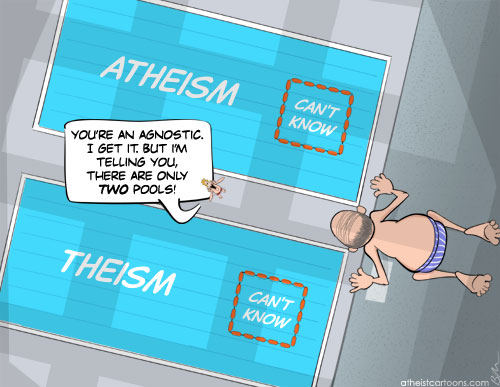
A first flaw that I personally found with your article, or at least your response to a great many comments on here, and thus at least one of your arguments - that agnostics are hypocrites for stating they cannot know if a god (any god) exists, but that they do not believe in the tooth fairy or leprechauns, and thus are not agnostic.
*Note under 'god' I include those like Zeus and Thor (because, come on, a god specifically with the ability to control lightening - or fart a thunderclap if you've ever read Rick Riordan - is a cool notion).
You define theism as the belief in a God. You define atheism as the lack of belief in God. You then go and define agnosticism as "the belief that there can be no proof either that God exists or that God doesn't." Or at least you quote a source that does. However, that does not change the fact you appear to have based your article and thus arguments off these definitions that specifically revolve around God. (On that note, why do you seem to lean towards God as though there is only one God, not that there are the potential for multiple gods or even a god with a lower case 'g'? I know you are atheist so it does not truly reflect your beliefs, but it seems to reflect a common perception I seem to see in Western society at least that if a god exists that there is only one god that could exist. But I digress. Back to picking apart your argument, if you don't mind a little debate.)
Your dictionary definition of God follows:
"1. God. A being conceived as the perfect, omnipotent, omniscient originator and ruler of the universe, the principal object of faith and worship in monotheistic religions.
2. A being of supernatural powers or attributes, believed in and worshiped by a people, especially a male deity thought to control some part of nature or reality."
So my question is this: why then do you bring in the argument of agnostics not believing in creatures that are not defined as a god to dismiss the position of agnostics? Your definition of God is either 'all knowing, all powerful and ruler of the universe' and/or 'supernatural being that is both believed in and worshiped.' I have never come across anyone worshiping a tooth fairy. Or a leprechaun. There in, in my experience a leprechaun is not a god and a tooth fairy is not a god (at least as far as I currently know). So why should a lack of belief in them mean that a person is atheist, not agnostic - or at least a picky agnostic - when the whole topic that the term 'agnostic' as you have taken in your article revolves around whether or not there is a God? Not general supernatural beings that may be believed in but are not worshiped or thought to be 'divine' in nature, of which one could argue a god would fall, but God specifically?
Therefore, an agnostic saying they absolutely do not believe in the tooth fairy, which is inherently not a god though it could be defined as a supernatural creature, should not affect whether they can be called an agnostic which is a term for your article that revolves around the idea of God.
Or, to take it one step further, an agnostic saying that the tooth fairy - which they do not define as a god according to their definition of a god by which they judge all gods like Zeus and Allah and Jehovah - does not exist should have no place when assessing their reasoning and the legitimacy of their stance on the issue of the existence of a god/s.
Before I sum up this argument, I will point out the flaws with this idea of mine and refute them. The first: people may worship the tooth fairy and thus the tooth fairy becomes a god. That issue, if you'll bear with me, I'll refute in my next point. The second: I myself have some bias when defining what a god is which probably affects my argument here, namely that I typically associate 'god' with 'divine' of some sort, which I fail to recognise leprechauns and tooth fairies as (i.e. they are not divine). That does not necessarily delegitimise my argument opposing you, although I do acknowledge it could throw it into doubt. However, this discrepancy between what your dictionary defines as a god and what I do will support my argument to follow.
Now for the second issue I have with your article: the assumption of same perception. You seem to assume that everyone has the same perception, or in other words the same definition and meaning for a word. For example, the difference between what your dictionary defined as a god and what I do. These both may be different to what someone else defines as a god and what other people have through time. Which is why stating that 'any agnostic who does not believe in leprechauns is a hypocrite' is a potentially wrong statement when taking into account what they define the word god as.
Then there is the issue of different perceptions of what the term 'agnostic' means to different people. You argue that people think the term 'agnostic' is something it is not. Which is fair enough if you look at the origin of the word I suppose. Yet in language it is not as simple as that (at least I don't think it is). Take the word 'Da' for example. In many English speaking countries it is an affectionate term a child calls their father. In Romania and Russia it is their word for 'yes'. Now that is an example across multiple languages, but the point still stands: different people view different words and letter groupings as having different meanings. Another example purely in the English language would be 'mass'. Now it depends on the context of what it is: could either mean a religious gathering of people or the weight of something. Still, I suppose you could argue that each word has its specific meaning and may double up, but it is still specific and written in the dictionary.
I, however, would not.
No meaning of a word is set in stone nor is any technically necessarily more right than another. It is all subjective to what a person views its meaning as; in other words there are no real facts behind words giving them a truth that cannot be denied. We made them up like a storyteller might make up a dragon - technically those words never existed in the rules of nature. Thus, being a societal/cultural thing developed by a society/culture of people those words can be argued to have no right or wrong definition. They are what one believes them to be. If you can follow my writing on this?
We learn through things like school and family the typical meanings of certain words as typically accepted by our society. For example (and I'll make an assumption here only to demonstrate an example), to you 'food' means that stuff we eat for nutrients and to sustain ourselves. And example would be chocolate or oranges. To me 'food' means the same thing. That would have been ingrained to us by our societies which hold the same meaning for the word. Yet, what is to stop me from attaching the meaning the word 'food' typically carries to the word 'but' or the word 'lupsm' (for if one attaches a meaning to a group of sounds/letters is surely becomes a word? Then again, I could be wrong, but still, my point stands - 'lupsm' would become the thing I use to refer to food). Technically I cannot be wrong to say that 'lupsm' means what 'food' typically does if I associate the same meaning as the latter with the former. Is that not how different languages work?
And again, one can also associate different meanings with the some word. For example 'food' could have it's typical meaning in western society for me, but also be associated with 'cats' and what I call 'boots' by me as well. The meanings would simply change in context. Technically I would not be wrong to do so. There is no natural/universal law that decrees only 'food' can possess the meaning of that stuff we eat. (And see, I also used 'stuff' to refer to what 'food' typically would - meanings can change in context). An easier to understand example would again be 'mass' or even 'fuzz' used to refer to a texture/thing/that rough-soft thing on material or peaches, but also to refer to police officers in several countries. Meanings change in context and can be changed - meanings of words are dynamic, changing, not set in stone.
Moving back to how this relates to your article: you define agnosticism as "the belief that there can be no proof either that God exists or that God doesn't" in your article. Someone else could define it as 'someone will not believe or disbelieve in the existence of the supernatural without proof' - a similar definition, but different. But who are you or anyone to say that they are wrong? That is simply the meaning they have attached to the word.
My point is this: you assume that everyone has the same definition of 'agnosticism' as your dictionary/you. That is a fair basis for your argument, but also becomes one of its flaws when people, indeed, do not have the same definition. It is also a flaw when you claim that those who define agnosticism differently are not using a legitimate definition. The question comes back to, then, how can you know what is the legitimate meaning of a word? (see above discussion regarding that).
Still, I bear probably the same deification of agnosticism as you do, if not only a tad bit different (that said, this fact does not undermine my previous argument; it is still a consideration).
The third issue I have with your article: you claim that people can fit only into one of two pools regarding belief in god. You state that theists are those with belief in god and atheists thus anyone without belief in god. I'll offer you a challenge - to categorise me into one of those categories without breaking the binary mould you have made yourself. I am interested to see if you will succeed.
A note before I state my beliefs - I typically view all religions (including Christianity and its various denominations, Islam, Wicca, paganism, etc.) that have a god/force/supernatural entity including beings like Zeus, as well as atheism in terms of theories. At least when I am explaining things - it helps a lot when I find when I attempt to explain my view.
Me: I believe that the existence of a god/s, force, deity, being or any other divine/supernatural thing is as equally possible and impossible to exist as they are not. At least at this point as far as we know and with the lack of definite proof in regards to all theories.
In other words, I simultaneously and equally do not believe that any such thing exists and do not disbelief that any such thing exists. I am without belief and without a lack of belief. For you cannot say that my disbelief in such things existing is atheism as I do not disbelief they exist either. I don't believe, but at the same time I haven't ruled out not believing. And this is doubly why - whatever is out there I accept as out there as a fact and I just don't know what it is/can't name it.
Now why this is not theism - what could be out there might not be a god or similar being/force. It could simply be nothing or science or what have you. I accept this, if it is true.
Now why this is not atheism - what could be out there might be a god or similar being/force. I accept this, if it is true.
Yet, neither have been proven to be true so what can I do? Hover is a state between belief and acceptance of the potential existence/non-existence of something, and the disbelief and non-acceptance. In a kind of purgatory if you'll allow an allusion to Christianity where heaven is for believers and hell for non-believers (not saying you deserve to go to hell for being an atheist, or that anyone does - one point I do not agree with this religion or many other religions over, but I digress).
At this point in time, I believe we cannot prove whether such gods exist (if they do). We do not have sufficient evidence pointing to the conclusive truth of one theory. Nor can one prove atheism - lack of conclusive proof again (doubly hard as in most cases one cannot prove the non-existence of something that was never there). But I do believe that whatever I know or don't know, whatever people believe in multitudes or alone there is a single fact and there will always be a fact. Either a god exists or one doesn't. Either a god existed and still lives or died, or a god never existed at all. Either multiple gods exist or one or none. A fact remains a fact, regardless of whether anyone knows it is a fact or not.
Take, for example an oak tree. Now the fact of the universe would be that it is an oak tree. But someone may look as say 'it's a maple tree, I truly believe it is a maple tree'. Another might say 'it is an alien that mutated its DNA to be like that of an oak tree, but I truly believe it is an alien in the shape of an oak tree which gave us life'. And another might say 'this oak tree never existed, I truly believe you people are hallucinating it'. It is all subjective truth to the person looking at the tree (if you've ever heard that term). They think what they believes is true, and it is for them. But it is not true technically in accordance with the facts of the universe (e.g. like gravity) - the fact remains that no matter what anyone believes it is still an oak tree. Now someone could come along and say it is simply an oak tree - their subjective truth aligns with universal fact. Now, another person could never know of the tree at all - still does not change the fact that it is an oak tree. If a tree falls in a forest there is still a sound even if no one hears (because sound is not made of us hearing, but rather of a force pushing its way through molecules in the air, ground, etc.).
I believe in this fact and that this fact exists. I do not know what this fact is; all I know are that there are multiple theories of both a theistic and atheistic nature and that these theories, as of now from what we know and all we may ever know, are equally as possible as impossible. I would say that none of us knows the fact and will not know, at least currently, but the thing is that someone really could and either not know it or not have the proof or simply not be listened to. Who knows? Not me.
So, where exactly do I fit into you binary pool? I am curious. I rather think I would go splat.
I can acknowledge that I may not fit your definition of agnosticism (even if I regard myself as agnostic according to how I define it). However, that does not mean that I am a theist or an atheist. At best I am neither. At worst I am both. Thus I do not fit into your binary view of this for it does not allow a 'neither' option nor an overlap of the two.
This fact greatly undermines your assumption that those who claim to be agnostic are either theist or atheist. Which undermines your article's argument that agnosticism is a 'silly belief' and a 'scam'. Especially since I claim it, or what i believe as agnosticism, to be a way to describe own legitimate with/without belief.
And, for the record, tooth fairies and leprechauns are something I do not believe or disbelief either. It is possible they are true, but it is also equally possible that they do not exist as far as I or anyone I know knows (which is not a thing of naivety, it is a thing of lack of proof going either way which is reason). Also, I know my explanation may not be the best but I hope you will not brush off my arguments because of it regardless of whether you disagree or not.
P.S.
Also, I just remembered a challenge you posed in your article (and then cut off without any evidence to back your statement up, at least that you showed).
"Show us one agnostic that is agnostic about Zeus and Thor, there is none."
I disagree. There is me. Yes I am truly agnostic about them. Why? Because there is no proof that they exist as there is equally no proof that they do not exist. Therefore it is another theory that could possibly be fact, could possibly be not, just as equally as all the tore theistic/atheistic theories out there (and that includes the idea that multiple theistic theories could be simultaneously true or at least true for the most part, or that a theory we haven't even though of could be true too; or that all of these are not true at all).
P.P.S.
Also (sorry) I just saw your comment that anyone who is unsure of Thor or the tooth fairy in terms of existence is not a sane adult. That is kind of offensive, actually. I will also offer you a very adult like challenge:
Prove to me, beyond a doubt, without mere speculation or theorising, but with actual hard evidence that neither Thor nor the tooth fairy exist. Prove to me with hard evidence, like the very adult-like science requires.
You can't. Logically you can't, or at least it should be very hard for you to try. Because it is very hard if not impossible to prove that something that isn't there isn't there, simply because there is no evidence it leaves of it not being there because it is not there.
Rationally, you cannot dismiss something that you cannot prove beyond speculation and theorising. That is simple logic: there is no proof it doesn't exist so technically it could, for all intensive purposes, still have a chance of actually existing. Even if there is no proof that it exists.
All you can do is believe that Thor does not exist. I doubt you have the irrefutable evidence to back up that belief (as much as I doubt anyone who believes that Thor does exist has the irrefutable evidence that he does exist). So I believe that it is as possible that Thor exists as he does not, for lack of proof either way.
Still, I'd be interested to hear you try.
Also, have a good day/night where ever you are. Just because we disagree doesn't mean we can't be civil.
-
Comment by the 'Silly Beliefs' Team, 18 Mar, 2017
Thanks for your comments, questions and challenges. You've put considerable effort into your arguments, and we're more than willing to consider them. Only if we answer challenges to our beliefs can we have confidence in them. In a separate communication you say it's unlikely anything we write in reply will cause you to change your perspective. We would argue that everyone is born an atheist, and then most are convinced into becoming theists, but increasing more and more are reverting back to atheism, including what you call agnosticism. As young children we were once lukewarm theists, then suddenly we noticed that we were uninterested and indifferent atheists, or what you would call agnostic, then years later we became informed and committed atheists. A change of perspective often isn't easy, but it's inevitable if you're committed to seeking the truth and going to where the evidence leads, not simply remaining where it's comfortable. So our reply is necessarily a long one. Sorry about that. We would rather just say that you're wrong, and that atheism rules and agnosticism sucks, but we doubt that would have gone any way towards swaying your convictions. You say you've read our article and the comments on this page, but clearly our explanations weren't good enough to answer your concerns. We wrote this as much for ourselves as for you, to see if we could justify our atheism, so don't feel guilty if you don't finish it.
First we'd like to correct a couple of things. You say that we 'define theism as the belief in a God' and 'atheism as the lack of belief in God. No, we quite clearly defined theism as 'a belief in God or gods', and atheism as being 'without a belief in God or gods'. It may seem like we're nitpicking to argue about you writing God (which you write in italics and a Bold font), and us writing 'God or gods', but you go on to ask, 'why do you seem to lean towards God as though there is only one God, not that there are the potential for multiple gods or even a god with a lower case 'g'?' You can only reach that false conclusion by misreading what we wrote.
Yes, our article does indeed focus on God, simply because in the real world writing a serious article that argues that the tooth fairy isn't real (or even Zeus), would be seen as a complete waste of time, like arguing that the Moon isn't made of green cheese. Children aside, no one believes in the tooth fairy, not even you. As you suggest, most agnostics (but not you), dismiss the tooth fairy as quickly, calmly and rationally as Christians dismiss the Norse god Thor. But while we focus more on gods than tooth fairies, our topic — agnosticism — covers far more than just gods. As we'll explain, it does include the likes of the tooth fairy and leprechauns, although most people conveniently ignore what agnosticism says about these neglected supernatural beings.
In our posts we do often simply write God (rather than gods), meaning of course the god of the Abrahamic religions — Judaism, Christianity and Islam — because almost without exception we are usually debating with a believer of one of those religions, usually Christians. The reality is that the majority of people on the planet believe there is only one god, and that no other gods have ever existed, and they call that god, with a monumental lack of imagination, God, with a capital G. That's like having a dog and calling him 'Dog'. Jews, Christians and Muslims all simply refer to their god as God, and yes, we know Muslims sometimes use the name Allah, but 'al-lah' simply translates as 'The God' in Arabic. Some religious people are even too afraid to mention him by name or even write God, choosing to write "G_d" instead. When we say we don't believe in gods, all that Christians hear and take from that is that we don't believe in God, their god, because of course they don't, by definition, believe in all those other gods either. If we raise the point that we don't believe in gods like Zeus or Thor, then Christians accuse us of making fun of them, as if we're suggesting that they've simply moved on from one silly god to another, from Zeus to God. And conversely, when we've said that we don't believe in gods, some Christians amazingly enough have thought that because we didn't say God, with a capital G, then they thought we still believed in their God. So unless we're making a specific point, whether we say we don't believe in God or we say we don't believe in gods, they both mean the same thing and it's all just shorthand for utter disbelief in any supernatural being or supernatural realm. Just because we don't mention the Canaanite god Baal doesn't mean we have a soft spot for him. The reality is that most people that debate this topic with us are always thinking of God, usually the flavour of God that their family and community taught them to believe in, even though they often don't realise it. For example, when we say there are no gods, a common response is to ask how the universe arose if it wasn't created, or where we get our morals from. But when we talk about all the gods that people have believed in, the great majority are not creator gods, nor are they dispensing morality, and so when people immediately jump to an all-powerful god that created everything or is teaching us morality, they aren't thinking of gods, they are thinking of God. They aren't thinking of how lightning happened in ancient Greek times if there was no Zeus, they're thinking of how the universe arose if God, the only god they're familiar with, didn't say things like, 'Let there be light'.
This talk about how agnostics like yourself are equally unsure about the existence of Zeus as you are of God, is, we feel, just a red herring, because not once does anyone ever present arguments for Zeus and Thor. All your arguments are for leaving the door open for God, never do you put any effort into arguing that one of the thousands of other gods are more likely than God, or even as likely. If the God of the Bible was to be conclusively debunked tomorrow, accepted by all believers and meaning the demise of Judaism, Christianity and Islam, we suspect that almost none of these now disillusioned believers would suddenly start worshiping Zeus, Thor or one of the thousands of other lower case gods. That's because the majority of believers and agnostics believe in God, or the possibility of God, not in gods. You're right that there is 'a common perception ... in Western society at least that if a god exists that there is only one god that could exist', but this is a perception of modern believers, not informed atheists. And since the majority of those believers follow a monotheistic religion, it would be quite illogical for them to view the notion of God in any other way.
Let's say that tomorrow someone in Ireland suddenly claims to have found an ancient text, one that reveals that the supernatural being that created the universe and life wasn't a god, but a very powerful, very knowledgable leprechaun called Paddy. Of course, even with the ancient text, there is no more evidence supporting this worldview than there is supporting the God worldview, or any of the worldviews connected to the lower case gods. Yet how many agnostics would be then found arguing with atheists that that we can't prove that Paddy the leprechaun doesn't exist, just as they now argue that we can't prove some god doesn't exist? We'd say none, because we already have supernatural beings as unlikely as Paddy, such as the Greek, Egyptian and Aztec gods, and no one ever starts their comment with: How do know Zeus doesn't exist? It's usually, How do you know God doesn't exist?, or less often, How do you know there is no god?, but never has anyone even hinted that by 'god' they meant a god like Zeus, Osiris or Quetzalcoatl. When pushed into a corner some agnostics will begrudgingly admit that those gods are on par with the oft mentioned favourite — God — but why don't they ever start their agnostic argument with Zeus or Osiris? If atheists don't mention these other gods, then agnostics happily stick with a single word: God or god. But if they're going to insist that they don't just mean God, that they don't think he's the obvious frontrunner, that they're equal opportunity agnostics, then why do they never mention one of these thousands of other gods by name? If they're not putting their money on God, then surely they must think there is better or at least equal evidence for some other god, so why do they never push this argument for this other god? They ask atheists why we always assume that they meant "God" when all they said was that "god" might exist? Well, we assume agnostics meant God because they never go on tell us it was a different god that they had in mind. You know that society biases us to think "God", so why aren't you introducing the names of the gods that you favour right from the get go?
Let's now look at your discussion of words and their meaning, as this is important for what will follow. We agree that the same word can mean different things to different people and in different contexts. However, effective communication becomes impossible when different people start using the same words/sounds to mean different things. That's one reason why we have dictionaries, so that we can ensure we all mean the same thing when we use the same word. That's why we defined the words we used, why we explained what they actually mean in case readers were mistakenly using the wrong meaning. You argue that, 'No meaning of a word is set in stone nor is any technically necessarily more right than another. It is all subjective to what a person views its meaning as'. It's true that each person is entitled to their own opinions, even their own definitions, but they're not entitled to their own version of the truth, and we shouldn't confuse opinion with truth. A legitimate and respected source for the word agnostic is the man that coined the word and the academics that now discuss it, and if the man or woman on the street want to identify themselves as agnostics, then that is the definition they should adhere to. You disagree with the dictionary definition of agnostic that we use, but then argue that you're still an agnostic because, 'I regard myself as agnostic according to how I define it'. You seem to be suggesting a form of relativism, where each person's definition is correct for them, and while it may not be correct for us, each individual opinion is as true for them as the next person's. It usually concerns moral relativism, the argument being that if some other culture sees rape, for example, as morally OK, then who are we to force our different view of morals on them? But we don't agree with relativism. No one, not you, not us, gets to make up their own definitions for words that already exist in our language. If they live on a deserted island and their only friend is a seagull, fine, they can make up their own definitions, but not if they want to be a functioning part of a society. It's not a valid argument for someone to say that the dictionary definition is wrong just because they have made up another definition for that word, or were told the wrong definition by their cousin. You say that someone could define a word differently to that in the dictionary, and you ask us: 'But who are you or anyone to say that they are wrong? That is simply the meaning they have attached to the word ... you assume that everyone has the same definition of 'agnosticism' as your dictionary/you ... how can you know what is the legitimate meaning of a word?'.
Well, umm ... dictionaries are obviously the first choice for determining the legitimate meaning of a word. You accept that confusion can arise if different people use different definitions, so you should be arguing that we all settle on one correct definition rather than each of us sticking with our preferred definition. You wonder how anyone can know what the legitimate meaning of a word is. Well, like many things, we should look to an authority, an expert. And how do we identify these sources of authority? Jill LeBlanc points out in her book, 'Thinking Clearly: A Guide to Critical Reasoning', that no one can know everything about everything, and so what is meant by 'an authority is someone who possesses expert knowledge on a particular subject'. LeBlanc lists the following 'Criteria for judging acceptability for authority:'
- The authority must be identified
- The authority must be respectable
- The matter must be in this authority's field of expertise
- The matter must be one on which there is a consensus of experts
We would hope that you would agree that a good dictionary would fulfil all those criteria. And if we narrow our sources to those that discuss agnosticism, books written by academics, such as philosophy textbooks, books that also fulfil all those criteria, then they too must be acknowledged as providing the legitimate definition of agnosticism. Indeed, they are the sources that the dictionary editors would have consulted. So we'd argue that if your personal definition of a word, be it agnosticism or veganism or whatever, no matter how attached you are to it, if it doesn't match that of an authoritative source, then you are living a fantasy of your own choosing.
So, using legitimate definitions, are you an agnostic or an atheist? In your comments you wrote the following. Rather than repeat all that preceded it, we've added the phrase [in gods] to make the context clear:
'I am without belief [in gods] and without a lack of belief [in gods]. For you cannot say that my disbelief [in gods] existing is atheism as I do not disbelief [gods] exist either.'
You say your are, 'without belief [in gods]', which is simply another way of saying you lack a belief in gods. You have just described yourself using the original and textbook definition of atheism: "without a belief in God or gods". It doesn't matter what else you believe or don't believe, since once you accept that you are without belief in gods, then you are an atheist. That is the legitimate meaning of the word. End of story.
But then your statement gets confusing. You start by saying you are 'without belief', meaning you have a lack of belief, but then in the very same sentence you completely contradict yourself by saying you are 'without a lack of belief [in gods]', meaning that you don't have a lack of belief. You're saying you're without belief and with belief. The two statements simply cancel each other out.
You go on to claim that 'you cannot say that my disbelief [in gods] existing is atheism as I do not disbelief [gods] exist either.' Well, yes, we can say your 'disbelief [in gods] existing is atheism'. Disbelief means a 'Refusal or reluctance to believe', and since you acknowledge that you don't believe in gods, then you most definitely do exhibit disbelief, a simple refusal or reluctance to believe in gods. My dictionary defines atheism as: 'Disbelief in or denial of the existence of God or gods'. So we can say your disbelief, your reluctance to believe in gods, is atheism. Again, it's a textbook definition of atheism. How confident you are in your refusal to believe is irrelevant. The fact that you think gods might be possible, and that you could possibly come to believe in them, is irrelevant. Until you start believing, you are without belief in gods, you are an atheist.
We think what you actually meant to say when you write 'disbelief' and 'without a lack of belief' is that while you have no belief that gods exist, ie atheism, you aren't prepared to go further and claim that you know they don't exist. And by know, you mean, to use some of your own words, that no one can prove gods don't exist 'beyond a doubt', 'without mere speculation or theorising', and with 'conclusive truth' and 'actual hard irrefutable evidence'. But here's the thing, that's exactly what informed atheists would say too. It's a complete falsehood that atheists say that we can prove gods don't exist, and that we know this categorically, absolutely, unquestionably, irrefutably, irrevocably, indubitably, unequivocally, conclusively, definitely, completely, incontrovertibly, indisputably, unambiguously, undeniably and without doubt. Nothing in the textbook and dictionary definitions of atheism say that atheists must insist that they know and can prove categorically that gods don't exist. We simply have to refuse or be reluctant to believe what religious folk want us to believe.
Of course many atheists, including us, confidently say that gods don't exist, in the same sense that Christians and Muslims say God does exist, in the same sense that young children sincerely say that Santa, not their parents, left them toys, in the same sense that people say their parents love them, and in the same sense that we say the Sun will rise tomorrow. We're not saying we have proved what we're stating, merely that we have extraordinary high confidence that what we say is true. It just makes life easier, since if we demanded absolute proof before we did anything, we would never get out of bed in the morning, afraid that the floor might not really be there. We prefer to say we know the floor will be there and simply get up.
When I say I know that I'll die eventually, and certainly before I reach 150, or that I'd die if I were to jump from a plane without a parachute or ingest a large dose of cyanide, I'm not saying I've proved this with actual hard irrefutable evidence. Of course I don't know absolutely that I'll die, I may unknowingly be an immortal being that can't die. But everything we know about human beings strongly suggests that I am no different from the 100 or so billion humans that have already lived. I can't prove it, but I believe I can confidently say beyond all reasonable doubt that I won't live to see the 22nd century. And it is in this sense that informed atheists say gods don't exist, that all the available evidence, mountains and mountains of it, clearly indicates beyond all reasonable doubt that gods aren't real. We're not saying beyond any and all doubt, we're saying beyond all reasonable doubt. We may use certain words and speak with such confidence that it sounds as though we know gods don't exist, but we feel that the evidence against gods is so overwhelming, and the evidence for gods so underwhelming, that the likelihood of them being real is so remote that it seems silly to even pepper our comments with disclaimers.
It is a complete nonsense that atheists know or claim to know 'beyond a doubt' and with 'actual hard irrefutable evidence', that gods don't exist, or for that matter, that the tooth fairy and Santa don't exist. To challenge an atheist, as you do, to prove that neither the god Thor nor the tooth fairy exists is to suggest that you don't understand what real atheists believe. And not just you, the great majority of agnostics. As you rightly state, it is impossible for us to produce that proof, even if they truly don't exist, so don't you think informed atheists already know that? An informed atheist is one that holds their view after considering philosophical arguments for and against gods, such as the argument from evil and the cosmological, ontological and teleological arguments, as well as scientific theories concerning things like quantum fluctuations, black hole singularities and thermodynamics. We may not be experts in science or philosophy by any stretch of the imagination, but we do understand enough to know that logic and the scientific method can never prove absolutely and categorically that gods and tooth fairies don't exist. Or that anything does exist, for that matter. Both theists and agnostics grasp this impossibility, so is it really believable that atheists are too stupid or too arrogant to see it too?
So why do agnostics hold this false view of atheists, that we are vocally adamant that we know, and can prove absolutely and categorically, that gods don't exist? Mostly we think it'd due to Christians. Aggrieved priests stand up and proclaim from the pulpit that these arrogant new atheists tell us that they know there is no God, that their atheistic science proves there is no God, and yet it is so clear to anyone prepared to open his heart to Jesus, that God is all around us. The sheer beauty and complexity of his creation is incontrovertible evidence of his existence and his love for us all. Christians spend their lives proclaiming that they just know that God exists, they feel it their heart, they see it in the smile of a baby, and, of course, we wouldn't be here if he didn't exist. So when these Christians encounter atheists that appear to say with equal confidence that we don't believe their God exists, or any gods actually, they assume, falsely, that we are also claiming to know that our view is correct, that we can prove it. It reminds me of a Christian I encountered awhile back who asked me if I was an atheist. After I said yes, she confidently said,
'There's nothing in the world, nothing that anyone could say or do, nothing whatsoever, that could ever convince me — EVER! — that God isn't real.'
Informed atheists aren't like that. We readily accept that there are things that would make us doubt our atheism. If a god showed up and started performing miracles, for example, or if evidence showed evolution to be false, or if the phrase 'Made by Zeus' was found embedded in our DNA. Christians think that we're as dogmatic as they are when it comes to what we think is true, which is simply not the case. As we've said, most of us did once believe in gods to some extent, but it was our willingness to examine the evidence and change our minds that made us atheists.
We keep saying 'informed atheists' rather than simply atheists, because simply to be without a belief in gods is to be an atheist. As we've said, technically babies are atheists. We know people without any belief in gods, so they are atheists, but they don't call themselves atheists (or agnostics), and they know absolutely nothing about the arguments — scientific, philosophical, historical etc — for and against gods. They just couldn't care less about gods, and see any serious discussion as irrelevant as arguing about Santa Claus. To them the world clearly seems as bereft of gods as it is of tooth fairies, and so it seems to require little thought to simply say that they don't exist and to move on with life. Of course they're right, but they've reached their conclusion for less than ideal reasons. So you might hear one of these "common sense" atheists say that they know gods don't exist, or that they heard science had proved gods impossible, but you shouldn't judge informed atheism by their comments. An informed atheist has looked at the arguments and evidence for and against gods (and tooth fairies and leprechauns) and knows that science can't prove absolutely and categorically that they don't exist. An informed atheist simply says that on the basis of probability, they don't exist.
But as we've said, many Christians have also grasped that proving gods to be impossible is impossible, so if they falsely and mischievously define an atheist as someone who has claimed to do something that is impossible, then atheists lose all credibility, and no one wants to be labelled as someone that claims impossible things. Of course atheists have always had a bad reputation with Christians, but now even non-believers fear the label. So people without belief in gods, like you, decide to label themselves agnostic: a person without a belief in gods, but one who at the same time also argues that you can't prove or disprove their existence. The only problem with that definition is that it is already the definition of an informed atheist. Non-believers shun the atheist label because they have been mislead into believing that to be an atheist you have to believe and argue that gods can be absolutely and categorically shown not to exist. This is absolute nonsense, but it is in the interest of Christians to maintain the belief that atheists are unreasonable, that our arguments are illogical, and our stance can't be supported. And it is essentially only in the Christian sphere that agnosticism is debated, Muslims for example see only Muslims and heretics, they couldn't care less what your reasons for not following Allah are. Christians hate reports that the number of atheists are rising worldwide, because in most everyone's eyes atheists are people that have no belief that God exists, whereas agnostics give them some hope. Agnostics are seen as people that are unsure whether God exists, they are sitting on the fence, and they could fall either way. Atheists are seen as a lost cause, our confidence in calling ourselves atheists means it's likely futile to even try and convert us, but with agnostics there's still a chance, since they usually think that the debate is evenly balanced and one new piece of evidence could tilt the scales in favour of gods. Christians encourage non-believers to identify as agnostics rather than atheists, since agnostics confused about the evidence and repulsed by the term atheist are in the Christian mind a step closer to becoming believers,
There certainly is great confusion between what separates an atheist and agnostic, so let's try an analogy. Rather than gods, let's consider aliens. Some people seriously believe that aliens are abducting people from their beds and performing medical experiments on them. Most people lack this belief that aliens are at work on our planet, in fact many don't know that such a belief has even been proposed. So we have a group that have a belief in these aliens, these would be the equivalent of theists, and another group, everyone else actually, that is without a belief in these aliens, these would be the equivalent of atheists. There is only two possible groups, it's binary, those with belief in aliens and those without belief in aliens. But, you might argue, surely there is a third group, those unsure whether aliens are real or not. But if you ask anyone in this proposed group if they have a belief in these aliens, ask if they're a "theist", they will answer no, that they are without a belief in aliens. So they must, by cold logic, first and foremost, be an "atheist", someone without a belief.
It's like asking someone if they're a human, and they say no, they are a woman. But "woman" is merely a description of what type of human they are. To be a woman you have to first and foremost be a human. When we spot someone in the distance, all we can initially say is that they appear human, only as they get closer can we say that they are also a woman. The terms man, woman and child allow us to differentiate between members of a group of humans, but at their core they are still all humans. So, returning to our aliens, and this proposed third group of those unsure whether aliens are real or not. At their core they are without a belief in aliens, so they are "atheists". We accept that they see themselves as unsure "atheists", perhaps racked with indecision, and certainly different to the other "atheists" that express no indecision, that confidently assert that there are no aliens abducting us. But both these "atheists", the unsure "atheist" and the confident "atheist", have one thing in common, they are both without a belief in aliens, the only thing that sets them apart is their confidence level. The unsure "atheist" may elect to call themselves an agnostic to reveal their indecision and set them apart from the confident "atheist", but just as a woman is still a human, they are still an "atheist".
But are we getting sidetracked by labels? To us it seems that it is the stigma attached to the atheist label that sees people embrace the agnostic label, more so than pure reason. But let's agree that these are only labels, and people are or aren't atheists based on what they believe, not on the label they use. So ignoring the validity of labels, the challenge becomes for agnostics to defend their argument, that there is clearly insufficient reason and evidence to make a call as to whether our universe is running on natural laws or some god's laws. Or, to put it in your words:
'I believe that the existence of a god/s, force, deity, being or any other divine/supernatural thing is as equally possible and impossible to exist as they are not. At least at this point as far as we know and with the lack of definite proof in regards to all theories.'
Theists, atheists and agnostics can all agree that the world exists, the thing that separates us is that theists posit something extra that only they can discern: a god or gods. And agnostics, while not quite believing them, argue that there's an even chance that they might be right. Since theists and agnostics are claiming that the universe contains, or possibly contains, something extra, then the burden of proof is on them to produce that evidence that gods exist, or the evidence that there is a high probability that gods might exist. Agnostics need to defend their claim that the evidence for gods is equal to the evidence against gods, and that this justifies their uncertainty and indecision.
This is what confounds us about agnostics, why are they, why are you, confused about the evidence? Agnostics imply that they've thought deeply about the religion versus science or supernatural versus natural debate, and yet they still can't find any evidence or argument that gives one side an advantage. This may have been the case in medieval times, but not now. For agnostics, somehow — miraculously perhaps — the evidence always works out as both sides being equally probable, meaning that the honest answer for agnostics is that they don't know which side to chose. It could go either way. You state this view several times, saying that you see the existence of gods etc., 'as equally possible and impossible to exist as they are not ... as far as we know'. You write that for the conflicting claims of religion and science, 'neither have been proven to be true', and that, 'We do not have sufficient evidence pointing to the conclusive truth of one theory'. You say that your indecisiveness between gods and no gods is held 'simultaneously and equally' and that 'from what we know and all we may ever know, [gods] are equally as possible as impossible'. But this is clearly not true. It's certainly true that we don't have 'definite proof' and 'conclusive truth', since we all agree that in the sense that you imply, that level of proof is impossible. So that leaves any reasonable person looking at the evidence we do have and asking where it points, towards a natural universe with physical laws, or a supernatural universe with gods.
You suggest that there are likely two options for explaining the universe, and we agree. 1) There aren't any gods, it's all natural and can be explained by science, or 2) there are gods, they are at work on and in the universe, and it's not science that will explain them. But more than that, your talk of 'equally possible and impossible' etc implies that each option has an equal chance of being true. And this is a common theme in agnosticism, that the available evidence simply isn't sufficient to make a rational choice between the two options, but we see it as a major flaw in the agnosticism argument.
We're sorry, but the argument reveals little understanding of how the universe works, and you seem too intelligent to truly believe what you appear to claim. Think how ridiculous it would be for someone to say that regarding the causes of mental illness, invisible demons are 'equally possible and impossible to exist as they are not', and should be 'simultaneously and equally' considered alongside the likes of viruses, chemical imbalances and physical injuries. Or someone saying that regarding the orbit of the planets, god's angels are 'equally possible and impossible to exist as they are not', and should be 'simultaneously and equally' considered alongside the theory of gravity. Or regarding the devastating tsunami that hit Japan a few years ago, that malevolent sea gods like Neptune are 'equally possible and impossible to exist as they are not', and should be 'simultaneously and equally' considered alongside theories such as plate tectonics and naturally occurring earthquakes.
It's an utter nonsense to argue that scientific theories are no more likely to explain the universe than are one or more of thousands of ancient religions. Contrary to what you suggest, that evidence and reason supports both options equally, 'At least at this point as far as we know and with the lack of definite proof in regards to all theories', the reality is that the scientific community in no way thinks that unseen gods and demons are just as likely as unseen viruses and gravity waves. They believe that they have overwhelming evidence favouring their view, and our modern, advanced society that relies so heavily on complex technology supports their stance.
The clear reality is that science has explained a monumental amount on how our universe works, demolishing untold religious explanations in the process. Over the centuries people have investigated millions of claims of gods being responsible for everything from lightning and crop failures to beautiful sunsets and handicapped children, but not once has a single piece of evidence ever shown a god to responsible for anything. And of all the mysteries yet to explain, not one of them has scientists hedging their bets as to whether the cause will be natural or supernatural. To argue that today we're still not sure whether events are likely natural or if some god is pulling levers in the background might have been OK in the Middle Ages, but it is no longer reasonable today.
Yes, it is possible that gods exist, just as it's possible that Santa Claus and the Easter Bunny exist, but based on everything we know about the universe, that possibility is so remote that it makes sense and saves time to simply say it's next to impossible. The next time you're at the edge of a high cliff, tell yourself this: It's possible that you could step off and float gently to the ground, or even fly like Superman. Keep telling yourself — it's possible, its possible! Will you step off? Or will you convince yourself that even though it's possible, it's extremely and astronomically likely that you'll plummet to your death instead? Were you to step off the cliff, there are indeed two possibilities, fly or fall, but based on scientific evidence and history, do you for one moment seriously believe that each possibility is equally plausible?
It's the same with looking at the world and asking questions, is it here because of gods or natural causes? Simply admitting that both are possible, doesn't mean that both are equally plausible. Saying that tsunamis might be caused by gods is like saying you might fly on stepping off that cliff. Maybe you're right, but we seriously think you'd be a major fool in taking that gamble, because all the evidence suggests you're wrong. Your stated argument that whether gods exist is 'equally possible and impossible', appears to basically bring it down to a coin toss, it's 50:50. It's like trying to convince someone standing next to you on that cliff that the evidence is evenly split on whether you'll fly or not, when clearly the evidence says with no ambiguity at all that there are no gods, and you'd be bloody stupid to step off that cliff.
You argue that as regards gods and no gods, '... neither have been proven to be true so what can I do?' And you're correct if you understand 'proven to be true' to mean proven absolutely and categorically to be true. But again, this is the unreasonable and misleading argument that reveals that agnostics don't understand science or what 'proven to be true' means in a realistic sense. Apart from elements in mathematics and logic, nothing else can ever be 'proven to be true', certainly not any scientific theories, or as we've argued before, even if God turned up on the front lawn of the White House, you could never prove that he actually had. All scientists can do is increase their confidence in various theories, they can never prove categorically that some theory is true. Science can say that it is 99.9999% (or whatever) confident that the Sun will rise tomorrow, but can never prove 100% that it will. It might for some unexpected reason explode tonight. Science says that evolution is true, that it's true that gravity causes apples to fall, and that claims that the universe is 13.7 billion years old is also true, but none of these "facts" have been 'proven to be true' in the sense that the layperson often understands it to mean. The layperson thinks that 'proven to be true' means that a claim has been absolutely, categorically proven 100% true, but, well, that's not true. And never will be, no matter how much science advances. This is where people misunderstand scientists when they ask them if something is proven 100% to be true or absolutely safe, and they answer No. Even though scientists might think that something is 99.9999% true or safe, their scientific honestly forces them to admit that it's not 100%, that it's not 'proven to be true' in the way the layperson is thinking. They accept that they could be proved wrong tomorrow, and while they believe that the chance of that happening is so unlikely that most laypeople would use the word impossible, scientists (annoyingly so at times because of the confusion it causes) will honestly admit that a particular claim has not been 'proven to be true'.
But there's a huge gulf between scientists admitting that they can't prove absolutely and categorically that invisible angels aren't pushing the Earth in it's orbit around the Sun (which they can't), and that they can't demonstrate to an extremely high degree of confidence that gravity is really what keeps the Earth in orbit (which they can). You're implying that the two options are evenly matched, that it could easily go either way, that the evidence as to whether the universe is natural or supernatural, and can be explained by scientists or gods, is balanced and indecisive. Clearly it is not. Mountains of robust evidence exist that posit the universe as natural, operating due to natural laws, and not a shred of believable evidence exists that shows our universe was created and is still being helped along by a supernatural being. To argue that a natural universe and a god-driven universe are both 'equally possible and impossible to exist as they are not', is just not tenable, and we doubt that even you truly believe it.
We're not debating whether there are two possible options to explain the universe — natural or supernatural — since of course we already accept that, we're debating whether one option is more likely to be true than the other. We're debating whether one option has more evidence supporting it than the other. The very essence of the typical agnostic stance is that the evidence supporting both options is so finely balanced that agnostics refuse to favour either option. And yet nobody demonstrates such agnosticism in real life situations. No one refuses to get on a plane or take an antibiotic until it can be proved 100% safe. They all say that while the evidence is not absolute and categorical, it is still very high in favour of them being safe, so that's good enough for them. Their agnosticism is merely speculative and abstract, something they quibble about on the Internet or at a dinner party, but not something that plays any part in their real life. No agnostic parent of young children is found withholding tooth money or Xmas gifts to see if the real supernatural beings show up. Agnosticism is just a talking point, it's not something that influences day to day life.
You'll disagree, arguing that agnosticism is about gods, and only gods, not tooth fairies. So let's give a god example. Some Christians and Muslims have argued that various natural disasters were caused by God because of his displeasure with us, usually something involving sex. But how many agnostics give partial support to this view, publicly arguing that a caring god is just as likely the explanation as uncaring nature? We don't see it at all, the commitment to agnosticism simply isn't there. But the reality is that agnosticism is not just about gods, it extends to everything that we question, from gods to tooth fairies to climate change. Agnosticism in the wider sense is a method, a way of thinking, the result of considering the evidence and deciding that as the evidence stands at present, we honestly can't make a choice between various competing options. Agnostics could argue that there's simply not enough good evidence to decide, for example, whether gods exist, whether tooth fairies are real, whether climate change is happening, whether vaccines are safe, whether aliens are visiting Earth, or whether Bigfoot is out there in the wilderness. Basic agnosticism on some particular controversy is a valid stance to hold when the evidence is lacking to make a reasonable and supported case for one side or the other, but when that evidence overwhelmingly favours one side, then it is no longer reasonable to remain agnostic. Anyone that accepts that this is a sound way of the looking at the world, that we should refrain from taking sides while the evidence is lacking or insubstantial, but should give up our indecision when the evidence becomes convincing, must surely accept that this method applies to everything, not just gods. It is illogical to argue that religious agnosticism is real and important, but that scientific agnosticism doesn't exist or simply isn't helpful. If it is possible to be agnostic about gods, then it is equally possible to be agnostic about everything from tooth fairies and leprechauns to aliens and climate change. We should be tripping over agnostic arguments, but apart from god agnostics, we don't see them. Whether it's tooth fairies or vaccine safety or climate change, most everyone takes a stance, we don't see agnostics arguing that we don't know, and can't know, ever. Yes, some people say they don't know, but they don't argue that experts can never know, merely that they themselves haven't bothered to learn enough to make a call.
But we should acknowledge that there is one important difference between religious agnosticism and scientific agnosticism, since religious agnosticism argues that because of the very nature of what they're considering — the supernatural — absolute truth is forever unattainable. Scientific agnosticism backs away from the "absolute truth" bit, and normally occurs when evidence is lacking, but there is the assumption that as time goes on and science advances, then new evidence will hopefully be forthcoming and indecision and uncertainty will disappear. Scientific agnosticism will be resolved (not absolutely, but with high confidence), but religious agnosticism never will.
Our argument continues to be that it is hypocritical for any agnostic to say that 'they absolutely do not believe in the tooth fairy' (and most do say this), because to do so means that they believe it is indeed possible to gather sufficient evidence, and say with complete confidence, that a specific supernatural being doesn't exist. And if they're right (and we believe they are), if they have good reasons for dismissing a single supernatural being, even if it's just the tooth fairy, then they've just destroyed the very notion of agnosticism. Since agnosticism rests on the claim that it is impossible to gather sufficient evidence to say with complete confidence that a specific supernatural being doesn't exist. Agnosticism doesn't just argue that we can never be sure if God exists. As you point out, it extends to cover all possible gods, from big gods to little gods, old gods to new gods. If we look at a dictionary definition, a god is 'A being of supernatural powers or attributes, believed in and worshiped by a people'. No one thinks of the tooth fairy as a god, but clearly she is a being with supernatural powers that is believed in and worshiped by many, where worship can mean to regard with love, esteem and devotion. You don't have to be a deity to be worshipped, look at Lady Gaga and Justin Beeber. So the tooth fairy falls somewhere on the supernatural being spectrum, clearly less powerful than God and Zeus, but perhaps more powerful than many Hindu gods, of which some say there might be a million or more.
You're arguing that to be a god, a necessary condition is that they must be both believed in and worshiped. And because the tooth fairy isn't worshiped then she's not a god, and not being a god means that agnostics, if they wish, can say that based on the evidence, she doesn't exist. But while Satan is believed in, just like the tooth fairy, typically people fear him, they don't worship him, so does that mean agnostics can decide that he doesn't exist, even though they can't say the same about his adversary God? And angels, demons and jinns are general supernatural beings that are believed in but aren't exactly worshiped either, and Heaven and Hell (or the Elysian fields) certainly aren't worshipped, even though they are supernatural and part of the god belief. Furthermore, nearly all of the thousands if not millions of gods from history are no longer believed in or worshiped, so the likes of Zeus and Thor are by definition no longer gods, but merely fictional characters from ancient literature. So not being gods anymore, can agnostics happily say they don't exist? If a god must be both believed in and worshiped, then for most people today, apart from the Hindu gods, the only god that by definition is still a god is the God of the Bible. But before God created humans there was no one to believe in him or worship him (which apparently was his purpose in creating us), so if we were to insist on blindly sticking with the dictionary definition, then even God wasn't a god. And if he wasn't a god then, he can't be a god now. So there, we've just proved that there are no gods and never have been. Of course we could only manage that by using a far too narrow definition for god. Clearly the definition needs to shortened, to say that the only true requirement to being a god is to be a supernatural being. Advanced aliens with god-like powers don't count. Now God lounging on his supernatural sofa and thinking about creating a universe and life for company can be called a god, even though he hasn't yet made any believers and worshipers.
It's ridiculous to say that to be a god you have to both be believed in and worshiped, otherwise you're not a god. That's like saying that for antibiotics to work you have to both understand how they supposedly work and believe that they will,  but of course antibiotics will work their "magic" without us having any inkling of how they work, or even knowing that we've received a shot. Just because horses don't know about antibiotics doesn't stop them working in the background. If the beings we call gods are real, then obviously they would exist whether we knew about them or not, it's ridiculous to think that gods rely on our worship to keep them real, that if we stop believing in them they will disappear from existence. And we don't mean disappear from our memories, like our great-grandparents do, we mean disappear from reality as if they had never existed in the first place. (Terry Pratchett's book 'Small Gods', from his humorous series of 'Discworld' books, makes fun of exactly this ridiculous notion, that real gods simply vanish from existence when we stop believing in them.) but of course antibiotics will work their "magic" without us having any inkling of how they work, or even knowing that we've received a shot. Just because horses don't know about antibiotics doesn't stop them working in the background. If the beings we call gods are real, then obviously they would exist whether we knew about them or not, it's ridiculous to think that gods rely on our worship to keep them real, that if we stop believing in them they will disappear from existence. And we don't mean disappear from our memories, like our great-grandparents do, we mean disappear from reality as if they had never existed in the first place. (Terry Pratchett's book 'Small Gods', from his humorous series of 'Discworld' books, makes fun of exactly this ridiculous notion, that real gods simply vanish from existence when we stop believing in them.)
But let's continue with what agnostics can and can't dismiss. You argue that 'an agnostic saying that the tooth fairy - which they do not define as a god ... does not exist should have no place when assessing their reasoning and the legitimacy of their stance on the issue of the existence of a god/s'. You're saying that their dismissal of the tooth fairy is irrelevant, that it has no bearing on whether gods might exist because the tooth fairy isn't a god. Again, it's true that the tooth fairy isn't thought of as a god, but the agnosticism argument isn't just about gods, it's about supernatural beings, and it argues that the very nature of the supernatural means that we can't say that any supernatural being, even a lowly tooth fairy, doesn't exist. Agnosticism doesn't look at the old stories of Zeus and accepts that he might have the spooky powers to hide his real existence from us, so we need to label him a 'Maybe', and then looks at the tooth fairy stories and determines her powers too insignificant to help her avoid detection, so labels her "Make Believe". Agnosticism doesn't rate the world's supernatural beings the way we might rate superheroes, it simply says that ALL supernatural beings and ALL supernatural realms might exist, or maybe only some do, or maybe none do, but the only thing we can say for sure is that we can never say for sure, we can never prove it absolutely either way. If they exist, all supernatural beings, even the lowly tooth fairy, gremlin and leprechaun, clearly have the power to hide their existence from us.
What you're saying is that agnostics that dismiss the likes of the tooth fairy can decide which proposed supernatural beings exist below a certain belief threshold, and therefore absolutely don't exist in real terms, and which supernatural beings are impressive enough, in their view, to move into the realm of supernatural beings that we should call gods, and which may have the powers to hide from us. But agnostics don't get to make that call, they don't get to choose which supernatural beings from which countries, cultures and historical eras fit their criteria and image of a respectable god. A firm believer in a specific god or supernatural being can certainly embrace their chosen being and flatly reject the rest as superstitious nonsense, that's how religions generally work, but an agnostic doesn't have that luxury, they can't take sides, he or she must equally embrace the possibility of every single supernatural being that has ever been proposed, from the clearly preposterous to the not so preposterous. If they start eliminating supernatural beings from their list then they are doing exactly what atheists are doing, arguing that enough evidence exists to get off the fence and actually take a stand, to say that a particular supernatural being clearly doesn't exist. But if they can eliminate the tooth fairy today, Santa tomorrow, leprechauns next week, the Sumerian gods after that, then the blood-thirsty Aztec gods, then clearly they believe they've found a reliable method that can potentially expose all supernatural beings or gods as completely bogus. If they can expose a single supernatural being as make believe, then clearly the potential exists to expose them all. Agnostics can't argue that if some real gods could potentially have the powers to hide from us, then we must remain undecided about them, but then go on to dismiss the tooth fairy, because logically all supernatural beings, not just those we label gods, have the power to hide from us. Remember that we don't have any understanding of even the lowly tooth fairy's powers. Agnostics can't dismiss a supernatural being simply because they think they sound childish. They could only eliminate them if they've proved they don't exist, but the whole agnosticism argument is that it is impossible to prove any supernatural being doesn't exist. So yes, any agnostic that says they have learnt enough to blithely dismiss a supernatural being called the tooth fairy, but then says we can never know enough to dismiss a supernatural being called Zeus, is a hypocrite. Why is it that fairies can be investigated and potentially dismissed, but not gods? We acknowledge that you don't dismiss the tooth fairy, but you argue that it wouldn't be hypocritical if you did, when clearly it would be.
You imply that agnostics really only have to be undecided about gods, not about leprechauns and the tooth fairy. So who are these gods? Some names you mention are God, Zeus, Thor and Jehovah. What if we asked if Bruce could be added to the list? We'd describe Bruce as a very powerful, very knowledgeable, very ancient being that traverses the universe and is capable of feats that seem nothing short of miracles. But while he's god-like, he's actually a very advanced alien. We suspect you'd say that Bruce doesn't count as a god since he exists in the natural universe, is forced to work within its natural laws, and his "miracles" are brought about by advanced science, not by mysterious "god" powers. We suspect you'd argue that to be a god you had to be a supernatural being, not a natural one, and come from a transcendental supernatural realm, not the natural one. This we would argue is what defines a god, it's their connection with the supernatural, their mysterious supernatural nature, their supernatural powers that confound all natural explanations. But again, it's also exactly what describes the tooth fairy and leprechauns.
Agnostics are saying that there isn't enough evidence to decide whether gods exist or not. But what does that really mean when we look at the world around us and everyday live? It means that agnostics must be unsure about everything around them, from gravity and disease to earthquakes and pregnancy. They're unsure whether these things are natural or the manifestations of some god at work. But this is not how your typical agnostic lives their life. When they board a plane they should be seen making prayers and sacrifices to numerous gods, while also checking the apparent airworthiness of the aircraft, the sobriety of the flight crew and the chance of bad weather, because if all things are equally possible, then they don't know whether it is supernatural gods or natural technology that will see them safe to their destination. But agnostics live their life with the almost unwavering belief that the natural world is real, that planes and antibiotics and lightning work from natural causes, not supernatural causes, and that their fellow humans are driven by their own desires, not pushed around by gods like pawns on a chessboard. When a space shuttle explodes or a murder happens, agnostics expect scientists and detectives to investigate and to look for natural causes, they never insist that priests and holy men conduct parallel investigations. But why not if they're unsure whether a natural or supernatural cause is the true explanation? This is why agnostics are hypocrites, happily and visibly living their lives with considerable confidence that the world is natural and running by natural laws, and everything they encounter will happen according to those well understood laws. Men won't walk on water, turn water into wine, or rise from the dead. Gods won't turn themselves in swans and have sex with fair maidens. Snakes and donkeys won't talk. Flying horses and dragons won't suddenly appear. Angels won't be found strumming harps on clouds. Small demons won't be found in the brains of mental patients. A large plaque that reads, 'Made by Vishnu', won't be found on the far side of the Moon. Murderers won't be set free because everyone accepts that it wasn't their fault, that Satan made them do it. People won't start seeking cures at their local church rather than their local hospital.
So agnostics are hypocrites, and we don't mean this in an insulting way, just that their behavior doesn't match their beliefs. The only time they act on their silly belief that they don't know whether the world is natural or supernatural, that it could be either, is in frivolous discussions with atheists. Once the discussion is over they go back to living in the natural world, all thought of gods and the supernatural is forgotten until they next meet an annoying atheist that has the arrogance to claim that there's no evidence that gods are real, even though agnostics live their lives by effectively following that exact same thought.
This unreasonable insistence on absolute proof before they'll get off the fence is not something that agnostics carry over to anything else in their lives, they apply it only to belief in gods, and perhaps not even that widely, often only to God. You may say that you extend your agnosticism to not only other gods like Zeus and Thor, but even to the likes of the tooth fairy and leprechauns, but we expect that if you have young children it will be you putting money under their pillow to replace a tooth, you won't be holding back and arguing that the tooth fairy might turn up. Your agnosticism doesn't play out in real life. But it should if it's a sound argument that we must remain undecided until we have absolute proof. After all, if we need absolute proof before we can decide on gods like Zeus and Thor, beings who apparently play no discernible part in our lives, why don't we need absolute proof before we decide on the safety of antibiotics, aeroplanes and smartphones, or whether viruses, UV rays and dinosaurs are real? Why are agnostics prepared to accept the best evidence available to make calls about whether there are monsters under their child's bed or whether smoking is harmful, but when it comes to deciding whether the jackal-headed god worshiped by the ancient Egyptians is real, they say we'll never know and the honest person should remain neither for nor against such a god. But monsters under their child's bed ... nah ... they obviously don't exist.
And again this is why we say that all agnostics are hypocrites, because they narrowly focus their agnostic argument on gods, while happily ignoring all the trillions of other things in their lives that they also can't be absolutely sure of, and yet they make a call anyway. Anyone can be agnostic regarding gods if that agnosticism has no impact on their life. It's like those nerds that argue over which sci-fi franchise is better, 'Star Wars' or 'Star Trek'? It may create interesting debates over a beer, but the outcome is frivolous and impossible to prove. The difference with this sci-fi debate and religious agnosticism is that agnostics take their meaningless debate very seriously, as if the future of humanity depended on it. And yet it's a debate that by its very nature can never be solved, so why waste even a minute fighting to keep an argument going that is going nowhere, and never will go anywhere? At least both theists and atheists make a call and live their lives to the full based on that call, but agnostics waste their lives treading water, completely unwilling to strike out in any direction.
Some atheists, like us, will happily say that gods don't exist, we won't prevaricate about simply not having a belief in gods. To reiterate once again, we're not saying that we know categorically that gods don't exist, anymore than when we say to someone, 'We'll see you tomorrow', that we know categorically that the meeting will take place. It's simply an expression of our confidence. We're saying that based on what we know about the world, in all likelihood gods don't exist and we will likely see you tomorrow. We're saying that there is simply no evidence that gods exist, or need for them to exist (meaning science explains lightning, we don't need gods), so the reasonable conclusion is that they don't exist. We're simply saying that on the balance of probability it makes good sense to live our lives on the well-supported assumption that gods aren't watching us in the shower. Informed atheists do not say that we can prove absolutely that gods don't exist, although many agnostics and theists falsely say that we do. It is because of this myth that many agnostics refuse to embrace their atheism, arguing that they don't want to be an arrogant atheist that claims impossible things. But atheists don't claim this, so agnostics are being scared off by something that truly doesn't exist. Atheists are as convinced as agnostics that absolute proof is impossible. The real difference between atheists and agnostics is that atheists can't be bothered wasting our lives wondering whether gods (and tooth fairies and leprechauns) might really be around the next corner, whereas agnostics are so unsure they have to go and look. And there's always another corner, and another...
You might want to distance yourself from atheists by calling yourself an agnostic, but you're simply an atheist debating with other atheists. You don't believe in gods, neither do we, we're all atheists, the thing that separates us is our confidence level. We are quite sure (certainly over 99% sure) that there are no gods (compared to your shaky confidence level of around 50%), so confident in fact are we of the evidence that we usually skip the percentages, skip the equivocal phrases and expressions of doubt, and simply say that gods don't exist. Full stop. Scientists and philosophers argue that because of the preponderance of evidence for a natural universe and the dearth of evidence for gods being the answer, then it is rational and entirely reasonable to, tentatively at the very least, side with the worldview that we can see, detect, measure and understand, rather than the one we can't see, can't detect, can't measure and can't understand, most likely because it's not even there,
We say to agnostics that it's time to take a leap of faith, and join us atheists in the big pool. The water's fine, and we're not as evil as Christians say. Barring that, here's our challenge to you, produce the evidence that clearly shows that it's too close to call whether Santa or sneaky parents are putting those gifts under Xmas trees. Or if you're one of those agnostics that just want to deal in gods, then produce the evidence for gods that equally balances out the evidence from science, the evidence that keeps you on the fence.
-
Comment by Ron, 23 Dec, 2017
Hi John
Found an interesting article on this site: 'Is Atheism a Belief or a Lack of Belief?'
It looks at atheism, to me, from a different angle. You may be familiar with this notion? He says when asked to prove atheism is true, many atheists say they don't have to prove anything, that atheism is not belief in god, but simply no belief in a god. Atheism is defined in that latter context, and if Catholics cannot prove god exists then a person is justified as being an atheist. He goes on to say the problem with defining atheism simply being that lack of belief, is there is already another group who fall into that definition: agnostics. He quotes a skeptic who saw a bumper sticker "Militant Agnostic, I don't know and you don't know either".
He fully agrees with this and explains more in his post.
John, would you, or would you ever, call yourself a militant agnostic?
-
Comment by the 'Silly Beliefs' Team, 24 Dec, 2017
Hi Ron. No, as things now stand, with the knowledge we have about the world, I couldn't honestly call myself a militant agnostic, and I can't see that changing. Nor for that matter would I call myself a militant atheist.
Let's look at the militant label first. My dictionary defines militant as, 'Having a combative character; aggressive, especially in the service of a cause'. I don't go up to people on the street or at social events and challenge their religious beliefs, and when I do have discussions about religion I'd like to think that I'm calm and friendly, and this can not always be said about those true believers I'm talking to. It's true I wear a symbol of my disbelief, ie my  'Born Again Atheist' button, but this is surely no different to the religious and their obvious symbols, from crosses and priestly dog collars to hijabs, turbans and skull caps. Does simply revealing that you hold a certain belief make you a militant, or must you do more? Catholics are protesting one day every month outside my local hospital over abortion and not a single atheist has ever protested outside their church over abortion or child sex abuse, and yet we atheists are described as the militants. Muslims hold rallies carrying placards that say, 'Butcher the Infidels', and yet we atheists are described as the militants. 'Born Again Atheist' button, but this is surely no different to the religious and their obvious symbols, from crosses and priestly dog collars to hijabs, turbans and skull caps. Does simply revealing that you hold a certain belief make you a militant, or must you do more? Catholics are protesting one day every month outside my local hospital over abortion and not a single atheist has ever protested outside their church over abortion or child sex abuse, and yet we atheists are described as the militants. Muslims hold rallies carrying placards that say, 'Butcher the Infidels', and yet we atheists are described as the militants.
If someone openly and publicly states that gods don't exist, they're called a militant atheist, but if someone openly and publicly states that God does exist, they're never called a militant Christian, they're merely called sincere, devout, pious. Arguing for atheism is seen as being militant, aggressive, something that is bad, while arguing for God is being devout, something that is to be praised. Why is Richard Dawkins labelled a militant atheist when only a small part of his life has been devoted to describing atheism, and yet the Pope isn't described as a militant Christian even thought his entire life has been devoted to pushing Christianity? Christian fundamentalist Ian Wishart described me as a 'hopeless idiot ... [and] rabid atheist' for writing an essay debunking his views. Yet even though Wishart has written at least two books defending Christianity, plus numerous articles, radio shows, TV interviews, his 'Investigate' magazine columns and websites etc, even with this fanatical and wide-ranging defence of Christianity, I guarantee that he would never describe himself as a rabid Christian. Christians can proudly display their belief in God in many ways and yet they expect atheists to keep their beliefs in the proverbial closet. They label atheists as militants, implying the we have an aggressive and combative nature, because they want us to feel ashamed of the label and thus silence us. They have spent centuries where only their views were heard, where expressions of atheism often carried a death sentence, and now that atheists are finally being heard, Christians want to make us feel that honestly speaking our minds is a harmful thing to do, like kicking puppies. They want us to shut up again, because their age-old view is fast losing ground, and beyond killing the messenger, they simply don't know how else to respond.
So when I say I don't think there are any gods but I do think religious belief is harmful, such as priests abusing children and believers flying planes into skyscrapers, I'm not being militant, I'm simply being honest. I'm an honest atheist, not a militant atheist.

Now to the agnostic label. We've discussed this topic in our article — 'Agnostics: Sanctimonious Fence Sitters' — and in the comments page that follows it (above), so rather than repeat all those arguments, we suggest you read it.
My take on Trent Horn's article — 'Is Atheism a Belief or a Lack of Belief?' — is that it's all about discrediting atheists and atheism in an attempt to move us back into the shadows. Horn wants to convince readers that atheists are being less than honest, that we're making arguments that are flawed, and that we're making demands on Christians that are unreasonable and unjust, such as insisting that atheists don't have to prove anything, but Christians do.
Horn begins by explaining, quite correctly, that, 'When asked to prove atheism is true, many atheists say that they don't have to prove anything'. This is what's known as the 'burden of proof' argument, meaning that the only reasonable and fair way for things to proceed in society is that people that make some new and contentious claim about the world are the ones that are required to provide proof of their claim. Horn later gives the example of a legal trial, stating that, 'In a murder trial the prosecution must show beyond a reasonable doubt that the defendant committed the murder'. I think we can agree that the prosecution is the one that has made some claim, ie the defendant has committed a murder, and it is the prosecution that must prove that claim. Imagine the chaos and the huge number of innocent people that would languish in prison if anyone could accuse someone else of a crime and the burden was on the accused to prove their innocence. I could accuse you of murdering some nameless stranger, and since you don't even know who you're supposed to have killed, then it's impossible for you to prove you haven't committed murder. So you would go to jail, and stay there. That's why it's rational to place the burden of proof on the person making a claim. I must prove that a specific person has gone missing, and that that person was last seen in a heated argument with you, and you were then spotted late at night dragging a large bag and a shovel into the woods. I made the bold claim that you're a murderer, so the burden is on me to prove that claim, not on you to prove your innocence.
Christians like Horn insist that atheists have a belief and are going around making some radical claim about the world — there are no gods, so atheism is true — so the burden of proof rests with the atheists. But this is deceptive since Horn conveniently overlooks why atheists are making this claim. The claim that atheists are making is not the initial claim, it is merely the response to an earlier claim. The claim that there are no gods makes absolutely no sense if someone hasn't already claimed that there are gods. Imagine if I said that green floggles don't exist. You'd naturally ask what green floggles are, and I'd reply that I have no idea since they don't exist. It's like the question, which came first, the chicken or the egg? Clearly believers in gods had to come first, and atheists followed as a response. People dreamt up the notion of gods, of why they're needed, what they do, where they live, what they look like etc, and believers then went around claiming far and wide that gods are real. Many people considered these claims and also came to believe, but a few reflected on these claims for gods and found the arguments flawed and so refused to believe, stating that there are no gods. Atheists only came into being in response to the initial claim made by believers in gods. It's like how a person only starts professing their innocence after someone accuses them of a crime. Until you're accused of a crime, there's no reason to go around saying you're innocent, and before someone claims that there is a god, there's no reason for atheists to exist. It would simply make no sense to have atheists going around denying gods before anyone had first invented the gods.
When someone says, 'You're a murderer', and the accused responds, 'No, no I'm not', we demand that the accuser, the person making a new claim about the world, proves their case, we don't say that the person that's simply responding to this surprising claim must prove their innocence instead. And yet this is exactly what Christians like Horn are demanding. We're minding our own business when out of the blue someone claims that this invisible powerful being called God exists, and he demands that we serve him and worship him, and give him money. We consider this surprising claim and find it quite silly, and so we respond that we see no evidence of this god. We ask if they can prove that their God exists, and Christians haughtily reply that the onus is on us to prove that he doesn't. It's demanded that we prove that an invisible, all-powerful, all-knowing being that is actively hiding from us actually exists. Talk about an impossible task, not to mention an unjust one.
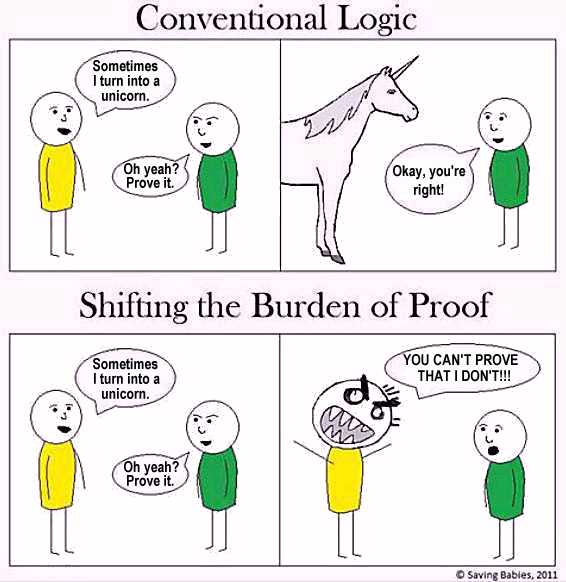
It's quite unreasonable, but nevertheless Trent Horn and others insist that the burden rests on atheists to prove God isn't real simply because they're running scared. They've tried it the other way, the right way. Believers in gods have for thousands of years tried to demonstrate that their gods existed, and without exception they have all failed miserably. And the thing is that we're told that these gods actually liked these people, and yet they wouldn't even prove their existence to their devoted followers. Christians are not the brightest bunch, but they've finally realised that proving their case is hopeless, so have started utilising a ploy popular with children. When some children are finally told that Santa isn't real they respond badly, flying into a tantrum and screaming, 'Oh yeah ... well he is real and you can't prove he's not!' Which is technically true, although very childish. It's a defiant but ultimately futile attempt to keep a cherished fantasy alive when faced with reality. If you can't prove your claim true, or even likely true, and instead insist that disinterested parties prove it false beyond all doubt, then you should accept that maybe your claim is floundering because it simply has no validity.
Trent Horn's article is also an attempt to promote his book, 'Answering Atheism: How to Make the Case for God with Logic and Charity', and in it he makes more baseless claims concerning whose responsibility it is to front up with evidence. For example, he writes,
'The bottom line is that God may have good reasons to allow evil in the world, and the burden of proof is on the atheist to show that he doesn't have any good reasons to allow such evil.'
Note how this Catholic simply dreams up a claim, 'that God may have good reasons to allow evil', and then demands that the atheist must do the hard work of looking for evidence to refute it. The whole thing makes no sense. Since atheists don't believe Horn's God even exists, how could we hope to show that the reasons he allows evil are not good reasons? For atheists to do as Horn demands and examine God's reasoning concerning evil, we would have to find and question a God that doesn't exist. This is a Christian not fully grasping what being an atheist means. Since God doesn't exist then there are no reasons to examine — good, bad or indifferent. Atheists can never prove that God's reasons to allow evil were something other than good since no God, and therefore no reasons, actually exist. I also find it a bit strange that a good Catholic would say 'that God may have good reasons to allow evil', with the emphasis on 'may'. This implies that Horn isn't at all sure that God is a good god acting in our best interests, that God may allow evil because he enjoys watching us suffer. You'd think a good Catholic would be utterly convinced that his God does things for good reasons.
In another example of Horn arguing that it is atheists that must do all the work concerning claims made by Christians, he paints us as a lazy and arrogant lot:
'Atheism has a burden of proof that is not discharged by saying, "Well, it's just obvious that my view is right".'
Well, I agree that it should be obvious that gods aren't causing earthquakes, smiting homosexuals, pushing the Sun across the sky, giving babies cancer or demanding that we slaughter heretics, but for many people it isn't obvious. And atheists know all too well that simply saying it's obvious that gods aren't real won't sway any views, and will only alienate people. Tell an informed atheist that you have an hour or two to kill and could they explain why atheism makes sense, and they will swamp you with explanations and arguments and evidence. It's really very deceptive of Horn to suggest that we'll just say, 'Well, it's just obvious', and quickly change the subject, with the implication being that we know we have nothing serious to argue with. This is Horn suggesting that atheism is all bluster and no substance, and that if people are experiencing some doubts about God, they should choose the humility of agnosticism over the hubris of atheism.
Horn began by stating that many atheists define atheism as, 'a "lack of belief" in God', rather than the oft heard claim that, 'there is no God'. This is technically correct, but Horn then argues that, 'the problem with defining atheism as simply "the lack of belief in God" is that there are already another group of people who fall under that definition: agnostics'.
Here Horn is implying that lazy atheists are new on the scene and have tried to usurp the worldview of a long established group, the agnostics, a group that have already laid claim to the 'lack of belief in God' idea.
This is quite wrong for two reasons. First, atheism as a stance and a label has existed for a couple of thousand years, whereas agnosticism as a stance and a label has only existed for a little over a hundred years. So if, as Horn suggests, atheists and agnostics are both clamouring to claim the same idea, it is atheists that have the true ownership and agnostics that are the lazy usurpers. He should be saying to agnostics and their 'lack of belief in God' idea that there is already another group of people who fall under that definition: atheists. There's no need to start a new group.
But then there's the second thing Horn is wrong about. Agnosticism is not a group of people who fall under the definition: 'the lack of belief in God'. My dictionary defines agnosticism as, 'The belief that there can be no proof either that God exists or that God does not exist'. Agnosticism is the argument that we can't prove whether God exists or not. Note that it does not say that we can't have a belief that God exists or not, merely that we can not prove this belief. We can still form opinions on whether we think that it is likely that God exists. Thus you have people that say, 'I have a belief in God, but I accept that I can't prove he's real. My belief rests on faith'. You also have people that say, 'I lack a belief in God, but I accept that I can't prove he's not real. My lack of belief rests on a lack of evidence for God'. The first type are believers — theists, and the second type are non-believers — atheists, and both are also agnostics, in that they both accept that they can't prove that their stance is true. Agnostics are not just people that lack a belief in God, many believers are agnostics too. So where does that leave atheists then? I'm an atheist and if pushed for accuracy I'd also say, 'I lack a belief in gods, but I accept that I can't prove that one or more are not real. My lack of belief rests on a disturbing lack of evidence for gods, a huge amount of evidence against gods, and no need for gods to explain the universe'. But while correct, that's not the sort of answer that fits on a button or bumper sticker is it? So confident atheists cut through all the legal crap and simply say, 'There are no gods'. When people say that there's no Santa Claus and no Tooth Fairy, they never qualify their concise statement of disbelief with longwinded admissions of how this is just where they believe the evidence points, and that they haven't actually proven that Santa and the Fairy don't exist, and to their knowledge no scientist has either, and if they're going to get technical, absolute proof of their existence or non-existence is impossible. Just as informed adults don't feel that they need to justify their concise statement of disbelief when discussing Santa, atheists likewise feel that a concise statement of disbelief when discussing God should be sufficient.
So as we argued in our article, there are only believers and atheists, agnostics are not a third option, they are merely a possible subset of the first two. But not all believers and atheists are also agnostics, in the way that all Catholics and Methodists are also Christians. Some believers argue that they do indeed have proof of God's existence, that they know with 100% certainty that he exists, so they are not agnostic. Of course this "proof" is usually something quite silly like claiming that they sense God in their heart, or that the 'Good Book' is proof. There might be the odd atheist that claims they have proof that gods don't exist, but I suspect they would be quite rare. While most atheists will simply say gods aren't real, and some may even say they know God isn't real, in the same sense that I "know" Santa isn't real, the reality is we're atheists first and agnostics second. We usually just skip the agnostic bit as being obvious, in the same way that no one ever says, 'I'm pregnant ... and I'm a woman too'.
Unfortunately the popular layman's definition of agnosticism simplifies and corrupts its real meaning. Agnosticism is commonly and mistakenly understood as the argument that there simply isn't enough evidence either way to make an informed choice on whether gods exist or not, with some arguing that there never will be. We must forever remain undecided and on the fence. Most people would describe the following exchange as agnosticism: 'Does God exist? I don't know'.
But is answering 'I don't know' to the question of gods a justified answer or just a lazy answer? How would you answer the following questions? Is there sufficient evidence to dismiss Santa Claus, the Easter Bunny and the Tooth Fairy stories? What about the stories of the Greek god Zeus turning into a swan or the Maori god Maui fishing up New Zealand's North Island? What about the story of God turning the stick Moses was holding into a snake? Even though they lack absolute proof, most informed adults have no problem immediately dismissing all those stories, until they get to the one about Moses and the stick.
Agnostics will point out that we can never prove absolutely if the Moses story actually happened, which is true, and that's where their agnosticism should stop. They've made their point, let's move on. The important question to ask is if it's at all likely, based on modern knowledge, that a stick would suddenly turn into a snake. Forget about absolute certainty, just think about probability, the chances that this might happen. Clearly this type of question is what led them to dismiss the story of Zeus turning into a swan, so why do they now stumble and hesitate with Moses and the stick? Do we have some evidence that snakes are easier to conjure up than swans? Would they have believed the story if it was written in an ancient Egyptian tomb? Of course not, so why believe it when it is found in an ancient Hebrew tomb? What is causing agnostics to give a free pass to clearly ridiculous stories found in one old book and yet giving the boot to similar and sometimes identical stories found in numerous other old books. For example, talk of a god causing a global flood is given the benefit of the doubt by agnostics when found in the Bible, but quickly dismissed as myth when told in an earlier Babylonian document.
This is where most agnostics fall down. They destroy their credibility when they refuse to judge the claims about God on the likelihood of them actually being true. They tell us, with apparently no more knowledge than what a medieval peasant might have had, that the evidence for and against the existence of God is flimsy and inconclusive, pointing neither one way or the other. They insist therefore that the only honest stance is to remain undecided. So be careful the next time you pick up a stick, since if the agnostics are right, there's an equal chance it will turn into a snake as remain a stick.
Clearly agnostics that argue that we can't know if God is real or not are being influenced and corrupted by fairy stories from their childhood, with their bias demonstrated by their unwillingness to be swayed by similar fairy stories from other cultures. These so-called agnostics that have a soft spot for the Christian God are not what it really means to be agnostic, but unfortunately this false view that Christianity and science are at an impasse is held by the masses. And it's a view that Horn wants to take advantage of. Just as these so-called agnostics have a soft spot for God, Horn has a soft spot for them.
Horn wants to discredit atheists, and one way of doing that is to turn us into agnostics, to silence our confident cries of 'Don't be silly ... there are no gods', and leave us whimpering, 'I don't know ... sob ... I just don't know!'
There is a clear psychological advantage in doing this. If they can't have a world of believers, Christians would much prefer it be populated with wishy-washy agnostics than in-your-face atheists.
Regardless of who is right, theists and atheists have one thing in common, we're both confident, decisive, forthright, outspoken. We've considered the question at hand and taken a stand. Theists will confidently affirm, 'Yes, God is real', and with equal confidence atheists will affirm, 'No, gods are not real'. Agnostics however are quite a different beast, a timid, shy beast, with their well-worn cry: 'Hey, don't look at me, I don't know'.
Most people are drawn to others that appear confident, knowledgable, decisive, be they priest or atheist, or lawyer, doctor, politician, military leader, explorer, engineer or stamp club president. No one is impressed with a doctor or lawyer or politician who answers every question with, 'I don't know, I don't think anyone knows, and I don't think anyone will ever know'. A stance based on ignorance is just not an attractive look. The only thing agnostics are confident about is their lack of knowledge and their inability to make a choice.
So from a believer's point of view, if they must have an opponent, if there must be people in the world that have no belief in their god, it is much better for them to be non-threatening, indecisive, ignorant agnostics rather than confident, knowledgeable, outspoken atheists. Agnostics don't challenge the claims made by believers, they merely sit back and think to themselves, 'OK, sounds a little weird, but they may be right, who knows?' Atheists are viewed as opponents in the fight for the mind, and a genuine and serious threat, whereas believers view agnostics as lost souls, confused folk that have simply lost their way, and given the right messages, may perhaps even be drawn back into the fold. In his article Horn mentioned Pope Benedict XVI speaking 'sympathetically' about agnostics, 'people to whom the gift of faith has not been given, but who are nevertheless on the lookout for truth, searching for God ... They suffer from his absence and yet are inwardly making their way towards him ...'. Note how Pope Benedict believes that agnostics are 'searching for God', that they 'suffer from his absence', and that they are 'making their way towards him'. And for some agnostics, perhaps most, I suspect that Benedict may be right. All too often agnostics will explain that they have no belief in God and that they honestly don't know how the universe came about, but will end by saying that however it happened, universes don't just pop into existence by themselves, there must be something out there that created it all. It may not be the Christian God or any god that we know of, but they still can't get past the belief that a god of some description must be lurking out there. They are sympathetic to the idea of divine creation, and so at worst believers view agnostics as quiet, respectful disbelievers and at best as potential converts, whereas atheists are viewed as antagonistic, close-minded tools of the Devil.
In an attempt to sway opinion, Horn states that, 'Because agnosticism seems more open-minded than atheism, many atheists are more apt to describe themselves like agnostics'. And if that's the case, then surely it's better to be seen as an open-minded agnostic than a close-minded atheist? But the way I see it, atheists that pretend to be agnostics merely so that those around them will think better of them are frauds. But the reality is that Horn's statement is misleading, because as Horn admits, agnosticism only seems more open-minded, when in fact it's not. Openly admitting that you don't know whether God caused stars to fall to the Earth or whether another god called Zeus tossed lightning bolts from Mount Olympus is not being open-minded, it's being irrational and gullible. Clearly those things didn't happen, and refusing to acknowledge that reality shows you up as an idiot.
Agnostics will argue that it's misleading and even childish to mention ancient Greek gods or any of the other ancient gods, since clearly they're only agnostic about the ancient Hebrew god. But what makes one ancient god far more likely than thousands of others? Why might the Hebrew god's powers be real but those of the Norse gods just too silly for words? Well, it seems it all comes down to an old book of tall tales that was read to them as children. A book about the adventures of a small-time Hebrew god and his conquest of some prime desert real estate.
But clearly to anyone with half a brain, it's not misleading to mention gods like Zeus. The real definition of agnosticism is the claim that we can never know with certainty whether gods exist, we can't prove it one way or the other. This uncertainty arises because of the nature of gods, because they are supernatural beings, and thus beyond the ability of human senses and instruments to detect. They have the power to hide from us and to perform miracles. And I'd argue that not just gods but other supernatural beings, such as Santa Claus and leprechauns, must be included in the list since they too were powerful and mysterious beings believed in by ancient cultures.
It's easy to broadly understand the notion of what gods are and what they're capable of, just as it's easy to understand what the matter transporters of 'Star Trek' do, why Superman can fly, what Harry Potter uses his wand for and how garden fairies might live in large toadstools. We can understand how all these things might be real, but the crucial question that we need to ask is whether any of these things are actually real, based on everything we know about the world and how it seems to work? Matter transporters, magic wands, superheroes, fairies and mischievous gods, is there any good or even weak evidence that these things might actually exist? Any intelligent, well-informed person would say no.
If you're a typical agnostic that's only agnostic about the Christian God and dismissive of all other gods, then you're a hypocrite whose stance is based on ignorance and fear, not reason and evidence, and if you're truly agnostic concerning all gods and other magical beings, then you're a fool. Either way, agnostics are not someone we need to take seriously. And if you're that other sort of agnostic, the apathetic agnostic, too lazy to inform yourself about the universe and life's big questions, then you have my contempt.
Whichever way you look at it, agnostics are not as serious a threat to Christianity as atheism is. Those terrified that God just might be real are careful not to offend or criticise believers, those few that are equal opportunity agnostics probably don't exist, like God himself, and those that simply don't care are never going to be bothered to challenge the Church over anything.
So that's why Christians like Horn attack atheism and give agnosticism a free pass. If you're going to express some doubt over God's existence, they'd much prefer that you became an agnostic than an atheist, since agnostics are willing to meekly give Christians the benefit of the doubt when talk about gods arise. Agnosticism is pushed as a far more honest, open-minded and honourable stance than atheism, and it's a far less threatening and preferable option to the Church because agnostics admit ignorance, they say they have no idea whether gods might be playing around behind the curtain. Agnostics don't openly state that God doesn't exist, nor do they challenge Church views and policies the way many atheists do, basically they don't embarrass the Church the way atheists do. When the Church says a talking snake deceived Eve, and an atheist says that is just childish nonsense, the agnostic will say, 'Now hold on, while it sounds rather fanciful, it can't be proven that snakes can't talk, or at least didn't talk in the olden days. I think we need to admit that either one of you could be right, and without access to a time machine, we'll never know which'. No matter what religious claims the Church makes and atheists deem ridiculous, be it a 6,000 year-old Earth, Noah's Flood, Lot's wife being turned into salt, the parting of the Red Sea, the Sun stopping in the sky, stars falling to the Earth, Jesus walking on water and magically resurrecting the dead, agnostics will continue to say that we just can't know whether those things happened or not. We may have no evidence that they did, they'll say, but it would be very foolish to say that a lack of evidence means that they didn't. Apparently we need to leave the door open to the contention that snakes can talk. But the weird thing is that agnostics will generally say that we can reliably know that Zeus didn't toss lightning bolts from Mount Olympus and that Mohammed didn't ride his horse to Heaven.
My experience with agnostics is that they are of two sorts, one that is truly ignorant, and one that is afraid. Some agnostics that say they don't know whether gods exist are being truthful. They have no real knowledge of science or history or religion, no knowledge of philosophical arguments concerning the existence of gods. They don't know if the arguments for gods make more sense than the arguments from science because they're not familiar with either side. These agnostics are apathetic, they just don't care about gods, real or not, in the same way that I don't care about ballet, and if I was asked which of two famous ballet dancers was the greatest, I would reply that I don't know. But my agnosticism would be based on ignorance and apathy, not on the claim that it's impossible to decide which dancer was best. While I'd accept that I honestly don't know which dancer was best, I'd quickly agree that there will be people well informed about ballet that could make that call. If I was interested enough to listen to their arguments I'm sure I'd swing towards one dancer or the other. As I gained more ballet knowledge it would be increasingly difficult to remain agnostic.
So to remain truly agnostic you must actively ensure you remain ignorant.
The second sort of agnostic is the sort that adamantly argue that they are somewhat knowledgable about the evidence for and against gods, and based on what they know, insist that it's simply not possible to say with any certainty whether or not gods exist. As Horn mentioned in his article, they maintain that the only honest answer to the question of gods is, 'I don't know and you don't either'.
These agnostics in my view are afraid, although they'll probably refuse to acknowledge their fear. Most of these agnostics have been raised as believers, but as they learnt more and more about the world and their religion, they came to realise that the god stories no longer stacked up and they simply couldn't believe any longer. But while they stopped telling people that God was real, and started living their lives as an atheist would, nagging remnants of years of childhood brainwashing remained. What if they were wrong, what if God was real after all, and Satan really was manipulating the scientific evidence to make it seem as if he wasn't? Is it wise to burn all your bridges and snub your nose at the idea of God? Might it not be prudent to hold out an olive branch just on the slim chance that God is real, I mean, remember what the Bible said about Hell? Wouldn't God likely be more lenient if I simply came across as confused, indecisive and non-threatening, rather than confident, independent and blasphemous?
So, Horn's argument that atheists should ditch atheism and embrace agnosticism simply because of a lack of belief in gods has failed to win me over. I'll willingly admit that I can't prove absolutely and with 100% certainty that gods don't exist, but I'll still publicly proclaim that gods don't exist with great confidence, just as I'll say that the Tooth Fairy doesn't exist, and for the same reasons. There is no evidence for these things and no need to invent these things to explain the world. No one calls me out when I deny the Tooth Fairy, and people only make themselves look foolish when they challenge my denial of gods. I'm an atheist and not a misguided agnostic because I simply don't buy the argument that the evidence against supernatural beings is inconclusive.
-
Comment by Anonymous-9, 15 Nov, 2018
Hello. When I was 10 years old I imagined a logical fallacy. The fallacy violated the 3rd Law of logic, "The law of excluded middle". What I imagined was a middle position between theist and atheist and I called it agnostic. Years later when I took a course in logic and it became clear to me that (theist/atheist) are a true dichotomy of a (believing/not believing) claim. I also realized (gnostic/agnostic) are also a true dichotomy of a (knowing/not knowing) claim. I also realized that true dichotomies are subject to the laws of logic, specifically the 3rd, "The law of excluded middle".
Later as my education and understanding of science and philosophy grew, I came to realize that their is a Uncertainty Principle of knowing in the quantum realm of reality, and because humans have subjective perception at the classical realm of reality, there is also a Uncertainty Principle of knowing in the classical realm of reality. What this means is we can assume absolute objective truths exist, but can not claim to know them.
The existence of some degree of uncertainty of knowledge limits the human mind to believing or not believing with respect to knowledge and a classification of of being agnostic with respect to knowing. This is consistent with the way our brains actually work. Our brains have no objective way to determine what is real and not real, true or not true, but we do have the ability to subjectively perceive information we have stored, information we are currently sensing, patterns we are recognizing, and information we imagine. Our brains also have the ability to objectively reason and subjectively create methods that reduce the inherent subjectivity that exists in the conception of our beliefs... ONE SUBJECTIVITY REDUCING METHOD IS CALLED SCIENCE.
-
Comment by Anonymous-10, 27 Jan, 2020
Hello,
I read your article and agree with it for the most part. However, your explanation of the prefix "a" in atheist as meaning "without" is incorrect in this context. While the Greek prefix "a" can mean without, it also means "not" and there are many words in the English language that use this prefix:
Atypical = Not Typical
Asymmetrical = Not Symmetrical
Atheist = Not Theist
The prefix is also written as "ab" as in abnormal meaning not normal.
Many people, when they hear the term atheist, think that the person belongs to a group of people who are band together against religion. This is far from the truth. For the most part, atheists, as least all of the ones that I have met, do not care what others believe and very few are out to change believers into non-believers. Atheism is not a cult or club or organization. They don't believe in the anti-Christ or the Devil. Atheists simply don't believe.
Therefore, when a person wishes to state their non-belief in gods or supreme beings as presented in various theological studies, they should simply say: "I am atheist." By adding the word "an" to their statement "I am an atheist," they are indicating that they are part of an organization of people that are non theists.
As for your theory that there is no middle between theism and atheism, I believe that you are wrong. As you know, the world is not black and white and there are no absolutes. There are those people that are hard core believers in some sort of god or supreme being, and those that reject the idea completely. However, I believe that there are people that are torn between that idea of a god and more importantly to them, an afterlife, and the science that disproves the biblical theories of the creation of earth, man, and all other primitive theories. There are those who are stuck in the middle between what they would like to think is possible and what they know is most likely improbable.
Your example of a person being either male or female is a prime example of a world being black and white. However, it has been proven that genitalia is not the only determining factor in determining sex as there are mental and emotional factors as well. The world if full of hermaphrodites, intersexed, and gender neutral people as well as transgendered.
I submit that just because you and I have a firm belief that there are no gods, supernatural, or omnificent beings; and others have a firm belief that there are such beings, does not mean that there are not other people who are undecided.
-
Comment by the 'Silly Beliefs' Team, 28 Jan, 2020
Hi. I sense that in basic terms we are both on the same page. As you say, we both have a 'firm belief that there are no gods, supernatural, or omnificent beings', and that atheists in general don't belong to 'a cult or club or organization. They don't believe in the anti-Christ or the Devil. Atheists simply don't believe'.
You've clearly stated the message that I try and get across when I discuss gods and religion with people. So I could leave it there and make no further comments, as some might accuse me of merely debating semantics. Which would be true, but hey, since we concur on the essential points, what else is left to discuss? Minor as they may be, they are worth a look.
I'd agree that the prefix "a" can also mean "not", but that said, every book that I have read on atheism that explained the etymology of the word atheist defined the "a" as meaning "without". Not one even mentioned the possibility of it meaning "not". While I can't easily refer you to those books (and in this day and age, does anyone read books anymore?), I can give you the Wikipedia entry on Atheism:
'The etymological root for the word atheism originated before the 5th century BCE from the ancient Greek "atheos", meaning "without god(s)".' ...
'Etymology
The Greek word "atheoi", as it appears in the Epistle to the Ephesians (2:12) on the early 3rd-century Papyrus 46. It is usually translated into English as "[those who are] without God".'
So I'd argue that the view taken by the majority is that since theism means "a belief in gods", then atheism should likely translate as "without a belief in gods". Of course you could argue that atheism could also mean "not having a belief in gods", but why introduce another phrasing when in principle they both say essentially the same thing? The etymology of the word is interesting but irrelevant at the end of the day. Many modern words now mean the complete opposite from when they were first coined. Girl originally meant a child of either sex. The important thing we need to have people understand is that atheists have no belief in any gods or supernatural beings, regardless of what the ancient Greeks might have intended or how others later used the term. For example, the early Christians were called atheists, not because they didn't believe in any gods, but because they didn't believe in the gods that the ruling Roman society believed in. Even today I find I often have to go beyond merely identifying myself as an atheist, and actually explain that the word means I do not believe in any gods. None at all. A door-knocking evangelist once told me he was a Mormon, and I told him I was an atheist. He then asked me, 'So what god do atheists believe in?'
So while I understand your argument for saying "I am atheist" rather than "I am an atheist", believers are already struggling with the word atheist, meaning most wouldn't even notice that you'd omitted the word "an". And if they did, they certainly wouldn't grasp the significance. We're dealing with people that have only read one book, a really old one, and even then only parts of it.
I'd agree with you that many people mistakenly think that atheists band together against religion, when most simply couldn't care less. Others think atheism is a religion, and that Charles Darwin or Richard Dawkins are worshiped as demigods. Likewise, I've had people accept that I don't believe in God, but then they ask me why I'm not afraid of the Devil torturing me in Hell for my disbelief. Many believers simply can't comprehend what a true lack of belief means, at least not when it comes to their God. They can understand and readily accept a lack of belief in the Greek god Zeus and the Aztec god Quetzalcoatl, but not in the equally ancient Hebrew god called God.
OK, now to my view that there is only theism and atheism, and no other option. I agree that in hindsight my example of humans being either male or female was not the best choice. Recent discussion of gender has muddied the waters somewhat. Perhaps I should have said a "typical" human is either male or female, in the same way that we would describe a typical human as having two arms and capable of sight and hearing but not flight, even though some humans are born with no arms, blind and deaf. But again, if you were describing the human species to an extraterrestrial on another planet, you would say the human species has two sexes, not one or three or more. So in that sense humans being either male or female is something most people can grasp as an analogy. When I expanded on my explanation further into our article, I did give better examples:
'If you're not a theist, that only leaves one option — you're an atheist. A rejection of theism leaves no other conclusion. It's like the phrase "dead or alive", "on or off" or the word "pregnant". You are either one or the other. Either dead or alive, on or off, pregnant or not pregnant, there is no middle option.'
As to how that binary choice relates to atheism, let me repeat what we wrote in our article:
'... there are only two possibilities when it comes to describing belief in God — theism or atheism. If someone is asked the question, "Do you believe God exists?" and they reply, "Yes", then they are a theist, regardless of how strong that belief is. Anyone that can't honestly answer, "Yes, I believe God exists", is obviously without a belief in God and is therefore an atheist. There are the people that believe in God, and there's everyone else. Everyone else is, by the broad and proper definition of the word, an atheist. They may only be a hair's-breadth away from believing in God, but until they make that leap of conviction they will remain an atheist. As much as they may hate or fear or abhor the idea of being called an atheist, that is what they are.'
You're correct that much of the world is not black and white, but in the examples I've just given, it is. I also agree that there are many people who are undecided when it comes to what to believe, the stories of gods or the evidence from science. But simply being undecided does not let someone claim that neither the theist or atheist label applies to them. Let me offer a new analogy. Let's say the elections are coming up and you're asked whether you're a registered voter or not. You reply that the world is not so black and white, explaining that you find politics confusing and you find politicians difficult to trust, so you're undecided who you would even vote for. But your indecision about the candidates and their policies doesn't answer the question, or alter your actual voting status, which you still haven't disclosed. Your knowledge of the potential candidates is unimportant. Your understanding of their policies is immaterial. Your actual intention to vote or not is irrelevant to the question that was posed. Raising any of these concerns in no way answers the actual question ... are you registered to vote? Yes or no? You've sidestepped the question if you instead talk about how uncertain you are about political science, or whether politicians can be trusted, or if your one vote can make a difference, since all that was asked was whether you are registered to vote in the upcoming election. It's an either/or answer. There is no middle ground, if you're not a registered voter then you are, by default, an unregistered voter. Your indecision about who to vote for is irrelevant to the question and to the label attached to you concerning your eligibility to vote.
And it's the same with the question, "Do you believe gods exist?" It's black or white, yes or no, where a Yes answer labels the person a theist and any other answer — be it No or they're undecided or whatever — labels them, by default, an atheist. Again, they were not being asked their view of gods, or if gods might exist, or if it's even possible to find out, or if they find the whole topic very confusing, they were simply asked if they believed gods exist. Not whether evidence has shown they exist, or whether they might exist, but whether they personally believed they exist. Yes or no? It's a black or white answer, any indecision or confusion they might have due to answers coming from theology or cosmology is irrelevant, and any reluctance to answer due to the fear that they might choose the wrong answer is understandable but futile. If a person can't answer, "Yes, I believe gods exist", then by default their silence implies a No. They may instead choose to rave on about uncertainty and complexity and first causes and the miracle of life, but all this is to cover their inability to say that they believe gods exist. And they may genuinely be torn that they can't commit to the idea of gods, but being unable to say that they believe, means logically that they lack a belief in gods, which is the very definition of an atheist. So whether someone believes in gods, whether they're a theist or an atheist, is black and white, but how strong that belief is certainly isn't black and white. Their conviction that they're right, that they feel their stance is well supported, that ranges from blind, dogmatic fundamentalism to reasoned research to believing on a mere whim or simply because their parents told them to. But when someone asks if you believe in gods, they expect a yes or no answer. They're not asking you to explain or defend your stance (not yet anyway), they merely want to know if you have a belief in gods or lack that belief. For those that lack that belief, I agree that many are confused and this makes them unwilling to commit to a belief in gods, but it's their lack of belief that labels them an atheist, not their enthusiasm for arguing with Christians. You don't become an atheist when you've studied and accepted a threshold number of arguments for atheism, you become an atheist simply when you refuse to label yourself a theist.
When I was looking online for the etymology of atheism, I came across an article by philosopher Paul Draper, who does put forward an argument (the only one I found) that the prefix should be taken to mean "not" rather than "without". Let me quote two relevant paragraphs"
'"Atheism" is typically defined in terms of "theism". Theism, in turn, is best understood as a proposition — something that is either true or false. It is often defined as "the belief that God exists", but here "belief" means "something believed". It refers to the propositional content of belief, not to the attitude or psychological state of believing. This is why it makes sense to say that theism is true or false and to argue for or against theism. If, however, "atheism" is defined in terms of theism and theism is the proposition that God exists and not the psychological condition of believing that there is a God, then it follows that atheism is not the absence of the psychological condition of believing that God exists (more on this below). The "a-" in "atheism" must be understood as negation instead of absence, as "not" instead of "without". Therefore, in philosophy at least, atheism should be construed as the proposition that God does not exist (or, more broadly, the proposition that there are no gods).
This definition has the added virtue of making atheism a direct answer to one of the most important metaphysical questions in philosophy of religion, namely, "Is there a God?" There are only two possible direct answers to this question: "yes", which is theism, and "no", which is atheism. Answers like "I don't know", "no one knows", "I don't care", "an affirmative answer has never been established", or "the question is meaningless" are not direct answers to this question.'
While I agree when he says that, 'Therefore, in philosophy at least, atheism should be construed as the proposition that God does not exist (or, more broadly, the proposition that there are no gods)', this level of argument is far beyond what one encounters on the street, and unlikely to sway those people that, as you say, are torn between the idea of a god and the science that disproves him. But more important is Drake's second paragraph, where like me he argues that, concerning whether someone is an atheist or a theist, 'There are only two possible direct answers to this question'. Like me he states that indecision — 'Answers like "I don't know"' — don't put you in a new group. If you don't know, then that means you don't believe, and that, by definition, means you're an atheist. As you yourself said, 'Atheists simply don't believe', and someone that's undecided if God exists or not, no matter how torn they are by that uncertainty, doesn't believe that God exists.
You and I have obviously both come to terms with our disbelief, and I suspect that of those hordes that are undecided about whether gods are real, it is not their disbelief that worries them, since if it was they would promptly believe just to be on the safe side, à la Pascal's Wager. It is the term atheist that scares them, since they are usually quite willing to call themselves agnostics or freethinkers or secularists or humanists or simply spend time explaining that while they currently don't have a belief that gods are real, please don't label them with that nasty A word. No, no, no. Because that would mean ... you know ... umm ... that they currently don't have a belief that gods are real.
 Return to Article
Add a Comment

|

 Support Science Not Superstition