

|
 Support Science Not Superstition
|
|
|
|
The Shroud of Turin Burial cloth of Jesus or cheap fake?
Add a Comment
Didn't scientific carbon dating prove it was a fake, and why won't the Pope who has possession of the shroud say it's the real deal? He has a hot line to its alleged owner on matters such as evolution, the Big Bang, abortion and condom use, so why so non-committal on the matter of the shroud's authenticity?
|


|
Update: After reading our original article on the Shroud of Turin and its carbon dating, a USA college student writing a thesis on the subject asked us a series of questions regarding our skepticism towards the Shroud of Turin. Thus we've rehashed this page to include our answers since they provide yet more reasons to reject the shroud as authentic. The
original article detailing Father Laisney's attempt to discredit the 1988 scientific carbon dating of the shroud now follows these answers. Following this we provide a list of 'Reasons to doubt the authenticity of the Shroud of Turin', basically a summary of points covered in the article.
The Questions
Question: What do you know about the Shroud? What is your experience with the Shroud?
The provenance or history of past ownership of the Shroud of Turin can only be traced back to the 14th century, around 1355 CE [1]. It turned up in the possession of a soldier of fortune who could not or would not say how he acquired the most holy relic in all of Christendom. There is no record of its existence from the time of Jesus' crucifixion until this date. That's 13 centuries of silence. The Bible, the only source that describes the miracles that revolved around Jesus, his eventual crucifixion and the rise of Christianity makes no mention of a burial cloth displaying the image of Jesus. While the Bible does describe the burial method and the burial cloth of Jesus, its description in no way matches the Shroud of Turin. A few decades after it first appeared in the 14th century, two bishops claimed the shroud was a fake and appealed to Pope Clement VII. The Pope ruled that it was not to be claimed that it was the true burial cloth of Jesus. And remember that we are told that popes are infallible, incapable of making an error. (Of course Catholics will argue that papal infallibility didn't exist back then and anyway, it doesn't apply to such trivial matters such as whether they should be worshiping an old stained cloth. Papal infallibility is for important things like deciding whether masturbation is a sin worse than murder.) (Also note that Clement VII was later declared an antipope by the Catholic Church, although this probably had nothing or little to do with his pronouncement on the shroud. See this comment.) In 1898 a photograph of the image on the shroud was produced. The 'negative' image of this photographic appears to reveal much more detail than the actual 'positive' normal image. Although it's not actually a true negative, this supposed photographic nature of the shroud's image generated great public interest and the debate around the shroud's authenticity began in earnest. In 1978 the Vatican allowed a group of scientists called STURP (Shroud of Turin Research Project) — most of who were deeply religious — to examine the shroud. They concluded that 'The image is an ongoing mystery and... the problem remains unsolved'. They also noted that 'few further definite conclusions are possible without information about the age of the cloth... [and] the only unambiguous means to establish this is by the carbon-14 method'. In 1988 the Vatican, no doubt buoyed by STURP's tests and recommendation, allowed a sample of the shroud to be carbon dated by three independent laboratories in America, England and Switzerland. They all concluded that the flax making up the shroud dates to between 1260 and 1390 CE. This matches perfectly the date of its first appearance — circa 1355 CE. Disappointed that they didn't get the expected 1st century date, shroud proponents have spent the intervening years trying to discredit the carbon dating tests by throwing up everything from accusations of outright cheating by atheistic scientists to incompetence in selecting the sample, from failure to account for contamination of the sample to incompetence in cleaning the sample. It needs to be remembered that they were perfectly happy with the integrity of the tests until the tests returned the 'wrong' date. I have not been involved in any investigation into its authenticity nor have I seen the actual shroud, although I have viewed a life-size high definition photograph of it. My knowledge of the shroud debate has been gained from articles, books, documentaries etc on the shroud, and the study of religion and science in general. Why don't you believe it's the burial cloth of Jesus Christ? Question: Why do you believe the Shroud is not the burial cloth of Jesus Christ? As with evaluating any claim, one needs to look at the evidence supporting it and the evidence against. Some reasons may be very strong and some quite weak, so it's not simply a matter of counting up arguments for and against. Sometimes one piece of evidence or one argument is insufficient to reach a conclusion, so one must look at the weight of evidence. Where does the majority of evidence point? Is it conclusive? In the case of the shroud, there are obviously arguments both for and against the shroud's authenticity. However I believe the shroud is not the burial cloth of Jesus because the strongest evidence, the most rational arguments and the weight of evidence all point to this conclusion. My conclusions are based on critical thinking, reason and logic, not faith. First I will briefly list the evidence against the shroud's authenticity, then I will provide the popular arguments that shroud proponents use, with a brief reason why I believe they fail. Strong evidence against the authenticity of the shroud:
Weak evidence put forward for the authenticity of the shroud:
How was the Shroud image formed? Question: How do you think the image on the Shroud was formed? To be honest I don't know. But if I had to pick the most promising method, I would say it could have been constructed using a rubbing technique on a bas-relief model. According to my dictionary 'bas-relief' means: a sculptural relief that projects very little from the background. Also called low-relief'. Joe Nickell, Senior Research Fellow of the Committee for Skeptical Inquiry (CSI, formerly CSICOP) and author of Inquest on the Shroud of Turin and Detecting Forgery, demonstrated this technique using a bas-relief and the pigments and tools available in the Middle Ages. "After experimenting with various techniques, the shroud artist would have prepared a suitable mixture of pigments and tempera binder, moulded a wet linen sheet over the bas-relief he had constructed, and using a dauber (also termed a pounce or tamper) apply the mixture to the surface of the linen. Methods for creating similar images are known and these methods were widely known in the Middle Ages. Faux-negative images are automatically produced by an artistic rubbing technique." The July 2005 issue of Science & Vie (Science and Life) magazine also documented the making of a shroud by these medieval techniques. STURP scientists have conceded that it is possible to create the image using this method, but have also said there is no evidence to suggest that such a technique was ever used prior to the 19th century. Joe Nickell on the other hand, claims the technique dates back to at least the 12th century.
UPDATE: In October 2009 it was announced that scientists in Italy had made a cloth bearing an image very similar to the shroud. Luigi Garlaschelli, a professor of organic chemistry at the University of Pavia, stated that, 'We have shown that it is possible to reproduce something which has the same characteristics as the Shroud'. One media article noted that, 'Garlaschelli reproduced the full-sized shroud using materials and techniques that were available in the middle ages. They placed a linen sheet flat over a volunteer and then rubbed it with a pigment containing traces of acid. A mask was used for the face. The pigment was then artificially aged by heating the cloth in an oven and washing it, a process which removed it from the surface but left a fuzzy, half-tone image similar to that on the Shroud. He believes the pigment on the original Shroud faded naturally over the centuries. They then added blood stains, burn holes, scorches and water stains to achieve the final effect.' Click on the photo (above right) to view the full shroud. Some people focus on this type of question, and take my answer of 'I don't know' as admission of defeat. Yet imagine if someone claimed that photographic holograms were created by invisible fairies, and then stated that if you couldn't explain exactly how you thought they were created, then by default it must be fairies. No intelligent person would accept this argument. While you may not be able to explain how holograms are created, you nevertheless see no evidence that fairies are involved. Just because you can't explain holograms, doesn't mean you have to accept fairies. Likewise, just because you can't explain a shroud image, doesn't mean you have to accept the supernatural. It's all right to say you don't know. And next week or next year you may discover how holograms really are created, and the shroud. It's also an arrogant assumption that if I don't know how something works or how something was made, then no one else does either, and certainly not some ignorant peasant from the Middle Ages. We need to be reminded that men and women in our distant past were not stupid. They were just as intelligent as you and I, and even though they didn't possess our scientific or medical knowledge, many could do things that you and I would consider amazing. There is another side to this question. How do the shroud proponents think the image was formed? Do they have theories that are plausible and that would tend to conflict with the medieval date or human manufacture? The following are the most popular theories:
What about alleged Carbon Dating flaws and conspiracies? Question: The Carbon 14 test in 1988 declared that the Shroud could be dated back to the years 1260-1390 and therefore could not possibly be the burial cloth of Jesus. However, there has been some new claims that state the test was flawed in many areas. For example, the 1532 fire would have effected the dating. Also the bacteria on the Shroud was not properly cleaned off. This also would have effected the dating. There was also talk of some conspiracies surrounding the testing (such as people switching and messing around with the test tubes and bets being placed ahead of time by the scientists). How would you respond to these? I believe the carbon dating testing was competently carried out and that their results are therefore valid. It needs to be highlighted that there was not one test but three, carried out at independent laboratories in the USA, England and Switzerland. The protocols used were agreed to in advance between the scientists and the Vatican and these protocols were followed. The scientists originally petitioned the Vatican to allow it to use 7 labs and more samples to increase the accuracy of the testing. The Vatican refused, allowing only three labs. Numerous people witnessed and videotaped the sampling of the shroud and the samples were packaged unobserved by the Archbishop of Turin and Dr Tite of the British Museum. The scientists from the carbon-dating laboratories were not involved. The labs used different cleaning procedures, control samples were used to test their calibration, some tests were performed blind, that is scientists didn't know if they were testing the shroud sample or a control sample and none of their results were compared until all three labs had completed testing. The results from the three independent laboratories were 'mutually compatible', i.e., they independently obtained similar dates. Let's look at the testing conspiracies first. The only time that the test tube samples were together and relatively unobserved was when the Archbishop of Turin was packaging them. Once they were sent to the labs, altering the sample at one lab wouldn't affect the samples at the other two labs. Since all three labs reached the same result, they obviously all had the same sample, so a fake medieval sample would have had to be planted when all three test tubes were together. So if there was a switch, it was performed by or at least observed by the Archbishop of Turin. I think you'll agree that this is highly unlikely. As for bets being placed ahead of time by the scientists, I haven't struck this one before, but even if true it sounds innocent enough to me. People place bets on horse races all the time, but we shouldn't infer from this that they have illegally rigged the outcome. I would suspect that many scientists of STURP would bet that the shroud is authentic, does this mean that they have also falsified their scientific results? In fact before they even examined the shroud, some STURP scientists went on record with statements such as "I am forced to conclude that the image was formed by a burst of radiant energy — light if you will. I think there is no question about that." This shows that they had reached a conclusion before their tests even begun, hardly the view of objective scientists. It's important to note that no reputable pro-shroud advocate in their numerous books and websites make any of these unsubstantiated accusations towards the scientists. None question the integrity of the laboratories. None accuse the labs of conspiracy, of fraud, of reneging on agreed protocols. Could the 1532 Chambery fire have effected the dating? The answer is an unequivocal no. Dr McCrone, a shroud researcher, has described this suggestion as 'ludicrous'. While the addition of biological contaminants could theoretically skew the result, Dr McCrone has calculated that carbon nearly twice the weigh of the shroud would have to be added. The 20 lb. shroud would need nearly 40 lbs. of contaminants to be added to shift a date 1300 years, from the 1st century to the 14th century. Even the untrained eye would notice 40 lbs of crud on the shroud. Also all three labs thoroughly cleaned their samples before testing, using different methods. The most unbelievable aspect of this claim though, is that by the most amazing and miraculous of coincidences, even after the labs supposedly cleaned off varying amounts of contamination, they all still returned a 14th century date. Are we expected to believe that the fire modified the fabric by just the right amount to give a date that matched the shroud's documented origin? It would be bad enough, in the eyes of shroud supporters, if the fire caused a date slightly later than the 1st century, but to give a date that matched its first appearance in the 14th century is a disaster. How unlucky! As for bacteria on the shroud not being properly cleaned off, and thus skewing the date, this explanation fails for the same reasons that the fire of 1532 fails. The amount of bacteria required is unrealistic, it could not pass unnoticed and the samples were all expertly cleaned, using different methods. If the cleaning methods used were inefficient as claimed, all three labs should still have cleaned off varying amounts of bacteria, even if nowhere near enough to give an accurate test. Thus the three labs should have all returned different dates, since they were measuring different amounts of bacteria. Yet they didn't. Like the fire scenario, it seems the bacteria all conspired to return the most damaging date possible, the 14th century appearance of the shroud. The most recent 'explanation' by shroud proponents for the 'wrong' date is that the sample removed from the shroud for testing was a patch. There's no denying that the shroud has been patched during its existence, especially after the 1532 fire. In it's early days some people even deliberately tried to damage it to prove that the burial cloth of their Lord Jesus Christ was indestructible. They were wrong. There's also no denying that most of these patches stand out like squares on a patchwork quilt. The contention is that the sample returned a 14th century date because it was not part of the original shroud linen, but part of a medieval patch. The carbon dating was 100% accurate. The mistake was made in selecting the sample. While this is of course plausible, there are several reasons to doubt this version of events. For one the Vatican had already examined the shroud over many years. They knew the shroud's surface intimately. The STURP scientists had also conducted their extensive examination of the shroud. The Vatican had already cut a sample from the shroud for examination by a textile expert called Raes, and this piece was not revealed as a patch. This fact is important because the carbon dating sample was taken from exactly the same area. It was only after consultation between the Vatican, scientists and textile experts that the sample area was agreed on. Everyone was well aware that they had to avoid patched areas. None of these groups, least of all the Vatican, would have permitted the sample to be taken from an area that wasn't thought to be the original material. Some people have since said that the scientists were incompetent, that they rushed the sample taking or that they deliberately chose a patch, knowing it would give a medieval date. But as I've said, the scientists didn't make the choice alone, they didn't take the actual sample and the Vatican fully supported the choice. No one expressed any doubts at the time. Only after the 'wrong' date was arrived at and their theories on bio-contamination were debunked did shroud supporters start looking at the possibility of a flawed sample. They now insist that you can't tell it's a patch, even under a microscope, because the medieval repairers employed 'invisible reweaving'. Obviously this skill of 'invisible reweaving' was lost by the time of the 1532 fire repairs in 1534, which appear very amateurish. Shroud proponents' claim that medieval artisans were too stupid to make the shroud but at the same time had this unknown weaving skill that is impossible to achieve today. The only real support for the patch theory comes from the late Ray Rogers, a retired chemist and also director of chemical research for STURP. In his home laboratory he performed some controversial tests on two threads he claims came from the carbon dating sample, stating they differ from the rest of the shroud which he has dated between 1000 BC and 700 CE. He achieved his dating using an imprecise, unproven scientific method involving the measurements of carbohydrates such as vanillin. A method that was not calibrated and that used no control samples. Needless to say the scientific community do not support his results or methods. While it is possible that the sample was a patch, there is no convincing evidence to support or even suggest this. Thus there is no evidence to suggest that the carbon dating result is flawed. There was no scientific conspiracy, the 1532 fire and/or devious bacteria didn't contaminate the sample, and Rogers' claim that the sample was a medieval patch is weak in the extreme. The Vatican's scientists would have never permitted a doubtful sample to be taken. One other problem with this tact is that if these challenges to the carbon dating results were valid — and shroud proponents believe they are — then they would apply no matter what date was returned. Even if a 1st century date were returned, shroud proponents would in all honesty have to state that they still can't accept it as accurate. The possibly of the fire and/or bacteria affecting the result would still exist. Perhaps this contamination was skewing the result and the shroud was older still, perhaps around 1300 BC. Likewise the patch problem could still exist but in reverse. A medieval shroud was patched with a piece of genuine 1st century cloth. You can't say the problem of contamination no longer exists just because carbon dating returns the date you were hoping for — the 1st century. If it's possible for the scientists to cheat, it's equally possible for the Vatican to cheat and substitute a sample of 1st century cloth for testing. Thus shroud proponents are in effect saying that they can't rely on carbon dating no matter what date it gives. They would be hypocrites to claim otherwise. But can you really imagine shroud proponents rejecting the 1988 carbon dating tests as inconclusive if they had returned a 1st century date? Can you imagine them mounting these arguments against that result? Neither can I. What about the detail seen in the image? Question: There is so much detail in the Shroud when it comes to the wounds and blood flow of the man on the Shroud. Do you think that a man in this time period (1260-1390) could have possibly created this cloth when at this time so little was known about medical things?
The blood flows may look realistic when we compare them to someone bleeding on the TV news, but we need to remember that this body was dead. When you die your heart stops and normally no more blood flows from your body, however a corpse can leak blood through an open wound due to gravity. On death blood will pool inside the body, sinking to the lower extremities such as the back or legs depending on how the body is positioned. If there are open wounds at these low points then you may get some blood flow, but you won't likely get blood flowing from wounds on the top of a body that is lying on its back. And since the Bible [John 19:40] indicates that Jesus's burial followed Jewish customs, meaning Joseph of Arimethea would have washed the body, this means that the blood flow onto the shroud must have occurred after it was washed and wrapped. Although contradicting the Bible account, the body shown in the shroud was not washed. Washed or not, evidently there was blood flowing freely from all of Jesus' wounds, not just the lower ones due to gravity, which is difficult to explain. Obviously Jesus would have bled while being tortured and crucified, but once dead the bleeding would have stopped and the exposed blood would have dried. The body was not washed, and the dried blood should not have transferred to the shroud. If the blood hadn't dried by the time Jesus was wrapped in the cloth (unlikely), then this means that while he was being removed from the cross and carried to the tomb, it would have been very difficult for those handling his body not to have smudged and rubbed the blood flows. If you've seen Mel Gibson's sadistic movie 'Passion of the Christ', which the Catholic Church assures us is an accurate portrayal of Jesus' final hours, then you'll remember that Jesus was naked and literally swimming in blood. Carrying a naked, heavy, slippery dead body without touching the blood flows would be impossible. And strangely enough, the shroud image is not covered in blood. Just a little blood to indicate the wounds described in the Bible. Even if by some 'miracle' the blood flows were still wet and not disturbed, as soon as you wrapped the body in an absorbent linen cloth, the blood would spread into the material. The detail that is supposedly seen in the image would be lost. Same with the blood from the scalp wound, it should mat the hair, not run in rivulets. Far from being accurate, the blood flows are more like an artist's representation of blood. The only wound that possibly conveys unexpected detail is the one that shroud proponents claim goes through the wrist, rather than the hand, since the Bible clearly stated that on the cross nails were driven though the hands, and almost all historical literature and paintings continued with this tradition. And I say unexpected detail for someone living in the 21st century, exposed as we have been for centuries about the nail wounds being in the hands, not necessarily unknown detail for someone in the 14th century. Yet we have since re-discovered that nails through the hands will not support the weight of a crucified body, and shroud proponents claim that since the shroud image appears to show a wound in the wrist, this proves it's from a real crucifixion, not just a fake image to match the BIble story. (Although note that more detailed research by skeptics has shown that what is claimed to be a nail wound is actually in the hand and not the wrist after all.) However historical documents have also revealed that many of the victims were actually tied to the crossbar rather than nailed (nails were expensive), so perhaps in the few cases when nails were used it was in addition to rope, meaning they could go through the hands as most of the weight would be taken by the rope. Anyway, since we haven't crucified people for centuries, we have forgotten the practical details and simply assumed that the Bible was accurate about the hands. We also arrogantly assume that since we didn't know the true details, then ignorant peasants in the Middle Ages wouldn't have known either. But they lived a lot closer to crucifixion times than we did, so it's quite possible that some people still remembered how it was really done. We need to stop assuming that man in times gone by was intellectually inferior to 21st century man. A similar argument is used for the fact that the image is naked. Paintings from the Middle Ages always show Jesus with some sort of loin cloth, thus, just as with the bit about the nails, it's suggested that medieval artists obviously didn't know he was really naked. However I think you have to be pretty naïve to believe that regardless of how they normally painted him, they didn't know he would have been naked. Crucifixion was a brutal punishment designed to act as an example to others. The Romans had just tortured him and were now killing him, are we expected to believe that they would be concerned about his nudity embarrassing him? His public nakedness would have been part of the punishment. Likewise, just because they normally painted him with nails through the hands didn't mean that they didn't know they should really go through the wrist. The shroud artist may simply have decided to forgo tradition and create a more realistic image, naked and with a wound in the wrist (although as I've mentioned, the wound claimed by shroud proponents to be in the wrist is actually closer to the back of the hand than the wrist). Of course if you still accept the argument that there is a lot of unexpected detail in the image, you then have to explain why a lot of detail you would expect is actually missing. For example the navel is missing. The body's buttocks, chest and toes "are defined poorly or not at all". The ears are missing. The top of the head is missing. The genitals are not visible. One pro-shroud website article explains this item away with the following: 'The genitalia are not visible because they are covered by a folded modesty cloth by Jewish custom'. What Jewish custom, and why would the body need a 'modesty cloth'? It was wrapped from head to toe in an opaque cloth. Also why did the radiation or whatever it was that created the image not penetrate the modesty cloth? The missing genitalia, whether covered by an unnatural posture, magic underwear or simply missing would suggest an artist trying to maintain Jesus Christ's modesty rather than portraying a naked body in a natural posture. And of course, as I've already mentioned, there are evidently serious anatomical problems with the image — "Jesus' face, body, arms, and fingers were unnaturally thin and elongated, one forearm was longer than the other, and his right hand is too long. The man is improbably tall, between 5' 11½" and 6' 2" tall. Jews who lived in the 1st century were much shorter than this." (As someone has commented, if Jesus was really this tall he would have really stood out and there would have been no need for Judas to point him out to the Romans). "The head is disproportionately small for the body, the face unnaturally narrow and the forehead foreshortened, and ears lost. The front and back images, in particular of the head, do not match up precisely, and the back image is longer than the front. The back of the head is wider than the front of the head. The hair is hanging straight down, as if the man was sitting." So there are in fact no medical details revealed in the image that hadn't already been discovered by the Middle Ages. It is simply an attempt to portray a wounded and bleeding body, a rather poor attempt. Rather than describe things that they couldn't have known, they actually got many details wrong. Details that they would have known well. After all, humans have been exposed to the sight of wounded, bleeding and dead bodies for thousands of years. We may be relatively shielded from that today, but in medieval times artisans would have been extremely familiar with blood and dead bodies. History details numerous wars involving close combat with sharp implements, the Inquisition with its judicial torture had already begun and remember also that the Black Death occurred during the 14th century so blood and death would have surrounded those living during this time. They may not have known why blood flowed but they would have been depressing familiar with all manners of horrific wounds and bleeding bodies. So now that we've established the real problems with the image, we move to the second part of the question: 'Do you think that a man in this time period (1260-1390) could have possibly created this cloth when at this time so little was known about medical things?' Since the image is actually quite inaccurate regarding 'medical things', the question now becomes: 'Could a man in this time period have possibly created a cloth displaying a 'medically inaccurate image?' Obviously the answer is yes. Any fool can create an image that doesn't accurately reflect reality. Since the image displays many details that don't occur naturally, the shroud image can't have formed by being wrapped around a real dead body. Didn't the STURP scientists authenticate the shroud? Question: The STURP group researched the Shroud and discovered that the cloth covered a real human body, the blood stains on the cloth were real blood, the image on the cloth could not have been burned on and the image on the cloth could not have been painted on. What do you think of their findings? The STURP (Shroud of Turin Research Project) group of scientists examined the shroud in 1978. Unfortunately almost all of these scientists were deeply religious, many were not specialised in the field they investigated and they were actively trying to prove its authenticity. In their book 'Debunked!', physicists Georges Charpak and Henri Broch noted that STURP consisted of 40 scientists, made up of 39 devout believers and 1 agnostic. Knowing that the proportion of believers to agnostics is much different in scientific circles than it is in the general population, they calculated that the odds of selecting a group of 40 scientists at random and achieving this high ratio of believers is 7 chances in 1,000,000,000,000,000. In other words the makeup of this group is stacked and very biased towards authenticating the shroud, and therefore you must take their claims with an extremely large grain of salt. In fact before they even examined the shroud, STURP scientists went on record with statements such as:
This shows that they had reached a conclusion before their tests even begun, hardly the view of objective scientists. Remember also that the authenticity of the shroud is vastly more important to Christians scientists than it is to secular scientists. So if secular scientists may have been prepared to cheat to discredit the shroud, as suggested by some shroud supporters, then it is equally reasonable to believe that Christian scientists are even more likely to cheat and falsify their results. We are not for a moment suggesting that the STURP group has been in any way dishonest, however all scientists must be continually alert that they don't allow their personal beliefs or desires to unconsciously bias their experimental results. STURP claiming that the cloth covered a real human body and that the alleged stains were real blood does not make it so. Other scientists have claimed just the opposite, that there is no blood on the Shroud: all the forensic tests specific for blood, and only blood, have failed. We've already mentioned that this "real blood" doesn't behave like real blood and that the argument that the cloth covered a real body is also suspect, since there are serious anatomical problems with the image. It's also vitally important to realise that even if there was a real body and real blood on the shroud, whose body was it, whose blood was it? How old is it? Medieval perhaps? An artist could have decided that the best way to represent blood stains was to use real blood and/or a real body. The existence of blood proves nothing as we don't know Jesus' blood group nor do we have a sample of his DNA to compare it with. Even if STURP's results were correct — real body, real blood — this knowledge can in no way be used to connect the shroud with the crucifixion of Jesus. Many hospitals possess cloths that contained real bodies and real blood, but none wrapped Jesus. STURP's claim that the image was not burnt or painted onto the cloth is accepted. However by 'painted on' STURP means that there was no paint or brush strokes detected on the shroud. However other scientists have detected what they believe could be paint pigments. As already mentioned, if the image was created by using a bas-relief technique that was known in the Middle Ages, no burning or brush strokes would be evident. The facts are that STURP did their tests in 1978, with the scientific tools they had available at the time. They were severely limited by the Vatican as to the tests they could perform and, importantly, they were unable to date the shroud. Carbon dating in 1988, a more invasive and accurate test, has since dated the shroud to between 1260 and 1390 CE. I repeat, STURP's conclusions have been superseded. Unlike religion, science is willing to accept more reliable evidence. What about 8th century paintings of the shroud? Question: How would you respond to the fact that certain paintings from the 8th century exist that show the Shroud?
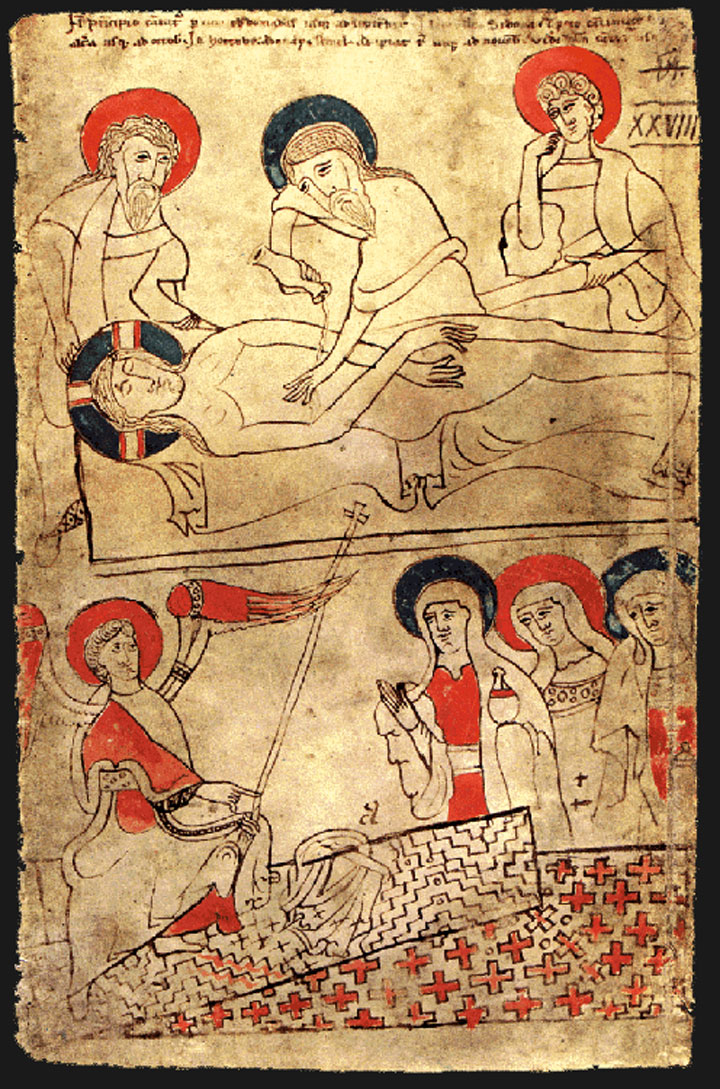
It's actually quite clear that the manuscript doesn't show the shroud, since a simple description of the shroud would be 'a large cloth with the image of a crucified man on it'. Yet the shroud shown in the manuscript is BLANK! Why paint a blank shroud if you're trying to show that the burial shroud of Jesus has his image imprinted on it? The only thing that makes the Shroud of Turin stand out from any other burial shroud is the mysterious image on it. And yet this mysterious image is the very thing that the manuscript neglects to show! It's claimed that they thought the burn marks were important to record for posterity, but evidently they could see no reason to show that the shroud had an image of Jesus on it. Clearly they had no knowledge of it. Can you imagine any modern Christian raving about the Shroud of Turin to someone who had never heard of it and all they talk about is the small burn marks and the herringbone weave of the cloth, and never reveal that it contains a miraculous image of Jesus? Without the image the shroud is just a piece of old cloth. And yet this is exactly what the Hungarian pray manuscript does, they refer to the death and burial of Jesus with pictures and text, but not once do they show an image on the shroud or mention that one could be seen. In fact no where in the text do they mention that the real burial shroud of Jesus, with or without an image, still exists and can be viewed. Why can no one be bothered to mention that this shroud actually still exists until the 14th century? People deceptively insist that this is an accurate representation of the shroud, but what it omits is far more revealing than what it appears to show. The only other image mentioned by shroud proponents is the 'Image of Edessa' (or the Edessa Cloth or the Holy Mandylion). This was an ancient cloth allegedly bearing an image of the face of Jesus. It no longer exists, if it ever did. The legend for this cloth began when Jesus was still alive, and like most legends, this one has been continuously embellished on each retelling. King Abgar of Edessa wrote to Jesus asking for his help, and initially the King only received a letter from Jesus, then the legend changed to one of the disciples bringing him a small cloth bearing the image of Jesus' face. The legend continues to change in certain details, but it important to note that the cloth never shows a full body image, only the face, and this legend actually began when Jesus was still alive, so it can't be referring to a burial cloth. So how do Shroud proponents tie the Shroud of Turin to the 'Image of Edessa'? By suggesting that they are in fact one and the same, even though they all acknowledge that these references to the 'Image of Edessa' always refer to it as an image of the face and never as a full body image. If the Shroud of Turin was known to history as the 'Image of Edessa', this would give the shroud a traceable history from the time of Jesus up until the Middle Ages. Only the face was visible because the shroud was folded up, like a beach towel on a shelf. They want us to believe that for all the centuries that this cloth existed, not one of its owners realised that it was actually a folded, 20 lb, 14 foot piece of linen displaying two full length images of Jesus. None noticed that the image extended beyond the face. Just how stupid to they think these people were, or us if we are to believe this fairytale? Proponents also fail to highlight that painters' representations of the 'Image of Edessa' bear no resemblance to the image on the shroud. While there are references to Jesus and burial cloths prior to the mid-14th century, the Bible for example, there are none that could reasonably be said to depict the Shroud of Turin. The most important and respectable reference, the Bible, actually conflicts utterly with the Shroud of Turin. Thus the shroud does not appear in history before the 14th century. Why do skeptics accept stories about Pontius Pilate but not Jesus? Question: If people claimed this was the burial cloth of Pontius Pilate or any other known historical person, would you believe it to be authentic? The answer to this question as it stands is a simple no. There is nothing about the shroud that matches what we know about Pontius Pilate. As for other people from history, there were a large number crucified that could theoretically have left behind burial cloths. The biblical description of the cloth and the missing historical record can be ignored if this shroud didn't belong to Jesus, but the scientific problems would still exist and would still suggest that it wasn't a 1st century burial cloth. However I suspect that this question is hinting at something else. Many Christians can't understand why skeptics are seemingly quite willing to accept stories about historical figures such as Pontius Pilate, Josephus or Tacitus by reference to historical documents, but then are highly skeptical of stories about Jesus or other biblical figures featured in other historical documents, specifically the Bible. Some Christians suggest that skeptics are not consistent, that we demand a higher standard of evidence for events involving Jesus than we do for other historical figures. This is blatantly incorrect. It needs to be highlighted that historians don't necessarily accept everything they read about people such as Pontius Pilate. The Bible tells us that he supposedly performed as judge in the trial and execution of Jesus, yet no Roman record mentions such a trial. Thus Pilate's existence is more widely accepted than his connection with Jesus. What some Christians don't grasp is that historians may be prepared to accept, on rather weak evidence, that Pontius Pilate for example, may have had two children. Pilate having children is perfectly feasible, it doesn't contradict other reports about Pilate or known laws of physics and it doesn't have any real impact on history. Christians then make the unwarranted leap that weakly supported claims about Jesus should also be accepted. If this merely involved the possibility that he ran his own carpentry business before turning to preaching or that he had two brothers, then historians would happily accept these claims as plausible even if there was only weak evidence for them. However the claims that Christians want accepted, based on weak or non-existent evidence, is that Jesus was actually God, that he walked on water, turned water into wine, raised people from the dead, performed numerous miracles and rose from the dead himself after being executed. These are claims that no sane person would accept without extraordinary evidence, yet Christians imply that if these claims were attributed to Pontius Pilate then historians would be more accepting of them, due to different standards. This is utter rubbish. Imagine if an ancient document surfaced that said Pilate could fly like a bird, turn himself invisible and walk through walls. Historians and skeptics would correctly state that there is no evidence that humans can perform these magical feats, that no one else wrote about Pilate possessing these powers and that Pilate himself did not write about it. They would deduce that this one document was a fantasy and could not be relied on to inform us about Pontius Pilate. And Christians would wholeheartedly support this conclusion. They would see it as ridiculous and impossible that Pilate had these magical powers. Even if you claimed that Pilate had these powers because he was actually the son of the Roman god Jupiter, still no one would believe you, neither skeptic nor Christian. The fact that Pilate was a real historical person rather than a biblical figure would not stop skeptics immediately dismissing this claim. Rather than the skeptic being inconsistent in the way that they deal with different historical claims, it is in fact the Christian that is guilty of this crime. Christians are perfectly happy when skeptics refuse to believe certain stories surrounding numerous other famous historical figures, and indeed, they don't believe them themselves. I'm referring to historical figures such as Zeus, Apollo, Osiris, Dionysus, Ra, Shiva, Thor etc. Not only are skeptics disbelieving of their exploits, they don't even believe they existed at all. And Christians support them 100%, seeing no problems with their reasoning and no problems with the scientific and historical research methods used to reach these conclusions. And yet when these same methods of inquiry are turned on a similar historical figure called Jesus, suddenly researchers are accused of being biased and unfair. It is important to realise that these figures are not silly fairytale caricatures. Long before Jesus allegedly appeared, they were the 'Jesus' of their time. They were believed to exist by most of the population and the similarity of some gods with the Jesus figure yet to come is considerable. Osiris, Dionysus, Mithra, Adonis, Bacchus, Attis etc all had events in their "lives" that would later be retold in the Jesus story. The myths concerning these names all involved 'a dying and resurrecting godman, who was known by many different names. In Egypt he was Osiris, in Greece Dionysus, in Asia Minor Attis, in Syria Adonis, in Italy Bacchus, in Persia Mithras. Fundamentally all these godmen are the same mythical being... [and] from as early as the third century BCE... the combined name 'Osiris-Dionysus' [was used] to denote his universal and composite nature' [6]. Some details about the 'Osiris-Dionysus' god clearly demonstrates this similarity with Jesus: he was born of a virgin on December 25 in a cave/manger with his birth being announced by a star and attended by Magi. He was baptised. He had 12 disciples. He turned water into wine at a wedding. He healed the sick, exorcised demons, provided miraculous meals and performed other miracles. He rode triumphantly into town on a donkey. His followers symbolically ate bread and drunk wine to commune with him. He was crucified as a sacrifice to redeem the sins of the world and was resurrected on the third day. If you removed the name Osiris and Dionysus from the above list of events, Christians could easily be convinced that you were describing the life of Jesus. And yet as similar as the ancient figures Osiris, Dionysus, Mithra, Adonis, Bacchus, Attis etc are to Jesus, not one single Christian believes that they existed. Christians will categorically state that there is no evidence whatsoever that there once existed someone who was born of a virgin, turned water into wine and rose from the dead — if that someone was called Osiris or Dionysus. They will confidently claim that any rational person should be able to discern that these stories are myths, with no support from science or history. Yet in the next breath they will assign the identical story to Jesus and proclaim it as fact. The reasons they so confidently trumpeted to demonstrate the falseness of the Osiris and Dionysus stories are forgotten. It is Christians who are inconsistent, who have different standards of proof, who correctly turn the full glare of reason and science onto the beliefs of others, but then turn down it's brilliance when examining their own. Thus skeptics do not have to fear that they are being unfair to Christians by refusing to give their stories equal credence with those of Pontius Pilate. It's a level playing field and claims stand or fall after being exposed to the same rational inquiry. Of course it would be revealing to ask shroud supporters the same type of question: If people claimed this was the burial cloth of Osiris, Dionysus or Zeus or any other known historical person, would you believe it to be authentic? But Christians never take skeptics to task for not believing that a certain Greek urn might have been used by Zeus, that a certain Roman toga might have been worn by Jupiter or that a recently discovered Egyptian sarcophagus might have been occupied by Osiris. Christians never accuse skeptics of being biased and unfair as they debunk these historical figures. Just the Jesus one. Does more research need to be done on the Shroud? Question: Do you think more research needs to be done on the Shroud? Yes and no. From an intellectual point of view it would be interesting to know exactly how the image was created, by whom and for what reason. That said, this would be a frivolous pursuit. There are far more important things that our scientists could be doing. The conclusions reached, whether 1st century or 14th century, would still just be considered a curiosity by most and have no impact on our future. If the shroud is from the 14th century, further scientific tests would just reconfirm the medieval date with increased accuracy. However shroud proponents have already shown that they aren't prepared to accept, and will challenge, any scientific result that doesn't favour authenticity, eg carbon dating. Is there any test that shroud proponents would accept? Probably not, as the 1988 carbon dating result should have squashed all serious debate. It didn't. The other possibility of course is that further testing could actually show that the shroud was 1st century after all. But how could shroud proponents accept 31 CE without labelling themselves hypocrites? They would basically be saying, 'I will accept any test as accurate that gives a 1st century result, and challenge all tests that don't'. Many shroud proponents already have their desired answer and now they merely need a test to return that date. Whether it's a revised form of radiometric dating or a silly psychic channelling one of the disciples is immaterial. Unfortunately there is no conceivable test that can be performed to conclusively prove it is the burial cloth of Jesus. None. Remember that nowhere in the Bible is there even a vague description of what Jesus might have looked like. Also remember that the Gospels that purport to describe his life and death were not written during his lifetime. They were not written by anyone that had ever met Jesus and in some cases they were written by people that weren't even familiar with Palestine of the 1st century or with Jewish custom. Originally they had no titles and only in later years were the Gospels called Mark, Matthew, Luke and John. However these disciples of Jesus were long dead before the gospels were written. Other than the New Testament of the Bible, there exists no other written document that mentions Jesus as an historical figure. The writings of Josephus and Tacitus that mention Jesus have been shown to be clear forgeries by the early church. At the end of an article by Frank R. Zindler — 'Did Jesus Exist?' — he lists 38 other Jewish and pagan historians and writers who lived during the time, or within a century after the time that Jesus is supposed to have lived. None mentioned Jesus, and thus we have no information whatsoever about Jesus that might be used to tie him to the image on the shroud. No one has any idea what Jesus actually looked like. The Bible contains no hints, no details at all, so how can anyone say that an image resembles him? And it should be obvious that he certainly wouldn't resemble the tall, light haired, European male that the churches and movies portray. He was Jewish not Swedish. We have no sketches, no photos, no blood group, no DNA sample. Since he supposedly had no children, he has no descendants that we can take DNA from to compare with DNA found on the shroud. His mother Mary had other kids according to the Bible, although this is debated by some Christians, but if she did, we have no idea who her descendants would be, so again we can't take DNA samples for comparison. The most promising outcome that could be achieved from a pro-shroud perspective is that scientific tests demonstrated that the shroud linen could be dated to the 1st century, that it did contain human blood and pollen from Palestine, and it had wrapped a crucified Jewish man. However this in itself proves nothing about it being the burial cloth of Jesus. Everyone agrees that linen was common in 1st century Palestine, as was blood, pollen and crucified Jewish men. At the end of the day most scientifically minded, rational people, Christian and non-Christian, have accepted the carbon dating result. The shroud is a medieval fake or religious icon. New evidence that supported this conclusion would make little difference to the devout believer in the shroud. They would not be swayed. Even if Jesus himself appeared in puff of smoke and said it was a fake, I suspect that they would merely say that the apparition was the work of the Devil. Thus further testing is unnecessary and would be a waste of time and resources. However the Vatican won't allow further testing so it's a moot point. What's the main reason you don't believe the shroud is authentic? Question: What is your number one reason why you don't believe this cloth could possibly be the burial cloth of Jesus Christ? Perhaps surprisingly, I'm not going to say carbon dating. There is a far more powerful argument than any single piece of evidence. It is the consensus of expert opinion. Think of a murder trial where several expert witnesses are called to produce evidence. If none of these witnesses can reach agreement as to whether the accused is guilty, then a guilty verdict is unlikely. However if the expert witnesses all concur, all agree that the evidence strongly points towards the accused having committed the murder, then the public can have greater confidence in a guilty verdict. In regards to the shroud, we are the jury and we have to rely on the expert testimony of scientists, historians and biblical scholars. Rather than concentrating solely on one expert and ignoring the rest, we must consider what they all have to say. We have to weigh up the strength and evidence for each argument and determine whether the experts support or challenge each other. While there is the odd dissenting voice — views from non-experts and interested parties — the majority view from our experts is unequivocal. They are all in agreement. The verdict is guilty. The shroud is a fake. Where does our expert testimony come from? It comes from highly qualified and respected scientists, historians and biblical scholars who have studied the shroud. Within each of these fields there is debate, but if we ask what single statement, what piece of evidence or test result is the most robust and the most widely accepted by the experts, a clear winner emerges in each case. For scientists it is the carbon dating to the 14th century. For historians it is the documented first appearance of the shroud in the 14th century. For biblical scholars it is that the burial cloth consisted of multiple strips of linen, not one large piece. All of these are powerful arguments in their own right. Each was arrived at independently, yet each is in agreement with and supports the others and this vastly increases our confidence that each individual argument is correct. So the best reason to reject the shroud as authentic is not simply that science, for example, has a good argument, but because the combined arguments from science, history and religion all jointly reject the shroud. All our expert witnesses agree. There is a consensus of expert opinion. Our choice is clear. We are not experts, so the only rational and logical step is to accept the conclusion of those who are. We must not be fooled into supporting the views of others simply because they express a view that we wish were true. Scientist David Bohm has said that science is about finding the truth, whether we like it or not. Any further thoughts on the shroud? Question: Is there anything you can recommend to help me further on my paper? There are only two outcomes from this debate. Either the shroud is authentic or it is not. I believe it isn't, but either way it is important to be objective and not subjective. I repeat what scientist David Bohm said: that science is about finding the truth, whether we like it or not. This quote from Joe Nickell is also fitting: 'Science didn't want to prove that the Shroud was not real; science just wanted to prove the truth'. Something else that's important to keep in mind is the 'Burden of Proof'. This principle states that the responsibility is with those that make an additional claim to prove their claim. The burden is on those who claim the shroud is authentic to prove their case, not on skeptics to prove it's a fake. Both believers and skeptics agree that it's an ancient linen cloth, but believers add one more claim to this, that it's also the burial cloth of Jesus. Believers make an additional claim, thus the burden is on them to prove this claim. It is they who must do the research to settle the issue, not the skeptics. This is nigh on impossible so many believers try and turn the tables, but it's important to remember that believers are not entitled to say, 'You prove it's not the burial cloth of Jesus'. Just like in a court of law, it's their claim, they must provide the proof. We then examine it and either accept or reject it. Another aspect that we need to consider is why the shroud is important to the faithful? How would their faith in Jesus suffer if the shroud weren't his burial cloth? Is their faith reduced because the Vatican doesn't also posses his robe, his sandals or his underwear? Doesn't the Bible encourage Christians to believe because of faith and not to seek material evidence? Didn't Jesus say, "blessed are those who have not seen and yet have believed"? What proportion of Christians actually believe in the shroud? Is it mainly Catholics, and if so, why? Another error that believers in the shroud make is claiming that it's evidence of Jesus' resurrection. An authentic burial cloth would merely be evidence of his death, not his resurrection. The fact that there were no bones in the shroud means nothing, as all burial cloths were eventually emptied and the bones buried. Most people don't debate whether Jesus died or was crucified, but whether he rose from the grave. Authentic or not, the shroud is silent on this point. There is also somewhat of a similarity between groups that try and find support for the shroud and those that try and find support for Creationism. That silly belief that the earth is only 6,000 years old, that evolution is a lie, that Noah's flood actually occurred and that the Bible is literally true in every detail. To me both groups seem committed to an unshakeable conclusion, and are willing to distort or suppress science, history, reason and logic to 'prove' their case. To paraphrase a statement from a book I'm presently reading - Belief in the shroud is unfailingly rooted in religion, not science. I wonder if there are any believers in the shroud's authenticity who aren't Christians? Are any Muslims, Hindus or atheists working to prove it's the real thing? And what of this modern research into the shroud by these pro-authenticity researchers? What do they hope to achieve, since people that try to prove a particular scientific test is flawed don't actually go anywhere towards authenticating the shroud? Even if you prove the carbon dating sample was a patch or its results unreliable, this just takes us back to having no idea how old the shroud is. Even if it were proven that the shroud is from 1st century Palestine, that it does contain human blood and that it did wrap a man crucified by the Romans, this would give almost no support to their case. The Romans crucified an enormous number of people, not just Jesus and a couple of thieves, as many Christians seem to believe. Even if we find a small name tag that says 'Property of Jesus of Nazareth', this in NO WAY provides any proof that Jesus rose from the dead, which after all is the real claim of Christians embracing this shroud. The most that anyone could ever prove is that Jesus was crucified, and at the moment they can't even do that. So knowing that they have no chance of proving that that it was the burial cloth of Jesus and that, more importantly, he rose from the dead, why do they continue to challenge the science? I believe they do it in the hope that they can at least turn it into a mystery again, to have people once again proclaim, "Well, we just don't know". Well, sorry, but we do know, it's a medieval fake. Get over it.
A Priest's attempt to discredit the Carbon Dating of the shroud
Rev. Father Francois Laisney — Dominican priest
It was obvious to me that the only purpose of this travelling lecture was to provide devout Christians, especially Catholics, with reasons to believe that the Shroud of Turin was the actual burial cloth of Jesus Christ. These reasons would revolve around discrediting the scientific evidence that show it is a medieval fake. So were these reasons valid and is the Shroud anything more than a religious gimmick used by the Church to bolster the shaky faith of their gullible and insecure flock? No and no. It's all a scam. The main purpose of this essay is to discuss that part of Father Laisney's lecture that I believe imparted the most reassuring revelations for believers and the most disturbing for skeptics. Those revelations concerned the 1988 carbon-dating of the Shroud and the damming medieval date that was attributed to it. Those revelations were false, and I will clearly show they were false. During the lecture I did not challenge Father Laisney over many of his claims such as the anatomical perfection of the image, the alleged pollens, blood stains etc, since this merely becomes an argument between opposing scientific claims. However I must take exception at the comments he made regarding the 1988 carbon-dating of the Shroud and the Nature magazine article describing these tests. It is the results obtained by this carbon-dating that have led most of the world to accept that the Shroud is a medieval fake. Thus it was these tests that Father Laisney wished to discredit. Father Laisney claims to have studied the shroud for many years. Nevertheless, I wish to give him the benefit of the doubt and assume that he has read an article produced by some unscrupulous zealot, and that this formed the basis of his talk regarding the controversy over the carbon-dating. Why? Because it is blatantly obvious that Father Laisney has never read the Nature article he referred to or else he would not have made such wild, erroneous claims. If it was not ignorance that motivated Father Laisney's lecture tour, then the only other option is deliberate deception. Like most of us Father Laisney probably doesn't bother to check all the references provided at the end of articles and simply trusts the integrity of the author. Unfortunately in this case Father Laisney has been seriously misled. Hopefully the following will cause Father Laisney to rethink his view regarding the carbon-dating conspiracy, or at least omit it from his future lectures in the fear that some of his audience may have actually read the Nature article or this essay. Also it is hoped that those present at his lectures where he pushed these erroneous views may realise that they also have been misled. Nature and the conspiracy behind the testing
Father Laisney mentioned a 1989 Nature magazine article and how it threw considerable doubt on the results obtained, and especially the methods employed, when the Shroud was carbon-dated in 1988. The article Father Laisney referred to was "Radiocarbon Dating of the Shroud of Turin", from Nature, Vol. 337, No. 6208, pp. 611-615, 16th February, 1989. It was not until after his lecture that I obtained a copy of this article and compared it to his comments. Among other things, Father Laisney claimed that the protocols agreed upon between the scientists and the Vatican included using seven labs, two different carbon-dating methods, two control samples, blind testing etc. Father Laisney then stated that the scientists went on to break every single protocol. His most serious accusation however, was that of scientific fraud. Father Laisney stated that while numerous people witnessed and videotaped the sampling of the shroud, the laboratory scientists took the sample into a back room where they packaged them along with the control samples. Their activity in this room was unobserved. Father Laisney went to considerable length to place suspicion on the scientists' handling of these samples, implying that they were switched to produce a fraudulent result. On hearing this, several people in the audience near me happily accepted this revelation, one summing it up with "Ah, so that's how they managed it!" On reading the Nature article that Father Laisney referred to, it is correct that the samples were packaged unobserved in the adjacent Sala Capitolare. However this unobserved packaging was performed by the Archbishop of Turin and Dr Tite of the British Museum. The scientists from the carbon-dating laboratories were not involved. So if fraud did occur in this backroom, it was committed by the Archbishop of Turin or by Dr Tite while being observed by the Archbishop of Turin. Yet everyone left his lecture, including me, believing that the scientists did the packaging, not the Vatican's representative, the Archbishop of Turin. (Note: The following indented text prefaced by Nature: are the actual quotes from the Nature article.) Nature: The samples were then taken to the adjacent Sala Capitolare where they were wrapped in aluminium foil and subsequently sealed inside numbered stainless-steel containers by the Archbishop of Turin and Dr Tite.As to Father Laisney's claims that the labs broke every single agreed upon protocol, the Nature article that Father Laisney said details these failures tells a different story, mentioning explicit approval by the Archbishop of Turin: Nature: The procedures for taking the samples and treating the results were discussed by representatives of the three chosen laboratories at a meeting at the British Museum in January 1988 and their recommendations were subsequently approved by the Archbishop of Turin.Father Laisney stated that seven labs were to be used, yet again the article shows the Archbishop choosing only three: Nature: In October 1987, the offers from three AMS laboratories (Arizona, Oxford and Zurich) were selected by the Archbishop of Turin, Pontifical Custodian of the shroud, acting on instructions from the Holy SeeIt is important to note that before the testing began, the protocol to use only three labs was agreed upon by both the labs (unwillingly) and the Vatican. This protocol was not broken. Father Laisney was correct in that the original intention was to use seven labs, but this was rejected by the Vatican, prior to testing, and not by the labs as Father Laisney implied. In the following points I have summarised the items relating to the change of protocols and who instigated them. (The full Shroud chronology can be found in the 1998 book titled "The Blood and the Shroud" by Ian Wilson, a pro-authenticity shroud advocate.)
Father Laisney also stated that two different carbon-dating methods were to be used, yet the Nature article clearly states why this would never have happened: Nature: The size of the sample then required, however, was ~500cm, which would clearly have resulted in an unacceptable amount of damage, and it was not until the development in the 1970s of small gas-counters and accelerator-mass-spectrometry techniques (AMS), requiring samples of only a few square centimetres, that radiocarbon dating of the shroud became a real possibility.Put simply, the Vatican would not permit the taking of a large sample, so no other carbon-dating method was available other than AMS. AMS only requires 7cm2 whereas other methods need samples to be 500cm2. Scientists would have been happy to use additional methods, but it was the Vatican that, understandably, insisted on only one method being used. Father Laisney stated that two control samples were to be used, but that the labs again broke the agreed procedures by using three control samples. Father Laisney also mentioned that the story behind the added control sample aroused suspicion but did not elaborate as to why. Once again the Nature article that Father Laisney referred us to states that the use of three control samples was agreed upon: Nature: The procedures for taking the samples and treating the results were discussed by representatives of the three chosen laboratories at a meeting at the British Museum in January 1988 and their recommendations were subsequently approved by the Archbishop of Turin.From a scientific point of view, the more control samples you use, the more you improve the reliability of your results. No sane person would complain even if an additional control sample were added. Father Laisney stated that blind testing was to be employed, but this agreement was broken. It is correct that blind-test procedures were not used. The article does not make it clear whether this was decided before or after the sampling began, but it does make it perfectly clear why. A blind test only works if there is no visible difference between the samples. Since the shroud weave was noticeably different there was no point pretending that nobody would notice. Making them different would have reduced the effectiveness of the test, thus the results obtained were more reliable by not being a blind test. However, as the article notes, at one stage in the testing, two laboratories did convert to blind testing when it permitted: Nature: The laboratories were not told which container held the shroud sample. Because the distinctive three-to-one herringbone twill weave of the shroud could not be matched in the controls, however, it was possible for a laboratory to identify the shroud sample. If the samples had been unravelled or shredded rather than being given to the laboratories as whole pieces of cloth, then it would have been much more difficult, but not impossible, to distinguish the shroud sample from the controls. (With unravelled or shredded samples, pretreatment cleaning would have been more difficult and wasteful.) Because the shroud had been exposed to a wide range of potential sources of contamination and because of the uniqueness of the samples available, it was decided to abandon blind-test procedures in the interests of effective sample pretreatment. .... Also, at two laboratories (Oxford and Zurich), after combustion to gas, the samples were recoded so that the staff making the measurements did not know the identity of the samples.Father Laisney stated that results from one lab differed vastly from that of the other two, but again the article contradicts this: Nature: From these data it can be seen that, for each laboratory, there are no significant differences between the results obtained with the different cleaning procedures that each used.Father Laisney stated that even though the laboratories had agreed to perform the testing on the same day and time and to not compare results, one lab did their testing 2 months after the others and they all continuously compared results during testing. It is unrealistic to believe that the laboratories would agree to perform the testing at an identical time. An understanding of the work involved in carbon-dating and the article's brief description of the methods used to clean and test the samples show that this would be impossible, and it would never have been agreed to by the labs. As to their comparing results, the article clearly states: Nature: the three laboratories undertook not to compare results until after they had been transmitted to the British Museum. ... On completion of their measurements, the laboratories forwarded their results to the British Museum Research Laboratory for statistical analysis.The conspiracy evaporates It is important to note that no reputable pro-shroud advocates in their numerous books and websites make any of these unsubstantiated accusations towards the scientists that Father Laisney made. Granted they question the date of 1260-1390 CE, but none question the integrity of the laboratories as Father Laisney did. None accuse the labs of conspiracy, of fraud, of reneging on agreed protocols. They instead say that the shroud may have been contaminated by a layer of bacteria, or altered by the fire in 1532, or that radiation emitted by Jesus as he was resurrected altered the shroud, etc. These have all been shown to be false, but they are legitimate possibilities as to why the shroud dated to the Middle Ages. The conclusion of the Nature article is very clear. There is no confusion, no debate, no controversy, no conspiracy: Nature: Very small samples from the Shroud of Turin have been dated by accelerator mass spectrometry in laboratories at Arizona, Oxford and Zurich. As controls, three samples whose ages had been determined independently were also dated. The results provide conclusive evidence that the linen of the Shroud of Turin is mediaeval.The article provides no support for his lecture whatsoever, on the contrary, it effectively demolishes all his claims. The Nature article "Radiocarbon Dating of the Shroud of Turin" can be found here on this pro-shroud website. New evidence authenticates the shroud? The media article advertising Father Laisney's lecture stated that: "Although at one point dismissed as dating only from the Middle Ages, recent carbon dating on original parts of the Shroud fitted it to the time of Christ's death, organiser Robert Wansink said".At the lecture Father Laisney agreed that this statement was wrong, and referred instead to chemical tests done by Ray Rogers, a retired research chemist. However many people, including many in the media, believe the 1988 carbon-dating results have been discredited. In the scientific sphere however, it is Ray Rogers "research" that has been discredited. Along with viewing a full size photograph of the Shroud, I believe this snippet about new evidence that overturns the 1988 dating was the other main draw card for his audience. Unfortunately information about this new evidence has been very misleading.
Comparing the carbon-dating and vanillin tests Many believers now uncritically accept the vanillin tests while still claiming that the carbon-dating tests are suspect. For many, religious bias causes them to blindly accept any claim, no matter how flakey, if it supports their cause. Likewise they will belittle the most respectable science if it is at odds with them. Remember that the Vatican only allowed carbon dating of the shroud because they knew it was widely respected and they were utterly convinced that it would return a favourable date. Science however is about the search for truth, no matter where it leads. Imagine if it was reversed though, that the carbon-dating results gave a 1st century CE date and the vanillin tests returned a medieval date. Would believers still be saying that the carbon-dating results, while agreeing with their beliefs, are still suspect because of possible contamination by bacteria or the 1532 fire? Would they still insist that the vanillin test is more reliable, even though it gives the "wrong" date? I don't believe they would. They would simply say that the best scientific minds in the world have shown the shroud to be from the 1st century CE. End of story. The following list compares attributes of both the 1988 radiocarbon tests and Rogers' recent vanillin tests. It is quite clear that they do not carry equal weight. That's not to say that Rogers' results are wrong, but let's imagine that these two groups were testing, not for the age of a shroud, but for a cancerous tumour in your child. Which group of tests would you have more confidence in?
Thus concludes my view of the two main treads of his lecture, the 1988 carbon-dating and the recent chemical tests that challenge them. No doubt Father Laisney will insist that there are still other good reasons for believing in the authenticity of the shroud. If Father Laisney feels so inclined, perhaps he can compare them to the reasons below and see how they stand up. Reasons to doubt the authenticity of the Shroud of Turin The following list is basically a summary of the points covered in this article. They are a compilation of arguments, observations and quotes sourced from numerous books and articles examining the shroud controversy.
In this essay I have shown that claims made by Father Laisney regarding the dating of the Shroud of Turin are irrefutably false. Whether they were made deliberately to deceive or through ignorance was not determined. I have also listed numerous reasons why the Shroud of Turin can not be, or is extremely unlikely to be, the burial cloth of Jesus Christ. For believers it's not just a matter of demolishing 2 or 3, or even 20 or 30 of these reasons, they must be able to clearly show that they are all flawed arguments. Since some use quotes from the Bible itself, for them to be false would mean that the Bible is in error also. Proving the Shroud authentic by proving the Bible wrong would be a backward step for the Church. If you can't have complete confidence in the Bible, you can't have complete confidence that Jesus even existed at all. I am of the opinion that the Shroud of Turin is nothing more than a religious gimmick used by the Church to bolster the shaky faith of their gullible and insecure flock. I believe it is unlikely that Jesus the man even existed, let alone was crucified around 30 CE. Thus no evidence of Jesus has ever existed and this explains why the manufacture of fake relics has been necessary and rampant for the last 2000 years. That these relics could fool ignorant, superstitious, medieval peasants is understandable, but that modern educated people with libraries of knowledge and scientific and forensic tools at their disposal still believe in this forgery is both amazing and disappointing. For some it is a testament to the human mind's ability to delude itself. For others it is an example of the lengths they will go to in their attempt to deceive their followers. Accepting the cloth as the burial shroud of Jesus Christ will remain the domain of faith, not science. I will end with a quote from Joe Nickell, author of Inquest on the Shroud of Turin: "We should again recall the words of Canon Ulysse Chevalier, the Carbolic scholar who brought to light the documentary evidence of the shroud's medieval origin. As he lamented, "The history of the shroud constitutes a protracted violation of the two virtues so often commended by our holy books: justice and truth."Please note that much of the information contained in this essay is obviously not my original work, and has been sourced from numerous books and articles examining the controversy surrounding the Shroud of Turin. I especially recommend The Skeptics Guide to the Paranormal by Lynne Kelly, and not just for her chapter on the shroud. The entire book is enlightening and well worth reading.
Authors: John L. Ateo, Rachel C.
Readers' Comments:
Add a Comment
[1] CE is short for 'Common Era' and is the modern, non-religious form of expressing dates. It is equivalent to AD or Anno Domini, meaning 'The Year of our Lord'. BC or 'Before Christ' is replaced with BCE or 'Before the Common Era'. |
||||||||||||||||||||||||||||||||
|
|
||||||||||||||||||||||||||||||||
|
Support Science Not Superstition
|
||||||||||||||||||||||||||||||||
|
www.sillybeliefs.com 
Last Updated Aug 2023 |

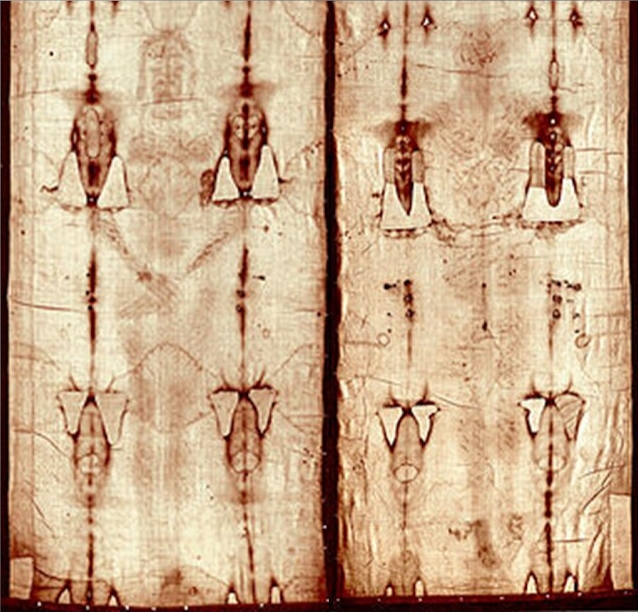
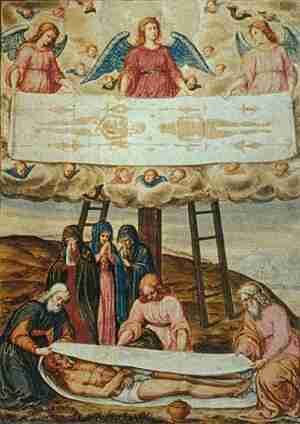 The Shroud of Turin is a large rectangular woven cloth, approximately 14 ft by 3.5 ft. It appears to show the front and rear images of a naked man and is alleged by some to be the burial cloth of Jesus Christ. It is owned by the Catholic Church and stored in the cathedral of St. John the Baptist in Turin, Italy, hence its name. It is rarely on display to the public. While some Christians vouch for its authenticity, many do not. Even the Vatican won't say it's authentic, which is in itself instructive.
 The Bible gives clear details of Jesus' burial cloth — linen strips and a separate cloth for the head — that clearly conflicts with the shroud, which is one large rectangular piece.
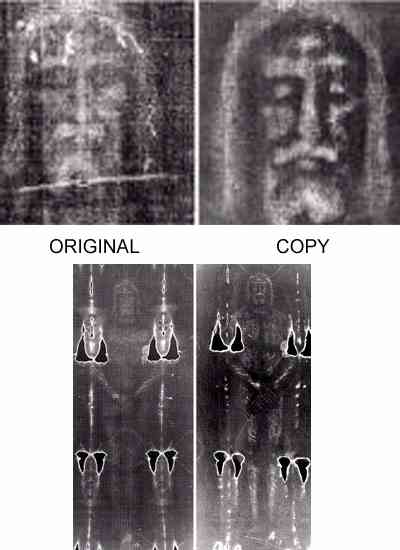
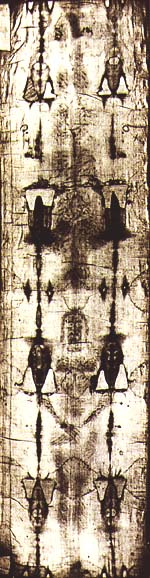 This question needs to be examined in two parts. First it's misleading in that it states "as fact" that there is a lot of detail regarding wounds and blood flow on the image that needs to be explained. I would debate this.
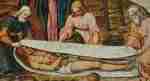 The clear implication of all three synoptics is that the material was bound tightly round the body, yet the Shroud of Turin shows an image made by simply lying a linen shroud on top of the front of the body, over the head and down the back.
 Joe Nickell demonstrated this using a bas-relief and the pigments and tools available in the Middle Ages (image on right). "After experimenting with various techniques, the Shroud artist prepared a suitable mixture of pigments and tempera binder, moulded a wet linen sheet over the bas-relief he had constructed, and used a dauber (also termed a pounce or tamper) to apply the mixture to the surface of the linen. Methods for creating similar images are known and these methods were widely known in the Middle Ages." The statement that we cannot make such an image is simply false propaganda. Faux-negative images are automatically produced by an artistic rubbing technique. The July 2005 issue of Science & Vie (Science and Life) magazine documents the making of a shroud by these medieval techniques. Also as noted above scientist Luigi Garlaschelli made a very convincing reproduction of the shroud in 2009.