|
Comments:
-
Comment by Charles, 27 May, 2006
The Turin Shroud a scam? Right. After 60+ peer-reviewed SCIENTIFIC papers it is still an authentic burial cloth with real human blood and matches every detail recorded in the Gospels. The C-14 test was truly a huge scam. The sampling was in gross error and was never a blind test. There is ample proof the cloth is far older than the 14th century.
You are in a tiny minority of angry-at-God scam artists. Joke Nichol has zero credentials yet since he is the only one alive willing to spew these lies people like you and the stupid press only talk to him. No one is buying this garbage. When they do REAL research they find out what silly fools you angry atheists make of yourselves. All the evidence is overwhelming. Why don't you try to duplicate the images on the shroud and let's see if you can fool the scientists from Los Alamos, Sandia, NASA, etc? They are so laughing at you strange people.
-
Comment by the 'Silly Beliefs' Team, 27 May, 2006
Sorry Charles, but with comments like "[the shroud] matches every detail recorded in the Gospels", you obviously haven't read our article or your Bible in any detail.
And you seem to be one of these religious people that can't grasp that atheists are not "angry-at-God". Are we also 'angry-at-Zeus' and 'angry-at-Shiva'? Can't you understand that atheists don't believe your god exists? It makes as much sense for us to be angry at your god as for us to be angry at leprechauns.
Get back to us if you can put together a more rational argument.
-
Comment by Ray, 27 May, 2006
Hi — I enjoyed reading your web page on the Shroud of Turin. I think you are wrong on too many
points to list in a short email. Let me just note that Ray Rogers did not use the vanillan test primarily to show that the shroud was old but that the material removed for the carbon dating was contaminated with more recent material. He did this in a couple of ways: 1) he found cotton which is uncharacteristic of the shroud more generally and so an anomolous material, 2) he found dyes on the cotton obviously intended to match the color of the surrounding linen fibers, 3) he found an end to end cotton to linen splice from material removed from the reserve sample that was part of the material removed for the carbon dating, and 4) he found that the material in the sample area tested positive for vanillan while the shroud in general does not test positive for vanillan. In addition there are a number of spectral pictures taken of the region which show that the sample site was anomolous. All in all it was unfortunate that the original protocol was not followed.
Much of what you said I agree with. However Joe Nickel is not a credible source for much of anything and the tabulation of measurements that suggest that the image is not anotomically correct fail to take into account the fact that the image was on a cloth that wrapped the body and the anomalies that you have mentioned have been examined and found to be correct for the case in question.
Dismissing someone because they believe the shroud is authentic is not a valid criticism. Your own criticism can be dismissed on the same grounds. The only serious ground is evidence. The carbon date has been discredited by a large variety of observations that show that the single sample was from an anomalous site. I might add that that was actually the only serious objection to shroud authenticity. There are quite a large number of scientific and historical reasons to support at least antiquity. I think you need to real all the literature on the shroud and apply critical reasoning. In particular the array of papers published in refereed journals contain the serious data on the shroud — not the Joe Nickel brand of debunking.
I might add that your web page gave the shroud science group an entertaining read.
-
Comment by the 'Silly Beliefs' Team, 28 May, 2006
Yes Ray, I agree that Ray Rogers' main purpose was to show that the carbon dating was performed on a patch and not the actual shroud. However, rightly or wrongly, the popular media tends to focus equally on the sample/patch debate and the revised shroud age he arrived at. Thus the layperson tends to remember the revised date rather than the debate about the fibres. As in the lecture I attended, this mistaken belief that Rogers' has overturned the carbon dating results surfaces. Also there is no independent evidence that the threads he tested came from the carbon dating sample, and since they have been destroyed they can never be compared. Likewise there is no rational explanation how simple medieval nuns could weave an invisible patch that textile experts and scientists with microscopes couldn't detect. No STURP member at the time of the carbon dating test is on record of complaining that the sample was taken from a patched area. Also the claimed differences between the "sample/patch" and the rest of the shroud is debated by others. If the "differences" are correct, perhaps the "sample/patch" is original shroud cloth and the other areas are the real patches? Supporters can't use the excuse 'We would notice if the other areas were patches' since they didn't notice the carbon dating area until it returned the wrong date. People can't just claim that those areas of the shroud that return appropriate data are authentic and those that don't must be patches.
You state that, "Dismissing someone because they believe the shroud is authentic is not a valid criticism." I agree entirely, although I don't believe I dismissed anyone in my essay solely on their belief that the shroud was authentic. The feature of my essay was Father Laisney and I dismissed his lecture solely on the inaccuracies he delivered. I did mention that Ray Rogers and most of STURP were believers, but only to inform that this bias must be taken into account. As you will be aware "double blind" scientific experiments are the best way to avoid intentional or unintentional manipulation of results. If possible bias exists and it can't be eliminated, then it needs to be acknowledged. If someone lectured you on the safety of cigarette smoking you would be annoyed if you later discovered he was a sales rep for a tobacco company. He may have believed what he said but I'm sure you would have preferred to have been informed of this association. Likewise scientists with religious convictions investigating religious icons need to disclose this, as would a scientist who was anti-religion.
I am an atheist but I believe I have reached this position because of critical thinking and not because of any backlash towards religion. I go where I believe the most reasonable answers lie. As per your suggestion I will try and "read all the literature on the shroud and apply critical reasoning".
-
Comment by Ray, 29 May, 2006
I replied before I read your response John — so I imagine that part of my response is something that you'd now agree with. The shroud is a very complex object and there has been a tremendous amount of study of the image, the blood stains, the fabric, the historical record and on-and-on. I think you do yourself a disservice if you don't read more widely about the work.
Barrie Schwortz's site is full of stuff worth looking at. There is also no shortage of material by the naysayers such as Walter McCrone, rest his soul. Of course to become "booked" on all this research and study is a lot of work — and there is no small amount of controversy and confrontation among both those who think the shroud likely to be authentic as well as those who think it a mediaeval production. The shroud presents many problems of interpretation.
The thing that I've found interesting is that most of the issues simplistically raised by the critics have ended up having relatively straightforward answers. It's quite a fascinating thing. I'm not sure if you are aware of a companion relic called the sudarium of Oviedo, or just cloth of Ovieda which is believed to be the cloth that wrapped Jesus's head when he was taken down from the cross. There are bloodstains on this cloth which has a documented provenance dating to before the 7th century that correlate with blood stains on the shroud — or so it is alledged. If that fact is established then it also shows the C14 date to be likely wrong and moves the date of any fabrication of the shroud back to the sixth or seventh century — or near the time of the alledged discovery of the Mandyllion in the city gates of Edessa and the time frame of the sudden coalescence of a standard iconography of Christ (circa sixth century). There are a good many mysteries — more than enough for a lifetime of study and few of us have the time.
-
Comment by Ray, 29 May, 2006
On the idea of being an atheist through the application of critical reasoning — I'm sorry but
that's an oxymoron. An atheist positively asserts the non-existence of God. That is a position impossible of proof and so cannot be the conclusion of critical reasoning. It may be plausible to assert that the evidence for the existence of God is insufficient to prove God's existence — however, just the fact that many plausibility arguments for the existence of God exist shows that it is not an unreasonable belief. Conversely to assert the non-existence of God is a dogmatic belief based on no evidence at all. I might question — if God does not exist, then why does
anything at all exist?
On the matter of invisible weaving I direct your attention to the work of Joe Marino and Sue Benford who actually substantiated the probability of invisible weaving by sending photographs of the weave in the sample area to experts without telling them it was the shroud and they identified subtle signs of invisible weaving. Ray Roger's sample was from the reserve piece that was part of the original sample cut from the shroud for the purpose of the dating. The assertion is not that some nuns did it but that experts did it. But of course there is no record and unless a critical
examination of the reserve sample that remains is allowed at some point, we'll not know for sure. What Rogers did however was show that anomolous cotton that had been intentionally tinted was in the reserve sample. The observation of cotton is consistent with the earlier observations of Raes — but no cotton was found by STURP on the rest of the shroud. They looked. There may be minute amounts of vanillin remaining on the shroud as you suggest. The power of the tests that Ray Rogers applied may not be sufficient to identify trace amounts. Indeed, the equation used to describe
the decay of vanillin is an exponential decay and such equations never predict "zero". But there is a huge difference between a lot of vanillin and almost no vanillin. That is the point. Contemporary linen or linen only a few hundred years old tests positive for vanillin while very old linen tests negative. The shroud tests negative while the C14 sample area tests positive. It's no contest. There's a clear problem. That discrepancy alone points to contamination. A point that was not raised is the high Chi-squared result of the C14 test samples. This also points to statistical problems with the site. All of these problems would have been avoided if the original protocol had been followed. In that case we would have been quarreling about the variation among the samples and not a single anomalous result. Whether or not "most of the STURP team" were believers is irrelevant. In fact a good number of them were not and those that remained represented a cross section of belief and were hardly fanatics. To date the STURP team has produced far and away the most technical papers published in referred journals while most of the naysayers have been on the professional sidelines throwing rocks and mostly rather unsubstantiated and speculative rocks. That's why I suggested a deeper reading of the shroud literature with a conscious effort to remove your own blinders. I don't know if the shroud is authentic, but both it and the scientists, historians, archeologists and others that have studied it and drawn conclusions different from
your own deserve better attention than you've given them.
-
Comment by the 'Silly Beliefs' Team, 29 May, 2006
Ray, I agree that many atheists — but not all — positively assert that gods don't exist. I'm one of them. However it is a religious myth to claim that atheists like myself say it is possible to prove gods don't exist. I agree that one can not absolutely "prove" that gods don't exist or equally — from your point of view — that God does exist. From a silly but legitimate perspective, you also can't "prove" that leprechauns or unicorns don't exist. However, like all scientific conclusions, it is perfectly rational to declare what you believe is true based on the best evidence available. Thus by using critical reasoning I have concluded that the best evidence indicates there are no gods, and never have been. No leprechauns or unicorns either.
You say that "to assert the non-existence of God is a dogmatic belief based on no evidence at all." That might have been true in 2000 BCE but the overwhelming evidence today from scientific fields like biology and genetics to cosmology and archaeology just scream a natural universe with the gods long relegated to superstition. It is the religious that are suffering from a lack of evidence in favour of their worldview.
Also if your logic was correct, and since you likewise can't "prove" God exists, you can't then have used critical reasoning to reach this conclusion otherwise this would also be an oxymoron. Do you hold your belief through faith alone? I prefer reason.
As for your question "if God does not exist, then why does anything at all exist?", it is much easier to explain the existence of the universe than of God. We only have to explain one thing — the universe, whereas you have to explain two things — the universe AND God. Every problem you have explaining the universe is only massively complicated by having to explain a god as well. You ask why does a universe exist at all? If we both agreed God existed, I would then ask — "Why does God exist at all?" "How did God create the universe?" "Why did God create the universe?" Rather than understand why the universe exists, all you have done is move the mystery back a step. You haven't solved anything at all.
-
Comment by Giulio, 31 May, 2006
I read a very detailed but not scientifically correct attack to the authenticity of the Turin Shroud. At the end it is written: "*Please note that much of the information contained in this essay is obviously not my original work, and has been sourced from numerous books and articles examining the controversy surrounding the Shroud of **Turin**." I write to you to inform that it exist some document probably neglected by your research that must be read before to arrive to such conclusions. If you want, I can help you in indicating some scientific text. I have written above "not scientifically correct attack" for many reasons but perhaps the most important is the following. As the body image is not up to now scientifically/technically reproducible, who is the middle-age artist that was able to make it? And why up to now it is not possible to reproduce it? On the other hand, if you know someone that is able to reproduce the Shroud body image with ALL the peculiar characteristics detected by many scientists (please see for example http://www.shroud.com/pdfs/doclist.pdf) please indicate it to me and send me a sample of this results; up to now I have studied many hypothetical "reproductions" but none of them were compliant with all the Shroud characteristics.
-
Comment by the 'Silly Beliefs' Team, 31 May, 2006
Thanks Giulio. I have downloaded the file you recommended (http://www.shroud.com/pdfs/doclist.pdf), plus a number of others from that site that I hadn't read before. I will study them further in the near future. It certainly is impressive the amount of scientific study that is still going on regarding the Shroud. In New Zealand debate or discussion surrounding the Shroud is almost non-existent.
You state in defence of the Shroud that: "perhaps the most important [reason] is the following: As the body image is not up to now scientifically/technically reproducible, who is the middle-age artist that was able to make it? And why up to now it is not possible to reproduce it?"
To me this is nothing more than the old claim "If we don't understand how something works or how it was made, then it must be attributed to a supernatural cause." As you will be aware, an enormous number of things throughout history, from lightning and earthquakes to human reproduction were attributed to God because Man couldn't understand how they worked, but no longer. Even if science and technology can't explain or reproduce the Shroud today, that doesn't mean it won't be able to in the future.
And no, I don't know of anyone able to make a duplicate of the Shroud. But then a decade or so ago I didn't know of anyone that could make clones of adult mammals either (ie Dolly the sheep). Good luck on your continuing research.
-
Comment by Giulio, 31 May, 2006
John, thank you for your answer and for the wishes. I agree with you, the fact that the body image up to now is not reproducible it does not directly imply that it was made by God or some other supernatural cause, but it is a strong fact against the hypothesis of a middle-age artist who certainly should have had much more technical means than we have now. You can suppose for example that it was made in that age by an extraterrestrial source but not by an human artist. I think that this is a sufficient basis to state that this is an open issue, without a reliable answer, that must be studied more in depth. You have collected an interesting list of 41 facts apparently against the Shroud authenticity, but many of them have a clear answer from the opposite point of view and some of them make reference to old scientific points that have been clearly explained with newer studies. You can find some papers on the subject in my site
(http://www.dim.unipd.it/misure/fanti/fanti-ital.html), but if I had time in the future I would answer to them point by point because I think interesting such a scientific comparison at Internet level.
-
Comment by Teresa, 24 Jan, 2007
Hello, my name is Teresa [bleep]. I am currently a senior at [bleep] High School in [bleep], Wisconsin.
I am doing my senior thesis on the Shroud of Turin. To complete my paper I must interview someone who believes the Shroud is the burial cloth of Jesus and I must also interview someone who does not believe the Shroud is the burial cloth of Jesus. I would like to present both sides of the debate. I am having a very hard time finding someone who DOES NOT believe that Shroud is the burial cloth of Jesus. I was hoping I could possibly interview you. The interview is only twelve questions and your answers can be as long or as short as you want. I can email you the questions and you can email me your responses as well. I know you must be busy, but I would truly appreciate if you could take the time to answer my questions. If not, do you know anyone who I could interview? Please let me know if this is at all possible. Thank you for your time.
-
Comment by the 'Silly Beliefs' Team, 25 Jan, 2007
Hi Teresa, I would be happy to help you with your thesis on the Shroud of Turin. It sounds fascinating.
You are correct in that I do not believe the Shroud is the burial cloth of Jesus, so I guess I qualify as one side of the debate. You may not be aware of the fact, but I live in New Zealand, and initially I was a little surprised that you were having trouble finding someone that would deny the Shroud's authenticity. We are not as religious a country as the US, in fact our 2006 census showed 'no religion' for 31% of the population. However on further thought I believe that even here most people would probably still hedge their bets and say that, although they know little about it, they've heard it is genuine. I know I would have trouble locating people that thought it was a fake and believed they could support that conclusion. And that second part is the important bit. Anyone can say they believe or don't believe a certain proposition, but do they have good reasons for their stand. I've had many discussions with friends and acquaintances over belief in such diverse things as ghosts and aliens to ESP and religion. Most say they believe in what ever the topic is, but further discussion shows that they know almost nothing about their belief. The knowledge that they base their belief on is superficial, sometimes false and sometimes simply based on a Hollywood movie, yet they still believe and argue that they're right.
Please email us your questions and we will do our best to answer them.
-
Comment by Teresa, 25 Jan, 2007
Thank you so much for responding to my request. I am so relieved that someone finally did!
-
Comment by Teresa, 08 Feb, 2007
Hello, thanks for completing my questions. I was so happy to see how much time you obviously put into the interview. Thank you so much! I would be glad to show you the other interview. As soon as I finish it and get it all typed up I will send it to you. To be honest I chose this topic because I wanted to do something really easy and just be able to pass it in quick and forget about it. It has turned out to be much harder than i ever thought it could be. I have talked to so many qualified people on both sides of the argument. I wish I could just turn the paper in with an "I don't know." :) As of right now, I am torn in the middle as far as my position goes. I just keep reading books from both sides and hopefully soon I will be able to make a conclusion that makes some sense. Thanks again for your time!
-
Comment by Phil, 28 Dec, 2007
Might be of interest — http://www.shroudstory.com/art.htm
-
Comment by Ray, 03 Jan, 2008
Hi John — I just read your piece on the Shroud of Turin. I really think that you did a nice job of showing some of the errors that Fr. Laisney committed, but I also think that you were biased in your anti-shroud authenticity discussion. There are problems with the statistics of the C14 sample which ought to have signalled to the researchers that the samples were inhomogeneous. That itself is disturbing since they ought not to have been dismissed as they evidently were. The dating of the samples appears to have a linear gradient which suggests the presence of anomalous material. The invisible weaving theory has not been shown to be wrong and Rogers found a thread in a sample from the reserve that had been spliced with dyed cotton. Rogers was not trying to date the shroud using his vanillin test. The date cited is a very wide range because the quantity of vanillin present is strongly influenced by the storage temperature of the shroud which is unknown. But it is known that the shroud went through a fire in 1532 capable of melting the silver reliquary in whcih it was stored. So the presence of vanillin in the sample area suggests intrusives. Only material from the C14 test area tests positive for vanillin. That was Rogers' actual point.
Your claim that the C14 scientists had no religious biases is simply untrue. They have expressed religious biases, at least some of them. I might add that simply being religious or having an opinion about the shroud is not bias — it is pure Bulverism to suggest that professional scientists are letting their religious views dictate the outcome of their tests and the like. It is also an argument that cuts both ways.
This is as true of both the C14 researchers and Rogers and STURP. A number of the STURP researchers were Jews who hardly have a pro-Christian bias and at least some were pretty secular. They were almost all professional scientists. So I think dismissing their findings if you don't agree with them as due to bias is itself an act of bias.
The idea that there were lots of shrouds is as far as I can tell largely itself false. There were lots of painted copies of the shroud of Turin, some acknowledged as such and some not. You can still find them all over Europe. The d'Arcis Memorcandum appears to have been based on one such copy, probably at Besancon which was destroyed by a committee of the French Revolution. This is likely the shroud that the memorandum referred to. Dan Scavone, a historian who has studied that aspect of the shroud history believes that the copy was made to conceal from the general populous that the shroud which belonged to nobles and not the church, had been transferred. Since I am not a historian I can't actually say just how likely it is. However, the fact that the shroud does not have any pigment on it except tiny quantities in the microgram range detected by Walter McCrone, shows that it isn't a painting. Under high power magnification there is simply no pigment and no signs of a pervasive binder which would be necessary if it were painted.
I think you account is at least as biased as Fr. Laisney's — you need to do more homework. I did enjoy reading what you wrote however.
I actually stumbled upon your site when I was looking for references on the d'Arcis Memorandum because someone said that there was evidence it was forged. I didn't find that evidence and in any case it would contradict the historical case that Scavone has erected, but I dd happen upon your account. I might add that my interest in the shroud is primarily due to wanting to understand the image mechanism. The radiation theories are only held by a minority of shroud researchers.
Rogers, for example, was researching a far more complicated and far less "miraculous" imaging model when he died. I was in correspondence with him at that time hoping to find some model systems that could be used to test his theories. If you want to explore a really bizarre theory of shroud image formation you need to look at Dr. John Jackson's dematerializing body theory. Jackson has been driven to that by the fact that none of the theories advanced even begin to do an adequate job of explaining the known features of the image. Short facile and dismissive accounts don't begin to do justice to the problem.
-
Comment by Mario, 12 Jan, 2009
Hi John, I read your article about Father Laisney's lecture on the Shroud (2005). On this matter you debate at length that his statement that a conspiracy of the labs would have taken place is wrong. I did not attend his presentation, so I cannot analyze this. (By the way, I recently attended an atheist presentation of the Shroud. I can actually make the same remarks: many statements are made that are incorrect, false, distorted, etc. You can read this here at www.sindonology.org. To get everything right is a difficult task.)
You state that the conclusion of the Nature article is very clear. I quote: "There is no confusion, no debate, no controversy, no conspiracy". But you seem to base this solely on reading the Nature paper. On what else? Of course, the paper does not do a debate or talk about a controversy.
Have you consulted the book written by Harry E. Gove "Relic, Icon or Hoax? Carbon Dating the Turin Shroud". Harry Gove is the co-inventor of the AMS carbon dating technique. You would see quite a different picture than "no debate", "no controversy" and even "no conspiracy". And Gove certainly does not show sympathy for the authenticity of the Shroud.
You point out that the Vanillin test done by Raymond Rogers is not as accurate as the radio carbon dating. I think this is obvious. I do not think any serious researchers would argue for the opposite. Some pro-authenticity researchers pointed this out explicitly.
You mentioned several reasons why the Shroud is a fake. In particular, you cite the July 2005 issue of Science et Vie. Have you read it? I did. This article is one of these popular presentations that pretend that it is easy to create a reproduction of the Shroud of Turin. Of course, you can show on some nice looking photos, something that look somehow similar to the Shroud (and even in this case I think that what Science et Vie presents is far from looking like the Shroud.) Water looks like vinegar, it is not the same based on chemical analysis. Likewise, for the Shroud, the physical details at microscopic level is quite different than these "copies". This is a very important aspect to consider. These articles do not do such studies. They are made for the masses.
For point 13 of your article, I point out a study I did. The paper can be accessed here. It shows that the no major distortion would occur when the image formed assuming that the cloth is not tightly wrapping the body.
Point 14 makes many claims about length, distortions, etc. Have you looked closely to what you reported? I think that all these measurements are randomly selected. Many others were done, and differ from what you reported.
You also mentioned the work of Walter McCrone. Have you read his book or his papers supposedly demonstrating that the Shroud is a painting? In particular, where does McCrone mention the amount of "paint" he finds on the Shroud? As far as I know, he never does. It is only a qualitative measurement with no data about the amount of these putative "pigments" he finds. His book on the subject is very confusing, I invite you to try to back what he claimed. And can you combine the result of McCrone who steadfastly claims that the Shroud was painted with a brush, and the claim that you make that it was probably made using a bas-relief? And if you look at the images you display on your website, which ones appear more life like?
Your comment 4 in the comments state: "Likewise there is no rational explanation how simple medieval nuns could weave an invisible patch that textile experts and scientists with microscopes couldn't detect." The medieval nuns are not attributed the invisible weaving. They actually patched the Shroud in 1534. (These patches were removed in 2002) As for "scientists with microscopes couldn't detect", I would like to know who did such a study.
I think that a careful study of the Shroud takes time. It is not clear that the Shroud is a fake.
-
Comment by the 'Silly Beliefs' Team, 02 Feb, 2009
Mario, the way I see it, there is only one reason that some people think the shroud might be the burial cloth of Jesus, and that's the stories in the Bible. If it weren't for the Bible this cloth would be a mere curiosity for everyone, not just skeptics. But importantly, if the shroud is really the burial cloth of Jesus, then the Bible is wrong, since its description of the cloth used to wrap Jesus doesn't in any way match the shroud. An authentic shroud means a false Bible. But if the Bible is false, then there was no Jesus in the first place that needed a burial cloth. Again I say, no matter how many scientific tests you discredit or place doubt on, such as whether image distortions would occur on wrapping a body or whether there was paint on the cloth, the most crucial source of dissent that you must discredit or throw doubt on is the Bible itself. But of course if you succeed in showing the Bible to be wrong, then Jesus disappears in a puff of fiction as does his burial cloth. I could accept that maybe the scientific tests carried out so far are flawed, that maybe the shroud was used to wrap a crucified man in 1st century Palestine, that maybe something strange happened to the body — perhaps aliens beamed it aboard their spacecraft — but I can't accept that the burial cloths described in the Bible and the Shroud of Turin are one and the same thing. Throwing doubt on the tests performed on the shroud may continue to keep its origin a mystery, but it in no way reconciles the shroud with the Gospels. Christians need to make a choice, believe in the shroud or believe in the Bible.
-
Comment by Keri, 09 May, 2009
This is the site I now direct my lovely but deluded traditional Roman Catholic friends to — well done John!
-
Comment by Anonymous-1, 16 Jun, 2009
Hey wise one, this stupid christian claims to have found proof for theshroud ofturn [Shroud of Turin?], schek out how stupid this idiots "proov" is: http://djknight.livejournal.com/15592.html. god he's such a dumb faggit
-
Comment by the 'Silly Beliefs' Team, 18 Jun, 2009
You're right, this Daniel J Knight is certainly not all that bright, although I think calling him 'stupid' and 'dumb' is an insult to the truly low IQ people in society. It's like accusing him of being as 'dumb as a chicken' would be unfairly dragging chickens down to his level of intelligence.
You'll note that while he quotes from our Shroud of Turin article, and pretends to debunk it, nowhere does he mention where he got those quotes. He never names our website or provides a link to it so that his readers can make up their own mind. Other articles of his contain links to other sites so it's not as if he doesn't now how to do this. Thus we can only assume he is afraid to point readers to our site. Also, all the quotes Knight attacks are gleaned from the two opening paragraphs in our article. Even though it appears that he read no further than this, he can't even construct a coherent argument against our introduction to the debate.
Rather than clearly identifying us, he simply labels us as the "Blind Biased Hypocrite Snake Father Bitter Atheist". Even more dishonest, he invents quotes from us merely so he can then criticise them. Of course if he linked his readers to our website, then they would realise that he was lying, thus no link.
His irrational, hateful rant is extremely poorly written, disjointed, clearly delusional and makes no argument for the authenticity of the shroud. It is just one long childish insult from a fearful fundamentalist. Apart from his insults, which make up the majority of his article, he often contradicts himself and makes numerous errors of fact. Even simple facts are beyond him it seems, like erroneously claiming that Star Trek's Gene Roddenbury invented the concept of teleportation. In addition to his reliance on insults, his poor grasp of grammar, spelling and his inability to construct a coherent argument makes one suspect that he might be quite young and immature, maybe only 10 to 12 years old. His repeated scenario of raping Christian kids in front of their parents and then murdering their parents — a fantasy or 'desire' he mentions five times in his article — would suggest he needs serious psychological help. This repeated image of raping kids and murdering their parents might suggest a disturbed pre-teen having sick erotic fantasies, although it might also be a sign of a Christian child that has been repeatedly raped by his father as he was growing up. The horrors of his own life continually surface in his childish rants. He obviously thinks that this rape fantasy of his is something that's common. Maybe being part of an American fundamentalist Christian family he knows something that we atheists don't, that rape of Christian children is common in these fundamentalist societies? And that these raped children consequently wish they could murder their parents?
The really scary thing is, this guy lives in the US with their easy access to all manner of weapons, so I wonder how long it is before he shifts from directing his venom at the internet and targets his innocent neighbours? If I get some time and I'm really, really bored, I'll leave a comment on his page, although to be honest arguing with him would be little different to debating with a seriously disturbed child or tormenting a pit bull terrier on a leash.
-
Comment by Maria, 09 Aug, 2009
Hi Silly Beliefs Team.
I'm a Portuguese Shroud researcher and I found your article by chance while looking for more Shroud stuff in the web.
I have to congratulate your work on this subject because it's really amazing how you gathered so much information and made a systematic approach trying to prove the Shroud being a fake. It is really a masterpiece of mixing some true facts with lots of misleading information and lies. It's truly the best of such kind of articles I've ever read. If I had not been researching on this subject for a longtime I'd be easily convinced the Shroud was a hoax. It is really quite good stuff to study all skeptical standpoint and make a systematical rebuttal to their claims.
Your article has been honoured by the comments of three well named scientists and Shroud researchers whose papers on the Image I read with much interest. I mean professors Giulio Fanti, Mario Latendresse and I guess Ray is Professor Ray Shneider (Mathematics and Computer Sciences). Why would these scientists and many others be interested in studying such a relic? The answer is quite simple, the Shroud of Turin deserves a special status among all the so called relics because it is a challenge for science.
I really did hesitate before writing this comment but I will go on because I'm convinced that although you are atheist you are honest and believe the information you got leads to the conclusion the Shroud is a forgery and not simply because it is just a way to attack christian beliefs and try to demolish an alleged material evidence for their faith.
I had the will to answer the so many inaccuracies and misleading statements contained in your article but it would be a much too long comment so I'll try to summarize and not repeating what those scientists stated.
1 — When you say «the cloth is incompatible with New Testament accounts on Jesus burial» that is not true because Matthew Luke and Mark mention a single cloth bought by Joseph of Arimathea which covered Jesus body and the Greek word in John's gospel was incorrectly translated.
It is debatable that no burial spices were found on the cloth and natron traces were found.
Accordingly to textile experts 3.1 herringbone twill and stitches of the cloth are indeed characteristic of first century.
When you mention «the Shroud has no known history prior to the mid-fourteenth century», that is simply misleading. What you should say is that the Shroud was shown for the first time in western Europe in mid-fourteenth century but it was well known in Byzantine Empire long before.
It is a well known historical fact that the Cloth of Edessa after being hidden for centuries was rediscovered in 544 and the army of the Byzantine emperor Romanus Lecapenus retrieved it and was brought to Constantinople in August 15th 944 and was spoken a sermon by Archedeacon Gregorius Referendarius which when translated by historians leaves no doubt that the Cloth of Edessa depicted not only a face but a complete body image.
You neglected other historical clues as Codex Vossianus Latinus and the writings about the Shroud of Christ in Constantinople such the French knight Robert de Clari and Theodorus Angellus just to mention a few.
2 — When you mentioned that pollens from Palestine were a fraud that is preposterous because Jewish botanist experts (Professors Avinoam Danim and Uri Baruk) confirmed Dr Max Frei's findings and added new pollen species.
You accused swiss criminologist Max Frei to be wrong when declaring Hitler Diaries as genuine but you don't tell the whole story. Dr. Max Frei and American expert Oroway Hilton were given several photocopied pages of the diaries and were asked to compare them with other samples of alleged Hitler's handwritings which matched, but that happened because both were (as experts concluded later) forgeries elaborated by the same forger, and by the way, why don't you mention Mccrone's wrong statement about Vinland Map?
3 — Shroud debunkers contradict each other. Each has a theory how a medieval forger produced the image some like Lynn Picknett and Clive Prince and Nicholas Allen claim the Shroud is a kind of negative protophotograph others like Chritopher Knight an Robert Lomas claim that Shroud's image was produced by the sweat an blood of a Master Templar, Joe Nickell states it was produced using a bas relief covered with a cloth and iron oxide and sulphuric acid but microscopist Walter Mccrone claimed the Shroud was a painting, but in 2005 the Shadow Shroud theory emerged so which of them fits ALL chemical physical and optical characteristics of Shroud Image?
The answer is short NONE.
Even when you mentioned Science et Vie experiment trying to reproduce the face of the Man of the Shroud (number 1054 July 2005) that's just junk science. If you want to learn read Christophe Mignot's (Engineer and 3D image analysis expert who is not a Shroud researcher) work who concluded that comparing Joe Nickell's, Science et Vie's and Shroud image the only one with true and full 3D encoding is the Face of the Shroud, just go to www.suaire-science.com.
Everyone knows the chemistry of Shroud image and it is definitely not a painting and the red or brown stains are not a mixture of red ocher and vermillion in a collagen temper as Mccrone claimed but they are true denatured old human blood. It is now a well known fact that Professor Raymond Rogers was right and radiocarbon sample was taken from a rewoven area of the Shroud where cotton fibers and spliced threads were also found as stated by physicist Robert Villareal in Ohio Shroud Conference 2008 (go to www.ohioshroudconference.com).
So there is no true radiocarbon dating of the fabric.
These are some hard facts not speculations. Till now science could not disauthenticate the Shroud, but of course there is not a scientific test to «prove» it is the cloth that covered Jesus body. But after analysing all the reliable historical and scientific data and through the application of critical thinking the only logical conclusion is that the Shroud of Turin is authentic and bears the image of Jesus Christ.
best regards
Maria da Glória Gonçalves Barroso
CENTRO PORTUGUÊS DE SINDONOLOGIA
-
Comment by the 'Silly Beliefs' Team, 12 Aug, 2009
Hi Maria, thanks for your comments. I'm slowly working my way through the papers from the shroud conference you mentioned. However I'm sure you won't be surprised to learn that none of the points that you raised or what I've read in those papers have caused me to change camps. Let me explain some problems I have with some of your points.
Regarding the description of the shroud in John's Gospel, you state that description of the linen being in strips was due to a word being mistranslated. I hadn't heard that before, but I'm certainly open to the view that much in the Bible has been mistranslated. For example, many Biblical scholars now believe that the word 'virgin' in relation to Mary, mother of Jesus, was mistranslated. Rather than 'virgin', it really meant 'young woman'.
If we look at John's Gospel, Jn 19:40 says "Taking Jesus' body, the two of them wrapped it, with the spices, in strips of linen." It's plausible that the word for "strips of linen" might have been mistranslated. However if we then look at JN 20:5~7, this says, "He bent over and looked in at the strips of linen lying there but did not go in. Then Simon Peter, who was behind him, arrived and went into the tomb. He saw the strips of linen lying there, as well as the burial cloth that had been around Jesus' head. The cloth was folded up by itself, separate from the linen." In this passage, mistranslating 'linen' into 'strips of linen' can not explain the claim that whether the linen was in one piece or in strips, there was a separate cloth around the head, separate from the body cloth. To explain this passage, not only must the word for 'strips of linen' be mistranslated, the lengthy description of the separate face cloth must be utterly bogus.
Also remember that Luke's gospel also mentions 'strips of linen' (LK 24:12), not just John.
However, this translation argument seems to be stating that we can believe what the gospels say about Jesus because some of the bits about Jesus are wrong due to mistranslation. I'm sorry, but I don't follow this logic. Any demonstration that what the Gospel's tell us is wrong in places only serves to reduce my confidence in the entire Bible. If the Bible was simply an ancient document written by some Greek philosopher or Sumerian king, then I could easily accept that our understanding of it might change as translations improve, but the Bible is supposed to be a supernatural being's message to mankind. While the Greek philosopher or Sumerian king has no knowledge or control over how we might interpret their writings, God does. God supposedly goes to great lengths to communicate his wishes to us, often involving great loss of life, and yet he seems to have no interest in correcting errors in his holy book, our only real source of information about him. Modern authors often go to great lengths to correct errors in their books, issuing reprints and corrections, even using the media to highlight mistakes. Why can't God? Each time scholars show another passage in the Bible to be incorrect, and worse still, when even believers accept that their Bible is wrong in yet another claim, it just reinforces my view that primitive man wrote this book, not an all-knowing, all-powerful god. The more the Bible becomes the error-ridden work of man, the more reasons we have to doubt the supernatural stories it contains. Improved translations of the Bible might bring us closer to the original document, but each change takes us further from the belief that a god wrote or inspired it. It's like a lawyer telling a jury that the more his client is forced to change his story, the more you can believe in his honesty.
You say that 'It is debatable that no burial spices were found on the cloth'. But both the gospels of Mark and Luke state that Joseph merely wrapped the body, and that the women had prepared spices for the body and were going to apply them when they noticed the body missing. Yet John's gospel states that Joseph not only wrapped the body, he added spices. In John's gospel there is no mention of the women preparing spices, obviously since it had already been done. So according to John's account the shroud should have traces of spices, but according to Mark and Luke, there should be no trace of spices. So whether spices are found or not, a passage in the Bible will support either stance. This blatant contradiction means that any argument regarding spices can not be resolved or used for support.
I accept that many shroud supporters believe that the Cloth of Edessa was actually the Shroud of Turin, but this claim only works if they reject the historical references to it while Jesus was still alive, and only highlight mention of it after he died. They must also explain why most people didn't know or else didn't care that the cloth contained a full body image and not just the face.
Regarding the pollen supposedly found on the shroud, when you say that Jewish botanist experts confirmed Dr Max Frei's findings, did they independently recover the same 57 pollens from the shroud or did they merely confirm that the pollen samples he had were from Palestine? And why so much pollen, I thought Jesus was placed in sealed tomb, not laid out in the fields? And how did they explain the pollen from insect-pollinated plants? And it's not just pollen, on reading one of the conference papers you mentioned, it states that 'hundreds of plant images have so far been discovered on the Shroud of Turin'. The author states that 'I cannot evaluate the reasons for putting these flowers on the head area'. Were these images caused by the same thing that caused the body image, meaning that they were placed on the body prior to the resurrection? The Bible doesn't mention flower-bearing crowds visiting the tomb. Nor does the Bible or historical records mention mourning crowds laying flowers on the burial cloth of Jesus after his resurrection. The above author also claims that the image of a cord can also be seen on the shroud. He states that 'this cord was used to bind the Man of the Shroud to the Cross'. Are we to believe that Joseph of Arimathea couldn't be bothered to remove the rope from the body or that he tossed it on top of the burial cloth? Does Jewish custom dictate that victims must be buried with the implements that killed them?
You say that I don't tell the full story about Max Frei and his failure to detect the 'Hitler Diaries' forgery, then neither do you. While it seems that during the initial analysis 'at least one of the documents the handwriting experts relied on was itself a Kujau forgery', some or most of the other documents retrieved from Germany's Federal Archives and used for analysis were genuine. As for your mention of 'McCrone's wrong statement about the Vinland Map', perhaps you should read this Wikipedia entry on it, which starts with 'The Vinland map is a 20th century imitation of a 15th century [map]'. A page on this pro-shroud site entitled 'Yale says Vinland map is authentic', states that 'McCrone concluded that the ink contained a significant amount of titanium anatase in it'. They then go on to show that McCrone was wrong because 'Dr Thomas Cahill... analyzed the map and the ink using a new process called PIXE or Particle Induced X-ray Emission tests. The results were startling because Cahill found only a minute presence of titanium anatase...'. However they need to update their site with the following from the Wikipedia site: 'Because they were the first to apply PIXE to ink analysis, nobody at the time could explain the difference between the Cahill and McCrone figures, but the accumulation of large amounts of PIXE data from other laboratories around the world in the ensuing decades was sufficient by 2008 to show that the Cahill figures for all elements in the inks of the Map and its companion documents are at least a thousand times too small, so the discrepancy is due to their [Cahill's] mistake. The McCrone team had also made mistakes, though none as fundamental as Cahill's.'
As for Yale University still believing the map is authentic, Robert Babcock, curator of early manuscripts at Yale's Beinecke Library, has stated, 'Although the Vinland Map continues to have supporters as well as detractors, there is increasing scientific evidence suggesting it is a 20th-century production'.
I agree that some 'Shroud debunkers contradict each other' as to how the image might have been produced. But let's remember that shroud supporters also have multiple theories on how the image formed. The fact is that no one on either side of the debate has been able to prove their particular theory. However being unable to convincingly explain — at present anyway — how the image was made, does not mean we need to shift support to a supernatural origin. There have been a million and one things that man throughout history couldn't explain, and many claimed we never would, but much of what used to be attributed to gods has now been explained. If it's likely that man made the shroud, we may never discover exactly how he did it. But I think we must agree that we are never likely to get a supernatural explanation. If it happened as supporters believe, we will never know how it happened exactly. Jesus has had 2000 years to give us a hint as to how the shroud formed, and he hasn't bothered. The only explanation we can ever hope for is a scientific one. If shroud supporters are correct, then we will have to be content with mystery rather than explanation.
You claim that 'It is now a well known fact that Professor Raymond Rogers was right and radiocarbon sample was taken from a rewoven area of the Shroud... So there is no true radiocarbon dating of the fabric'. I'm sorry, but it is neither well known nor a fact. If it was, then the world would have dismissed the carbon dating result and both public and scientific opinion would have reverted to the old belief that the shroud was probably genuine.
The conference papers mention this patch controversy. Look at the following two statements from shroud 'experts':
'although the Shroud visually appears to be one whole cloth and shows no obvious seams, we will analyze evidence... that show that 16th century weavers, were, in fact, capable of producing an "invisible reweave" '. (Joseph Marino and M. Sue Benford)
Yet chemist Alan Adler, a member of the STURP team, states that regarding the C14 sample, 'That's an area which has obviously been repaired. There's cloth missing there. It's been rewoven on the edge. They even cut part of it off, because it was obviously rewoven on the edge'.
Two experts argue that a patch was erroneously tested because it was invisible and not obvious, yet another argues that the test was flawed because it was so obviously a patch. Both are shroud supporters but they contradict each other. At least one must be wrong. Another conference paper told us that 'The Shroud of Turin Research Project (STURP),... had studied the most intensely-studied artifact in human history for five days in 1978'. So why didn't they object when an obvious patch was selected as the test sample? The above chemist who claims the patch was obvious was a member of STURP. We're also told that 'the Cardinal of Turin's scientific advisor, Piero Savarino,... acknowledged that repairs had been done routinely on the Shroud throughout its history and that if the sample had been taken from such an area "the carbon-dating results would not be reliable" '. Thus the Catholic Church knew that the shroud had been repaired and did contain patches, so they would be extremely careful not to test anything that remotely resembled a patch. Shroud supporters were perfectly happy with the site of the test sample until it returned the 'wrong' date. I'm sure many carbon dating labs would be perfectly happy to test further samples. Unfortunately, since shroud supporters now insist that the shroud contains many invisible patches, they could never be confident that another patch wasn't being tested. Even if a future test of another sample returned a 1st century date, they must, to be consistent, agree that it might just be a patch that used old 1st century linen, rather than a piece of the original medieval shroud. If the shroud is a patchwork of old and new, they can never know when they're testing a piece of the original.
Regarding these patches, one paper states, 'According to Mr. Ehrlich, French Weaving, one type of invisible reweaving, now only done on small imperfections due to its extensive cost and time, results in both front and back side "invisibility"... the technique used in sixteenth century Europe called "French weaving" is..., indeed, invisible. Sixteenth century owners of the Shroud certainly had enough material resources and weeks of time at their disposal to accomplish the task'.
We're expected to believe that centuries ago people had the wealth, time and desire to repair damage to the shroud, but not anymore. So even though we can still perform invisible weaving, seemingly because of the cost and time involved it is little used. The Catholic Church is obscenely wealthy, yet we're expected to believe that the shroud is in its present state of disrepair because they couldn't afford to repair the shroud or weren't prepared to wait for the weeks it might take? In the past they went to such lengths to repair the shroud that evidently modern scientists with microscopes can't agree on where the patches are, yet while they were making their invisible repairs, it never occurred to them to repair the burn marks on the shroud from the 1532 fire. Why not?
I'm always a little suspicious of the conclusions that conferences that exist on the fringe arrive at. For example, most speakers at UFO conferences believe UFO and aliens exist, likewise, speakers at cryptozoology conferences usually believe in the likes of Big Foot and the Loch Ness monster. Yet these conferences are contrary to what mainstream scientists believe, and while the conference attendees may be in complete agreement with each other, they are out of step with the majority of experts in their field. I accept that this doesn't mean that they are wrong, but if they can't convince other experts, it means little for them to convince a layperson. If they can convince you or me, it is most likely because we don't have the expertise to see the flaws in their argument that real experts can. I won't be convinced of arguments from shroud scientists until they can also convince their associates. Remember that we are expected to believe that not only are mainstream scientists wrong, but mainstream historians are also wrong, and mainstream Biblical scholars are wrong too. It would take a massive conspiracy to get all these experts to agree to falsify their view. While some might say that atheistic scientists and historians want to hide the truth, why would theologians, Bible scholars and many Christians want to deny the truth? Why is even the Catholic Church unwilling to say the shroud is authentic?
In closing I want to quote a passage from one of the shroud conference papers entitled 'Advancing the Shroud into the 21st Century'.
'I am not particularly interested in old linen cloths. I have little interest in other ancient artifacts or alleged relics either... [The shroud] is potentially the most important artifact on the planet. Its importance is derived from the message... that the very Son of God came to earth in the form of a man and humbled himself to dying on a cross in our place but then rose from the grave defeating the power of sin and death. And he offers the same victory for all who believe. What a message! Can there be a better message?... The unifying statement that defines my interest in the Shroud is [that]... it potentially confirms the message of God's love.'
Does this sound like the attitude of an objective scientist or investigator, someone searching for the truth of the matter wherever it might lie, or someone that has an agenda? I suspect that this is why many won't accept the widely accepted view of the shroud, their strong religious beliefs are influencing their objectivity. They are desperate for evidence of their god, and cling to a mystery. I'm glad that you accept that even though my friends and I are atheists, our view of the shroud controversy is based solely on an honest appraisal of the evidence, and is not motivated by animosity towards Christians. Can you say the same about all shroud supporters, that they are honestly appraising the evidence and are not motivated by a need to find evidence to support their faith?
You finished by stating that 'after analysing all the reliable historical and scientific data and through the application of critical thinking the only logical conclusion is that the Shroud of Turin is authentic and bears the image of Jesus Christ'. I agree with your method, but strangely enough I come to the opposite conclusion. If I were a shroud supporter, I would wonder why God, or even the Catholic Church, wasn't coming to my assistance with some evidence that no one could argue with. Perhaps God doesn't want his followers worshipping a piece of cloth, even if it is genuine? You know, false idols and all that sort of thing.
-
Comment by Maria, 23 Aug, 2009
Hi Silly Beliefs team. Thank you for answering my comment. It was really a quite long one and it took me a long time to analyse it in full detail, but it was quite useful for going deeper into some subjects, namely the Vinland Map.
I have to recognize you are very skilled in dealing with rhetoric always trying to make your standpoints to prevail no matter contradicting established facts. As I'm not so skilled and I'm writing in a foreign language I'll summarize my comment focusing only on what really matters for making myself clear and refute some statements which I utterly disagree. I'll try not to get into religious subjects like God's existence or not as you are always doing.
New Testament accounts on the death and burial of Jesus Christ do not contradict the Shroud, as I stated. In John's gospel account 19:40 he uses the Greek word 'othonia', which does not mean strips but cloth or clothes, so strips was a mistranslation of the original. The body of Jesus would have been wrapped in a long sheet — the Shroud — and perhaps tied with strips at the neck hands and feet. Wrapping with strips was not a Jewish burial custom but an Egyptian one, just recall mummies. Mark, Matthew and Luke are even more precise using the Greek word 'sindon' which means burial cloth or Shroud, 'And taking the body Joseph wrapped it in a clean linen cloth', Matthew 27:59, 'And he took it down and wrapped it in a cloth', Luke 23:53, 'And he bought a cloth and taking Him down, wrapped Him in fine linen', Mark 15:46. So it is not accurate to state that Luke's gospel mention strips as you did.
The question of burial spices being or not placed on the cloth is irrelevant in gospel accounts because they are in agreement in the most important issue, I mean the sufferings crucifixion death on the cross and burial of Jesus. I stated 'it is debatable that no burial spices were found on the cloth' because Shroud researcher Professor Baima Ballone forensic pathologist from Turin is mentioned in several articles as having found traces in former studies and even Professor Alan Adler in his excellent paper entitled 'A CHEMICAL INVESTIGATION ON THE SHROUD OF TURIN' first published in peer reviewed journal Canadian Society of Forensic Science Journal 14(03)1981 when dealing with tests for organic species and funcional groups, clearly states, 'although all of the other organic tests are negative, this does not preclude the possibility that some of these substances may have resided on the cloth in the past and been lost over time through oxidation, degradation etc. For example the possible presence of fats and oils was checked... this does not preclude their possible past occurrence and loss through slow peroxidation'. So it is quite possible to reconcile the Shroud with all four synoptic gospel accounts and I sincerely hope this being settled once and for all.
Concerning the Vinland Map I have to agree not being updated and again I thank you the reference you provided. It was a starting point for an interesting but fastidious research. I have to admit Thomas Cahill PIXE method was criticized later but the Wikipedia article also acknowledges 'the McCrone team had also made mistakes' nonetheless carbon dating in 1995 dated the parchment to approximately 1434 A.D. and the discussion of Vinland Map being or not a 20th century forgery continues. Perhaps you should read the 'Conclusions and Outstanding Issues' from J. Huston McCulloch's paper 'THE VINLAND MAP SOME 'FINER POINTS' OF THE DEBATE (www.econ.ohio-state.edu) and recent Scientific American news July 22 'Pre-Columbian Map of North America could be Authentic — Or not', about a new study by Danish expert Rene Larsen who presented his team's findings at an international cartographer's conference explaining ink's anatase findings. Thus Vinland Map cannot be considered surely a 20th century's forgery as McCrone stated and of course if he right or wrong in this issue is meaningless for Shroud studies, but it's not so when he asserts the Shroud 'being a beautiful painting [is] nevertheless the work of an artist'.
I am not a chemist but I have some chemistry knowledge and I read carefully several Professors John Heller and Alan Adler papers where McCrone's painting theory is absolutely dismissed just to mention solely on the basis of protein not being found on image fibers with fluorescamine (most sensitive test for amino acids and protein detection), and proteolytic enzymes have no effect on image fibers but do so on blood fibers. This and a fastidious but impressive battery of chemical microscopic and spectroscopic tests concluded that the image on the Shroud is not a painting and red-brown stains are not a mixing of red ocher and vermillion in a collagen tempera, but they are indeed human blood.
Max Frei was a respected Swiss criminologist and pallinologist and was one of several experts asked to pronounce on Hitler Diaries authenticity, as a matter of fact very few web articles on this subject make reference to him, main expert was English historian Hugh Trevor-Roper. The truth is that Dr. Max Frei and American expert Ordway Hilton were given several photocopied pages of the purported Hitler Diaries and were asked to compare them with other samples of Hitler's handwritings, purportedly retrieved from the German Federal Archives and I say 'purportedly' because later it was discovered that they were also forgeries produced by the same individual who forged Hitler Diaries whose name was Konrad Kujau, an Hitler enthusiast and collector of relics from the Third Reich. So being it turns out that even carefully comparing the documents provided, the conclusion could be no other than 'the handwriting was a match'. Thus Dr. Max Frei was mistaken as any other expert with that provided material would be, and that can absolutely be no claim to cast doubts on his honesty concerning his studies on Shroud pollens.
Dr.Max Frei classified 58 pollen species, most of them from Middle East namely Palestine, others from Turkey and Europe and his findings were later corroborated by Israeli botanists Professors Avinoam Danim and Uri Baruk, not on new collected surface samples but working on Frei's samples which were in Dr Alan Whanger possesion after Dr. Frei passed away.
The objection that S.T.U.R.P. samples contained few pollen grains when compared with Frei's is explained because of different collecting method. Dr Frei exerted more pressure with his fingernail while pressing on the tape to collect stuff from the cloth surface getting deeper located materials including pollens. The accusation made by skeptics that he forged results by introducing himself the pollens from Palestine is nothing but an infamous calumny. There is an available photograph taken in 1978 in several web sites showing Dr. Max Frei collecting a sample and being carefully watched by Professor Raymond Rogers. The doubt concerning the presence of large concentration of insect-pollinated pollens is easily explained because flowers and plants were laid on the Shroud as concluded by Dr Alan Whanger and Israeli botanist Professor Avinoam Danim.
You will object saying that seeing flowers on the Shroud is the same as seeing faces in the clouds. I'm sorry but I utterly disagree and I invite you to look at the famous image of Chrisantemum Coronarium located at the right top of the head's image. I guess nobody can deny there is a flower image. Remember that if you look at a chest X-ray may be you can identify the left ventricle or the ribs but you surely won't notice the image of an early growing lung cancer but a trained radiologist will detect it easily and at first sight. This image was discovered in 1983 by German physicist Oswald Scheuermann who got similar flower images on cloth by using coronal discarge. Professor Danim asserts that plant images are not random artifacts and he saw and classified several plant species including Gundelia Tournefortii, Zigophillum Dumosum and Cistus Creticus which is a very important discovery that allows us to conclude by itself that the Shroud had been in an area between Jerusalem and Hebron once in his lifetime and in March or April because it is blooming time of those plants. Plant images were identified in Pia's 1898 photographs Enrie 1931 and Vernon Miller photos in 1978 including U.V. photos where they are more clearly apparent. Actually there are two Chrisantemum flower images at each side of the top of the head of the Shroud's ventral image and if you look at the 6th century Byzantine icon Christ Pantocrator located at St. Catherine's Monastery in Mount Sinai there are the same flower images at the same relative location. This facial image shares enough congruence points with the face of the Man of the Shroud as determined by Polarized Image Overlay Technique that allows us to conclude that the 6th century unknown artist who painted it did so watching the Shroud.
And that happened a few years after the rediscovery of the Edessa Cloth in 544.
About the Edessa cloth being actually the Shroud of Turin you stated 'this claim only works if they reject the historical reference to it while Jesus was still alive, and only highlight mention of it after he died. They must also explain why most people didn't know or else didn't care that the cloth contained a full body image and not just the face.'
Actually there are no historical references of the Edessa Cloth until the 6th century, there is just the Legend of King Abgar and the syriac writings of the Doctrine of Addai and Apocriphal Acts of Thaddeus from the 5th century and legends are allegories, but from those writings historians can conclude that 'something' came from Jerusalem to Edessa and was named the Edessa Cloth and it's a historical fact that the army of Byzantine emperor Romanus Lecapenus retrieved the Edessa Cloth in 944 — it is no coincidence that there is a picture dated from that time showing the emperor receiving a full length cloth and not a kind of towel. This fact, the Gregorius Referendarius sermon in August 16th 944 in Constantinople and several historical references to the Shroud of Christ in Constantinople allow historians to make the Edessa connection. For a thorough understanding I invite you to read historian Jack Markwart's interesting paper about ancient Edessa — www.ohioshroudconference.com
About the issue of invisible mending of the area where the carbon sample was taken in 1988, it is now sure to state that the art of French Weaving allowed skilled artisans to make perfect repairs and despite Turin's textile expert Metchild Fleury-Lemberg denial of such a possibility, other independent textile experts had the opposite opinion when observing magnified photographs of the area. When Sue Benford and Joe Marino presented their work about the invisible reweaving in a Shroud congress in Orvieto 2000 that was considered of the lunatic fringe even by Shroud authenticity supporters, and Professor Raymond Rogers' aim to study the samples he had in his possession was to dismiss them, but he really concluded they were right. Professor Rogers was a respected chemist and very objective, he always applied the scientific method to the study of the Shroud of Turin. Perhaps you should read his article in scientific articles — www.shroud.com. All later studies confirmed Professor Roger's conclusions namely Professor John Brown, Robert Villarreal and his team from Los Alamos National Laboratory and Dr. Thibault Heimburger.
When you mentioned why S.T.U.R.P. scientists did not object 'when an obvious patch was selected as the test sample' and Alan Adler was a S.T.U.R. P. member we have to analyse the facts in a chronological order and not as you presented them. The sample for radiocarbon tests was cut in 1988, the protocol was not followed and that happened in disagreement with S.T.U.R.P. scientists. Dr. Alan Adler's statement 'That's an area which has obviously been repaired. There's cloth missing there. It's been rewoven on the edge. They even cut part of it off because it was obviously rewoven on the edge.' This statement was done in 1996 following a paper of the same year entitled 'UPDATING RECENT STUDIES ON THE SHROUD OF TURIN' published in journal Archeological Chemistry: Organic Inorganic, and Biochemical Analysis 1996 and also in the Orphaned Manuscript. So it turns out that S.T.U.R.P. scientists had nothing to do with area selection for radiocarbon sample.
You made a curious assertion about Shroud repairs '...The Catholic Church is obscenely wealthy, yet we're expected to believe that the shroud is in its present state of disrepair because they couldn't afford to repair the shroud or weren't prepared to wait for the weeks it might take... it never occurred to them to repair the burn marks on the shroud from the 1532 fire. Why not?'
I think you should study a bit of Shroud History. At the time of Chambery's fire in 1532 the Shroud was not in possession of the Catholic Church, it belonged to the noble Savoy family so direct that question to their descendants.
And another still more curious 'Unfortunately since shroud supporters now insist that the shroud contains many invisible patches, they could never be confident that another patch was being tested.' Can you tell me please where you got that stunning information? Was it in a peer reviewed paper or any news article?
Scientists who seriously study the Shroud don't want to convince anyone of Shroud's authenticity, they are just responding to the challenge of studying such a curious artifact. Nevertheless their discoveries can lead to the conclusion that the Shroud is not a forgery. The Shroud is not a well known subject among scientific community as it is not even by Christians, but there is actually a growing number of scientists interested on it, just read all new names that appear in new papers and Shroud Conferences whereas I know few skeptic scientists seriously studying the Shroud, and besides their information is not quite updated, see for example Dr. Steven Shaffersman website is not updated since 2006.
It is well known that the Shroud image is not a painting, its color results from chemical changes in a very thin polysaccharide layer of topmost fiber threads . The chromophore has been determined as a carbonyl group with conjugated carbon bonds produced as a result of oxidation and dehydration. It's amazing how colored fibers are side by side with colorless ones, Science cannot yet explain this fact and there is no technology to produce such effect at microscopic level. And what caused those chemical changes?
Unlike skeptics who always have their own explanation how the image was made, scientists that seriously study this issue don't have yet an answer although I believe in the future they will. Nevertheless even if it's concluded that what caused the chemical changes was for example an electromagnetic radiation with a certain wavelength or something else, the problem will not be solved. The fact is that even if the image by itself might perhaps be explained in a near future by science, that mysterious event happened only once in the History of Mankind and allegedly with one man whose name was Jesus Christ.
When I finished my previous comment stating 'The only logical conclusion is that the Shroud of Turin is authentic and bears the image of Jesus Christ', your reply was, 'but strangely enough I come to the opposite conclusion'. For me it was not strange at all, I was really expecting such a conclusion. I agree with Ray Shneider when he stated in a previous comment for you to read Shroud literature 'with a conscious effort to remove your own blinders'. If that will ever happen perhaps you will change your mind.
Till now science could not disauthenticate the Shroud and I recall a sentence from Shroud researcher Dan Porter, 'SCIENCE CANNOT RULE OUT A MIRACLE BUT IT CAN AND DOES RULE OUT FAKERY'.
The Shroud of Turin is a true message and it is up to each one to accept it or not.
best regards
Maria da Glória Gonçalves Barroso
CENTRO PORTUGUÊS DE SINDONOLOGIA
-
Comment by the 'Silly Beliefs' Team, 29 Aug, 2009
Hi Maria, thanks for your comments. I wasn't really sure how to reply. None of your challenges shake my view of the shroud, and I can explain why if you're really interested, but I realised that this backward and forward rebuttals of minor claims concerning the shroud is side-stepping the crucial difference between our worldviews. We both approach this debate with different assumptions. You highlighted this difference in your opening paragraph: 'I'll try not to get into religious subjects like God's existence or not as you are always doing.' You and other shroud supporters want to limit the shroud debate to the natural world, to physical details that can be examined by scientific and historical research. And yet if pushed, you will acknowledge that a supernatural God is at the very crux of the debate, that ultimately it all hinges on what God did 2000 years ago. But a suggestion from me that this god might not even exist annoys you, or at the very least, you think it is trying to deny the obvious and that discussion about god is thus unnecessary.
Let me explain. Let's say we both agree that a murder has been committed, but you believe the murderer is Person A whereas I believe it was Person B. We can each present evidence and arguments that point to either Person A or B. We each agree that whoever presents the best case will have identified the murderer. Now let's add to this scenario a friend who doesn't even believe that a murder has even been committed. They say that it is meaningless to accuse either Person A or B since there hasn't been a murder for them to be guilty of. Thus, before we can find either person guilty to our friend's satisfaction, we must first prove to them that someone has actually been murdered. Only once we've established that a murder has happened can we try and show them who might have done it. Only once we all agree that a murder has actually been committed can we rationally debate who did it.
For many the shroud debate is like this murder scenario. Many people believe God exists and that Jesus was resurrected. On discovering the shroud they now want to debate whether it was connected to Jesus and God. However I'm like the friend, people like myself don't believe God and Jesus even exist, so it seems silly to debate whether a piece of cloth might have belonged to a mythical person. Like the murder, you take God and Jesus as a given, and concentrate solely on the shroud. You can debate with others who don't believe in the shroud but who do still believe in God and Jesus, and both of you will easily overlook evidence that might suggest God and Jesus don't exist, because God's existence is not what you're questioning. For these believers, I suspect that neither side would be all that concerned if their debates and examination of evidence caused them to change camps. Their faith in God and Jesus remains strong no matter whether they believe in the shroud or not. The shroud's authenticity is a relatively minor thing on the scale of belief in God, and thus they are happy to debate pollen spores, invisible weaving and how bacteria might skew carbon dating, content in the knowledge that either side of the debate would still allow them to maintain their belief in God, Jesus and salvation. Whether they believe in the shroud or not, they are both still Christians and both know that the other side isn't going to ask embarrassing questions that might shake their faith. They're like two lovers of ice-cream arguing over which is the best flavour. Neither side is contemplating giving up ice-cream for chocolate.
Effectively you want me to name the murderer when I'm not even convinced a murder has occurred, which is why we are talking at cross-purposes. You would need to convince me that God and Jesus exist before you would have a hope in hell of convincing me that the shroud is genuine. Without me adopting this prior belief, at most all you could ever do is convince me that the shroud was an authentic 1st century burial shroud of a crucified man. However this would in no way prove that Jesus was that man. Through lengthy correspondence you could possibly cause me to doubt the likes of the carbon dating result, but without discussion of God's place in all this, you would have achieved little. We could quibble about pollen, weaving and Bible translations, but at the end of the day you wouldn't have brought me any closer to believing your claim that 'The Shroud of Turin is a true message', which sounds as though you're willing to get into religious subjects when it suits.
I guess you need to remember that I'm an atheist and not simply a Christian skeptical of the shroud, thus any debate that would cause me to change my view of the shroud must naturally include a large debate about God. Forcing me to wear blinders that shield me from thinking about God and that focus my attention solely on the shroud might turn me into a believer, but it would be an empty victory. A conversion gained only because I had been denied the chance to consider all the evidence and all the arguments. By all means raise your concerns about pollen and invisible weaving, but don't forget the foundation that this whole debate rests on — the existence of God. Without God, the shroud is just a curiosity. If you can't defend God, then the shroud is just an old relic, and the only question is, how did they make it?
-
Comment by Hugh, 20 Apr, 2010
For me, what sinks the cloth as The Shroud is something that convinces many believers, including a recent radio reviewer of Ian Wilson's newest book. It has TOO MANY marks associated with the gospel Passion — and not enough of the marks a real corpse would leave. Considering the passions were not written until well after the event (and Matthew especially has so much dialogue — including dialogue that the writer of Matthew would not have been present at, such as Jesus alone in the Garden of Gethsemene — that it's been suggested it was written as a Passion Play), it is hghly suspicious that the marks on the shroud should follow them so closely: crown of thorns, exactly 39 scourge marks, wounds on hands, feet and side, mark on cheek (which one enthusiast even identified as being caused by a sponge!). One super-enthusiast identified the Roman coins on the eyes, from the marks they had left on the cloth. But not any of the secretions that would naturally leave a corpse in the 36 hours after death. They would NOT make for such an inspiring image.
-
Comment by the 'Silly Beliefs' Team, 23 Apr, 2010
Quite right Hugh, and you've also raised a separate point that we have often been amazed at, that there is in the New Testament many descriptions of events in the life of Jesus for which there were no witnesses. You mentioned one, Jesus alone in the desert with Satan is another. And yet Christians take these conversations as 'gospel' when there is no way in hell that the gospel writers could have known what happened or what was said, since there were no witnesses. These accounts in the Bible MUST be pure inventions, pure fiction, and where there is evidence of a handful of fictions, this leads obviously to wondering what else that is mentioned might also be fiction. These bogus conversations demonstrate that the gospel writers were trying to create a god and saw nothing wrong with inventing episodes in the life of their mythical leader, right down to even penning impossible events like the resurrection. When people can't even grasp that these records of conversations Jesus had when he was alone must be blatant, deliberate, bald-faced lies, what hope have they got of seeing problems with some of the more complicated claims surrounding the alleged resurrection of Jesus and the suit he was buried in?
-
Comment by Anonymous-2, 08 Jul, 2010
Well 'Silly Beliefs", I've read thru all your writings and these comments and have come to several conclusions 1. Maria daGloria in her above statements, as opposed to yours, proves to me that she has undoubtably put more effort into finding the truth about this subject then you have.....thanks Maria for your input!!. 2. You definately have not done enough 'open-minded research' into this subject but have looked at it from the beginning with a bias towards the ethiest's point of view...which is a trait you still follow even after people have shot down your uneducated comments.....This is not the trait of a true researcher!...You need to work on that buddy....Personally I still have not come to a conclusion on whether this Shroud is authentic or not and I have been doing research on the subject for over twenty years.
I'll give you a simple example of what I mean; You mention several times about the wounds on the wrists as depicted on the shroud as opposed to the scriptures stating them being thru the wrists...so your conclusion being; the bible must be wrong if the shroud is to be believed! IF you had done proper research this exact topic has been covered by many experts....Their conclusions were that in Aramaic and in ancient Greek (which the gospels were originally written in), the word used to describe 'hands' could also be interprated to mean the hand, wrist or forearm.So simply put; The scriptures are not in error, just the interpretation is.
-
Comment by the 'Silly Beliefs' Team, 09 Jul, 2010
Thanks for your comments, but the truth is not arrived at based on how much effort one puts into research. Sir Isaac Newton put far more effort into alchemy and religion than he did physics, and yet he was wrong on everything but physics. Johannes Kepler put considerable effort into astrology, but again he was wrong. It doesn't matter how much effort Maria or you have put into finding the truth, the only thing that matters, as Newton's and Kepler's work shows, is research that can be supported by evidence. And as you admit, even after more than twenty years of research you not only have no good evidence, you don't even have enough circumstantial evidence to allow you to even take a tentative stance on the debate. The available evidence must be extremely weak if you won't even hedge towards the shroud being authentic.
Yes we are atheists, and as such the knowledge, reason and evidence that cause us to deny gods is obviously tested against the shroud claims. Everyone has initial beliefs, even you, the question is whether they are prepared to let their initial beliefs suppress contrary evidence. To use the claim that we are closed-minded and biased implies that we are dishonestly representing the shroud debate, but your claim has no basis and is nothing but an empty insult.
You obviously are not an atheist, therefore you are a believer, and therefore we could equally claim that 'You definitely have not done enough 'open-minded research' into this subject but have looked at it from the beginning with a bias towards the BELIEVER'S point of view... This is not the trait of a true researcher! ... You need to work on that buddy...' Do you accept that your own research must therefore have been closed-minded and biased from the beginning? If your view of reality doesn't make you biased, why do you insist that ours' does? And I guess we should ignore everything the Pope says because of his obvious bias?
Furthermore, science has repeatedly shown that it's willing to change its mind no matter what it thought initially or what its bias was, whereas dogmatic religion has never, ever, changed its story. The bias was that God exists and killed his son and that is the story they're sticking with, come what may.
And contrary to what you claim, that after more than twenty years research you still haven't concluded whether the shroud is authentic or not, it is blatantly obvious where your sympathies lie. If your indecision were real you should support at least as many of our arguments as those provided by the likes of Maria. And yet you appear to have rejected every single argument we mentioned, while praising Maria's research and even mentioning a snippet of your own research, but you still claim you are undecided. We are not convinced.
As for your comments about the wound on the wrist, the Bible most definitely says 'hands' and not wrist. You claim that 'The scriptures are not in error, just the interpretation is'. If they have reached the wrong interpretation then they are in error. That's what error means. The Bible can't be both right and wrong at the same time. Two thousand years, innumerable translations and reinterpretations and yet they still keep writing 'hands' rather than wrist. Why? We agree that the Bible is wrong in many, many places, and it could be wrong in this case as well, but you are simply guessing that the Bible must be wrong here since it contradicts the shroud. Like numerous other clear and concise claims in the Bible, you are trying to reinterpret them because they clearly conflict with modern evidence. If after twenty years research, debating this Bible error about the hands is the best example that you could provide, then we can see why you're not willing to stand up and say that the shroud is authentic.
-
Comment by Bernadette, 18 Jul, 2010
Hello John, if the gospels are correct, then the Shroud could not be that of Jesus. According to the Gospel writers, there was more than one cloth, and the head cloth was found folded in a different place. The face then would (it seems to me), be either much lighter or not shown at all. Also where are the other cloths, and how were they wrapped around the body?
-
Comment by the 'Silly Beliefs' Team, 19 Jul, 2010
Hi Bernadette. You are of course quite correct, and we don't understand why shroud supporters aren't at all concerned or worried with claiming that the Gospels must be wrong in their description of the cloth that wrapped the body of Jesus. After all, it is the Gospels — and only the Gospels — that tell us about Jesus, his relationship with God, that he was crucified, and how his body was handled. If we are to believe that the Gospels are incorrect, then why should we believe anything they say? Why should we believe that Jesus even existed, let alone was crucified? Any shroud argument that requires the Bible to be wrong seems to us to be shooting itself in the foot.
-
Comment by Bernadette, 19 Jul, 2010
I think the Shroud believers are in need of something to satisfy their beliefs. The Shroud gives them that something. If they believed they wouldn't need a cloth. I think the early church used such things to convince the people to believe.
Some people need a belief and that is their right it seems to help them through hard times. Some use their beliefs for good, some for bad. Just like some people use a knife for slicing bread or meat etc. while some use it to kill another. It is a matter of how it is used.
-
Comment by Bob, 19 Jul, 2010
The Shroud of Turin is something I can't be bothered getting all het up about. I don't care whether it came from the Middle Ages or 2000 years ago. There are many artifacts which are controversial but usually only of interest to scientists and archaeologists. If it does come from the time of Jesus why should it be his burial cloth? Many people were executed by the Romans many by crucifixion. Why say the cloth was wrapped around one particular body? Moreover if it is a deliberate fake wouldn't the creator try to make it match biblical description?
To me it is a big yawn.
-
Comment by the 'Silly Beliefs' Team, 21 Jul, 2010
Thankfully Bob most people these days are like you and give the shroud little thought. Obviously we don't believe the shroud is authentic or that God exists, and having put forward our arguments we aren't going to spend too much time on it, but we are fascinated by the bigger picture, that of religion.
If people were debating whether a jacket belonged to Capt James Cook, then its outcome would be of insignificant importance, since we all agree that Cook was a real person who did great things. However the shroud is not just something that Jesus may have worn, it is an item that if proven authentic would prove beyond doubt that Jesus existed, was crucified and rose again. It would also prove that the Bible was factual, that God really exists and that Christianity was the one true religion. And that we here at Silly Beliefs are going to Hell. For shroud supporters, the shroud is the smoking gun, the one and unfortunately only piece of physical evidence that exists of their god. Capt Cook's jacket would be just another minor artefact stored in a museum somewhere, that contributed little to our knowledge of the man and his exploits, but the proven history of the shroud would be a momentous, life changing event for the entire world. The shroud in itself is not important, it is what its authenticity would signal that matters, that God exists and that his son Jesus Christ died on the cross for our sins, rose again and is waiting for us all to commit ourselves to him.
While shroud supporters may rabbit on about scientific and technical matters, with little or no mention of God or salvation, they don't really care two hoots about the shroud. It is what an authentic shroud would signify that is important to them, that is, that Jesus really did exist, die, and rise again. The shroud is like a crucial piece of evidence in a murder trial, evidence that is utterly mundane in normal circumstances, such as a used condom, but in this case could mean the difference between a guilty or not guilty verdict. In one respect shroud supporters are like Intelligent Design proponents, they both try to sound scientific rather than religious, and yet we all know that all they're trying to do is prove their god exists and get us into church.
The shroud is of no-account, it is just device to help people with doubts. Bernadette is astute in seeing that shroud supporters are using the shroud to bolster what must be a shaky belief. They have doubts and seek scientific assurance of religious claims. Yet the Bible encourages Christians to believe because of faith and not to seek material evidence. Even Jesus himself said, 'blessed are those who have not seen and yet have believed'.
Shroud supporters obviously aren't content with mere faith in Jesus. They need more, but must be annoyed that an old cloth is all that their God left behind in his rush to get his murdered son's body out of the tomb before the CSI team arrived.
-
Comment by Joe, 22 Oct, 2010
I want to say that I am a big fan of your website and it has a lot of great information on it...
But just to clarify, you mention Clement VII as an authority as declaring the Shroud of Turin to be a fake. The problem is that that Clement VII who
ruled from Avingon is considered to be an "anti-Pope". Robert of Geneva is an "anti-Pope" in the eyes of the Catholic Church. The "Legitimate" pope with the name Clement VII was Giulio di Giuliano de' Medici, who held the title in the 16th century, when they were doing such brilliant things like not granting Henry VIII a divorce.
This is a very quibbling issue, and I don't want to dwell on it, but I think it is only fair that if you are going to make the point, you should do
so honestly.
I think most of the points you bring up are legitimate, but the omission of the legal issues about Clement VIII would give a fundementalist a wedge to distract from the issue.
(We aren't all dumb bible thumpers in the States.)
-
Comment by the 'Silly Beliefs' Team, 23 Oct, 2010
Thanks Joe, and you're right, the Pope Clement VII that commented on the shroud was later declared an antipope, which according to my encyclopedia, is a 'person elected pope whose election was later declared uncanonical and in opposition to a canonically chosen legitimate pontiff'. And then in its wisdom the Catholic Church decided two centuries later to give another pope the same title — Clement VII. They're like the ancient Egyptians who used to chisel the names of previous rulers they didn't like off monuments in an attempt to delete them from history.
We've put a note in our article re him being an antipope.
Evidently there have been around 35 antipopes in the history of the Roman Catholic Church, and seemingly God didn't have a bad word to say about any of them. Isn't it strange that the first Pope Clement VII ruled as pope, at least in the eyes of many cardinals and bishops, from 1378 to 1394? If God himself was evidently happy with Robert of Geneva calling himself pope, or at least wasn't prepared to do anything about it, then who are we — or the Catholic Church — to argue with God?
I think the important element of the Clement VII incident is that the Bishop of Troyes Pierre D'Arcis and his predecessor Henri de Poitiers claimed to have knowledge as to the origin of the shroud and made their views known to the authorities of the time. It is the view of the bishops that is revealing, rather than whether the pope — or antipope — agreed with them.
And of course we agree with your signoff — 'We aren't all dumb bible thumpers in the States'. The great majority of our favourite books on atheism, skepticism and science are by Americans. We're always annoyed with those that deal in stereotypes, since while the States may have some of the most religious and deluded people on the planet, you also have many of the greatest minds at the other end of the spectrum as well. While some stereotypes are true to a degree, we should treat people as individuals and ask what they personally think about various topics. We could be surprised.
-
Comment by Ignatius, 16 Jan, 2011
Instead of giving a detailed scientific explanation about the Shroud I would rather state a simple uneducated statement: The Shroud of Turin is authentic and you are wrong. The greatest sin of man is Pride.
-
Comment by the 'Silly Beliefs' Team, 16 Jan, 2011
We agree with you Ignatius. That is certainly a 'simple uneducated statement', and as such is completely worthless. With that childish logic and arrogance you could settle any debate you wished. Ghosts are real and you are wrong. Aliens are real and you are wrong. The Earth is flat and you are wrong.
We wonder why you even felt the need to utter that 'simple uneducated statement'. Since you add nothing to the debate, and avoiding the fact that no 'detailed scientific explanation' actually exists to support the shroud, could it be that you take some pleasure and satisfaction in simply telling us we are wrong, the very definition of pride that you accuse us of?
You claim that 'The greatest sin of man is Pride'. We assume you get this nonsense from the 'seven deadly sins of pride, covetousness, lust, anger, gluttony, envy and sloth'. I have felt all those emotions at one time or another in my life and yet I still consider myself a far more moral and worthy human being than every child-raping Catholic priest hiding under the skirts of the pope and his bishops, or that cruel, inhuman bitch Mother Teresa. Anyone or any group that believes pride and gluttony etc are greater human flaws than murder, torture, rape, child abuse, stealing etc, is seriously deluded and a danger to society.
It is arguments like yours that give us the confidence that religion is the problem and atheism is the answer.
-
Comment by Anonymous-3, 02 May, 2011
The Shroud of Turin is not, and was never intended to be, proof of the existence of God. Rabbi Yehoshua ben Yosef was confronted by establishment rabbis who demanded a "sign" that He was the Jewish "Messiah". The Great Rabbi did not say, "Look, here is Lazarus, whom I raised from the dead", nor did he point to any of the many other miracles and healings that He had caused. He just said that the only sign that he would give would be the "Sign of Jonah". That "only sign" is His image on His burial cloth, the Shroud of Turin. It is the sign that Rabbi Yehoshua ben Yosef was and is the Hebrew Messiah, and it is the "only sign" in the sense that it has lasted through the ages for us to see in the 21st century.
-
Comment by the 'Silly Beliefs' Team, 03 May, 2011
Well at least we both agree that the Shroud of Turin is not proof of the existence of God. But then who said it was? The shroud is held by believers to be proof of the resurrection of Jesus, although of course it fails miserably even on that count. It surprises us that you don't challenge a single criticism that we make about the shroud, and instead merely say that when asked to provide proof, Jesus was unable to show that he was the Messiah. He instead mentioned some vague sign that would be seen at some undetermined time in the future, that he labelled the 'Sign of Jonah', which people later suggested had to do with the myth of the guy that lived in a fish (not to be confused with the woman who lived in a shoe). To suggest that the shroud is what Jesus was referring to is really clutching at straws. Especially since it was only made in the 14th century, only a handful of Christians have ever seen this 'sign', and even today no one can see this 'sign' even if they want to. The image is fading and it's so fragile that it's locked away, so it is definitely not acting as a 'sign'. Isn't it strange that your god couldn't make a sign that was durable and could actually be used as a sign? Why is that?
-
Comment by ColinB, 31 Dec, 2011
Hello John
What a brilliant site. I have learned so much in a short space of time.
My interest in the Shroud began many years ago when the Sunday Times devoted a major part of a colour supplement to the many details which is said made it probable (!) that it really was an image of a crucified man and by implication Jesus Christ. That was before the carbon dating, which inconveniently gave the wrong answer for many folk who wanted their faith to be underpinned by 20th century science.
I have another (selfish) reason for writing. I came up yesterday with an idea for how the image was produced using simple technology — one I hope to test in the next few days. For the moment it seems plausible, so as a (retired) scientist I want to get it in the public domain, if only to prove to myself and the world at large that I am not totally brain dead.
i have called it "thermo-stencilling", which is a provisional name I may want to change later. I have described it on Tom Chivers blog on the Telegraph, and posted my own comments there last night to my own science buzz site:
http://colinb-sciencebuzz.blogspot.com/2011/12/turin-shroud-could-it-have-been.html
Any chance you could display this on your own site as a comment?
Many thanks
ColinB, aka sciencebod aka newsjunkie
-
Comment by the 'Silly Beliefs' Team, 05 Jan, 2012
Hi Colin, we're all for investigating new thoughts on how the shroud may have been made, although of course the first crucial step is realising that it is a human forgery. Eventually we hope that the public will look on the shroud the same way as they do the likes of Stonehenge, how it was made may be a mystery, but no one thinks the gods made it.
-
Comment by A.M., 15 Jan, 2012
Dear 'Silly Beliefs' Team. If you would be so kind, could you please point me to the best materials — magazines, articles, studies, etc. — which attest to the shroud being a forgery (the more recent the better)? My searches for expert analyses on the shroud have, for the most part, brought up the pro-authenticity rhetoric; indeed, the rather unsubtly named shroud.com website follows such a line.
Also, have you read Ian Wilson's recent book The Shroud? Any comments regarding it and his arguments within?
Thank you.
-
Comment by the 'Silly Beliefs' Team, 16 Jan, 2012
Hi. We're not sure there is much recent work showing that the shroud is a forgery. Or even early work. Once the shroud was carbon-dated in 1988 and shown to be medieval in origin, what little interest there was in it from a skeptical scientific perspective pretty much disappeared. Just as scientists no longer bother debating whether the Earth is flat, none bother with the shroud either. Those that are still writing volumes about it are believers desperate to bolster their faith.
The definitive article is Radiocarbon Dating of the Shroud of Turin from Nature. Skeptic Joe Nickell evidently released a new edition of his book 'Inquest on the Shroud of Turin' back in 1998(?). It would be well worth a read.
I haven't read, or even seen, Wilson's recent book 'The Shroud: The 2000-Year-Old Mystery Solved'. The topic is not popular with mainstream booksellers. It's evidently an update of his earlier book, which I read a little of years ago, which I thought was nothing but religious nonsense. Of course it was written before the carbon dating and Wilson wrote with the false confidence that the shroud would never be shown to be a forgery. It's surprising that his latest book has the subtitle 'The 2000-Year-Old Mystery Solved', and yet for some reason the world's media, the scientific world and even the Vatican itself has completely ignored this revelation. It's pretty obvious to us that the mystery hasn't been solved, or has the carbon dating been discredited, except in Wilson's mind.
-
Comment by Graeme, 16 Jan, 2012
An array of articles on the shroud of Turin courtesy Committee For Skeptical Inquiry, here.
http://www.csicop.org/search?cx=partner-pub-7990294390318881%3Akq7omegpkyf&cof=FORID%3A10&ie=UTF-8&q=Shroud+Turin&sa=%C2%BB
Hope this helps. All best.
-
Comment by the 'Silly Beliefs' Team, 17 Jan, 2012
Thanks for the link Graeme.
-
Comment by ColinB, 25 Jan, 2012
Hello again John. Just thought I'd let you know that this sceptic has posted 38 (yup, 38) points to consider re deciding on the age and authenticity of the Turin Shroud, and of possible mechanisms by which it was produced as a medieval fake.
http://colinb-sciencebuzz.blogspot.com/2012/01/shroud-of-turin-think-of-it-if-you-will.html
Comments welcome, either here or on my own 'science buzz' site.
-
Comment by Anonymous-4, 03 Feb, 2012
Unbelievable! You people who are so-called rational in your thought process never cease to amaze me in your irrationality. However, what disgust me the most is your out right lying to the public!
I will only confront one sentence in your article to make the case against you. "STURP consisted of 40 US scientists, made up of 39 devout believers and 1 agnostic.STURP consisted of 40 US scientists, made up of 39 devout believers and 1 agnostic."
THIS IS NOTHING WHATSOEVER BUT CONJECTURE! If you would have said it is believed, you would have been more credible. BUT since you make the presumptuous claim as fact, YOU ARE A LIAR and not to be believed for anything you say.
-
Comment by the 'Silly Beliefs' Team, 07 Feb, 2012
Thanks for your insults, since both positive and negative comments are always enlightening. We are also amazed by your irrationality, although unlike you we are not disgusted by your silly belief that your childish and bogus argument somehow adds any support to the claim that a medieval fake shroud was worn by an imaginary god.
Out of all the arguments we listed to show that the shroud is an obvious fake designed to comfort gullible followers, all you could find to challenge was the numbers making up a group trying to prove its authenticity? You don't even say what part of that claim that you disagree with, that there were exactly 40 members, that they were all scientists, that they were all American, or how many were actually believers?
Why did you not provide your evidence that our quoted claim was only guesswork? Surely you must have this evidence to accuse us of lying? But perhaps not, as you go on to say that if we had said: 'It is believed STURP consisted of 40 US scientists... ', this would have been OK, which suggests that you actually have no idea what the makeup of the STURP group was. You're implying that what we said might be correct, but you'd rather we didn't say it in such a confident way.
But even if the figures were slightly out, maybe it was 35 devout believers and 5 agnostics, how would this in any real way alter the powerful arguments that the shroud is a fake? It actually increases our confidence when believers focus their arguments on such childish complaints, ignoring the scientific and Biblical evidence, and deluding themselves that they are somehow making a difference.
We are not LIARS until you make the effort to show we are, and if our quoted claim is wrong, we will happily change it. We await your evidence.
-
Comment by Jim, 07 Feb, 2012
John, first off, I want to apologize if I offended you with my derogatory comments. My initial disgust was more rooted in being annoyed with you rather than upset. However, I suppose the two can go hand in hand and emotions can easily overtake rational thought and behavior. The result typically ends in any possible valid points made being lost. But more importantly I wish at this time is to make amends for my disrespectful comments. I would also like to thank you for bringing it to my attention. You could have just as well sent my message to the garbage can without giving it a second thought. Upon re-reading what I wrote, it's a great probability that that is what I would have done!
Now, to what you wrote in response. You wrote: Thanks for your insults, since both positive and negative comments are always enlightening.
You are very welcome. I am pleased I could enlighten you but I think annoy might have been a more descriptive word. Although I acted like a jerk I will stand fast on the central meaning of my opinion.
You wrote: We are also amazed by your irrationality, although unlike you we are not disgusted by your silly belief that your childish and bogus argument somehow adds any support to the claim that a medieval fake shroud was worn by an imaginary god.
Silly belief? Childish and bogus argument? Now who's being disrespectful? Sounds like you are disgusted and upset, not to mention presumptuous. But, I understand; it's called retaliation and I had it coming. However let's clear something up. You have no idea what I believe. I do not just weigh what I read on any topic presented by content alone but likewise the motives behind the content. The presentation from STURP's side reveal no motive at all for advancing a religious belief system. I have clearly gotten indications that the group "as a whole" are more interested in solving a mystery of how the image appeared rather than WHO it was. I have no idea about any of their individual religious convictions because NOTHING I have ever read, as it relates to reporting on the final results has revealed it. The very last sentence of the report reads:
The image is an ongoing mystery and until further chemical studies are made, perhaps by this group of scientists, or perhaps by some scientists in the future, the problem remains unsolved.
Although, the media on BOTH sides of the equation seem to always want to express their own personal views, giving away their motives, this has NOT been the case from the research scientists. The latest reporting on the topic of the shroud that I am aware comes from a verified accurate report from a Vatican Insider on December 14th:
ENEA, the National Agency for New Technologies, Energy and Sustainable Economic Development, has published a report on five years of experiments conducted in the ENEA center of Frascati on the "shroud-like coloring of linen fabrics by far ultraviolet radiation." "Simply put: we tried to understand how the Shroud of Turin was imprinted by an image so special that it constitutes its charm, and poses a great and very radical challenge, "to identify the physical and chemical processes capable of generating a color similar to that of the image on the Shroud."
Nothing unusual there but later in the report they make an interesting statement:
The double image (front and back) of a scourged and crucified man, barely visible on the linen cloth of the Shroud of Turin has many physical and chemical characteristics that are so particular that the staining which is identical in all its facets, would be impossible to obtain today in a laboratory, as discussed in numerous articles listed in the references. This inability to repeat (and therefore falsify) the image on the Shroud makes it impossible to formulate a reliable hypothesis on how the impression was made.
It was made VERY clear that it was impossible to formulate a "reliable hypothesis" on how the impression was made. So what does the media do with that? They make outlandish claims like "The Shroud is Not a Fake!" And "Turin Shroud 'was created by flash of supernatural light': It couldn't be a medieval forgery, say scientists"......That's a lie; excuse me, misleading. What's the media's motive? RATINGS.... Therefore, sensationalism. I am just as annoyed with that reporting as yours sir. Again, you do not know what I believe but I CERTAINLY know what you believe because you make it clear in your article and your reply back to me! That continues to be my point sir. Your reporting is tarnished by partiality of your own beliefs as you accuse the scientist the same. You have no evidence on them but there is plenty on you.
In conclusion, neither of us have evidence as to the religious motivation of the members on the research group. Although, calling you a liar is too strong and even unnecessary, unless you can provide absolute evidence to show otherwise, to make the presumptuous statements that you have made about religious motivations are VERY misleading. Your silly belief and imaginary god comments appear to testify against you and reveal motives that cloud objectivity. If you desire more credibility you would be wise not to allow your own belief system (yes, I said belief system) to taint your judgments when reporting. You may conclude that I am some upset fundamentalist Christian offended by your attacks on my Jesus, but then you'll be missing the bigger point. If by chance, I am the former description given, do you really think it matters to me if the shroud is fake? Do you truly think it matters to any believer in the "imaginary god" whether it's fake or not??? On the other hand, to those who have spent a lifetime opposing this imaginary god is it not of the UTMOST importance that that god remain imaginary? Faith requires no evidence so let's get REAL logical here. Which side is more likely to be motivated to slant the reporting to their side?
You have a right to believe as you wish. I just wish more people like you would become more objective instead of subjective like they are always accusing the religious folk of being.
-
Comment by the 'Silly Beliefs' Team, 09 Feb, 2012
Hi Jim, thanks for attempting to take a more productive tack. First we note that you provide no evidence that the majority of STURP members were not devout believers, claiming that 'neither of us have evidence as to the religious motivation of the members on the research group'. So it appears to us that it is actually pure conjecture on your part when you call us liars and challenge our claim. You admit that you don't know what the makeup of the group was. Furthermore we did not comment on their religious motivation, we merely highlighted a possible bias by revealing their religious beliefs. We clearly noted that, 'We are not for a moment suggesting that the STURP group has been in any way dishonest, however all scientists must be continually alert that they don't allow their personal beliefs or desires to unconsciously bias their experimental results'.
And unlike you, our claim that 39 devout believers and 1 agnostic made up STURP was not unfounded guesswork as you claimed. You say that you 'have no idea about any of their individual religious convictions because NOTHING I have ever read, as it relates to reporting on the final results has revealed it'. Well we have read about their religious convictions. That claim was made by Physics Nobel Prize winner Georges Charpak and physicist Henri Broch in their book 'Debunked!'. We did not just guess that anyone interested in examining the shroud was no doubt a believer. You also state that, 'Although, the media on BOTH sides of the equation seem to always want to express their own personal views, giving away their motives, this has NOT been the case from the research scientists'. Not so. In our article we noted that before they even examined the shroud, some STURP scientists went on record with statements such as:
"I am forced to conclude that the image was formed by a burst of radiant energy — light if you will. I think there is no question about that."
"What better way, if you're a deity, of regenerating faith in a sceptical age, than to leave evidence 2000 years ago that could be defined only by the technology available in that sceptical age."
"The one possible alternative is that the images were created by a burst of radiant light, such as Christ might have produced at the moment of resurrection."
"I believe it through the eyes of faith, and as a scientist I have seen evidence that it could be His shroud."
This shows that they had reached a conclusion before their tests even begun, hardly the view of objective scientists. When a scientist says, 'I believe it through the eyes of faith... ', this is clear evidence of religious bias. We also mentioned the fact that the leaders of STURP — Jackson and Jumper — were Roman Catholics that served on the Executive Council for the Holy Shroud Guild, a Catholic organisation that advocated the "cause" of the supposed relic. All these points suggest that STURP had a religious bias that must be accounted for. But this aside, it should also be noted that STURP has disbanded and its final report was in 1981, over three decades ago, and seven years before the shroud was carbon dated. It's conclusion that the shroud was authentic, and the scientific techniques used, have been well and truly superseded. It is probably now a moot point as to whether their religious convictions affected their objectivity.
You said that we sounded disgusted and upset and were being disrespectful and presumptuous when we suggested that you laboured under a silly belief by believing that your childish and bogus argument — that we lied about STURP — somehow completely discredits our entire argument regarding the shroud. You state, 'let's clear something up. You have no idea what I believe'. But again, we do know what you believe. You believe that because we commented on the religious makeup of the STURP group, this proves in your view that we are liars, and therefore all the other (far more cogent) arguments against the authenticity of the shroud that we mentioned can be ignored because we can't be trusted. You repeat this accusation of our willingness to resort to dishonesty in your reply: 'to those who have spent a lifetime opposing this imaginary god is it not of the UTMOST importance that that god remain imaginary?' Again you insult us by implying that we will do anything to suppress any and all evidence that might suggest gods are real. We also infer from your comment that you are a devout believer, otherwise you've also implicated yourself as a devious non-believer who suppresses and/or fabricates evidence. The naive belief that non-believers spend their time keeping real gods hidden is as silly as claiming that Christians spend their life falsifying history to ensure that Zeus and Thor remain imaginary.
And regarding religious belief, you declare that, 'Again, you do not know what I believe but I CERTAINLY know what you believe because you make it clear in your article and your reply back to me! That continues to be my point sir. Your reporting is tarnished by partiality of your own beliefs... ' It is true, on our website we have openly and clearly declared our stance — we are atheists — so this 'conflict of interest' when discussing religion can be taken into account. However when we say that the shroud was carbon dated to the Middle Ages or that the Bible contradicts the shroud, these are objective facts and our atheism is immaterial. They are facts for believer and atheist alike. You again insult us by asserting that we are incapable of being objective and honest, and that we'll deliberately doctor the evidence to hide the truth about the shroud. And isn't it amazing that mere atheists, in league with science, can generally convince the world that the shroud is a medieval fake, even though the shroud is, according to believers, the clothing of a supernatural being. God it seems is not the least bit interested, or is incapable, of showing that the atheist and scientific arguments have been cunningly created to ensure, in your words, 'that god remains imaginary'.
You ask, 'Faith requires no evidence so let's get REAL logical here. Which side is more likely to be motivated to slant the reporting to their side?' You're correct, faith requires no evidence and so therefore need produce none. And yet it was the religious that allowed STURP to scientifically investigate the authenticity of the shroud, and buoyed by their results, to then allow the shroud to be carbon dated. It was the religious seeking hard evidence to bolster their faith that was their downfall. If they had been secure with faith alone they would have refused the carbon dating and the world would still be in the dark as to its authenticity. However science does not work on faith, and accepts nothing without evidence, and so therefore the lack of evidence places the shroud in the box with fairies, witches, mediums, healing crystals and alien abductions. Science does not need to fabricate evidence to keep these fantasy things in the box, but believers do need to produce or fabricate serious evidence to convince science to reconsider these silly things.
Let's honestly ask to which group is the shroud really important, believers or atheists? Which group calls it an important relic? Believers. Which group keeps it locked away to preserve it? Believers. Which group argues for its authenticity? Believers. Which group refuses to let modern science perform further tests to settle the debate? Believers. Which group uses the claimed authenticity of the shroud to attract pilgrims in their thousands to view it? Believers. Which group uses it to bolster belief? Believers. Do you really expect people to believe that the shroud as a religious fake is far more important to atheists than it is to believers as the real deal? You claim that Christians couldn't care less whether the shroud is a fake, and we would say this is true for most Christians, but not a large number of Catholics, and certainly not the Vatican. Try asking the Vatican if you can see the shroud and you'll see how protective they are of it, which is rather strange if they don't care either way. Likewise you, why did you seek out and read our article, then accuse us of lying, if the shroud's authenticity means absolutely nothing to you? Contrary to your claims of indifference, we suspect you are a believer whose interest in the shroud goes beyond wondering how some medieval artisan might have made it.
We fail to see why atheists such as us would need to put a misleading slant on talk of the shroud. The shroud is such a minute, insignificant element in religious discussions that even if the carbon dating hadn't ruined Catholic claims, the shroud still wouldn't feature in any arguments that serious atheists or believers would normally bother debating. You obviously attribute an unrealistic importance to the shroud if you think atheists and scientists would feel the need to deviously manipulate any evidence supporting it. Whether it is seen as a fake or a mystery, no atheist would waste their time or credibility forging shroud evidence, when there are far more important and convincing debates to be had on whether gods exist.
Atheists have no need to fabricate evidence. We only need to say: carbon dating! And if pushed further, add that highly qualified and respected scientists, historians and biblical scholars have found no evidence for the shroud's authenticity. You may view these as subjective claims, but they are in reality objective facts.
-
Comment by Bob, 09 Feb, 2012
Hi John, I can't understand the fuss over the shroud. The age of it might be interesting but how can anyone match it to any particular person in history, Jesus or otherwise? Apparently the Romans crucified thousands of people. It might be of interest to a few scientists, museum keepers or antiquarians but that should be about all.
-
Comment by the 'Silly Beliefs' Team, 09 Feb, 2012
We agree Bob. When we think of all the books we've read that argue for atheism or Christianity, none even mentioned the shroud, that's how relevant they thought it was. The shroud is a curiosity that lost its mystique with the carbon dating. The Vatican and various Catholics dispute the results, but even they aren't brave enough to have it retested and risk having the age reconfirmed. To paraphrase Monty Python's parrot sketch, it is an ex-shroud, and the world has lost interest.
-
Comment by ColinB, 12 Feb, 2012
Am glad to see this thread is still going strong, because I want to announce a eureka moment in my otherwise boring old life. I think I know how the Shroud image was produced (and it did not require uv lasers). The methodology was absurdly simple. Get hold of a bronze statue of the crucified Christ (an even flatter bas relief will do), heat in an oven till on testing it is hot enough to scorch linen, then press each side in turn into linen placed over a bed of sand. Remove when you can feel the underside of the linen getting hot. The result is a scorched-on image that can replicate an amazing amount of detail off the original, converting 3D contours to a 2D image.
Ah, but does this process encode 3D information as shown for the Shroud image? Answer — YES. I have shown how it works in miniature, using a small metal trinket. I have used it to brand an image into linen that then gives a 3D effect when entered into freely-downloadable software.
Here's a link if you are interested:
http://colinb-sciencebuzz.blogspot.com/2012/02/final-post-from-this-science-bod-on-why.html
Well done you medieval blacksmiths/monastery monks whatever. I raise my hat to you — having fooled generations of faithful with your fairly basic technology, and even some 20th/21st century scientists who really ought not to have been so gullible.
-
Comment by ColinB, 25 Feb, 2012
I believe the Shroud could, and indeed should, be described a "scorchograph", certainly not any kind of photograph, primitive or supernatural. I have just said as much on my own site (and challenged anyone to disprove it).
http://shroudofturinwithoutallthehype.wordpress.com/2012/02/24/the-turin-shroud-man-is-a-scorchograph-and-i-challenge-anyone-to-prove-otherwise/
-
Comment by Charles Freeman, 30 May, 2012
Dear Silly Beliefs, I hope my article on the pseudohistory of the Shroud is of interest to yourselves and your readers. It is just up and can be accessed as follows:
The Shroud of Turin and the Image of Edessa: A Misguided Journey
And I am not going to make any money out of it!
-
Comment by the 'Silly Beliefs' Team, 30 May, 2012
Thanks for the link Charles and the fascinating article. We aren't historians, but like you we agree that medieval relics are the most likely origin of the shroud. I'm always suspicious of the likes of Ian Wilson, since as devout believers they're always looking for evidence to support their belief, rather than simply accepting the conclusion that the evidence suggests. Their goal is to validate the shroud as genuine, not simply to discover its origins.
-
Comment by Charles Freeman, 08 Jul, 2012
Thanks for your response. I see I am being targeted now by both pro-Shroud blogs (Dan Porter and Stephen Jones) but so far they have said nothing of interest and all publicity for my article is welcome. Ian Wilson falls so far short of professional standards that we would expect of any historian that it is important to challenge him. I am never going to convince the Shroud community but it becomes more serious when people who are outside that community believe that his various theses are accepted — which they are not by anyone who works in the academic world. If anything of interest comes up in the debate I shall write a response, say in six months time when everyone has had chance to say what they want.
-
Comment by the 'Silly Beliefs' Team, 09 Jul, 2012
Hi Charles. You're right in that you're never going to convince the Shroud community, but that applies to all silly beliefs, be it in the shroud or alien abductions or the magic underwear of Mormons. Those that we need to target are those outside the community, that haven't yet rejected reason.
-
Comment by Charles Freeman, 10 Jul, 2012
Hi John, yes, you need to chip away. The Shroudies are quite unbelievable but oddly enough there is a guy called Yannick Clement, a pro-Shroudie, who has it in for Wilson as well and has weighed in in my support on Dan Porter's blog.
-
Comment by Anonymous-5, 05 Aug, 2012
Enough!!!!! A curse on both your houses — believers and nonbelievers. Amazing amount of time spent on debunking beliefs and views of others. How about spending time thinking and writing about making the better world to live and solve problems and suffering confronting humanity????? Ironic Atheists repeatedly use the existence of suffering in the world to argue against the existence of God — great you win — now what??? Christians: Jesus said "the kingdom of God is here and now." So get working and stop wasting time on debates that add nothing. Why spend time staring at a shroud convincing others it is Jesus? Let Christ live in your hearts and let those who don't believe alone. Atheists: its about time you guys stand for something and leave behind the inner anger you have against religion and God. One day we will all find out who is right and wrong about the existence of God (I think both camps actually AGREE we are all going to die someday!!!) and if there is a God — he or she or whatever — certainly will not be pleased at our wasting the opportunity to find things we agree upon so as to make the world a better place.
-
Comment by the 'Silly Beliefs' Team, 06 Aug, 2012
Sorry, but I don't think you've really thought through what you're trying to say. First, you do realise you've also cursed yourself, since you must be either a believer or nonbeliever?
Second, you consider it a huge waste of time debunking religious beliefs, and yet seemingly you waste your valuable time searching the Internet for these very debates. Why are you so concerned with the silly shroud? You've obviously read our arguments, since surely no honest person would criticise arguments that they hadn't read, but again this involves a huge waste of time in your opinion. Why are you considering shroud arguments and criticising us rather than changing the world for the better?
Instead you challenge us: 'How about spending time thinking and writing about making the better world to live... So get working and stop wasting time on debates that add nothing'. Do you not realise that turning people away from silly religious beliefs is helping to make a better world? We consider it worthwhile to expose the stupidity of religion and the huge harm it causes. As long as the majority of the world's population continues to follow the fictional dictates of various gods, then we will continue to have religious intolerance, hatred and violence. We will continue to have priests sexually abusing children, radicals slaughtering the innocent in markets with suicide bombs, the poor donating money they can ill afford to give to an already wealthy church, and parents brainwashing their children with fantasies of their particular god, and pushing the superiority of religion over science.
You also misunderstand what atheism is about. You state that 'its about time you guys stand for something and leave behind the inner anger you have against religion and God'. Atheists, unlike believers, don't need to stand for anything. The religious have duties and responsibilities placed upon them by their gods, they are told to evangelise or clothe the poor or kill the infidels, but atheists have no such responsibilities. You no doubt don't believe in fairies at the bottom of gardens any more, but as an ex-fairy believer you also won't feel the need to get organised and make the world a better place on behalf of ex-fairy believers everywhere. You may well be doing things that improve society, but it will have nothing to do with your lack of belief in fairies. Likewise atheists can be involved in many worthwhile schemes that have nothing to do with atheism. You shouldn't assume that because we debunk silly beliefs that this is the only thing that we do for the betterment of society. But even if it were, as I've said, making people realise that religion is nonsense and removing superstition can only help make the world a better place.
We sense you are a believer of some description, since you say things like, 'Let Christ live in your hearts and let those who don't believe alone', whereas an atheist would say something like, 'If you want to believe in fairies on clouds and carpenters rising from the dead then go for it, just keep it to yourself'. You say, '...if there is a God — he or she or whatever — certainly will not be pleased...' You again express a Christian view of God, of a god that cares about what we think and do. You also express the silly belief that only believers hold: 'One day we will all find out who is right and wrong about the existence of God... [since] we are all going to die...' Why can believers not grasp that we will only find out who is right and wrong if there actually is a god. If there is no god then you will just die and cease to exist, and you will never discover that you were wrong. Which is a shame.
-
Comment by Phil, 15 Sep, 2012
You've obviously wasted a lot of time trying to debunk belief in the shroud. For what purpose? Even if it is not the burial shroud of Jesus it still has significance for believers in that it draws to mind His passion and death. But, it's not as if the Christian faith depends upon its authenticity.
More fool you for devoting so much time to what you call a silly belief.
-
Comment by the 'Silly Beliefs' Team, 16 Sep, 2012
Phil, you ask, 'For what purpose' do we debunk the shroud? We do it so that people might know the difference between ancient superstition and reality, and be guided in their lives by facts and reason rather than ignorance. And unlike religious people, we don't consider discovering the truth is a waste of time. In fact we consider it vitally important to know what is real and what is make believe. You may be content to let many Christians believe in a fake Jesus souvenir if it keeps them deluded, to let a small lie bolster an even bigger lie, but we think it is unethical to encourage adults to believe in harmful fairy stories. Telling us that it's OK to lie to one's followers since some lies might make them more inclined to believe something else, seems to us as a thoroughly dishonest approach, and one that is logically likely to lead to people believing in one over-arching enormous lie. A conclusion must be supported by facts, not comforting lies.
However, if believers want to believe that the shroud is the only remaining physical evidence of when a barbaric god killed his son, then so be it. But if rational, intelligent doubters wonder whether this fantasy is actually true, we skeptics reserve the right to express our opinion too.
Furthermore, we didn't just try to debunk belief in the shroud, we believe we succeeded in debunking belief. You gave not one reason why anything we noted might be mistaken, and indeed, it doesn't appear that even you are all that convinced it's real. We are very confident in our belief, unlike you it seems, a person who trolls the Internet looking for criticism of the shroud just so you can express your uncertainty in the matter.
You apparently appear fearful that if Christians were to doubt the shroud then this might lead them to doubt other religious claims. That it might be the slippery slope or the straw that broke the camel's back, that once they realise that the shroud is a fake then before you know it they are questioning whether Jesus even existed. The answer in your view seems to be to hide the truth, to silence the critics, and luckily for us, our laws don't allow inquisitions anymore. Frankly Phil, if your faith can't handle the debunking of the shroud, and that you feel you need to embarrass us into silence — 'You've obviously wasted a lot of time... More fool you', then we suspect that you already realise that your religion is on the slippery slope to becoming a fringe belief.
-
Comment by Phil, 16 Sep, 2012
Mate, you've drawn a lot of conclusions from a two line email. If you want people to be guided by facts you should consider presenting some. On your own admission you don't know how the shroud was formed yet you consider it a fake. Why fake? Why could it not be simply a devotional work of art? I'm not in the least concerned whether it is a work of art or the result of a supernatural process. If it calls the attention of believers to the passion and death of Jesus Christ what is it to you? If some people need religion as a crutch or a comfort why is it so important to you to take it from them? I'll tell you why. Because you can't mind your own business and your ego tells you that people should believe what you want them to believe.
In addition you know nothing about Christianity. A barbaric God killed His son? Lol.. what religion is that? Educate yourself, son, before you start trying to debunk things you have no knowledge of. Belief in a supernatural origin for the shroud of Turin is no sillier than belief in spontaneous generation or abiogenesis which is where your beliefs take you. I try to keep an open mind and like evolutionist Ken Miller I believe in a material reality that relies on science and a spiritual reality based on faith. That is, I believe, a more more mature and intelligent approach to life than yours.
-
Comment by the 'Silly Beliefs' Team, 16 Sep, 2012
Phil, you write: 'On your own admission you don't know how the shroud was formed yet you consider it a fake. Why fake? Why could it not be simply a devotional work of art?'
Seriously... why do we think it's a fake? You mean apart from the radio carbon dating and our list of 40 Reasons to doubt the authenticity of the Shroud of Turin? Did you even read our article? We also stated that 'the best reason to reject the shroud as authentic is not simply that science, for example, has a good argument, but because the combined arguments from science, history and religion all jointly reject the shroud'. And do you not realise that arguing that it might be 'a devotional work of art' is simply another way of saying that it is not the burial shroud of Jesus as claimed, ie it's a fake? No believer in the shroud's authenticity sees it as merely a work of art, and those that do view it simply as a religious icon would never argue that it is authentic. You shouldn't conflate the two.
And just because we might not know how something was made does not mean that we therefore have to accept nonsense explanations as equally plausible to rational ones. I might not know how those mushrooms at the bottom of my garden arose, but that doesn't mean that I should consider the work of fairies. It is quite reasonable in the modern world to immediately dismiss certain explanations as nonsense or certain things as fakes even though we may not know what the true explanation is or how the fake was produced. I may not know how the official looking university degree certificates are produced that I keep getting offered by email correspondents (with my name on them), but I'm reasonably certain they are fakes.
You continue, 'I'm not in the least concerned whether it is a work of art or the result of a supernatural process'. Perhaps not, but you are obviously concerned that those that do need it to believe in Jesus are not shaken in their faith by our debunking. You say that 'If it calls the attention of believers to the passion and death of Jesus Christ what is it to you? If some people need religion as a crutch or a comfort why is it so important to you to take it from them? I'll tell you why. Because you can't mind your own business and your ego tells you that people should believe what you want them to believe'. Adopting your stance and essentially repeating your words, we could ask you the same thing: If our skeptical article calls the attention of believers and skeptics to the fraudulent nature of the shroud and of Jesus Christ, what is it to you? If some people need religion as a crutch or a comfort why is it so important to you that they stay reliant on this crutch rather than learning to walk unaided? I'll tell you why. Because you can't mind your own business and your ego tells you that people should believe what you want them to believe.
So are you as arrogant as you accuse us of being? You rightly imply that Christians are entitled to believe whatever fairy tales they wish, but you also imply that Christians don't try and tell people what to believe, as you say we do. In fact we never tell people what to believe, we merely express our opinions based on the facts and evidence as we see it and let people make up their own minds. Why is it that everyone that disagrees with us insists that we are TELLING people what they MUST believe? Why do you confuse our opinions with demands? We would like people to accept our views but only because they can see they are rational and reasonable, not because we are threatening them with eternal damnation or promising to comfort them with unfelt caresses and a luxury apartment when they die. Again, you confuse us with Christians who have been trying to force their beliefs onto the world since they first picked up the sword. Think about it Phil, did we go to you, like some door knocking evangelist, demanding that you read our views and then adopt them, or did you come to us? And did you not immediately realise that we might not be good god-fearing folk?
You say that you 'believe in a material reality that relies on science and a spiritual reality based on faith. That is, I believe, a more mature and intelligent approach to life than yours'. It's hardly a mature and intelligent approach to have one foot in the natural world and the other in a supernatural world, torn between them both and unwilling to commit to either. No doubt desiring the real products of science and technology but also grasping at the wispy promised rewards of a god that will only appear after you die. In our view it's either science and reason or religion and faith, you can't honestly have both. You can't seriously say that you insist that science produces evidence and yet religion need not bother, and still describe yourself as mature and intelligent. If religion doesn't need evidence then why does science? If religion, which for believers is far more important than science, can inform us and be believed implicitly by faith alone, why in science do we not swap evidence for faith? Because history has taught us that blind faith leads us down blind alleys, often where horrors await, and only reason and evidence points us to the paths that lead to the truth.
As I write this, fanatical Muslims are rioting and killing worldwide, fuelled by the same childish, ignorant belief in dual natural and supernatural realities. Greedily grasping material reality in the form of a YouTube movie and an assault rifle, and letting spiritual reality dictate who they fire it at.
You also say, 'In addition you know nothing about Christianity. A barbaric God killed His son? Lol.. what religion is that? Educate yourself, son, before you start trying to debunk things you have no knowledge of'.
You don't say which point in 'A barbaric God killed His son' you disagree with. Whether God was barbaric, that Jesus was his son or that he had him killed, so we'll touch on them all. Although Christians like to suppress the barbaric and disgusting acts committed by their God, no one can read the Bible, especially the Old Testament, without being shocked by what God did or commanded others to do. Surely we don't have to give a long list of examples do we? How about slaughtering every living innocent thing on the planet, bar one guy's family and his pets, in a worldwide flood, or the obscene game that God and Satan played with Job? Likewise we can't see how you could argue that Jesus isn't claimed by Christianity to be the son of God. Did not God get Mary, the mother of Jesus, pregnant without her knowledge (which in the modern world would be called rape)? Or is it that you're claiming that God had nothing to do with the unfortunate death of Jesus, that he was as surprised and shocked as anyone when he heard the news? But if so, then how to you explain the fundamental Christian belief that Jesus had to die as a sacrificial lamb, that he had to die so that our sins might be forgiven? Or the belief that his birth and death had been foretold in the Old Testament, and that even Jesus told his followers that it was the desire of his father that he must die? Any fool can see that Jesus was just a pawn in God's plan, created and then killed solely so that God might wipe away many of his mistakes and start afresh with a new covenant, a new testament. (Although apparently that didn't work out either and God eventually went on to cancel that covenant too and published yet another new testament, commonly called the Koran.) But back to Jesus, if this is your problem with my comment, are you saying that God didn't know that Jesus was to be executed, or if he did know, God still had nothing to do with the execution and he chose to do nothing to stop it? Of course if the horrible death of Jesus was not part of God's plan, why did he not intervene to save Jesus of whom he had earlier said: 'This is my Son, whom I love; with him I am well pleased', and why did he allow Jesus to form the belief that it was his destiny to die on the cross? A loving father, really?
So please, if you can stop laughing at our ignorance of true Christianity, explain how my Bible got it so wrong in its English translation.
You go on to state that 'Belief in a supernatural origin for the shroud of Turin is no sillier than belief in spontaneous generation or abiogenesis which is where your beliefs take you'. I disagree. Belief in supernatural explanations allows you to believe in not only extremely silly things, but even illogical and impossible things, such as talking serpents and donkeys, men walking on water, burning bushes that don't burn, the claim that day and night existed before the sun was created and that stars fell to earth. And of course there is the impossibility of an omnipotent, omniscient, omnipresent and omnibenevolent being. The idea of abiogenesis on the other hand, 'the development of living organisms from nonliving matter', breaks no laws of physics and doesn't require an embarrassing trip into some supernatural realm to make it work, anymore than the big bang or evolution does. While science hasn't yet discovered how life first arose, there is no good reason to suppose that it wasn't completely natural in origin. Just as science has replaced supernatural explanations of the origin of the universe and of humans with naturalistic explanations, so too we can have good expectations for science to explain abiogenesis, with no recourse to wispy tentacles or Biblical explanations such as 'God did it'.
You give no reasons as to why our debunking of the shroud might be flawed, indeed your gripe appears to be that we're merely being insensitive to naive, gullible and ignorant folk that believe in the shroud's authenticity. The main problem we have with your stance Phil is your apparent willingness to use a lie — the burial shroud of Jesus — to comfort and reassure believing sheep within the Christian flock. Of course this tactic is well used within all religions, indeed it could be argued that hiding lies and falsehoods, big and small, is essential to the survival of any religion.
But when believers recognise that a religious claim is false, or most likely false, and yet still encourage others to maintain their belief in this lie if it bolsters their faith, this smacks of hypocrisy. And this hiding of the truth from those that might be shaken by it extends evidently to silencing skeptics and atheists that value truth above blind faith towards false gods. Sorry Phil, but we will not stop debunking religion simply because some Christians struggle to handle reality.
-
Comment by Michael, 12 Jun, 2013
Dear John and Rachel, you make some very compelling arguments and I share your view that the Shroud is most likely a medieval forgery. However, there are a few things which still make me wonder, and I'd be interested to hear your response:
1: Is it really credible that the people in the medieval era would know to put the wounds in the wrists, when there's no evidence that anyone at that time knew that's how it was done?
2: Do the burn marks in the Hungarian pray manuscript match those on the shroud (ie. the same shapes and in the same places?
3: I just watched a very interesting BBC documentary on the Shroud from 2008 on youtube which seemed to take a pro-authenticity stance. I don't know if you've watched it, but if you want to, just type BBC Shroud of Turin documentary into youtube. The BBC is normally quite reliable on these sort of matters and certainly carries no torch for religion. There are some points raised in that documentary which I can't explain and I'd be very interested to hear your view:
A) apparently the Shroud fits perfectly with the cubit measurement system used at that time.
B) The programme makes a big deal out of the supposed similarity between the Shroud and the Sudarium relic in Spain, including stating that the blood stains are in the same places on both and that type AB blood was found on the Sudarium, matching what some people thought was the blood type (if indeed there is blood) on the Shroud.
5: There was recently a lot in the news about an Italian scientist called Giulio Fanti who has reexamined material from the Shroud using different dating techniques (you'll have to look it up, I'm afraid I really don't understand that sort of thing!) and has come up with a date range which covers the first century. I just wondered what you think about his results and what mistakes he may have made.
-
Comment by the 'Silly Beliefs' Team, 13 Jun, 2013
Hi Michael. In answer to your questions, I'm not sure that we can assume that some medieval artisans wouldn't have known that the nails would go through the wrists and not the hands. They were a lot closer to crucifixion times than we are, and were far more obsessed about the death of Jesus. Also society changed very slowly back then compared to today, and knowledge stayed static for long periods of time. It's not unreasonable that some people would still know how people were executed in previous centuries, as we still do today. We must also remember that crucifixion wasn't just used once on Jesus and then forgotten. It's an ancient execution method and the Romans alone crucified thousands of people over a long period. It's also probable that far more people were simply tied to the cross rather than nailed. As we've said, even though artists generally painted Jesus with nails through the hands it doesn't mean they didn't know this was wrong, they would have been depicting the gospel description. These were times when you could be killed for contradicting what was said in the Bible. It's also very important to grasp that if the shroud is correct about the wrist wound, then the Bible is wrong. An authentic shroud means a FALSE Bible. And a false Bible likely means Jesus wasn't crucified at all or even existed. Rather than ask why the shroud shows wounds in the wrist, people should be asking why the Bible got it wrong.
As for the burn marks in the Hungarian Pray Manuscript that allegedly depicts the shroud prior to 14th century, I've edited that section to make it a little clearer (hopefully) as to why it's bogus. I'll repeat that text here. An illustration in this manuscript appears to show Jesus being prepared for burial and the shroud after the resurrection, although it takes considerable imagination to see the shroud in the picture. It's claimed that it shows the unusual weave of the cloth, some burn marks, the act of Jesus trying to cover his genitals and the fact that you can't see Jesus' thumbs, just like the shroud. There is the claim that four small circles in this image do match burn marks on the shroud, but why the obsession to show minor burn marks on the cloth that had nothing to do with the crucifixion, and yet omit important details such as the wounds through the wrists and feet of Jesus, in fact there is no sign of blood on the body or the shroud. The hands are shown in the wrong position, and in the shroud image Jesus clearly has a moustache and beard, but not in the manuscript image. We're asked to believe that the artist went out of his way to show the unimportant herringbone pattern weave of the shroud, which isn't at all obvious, and the four small burn marks, but seemingly ignored the important detail the shroud revealed of Jesus. Why bother getting a very minor thing like the linen right, which was evidently common in the Middle Ages, if you're not going to bother showing the right clothes, since the people administering to Jesus are shown dressed in medieval clothes? As for the artist deliberately omitting the thumbs to accurately portray the image on the shroud, supporters neglect to tell us that the man with his hand on the chest of Jesus is also missing a thumb, as is the guy top right and the guy bottom left has five fingers and no thumb. Obviously the artist simply had a problem with drawing hands. There is also a large halo like object around Jesus' head. Why didn't that show up on the shroud image? And Jesus covering his genitals is just another example of artistic modesty.
It's actually quite clear that the manuscript doesn't show the shroud, since a simple description of the shroud would be 'a large cloth with the image of a crucified man on it'. Yet the shroud shown in the manuscript is BLANK! Why paint a blank shroud if you're trying to show that the burial shroud of Jesus has his image imprinted on it? The only thing that makes the Shroud of Turin stand out from any other burial shroud is the mysterious image on it. And yet this mysterious image is the very thing that the manuscript neglects to show! It's claimed that they thought the burn marks were important to record for posterity, but evidently they could see no reason to show that the shroud had an image of Jesus on it. Clearly they had no knowledge of it. Can you imagine any modern Christian raving about the Shroud of Turin to someone who had never heard of it and all they talk about is the small burn marks and the herringbone weave of the cloth, and never reveal that it contains a miraculous image of Jesus? Without the image the shroud is just a piece of old cloth. And yet this is exactly what the Hungarian pray manuscript does, they refer to the death and burial of Jesus with pictures and text, but not once do they show an image on the shroud or mention that one could be seen. In fact no where in the text do they mention that the real burial shroud of Jesus, with or without an image, still exists and can be viewed. Why can no one be bothered to mention that this shroud actually still exists until the 14th century? People deceptively insist that this is an accurate representation of the shroud, but what it omits is far more revealing than what it appears to show.
We've since viewed the BBC doco you mention (The Shroud of Turin with Rageh Omaar), and were disappointed but not surprised. Our feeling is that it clearly took a pro-shroud stance. It's no wonder that many people believe in nonsense when they are only given nonsense to believe in. Not one single person that was skeptical of the shroud's authenticity was interviewed or quoted. The doco focused primarily on the views and claims of scientist John Jackson. It was not revealed that Jackson is a devoted Roman Catholic, that he is was one of the leaders of the now disbanded Shroud of Turin Research Project (STURP), that the scientists of this group were all selected by the Holy Shroud Guild, and that Jackson served on the Executive Council of this Guild, which was a Catholic organisation that advocated the "cause" of the shroud. There was no hint of this religious bias, Jackson was portrayed as just a scientist doing research. The quality of this doco was like doing one about God's existence and only interviewing the pope.
The doco started from the outset by suggesting that there were good reasons and new evidence to indicate that the 1988 carbon dating was wrong, with Omaar saying that the lab results might have 'lied'. He didn't say they might be flawed, he said they had 'lied', which implies deceit, the deliberate intention to deceive. But of course data can't lie, only the humans that interpret it can lie. This theme was continued throughout the doco, that by the end the new evidence would be revealed and we would be shocked. But this never happened. Eventually it was revealed that Jackson and others had devised an hypothesis that the 1988 carbon dating was wrong because the samples were contaminated. Put very simply, carbon monoxide could contaminate the sample and would skew the dates. They claimed that 2% contamination would produce a 14th century date from a 1st century sample. They got a lab to start the experiments to check their hypothesis, but all completed results showed no support for their claims. Jackson intends to see if they can cause carbon monoxide contamination by how they handle the sample and whether this might skew the date. Why didn't they wait until all their testing was completed before they made their documentary? The program's claims revolved around this 'new evidence' and yet the scientific evidence that was examined and mentioned discredited their claims. Viewers are still in the dark as to whether their planned experiments might challenge the 1988 carbon dating. Our guess is that the doco had more influence for believers with the rest of the experiments still outstanding, since there is the (very slim) possibility that they will succeed, whereas a doco that reported that all their experiments had failed and that the credibility of the 1998 dating remains would have been quite demoralising. Even though the claims that the 1988 carbon dating was flawed were utterly demolished, the doco would have still left many viewers with the feeling that this was all about to change. It's the way that all these religious docos conclude, being very careful not to destroy the mystery or disillusion the faithful. Pathetic really.
Following the new carbon dating 'evidence', the secondary argument of the doco was that there was good evidence that the shroud existed before the 14th century, that evidence being a vague image in the 12th century Hungarian pray manuscript and a small cloth first mentioned in the 6th century called the Sudarium. Then they finally refer to the gospel accounts of a burial cloth. Thus the carbon dating to the 14th century must be wrong. But it's inconceivable that these three pieces of 'evidence' would convince anyone but a deluded believer. And the gospel accounts should argue against their claims. Remember that there is no mention whatsoever of a miraculously imaged Shroud in the New Testament, or any early Christian writings. Surely, given the desire for miraculous proof of the divine nature of Jesus, such a relic would have rated a mention? The image on the cloth would presumably have been at its brightest and most obvious at this time. They couldn't help but notice it, so why did they ignore it? Why don't the gospels, who mentioned the linen used to wrap the body, bother to mention this miraculous image? The most obvious answer is that you can't write about an image that isn't there.
Regarding the cubit, from memory, I think it was Rebecca Jackson who in the doco claimed that the shroud was precisely 8 cubits by 2 cubits. Our understanding is that the cubit has been used (according to Wikipedia) in 'antiquity, during the Middle Ages and as recently as Early Modern Times'. It is based on 'the length of the forearm from the elbow to the tip of the middle finger'. While the exact length can vary by about 13 cm, since the same rough measurement was used in the first century and the Middle Ages it's not surprising that artefacts from either era might be measured in cubits or appear to be so. It may just be a coincidence. I could measure a Bronze Age sword to be one metre in length, and ask how is that possible since they didn't use metres back then? Wikipedia states that a cubit is 'of various lengths' but (according to the Merriam Webster dictionary) is 'usually equal to almost 18 inches (46 centimeters)'. My 'American Heritage® Dictionary of the English Language' states that it varies between about 17 and 22 inches (43 to 56 centimeters). The shroud is said to be 4.3 by 1.1 meters (14 feet 3 inches by 3 feet 7 inches). If the linen is 2 cubits wide, this means that they have made their cubit equal to 55 cms. If we divide this 55 cm cubit into the 4.3 m length, then the linen is 7.8 cubits, not precisely 8 at all. But note that their 55 cm cubit is almost at the extreme range of the cubit variation. If we use the 'standard' cubit then the shroud is actually 9.3 cubits by 2.4 cubits, not very precise at all. Did they choose 55 cms as a cubit simply because it was half the width? A cubit, if based on my arm, would be 47.5 cms, and considering humans back then wouldn't have on average been of a larger stature than today, is it likely that their cubit was 55 cms? But regardless, the ratio of the shroud's width to its length is 1:3.9, so no matter what length one makes a cubit, it can never match both the width and length. And since no one knows 'exactly' how long a cubit was at various times in history, no one can say that 'the Shroud fits perfectly with the cubit measurement system used at that time'. For me, the most logical reason the shroud is that size is the same reason that a coffin is a certain size, that's the size it needs to be to fit a human body.
And we must remember that the shroud is only the width that it is because a strip has been sewn along its entire length. Shroud proponents claim that this strip was torn off the original linen and used to tie the shroud to the body. So if this strip was not part of the actual shroud that wrapped the body of Jesus, why was it sewn back on at some later date? Also, if it was tied around the shroud, head to toe, it should have took up an image based on what part of the shroud it was lying across. There should be blood stains and marks that match marks on the shroud but that now make no sense because it has been removed from where it was and sewn along the side. Why is this not the case? Think of continental drift and how coastlines match where they used to be rather than where they are now.
The doco demonstrated how the body would have been trussed up with this strip, and they then put it in a real tomb and got an expert to examine it. Of course they removed the body first, leaving the burial cloth as it would have been if the body had simply vanished or dissolved, al la the 'Star Trek' transporter. They didn't fold but roughly put the cloth that they claimed was around his head above the head. But again, this image doesn't match that described in the gospels, they 'saw the strips of linen lying there, as well as the burial cloth that had been around Jesus' head. The cloth was folded up by itself, separate from the linen.' (Jn 20:6-7) Luke's gospel also mentions 'strips of linen' (LK 24:12). The doco setup showed the burial cloth still in the exact outline of the body, as if the body might still be in there, just deflated. The gospels however suggest that the strips of linen were lying as if the body had revived and undressed, carelessly discarding the cloth before leaving. Also the way the 'experts' wrapped the body in the cloth should have produced marks on it that aren't on the shroud, meaning either that they're wrapping it wrong or that the image wasn't formed on a dead body.
As for the Sudarium of Oviedo, it's claimed that this was the cloth that was wrapped around the head of Jesus, underneath the actual shroud. Firstly we don't think there is any good evidence that marks on the shroud represent the bleeding body of Jesus, or even real blood at all. Even if there were blood on the shroud, pro-shroud advocate and scientist Ray Rogers noted that any claims that the blood is type AB 'are nonsense'. And even if it was AB, the blood type is meaningless since no one knows what blood type Jesus had, or if he even had real blood. Do gods need blood? Wikipedia notes that the Sudarium 'is a bloodstained cloth... severely soiled and crumpled, with dark flecks that are symmetrically arranged but form no image, unlike the markings on the Shroud of Turin'. There is no mention or even hint that the blood stains match those on the shroud. However the doco claimed that some blood stains match exactly. They overlaid stains supposedly from the face cloth and the shroud that matched exactly, both the same size and shape. But everyone knows that when blood touches absorbent cloth it spreads out, thus bleeding from head wounds would spread out on the Sudarium, and spread out even more when reaching the shroud. The detail of the wound would be lost, and yet we're told that stains on both cloths remained the same. The blood stains are the opposite to what would be expected. Worse still, there is no image of the face of Jesus. This must mean that whatever effect caused the image on the shroud passed mysteriously through the Sudarium cloth leaving no trace. Some proponents insist that while 'the blood types match, the wound marks match, the facial features and measurements coincide', they explain the lack of image being due to the cloth being discarded before Jesus was wrapped in the shroud. But if the Sudarium was placed over a head wound and then later removed and replaced by the shroud, it's unbelievable that the wound would produce identically shaped blood stains on both cloths. Plus this scenario contradicts the Bible. As already mentioned, one of the gospels tells us that on reaching the empty tomb, they 'saw the strips of linen lying there, as well as the burial cloth that had been around Jesus' head. The cloth was folded up by itself, separate from the linen.' (Jn 20:6-7) This strongly implies that the witnesses expected to see the strips of linen AND the small burial cloth still wrapped around a dead Jesus. They intentionally mention that the small cloth was now folded up by itself and separate from the linen strips because quite clearly this was not where it was left. If the small cloth was left off the body and was still there later on, why mention something that hadn't changed? The gospel is proclaiming: the linen strips and small cloth were wrapped around the dead body of Jesus, now they are both lying over there and the body is gone. The evidence is clear to the gospel writer, Jesus has risen and discarded the cloth he was wrapped in. If the Sudarium was wrapped around the head of Jesus as claimed, it should have an image identical to the shroud on it, but it hasn't. The only similarity between the Sudarium and the shroud is that they are both cloths that some religious people want to desperately connect to a miracle.
The program also kept showing medieval paintings and criticised the artists for showing wounds in the hands of Jesus, implying that it was they who were deliberately creating this false view. Why wouldn't they reveal that it is in fact the Bible that insisted that Jesus had nails through his hands? They were merely painting what God told them, it's devious of the doco to put the blame on the artists.
Everyone in the doco that mentioned blood stated as fact that not only is there real blood on the shroud, it has been tested as group AB. Not one person revealed that blood being present on the shroud is debated and controversial, and that there is no good evidence whatsoever that it is AB. This is just another example that only the views of the pro-shroud group were presented. I can't believe that the BBC and Rageh Omaar weren't aware that there was no balance in this doco, or that they were only talking to believers and featured not one single skeptical view. Even the carbon dating scientist in the Oxford lab that performed the initial tests, while sticking provisionally with the 1988 tests, still repeated the same beliefs about there being blood on the shroud etc.
It was claimed (by Rebecca Jackson I think) that the shroud was made from linen because Jewish law states that it is forbidden to mix linen with wool. She admitted that there was some cotton in the shroud but Jews had no problem with this, just with wool. However the Old Testament (the Jewish 'Bible') clearly quotes God saying: 'Keep my decrees... Do not wear clothing woven of two kinds of material' (Lev 19:19). Believers seem to have no problem with fudging the facts when it suits.
Again, we thought the doco was very biased and apparently designed simply to keep believers deluded.
I searched for info on Giulio Fanti's new dating of the shroud, but it was all rather vague, this article is typical:
Turin Shroud 'is not a medieval forgery'. It states that 'Scientists, including Prof Fanti, used infra-red light and spectroscopy — the measurement of radiation intensity through wavelengths — to analyse fibres from the shroud, which is kept in a special climate-controlled case in Turin. The tests dated the age of the shroud to between 300 BC and 400AD'.
However the general lack of coverage by media science and religion journalists suggests that none find it a serious challenge to the carbon dating. Those that do pick it up are rather sensationalist. The above article states that the shroud 'could in fact date from the time of Christ's death, a new book claims', and another article states that Fanti's 'new examination dates the shroud to between 300 BC and 400 AD, which would put it in the era of Christ'. Talk about misleading! This so-called 'era of Christ' is a span of 700 years, covering the 3rd century BCE, the 2nd century BCE, the 1st century BCE, the 1st century CE, the 2nd century CE, the 3rd century CE and the 4th century CE. Do they not realise that Jesus supposedly lived only in the 1st century CE and then only for some 33 years? Quoting a wide range of 700 years and then implying that this convincingly compresses down to 3 very specific decades is deceptive. But as we've said, even if the shroud was made of 1st century fabric, this by itself means little. Museums have many artefacts from the 1st century CE, none of which were owned or used by Jesus.
The articles give no hint as to how 'infra-red light and spectroscopy' might be used to date the shroud. It seems we must buy his book — 'Il Mistero Della Sindone' ('The Mystery of the Shroud') — to learn more, a book he coauthored with journalist Saverio Gaeta. Unfortunately it's only published in Italian, so evidently he doesn't think the rest of the world will be interested. We always question why some scientists who claim to have discovered something that contradicts conventional science go not to their fellow scientists and peer-reviewed journals but to the layperson with a book that offers a severely simplified view of the science and no forum for analysis and criticism.
We must also wonder where the fibres came from that scientists keep testing. The Vatican has not allowed anyone to take sample fibres from the shroud since the 1988 carbon-14 dating tests. These fibres were destroyed as part of the testing. There is no independent evidence that the fibres now being tested actually came from the shroud. Our understanding is that the Vatican did not give permission for extra fibres to be collected and offered to any scientist who wanted to play with them, and potentially destroy them in the process. Are different scientists sharing the same 2 or 3 fibres, testing them over and over again? How degraded and contaminated must they now be?
Fanti evidently disagrees with the majority of shroud proponents who claim that the carbon-14 date of between 1260 and 1390 CE is wrong because a medieval patch was tested, not the original shroud material. Fanti says that tests 'were "false" because of laboratory contamination'. However we have a couple of problems with this. Three different laboratories were used to provide independent results — Oxford, Zurich and Arizona. Since they all returned essentially the same date range, this means that an identical type and level of contamination must have occurred independently in all three labs. Very unlikely. Another problem is that this contamination that occurred not once but three times generated a result that just happened to match the first documented appearance of the shroud in the 14th century. What are the odds that simple contamination would conspire to produce the worst date possible?
We read that both Fanti and Gaeta are committed Catholics, with Fanti saying that 'the fruit of 15 years of research' brings him to believe that 'the imprint was caused by a blast of "exceptional radiation", although he stopped short of describing it as a miracle'. He may stop short of saying miracle, but being a committed Catholic obsessed with verifying the shroud means that 'exceptional radiation' is nothing but a geeky term for miracle. And really, once the supernatural is invoked, you might as well give up science since miracles by their very definition do not obey the laws of nature as observed by science. Even if there is found some evidence of some utterly unlikely radiation — say a burst of neutrinos or gamma rays — this will not be evidence of Jesus flitting off to meet God for a coffee. Far more likely to be some advanced aliens playing tricks on superstitious tribesmen. Let's remember that Biblical 'evidence', historical evidence and scientific evidence all converge on the clear conclusion that the shroud is a fake.
In conclusion, there exists a major problem that most religious people refuse to come to grips with. Either the Bible is true, every single word and claim, or else it is false, just an ancient version of Lord of the Rings. It's not like a history or science textbook that can unknowingly contain some claims that turn out to be false. These books were written by man, and man is fallible. The Bible cannot contain errors, since if it does it proves that it is not the word of a perfect God. And worse still, once it is admitted that the Bible is flawed there is no way of knowing which claims can be trusted and which can't. The entire book is suspect, which means the very notion of God is suspect.
Outside of the Bible there is no reason whatsoever to believe Jesus ever existed, just as J K Rowling was the only person to ever write about Harry Potter and only Tolkien ever wrote about hobbits. Dismiss Rowling's books and you dismiss all knowledge of Harry Potter, dismiss the gospels and you dismiss all knowledge of Jesus and his shroud. Shroud proponents insist that they only learnt of the shroud from the gospels, but then tell us that the 'real' shroud doesn't match the gospel shroud because the gospels are erroneous. How can they seriously claim to have found a real 'something' that was only ever described in a fantasy, especially if that 'something' doesn't even match that which was described?
So to reiterate, if the Bible is factual, and being God's word how can it not be, then it's impossible for the Turin shroud to be the burial cloth of Jesus. If the shroud did indeed wrap a crucified man in the 1st century CE, whoever that man was, it can't have been Jesus. Jesus only exists, is only known, because of the Bible stories. Dismiss the Bible stories and you dismiss Jesus. Reject the gospel accounts and there is no Jesus to crucify in the first place and no shroud to be found.
-
Comment by Bob, 17 Jun, 2013
The Shroud of Turin is intriguing even if you don't believe it is the figure of Jesus. To my mind proving it is 2,000 years old doesn't prove who the figure was in life. The Romans were reputed to have crucified thousands of people. Even the controversy about the nails through hands doesn't mean much. The Romans would have soon found out nails through hands don't work while Christians later simply accepted it in ignorance and perpetuated the idea.
However if you haven't seen it the following YouTube science video is interesting — http://www.youtube.com/watch?v=QJqoAef9VHA. Also going through a number of videos with apparently knowledgeable people is quite interesting, it shows scientists can be as confused as lay people when they are not sure of their facts. If it wasn't for the number of people who want it to be the burial shroud of Jesus it would be no more than an historical curiosity filed away with all the others.
-
Comment by the 'Silly Beliefs' Team, 18 Jun, 2013
We agree Bob, the shroud is intriguing. Like a good magic trick, you're left wondering how they did it. You're right that proving the shroud to be 2,000 years proves nothing. Even if it were likely that Jesus of Nazareth was indeed crucified and wrapped in that cloth, that makes it nothing more than an historic artefact, similar to Galileo's telescope or Marilyn Monroe's underwear. Jesus is not famous because he was crucified and was buried, he's famous because it's claimed he rose from the dead. If verified as his shroud, at the most all it could do is show that he did indeed exist and then died. It would no more provide evidence that he is God than would finding a pair of his sandals. And the bit I don't get is that historians and archaeologists seek physical artefacts because that is the only way they can verify historical accounts that the likes of Julius Caesar or Cleopatra actually existed, but Christians surely don't need to resort to secular methods to verify their claims. So why do they lower themselves to use atheistic science to make their case? Isn't it an argument against the shroud being authentic that the shroud's owner, who they claim is still around and watching events, refuses to come forward? Especially since we're also told that the owner is desperate that we believe in his existence. Why the silence?
And again, my problem with the shroud is that proponents admit that it doesn't match the gospel accounts. But if they agree that the gospels are wrong and ignore them, as they do, then what reason do they have to think that someone called Jesus ever existed? And if there is no good reason outside the gospels to believe he existed, why even look for a shroud? They'll reply that the gospels tell them that Jesus lived, died and rose again, but these are the same gospels that they claim are wrong about the shroud. This is a problem of flawed reasoning where the same source is claimed to be both true and false at the same time. Blind faith will make you ignore reason.
And you're right too that when scientists stray into areas outside their expertise then they are often no more knowledgable than you or I.
-
Comment by Jeff, 10 Nov, 2013
Why has this article gone so long without any effort to correct its misstatements? If you want to list all the reasons for skepticism, fine. That's helpful. By why allow so many annoying errors to go uncorrected? It completely undermines your claims of reasoned objectivity.
Honestly, I wish I had the time for an exhaustive critique, but I've chosen a few representative samples I think you could easily fix. Doing so would spare others the experience of trying to focus on your argument but being distracted by niggling errors that could be easily dispatched.
#1. STURP made no conclusion regarding the authenticity of the Shroud. Schwalbe and Rogers, reporting the group's finding in 1982, merely concluded they could rule out the proposed mechanisms of image formation that had been proposed to date. They closed with the following:
"With all of the questions concerning variations of contrast with time, latent images, artistic dyes and techniques, few further definite conclusions are possible without information about the age of the cloth. Given the unique nature and complexity of the problem the only unambiguous means to establish this is by the carbon-14 method."[1]
So, not only did they make no claim for authenticity, they pointed to what they felt was the next step: the radiocarbon dating test that would finally be carried out (without STURP's involvement) in 1988. At the conclusion of the group's work, they released the following statement: "The image is an ongoing mystery and until further chemical studies are made, perhaps by this group of scientists, or perhaps by some scientists in the future, the problem remains unsolved."[2]
#2. You make the following statement regarding a ruling by the Avignon antipope Clement VII: "The Pope ruled that it was not the true burial cloth of Jesus. And remember that we are told that popes are infallible, incapable of making an error." Let's set aside the fact that Clement merely instructed Geoffrey de Charny that he could not publically claim the Shroud was authentic -- without making a determination on the question per se. Your misapprehension of papal infallibility is quite common but wholly incorrect. The doctrine does not impart a blanket guarantee of inerrancy on any matter from the trivial to the sublime. Rather, it applies only under the narrow (and supremely rare) occasions when a pope defines obligatory doctrine.[3] While I'm sure this strikes you as papist nonsense half a degree beyond shamanism, I can see no value in mischaracterizing what Catholics actually believe.
#3. Blood will absolutely flow post-mortem due to multiple factors[4], chief among them gravity.[5]
#4. You make the statement "Yet all of the 1988 sample was completely destroyed during testing." I think you want to be careful here, because you're essentially calling Rogers a liar. Without the documentation to back that up, you risk considerable loss of credibility.
The sample was cut from the Shroud by Prof. Giovanni Riggi of the University of Turin. A little more than half was divided up among the three laboratories (Arizona, Zurich, and Oxford). The remainder was retained by him at the direction of Cardinal Ballestrero, the Archbishop of Turin. The radiocarbon paper in Nature[6] confirms the sample size and Riggi's role, as well as the presence of Prof. Luigi Gonella, who acted as a scientific advisor to Cardinal Ballestrero.
When Rogers conducted his tests in 2004, he used threads received from Gonella. I don't believe the provenance of those materials is seriously questioned. Here's what Rogers says:
On 12 December 2003, I received samples of both warp and weft threads that Prof. Luigi Gonella had taken from the radiocarbon sample before it was distributed for dating. Gonella reported that he excised the threads from the center of the radiocarbon sample.[7]
#5. You seem to credit the work of Joe Nickell (with a PhD in English) above that of Ray Rogers, whose degree you don't even cite (PhD, Chemistry). This may be fine if the subject is Appalachian folk narratives, but on scientific matters, I'd probably defer to Rogers rather than impugning his character as you do. Ultimately, that's your call, but I'll be frank: it directly undermines your credibility.
#6. You make the following statement regarding the Shroud's provenance: "The shroud surfaced in France exactly at the height of the 'holy relic' craze. Not one such relic has ever been proved to be genuine." While I think I understand what you're trying to say, the statement as it reads is patently absurd. For many relics, provenance is rather easily established. Take for example Pope John Paul II, who will be canonized on April 27, 2014. When that occurs, all of the many private possessions which are extant around the world will become relics. A similar situation obtains for most saints. I suspect you are referring to more ancient relics, such as those claimed to result from the Passion. You might want to make that more clear.
References:
- Physics and Chemistry of the Shroud of Turin. Analytica Clinica Acta, 135 (1982) 3-49.
- A Summary of STURP's Conclusions. http://shroud.com/78conclu.htm Accessed 10 November 2013.
- Vatican Council, Sess. IV , Const. de Ecclesia Christi, Chapter iv.
- Study of postmortem blood circulation. Z Rechtsmed. 1989;103(1):27-32.
- Frederic T. Zugibe, M.D., Ph.D. The Crucifixion of Jesus: A Forensic Inquiry. (New York, NY, M. Evans and Company, Inc. 2005).
- Radiocarbon dating of the Shroud of Turin. Nature 337, 611 - 615 (16 February 1989); doi:10.1038/337611a0
- Studies on the radiocarbon sample from the shroud of turin. Thermochimica Acta. Volume 425, Issues 1-2 , 20 January 2005, Pages 189-194; doi:10.1016/j.tca.2004.09.029
As I say, the only barrier to my providing additional comments is time. If you'd like to improve the page further, though, I could make that effort. Just let me know.
-
Comment by the 'Silly Beliefs' Team, 13 Nov, 2013
Hi Jeff. Thanks for your comments and suggestions. I've made some changes to the text, which hopefully clarifies my reasoning re the points you raised. I do of course like to be as accurate as possible, and have no interest in winning a debate through misdirection, deliberate omissions or blatant falsehoods.
Thankfully these points, and I assume they are the most serious that you noticed, are in my view very minor and do nothing to threaten the skeptical view that the shroud is likely a medieval forgery. True, we still don't know for sure how it was made, but this is no reason to suspect gods. I don't even know exactly how they make ice cream, but I don't think Jesus needs to be involved.
The following are my comments on your points.
#1. You're right, I did give the false view that STURP scientists had authenticated the shroud, when in fact they — officially at least — did nothing of the sort. But confusingly some of the STURP scientists did go on record, even before their tests were completed, with statements such as:
- "I am forced to conclude that the image was formed by a burst of radiant energy — light if you will. I think there is no question about that."
- "What better way, if you're a deity, of regenerating faith in a sceptical age, than to leave evidence 2000 years ago that could be defined only by the technology available in that sceptical age."
- "The one possible alternative is that the images were created by a burst of radiant light, such as Christ might have produced at the moment of resurrection."
- "I believe it through the eyes of faith, and as a scientist I have seen evidence that it could be His shroud."
I believe the STURP conclusion was that while they hadn't authenticated the shroud, they felt they had dismissed all the claims that it was a clear fake. And of course in the public's mind the inference is that if it's not a fake then it must be authentic. I have changed both sections of the article that mentioned STURP authentication, eg
'STURP scientists authenticated the shroud'.
No, they didn't. They concluded that 'The image is an ongoing mystery and... the problem remains unsolved'.
This clarification of course reaffirms that no scientific tests have authenticated the shroud.
#2. My understanding is that in 1390 Pope Clement VII declared that it was not the true shroud but could be used as a representation of it, provided the faithful be told that it was not genuine. I've edited our text to read: 'The Pope ruled that it was not to be claimed that it was the true burial cloth of Jesus', since perhaps he did put the onus back on Geoffrey de Charny to prove its authenticity, but either way, the pope refused to assert that it was the real thing. And yet he was supposedly the one person that had a direct line to its original owner, and should easily have been able to ascertain whether it was the real deal. Over the centuries the Vatican has seemed happy to profit from the hold the shroud has had on its followers while at the same time acknowledging that it could just be an ingenious fake. Their refusal to resolve the dispute when they could easily do so is suspicious to say the least.
Regarding papal infallibility, but of course you're right that I (and well, most people actually, even many Catholics) do view infallibility as 'papist nonsense half a degree beyond shamanism'. It is an utter nonsense and contradiction to believe that the pope is made infallible by god regarding certain trivial topics, such as whether we will go to hell for masturbating, and yet is kept completely ignorant on other matters of great importance, such as whether priests are raping their choir boys. You talk of 'what Catholics actually believe', and suggest that I misrepresent their faith by implying that it's reasonable to believe that an infallible pope backed up by an all-knowing god should actually know whether the shroud is real. Of course this is an atheist's view of what an all-powerful, all-knowing, all-loving god would be like. To my mind, to argue that both the pope and god view the shroud as a trivial curiosity unworthy of commenting on is in direct contrast to the great importance placed on it by many Catholics and the Vatican itself. I can't believe that god, as described by Catholics, doesn't care that untold numbers of his followers are worshiping what they believe is the burial shroud of his murdered son, and that this act of faith is so trivial and inconsequential that the pope doesn't need to know or care whether it's appropriate or not.
It could also be argued that papal infallibility didn't even exist in the 14th century, since it was only concocted in the 19th century, however my view is that, if it's real, all popes would have been infallible, even if they didn't know it at the time. It's hardly something that god would have just thought of recently. If asked a question it would have been impossible for them to give a false answer. Perhaps Pope Clement VII was unable to proclaim the shroud authentic because his papal infallibility, something he was unaware of, made it impossible. But the embarrassing fact is that popes have clearly contradicted each other throughout history, concerning Galileo and Biblical doctrine for example, and this makes a joke of papal infallibility.
I've added the following comment to our article:
Of course Catholics will argue that papal infallibility didn't exist back then and anyway, it doesn't apply to such trivial matters such as whether they should be worshipingYes, you're quite welcome. However to ensure we're on the same page and not talking at cross purposes, for any alleged proof you wish to discuss, I'd like you to state what you think the validation of that proof would indicate. For example, proving that there was human blood on the shroud would only prove that there was human blood on the shroud, it would say nothing whatsoever about whose blood it was or when or how it got there. Proof of blood on the shroud would not allow anyone to make a connection with Jesus Christ rising from the dead, such a link would be mere wishful thinking. When you talk of authenticity you clearly mean the claim that the shroud wrapped Jesus when he was resurrected, so any alleged proof must validate that specific claim, not some irrelevant claim like the image looks like a man we have no description of. an old stained cloth. Papal infallibility is reserved for important things like deciding whether masturbation is a sin worse than murder.
I think too it's important to emphasise that we're not dealing with mere humans here, but people who claim to be close friends and servants of god. If true, then there is no reason for them to plead ignorance regarding the authenticity of the shroud. The embarrassing fact that they can't get a simple answer from their god, or any answer, strongly suggests that it's not just the shroud that isn't real.
#3. To correct one of my perceived 'misstatements', that a corpse does not bleed, you state that 'Blood will absolutely flow post-mortem due to multiple factors, chief among them gravity'. I think this counts as a misstatement on your part. Medical examiners can often tell how long a bleeding person took to die based on the amount of blood next to a fatal wound, since when the heart stops the bleeding generally stops. Your claim suggests that 'multiple factors' cause bleeding to continue after death. You are correct that a corpse can leak blood through an open wound due to gravity. I've added this point to our article. On death blood will pool inside the body, sinking to the lower extremities such as the back or legs depending on how the body is positioned. If there are open wounds at these low points then you may get some blood leakage, but you won't likely get blood flowing from wounds on the top of a body that is lying on its back. And yet evidently there was blood flowing freely from all of Jesus' wounds, not just the lower ones due to gravity. What caused this flow? And after being wrapped, why if the blood was still flowing did it not spread out into the cloth, distorting the flow pattern? Plus the body would have been horizontal when wrapped, so fresh bleeding from head wounds after he was dead should have run to the back of the head (gravity) and not towards his feet as if he was still upright on the cross.
#4. I'm not calling Rogers a liar, I'm simply saying he can't claim to have tested the same samples that were carbon dated, because they were destroyed in testing. Whatever he tested, it was something different, and because it was not approved or monitored, we have no independent assurance that it was actually part of the shroud. Fraud happens in both science and religion, and Rogers would have had no idea whether the sample he was given was real. He was working on trust, which is not how science collects evidence.
The 'Nature' paper does give the approximate size of the sample taken from the shroud, however it makes no mention that around half of this sample was never used. The Vatican was very reluctant to donate any sample for scientific testing, knowing it couldn't be returned, so why did they remove twice as much as was needed? The Vatican has refused to have another shroud sample taken to recheck the dates, and yet now you say that they have had a sample lying around that they won't allow to be tested, and yet they will hand parts of it out to sympathetic scientists to test in their home laboratories and hopefully achieve their desirable dates. The Vatican and pro-shroud scientists seem intent on performing secret investigations until a result they're happy with arises. Again, this is not how science works. There was also no mention that before Gonella gave the sample to the scientists for testing he removed 'threads from the center of the radiocarbon sample'. This seems very unscientific and unprofessional, to potentially corrupt the sample by removing threads that could have potentially pushed the dating one way or the other. Imagine an Olympic athlete giving a urine sample for drug testing being allowed to give that sample to a friend who then alters it in some way before sending it off for testing.
Furthermore, Rogers said that: 'As unlikely as it seems, the sample used to test the age of the shroud in 1988 was taken from a rewoven area of the shroud'. If this is true, it doesn't matter what dates he gets since he's not dating the shroud. What Rogers needed to prove was that the carbon dating sample was a medieval patch, and thus the carbon dating was testing the wrong material. He hasn't done this, and further testing by Vatican-friendly retired scientists on a secret sample that logically must also be part of that medieval patch is a waste of time. They need to convince the Vatican to allow new samples to be taken and tested by independent scientists. Although as history has clearly shown, even this would be a waste of time, since pro-shroud believers will dispute every date that isn't 33 CE. And since they argue that carbon dating is so unreliable, even a 1st century date must be viewed as suspect if, as they say, carbon dating is so unreliable. They have put themselves in a difficult position by disputing the scientific method that indicates it's a forgery, but then will quickly support that same method if it returns a favourable date. They don't want the truth, they want the answer they prepared earlier to be accepted by the world.
# 5. Regarding Ray Rogers, I don't mention his degree in chemistry, but I clearly note that he was a retired chemist, a Fellow at Los Alamos National Laboratory and also the director of chemical research for STURP. And yes, I do 'credit the work of Joe Nickell (with a PhD in English) above that of Ray Rogers', since it is not Nickell's expertise in English but his critical thinking regarding the shroud and his position as Senior Research Fellow of the Committee for Skeptical Inquiry that I value. Certainly Rogers trumps Nickell regarding knowledge of chemistry, but there is far more to the shroud than Rogers' vanillin analysis of his unsanctioned sample. One must consider the various claims put forward by scientists, historians and biblical scholars and the majority view from experts is unequivocal. The combined arguments from science, history and religion all jointly reject the shroud. I don't support Nickell per se, I support his argument.
# 6. Regarding my mention of the 'holy relic' craze in 14th century France, I perhaps could have made it clearer that in saying 'Not one such relic has ever been proved to be genuine', I was referring to these patently false relics relating to Jesus. Further into the article I do give more details of the silly items that were claimed as genuine Jesus relics, such as 26 plus burial shrouds, countless crucifixion nails and crowns of thorns and untold fragments from the cross. Six churches claimed to have the foreskin of Jesus, another had the cradle he slept in as a baby, there were vials of his tears as well as vials of Jesus' mother's milk. Plus the original stone tablets of the Ten Commandments and the axe with which Noah made the Ark, and on and on the silly list goes. There was no reason beyond gullibility and ignorance to believe these relics were genuine, and even today there is no good reason to still believe that one of those many fake shrouds might actually be real. I've made changes to the text to highlight that these false relics relate to Jesus.
As for the mundane and genuine holy relics that you allude to, such as Pope John Paul II's underwear, I fail to understand why Catholics view these items as appropriate for religious veneration. Isn't there a commandment against worshiping false idols? In a survey in Italy a few years ago Catholics were asked who they prayed to, and Jesus came in at number 12 on the list! Why do Catholics bypass Jesus and pray to some saint, pope, bishop or nun for help? And why should the Vatican happily believe dead popes and nuns such as the agnostic Mother Teresa are performing miracles for people who pray to them rather than Jesus? You talked about 'what Catholics actually believe', and to me it seems they have lost faith in god and are turning to praying over relics that they know once belonged to real people. But of course real dead people can't do miracles, so it all seems rather futile.
I regard this beatification and sainthood of dead people as primitive superstition in the extreme. That someone who couldn't make a decent cup of coffee when they were alive can now cure cancer when they're dead is childish thinking. Of course Catholics might argue that it is god that is actually healing cancer through that dead person, so then why does the dead person get the credit and the promotion? And why is god encouraging his followers to plead to corpses to heal them rather than directly to him, which is what we're told they're supposed to do? And this nonsense connects to the shroud controversy as well. The Vatican and the pope consistently refuse to comment on the authenticity of the shroud, and yet are more than happy to authenticate silly healing miracles contrary to scientific and medical advice. If they have the expertise and support from Jesus to determine whether a miracle happened, even going so far as disagreeing with scientific evidence, why can't they make a call on the shroud miracle? What are they afraid of?
In conclusion, I want readers to understand that even if it was shown that the shroud did indeed wrap a 1st century crucified body in Palestine, this would not prove it was Jesus, in fact it would argue that it wasn't, since it doesn't match the Biblical description of Jesus's death. For it to be Jesus the Bible must be false, and if the Bible can't be trusted, there is no reason to even believe Jesus ever existed, let alone died on the cross. I don't understand how believers can assert that even though the shroud doesn't match God's Word, clearly expressed as Gospel testimony, it is still the true shroud. Clearly God got it wrong when he oversaw the writing of his memoirs, or so we are asked to believe. Is that reasonable, from a god that can't make mistakes?
Furthermore, questioning any one piece of evidence, eg blood on the shroud, does nothing to discredit all the other scientific, historical and Biblical evidence that points to a medieval origin. In my view there is nothing that I can think of that would authenticate the shroud in my mind. Except faith, but if I was going to believe in gods, I'm rather partial to the Greek gods, and their sensuous goddesses.
-
Comment by Jeff, 30 Nov, 2013
John, I notice you have updated your page in response to some of the corrections I offered. The changes are telling, since I think they establish one of two things: Either your intent is malicious, and you have no intention of dealing fairly with your opponents' arguments, which I choose not to believe (yet). Or, the opposing point of view (which does not, incidentally, presume a theist perspective) is so utterly foreign that you cannot help but misrepresent it. There may be other possibilities, of course, but I don't think they would explain your evident talent for anti-discernment -- or deriving the exact opposite meaning from my words.
A case in point is your response to my point (#2) regarding papal infallibility. Without delving into the matter or the nature of your misstatements, I'll simply say you managed to make your page 'more wrong.' I suppose the only thing still worth saying is: just because you regard your opponent's position as nonsense does not relieve you of the obligation to represent it fairly and accurately. Your caricature of the pope having a 'direct line' to God for everyday Q and A is a common one that even Catholics occasionally toss around tongue-in-cheek. I don't think, though, it suffices in what I assume is a serious attempt to refute claims regarding the Shroud. Since I actually prefer, when discussing or debating the Shroud, to focus on the copious evidence in favor of authenticity, I'll forego any further discussion of Catholic doctrine. I will, however, point out that the Catholic Church did not own the Shroud until 1985, so offering a profit as a motive for their ambiguity strains credulity.
A few words in response to your question regarding whether the corrections I offered addressed the most egregious errors on the page. Unfortunately, your assumption in that regard is both unwarranted and incorrect. After posing the question 'Why do you believe the Shroud is not the burial cloth of Jesus Christ?' you offer 15 arguments against and 17 of what you identify as 'Weak evidence put forward for the authenticity of the shroud.' Every single one of these paragraphs is factually incorrect, fallacious, or (in the latter case) misrepresented and the basis for false conclusions. I repeat my offer to correct each and every one of them, but given the effect of my first attempt, I'm leery of expending the requisite effort.
Now, I get it. You have no use for the Shroud or anything else that even hints at being evidence for something which you a priori reject as even a possibility. I repeat, though, my appeal to intellectual honesty. Are there arguments to be made against authenticity? Of course there are, and strong ones too. Make them. To do so, though, you'd have to delve into the research -- beyond the refuted, discredited Nickell and McCrone -- which I submit is exactly what you want to avoid. I suspect -- subject to correction, of course -- that you're perfectly content to ridicule a straw man. As long as the page is generating a fair amount of traffic, who really cares what it says? It's hard, though, to argue for the superiority of atheist logic over well-reasoned faith when you've effectively sidestepped any actual confrontation.
-
Comment by the 'Silly Beliefs' Team, 01 Dec, 2013
Hi Jeff, I'm sorry that you were displeased with the changes I made, especially when I agreed with some of your comments. For example when, on your recommendation, I changed the text to show that STURP did NOT authenticate the shroud, and clarified my comments on papal infallibility and holy relics, this evidently still upset you.
You attempt to convince me, and presumably readers, that my new comments on papal infallibility are even 'more wrong' than before, and that you'll somehow do this 'Without delving into the matter or the nature of your misstatements'. Really, that's how you think debates are won, by not discussing them, by saying that there is a problem with my argument but you're not going to tell me what it is? I don't, as you claim, regard your position as nonsense, I regard it as childish. Nor did I intend my mention of papal infallibility to be 'a serious attempt to refute claims regarding the Shroud'. If you remember I agreed with your proffered description that papal infallibility is 'papist nonsense half a degree beyond shamanism'.
You state that my view that the pope has a special relationship with god and that he could ask god everyday questions is a caricature that even Catholics know is utterly false. If this is true, that not even the pope can expect god to entertain his honest entreaties, then clearly your ordinary Catholic will likewise be completely ignored by god when they express some earnest prayer or plea. Thus prayer is useless. Are you seriously arguing this, that Catholics, not even the pope, can expect god to answer their simple, heartfelt questions?
And if querying whether the shroud is the burial cloth of their god is just an 'everyday Q and A' to Catholics, akin to will I have tea or coffee or is it going to rain, then why do so many Catholics, the pope and the Vatican included, treat the shroud with such reverence? If, as you suggest, it's such a trivial curiosity that the pope doesn't need to know or care whether it's real or not, then why do so many Catholics expend so much energy researching it, and the Vatican so much money protecting it? You argue that neither god nor the pope place any great importance on the shroud, apparently to explain why the pope is ignorant as to its authenticity. I find it confusing that you argue that the shroud is just some everyday object and yet important enough for you to troll the Internet defending its authenticity. Why is it important to you and not the pope?
You say that you 'actually prefer, when discussing or debating the Shroud, to focus on the copious evidence in favor of authenticity'. It is a very biased approach to focus primarily on evidence that appears to support a conclusion that you prefer, at the expense of evidence that argues against your preferred outcome. Furthermore, it's strange that in your debate with me you haven't mentioned one shred of this positive evidence. What copious evidence have you neglected to reveal that discredits the scientific evidence, the historical evidence and the Biblical evidence? Why bother quibbling over papal infallibility or holy relics or convincing me that STURP never authenticated the shroud, when your passion is exposing 'the copious evidence in favor of authenticity'?
You challenge my claim that 'Over the centuries the Vatican has seemed happy to profit from the hold the shroud has had on its followers...'. You state that 'the Catholic Church did not own the Shroud until 1985, so offering a profit as a motive for their ambiguity strains credulity'. I use the word profit primarily in the sense of benefit, to derive an advantage, not as a financial profit. Pro-shroud proponents claim that Catholics have been revering the shroud as a holy relic for centuries, and anything that keeps their followers on their knees and believing will benefit the Catholic Church as a whole. That said, I've been to St Peter's in the Vatican twice, and not once did this multi-billion dollar organisation let me in until money had changed hands, so no doubt the Vatican has profited financially from the shroud as well.
I made the assumption that the minor corrections you wanted made, that you went to the bother to write to me about, were the most serious that you noticed regarding our challenge to the authenticity of the shroud. But now you say, 'Unfortunately, your assumption in that regard is both unwarranted and incorrect', and you refer me to a section in our article entitled 'Weak evidence put forward for the authenticity of the shroud'. But after claiming that 'Every single one of these paragraphs is factually incorrect, fallacious...', you again neglect to offer even one example to justify your assertion.
And not that I believe they are incorrect, but frankly I wouldn't be all that concerned if some or even all of these minor points supporting the shroud were true, since they are inconsequential. The important evidence that shroud proponents need to show to be false is the scientific evidence (carbon dating), the historical evidence (provenance indicates the 14th century) and the Biblical evidence (burial cloth and wounds different to the shroud). Why aren't you offering to correct the flaws in this evidence, the evidence that matters and that has swayed a rational world?
You're correct that I 'have no use for the Shroud or anything else that even hints at being evidence for something which you a priori reject as even a possibility'. For the same reason I reject painted eggs as possible evidence for the Easter Bunny and Xmas gifts as evidence for Santa. If there is no good evidence that god or the Easter Bunny or Santa exist, and abundant evidence that they don't, then there is no good reason to suspect that some strange artefact might have belonged to one of these fantasy beings. Your debate style is analogous to two children debating whether Santa has a wife or how many elves work for him, when they should be first questioning whether Santa even exists. Your questionable objections to minor points do nothing to shake my conviction that Jesus most likely never existed, and certainly was never beamed up to heaven, naked, to confront his father who left him to suffer and die.
You ask: 'Are there arguments to be made against authenticity? Of course there are, and strong ones too. Make them'. I find this astounding, that beyond the cogent scientific, historical and Biblical evidence that we claim has convinced the rational world, you assert that there are actually better and stronger arguments that we could have presented that would bolster our case. And yet while you quibble over minor points in defence of the shroud's authenticity, you neglect to even hint at what these arguments against your stance might be. You accuse me of being malicious or ignorantly misguided in discussing the shroud's authenticity, and yet here you are admitting that you know of powerful evidence that would presumably discredit your own stance, and you neglect to reveal it. You are apparently suppressing evidence that would harm your case and expose the truth. You offer to correct minor points in your favour, but make no move to reveal the evidence that would clearly show the shroud as being a fake. This doesn't sound like a search for the truth, but a quest to retain a silly belief in a god.
You talk of 'the refuted, discredited Nickell and McCrone' as if our argument solely rests on their arguments, when in fact they have nothing to do with the strongest scientific, historical and Biblical arguments. Furthermore, it is only pro-shroud proponents that claim they have been refuted and discredited. It is you that is creating a straw man argument by implying that the authenticity of the shroud rests on what Nickell and McCrone have said. Do we need to remind you of the carbon dating?
You finish by stating that 'It's hard, though, to argue for the superiority of atheist logic over well-reasoned faith when you've effectively sidestepped any actual confrontation'. That is, if you'll excuse my French, religious bullshit. There is no such thing as 'atheist logic', except in the minds of the religious, anymore than there is Catholic logic and Hindu logic, or Western science and Eastern science. There is only logic, and only science. If the conclusion of a logical argument is true, then it is true for both atheist and Catholic. You can't argue that logic employed by an atheist can be conveniently ignored by a Catholic, simply because your god says atheists are fools. Not that you claim to use Catholic logic, you are evidently employing 'well-reasoned faith' to counter my arguments. Sorry, but it's religious bullshit again. The phrase 'well-reasoned faith' is an oxymoron. To use George H. Smith's definition, 'Faith is belief without, or in spite of, reason', or to quote my dictionary, faith is: 'A belief that does not rest on logical proof or material evidence, and may exist even contrary to the evidence'. 'Well-reasoned faith' is as nonsensical as a married bachelor or a boiling hot ice cube. As soon as faith raises its head then reason goes out the window.
As for me having 'sidestepped any actual confrontation', it is you that merely hints at serious errors and hidden evidence, and how you'd love to tell us about them but you're rather busy, and anyway, we'd probably just challenge your answers, so why should you bother. You haven't confronted me with any evidence that could shake my stance, so I could hardly have sidestepped it. So please, confront me with the real evidence that shows the carbon dating was flawed, that there is historical evidence of a provenance for the shroud right back to the death of Jesus, and that the Bible gospels are wrong concerning crucial crucifixion and shroud details. And confront me with the strong augments that I would be better to use to express my view that the shroud is a fake. But confusingly this evidence must conflict with the evidence for authenticity, so do confront me with this paradox as well.
And if you really want to stop me in my tracks, confront me with the evidence that your god even exists. Why waste time arguing over an old stained cloth that could have belonged to anybody or any old god, why muck around on the fringes of religious belief that either way proves little? Move to the big time with the grown ups and confront me with evidence that shows that, not just that a man lived and died in ancient Israel, but that a god even exists that could have resurrected him. Placing the shroud in ancient Israel does no more for the existence of a god than does finding a reindeer footprint near the North Pole support the existence of Santa.
You want confrontation, then give me something to confront. To save you some time, my stance is that I see no evidence of gods, or any need for gods. Your argument must challenge this view.
-
Comment by Jeff, 02 Jan, 2014
Yes, time is always a factor. Surely you can see -- perhaps even empathize -- when I say that devoting my time to helping an atheist more efficiently mock what I believe just isn't compelling as some of the other items I currently have on my plate. Yes, I had hoped to proceed methodically (but with barely restrained glee!) through your page, sprinkling logic and facts as one decorating for the holiday season might do with the accoutrements of yuletide cheer. Sadly, as you point out, time -- which seems so elastic when it hardly matters -- is inflexibly short.
Consider also the magnitude of the task. I stand by my statement that your page gets almost every detail exactly wrong. Let's take just one example: "There is no mention of a miraculously imaged Shroud in the New Testament or any early Christian writings. Surely, given their desire for miraculous proof of the divine nature of Jesus, such a relic would have rated a mention?"
This argument is doubly injurious to your position. First, you commit the basic historian's fallacy: believing you can understand the motivations and decisions of a group of people who are not only removed from you by two millennia, but whose entire world view you reject as nonsensical. You can't possibly understand the desires or motivations of the Apostles, who clearly believed they already had overwhelming, miraculous proof of the Resurrection: they were seeing and speaking to a living, breathing Jesus. Surely they had no desperate need for material artifacts as a means of convincing people of this fact. I have only to cite the current population of Christians -- 2.18 billion according the the latest Pew research[1] -- as evidence the Apostles were correct. They didn't need the Shroud to convince anyone.
And yet they had it, so why not mention it? As a biblical scholar, you are surely aware that 1st century Jerusalem was subject to Jewish law. The Shroud contained blood; the law mandated that it be buried with the body. Its image would have been interpreted as 'graven' by the authorities. Already under suspicion, the Apostles could ill afford to keep the Shroud in Jerusalem. Yet they needed to ensure its preservation. So, what then? By way of the proverbial "final nail" for your statement, multiple early Christian texts mention the Shroud. They also provide the answer to what happened to the Shroud after it left Jerusalem.[2]
It is not really that I haven't the time, though, or that I deem the subject or even your website as unworthy of my efforts. The enigmatic character of the Turin Shroud is so firmly established that I frankly regard it as beyond dispute. Certainly, its true nature is completely unresolved -- but THAT is the matter for discussion, not whether it is uncertain in the first place. So, challenging your assertions and errors point-by-point serves neither of us. After all, were I to engage in a debate with an atheist, I would certainly not choose to play defense. ;)
Shall we put all our cards on the table? I've not been completely honest with you when I say I want to help you "improve" your page. What I actually mean is that I'd like to strip away the cruft of annoying but ultimately insignificant factual errors so that the fallacious core of your position regarding the Shroud is laid bare.
What position is that? You say the Shroud is a fake. I call shennanigans on that assertion. In fact, given what is known of the Shroud image, I'd say it's a rather extraordinary claim. But I acknowledge no burden of proof in science; I would not require 'extraordinary evidence' from you. If that's as far as it went, I'd leave it at that. I continue this dissonant, possibly futile, correspondence cheifly because you continue to unfairly represent my position. I am curious as to why that is.
What is my position? It is simply this: that the Shroud is a first-century burial cloth which wrapped the body of a beaten, crucified man whose post-mortem condition is consistent with that of the historical Jesus of Nazareth. The evidence supports that conclusion. That doesn't necessarily mean it's correct, or that it's the only possible conclusion -- but it denies you any sound basis for the hauteur in which you indulge and the ridicule to which you subject opposing argument. It may be comforting to belittle theists, but then who's really being irrational? Furthermore, it has no bearing on the nature of the Shroud. A person can be utterly irrational and lose every argument, but still right. Epistemology can be vexing, I know.
So the Shroud wrapped a man named Jesus -- a Nazarene preacher executed by the Romans in A.D. 30 or 33. So what? That didn't bother the avowed agnostic Yves Delage, the first scientist to examine the shroud. He didn't regard it as suggestive of divinity when he told his audience at the Sorbonne in 1902: "It is the Christ." In fact, he insisted it was merely physical evidence, undoubtedly the result of some unknown natural phenomenon, of the historical Jesus. It is this and much more, of course. There are probabilities, there are implications, and there remain many unknowns. I'm sure the chiliastic ramifications are troubling to some; it's easier to just deny the possibility. Where the Shroud is concerned, though, I confine myself to the facts. I will relate a few here.
I don't see any reason to delve into the mechanism of image formation. You admit you don't know how it was made, and well-established research precludes all known forms of human artiface.[3] For the sake of brevity, I'll break my position into three statements and provide a few references for each. Ideally, the spirit of curiosity and free inquiry will drive you to dig further and discover some of the many additional sources supporting the following:
1. The Shroud is a first century burial cloth.
- The material and weave, with its Z-twist yarns, absence of wool fibers, and 3:1 herringbone pattern is consistent with extant samples dated to that era and earlier.[4]
- Banding in the cloth, visible under UV light,[5] is consistent with ancient, not medieval, methods of preparing linen.[6]
- A single cloth, doubled over the body, is consistent with first-century Jewish burial practice.[7]
- There is ample basis for setting aside the 1989 radiocarbon results. The methodology was sound, but the value of the testing was compromised by a contaminated sample. The conclusions of Riani, Atkinson, et al are worth quoting here, "Due to the heterogeneity of the data and the evidence of a strong linear trend the twelve measurements of the age of the TS cannot be considered as repeated measurements of a single unknown quantity. The statement of Damon, Donahue, Gore, and eighteen others (1989) that 'The results provide conclusive evidence that the linen of the Shroud of Turin is mediaeval' needs to be reconsidered in the light of the evidence produced by our use of robust statistical techniques." [8]
- Chemical differences in the area of the sample were noted ten years earlier during the STURP examination [9].
- Oxford even reported the presence of interwoven cotton in their sample.[10]
- Oxford's hired, third-party expert said the cotton was ancient and most likely Egyptian in origin.[11]
- The sample area tested positive for vanillin, which was completely depleted throughout the rest of the Shroud.[12]
- Evidence of repair was evident under microscopic examination. Cementation of fibers and spliced linen-to-cotton splices were found in the sample area.[12]
2. The Shroud wrapped the dead body of a crucified man.
- Blood stains on the cloth are human blood; they test positive for protein, hemin, bilirubin and albumin and give positive hemochromogen and cynamethemoglobin responses. [13]
- The blood stains contain degraded human DNA. [14]
- There is no image underneath the blood, so it was on the cloth first.[13] Ergo, a medieval forger would have needed to create the image accurately around the blood.
- Unlike the image, blood stains soak into the cloth, cementing fibers together.[15] Consequently, the blood is visible in transmitted light, whereas the image is not.[16]
- The body is a morphologically accurate depiction of a normal human male.[17] Excursions from anatomically-standard measurements are explained by the position of the body.[18]
- Dislocation of the right shoulder is apparent, resulting in the right arm appearing excessively long.[19]
- Blood stains, particularly from the wound in the chest, is consistent with post-mortem flow due to gravity.[20]
3. Matches description of Jesus.
- The Shroud is consistent with Gospel narratives of the Passion, Crucifixion, and burial of Jesus.[21] Together with the Sudarium of Oviedo, it accounts fully for the plural 'cloths' described in John 20:5.[22]
- The body has been scourged with a Roman flagrum.[23] There are additional injuries to the face and knees.[24] Dirt in these areas contains Jerusalem aragonite similar to samples taken from other first-century tombs in Jerusalem.[25]
- Abrasions on the back are consistent with a heavy object being secured there at an angle.[26] Scourge wounds have not been exacerbated, suggesting the intermediate presence of an article of clothing.[27] This conforms to John (Jn 19:23-24) and the Synoptic Gospels (Mt 27:35, Mk 15:24, Lk 23:24) as well as the Psalms, "[T]hey divide my garments among them; for my clothing they cast lots." (Psalm 22:19)
- The wound visible on the left wrist depicts the expected exit wound from a nail driven at a slight angle through the base of the palm.[20]
Even in summary, the evidence supports my conclusion (note: not proof; my reasonable conclusion) that the Shroud is the burial cloth of the man Jesus, a Galilean executed by the Romans in the first century A.D.
Your affirmative claim -- that the Shroud is a fake -- is not supported by the evidence. Where you do cite sources (chiefly the work of McCrone and Nickell), they have been conclusively refuted. If you can disparage the work of Ray Rogers because he was a retired chemistry PhD working in a home laboratory, I can apply the same standard to your sources. Nickell was a former stage magician (i.e. he practiced deception professionally) and McCrone's work was not peer-reviewed but effectively self-published in a journal over which he exercised editorial control. Wow! You know, you're right? Dismissing people out of hand is fun! Even better when their unprofessional antics are fully documented.[28]
The reality, as I suspect anyone reading this is aware, is that you do not reject the Shroud for any reason derived from those sources. You reject evidence of the Shroud's authenticity because you first reject the *possibility* of the Shroud's authenticity. Everything else -- this entire page -- is window dressing. It is, of course, an a priori assumption that blinds you to any evidence I might offer, no matter how solid the science, no matter where it was published.
Self-professed skeptics are rarely that. As a defense against naive credulity skepticism has its usefulness, but it is a difficult state to maintain. After all, a true skeptic must remain skeptical even of his skepticism, and the human mind is ill-suited to such recursive introspection. When skepticism becomes an ethos, untouched by reason and immune to evidence -- then it is merely denial, a kind of compulsive incredulity. Now, were I to debate an atheist, *that* would be the subject of my argument -- the nature of that incredulity and the growing body of evidence that its origins are pathological, not intellectual. Alas, time is, as you say, fleeting.
NOTES:
[1] Global Christianity: A Report on the Size and Distribution of the World's Christian Population. The Pew Forum on Religion & Public Life (2011). http://www.pewforum.org/2011/12/19/global-christianity-exec/
[2] Wilson is the chief proponent of the Edessan theory, and the latest edition of his book gives it the best exposition. So, I won't recapitulate his argument here. See Wilson, Ian. The Shroud. London: Bantam, 2010.
[3] Fanti, G. 2011. "Hypotheses Regarding the Formation of the Body Image on the Turin Shroud. A Critical Compendium." Journal of Imaging Science and Technology 55 (6) (November 1): 1-14. doi:10.2352/J.ImagingSci.Technol.2011.55.6.060507.
[4] Tyrer, John. 1981. "Looking at the Turin Shroud as a Textile." Textile Horizons (December): 20-23.
[5] Miller, V.D. and S.F. Pellicori, "Ultraviolet Fluorescence Photography of the Shroud of Turin," Journal of Biological Photography, Vol. 49, No. 3, 1981, pp. 71-85.
[6] Rogers, RN. 2008. "A Chemist's Perspective on the Shroud of Turin." Rogers J, Schwortz BM, Editors.
[7] Grossi, A. 2012. "Jewish Shrouds and Funerary Customs: a Comparison with the Shroud of Turin." Proceedings of the 1st International Congress on the Holy Shroud in Spain. Valencia, Spain. April 28-30, 2012.
[8] Riani, Marco, Anthony C. Atkinson, Giulio Fanti, and Fabio Crosilla. "Carbon Dating of the Shroud of Turin: Partially Labelled Regressors and the Design of Experiments." (2010).
[9] Benford, M Sue, and Joseph G Marino (2008). Discrepancies in the Radiocarbon Dating Area of the Turin Shroud. Chemistry Today (2): 1-24.
[10] Damon, P.E., Donahue, D.J., Gore, B.H., et al. "Radiocarbon Dating of the Shroud of Turin." Nature, Vol. 337, pp. 611-15.
[11] "Rogue Fibers Found in the Shroud." 1988. Textile Horizons (December): 1988.
[12] Rogers, Raymond N. 2005. "Studies on the Radiocarbon Sample from the Shroud of Turin." Thermochimica Acta 425 (1-2) (January): 189-194. doi:10.1016/j.tca.2004.09.029.
[13] Heller, J.H. and A.D. Adler (1981). A Chemical Investigation of the Shroud of Turin. Canadian Society of Forensic Sciences Journal, 14(3), 81-103. See also: Adler, A.D. 1996. Updating Recent Studies on the Shroud of Turin. American Chemical Society, Symposium Series 625, 17, 223-228.
[14] Kearse, Kelly. 2012. "DNA on the Shroud of Turin: Distinguishing Endogenous Versus Exogenous DNA": 1-9. http://www.shroud.com/pdfs/kearse2.pdf.
[15] Fanti, G., La Sindone, una sfida alla scienza moderna, Aracne Rd., Roma, Italy (2009).
[16] Refer to Rogers (2006) p. and See STERA, Inc. Image Library, photos 4X5FTA.jpg and 4X5DTA.jpg. http://www.shroud.com/gallery/index.htm.
[17] Barbet, Pierre. A doctor at Calvary: the passion of Our Lord Jesus Christ as described by a surgeon. Pj Kenedy, 1953.
[18] Piczek, Isabel. 1996. "Alice In Wonderland and the Shroud of Turin." Shroud.com. http://www.shroud.com/piczek2.htm.
[19] M. Bevilacqua, G. Fanti, M. D'Arienzo, R. De Caro, Do we really need new medical information about the Turin Shroud?, Injury, Available online 19 September 2013, ISSN 0020-1383, http://dx.doi.org/10.1016/j.injury.2013.09.013.
[20] Zugibe, Frederick T. The crucifixion of Jesus: a forensic inquiry. Rowman & Littlefield, 2005.
[21] Stevenson, Kenneth E., and Gary R. Habermas. Verdict on the shroud: evidence for the death and resurrection of Jesus Christ. Servant Books, 1981.
[22] Bennett, Janice. Sacred blood, Sacred Image: The Sudarium of Oviedo: New Evidence for the Authenticity of the Shroud of Turin. San Francisco Calif: Ignatius Press, 2005.
[23] Faccini, Barbara, and Giulio Fanti. 2010. "New Image Processing of the Turin Shoud Scourge Marks." Proceedings of the International Workshop on the Scientific Approach to the Acheiropoietos Images, (2010).
[24] Bucklin, Robert, "The Shroud of Turin: Viewpoint of a Forensic Pathologist," Shroud Spectrum International, (1984).
[25] Kohlbeck, J.A. and Nitowski, E.L. 1986. "New Evidence May Explain Image on Shroud of Turin," Biblical Archaeology Review, Vol. 12, No. 4, July-Aug., pp. 23-24
[26] Faccini, Barbara, and Giulio Fanti. 2010. "New Image Processing of the Turin Shoud Scourge Marks." Proceedings of the International Workshop on the Scientific Approach to the Acheiropoietos Images.
[27] Ricci, G., 1977, "Historical, Medical and Physical Study of the Holy Shroud," in Stevenson, K.E., ed., 1977, "Proceedings of the 1977 United States Conference of Research on The Shroud of Turin," Holy Shroud Guild: Bronx NY, p.69.
[28] Ford, David. 2000. "The Shroud of Turin's 'Blood' Images: Blood or Paint? A History of Science Inquiry" (December). www.shroud.com/pdfs/ford1.pdf.
-
Comment by the 'Silly Beliefs' Team, 04 Jan, 2014
Jeff, let's start with this admission from you, ''I've not been completely honest with you when I say I want to help you "improve" your page'. Well it's good that you've finally decided to come clean and drop the charade, although frankly it was quite obvious from the very start that you no more wanted to help improve our article than I want to become a priest and have sex with little boys. Is subterfuge typical for Christians engaging in religious discussions?
Clearly your purpose is to weaken our article so much that its arguments become ineffectual. You say that you want to alter it 'so that the fallacious core of [our] position regarding the Shroud is laid bare'. If you believe you can readily spot deceptive core arguments, why don't you just expose them and destroy our whole argument, rather than continually wasting time on what you call 'annoying but ultimately insignificant factual errors'? Why fight some minor battles when you could be winning the war?
You're correct Jeff, the apostles 'had overwhelming, miraculous proof of the Resurrection', plus they were utterly convinced that the second coming was imminent, and thus 'Surely they had no desperate need for material artifacts... They didn't need the Shroud to convince anyone'. You have just given a convincing argument as to why the apostles wouldn't have bothered saving a stained burial cloth. And yet, contradicting the logic of your own argument, you then claim: 'And yet they had it'. I'm impressed that you can hold two contradictory beliefs: that they wouldn't have kept it but they did keep it. But I suppose that's nothing for someone that can believe that Jesus is both dead and alive, and that a trinity of gods is still just one god.
So, having argued that the apostles had 'no desperate need for material artifacts', you then contradict yourself by arguing that 'they needed to ensure its preservation'. You tell me that they made the decision to protect and hide the shroud, and were motivated to do this against a very real risk of mortal punishment from the authorities. And yet you began your criticism with an example of mine where you claim that I 'commit the basic historian's fallacy: believing you can understand the motivations and decisions of a group of people... removed from you by two millennia'. So how is it possible that you can claim to 'understand the motivations and decisions' of the apostles? Does god give you the answers in a dream? In fact historians do have some idea of the motivations, worldview and the decisions the apostles made, it's an old book called the Bible. And theologians have spent centuries studying early Christian mythology, are you suggesting that they have learnt nothing? And I'm sure you're aware that apostles and the gospel writers are different people. None of the gospel writers ever met Jesus, either while he was alive or in ghostly form after he died. Thus they had no evidence or artefacts to convince non-believers other than hearsay evidence. Only unsophisticated Christians believe that Mark, Matthew, Luke and John were friends with Jesus. Their names were simply invented long after the gospels were written.
So let's get this right. Even though they had no good reason to keep the shroud, for some unknown reason they risked their lives to do just that? On top of this irrational move, you're saying that the apostles were too afraid of Jewish authorities to reveal even to other Christians that the shroud existed, but were perfectly willing, dropping hints about the burial cloth as they went, to write the gospels which dismissed Judaism as false, willing to preach their heresy around the whole Roman Empire, and willing to face martyrdom? But they were too scared to mention the shroud? In fact they even falsified the gospels to hide the shroud's existence. But would their ruse have succeeded in fooling the authorities? If they feared the authorities might accuse them of holding onto the burial cloth as a bloody souvenir, regardless of whether it had a spooky image on it, why did they mention it in the gospels at all? Whether it was a large single cloth like the shroud or linen strips, the authorities wouldn't care what shape the cloth was, merely that it had blood on it, so mentioning a burial cloth of any description would have been stupid. And yet they did mention it. They revealed to the authorities that a burial cloth that one could reasonably assume would contain blood, after all you have argued that bodies bleed after death, was found by them in the tomb. And yet they gave no hint of it containing a miraculous image. They revealed the very thing that the authorities would persecute them for and hid the thing that the authorities would have ignored. This doesn't make sense, unless they never saw any image.
One can only assume that the bloody image on the shroud, if it existed, was most obvious when it was first found, and faded from then on. If anyone was going to notice the image it would be those that first grabbed the shroud and took it into hiding. From there they had decades to decide how they were going to make mention of it in the gospels, because let's remember that the gospel comments concerning the burial linen were not written on the fly as events unfolded. They were written many decades later, maybe 70 years later in the case of John's gospel, by people that were only writing down hearsay, some who had never even been to Israel. They make clear implications that there existed a burial cloth that wrapped a bloody body, an admission for which they evidently fear persecution, and yet they gave no hint of it containing a miraculous image. But they did think it important to mention other miracles, for example when Jesus died, 'At that moment the curtain of the temple was torn in two from top to bottom' [MT 27:51]. Should we assume that this piece of cloth was also kept as a souvenir of the power of Jesus? Clearly they were desperate to recount miracles surrounding the death of Jesus, and barring seeing him disappear from the cross, the image on the shroud would have been the next best. They didn't mention it because they never saw one, and they didn't think of inventing a miraculous image.
And as I've mentioned, Christians, mainly Catholics, have spent the last 2,000 years producing bogus religious relics relating to Jesus, including numerous burial shrouds, none which included an image. Clearly they were motivated to have souvenirs of their god. So the question now is why did they hide and deny the existence of the one artefact that was real from the thousands that were fake? Why accept persecution over fakes but not the real thing? You also claim that 'multiple early Christian texts mention the Shroud'. Actually not one text clearly and unambiguously mentions the shroud, this is why its provenance stops at the 14th century. Seeing the shroud in early Christian texts is like seeing the virgin Mary in a cloud, wishful thinking. And again, if some Christians knew of its existence, why did they do their utmost to keep it hidden, then suddenly in the 14th century change their minds and want all of Christendom to see it?
You say that you 'have only to cite the current population of Christians -- 2.18 billion according the the latest Pew research[1] -- as evidence the Apostles were correct. They didn't need the Shroud to convince anyone'. I'm surprised that you think the reality of a religion is based on adding up its followers. Before Christianity was invented the ancient Egyptians, Greeks and Romans all had widespread belief in their respective gods, and they didn't need a shroud to convince anyone either, so does this mean that their gods were real too? Surely you're not going to say their followers were mistaken? I would also point out that there are around 7 billion people alive at present, thus nearly 5 billion people are convinced that Jesus never rose from the dead, more than twice as many than there are believers, and atheism is increasing worldwide. As far as the majority of the world are concerned, and this has been true throughout history, your Jesus doesn't exist. Perhaps many more people would have become Christians if they hadn't hidden the shroud?
You claim that my saying that the shroud is a fake is 'a rather extraordinary claim' based on 'what is known'. So you're saying that your claim that an old cloth belonged to a god isn't extraordinary? Really? Do you mean that it can't possibly be a fake based on the well known carbon dating result that dates it around the 14th century, or the known provenance of the shroud that can only be traced back to the 14th century, or the known discrepancy with the Biblical account? Or the fact that gods can't resurrect their sons since they don't exist? I put it to you that the 'rather extraordinary claim' is your claim that it is authentic by ignoring these facts. As inconvenient as they may be to you, they are the accepted view to all but some Catholics, who of course have a vested interest in the shroud being authentic. You say that you 'acknowledge no burden of proof in science; I would not require 'extraordinary evidence' from you'. I'm a little confused with this, but you are correct that it is those making a claim, in this case that the shroud is the burial cloth of Jesus, that have the burden to prove their claim, it is indeed you that must provide the extraordinary evidence, not me.
Then I read this complaint: 'you continue to unfairly represent my position. I am curious as to why that is'. If you remember, you have just admitted that you have been lying about your position. I couldn't be unfairly representing your position as you claim, since you have been misrepresenting yourself. At most I could only have been misrepresenting the falsehood that you offered, although I deny even this.
So your new position is that 'the Shroud is a first-century burial cloth... consistent with that of the historical Jesus of Nazareth. The evidence supports that conclusion'. No it doesn't. There are Biblical accounts of the life of Jesus, but absolutely no historical accounts written by contemporary pagan or Jewish authors. As we mentioned in our article, other than the New Testament of the Bible, there exists no other written document that mentions Jesus as an historical figure. The writings of Josephus and Tacitus that mention Jesus have been shown to be clear forgeries by the early Church. At the end of an article by Frank R. Zindler — Did Jesus Exist? — he lists 38 other Jewish and pagan historians and writers who lived during the time, or within a century after the time that Jesus is supposed to have lived. None mentioned Jesus. Of course Christians do argue that Jesus has been written about by untold writers since his death, but then so have gods such as Zeus, Osiris and Thor, does that make them historical figures too? The shroud could match the gospel accounts but not the historical accounts, since none exist. But the fact is that the shroud doesn't even match the gospel accounts, as you've already agreed, since the apostles needed to hide its existence from the authorities. So, remembering that carbon dating puts the shroud in the 14th century and that there is no historical accounts of Jesus, thus the evidence does not support your conclusion that 'the Shroud wrapped a man named Jesus -- a Nazarene preacher executed by the Romans in A.D. 30 or 33'. Or have they now found a small label on the shroud that says, 'If found, return to Jesus of Nazareth'?
As to how the shroud image was made, you claim that 'well-established research precludes all known forms of human artiface'. This is simply the 'argument from ignorance', we don't know how it was made so nobody does or ever will. And if we don't know how humans could have made it, then it must have been made by supernatural means. Obvious really! Using this same logic causes some people to claim that aliens must have built the Egyptian pyramids. It was this sort of ignorance that invented gods in the first place, positing gods to explain things that people were convinced couldn't have natural explanations. History has shown us that much of what is in the Bible, not to mention thousands of other long dead religions, is primitive, superstitious nonsense. Everything that was given a supernatural explanation that has now been researched and explained has turned out to be natural after all. Not one single thing has been shown to actually be supernatural all along, eg god really does keep hail and snow in storehouses as the Bible claimed. There are of course still many mysteries to be solved, but there is no reason, not one example from history, to suggest that some god might be needed to explain an old stained cloth hidden away in some drawer in Turin.
As for your three arguments, let's quickly look at them.
'1. The Shroud is a first century burial cloth'.
The carbon dating results show it isn't. These have not been overturned by the scientific community. You give many references but not one detailing the scientific consensus that the carbon dating was wrong. And as for the unproven claims that the shroud sample was clearly a medieval patch or contaminated, any reasonable person must ask why these concerns were only raised by Catholics AFTER the testing revealed an unexpected date. If the problem with the sample area was so well known prior to the sample being taken, it beggars belief that the Church would allow that sample to be used, or that the scientists would accept it. This desperate hunt for a mistake in the carbon dating just appears to be a case of sour grapes. And if the Church and shroud supporters were so confident that a different shroud sample would vindicate their stance, why won't they authorise a second test? Simple, they are afraid it would return the same embarrassing result. You can moan all you want about the carbon dating results, the ball is in your court if you want them redone.
'2. The Shroud wrapped the dead body of a crucified man'.
All of what you claim regarding the presence of blood, DNA etc is disputed, and you make ad hoc explanations to explain problems with the image, ie because the right arm is abnormally long you assert, with no Biblical justification, it must have been dislocated rather than poorly drawn. And since untold people have handled the shroud, especially before they started to protect it, it would be no surprise if DNA or blood was present. The utterly unreasonable thing would be to expect only the blood or DNA of Jesus to be on the shroud. The shroud, in some ways but not others, does have the appearance of having wrapped a body, but until the mystery of how this image was made is solved, we can't categorically say whether the image is real or a fabrication. Since throughout known history there is not one single verified occurrence of a body disappearing and leaving an image on cloth, then it is reasonable to conclude that this image has a simple, natural explanation. There is no good reason to jump to gods just yet.
'3. Matches description of Jesus'.
No one knows what Jesus looked like, whether he was tall or short or bald. Thus it is disingenuous to say the image matches the description of Jesus, and equally so to say 'The Shroud is consistent with Gospel narratives'. Only a fool could confuse the gospel account of holes through the palms with holes through the wrist on the shroud. Only a fool could confuse the gospel account of linen strips and a separate cloth for the head with one large rectangular piece. When I asked why there is no mention of a miraculously imaged shroud in the New Testament or any early Christian writings, you explained that the apostles were too afraid of Jewish authorities to reveal even to other Christians that the shroud existed. And yet now again you completely reverse your stance, arguing that 'The Shroud is consistent with Gospel narratives', implying that it does mention a miraculously imaged shroud. You need to get your story straight.
At the very least all you can claim is that the image suggests that the cloth might have wrapped a crucified man, and let's remember that the Romans crucified hundreds of Jewish men. There is no reason to believe that they didn't suffer in the same way that Jesus allegedly did. You also attempt to use the Sudarium of Oviedo to support your shroud claims, which is like getting the tooth fairy to vouch for the Easter Bunny. You also reveal one of many problems with the Bible with this quote: '[T]hey divide my garments among them; for my clothing they cast lots.' (Psalm 22:19) How do we know this? Was Jesus writing notes on his iPad or dictating to his biographer at the base of the cross? These are comments supposedly made by Jesus when none of the apostles were present to hear them and later write them down. So we shouldn't know what happened to his clothes or what he said, and yet strangely these comments appear in the Bible. They are typical of works of fiction, where the author is free to put whatever words they wish on the lips of their characters and we even get to hear their very thoughts as well.
You conclude by stating that 'the evidence supports my conclusion... that the Shroud is the burial cloth of the man Jesus'. As I've said, it does no such thing. There is no good evidence that Jesus even existed, and even if he did, no support beyond wishful thinking that he was beamed naked and dead out of that piece of cloth.
Regarding your first two arguments, I would see no problem if the shroud were indeed a first century burial cloth and/or it wrapped a crucified man, hell, it could even have been someone called Jesus. But as I've already stated, 'Placing the shroud in ancient Israel does no more for the existence of a god than does finding a reindeer footprint near the North Pole support the existence of Santa'.
You could conceivably even prove to me that 'the Shroud is the burial cloth of the man Jesus', but even so it would be a small victory from your perspective. Even you talk of 'the man Jesus' rather than Jesus the son of God, implying that it's all about science and natural events rather than gods and the supernatural. But you and other shroud proponents don't really care about the shroud, you only care about its temporary owner and your belief that the shroud is evidence that he rose from the dead, and is now in heaven planning the apocalypse or whatever. It is this final detail that you need to convince me of, not whether the shroud is first century or it wrapped a dead body and has traces of DNA on it. Convincing me of these trivial things while ignoring the god bit is a waste of time. For example, I readily accept that there is a North Pole, reindeer, and children do mysteriously receive gifts on Xmas Eve, but even so, I still can't see that this is good evidence that Santa Claus exists. Likewise you could conceivably convince me that the shroud is indeed a first century burial cloth that wrapped a man called Jesus, but that's where it stops. A deluded carpenter got himself killed for no good reason, and even though he promised to return momentarily, that was the last we saw of him. No gods made an appearance.
You assert that our belief that the shroud is a fake 'is not supported by the evidence. Where you do cite sources (chiefly the work of McCrone and Nickell), they have been conclusively refuted'. On the contrary, the main source of evidence that is the focus of our argument has not been refuted, and that evidence is the carbon dating results. Nor have the historical or Biblical arguments been refuted. I've explained why I criticised Rogers' work, and as for your implication that Nickell was being deceptive in his shroud analysis, this is totally underhanded. His conclusions may perhaps be wrong, but there is no evidence that he is being deceptive. Also it is misleading to say that Nickell 'practiced deception professionally'. Magicians are professionals who practise 'honest and open' deception as entertainment, they do not claim that what they say and do is actually real, you're confusing them with psychics and priests. And who better to detect deception re the shroud than a trained magician and skeptic? Numerous scammers are likewise annoyed when magician James Randi decides to investigate their claims.
You finish with an unfounded accusation: 'You reject evidence of the Shroud's authenticity because you first reject the *possibility* of the Shroud's authenticity' and this 'blinds you to any evidence I might offer, no matter how solid the science'. I do not 'reject evidence of the Shroud's authenticity', if it were truly good evidence I would accept it. Unlike Catholics I am searching for the truth, where ever it falls, I am not seeking evidence to support a delusion. As for solid science authenticating the shroud, a supernatural artefact, you should know that it is nonsense to talk of science and the supernatural in the same breath. If god exists, controlling and interfering in nature with his miracles and disasters, creating humans from dust, smiting people with lightning bolts and planting dinosaur fossils to mislead us, then the predicability and reliability of science goes out the window. Evolution, genetics, archaeology, cosmology etc would be a joke, disciplines we could no longer trust, since we could never know if god had manipulated the evidence. The natural and supernatural worlds are incompatible, if god were to show himself, it would not be through science, it would be through the failure of science.
I find myself in the natural world, with no suggestion of a supernatural one nearby. Reason and evidence tells me that the world is round rather than flat, billions of years old rather than 10,000, and that the tooth fairy doesn't exist. If just the opposite were true, if for example there were good evidence for the tooth fairy, I wouldn't lose any sleep and spend my days denying it all. Likewise, if there were good evidence for gods I would accept it, but again, there is not. I reject belief in gods and tooth fairies simply because it is entirely reasonable to do so due to a dearth of supporting evidence. I do not reject belief in gods and hence the shroud simply because I don't want them to be real. I do not, as you insinuate, casually pick something I would like to be true and then allow that fickle choice to blind myself to evidence to the contrary. Unlike religious types, I embrace knowledge rather than beliefs, knowledge founded on reason rather than blind faith. Indeed, if it was merely about picking the most advantageous option, if my beliefs could create reality as some believe, why wouldn't I choose to believe in a loving god that was looking out for me? If as Blaise Pascal argued (poorly), if I believed in god I would win and if I didn't I would be screwed, so why wouldn't I choose to believe just to be safe? Again, it's because I don't believe things based on desire, I accept things might be true based on reason and evidence alone. As I've said to many evangelists, if you can show that your god is real, I'll convert on the spot. Seriously, I would prefer spending eternity in paradise to just simply turning to dust. I have not adopted atheism just to annoy Christians.
So to repeat, I have rejected so-called 'evidence' of the shroud's authenticity, first and foremost, because the clearest scientific, historical and Biblical evidence all suggest it is a medieval fake. But having said that, even if the evidence indicated it was the first century burial cloth of a man called Jesus, I would accept this, but I would likely still reject the claim that this Jesus was the son of a god. Dead carpenters, burial shrouds and Roman crucifixions are well accepted even by me, and perfectly natural, but moving this story to gods, spooky resurrections and the unseen supernatural world is a whole different matter. It certainly requires a whole new level of reason and evidence.
Certainly the method of the shroud's creation is puzzling, but let's not fool ourselves that we are debating whether first century burial shrouds existed. We are arguing over whether God's son Jesus rose from the dead, staining his burial cloth as he did so. That is the crux of this whole debate, regardless of what shroud proponents might claim. And as such I do believe it is perfectly proper to discuss whether the father of the body in the shroud actually existed. If he didn't, the whole thing is moot. Imagine if someone claimed a toga they found once belonged to the god Zeus. It would be expected that educated people would point out that, while the toga may be real and even very old with real Greek olive oil stains, it is very unlikely that it belonged to Zeus, since gods don't exist. The toga's origin, like the shroud's, may be a mystery, but I think we can rule out gods.
Many shroud proponents are like those pushing Intelligent Design, they pretend that it's all about the science, not religion, and refuse to discuss who they think the intelligent designer might be, when we all know that they aren't trying to prove intelligent design per se, they're trying to prove god. You Jeff talk of the man Jesus and DNA, when we all know you're trying to prove god. You're not really looking for a man or DNA, since if Jesus was a man then he wasn't a god or the son of a god, and if he was a god or the son of a god then he wouldn't have human DNA. Like ID proponents, shroud proponents have a hidden agenda, showing people that god exists.
I'm surprised that you resort to implying that my doubting of the shroud is merely due to philosophical skepticism rather than modern skepticism, when clearly if this were the case I would also doubt the scientific and historical evidence and the arguments for atheism. I would be a fence sitting agnostic, not knowing what to believe, too afraid to take a stand. Surely you know that regarding skepticism (to quote philosopher Stephen Law), 'outside of philosophy, the term is more commonly used to refer to someone unwilling to accept claims of the miraculous and the extraordinary that don't withstand close critical and scientific scrutiny'. But you claim that 'When skepticism becomes an ethos, untouched by reason and immune to evidence -- then it is merely denial, a kind of compulsive incredulity'. The way I see it, it is religious blind faith that is by definition 'untouched by reason and immune to evidence'. Let's remember that Martin Luther gave us such wisdom as: 'Reason is the greatest enemy that faith has; it never comes to the aid of spiritual things', 'Reason should be destroyed in all Christians', and 'Whoever wants to be a Christian should tear the eyes out of his reason'. Good advice for those looking for angels on clouds.
As for your claim that as regards atheism, there is a 'growing body of evidence that its origins are pathological, not intellectual', might this evidence be found on the shroud too? To assert that atheism is probably abnormal behaviour due to a diseased brain is clearly the childish argument of someone that has never read and understood the subject. Most of our greatest scientists and philosophers today are atheists, and they offer intellectual arguments that have dismissed every single historical argument for god, arguments that theologians have failed to counter. If atheism is not intellectually based, why can't theologians quickly demonstrate how foolish the arguments are? Why indeed do you not show me how silly I am not to be skeptical of atheism? That you would hope to win a debate with an atheist by arguing that he was mentally deranged, in denial, and immune to reason and evidence, quite frankly astounds me.
You're like one of those Christians that tell us atheists that we are angry with god, and that's why we 'pretend' not to believe in him. I wonder if you don't believe in the tooth fairy for the same reason? Is your disbelief, your atheism regarding the tooth fairy, pathological or intellectual? Are you just in childish denial Jeff, following a forgotten tooth pickup? Or, like me, do you intellectually understand why fairies don't exist? I suspect you do. Now apply the same intellectual faculties to old sky fairies, and you'll understand why dead bodies aren't plucked out of tombs by gods.
Surely you must realise Jeff that if your god doesn't exist, then the shroud quickly becomes a trivial curiosity, hardly worth the time and resources spent investigating it? So shouldn't the reasonable move be to investigate whether your god exists first? But perhaps not since you believe atheistic arguments like this are pathological rather than intellectual. You apparently can't even conceive that gods might not exist.
-
Comment by Anonymous-6, 04 Jan, 2014
After reading several articles about the Turin their are still arguments that make me wonder whether it really is a medieval forgery. You have dismissed the statement that we cannot make an image like the Shroud of Turin as false propaganda , yet according to what I've read Luigi Garlaschellis attempt had several flaws that we might not be able to explain with the aging process that the Shroud went through over the years.
His copy of the Shroud, and the technique he used apparently haven't been peer reviewed and those who compared the original and the fake came to the conclusion that his work does not conclusively prove that the Shroud must be a medieval forgery .
Till now, nobody was able to replicate all the body image characteristics. This inability to repeat (and therefore falsify) the image on the Shroud makes it impossible to formulate a reliable hypothesis on how the body image was made. As a consequence, we cannot state ultraviolet light is the most plausible way the original marking was made. Certainly, the radiation-based attempts (ultraviolet light, corona discharge, protons) gave coloration results which are much closer to the Turin Shroud image than the contact paint or chemical attempts are. In particular, the recent results obtained by Prof Garlaschelli using acid, powders and paints show the incapacity of chemistry-based attempts to match the original characteristics at the microscopic level.
....all the attempts to replicate the body image on the Shroud were partially (often totally) unsuccessful. We must admit it is not easy creating an image that is negative, has 3D encoded information, is extremely shallow, with the color intensity is determined by the surface density of fibrils all having the same RGB value, and which does not fluoresce under UV illumination. Modern technologies seem unable to produce an image with the characteristics of the Shroud image, even using the most advanced tools like those used in our experiments. As a consequence, it is unlikely that a forger could have created this image using technologies available in the Middle Ages. In addition, we must consider the body image is not the only difficult-to-replicate marking. On the Shroud there are also stains of blood with high levels of bilirubin which would be consistent with a haemolytic process caused by torture, eg whipping (the bilirubin content being only visible by UV lamps, such as those used by policemen to detect organic traces), there is the absence of image under the blood stains, and many other forensic details unknown in the Middle Ages.
As a scientist, I think we will never demonstrate the Shroud is the burial cloth of Christ. Even if it will be shown this cloth is of the first century, we will have a probability, never a certainty. However, I have studied more than 60 peer-reviewed papers on this topic, analysed a lot of microphotographs and microscope images, read sophisticated spectral information, and considered many other scientific data available. The more one studies the Shroud from a scientific perspective, the clearer it becomes that this image could not have been made by a forger, either medieval or modern. This allows to come back to the question of questions : how was the body image on the Shroud made?
- Dr Paolo Di Lazzaro in an e-mail interview with Tom Chivers (http://blogs.telegraph.co.uk/news/tomchiversscience/100126480/the-shroud-of-turin-forgery-or-divine-a-scientist-writes/)
Here is also a detailed comparison of the fake and the Shroud of Turin - https://www.shroud.com/pdfs/thibault-lg.pdf
Futhermore the carbon dating results seem to be once again extremely controversial -
The Shroud of Turin may be the real burial cloth of Jesus. The carbon dating, once seemingly proving it was a medieval fake, is now widely thought of as suspect and meaningless. Even the famous Atheist Richard Dawkins admits it is controversial. Christopher Ramsey, the director of the Oxford Radiocarbon Laboratory, thinks more testing is needed. So do many other scientists and archeologists. This is because there are significant scientific and non-religious reasons to doubt the validity of the tests. Chemical analysis, all nicely peer-reviewed in scientific journals and subsequently confirmed by numerous chemists, shows that samples tested are chemically unlike the whole cloth. It was probably a mixture of older threads and newer threads woven into the cloth as part of a medieval repair. Recent robust statistical studies add weight to this theory. Philip Ball, the former physical science editor for Nature when the carbon dating results were published, recently wrote: It s fair to say that, despite the seemingly definitive tests in 1988, the status of the Shroud of Turin is murkier than ever. If we wish to be scientific we must admit we do not know how old the cloth is. But if the newer thread is about half of what was tested and some evidence suggests that it is possible that the cloth is from the time of Christ.
From the Shroud of Turin blog
I have no scientific training whatsoever and can't deterime whether these statements are true or just B.S. Would be cool if you could take a closer look at them and tell me what you think.
Something which has always bothered me personally about the shroud is how the nails have been driven through the wrist and not through the hands. Perhaps it is true that some people in the middle ages knew how cruxifictions really were done , but if someone wanted to forge a relic during that time , why would he bother with that kind of realism ? Espacially since it would have only made those who had seen depictions of the cruxifiction or could actually read the bible more sceptical . Why create an artifact that is able to fool 21 century scientist into being convinced that it belonged to Jesus ? At that time people would buy all kinds of shit like simple piece of wood from the two cross . But something contradicting the Bible ? Blasphemy ! This might exactly be the reason by Pope Clemont declared it fake . Or the good Bishop who send him that letter simply wanted to take out a rival so that he can sell his own relics more easily.
Finally I want to ask if their are any plausible natural explanations to how the image was formed that you haven't already mentioned in the article some kind of chemical reaction etc.
-
Comment by the 'Silly Beliefs' Team, 04 Jan, 2014
Regarding the shroud you say you 'wonder whether it really is a medieval forgery'. I assume you are not suggesting that it might instead be a forgery from some other period, but are instead wondering whether it might be real. But have you considered what this alternative view means, that it is a piece of cloth that belonged to a god? Let's consider this, an Irish friend has shown me some green cloth he claims is a leprechaun's waistcoat, is it more likely to be a forgery or the real thing? I would hope you would quickly opt for it being a forgery, solely because there is no good evidence for leprechauns. Likewise there is no good evidence for gods, so it is very unlikely that we will stumble across some god's clothing, thus the reasonable conclusion is that the shroud is a forgery. Perhaps not a medieval forgery, but a forgery never the less, and if not a forgery, then just some natural artefact that has yet to be explained. No matter how mysterious the marks on the shroud might be, we can not explain them by positing something even more mysterious, ie God! Primitive natives often invoke gods to explain the mysterious technology of modern explorers, but modern man should know better.
As for Dr Paolo Di Lazzaro asserting that 'this image could not have been made by a forger, either medieval or modern', I disagree. Until we know how the image was made, we simply can not definitively say that it is impossible for a human to have made it. Let's remember that we have people insisting that the pyramids couldn't have been built by the ancient Egyptians, and there are many famous scientists that once claimed that technology that is now common place was impossible, there was even that scientist who claimed that he had proven that it was impossible for bumblebees to fly.
As I said in our article, I don't know how the shroud was made, and we may never know. Likewise I don't know what happened before the Big Bang, or how life began, but this doesn't scare me and give me sleepless nights. I feel no need to invent a mysterious god just so that I can have a comforting answer. As I've already said, you can't use a mystery to explain another mystery.
You suggest that the 'carbon dating results seem to be once again extremely controversial'. I would disagree. When they were first released, they were only controversial in the minds of the religious who were shocked that they gave an embarrassing date. Today it is again only the religious that are desperately trying to imply that there were flaws in the tests. Although I can't verify he ever said this, perhaps Richard Dawkins does admit it is controversial, but probably only in the sense that there is a controversy, a public dispute between science and religion. Christopher Ramsey, the director of the Oxford Radiocarbon Laboratory, may well think more testing is needed, as do I. But I don't think another test is required because of mistakes or deception, but simply to shut up the naysayers. But does Ramsey actually think more testing is needed, as the 'Shroud of Turin blog' claims? In the first article that you quote, the reporter Tom Chivers notes that 'Prof Christopher Ramsey of the Oxford Radiocarbon Accelerator Unit tells me we have no reason to doubt... [the] radiocarbon dating results which put the Shroud at around 800 years old'. Is the 'Shroud of Turin blog' perhaps being a little misleading with the Ramsey and Dawkins 'quotes'?
But do we seriously think that shroud proponents would grudgingly accept another medieval date, or would they just insist that the second test was flawed as well? Shroud proponents aren't looking for an accurate dating, they're looking for a first century date, and the tests will be flawed, somehow, until that date turns up. And let's remember, as vocal as religious critics now are about the carbon dating, not one complained about the sample or the testing method until the 'wrong' date surfaced.
And no, I haven't heard of any plausible natural causes that might have formed the image, which of course suggests either a forger or a very, very, very rare unknown natural cause that has only ever happened once.
As for why a forger would show a wound through the wrist rather than the palm, I have no answer. Perhaps he did just know where it should be and was a stickler for accuracy. One could equally ask why the gospel writers got it wrong, when everyone that they were communicating with were still very familiar with crucifixion. Why didn't they notice the mistake and suspect that the writer was just making it all up? Of course the image is not at all clear when viewed naturally, many features are difficult to make out, and you can only see one wrist, so I doubt if your typical peasant or priest would have even noticed where the wound was. You wonder why those that could actually read the Bible weren't a bit more skeptical about the location of the wounds. Let's remember that in the 14th century almost no one could read the Bible except the priests. Everyone today can read the Bible and yet still billions, even with the benefit of an education, still aren't at all skeptical about untold silly things in the Bible. Anyone that thinks there's nothing unbelievable about a snake chatting to a naked woman is not likely to think too deeply about where the nails should go in a Roman crucifixion.
And let's remember that the Catholic Church has never encouraged a questioning attitude towards its beliefs, especially back then, when burning heretics was a popular pastime.
-
Comment by Jeff, 05 Jan, 2014
~ For reasons that will become clear, I'm responding with inline comments rather than work up a more formal response. My comments are preceded by the tilde (~) character.
[Note by Silly Beliefs: Jeff's comments are also in purple. Our original comments (#76 above) are in black, and our response to Jeff are in blue and indented.]
Jeff, let's start with this admission from you, ''I've not been completely honest with you when I say I want to help you "improve" your page'. Well it's good that you've finally decided to come clean and drop the charade, although frankly it was quite obvious from the very start that you no more wanted to help improve our article than I want to become a priest and have sex with little boys. Is subterfuge typical for Christians engaging in religious discussions?
~ While I vacillate regarding your motives, the line about priests suggests a malicious bigotry. So, I'm inclined to believe this page isn't really about the "religious argument" you desperately wish I'd engage you in. We're discussing the facts regarding the Shroud. You're the one who insists on making this about God in a desperate attempt to obscure the fact that the science is simply not on your side.
I'm making the point that, like Intelligent Design proponents, you continually refuse to acknowledge that your god is at the root of your argument. It is this god that you want us to accept as being the cause of the shroud, and if this were indeed true, I think it is extremely important to reflect on what this would mean for the world. You and other believers are arguing for the existence of a loving god powerful enough to resurrect a human but not powerful enough to stop his own priests from raping little boys, or to even know that it is happening evidently. I know this inconsistency doesn't worry most Catholics, but it does concern the rest of us, and we can't lock these inconvenient facts in the dark recesses of our mind. You Christians need to be reminded that you don't get to chose what your god might be involved in. If you happily see the hand of god in the shroud, you need to explain why he came to the aid of Jesus (eventually), but won't help children being raped. You may be able to ignore this problem of god ignoring evil, to be able to put the blinkers on and concentrate solely on the technical details of godly resurrection, but the rest of us want to look at the bigger picture. We don't just want to know how he was resurrected, we want to know why god thought torturing and killing his own son was a good idea. Even if we were to accept that god exists, we would want to know why we should worship the bastard.
Regarding the shroud, truly I don't want to be 'making this about God'. Trust me when I say that I am more than happy for both of us to agree that the Christian god has nothing to do with it. Are we agreed? ... I didn't think so.
And the fact is that the science, the accepted science, is on the side of skeptics. Only a handful of religious people think otherwise. Annoying as it may be for you to accept, the world in general views the shroud as a medieval forgery and has long moved on to more important matters.
And you forgot to explain why you found the need to lie about your motives in your initial comments.
Clearly your purpose is to weaken our article so much that its arguments become ineffectual. You say that you want to alter it 'so that the fallacious core of [our] position regarding the Shroud is laid bare'. If you believe you can readily spot deceptive core arguments, why don't you just expose them and destroy our whole argument, rather than continually wasting time on what you call 'annoying but ultimately insignificant factual errors'? Why fight some minor battles when you could be winning the war?
~ I don't need to destroy your argument because you don't make one. All you do is string together innuendo and assertions which are dependent on your a priori assumption that God does not exist. You're an atheist. We get it. Now how about actually discussing the Shroud and the evidence I've provided you, instead of making this about your beliefs?
There was nothing about atheism in that paragraph. It was you that said you had been concentrating on 'annoying but ultimately insignificant factual errors'. I merely asked why you didn't address the significant errors that you claimed to have spotted, and didn't bother to mention.
You're correct Jeff, the apostles 'had overwhelming, miraculous proof of the Resurrection', plus they were utterly convinced that the second coming was imminent, and thus 'Surely they had no desperate need for material artifacts... They didn't need the Shroud to convince anyone'. You have just given a convincing argument as to why the apostles wouldn't have bothered saving a stained burial cloth.
~ The partial, out-of-context quote dishonestly distorts my meaning. You present a false contradiction. Announcing the existence of a miraculous image (and subsequent inclusion in the Gospels) is *entirely different* from the question of whether the Shroud would have been regarded as sacred and worthy of preservation. Again, this speaks to an astonishingly simplistic conceptualization of the early Church and the motivations of the apostles.
But again you contradict yourself. You claimed it is arrogant of me to pretend to understand what the apostles' motivation might have been, and yet again you imply that you DO understand what they were thinking, that they would have kept the shroud because it was 'sacred and worthy of preservation'. You criticise my view as 'an astonishingly simplistic conceptualization of the early Church and the motivations of the apostles', which again implies that you CAN somehow grasp their motivations but it's impossible for me. If you're arguing that historians and Biblical scholars can't know why the apostles didn't mention the shroud, don't pretend that you somehow can.
And yet, contradicting the logic of your own argument, you then claim: 'And yet they had it'. I'm impressed that you can hold two contradictory beliefs: that they wouldn't have kept it but they did keep it. But I suppose that's nothing for someone that can believe that Jesus is both dead and alive, and that a trinity of gods is still just one god.
~ Again, you mock what you clearly do not understand: Christians do not believe Jesus is both alive and dead. The Trinity is a mystery we can never fully comprehend. Nevertheless, the trinitarian nature of God follows necessarily from attributes of God.
No, I mock that which deserves to be mocked. The trinity is a nonsense that even most Catholics now view as an embarrassment and wish it had never been invented. To call it a mystery and yet still pretend that you know why it had to come about is arguing that you understand something you can't comprehend.
So, having argued that the apostles had 'no desperate need for material artifacts', you then contradict yourself by arguing that 'they needed to ensure its preservation'. You tell me that they made the decision to protect and hide the shroud, and were motivated to do this against a very real risk of mortal punishment from the authorities. And yet you began your criticism with an example of mine where you claim that I 'commit the basic historian's fallacy: believing you can understand the motivations and decisions of a group of people... removed from you by two millenia'. So how is it possible that you can claim to 'understand the motivations and decisions' of the apostles? Does god give you the answers in a dream? In fact historians do have some idea of the motivations, worldview and the decisions the apostles made, it's an old book called the Bible. And theologians have spent centuries studying early Christian mythology, are you suggesting that they have learnt nothing? And I'm sure you're aware that apostles and the gospel writers are different people. None of the gospel writers ever met Jesus, either while he was alive or in ghostly form after he died. Thus they had no evidence or artefacts to convince non-believers other than hearsay evidence. Only unsophisticated Christians believe that Mark, Matthew, Luke and John were friends with Jesus. Their names were simply invented long after the gospels were written.
~ This paragraph is an incoherent mess. I'll leave to your readers the task of trying to divine your meaning here.
Basically, you contradict yourself by arguing that the apostles had no need or motivation to keep material artefacts, which one could reasonably assume is an argument that they DIDN'T keep the shroud. But then you claim that they did actually keep the shroud, a material artefact, because it was 'sacred and worthy of preservation'. The end of my paragraph was a (perhaps clumsy) attempt to highlight a problem, that the apostles that hid the shroud were completely different people from those who wrote about it in the gospels. Thus what the gospel writers were commenting on was not necessarily based on knowing what the apostles might have done.
So let's get this right. Even though they had no good reason to keep the shroud, for some unknown reason they risked their lives to do just that?
~ Before you get rolling here, I'll just point out that what follows is based entirely on your misunderstanding and/or misrepresentation of my words. There is zero contradiction here to anyone who refuses to impose the most simplistic interpretation possible rather than admit what they don't know.
You claim that I've misunderstood and/or misrepresented your words, and that I should admit to what I don't know, and yet you make no effort to explain or correct this misunderstanding, which presumably concerns the shroud and the apostles. What I do know, if the Bible can be believed, is that the apostles said the burial cloth was comprised of strips of linen and a separate cloth for the face. And since the gospels were written to inform us about things we needed to know about Jesus and his life, I can infer that they never wanted us to pay any special attention to any burial cloth. This I do know, unless, as I say, the Bible can't be trusted as a true record of what unfolded 2,000 years ago.
On top of this irrational move, you're saying that the apostles were too afraid of Jewish authorities to reveal even to other Christians that the shroud existed, but were perfectly willing, dropping hints about the burial cloth as they went, to write the gospels which dismissed Judaism as false, willing to preach their heresy around the whole Roman Empire, and willing to face martyrdom? But they were too scared to mention the shroud? In fact they even falsified the gospels to hide the shroud's existence. But would their ruse have succeeded in fooling the authorities? If they feared the authorities might accuse them of holding onto the burial cloth as a bloody souvenir, regardless of whether it had a spooky image on it, why did they mention it in the gospels at all? Whether it was a large single cloth like the shroud or linen strips, the authorities wouldn't care what shape the cloth was, merely that it had blood on it, so mentioning a burial cloth of any description would have been stupid. And yet they did mention it. They revealed to the authorities that a burial cloth that one could reasonably assume would contain blood, after all you have argued that bodies bleed after death, was found by them in the tomb. And yet they gave no hint of it containing a miraculous image. They revealed the very thing that the authorities would persecute them for and hid the thing that the authorities would have ignored. This doesn't make sense, unless they never saw any image.
~ Again, this is mostly nonsense, but I'll call out just one misrepresentation. I have not argued 'bodies bleed after death.' I have supplied you with EVIDENCE -- in the form of a reference to Zugibe -- to experimental results which show how washed wounds will result in seepage of post-mortem blood sufficient to stain cloth. Review the evidence. Or, put your head firmly back into the sand.
You can't just say my argument is nonsense, you must say why, otherwise we must assume that you can't explain why. And even when I conceded your point that bodies could still bleed after death and stain cloth, and hence I agree that a burial cloth, whatever its shape, could have blood on it, you still take offence.
One can only assume that the bloody image on the shroud, if it existed, was most obvious when it was first found, and faded from then on.
~ An absurd, irresponsible assumption considering you have ZERO basis for making it, since you've admitted you don't know how the image was formed.
Of course I have a basis for making this assumption. It's called evidence and experience. We know that the shroud, however it was created, is degrading, and that the image is becoming less obvious over the years, so why wouldn't it have been fading from the day it was made, rather than just starting to fade once the Church got hold of it? After all, this is one reason why they refuse to leave it on display. The blood stains on the shroud are very difficult to see today, and there is no rational reason, based on our knowledge of cloth and blood, to suppose that the blood stains wouldn't have been far more obvious a few minutes or hours after they were made. Too argue otherwise, especially without any Biblical evidence to the contrary, is to propose a state of affairs that has never been observed in nature. To call my reasonable assumption that blood on cloth will likely fade over a span of 2,000 years 'absurd' and 'irresponsible' is... well, words fail me.
If anyone was going to notice the image it would be those that first grabbed the shroud and took it into hiding. From there they had decades to decide how they were going to make mention of it in the gospels, because let's remember that the gospel comments concerning the burial linen were not written on the fly as events unfolded. They were written many decades later, maybe 70 years later in the case of John's gospel, by people that were only writing down hearsay, some who had never even been to Israel.
~ Gonna cut you off there. Read the evidence supplied or don't bother to reply. Argument from ignorance is a waste of my time -- and especially unfair when I took the time to supply you with extensive references.
Yes you did give extensive references, at least 35, nearly all of which are articles in obscure journals and publications, which surely you must know we (and our readers) won't have access to. You might as well have suggested we go and chat with the pope himself. I am always suspicious of people that try to win a debate by essentially saying, ''I'm right, you're wrong. Read my extensive references to see why, or don't bother to reply'. I will not be intimidated by unobtainable extensive references writing for a fringe group on a trivial topic.
Also have you not realised that the problem with many fringe publications is that by using them we can find 'evidence' for Bigfoot, alien visitation, ghosts, psychic healing, untold conspiracy theories, and of course, the shroud? If you expect me to change my worldview, and you do, then I expect to easily find the evidence in all the major scientific journals and to be widely featured in the media.
If you can't explain why I'm wrong, at least in summary, then I can only assume you can't explain why I'm wrong. And again, few Biblical scholars believe that Mark, Matthew, Luke and John wrote the gospels, that they were friends with Jesus, or that they had even met him, although of course many Christians do believe this myth.
They make clear implications that there existed a burial cloth that wrapped a bloody body, an admission for which they evidently fear persecution, and yet they gave no hint of it containing a miraculous image. But they did think it important to mention other miracles, for example when Jesus died, 'At that moment the curtain of the temple was torn in two from top to bottom' [MT 27:51]. Should we assume that this piece of cloth was also kept as a souvenir of the power of Jesus? Clearly they were desperate to recount miracles surrounding the death of Jesus, and barring seeing him disappear from the cross, the image on the shroud would have been the next best. They didn't mention it because they never saw one, and they didn't think of inventing a miraculous image.
~ Again, all addressed by Ian Wilson.
And again, referring to a paperback by religious fanatic Ian Wilson is a waste of time if I don't have it. I am not a mind reader. If Wilson's argument is not worth summarising, then you are wasting your time even mentioning it. I note that the full title of Wilson's book is 'The Shroud: The 2000-Year-Old Mystery Solved'. Solved eh? Isn't it strange that the world's media, the scientific world or even the Vatican haven't picked up on this? Why might that be Jeff, perhaps his evidence is not as robust as you believe?
And if you believe referring to paperbacks is appropriate for this debate, I should refer you to Michael Baigent, Richard Leigh and Henry Lincoln's book the 'The Holy Blood & The Holy Grail', or Dan Brown's book 'The Da Vinci Code', both which argue that Jesus never died on the cross. And interestingly my local library has both of these popular books, but not Wilson's.
And as I've mentioned, Christians, mainly Catholics, have spent the last 2,000 years producing bogus religious relics relating to Jesus, including numerous burial shrouds, none which included an image.
~ Please provide evidence for a claimed burial shroud other than one of the 62 known (and documented) third-class relics of the Shroud.
You want me to provide a reference to a fake shroud OTHER than the 62 fake shrouds that you know of? How many fake shrouds do you need before you'll accept that Catholics were into faking Jesus relics?
Clearly they were motivated to have souvenirs of their god. So the question now is why did they hide and deny the existence of the one artefact that was real from the thousands that were fake? Why accept persecution over fakes but not the real thing?
~ Again, references already provided explain this in detail. Please review before responding.
And again, I am not a mind reader. It's a simple question, why did Christians accept persecution over fake relics but weren't prepared stand behind the real shroud?
You also claim that 'multiple early Christian texts mention the Shroud'. Actually not one text clearly and unambiguously mentions the shroud, this is why its provenance stops at the 14th century. Seeing the shroud in early Christian texts is like seeing the virgin Mary in a cloud, wishful thinking. And again, if some Christians knew of its existence, why did they do their utmost to keep it hidden, then suddenly in the 14th century change their minds and want all of Christendom to see it?
~ References prove you wrong here as well. Please review.
And yet again, I am not a mind reader. Wrong about what? Please review what?
You say that you 'have only to cite the current population of Christians -- 2.18 billion according the the latest Pew research[1] -- as evidence the Apostles were correct. They didn't need the Shroud to convince anyone'. I'm surprised that you think the reality of a religion is based on adding up its followers. Before Christianity was invented the ancient Egyptians, Greeks and Romans all had widespread belief in their respective gods, and they didn't need a shroud to convince anyone either, so does this mean that their gods were real too?
~ Statements like lend credence to my suspicion there is a pathology at work here (see references below). The current number of Christians was provided as evidence the Apostles had enough testimony to elicit conversions. In other words, Christianity's success is evidence that the Apostles could create Christians -- not as evidence for the veracity of the Gospel accounts. Now, the real question: did you honestly not understand me, or are you merely dissembling here?
So what, apostles made converts without mentioning the shroud? Every one of thousands of religions throughout history could use this argument, that they had enough testimony to elicit conversions. This is like Muslims saying that they could elicit conversions without mentioning the waffle iron. The question is not whether the apostles could elicit conversions without mentioning the miraculous shroud, it's why didn't they bother mentioning it? They insisted on mentioning the walking on water bit, of turning water into wine, of raising Lazarus from the dead, and cursing that poor fig tree, why neglect another Jesus miracle?
Surely you're not going to say their followers were mistaken? I would also point out that there are around 7 billion people alive at present, thus nearly 5 billion people are convinced that Jesus never rose from the dead,
~ This statement does not logically follow.
OK, 'convinced' was a poor choice of words (if that's your gripe, but I'm guessing here because as is becoming a habit, you don't say), but clearly nearly 5 billion people, all those that aren't Christians, do not go to bed at night believing Jesus rose from the dead through the magic of the Christian god. Can you not grasp that if you asked a certain 5 billion people if they believed in Jesus, they would answer no?
more than twice as many than there are believers, and atheism is increasing worldwide. As far as the majority of the world are concerned, and this has been true throughout history, your Jesus doesn't exist. Perhaps many more people would have become Christians if they hadn't hidden the shroud?
~ Please supply an explanation for the 'democratic epistemology' you seem to be proposing.
All I can say is 'Please supply an explanation for the 'democratic epistemology' you seem to be proposing.'
Are you claiming that the world's non-Christians, the majority of the population, all believe in Jesus without knowing it? That the world's Muslims, Hindis, Buddhists, Sikhs, Jews, atheists etc are all secret Christians, as were the Aztec, Maya, Norse, Greeks etc from history?
You claim that my saying that the shroud is a fake is 'a rather extraordinary claim' based on 'what is known'. So you're saying that your claim that an old cloth belonged to a god isn't extraordinary?
~ Again, you are either misunderstanding or misrepresenting me. I specifically gave you an argument that did not make any claims regarding the divinity of Jesus. Do you even read what your commenters submit?
So have we finally found something that we can both agree on, that if Jesus actually existed he had nothing to do with silly gods? Or are you again misrepresenting your position, pushing god behind the curtain, to be brought out later to explain the mystery of the resurrection?
Really? Do you mean that it can't possibly be a fake based on the well known carbon dating result that dates it around the 14th century, or the known provenance of the shroud that can only be traced back to the 14th century, or the known discrepancy with the Biblical account?
~ Again, you're making arguments I have refuted with evidence. Please submit evidence to the contrary or concede these points.
The 14th century date has not been refuted, by you or anyone else. I think it would have made the TV news if it had. As you admitted in your last email, the burden of proof is on you. You need to submit the evidence, and I mean real evidence, not some paperback full of a religious writer's baseless opinions.
Or the fact that gods can't resurrect their sons since they don't exist?
~ Begging the question.
I agree my dismissal of divine resurrection does hinge on the belief that gods don't exist, but my disbelief in gods does not cycle back to hinge on resurrection. Think of it as a logical argument:
Gods don't exist.
Things that don't exist can't perform actions in the real world.
Therefore gods can't resurrect their sons.
If you imply that this is a false argument, and should be dismissed, then the following statement following the same logic must also be dismissed:
Santa Claus can't deliver gifts because he doesn't exist.
Is this also begging the question? Might Santa be real too?
I put it to you that the 'rather extraordinary claim' is your claim that it is authentic by ignoring these facts. As inconvenient as they may be to you, they are the accepted view to all but some Catholics, who of course have a vested interest in the shroud being authentic. You say that you 'acknowledge no burden of proof in science; I would not require 'extraordinary evidence' from you'. I'm a little confused with this, but you are correct that it is those making a claim, in this case that the shroud is the burial cloth of Jesus, that have the burden to prove their claim, it is indeed you that must provide the extraordinary evidence, not me.
~ NO. You have made your own, opposing claim: that the Shroud is a fake. You must supply evidence of this claim, just as anyone else does, because it does not logically follow that if the Shroud is not the result of a miracle, it must be a fake. Natural mechanisms of image formation have been proposed as well, so you are most assuredly making an affirmative argument when you say it's a fake.
Oh that's nonsense. The person making the original claim has the burden of proof. Imagine if I claimed that you were a pedophile. You would respond with an opposing claim, that you're not a pedophile, that you're innocent of those charges. Following your argument, I would then insist that you 'must supply evidence of this claim, just as anyone else does'. But of course it would be impossible for you to prove your innocence beyond all doubt, and off you would go to jail. This is why the burden of proof doesn't work the way you insist it does.
I could also argue, following your logic, that it was me that made the initial claim in my article that the shroud is a fake, and you came along and made your own, opposing claim, that the shroud is real. So again, it is you that 'must supply evidence of this claim, just as anyone else does'.
And I have provided evidence of my claim in any case, not that I am compelled to. Remember the 1988 radiocarbon dating results?
Then I read this complaint: 'you continue to unfairly represent my position. I am curious as to why that is'. If you remember, you have just admitted that you have been lying about your position. I couldn't be unfairly representing your position as you claim, since you have been misrepresenting yourself. At most I could only have been misrepresenting the falsehood that you offered, although I deny even this.
~ Really? You can't differentiate between my motivations and my position? That's an interesting admission, as I think it helps explain why the miscommunication is occurring.
Since you have been less than forthright in your comments, only on your third communique admitting that you weren't the skeptic you were pretending to be but a believer, I can't see why you would think I was fully cognisant of your motivations and your position. I'm surprised that you can't grasp that deliberate subterfuge can actually explain miscommunication. Even now I don't know how your undisclosed but suspected religiosity might be motivating you to view this debate.
So your new position is that 'the Shroud is a first-century burial cloth... consistent with that of the historical Jesus of Nazareth. The evidence supports that conclusion'. No it doesn't. There are Biblical accounts of the life of Jesus, but absolutely no historical accounts written by contemporary pagan or Jewish authors. As we mentioned in our article, other than the New Testament of the Bible, there exists no other written document that mentions Jesus as an historical figure. The writings of Josephus and Tacitus that mention Jesus have been shown to be clear forgeries by the early Church.
~ No. There are *some* scholars who believe a few phrases have been interpolated by piously-motivated transcribers. To take that and say Josephus is a blanket forgery is absurd. Again, I'll assume ignorance rather than dishonesty, but that becomes increasingly difficult to do.
Clearly I didn't suggest the entire writings of 'Josephus is a blanket forgery', only the minute, obscure Jesus bit. And why didn't you defend the writing of Tacitus? And saying that there 'are *some* scholars who believe a few phrases have been interpolated', is akin to saying there are *some* scientists who believe life may have evolved.
At the end of an article by Frank R. Zindler - Did Jesus Exist? - he lists 38 other Jewish and pagan historians and writers who lived during the time, or within a century after the time that Jesus is supposed to have lived. None mentioned Jesus.
~ I would think you'd be acquainted with Carl Sagan's quip that "Absence of evidence is not evidence of absence."
What you could have tried explaining is why no contemporary writers mentioned Jesus, instead of offering that (in this case) misleading quote from Sagan. I could claim to have fairies at the bottom of my garden, and when you condescendingly note that you can see no evidence of said fairies, would I make you reconsider your view with Sagan's quote? Often absence of evidence IS evidence of absence. Think of gods like Zeus and Apollo, are you suggesting that absence of evidence for them is NOT evidence of their absence? Might they all be playing cards with your god as I write this?
Of course Christians do argue that Jesus has been written about by untold writers since his death, but then so have gods such as Zeus, Osiris and Thor, does that make them historical figures too? The shroud could match the gospel accounts but not the historical accounts, since none exist. But the fact is that the shroud doesn't even match the gospel accounts, as you've already agreed, since the apostles needed to hide its existence from the authorities. So, remembering that carbon dating puts the shroud in the 14th century and that there is no historical accounts of Jesus, thus the evidence does not support your conclusion that 'the Shroud wrapped a man named Jesus -- a Nazarene preacher executed by the Romans in A.D. 30 or 33'. Or have they now found a small label on the shroud that says, 'If found, return to Jesus of Nazareth'?
~ The carbon dating has been refuted by evidence already proffered. Refute that evidence directly or concede the point. Argumentation 101.
'Refuted' means to have been proven false or erroneous, and the entire world knows, that have been paying attention, that the carbon dating results have not be refuted. You pointing to obscure journals and paperbacks as evidence is no different to Intelligent Design proponents pointing to their 'evidence' and claiming that evolution has been refuted. Or do you believe them too? You obviously don't understand 'Argumentation 101'.
As to how the shroud image was made, you claim that 'well-established research precludes all known forms of human artiface'. This is simply the 'argument from ignorance', we don't know how it was made so nobody does or ever will.
~ No, this is not argument from ignorance. It is affirmative evidence which establishes, for a series of techniques, that no medieval method could have been used to produce the Shroud.
No. It's only talking about precluding 'all known forms' of medieval artifice, not all unknown forms. You can't rationally dismiss techniques you're ignorant of, but you are.
And if we don't know how humans could have made it, then it must have been made by supernatural means. Obvious really! Using this same logic causes some people to claim that aliens must have built the Egyptian pyramids. It was this sort of ignorance that invented gods in the first place, positing gods to explain things that people were convinced couldn't have natural explanations. History has shown us that much of what is in the Bible, not to mention thousands of other long dead religions, is primitive, superstitious nonsense. Everything that was given a supernatural explanation that has now been researched and explained has turned out to be natural after all. Not one single thing has been shown to actually be supernatural all along, eg god really does keep hail and snow in storehouses as the Bible claimed. There are of course still many mysteries to be solved, but there is no reason, not one example from history, to suggest that some god might be needed to explain an old stained cloth hidden away in some drawer in Turin.
~ Please respond to the argument and evidence actually being made, not something you may have seen on the Discovery Channel.
My point, that you don't want to acknowledge, is that thousands of gods have been proposed by mankind and they've allegedly performed untold supernatural acts, and yet not a single one has ever turned out to be true. Every event that was attributed to gods, that indeed it was claimed that only gods could have done, have been shown to be perfectly natural events or outright fictions that never happened. You have fallen into the trap, like millions before you, of thinking that you've finally found something that only a god could have done. The odds are not in your favour.
As for your three arguments, let's quickly look at them.
'1. The Shroud is a first century burial cloth'.
The carbon dating results show it isn't. These have not been overturned by the scientific community.
~ Um, what is a 'scientific community,' and what makes you think it weighs evidence like some kind of judicial proceeding? For the purposes of this argument, the radiocarbon results are refuted until you prove otherwise.
You're truly not familiar with the phrase 'scientific community'? It's the worldwide scientific consensus of experts in their field that argues that contrary to what the Bible claims, the world is not flat and built on pillars, it was not created in six days 6,000 years ago, humans were not created by a god from dust, snakes do not talk, a god did not flood the entire planet, man did not walk with dinosaurs, virgins do not get pregnant, men do not miraculously rise from the dead, and souls do not float off to heaven when the body dies. And among this also is the worldwide scientific consensus that the shroud has been dated to the 14th century.
You argue that 'For the purposes of this argument, the radiocarbon results are refuted until you prove otherwise'. Oh what nonsense. This is as bogus as a Flat Earther stating, 'For the purposes of this argument, the evidence against a flat Earth is refuted until you prove otherwise'. And if I tried to present the clear scientific evidence disproving a flat Earth, the Flat Earther world ignore it, angrily stating, 'I said we were assuming that it has been refuted, that it is wrong, so you can't use it as evidence'. If I'm to pretend that scientific evidence has been refuted, then what chance have I got of presenting a real argument? And why should it be my task to pretend that the carbon dating results are flawed and then somehow prove that they are valid after all? I (and the rest of world) already believe they are valid, why should I jump through your hoops just to arrive back where I began?
You give many references but not one detailing the scientific consensus that the carbon dating was wrong. And as for the unproven claims that the shroud sample was clearly a medieval patch or contaminated, any reasonable person must ask why these concerns were only raised by Catholics AFTER the testing revealed an unexpected date. If the problem with the sample area was so well known prior to the sample being taken, it beggars belief that the Church would allow that sample to be used, or that the scientists would accept it. This desperate hunt for a mistake in the carbon dating just appears to be a case of sour grapes.
~ No, it's science. You're clinging desperately to flawed results. It happens. The solution? Do more science.
One, your didn't even attempt to explain why believers only complained after the tests were done. Two, you're again repeating the erroneous claim that the results were flawed. Just because you don't like them doesn't mean they must be flawed. Perhaps you need a relevant lesson from history? The Catholic Church clung desperately to the idea of an Earth-centred Solar System for centuries, insisting that the scientific evidence was flawed. And we all know how that turned out for them. Badly. More science was performed, and eventually the Church begrudgingly admitted that the Bible was wrong.
And if the Church and shroud supporters were so confident that a different shroud sample would vindicate their stance, why won't they authorise a second test? Simple, they are afraid it would return the same embarrassing result. You can moan all you want about the carbon dating results, the ball is in your court if you want them redone.
~ Fortunately, it's still possible to do more science while the Church waits for non-destructive dating methods to gain the requisite degree of acceptance.
For Christ's sake, it's just an old piece of cloth, that's already seen plenty of damage. Do I need to remind you again of your god's commandment against worshiping false idols? There would be no great loss to take a few more samples. We're not even allowed to view it, you could cut away half of it and the public would never know, or care. A cynic would say that the Church is waiting for a test that is guaranteed to give their desired date. We'll have a long wait.
'2. The Shroud wrapped the dead body of a crucified man'.
All of what you claim regarding the presence of blood, DNA etc is disputed, and you make ad hoc explanations to explain problems with the image, ie because the right arm is abnormally long you assert, with no Biblical justification, it must have been dislocated rather than poorly drawn.
~ No. Review the evidence. I supplied you a paper showing the dislocation. I supplied experimental evidence *replicating* the distortion.
Perhaps so, but there is no evidence that Jesus had a dislocated shoulder, at least not in my Bible. This is merely an ad hoc explanation to try and explain away a limb that is clearly too long.
And since untold people have handled the shroud, especially before they started to protect it, it would be no surprise if DNA or blood was present. The utterly unreasonable thing would be to expect only the blood or DNA of Jesus to be on the shroud. The shroud, in some ways but not others, does have the appearance of having wrapped a body, but until the mystery of how this image was made is solved, we can't categorically say whether the image is real or a fabrication. Since throughout known history there is not one single verified occurrence of a body disappearing and leaving an image on cloth, then it is reasonable to conclude that this image has a simple, natural explanation. There is no good reason to jump to gods just yet.
~ Once again: no one here is jumping to divine explanations here. You're the one who insists on bringing up God. It's not reasonable to conclude anything in the absence of evidence. Please supply evidence for a natural formation mechanism that has not already been investigated.
Oh come on, your whole case rests on a divine explanation. Why are you always trying to hide this fact? Do you think talk of gods will just make it all sound too silly? You continually refer to Christian mythology, such as insisting that 'The Shroud is consistent with Gospel narratives'. I'm trying to get you off god, to make you realise (to use your phrase) how it's not reasonable to conclude anything in the absence of evidence. And I can't supply evidence for a natural formation mechanism, since I have never argued it was natural. Have we forgotten about the forgery bit?
And if, as you imply, you truly don't see a divine explanation, are you admitting that the shroud has a natural, albeit unknown, explanation? No gods involved?
'3. Matches description of Jesus'.
No one knows what Jesus looked like, whether he was tall or short or bald. Thus it is disingenuous to say the image matches the description of Jesus, and equally so to say 'The Shroud is consistent with Gospel narratives'. Only a fool could confuse the gospel account of holes through the palms with holes through the wrist on the shroud.
~ Only a fool would assume Greek words mean the exact same thing as their modern English translations.
So what are you saying, all the gospels are just guesswork? When those fluent Greek speakers didn't know a word they just took a guess and made something up? For example, when it now says 'virgin' in English we can't assume it meant the same thing to them? (And I should add that I do agree that Bible scholars do dispute the intended meaning of many, many words. And in fact, regarding the word now written as virgin, scholars now say it didn't mean that, which makes the 'virgin' Mary story a little more believable, although now very unremarkable). Perhaps 'resurrection' meant something different then too, perhaps similar to what people say now when someone dies, 'He's with god now'. But he's still dead.
Really Jeff, that's a pretty pathetic argument as to why the gospels are wrong — they were poorly translated into English. Surely you realise that once you admit to one mistake, you are forced to accept that there could be many, many more. Hell, the entire Bible could be just one big mistake.
Only a fool could confuse the gospel account of linen strips and a separate cloth for the head with one large rectangular piece. When I asked why there is no mention of a miraculously imaged shroud in the New Testament or any early Christian writings, you explained that the apostles were too afraid of Jewish authorities to reveal even to other Christians that the shroud existed. And yet now again you completely reverse your stance, arguing that 'The Shroud is consistent with Gospel narratives', implying that it does mention a miraculously imaged shroud. You need to get your story straight. At the very least all you can claim is that the image suggests that the cloth might have wrapped a crucified man, and let's remember that the Romans crucified hundreds of Jewish men. There is no reason to believe that they didn't suffer in the same way that Jesus allegedly did. You also attempt to use the Sudarium of Oviedo to support your shroud claims, which is like getting the tooth fairy to vouch for the Easter Bunny. You also reveal one of many problems with the Bible with this quote: '[T]hey divide my garments among them; for my clothing they cast lots.' (Psalm 22:19) How do we know this? Was Jesus writing notes on his iPad or dictating to his biographer at the base of the cross? These are comments supposedly made by Jesus when none of the apostles were present to hear them and later write them down. So we shouldn't know what happened to his clothes or what he said, and yet strangely these comments appear in the Bible. They are typical of works of fiction, where the author is free to put whatever words they wish on the lips of their characters and we even get to hear their very thoughts as well.
You conclude by stating that 'the evidence supports my conclusion... that the Shroud is the burial cloth of the man Jesus'. As I've said, it does no such thing. There is no good evidence that Jesus even existed, and even if he did, no support beyond wishful thinking that he was beamed naked and dead out of that piece of cloth.
~ You've said it; you keep saying it. But you've refuted nothing.
There is no good evidence that Jesus ever existed, and that is why the majority of the world aren't Christians. I do keep saying it, hoping that Christians might finally realise that most people don't think as they do. And again, the onus is on you to prove that your cloth is magical, not on me to prove it is otherwise.
Regarding your first two arguments, I would see no problem if the shroud were indeed a first century burial cloth and/or it wrapped a crucified man, hell, it could even have been someone called Jesus. But as I've already stated, 'Placing the shroud in ancient Israel does no more for the existence of a god than does finding a reindeer footprint near the North Pole support the existence of Santa'.
~ AGAIN. Respond to the argument I'm making, not the one you wish I were making.
You fail to grasp my point, that your arguments that the cloth is first century or wrapped a crucified man are incidental and ultimately irrelevant. You need to prove that god's actions caused the image on the shroud, everything else is just trivial. We all accept that Jews, probably even some called Jesus (it was a very popular name) were crucified and wrapped in burial cloth. No one cares. Unless the Jew was born of a virgin and rose from the dead. There's your task, prove that.
You could conceivably even prove to me that 'the Shroud is the burial cloth of the man Jesus', but even so it would be a small victory from your perspective. Even you talk of 'the man Jesus' rather than Jesus the son of God, implying that it's all about science and natural events rather than gods and the supernatural. But you and other shroud proponents don't really care about the shroud, you only care about its temporary owner and your belief that the shroud is evidence that he rose from the dead, and is now in heaven planning the apocalypse or whatever. It is this final detail that you need to convince me of, not whether the shroud is first century or it wrapped a dead body and has traces of DNA on it. Convincing me of these trivial things while ignoring the god bit is a waste of time. For example, I readily accept that there is a North Pole, reindeer, and children do mysteriously receive gifts on Xmas Eve, but even so, I still can't see that this is good evidence that Santa Claus exists. Likewise you could conceivably convince me that the shroud is indeed a first century burial cloth that wrapped a man called Jesus, but that's where it stops. A deluded carpenter got himself killed for no good reason, and even though he promised to return momentarily, that was the last we saw of him. No gods made an appearance.
~ Whether Jesus was as you say, or whether he was the Son of God as Christians believe, he was a man. He had material existence. So, there's nothing dishonest about discussing him in historical or scientific terms.
As I've said, gods such as Zeus, Thor and Ra can all be discussed in historical and scientific terms, but that doesn't mean they ever had a material existence. Or do you disagree?
If Jesus was merely a man, an itinerant preacher out to save the Jews, and only the Jews, then it's all nonsense about him saving humanity, since only a god could do that, not a man who couldn't even save himself. On the other hand, if he was the son of a god, how could he be a true man with only maternal DNA? God may have made him resemble a real man, but then clearly he was no different to those shape-shifting reptilian aliens that some people claim are running the world, beings that just look human on the outside. But if god could simply make a man, and the story of Adam and Eve suggests he could, why did he need to rape Mary?
Clearly Jesus can't have been both a real man and a true god, that is impossible. If Jesus was just a man then he wouldn't have had the godly powers to resurrect himself after he died. If he was merely god in disguise, then he never suffered on the cross, since god can't suffer, so the suffering and dying bit was just an act, a bit of dramatic theatre to suck in more followers. Of course Christians also argue as to whether Jesus was the son of god or simply god himself with a robe and a false beard. But this just raises yet more problems, like if Jesus is merely the son of god, then who is forgiving humanity, Jesus or god, and do they both agree with this plan? In the Old Testament there is clearly many gods fighting for supremacy, but come the New Testament it's claimed that there is only one god, and there's only ever been one. But then god rapes a virgin and has a hybrid son, and this son, in the minds of Christians, becomes a more worthy person to run the family business. Catholics pretty much ignore the father and enter into contracts with the son, and even with his mother. We're told that it is Jesus that we must accept to make it to heaven. God, if he's still alive, has been pushed into the background or a retirement home. But if Jesus has the same powers and knowledge as god, then clearly there are now two gods vying for our obedience and fear. And then we have the holy ghost, which makes three gods, all in a religion that is only supposed to have one. At least Judaism and Islam argue that one god means ONE god. They have no confusion as to who's in charge and who they should be praying to.
You assert that our belief that the shroud is a fake 'is not supported by the evidence. Where you do cite sources (chiefly the work of McCrone and Nickell), they have been conclusively refuted'. On the contrary, the main source of evidence that is the focus of our argument has not been refuted, and that evidence is the carbon dating results. Nor have the historical or Biblical arguments been refuted. I've explained why I criticised Rogers' work, and as for your implication that Nickell was being deceptive in his shroud analysis, this is totally underhanded. His conclusions may perhaps be wrong, but there is no evidence that he is being deceptive. Also it is misleading to say that Nickell 'practiced deception professionally'. Magicians are professionals who practise 'honest and open' deception as entertainment, they do not claim that what they say and do is actually real, you're confusing them with psychics and priests. And who better to detect deception re the shroud than a trained magician and skeptic? Numerous scammers are likewise annoyed when magician James Randi decides to investigate their claims.
~ I can only repeat my earlier statements: Review the evidence before claiming it does not refute your arguments.
You confuse 'your' evidence with what the real world is doing. Regardless of what 'your' evidence might or might not prove, it has NOT refuted the carbon dating results. Until that happens in the real world, rather than your imagined world, the carbon dating results stand.
You finish with an unfounded accusation: 'You reject evidence of the Shroud's authenticity because you first reject the *possibility* of the Shroud's authenticity' and this 'blinds you to any evidence I might offer, no matter how solid the science'. I do not 'reject evidence of the Shroud's authenticity', if it were truly good evidence I would accept it.
~ Anyone who's still reading at this point is having a hearty chuckle at this point.
My point was that there is a major difference between rejecting EVIDENCE of the shroud's authenticity, and simply rejecting the shroud's authenticity on faith. Let's try an analogy, I reject the claim that aliens are visiting Earth, because there is no evidence, but if shown GOOD EVIDENCE tomorrow that aliens are indeed visiting Earth, I would not reject it. If they landed on my lawn I would not continue my disbelief. Your accusation was that I would, and indeed am, deviously and deceptively ignoring good evidence simply to maintain the status quo.
Unlike Catholics I am searching for the truth, where ever it falls, I am not seeking evidence to support a delusion.
~ Bigotry. Pure, simple, and ugly. Gonna skip a bit....
The truth sometimes is 'pure, simple and ugly'. The ancient Egyptians looked for evidence to support their belief in gods, and even Catholics admit it was delusion, but surely I'm not being a bigot to recognise this, but simply honest. It would have been an ugly and depressing realisation for the Egyptians to have realised that they spent their lives believing in a delusion, but it would have been a fact no less. Thousands of religions throughout history have come to this pure, simple and ugly realisation, as have many Christians in this age.
Catholics may hate their faith being referred to as a delusion, but in the mind of every non-Catholic that is exactly what it is, a false belief. Catholics would no doubt use the same term to describe the beliefs of Muslims or Hindus. Also no true Catholic can be searching for the truth, for to believe in the god of the Bible means that they sincerely believe they have already found the truth. Their search stopped, if it ever began, when they accepted Jesus as their lord and master. Remember that the Bible clearly instructs Catholics that they should blindly believe, and not seek evidence for their faith:
'I tell you the truth, anyone who will not receive the kingdom of God like a little child will never enter it.' (Mk 10:15)
'Now faith is the substance of things hoped for, the evidence of things not seen' (Hebrews 11:1)
'For we walk by faith, not by sight' (II Corinthians 5:7)
'Blessed are they that have not seen, and yet have believed.' (John 20:29)
And in the Bible god also instructs his followers that they should kill anyone that tries to suggest that god might not be real. This is not a religion that encourages the search for truth.
As for solid science authenticating the shroud, a supernatural artefact, you should know that it is nonsense to talk of science and the supernatural in the same breath. If god exists, controlling and interfering in nature with his miracles and disasters, creating humans from dust, smiting people with lightning bolts and planting dinosaur fossils to mislead us, then the predicability and reliability of science goes out the window. Evolution, genetics, archaeology, cosmology etc would be a joke, disciplines we could no longer trust, since we could never know if god had manipulated the evidence. The natural and supernatural worlds are incompatible, if god were to show himself, it would not be through science, it would be through the failure of science.
I find myself in the natural world, with no suggestion of a supernatural one nearby. Reason and evidence tells me that the world is round rather than flat, billions of years old rather than 10,000, and that the tooth fairy doesn't exist. If just the opposite were true, if for example there were good evidence for the tooth fairy, I wouldn't lose any sleep and spend my days denying it all. Likewise, if there were good evidence for gods I would accept it, but again, there is not. I reject belief in gods and tooth fairies simply because it is entirely reasonable to do so due to a dearth of supporting evidence. I do not reject belief in gods and hence the shroud simply because I don't want them to be real. I do not, as you insinuate, casually pick something I would like to be true and then allow that fickle choice to blind myself to evidence to the contrary. Unlike religious types, I embrace knowledge rather than beliefs, knowledge founded on reason rather than blind faith. Indeed, if it was merely about picking the most advantageous option, if my beliefs could create reality as some believe, why wouldn't I choose to believe in a loving god that was looking out for me? If as Blaise Pascal argued (poorly), if I believed in god I would win and if I didn't I would be screwed, so why wouldn't I choose to believe just to be safe? Again, it's because I don't believe things based on desire, I accept things might be true based on reason and evidence alone. As I've said to many evangelists, if you can show that your god is real, I'll convert on the spot. Seriously, I would prefer spending eternity in paradise to just simply turning to dust. I have not adopted atheism just to annoy Christians.
So to repeat, I have rejected so-called 'evidence' of the shroud's authenticity, first and foremost, because the clearest scientific, historical and Biblical evidence all suggest it is a medieval fake. But having said that, even if the evidence indicated it was the first century burial cloth of a man called Jesus, I would accept this, but I would likely still reject the claim that this Jesus was the son of a god. Dead carpenters, burial shrouds and Roman crucifixions are well accepted even by me, and perfectly natural, but moving this story to gods, spooky resurrections and the unseen supernatural world is a whole different matter. It certainly requires a whole new level of reason and evidence.
Certainly the method of the shroud's creation is puzzling, but let's not fool ourselves that we are debating whether first century burial shrouds existed. We are arguing over whether God's son Jesus rose from the dead, staining his burial cloth as he did so. That is the crux of this whole debate, regardless of what shroud proponents might claim. And as such I do believe it is perfectly proper to discuss whether the father of the body in the shroud actually existed. If he didn't, the whole thing is moot. Imagine if someone claimed a toga they found once belonged to the god Zeus. It would be expected that educated people would point out that, while the toga may be real and even very old with real Greek olive oil stains, it is very unlikely that it belonged to Zeus, since gods don't exist. The toga's origin, like the shroud's, may be a mystery, but I think we can rule out gods.
Many shroud proponents are like those pushing Intelligent Design, they pretend that it's all about the science, not religion, and refuse to discuss who they think the intelligent designer might be, when we all know that they aren't trying to prove intelligent design per se, they're trying to prove god. You Jeff talk of the man Jesus and DNA, when we all know you're trying to prove god. You're not really looking for a man or DNA, since if Jesus was a man then he wasn't a god or the son of a god, and if he was a god or the son of a god then he wouldn't have human DNA. Like ID proponents, shroud proponents have a hidden agenda, showing people that god exists.
I'm surprised that you resort to implying that my doubting of the shroud is merely due to philosophical skepticism rather than modern skepticism, when clearly if this were the case I would also doubt the scientific and historical evidence and the arguments for atheism. I would be a fence sitting agnostic, not knowing what to believe, too afraid to take a stand. Surely you know that regarding skepticism (to quote philosopher Stephen Law), 'outside of philosophy, the term is more commonly used to refer to someone unwilling to accept claims of the miraculous and the extraordinary that don't withstand close critical and scientific scrutiny'. But you claim that 'When skepticism becomes an ethos, untouched by reason and immune to evidence -- then it is merely denial, a kind of compulsive incredulity'. The way I see it, it is religious blind faith that is by definition 'untouched by reason and immune to evidence'. Let's remember that Martin Luther gave us such wisdom as: 'Reason is the greatest enemy that faith has; it never comes to the aid of spiritual things', 'Reason should be destroyed in all Christians', and 'Whoever wants to be a Christian should tear the eyes out of his reason'. Good advice for those looking for angels on clouds.
As for your claim that as regards atheism, there is a 'growing body of evidence that its origins are pathological, not intellectual', might this evidence be found on the shroud too? To assert that atheism is probably abnormal behaviour due to a diseased brain is clearly the childish argument of someone that has never read and understood the subject.
~ SIGH. I'll be honest: my eyes glazed over for a bit there. I may have fallen asleep. No one is calling you names. I am referring to the growing body of evidence linking atheism and Autism Spectrum Disorders. See below.
How strange, when I explain what I believe could be the crux of the entire shroud debate, you ignore it by falling asleep, and thus make no comments. Perhaps that's why you struggle to understand scientific and atheistic arguments, you gloss over the important bits?
As for your suggestion that atheism is pathological and not intellectual, I didn't say I took it as an insult, I said it was a childish argument.
Most of our greatest scientists and philosophers today are atheists, and they offer intellectual arguments that have dismissed every single historical argument for god, arguments that theologians have failed to counter. If atheism is not intellectually based, why can't theologians quickly demonstrate how foolish the arguments are? Why indeed do you not show me how silly I am not to be skeptical of atheism? That you would hope to win a debate with an atheist by arguing that he was mentally deranged, in denial, and immune to reason and evidence, quite frankly astounds me.
~ I'm not debating an atheist. I've been providing evidence which you've been ignoring. I would hardly call that 'argument.
Oh but you are debating an atheist, and you know you are. I merely made these points to challenge your silly claim that atheism is 'pathological, not intellectual'. I wasn't suggesting that ours was a debate about atheism, only that I thought it astounding that you said, 'were I to debate an atheist, *that* would be the subject of my argument'.
You're like one of those Christians that tell us atheists that we are angry with god, and that's why we 'pretend' not to believe in him.
~ Am I now? Have I made such a statement? Maybe I mumbled something while I dozed off and you misinterpreted it. I
don't think you pretend not to believe.
I said you are LIKE that type of Christian, that can't accept that atheists might have intellectually decided that gods don't exist, and you instead opt to explain our disbelief with anything but the application of evidence, reason and free will on our part, in your case you choose a pathological problem. Evidently I should be pitied, for it's not my fault that I'm an atheist, there was a problem with my embryonic mental development.
I wonder if you don't believe in the tooth fairy for the same reason? Is your disbelief, your atheism regarding the tooth fairy, pathological or intellectual? Are you just in childish denial Jeff, following a forgotten tooth pickup? Or, like me, do you intellectually understand why fairies don't exist? I suspect you do. Now apply the same intellectual faculties to old sky fairies, and you'll understand why dead bodies aren't plucked out of tombs by gods.
Surely you must realise Jeff that if your god doesn't exist, then the shroud quickly becomes a trivial curiosity, hardly worth the time and resources spent investigating it? So shouldn't the reasonable move be to investigate whether your god exists first? But perhaps not since you believe atheistic arguments like this are pathological rather than intellectual. You apparently can't even conceive that gods might not exist.
~ If I were convinced God did not exist, I would still have ample reason for disregarding materialism. Regarding autism, here are a few blog entries papers to get you started. I'll let you explore, rather than pointing to a lot of evidence you probably won't bother to read ;)
http://www.psychologytoday.com/blog/psyched/201205/does-autism-lead-atheism
http://blogs.discovermagazine.com/gnxp/2011/09/what-atheism-and-autism-may-have-in-common/#.Usmjv_RDucV
http://blogs.discovermagazine.com/gnxp/2011/09/atheism-as-mental-deviance/#.Usmj8vRDucW
http://www.plosone.org/article/info:doi/10.1371/journal.pone.0036880
http://www.sciencedirect.com/science/article/pii/S1364661312002677
I'm confused, if you were somehow convinced that gods and the supernatural didn't exist, and you believe you have ample reason that materialism (or the natural world) can't exist by itself either, what are you left with? Where would your ample reason have taken you? Smurf land?
As for your belief that atheism can be explained by suggesting that we all suffer from autism, well you're really clutching at straws there. For the benefit of readers, following your links we're told that 'Scientists who study religion have come to agree that belief in God (or gods) relies on everyday social cognition: our ability-and propensity-to think about minds', or to put it another way, 'It's hard to have an experience of God in your life unless you think of him as a person, with mental states, who you can pray to, who will answer your prayers, who cares about you', We also read that autistics 'either lack, or are highly deficient in, a great deal of naive social intelligence'. Thus there is 'the possibility that autistic individuals are more likely to be atheist because they lack a fully fleshed "theory of mind," which would make supernatural agents, gods, more plausible'.
Of course this is all quite persuasive, but by using the same reasoning any sentient being that lacks a 'theory of mind' must also be an atheist, eg your cat and your goldfish. And this is no doubt technically true, cats and goldfish lack a belief in gods, they are by definition atheists. But there is a massive difference between the atheism of an autistic or a cat and the atheism of intelligent, non-autistic humans. Atheism was effectively forced onto autistics and cats, and talk of atheism or theism is meaningless to them. While an autistic may technically be an atheist, he hasn't reasoned himself into this position, and he could give you no good reasons why atheism is superior to theism. He wouldn't even understand atheism. Saying autism causes atheism is a little like saying blindness causes a lack of interest in photography. Thus if you have no interest in photography then you must be blind, even if you don't think you are.
And how could this theory explain that many atheists started out as believers, this should be impossible? Do you not accept that intelligent, educated atheists became atheists through reason and evidence and not a failed brain state? Even the researchers that you quote note that 'He and his collaborators point out that mentalizing deficits are of course not the only path to atheism. There are also cultural and educational influences — exposure to other skeptics, say — and cognitive style — some people are more likely to use rationality to second-guess superstition.' Why did you ignore this quote, inconvenient to your argument perhaps?
And Jeff, do you really think that an autistic could be writing these replies to you, debating about what the motivations of the apostles might have been, even though I apparently have no concept of other minds? That in your desperation to dismiss atheism as nonsense you seize on the belief that it is a pathology speaks volumes. I will sleep well tonight if that is the best argument you can come up with. Atheism is again safe.
And importantly, being able to read your atheism/autism references, looking for your claimed evidence, I discovered that they didn't support your argument at all. Of course your difficulty in understanding atheism, and misrepresenting your references, gives me no confidence that you are doing any better with the shroud evidence.
P.S. If shroud proponents want to further this debate, like the Intelligent Design crowd they need to stop pretending that it's all about the science and that it has nothing to do with their belief in god, which they are unwilling to talk about in this context.
The crux of the shroud debate I believe is this: is its origin natural or supernatural? Is it a clever forgery or natural mystery that we can't explain, and maybe never will, or a supernatural mystery that we definitely will never explain? Natural or supernatural? If shroud proponents refuse to engage in this debate, sticking solely to arguments of science and reason, then it seems that we both agree, it's a natural mystery.
Throwing up doubts about its age and highlighting that the details of its creation are a mystery, merely brings the debate to a standstill, it does nothing towards resolving it. And let's remember that mystery does not equal god. There are untold examples from history of religious folk attributing mysterious things to their gods. For example, before Charles Darwin, Christians argued that life hadn't evolved, that their god had created humans in the Garden of Eden nudist colony. Their argument was that they could think of no other explanation so it must be god. Ditto with the likes of Copernicus, god made the Earth flat and at the centre of the universe because Christians couldn't think of any way nature could stop us falling off otherwise. If shroud proponents should have learnt anything, it is that not one single time in all of history has a mysterious event or artefact ignorantly attributed to a god turned out to be true. There is a lesson there I believe. So at best we have a medieval forgery of unknown craftsmanship, and at worse we have a first century burial cloth with some mysterious but naturally stubborn stains.
-
Comment by Jeff, 10 Jan, 2014
Wow. Just ... wow.
"But there is a massive difference between the atheism of an autistic or a cat and the atheism of intelligent, non-autistic humans. Atheism was effectively forced onto autistics and cats, and talk of atheism or theism is meaningless to them. While an autistic may technically be an atheist, he hasn't reasoned himself into this position, and he could give you no good reasons why atheism is superior to theism."
I should probably congratulate you for managing to surprise me with one of the most shockingly insensitive statements I've seen on the Internet in a very long time. The fact you were able to do so while simultaneously demonstrating that your ignorance of autism is at least as vast as your ignorance of the Shroud kicks you up a few more notches. That you do all this in the context of ironically proving my overall point places you among a kind of royalty of ineptitude. Kudos, sir -- however dubious the accolade, you have achieved a kind of perverse greatness.
-
Comment by the 'Silly Beliefs' Team, 10 Jan, 2014
Well Jeff, at least you recognise greatness when you see it, that's something I suppose. And I must congratulate you too on pointing out that you vehemently disagree on some point I've made and yet once again refusing to reveal exactly what your gripe is. At least you're consistent. Again Jeff, I am not a mind reader. If your purpose is to change my view by highlighting flaws in my thinking, the very least you must do is let me know what those flaws might be. You need to explain why you find my mention of atheistic cats 'shockingly insensitive' if I am to respond. I've run the paragraph you quoted past a couple of local cats, and neither appeared shocked. Likewise you need to explain why my comments on autism demonstrate ignorance and what your 'overall point' might actually be that you feel I have proven correct. I'm also surprised that you've repeatedly said that the debate isn't about atheism or god, and yet following my many comments on the shroud, you only found it necessary to challenge me about atheism and autism. If I were a teacher writing your report card, my comment would be: Must do better.
-
Comment by Mike, 13 Jan, 2014
"/"But there is a massive difference between the atheism of an autistic or a cat and the atheism of intelligent, non-autistic humans. Atheism was effectively forced onto autistics and cats, and talk of atheism or theism is meaningless to them. While an autistic may technically be an atheist, he hasn't reasoned himself into this position, and he could give you no good reasons why atheism is superior to theism."
/I'm Autistic, I was raised in the Catholic church, went to mass every Sunday, was an altar boy, attended Catholic primary and secondayry schools, was "born again" shortly after leaving school.......and decided it was all rubbish shortly after that.
Don't tell me I didn't reason it through you sanctimonious tosser, and I can give you meany good reasons why atheism is superior to theism, but only 2 are required:
- it fits the observed facts and;
- does not require blind faith in a self contradictory book of mythology
-
Comment by the 'Silly Beliefs' Team, 15 Jan, 2014
I think you're overreacting Mike. Of course there are various levels of autism with varying symptoms. You should not assume that I meant no single person with autism understands the concept of 'theory of mind' anymore than I should believe that you are implying that all autistics are perfectly able to dismiss religion through reason. Since you Mike do apparently understand 'theory of mind' and function well in social situations, such as commenting on blogs, I would argue that you are not what people generally think of when they say their child has been diagnosed with autism.
I was referring specifically to the research that Jeff linked to, where they argued that in general autistics 'either lack, or are highly deficient in, a great deal of naive social intelligence'. Thus there is 'the possibility that autistic individuals are more likely to be atheist because they lack a fully fleshed "theory of mind," which would make supernatural agents, gods, more plausible'.
Let's look at some more quotes regarding autism and theory of mind. On the 'Autism Research Institute' website they note that the
'Theory of mind refers to the notion that many autistic individuals do not understand that other people have their own plans, thoughts, and points of view. Furthermore, it appears that they have difficulty understanding other people's beliefs, attitudes, and emotions... By not understanding that other people think differently than themselves, many autistic individuals may have problems relating socially and communicating to other people. That is, they may not be able to anticipate what others will say or do in various situations. In addition, they may have difficulty understanding that their peers or classmates even have thoughts and emotions, and may thus appear to be self-centered, eccentric, or uncaring'.
This Wikipedia article states that
'In 1985 Simon Baron-Cohen, Alan M. Leslie and Uta Frith published research that suggested that children with autism do not employ a theory of mind, and suggested that children with autism have particular difficulties with tasks requiring the child to understand another person's beliefs. These difficulties persist when children are matched for verbal skills and have been taken as a key feature of autism. Many individuals classified as having autism have severe difficulty assigning mental states to others, and they seem to lack theory of mind capabilities'.
Note that the Wikipedia article states that problems with 'theory of mind' are 'taken as a key feature of autism', and on the 'Autism Speaks Inc'. website I read that 'social deficits caused by theory of mind' can be:
1. Difficulty explaining ones behaviors
2. Difficulty understanding emotions
3. Difficulty predicting the behavior or emotional state of others
4. Problems understanding the perspectives of others
5. Problems inferring the intentions of others
6. Lack of understanding that behavior impacts how others think and/or feel
7. Problems with joint attention and other social conventions
8. Problems differentiating fiction from fact
So again, I am referring to what is 'taken as a key feature of autism', that in general autistics have problems with 'theory of mind', and that this trait can affect how they view gods.
In this 'Daily Mail' article, 'Are autistic people 'unable' to believe in God?', it is written that
'Religious believers usually think of their deities as beings who 'think' in a way similar to human beings. People with autistic spectrum disorders have difficulty mentalising. 'Autistic adolescents expressed less belief in God,' say the researchers'.
And in the article 'Does Autism Preclude Beliefs in God(s)?' the author writes:
'In 2001, a group of neuroscientists in England found that autism impairs both agency detection and theory of mind... These researchers also administered tests showing that autism impairs the ability to attribute agency to animate objects (such as cats and horses) and understand that certain kinds of objects (such as motorcycles) are capable of movement. If the neural processes which support agency detection and theory of mind are critical to the formation of supernatural beliefs (i.e., that there are invisible spirits or gods at work in the world), it would be reasonable to hypothesize that autistics have great difficulty understanding "religion."
The article went on to note that:
'websites that provide support for parents with autistic children discuss the problems they face when it comes to religion. If one reads between the lines, it appears that autistic children fail to understand "religion" and parents are frustrated by the fact that their children do not comprehend the idea of God. Here is a particularly telling excerpt from one of those sites:
When my son David was approaching his bar mitzvah, my husband began to question whether it was appropriate for him. Gary said that David didn't even know what God is.'
And again, this is what Jeff was arguing, that people that lack a grasp of 'theory of mind' would struggle to understand what gods were and thus would likely reject them. It doesn't matter whether some autistics do understand 'theory of mind', this argument only applies to any person or being that for whatever reason (autism, brain injury or an alien brain-washing machine) doesn't understand 'theory of mind'. And it is a convincing argument.
But you Mike clearly do not fall into this category. You correctly state that atheism is superior to theism because 'it fits the observed facts', which I assume means that you understand why scientific theories like evolution and the Big Bang explain the universe and why arguments for god such as the cosmological, ontological, and teleological arguments fail. You also apparently understand why blind faith is flawed, why the Bible is mythology, and why it's self contradictory. And on top of that, you grasp that not only do some people like to socially debate atheism versus theism, you can follow this debate and even offer intelligent input. I'm sorry, but you don't seem to exhibit what is described as 'a key feature of autism': no 'theory of mind'. You may label yourself as autistic, but I believe that many parents of autistic children would be overjoyed if their children functioned as well as you apparently do, or could even follow this argument.
But let's remember that Jeff's argument went further than simple arguing that a person lacking a grasp of 'theory of mind' would likely have no belief in gods, ie, be an atheist, and it was this argument of his that I was debating. Jeff argued for 'the growing body of evidence that [atheism's] origins are pathological, not intellectual'. He argued that I (and you Mike) could not have reasoned our way to atheism, even if we think that we did. According to Jeff, atheism is caused, not by the application of reason, but by a common autism trait that often causes autistics to struggle in social situations. Jeff's mistake was to claim that just because an autistic might become an atheist because of a 'theory of mind' problem, then every atheist in the world must have also been lead to atheism via the same path. Apparently Jeff believes that what typically causes atheism in autistics is clearly the cause for atheism in everyone. The implication is that all avowed atheists, even if we deny it, must have a problem with the 'theory of mind' concept. We evidently all struggle with the notion that other things or 'persons' could have thoughts, desires and feelings like us, and thus we dismiss them. Gods that worry about us or want our prayers make no sense, so we become atheists by default.
As I've said, the research that this could be true for your typical autistic is convincing. But Jeff's argument fails miserably when he insists that people who clearly do have a good concept of 'theory of mind' are atheists only because they don't have that which they clearly do have. This cause — no 'theory of mind' — could well explain atheism in your typical autistic but it can not explain atheism in others since most people do generally have a 'theory of mind'. Jeff's argument is that autism causes atheism, and when atheism surfaces in people that don't apparently have autism, it's because they evidently do have one key feature of autism, no 'theory of mind'. Your anger should be directed toward Jeff, since he argues that no one, autistic or otherwise, can honestly claim that they reached their atheism through reason. It was merely something our brain forced on us.
-
Comment by Tierra, 15 Jan, 2014
I tried to read your article about the shroud and the comments some what but I already had an opinion. Gotta love Mona Leo and the shroud of Leo. I think that was the most plausible explanation. They wrapped for burial in those days and cured with herbs. and I doubt since the Bible said Jesus had risen in three days and his body was gone too soon for that impression to be left. He was put in the tomb Nisan 14 laid there all day Nisan 15 and by the evening on Nisan 16th the body was gone.However, was Jesus buried in a one-piece shroud? No, he was not. God's inspired Word, the Holy Scriptures, states at John chapter 20, verses 6 and 7, that in the empty tomb after Jesus was resurrected the apostle Peter "observed the wrappings on the ground and saw the piece of cloth which had covered the head not lying with the wrappings, but rolled up in a place by itself. "Catholic "New American Bible."
So there were several cloths, with a separate one around Jesus' head. Thus the "Shroud of Turin" could not have been any part of the actual cloths used in Jesus' burial, since it is in one piece and Jesus was "bound . . . in wrappings of cloth," with a separate one being used for his head.—John 19:40, "NAB."
In 1988 the then archbishop of Turin, Anastasio Ballestrero, had the Shroud of Turin examined by radiocarbon dating to determine its age. The tests, conducted by three prestigious laboratories in Switzerland, England, and the United States, revealed it to be medieval, thus belonging to a period long after the death of Christ. Ballestrero accepted the verdict, declaring in an official statement: "In entrusting the evaluation of these results to science, the church reiterates its respect and veneration for this venerable icon of Christ, which remains an object of devotion for the faithful." European history, the Middle Ages, or Medieval period, lasted from the 5th to the 15th century. It began with the collapse of the Western Roman Empire and merged into the Renaissance and the Age of Discovery. Leo live 1452-1519 and really out did himself. I loved that documentary on the shroud and Leo, but people need to have something more than God's word found in the Bible to believe in. It shows their faith to be lacking and made up of images. It makes it harder for real Christians of faith not to be deemed as gullible and superstitions with a belief in relics when in fact a person of faith does not need these counterfeit items to believe in GOD. I appreciate what I did read in your research. Oh, and needless to be said but really Leo does not make for an authentic looking Jew of that time period now does he?
-
Comment by the 'Silly Beliefs' Team, 16 Jan, 2014
As we mentioned in our article Tierra, a glaring problem with Leonardo da Vinci creating the shroud is that the shroud had already existed for a hundred years before Leonardo was even born. Of course the most serious problem I feel is the one you mentioned, that the Bible authoritatively claims that the cloth that wrapped Jesus was not one single piece of cloth, which the shroud is. If shroud proponents argue, and they must, that the Bible is wrong, then clearly if the Bible can not be trusted then there is no reason to believe that Jesus even existed, let alone rose from the dead.
You said that 'a person of faith does not need these counterfeit items to believe in GOD', and yet acknowledge that many people do need more than blind faith in the Bible to believe in god. I think that in this modern age when people (rightly) demand evidence for the claims made by others, that the universe is billions of years old, that life evolved, that the dinosaurs really existed, that we did land on the Moon etc, then many no doubt do feel naïve and gullible to blindly accept claims made in the Bible with no evidence. Let's also remember that these Biblical claims are by any measure totally outrageous and utterly extraordinary, and that they clearly contradict scientific claims that we do have robust evidence for. So it is not surprising that many religious people that understand the power of evidence seek to bolster their religious belief by discovering reasons and artefacts that put Biblical claims on the same level as scientific claims. No intelligent Christian today would think it wise to simply believe some door knocking salesman or some email offer from Nigeria, without first sighting strong evidence that the claims were genuine. So I think many smell a rat when they are asked to ignore concerns they might have about the Bible and that they should simply accept its claims on blind faith. Why they wonder, if god is real and the Bible is a true account, should he fear me asking questions? Scientists welcome questions and the chance to explain their work, why are the people that push god as the answer terrified of genuine inquiry? What are they afraid that people will discover?
-
Comment by Tierra, 16 Jan, 2014
The terror is "That God only backs one religion" and that theirs may be wrong. People use religion for dangerous control reasons, but not GOD, he uses it as a way of salvation for teachable people. God wants us to study and question everything we are taught and not take Man's word on it. All scripture is beneficial for teaching 2 Timothy 3:16. The Bible is the only book that you can read about the founding of the earth and the first 3 chapters explain creation, the order in which things were created, )and no the world was not made in 6 24 hour days the Bible explains a day to God is a thousand years to us) and in chapter two how death came into the world. Now talk about getting an proper education. Anyone who relies on man for truth will be sorely disappointed. You show me one man who tells the truth and its is probably a man/woman who is just good at lying and fabricating stories. Mankind apart from God is incapable of anything good. I have no fear in anyone proving the Bible a lie it is impossible. And it is impossible for God to lie. God says in the Bible that it is a stupid man that does not believe in him. Some translations say the man who does not believe in God is a fool. I would never want God to feel I am stupid or a fool. So question the Bible all you want, it is infallible, it is only the teachings of a man who uses God word for material gain that is terrified of your questions. The bible is in complete harmony with itself, it is mankind that twists what is says so they can deceive people and when ask to explain further they say God is a mystery and those are the people to beware of. I feel no terror when people ask me about God and when they don't believe in him it doesn't shake my faith at all. I feel sad for them because in John 17:3 This means everlasting life there taking in knowledge of you the true God, and the one whom you sent forth Jesus Christ.So their life is at stake. For a man who lived 3,000 years not to exist and yet the whole world knows his name is ludicrous in itself. It is people who do not believe the Bible that are in error and in terror because the end of life for you is death. Death is what you are living for. Sad very sad. If there is no creator and a plan to fix all this sickness and death then what hope do you have because death is the end of everything. And as far as needing material things to prove God exists such as statues that cry tears or a shroud claimed to be Jesus isn't necessary and God warns about such things. Too much time is spent and wasted on proving whether it is a real artifact or not, and guess what? In your articles you have proven that man is mistaken or a liar and yet you still trust man's word over God, What are you scared of? Why do you still after proving all these conspiracies on your site, have more faith in man than God? Where is the logic in that? Do you actually read what you write? You have supplied so much proof in the area that mankind is deficient in. I feel it is you who might be terrified of a higher power other than man. Just because you do not believe in God does not make him unreal. And if you actually read the Bible and let it interpret itself you will be amazed at how much you are mistaken about it.
As far as Leo goes either way it is not Jesus wrong time era. I just think it looks an awful lot like Leo could be coincidental but not worth proving either way, it does not effect really anything. It is not that important at all. And science has its place and I give it is due credit and I love it. Especially chemistry and biology and I am intrigued with geoengineering. But it has its place just as everything else and doesn't deserve higher recognition than God because it is from man whom you have proven is fallible even more that the Bible.
-
Comment by the 'Silly Beliefs' Team, 18 Jan, 2014
My reply to Tierra's comments can be viewed on this blog post: 'God. What's not to believe?'
-
Comment by David, 18 Feb, 2014
Dear SB!
In your web-site where you were talking about shroud of Turin, I saw, that you said, that also other gods were same like Jesus, were born of a virgin in 25 of December, followed by star and magi, etc... So I would like to ask you, where did you get those information? I would like to see a primary source for all those claims. For Attis, Aion, Mithra, Adonis,... and tell me, who is Osiris-Dionysus? As far as I know is Osiris from the Egypt and other from Greece. But anyway I'm looking for primary source for those claims.
Example: if I claim that in original story Paris killed Achilles, my primary source would be Homer's Iliad. So here I need the same and I also need original date.
-
Comment by the 'Silly Beliefs' Team, 19 Feb, 2014
Hi David, firstly, I can see how you were mystified as to who 'Osiris-Dionysus' was, since I hadn't explained the combined name. I've made changes to the text, explaining that 'The myths concerning these names all involved 'a dying and resurrecting godman, who was known by many different names. In Egypt he was Osiris, in Greece Dionysus, in Asia Minor Attis, in Syria Adonis, in Italy Bacchus, in Persia Mithras. Fundamentally all these godmen are the same mythical being... [and] from as early as the third century BCE.,... the combined name 'Osiris-Dionysus' [was used] to denote his universal and composite nature'.
But as for your desire for the primary sources of these myths along with original dates, I can't help you, at best I could refer you to books I have read by academics that mention these myths. However historians and religious scholars assure us that there is ample evidence for these myths from Egyptian, Greek, Roman etc sources. I have no interest in locating these sources since I don't speak any ancient languages and nor do I have the training to properly interpret them. Just as most Christians have to trust what their Bible says, rather than insisting on reading the original (that no longer exists) in a language they don't understand, I have to trust the accounts that academics write for the layperson.
I'm wondering why you're looking for the many original sources? Do you suspect that none exist, that stories of gods dying and resurrecting before the time of Jesus are all made up to discredit Jesus? Do you suspect that the notion of a god being born of a union between a god and human female and later rising from the dead was unknown before the Jesus story? I hope not, since many theologians do accept that these myths existed prior to Jesus, the only difference being that they believe the earlier accounts were all myths and Jesus was the first one that did it for real.
To find the original sources I suggest you contact a university, but even then I'm not sure where you would go from there. If some expert said the Osiris myth came from certain pyramid hieroglyphics dated to 2,500 BCE, would you believe him, since you couldn't read it for yourself? If you believed him, why wouldn't you believe him when he told you the myth and simply assured you that he at learnt this from ancient sources that he didn't show you? If as say, you need primary sources and dates, I wonder where you stand on the Bible and the stories about the burial shroud of Jesus?
I guess it comes down to having confidence in the people that one gets their information from, and not needing to continuously demand that more and more basic evidence must be shown. I haven't done the calculations to find the gravitational constant nor have I proved that human life results from the union of sperm and egg, rather than arising spontaneously as used to be believed. And yet I accept these things, because reason and evidence strongly suggest that I can trust these conclusions without having to sight a primary source.
-
Comment by Dennis, 22 Apr, 2014
Hello, I was curious if you have ever heard of the "Sudarium"? This is the piece of cloth said to cover the face and head of Jesus. It is mentioned in the Gospel of John, and is actually referenced separately from the linen (note the singular form) of the cloth rolled up. This Sudarium is currently in Spain, and has stains on it which consist of one part blood and six parts fluid from a pleural oedema. This liquid collects in the lungs when a crucified person dies of asphyxiation, and if the body subsequently suffers jolting movements, can come out through the nostrils. The blood is said to be AB, same as the Shroud.
Circling Back, Here is the exact verse:
"Simon Peter, following him, also came up, went into the tomb, saw the linen cloth lying on the ground, and also the cloth that had been over his head; this was not with the linen cloth but rolled up in a place by itself."
So, the Gospel of John does not really contradict the Shroud. Admittedly, there are contradictions among the Gospels, but, that is true throughout the Gospels — not just the part regarding Jesus' burial. But, if you think about it, though, wouldn't it be MORE suspicious if four peoples' accounts of events lined up 100% accurately?
Something else I noticed was that — at least from what I saw — your site didn't mention that the carbon datingg experiment done in 1988 took one sample (divided into three sections), cut from the edge of the fabric. As far as I see, this isn't really contended anywhere. That is a huge problem, if accurate, because the shroud was repaired on multiple occasions with new material. In order to have a real estimate of its dating, the whole garment would need to be tested.
On the issue of why the Pope doesn't authenticate it? Simply because no one can know for sure, at this point. The Pope must be 100% convinced. However, Popes John Paul, Benedict, and Francis have spoken on it on multiple occasions, in essence providing their opinions on its authenticy.
Anyways, just wanted to make those comments. There is A LOT of evidence — even if you dismiss all of it — for the shroud.
-
Comment by the 'Silly Beliefs' Team, 23 Apr, 2014
Yes Dennis, I have heard of the Sudarium of Oviedo, which I'm sure you're referring to rather than other sudariums or 'sweat cloths', such as the Veil of Veronica. I did mention John writing about this separate cloth in highlighting that if the Gospel accounts are to be trusted, then the body was wrapped in linen strips. I noted that:
The Bible gives clear details of Jesus' burial cloth — linen strips and a separate cloth for the head — that clearly conflicts with the shroud, which is one large rectangular piece.
'Taking Jesus' body, the two of them wrapped it, with the spices, in strips of linen. This was in accordance with Jewish burial customs.' [Jn 19:40]
'So Peter... reached the tomb first. He bent over and looked in at the strips of linen lying there but did not go in. Then Simon Peter... went into the tomb. He saw the strips of linen lying there, as well as the burial cloth that had been around Jesus' head. The cloth was folded up by itself, separate from the linen.' [Jn 20:3-7]
'Peter, however, got up and ran to the tomb. Bending over, he saw the strips of linen lying by themselves...' [Lk 24:12]
Note also that Jesus was wrapped buried 'in accordance with Jewish burial customs'. Jesus was not the only person in the Bible to rise from the dead, so did Lazarus, and following Jewish burial customs he was also wrapped in strips of linen:
'The dead man came out, his hands and feet wrapped with strips of linen, and a cloth around his face. Jesus said to them, "Take off the grave clothes and let him go."' [Jn 11:44]
So yes, one of the four gospels do talk of a separate cloth, but there is no good evidence that the Sudarium of Oviedo is that cloth. According to this source, 'The cloth has been dated to around 700 AD by radiocarbon dating'. You talk of fluid and AB blood on the cloth, but so what, even it had come in contact with a crucified person, there is no evidence that it was Jesus, or that Jesus even had real blood, let alone AB blood — after all he was only half human, a hybrid. Furthermore, those making the argument that you quote — 'one part blood and six parts fluid from a pleural oedema' — insist that for these stains to happen means 'that the sudarium was put into place while the body was still on the cross'. There is no mention in the gospels or church tradition that Jesus had a hood over his head while still on the cross. And how would they have wrapped the sweat cloth around his head while still high on the cross, and why would the soldiers have let them? This was an execution, not an accident. To give him a drink that had to put a sponge on a stick to reach him, which all four gospels thought vitally important to mention, and yet none mentioned wrapping his head, which one would have thought would have muffled his final words.
So yes, the Gospel of John, and Luke, with their description of strips of linen do indeed contradict the shroud. If anyone is to argue that the talk of 'strips' might be mistaken, then they must honestly and logically also agree that the talk of a separate face cloth might be a mistake also. Once we start accepting that there are mistakes in the gospels, and no one can argue otherwise, then we can have no real confidence in any claim that is made. It is deceptive to argue that we can have complete confidence in claims that we want to be true while quickly finding fault in claims that are inconvenient. The fact is that it has become utterly confusing as to what we can believe in the Bible since we're told that only some parts can now be taken literally. We know that the church deliberately puts forward false views to their followers even when it contradicts Biblical claims. For example, every historical and modern image of Jesus on the cross shows him clothed, when in reality he was naked, as the Gospel of John described. The church is more than willing to reinterpret the Bible to suit contemporary values and sensibilities. Seemingly it's no longer pleasing to God for us to kill homosexuals, although he has yet to make it official with a Bible addendum.
You say that, 'Admittedly, there are contradictions among the Gospels, but, that is true throughout the Gospels — not just the part regarding Jesus' burial'. Yes, yes, and yes, meaning that at the very least some of their claims MUST be false if contradictory ones are true. A further possibility is that ALL of their claims are false, and this is the reason for the many contradictions. You ask, 'wouldn't it be MORE suspicious if four peoples' accounts of events lined up 100% accurately?' I agree that witness testimony is unreliable, and we know that the many claims made in the gospels are all just hearsay. None of the anonymous gospel writers were eyewitnesses to the events they describe, and in law this is called incompetent evidence. In many cases one gospel writer simply copied what an earlier gospel writer had written, but they also added new information that earlier gospel writers apparently didn't know about. For example Mark had no idea that Jesus was born of a virgin, or else thought it was so ordinary that it wasn't worth mentioning. I find this of-repeated argument that the gospels can be trusted solely because they can't be trusted in everything they say weak in the extreme. It's arguing that their overall claim must be right because they got many of their supporting claims wrong. In the real world, if four alleged witnesses all give conflicting testimony, we should dismiss their testimony completely pending new evidence, because it suggests that they might not have witnessed the events they describe, which of course in the case of the gospel writers, they didn't.
You point out that carbon dating more than one sample from the shroud would have been far more accurate. Indeed it would have been, but the Vatican refused to allow samples from different sites to be taken, and still refuse to allow any more to be taken. As for accidentally taking the sample from a repair site rather than the original cloth, the shroud had been extensively examined by experts and everyone, including the Vatican's experts, were adamant that the sample was taken from the original cloth, not a patch. It is the Vatican that is stopping any future tests, probably fearful that they would return the same medieval dates.
As to why the pope won't say the shroud is genuine, you say that it's 'because no one can know for sure, at this point. The Pope must be 100% convinced'. As I've pointed out in previous comments, there are people in the pope's world that do know for sure: the pope's boss and the boss's son. Why do Christians keep forgetting this? Why won't the pope simply ask? The pope is, unlike Mother Teresa, no doubt 100% convinced that God is real, and yet he's never met him. I'm sure he's also 100% convinced on other matters that are false in my view, such as using condoms is sinful. He will also be 100% convinced that, while running very, very late, Jesus will eventually return, but I would argue that no one can know for sure. The pope, unlike people who don't have divine friends, should know whether the shroud is genuine, and his reluctance to say speaks volumes.
I disagree that 'Popes John Paul, Benedict, and Francis have spoken on it on multiple occasions, in essence providing their opinions on its authenticy'. Pope John Paul II said that 'the Catholic Church had "no specific competence" to pronounce on its authenticity and urged further scientific analysis'. Benedict said that the shroud was 'an icon written in blood; the blood of a man who was whipped, crowned with thorns, crucified, and injured on his right side'. Francis has only said that 'This image, impressed upon the cloth, speaks to our heart'. Benedict and Francis see it as an important symbol of the Christian faith, as an icon, but none are prepared to say that it is anymore than a symbol or representation of Jesus.
You finish by saying that 'There is A LOT of evidence — even if you dismiss all of it — for the shroud'. I'm sorry, but evidence that can be dismissed is evidence against the shroud, not for it. If the evidence for the shroud was so convincing, then surely the pope of all people would be willing to hop off the fence, and perhaps give the scientists a few more samples to prove his stance. Clearly the Vatican doesn't have your optimism in the evidence.
-
Comment by Dave, 06 May, 2014
I have been reading about the shroud since the 70's though I am clearly not a scholar on the issue. While I have seen and read the scientific papers written on the C14 dating and the presence of ocher and pigments, and have even seen the paper written on neutron emission in an earthquake; I have not seen many actual scientific papers supporting the authenticity of the shroud. There was a burst of papers attempting to discredit the C14 dates, but they are all from distinctly religious viewpoints. Is there a body of peer-reviewed, widely acknowledged science that supports the shroud as authentic?
-
Comment by the 'Silly Beliefs' Team, 06 May, 2014
Well, I'm not a shroud scholar either Dave, and I'm sure that many of the shroud proponents that have scientific expertise could easily confuse me with complex data, making me unsure of what science truly says about the shroud. However any expert, be they scientist, lawyer, doctor or farmer, can confuse a layperson. The question I always ask is whether this expert can convince his fellow colleagues that his or her claims are justified. A Creationist may be able to convince a man on the street that evolution is bogus, but I question why he can't convince thousands of biologists. Likewise authors writing books for the layperson may be able to convince my cousin that aliens built the pyramids, but why can't they convince all the Egyptologists and archaeologists, the real experts? When I apply the same concern to the shroud, I find that shroud proponents can make no head way in convincing independent scientists that the shroud needs a closer look.
So to answer your question, no, there is definitely not any 'body of peer-reviewed, widely acknowledged science that supports the shroud as authentic'. And worse still for shroud proponents, there is a body of peer-reviewed, widely acknowledged science out there, only it argues that the shroud is a fake. In my view, shroud proponents, like Creationists and Flat Earthers, are trying to prove something that they simply read about in primitive myths. And why do they look to science anyway, ignoring the fact that their god could resolve the dispute in a heartbeat, by simply popping in to reclaim his property. I simply fail to understand why people that have an all-powerful, all-knowing, all-loving god on their side would even bother to look to science for answers. Surely this embarrassment that they are forced to resort to using science should tell them something?
-
Comment by Anonymous-7, 27 May, 2014
I have learned so much from this thread. Thank u
-
Comment by the 'Silly Beliefs' Team, 27 May, 2014
You're very welcome. I'm glad we've helped.
-
Comment by Anonymous-8, 02 Jun, 2014
I have become almost obsessed with The Shroud of Turin, reading and watching everything I get my hands on. I find the Silly Beliefs Report (and others like it) falling terribly short of accurate and responsible journalism. I say this because everything they're reporting has been answered comprehensively and without bia, but these facts are being distorted. This would be true in every example. There will always be those that do not believe in The Shroud as well as God. In John 20:29, Jesus said to (doubting) Thomas, because thou has seen me, thou has't believed; blessed are they that have not seen, and yet have believed. God has given us something tangible for those who want proof... and still they don't believe.
-
Comment by the 'Silly Beliefs' Team, 03 Jun, 2014
Sorry, but your argument is no different to other obsessed Christians (and Jews and Muslims) who claim that the Earth is only 6,000 years old, that humans were created from dust by a god, that the flood of Noah was real, and that all the scientific evidence to the contrary is wrong. And why must the evidence be wrong? Simply because it doesn't match the fanciful stories told by some Bronze Age goat herders thousands of years ago!
But I'm sure there are many, many claims made in the Bible that even you don't believe, and many, many commandments from God and Jesus that you don't follow. And as we've pointed out, even if we did believe the Biblical comments on the burial cloth of Jesus, this would indicate that the shroud isn't real. And unlike you, not a single pope has been willing to acknowledge that it is real, even though they undoubtedly have more experience of it than you do. Why are they so reluctant to make the stand that you make? What do you know that they don't, or vice versa?
You may claim that we have distorted the facts regarding the shroud, ie lied, but revealingly you don't offer one example of where we've mislead readers, even though you've determined that distortion is 'true in every example' we give to argue against the shroud. Why don't you expose our dishonesty, rather that just accusing us of it?
You correctly state that 'There will always be those that do not believe in The Shroud as well as God', and then argue that Jesus thinks more highly of people that will believe something without evidence, and even against evidence, that is, will believe something on blind faith alone. Contrary to scientific, historical and Biblical evidence, you blindly point to the shroud and confidently proclaim: 'God has given us something tangible for those who want proof... and still they don't believe'. All this is as naïve as a child acknowledging that there will always be those that do not believe in Santa Claus, and then holding up a gift she received in her Xmas stocking and claiming: Santa has given us something tangible for those who want proof... and still they don't believe.
If you can come up with something better than an argument a child could use to prove Santa, please let us know.
-
Comment by Anonymous-9, 23 Jun, 2014
Reading most of these blogs, leads me to feel that you seem to feel a personal stake in the Shroud of Turin being taken off the world radar screen and being dropped as a subject of scientific inquiry. Most Christians, including most Protestants and many Evangelicals, for example, have absolutely no problem with the idea that the Shroud could be a fraud, since they object to the idea of religious relics anyway, and are quite aware of the history of the Roman Catholic Church in manufacturing religious relics, medal, etc. for money raising purposes. But if the Shroud were to be scientifically shown to have unusual characteristics, why should that threaten or bother you?
Is the fact that some scientists have demonstrated a hypothetical historical trail back to the burial cloth of a historical Jesus, combined with the claims by some scientists that the Shroud's images are demonstrated to show unusual properties in various scientific testing procedures, that then seems to hold some form of a threat to your world view?
Many years ago, a group of Scientists started an investigation and seemed to want to gain more insight into phenomena they admitted that they didn't understand in that investigation of the Shroud of Turin. Most scientists, when faced with common or uncommon phenomena they don't understand, quite naturally want to continue investigating to understand what processes could bring about unusual characteristics. It would be quite natural curiosity, therefore for them to keep submitting the Shroud to analysis until they could understand the process that created it. I see no need for you to imply that they lied, were bribed or any of a number of other unsavory implications you have made through time in this blog. (I am not related to any of these people, by the way!)
The more interesting characteristics of the Shroud (its photo-negative quality, the purported 3-D informational character of the images, the very thin and incomplete nature of the different images discovered on the cloth, the focused directionality of whatever created the images — these characteristics continue to bring new Scientists to the study of the Shroud. I listened, for example, to a quantum physicist state that she was intrigued by this last quality of the Shroud because lasers are the closest thing that modern science has to a bring about focused directionality in an energy sourse, such as whatever created the Shroud's images seemed to possess. According to her, the Big Bang's initial light (in a singularity) was the only example in nature where they thought such focused directionality in an energy source could exist, so if another natural source could be found, she wanted to study it (since they can not directly observe the energy created at the moment of the Big Bang.)
It is obvious to me that you continue to willfully oversimplify the scientific issues involved in studying this artifact. I thought open-minded people want to encourage, and not cover-up or sweep under the rug new things being discovered. Quantum physicists are asking new questions about whether our physical existence is real, or only virtual. Brian Greene, as an atheist scientist, can make a statement on Nova (the excellent educational science mini series made from his book, The Elegant Universe) that it is not impossible, only highly improbable, for a person to walk through a solid wall, without him being accused of being superstitious or believing in impossible supernatural events, but the STURP team scientists seem to be being accused by you of various vague deceptions or unethical or unscientific behavior or thinking because of their continued interest in studying and disseminating their theories about what could have created this artifact and for trying to investigate and test these theories.
I don't pretend to understand the Physics Theories behind Brian Greene's making such an extraordinary claim or why some quantum physicists claim that there is some evidence that our physical universe may only be virtual, not a physical reality at all, Coming back to your main problem of the Shroud possibly being associated with the purported physical resurrection claimed for the historical Jesus, and the question of whether such an event is scientifically impossible? I suspect Briane Greene's answer would be,a s a quantum physicist, I scientifically can't say its impossible, but only that it's highly unlikely.
It's my belief that we should let the scientists study the Shroud and disseminate what they learn without disparaging their motives. They may see scientific implications that you do not see (or which maybe you have a personal emotional stake in covering up), if they manage to find that whatever process created this artifact, in fact can demonstrate to scientists new things we do not yet know about our own physical world.
-
Comment by the 'Silly Beliefs' Team, 24 Jun, 2014
You claim to have read most of what I've written on the shroud, and yet you then accuse me of writing things that I don't believe appear anywhere in our article or associated comments. Unfortunately, and typically of religious believers, you conveniently neglect to quote the comments that have so incensed you.
You say that I 'seem to feel a personal stake in the Shroud of Turin being taken off the world radar screen and being dropped as a subject of scientific inquiry'. I don't know what world radar screen you've been looking at, but it doesn't feature on any that I know of. The Shroud of Turin is as important to the world as what I had for dinner last night. As even you agree, most people simply don't care, and even most Catholics don't care about it. And nowhere have I said or implied that it must be 'dropped as a subject of scientific inquiry'. What nonsense. What I have argued is that I don't agree with their conclusions. Even if I had said that I thought they were wasting their time, it is their time to waste.
You ask, 'if the Shroud were to be scientifically shown to have unusual characteristics, why should that threaten or bother you?' Why do you mistakenly believe it does threaten or bother me? Do you really think I lie awake at night feeling threatened by the mysteries of some old stained cloth? If I'm going to be bothered by unusual scientific characteristics, I'll at least be bothered by more profound things, like quantum mechanics, relativity theory and hidden dimensions. You continue this theme by saying that the shroud 'seems to hold some form of a threat to your world view?' I suppose you could argue that if the shroud truly is the magical burial cloth of Jesus, then this fact would indeed be a huge threat to me, 'threat' meaning impending danger or harm. The shroud's authenticity would understandably terrify me, because I would know that the Catholic's loving God has booked me in for eternal torture and unspeakable suffering. And I would know that he was capable of such cruelty, look at how he treated his own son. But the reality is that the shroud is either genuine or it's not, it doesn't matter what I choose to believe. You seem to be saying that I believe that as long as I remain closed-minded and deny the shroud's authenticity, then my belief can make God disappear and save me from torture. If I truly felt that the shroud's potential authenticity posed a threat to me, I would be desperate for scientists to determine its origin so I could swap sides if need be and make amends. I know Christians fear their God, and live under what they see as real threats, but you need to understand that for atheists this supernatural threat is meaningless. I have seen my worldview in terms of science, history, justice, ethics and religion change considerably, and not once did I feel threatened by these changes, nor do I feel threatened that they might continue to change into the future.
You say that it 'Is the fact that some scientists have demonstrated a hypothetical historical trail back to the burial cloth of a historical Jesus'. That's misleading in the extreme. First, hypothetical means not proven, not practical, speculative. I could draw up a hypothetical historical trail of me going back to the Greek god Zeus. But like your hypothetical historical trail, I'd have trouble showing that it was actually real. Second, there is no good evidence that Jesus was historical, that Jesus the man even existed, and thirdly, even if he did, dead bodies do not suddenly disappear, soiling their burial cloth as they go. Criminal lawyers, philosophers, Muslims, homeopaths and Scientologists all talk about hypothetical things, but they are all imaginary until proven to be more than hypothetical.
You write: 'I see no need for you to imply that they [the shroud scientists] lied, were bribed or any of a number of other unsavory implications you have made through time in this blog'. You could have at least provided one or two examples of where I did this, your failure to do so reassures me that they do not exist. I did say that I suspected some of the STURP scientists of religious bias, but these accusations were not malicious or unfounded, I supported my argument, something you haven't done. For example, I wrote that before they even examined the shroud, some STURP scientists went on record with statements such as:
"I am forced to conclude that the image was formed by a burst of radiant energy — light if you will. I think there is no question about that."
"What better way, if you're a deity, of regenerating faith in a sceptical age, than to leave evidence 2000 years ago that could be defined only by the technology available in that sceptical age."
"The one possible alternative is that the images were created by a burst of radiant light, such as Christ might have produced at the moment of resurrection."
"I believe it through the eyes of faith, and as a scientist I have seen evidence that it could be His shroud."
This shows that they had reached a conclusion before their tests even begun, hardly the view of objective scientists. When a scientist says, 'I believe it through the eyes of faith... ', this is clear evidence of religious bias. I also mentioned the fact that the leaders of STURP — Jackson and Jumper — were Roman Catholics that served on the Executive Council for the Holy Shroud Guild, a Catholic organisation that advocated the "cause" of the supposed relic.
This potential bias must be revealed and controlled for, but since it seems to be mainly Catholic scientists investigating the shroud, it's difficult to see how this bias is being controlled. One of the reasons science works is that a scientist's results must be replicated by other independent scientists who don't have the same vested interest in that scientist's hypothesis. The scientific method helps eliminate conscious and unconscious bias towards a specific outcome. In our law courts, friends, family members, associates and enemies of the accused are barred from serving on the jury because it is not known if they can be objective. Can you imagine what the outcome would likely be if a committee of devout Muslims were tasked with deciding whether Allah was real or not? Of course some people can hear evidence against their friend and find him guilty, and some religious believers can examine the evidence for gods and become atheists, but this objectivity should not be taken for granted. When I discuss the science of the shroud and God, I am upfront with also being an atheist, shroud proponents should be equally honest as to their core beliefs.
You say that I 'continue to willfully oversimplify the scientific issues involved in studying this artifact'. I have certainly said that the scientific evidence, the historical evidence and the Biblical evidence separately and together all argue that the shroud is not the burial cloth of Jesus. This may be too simple a statement for you but it is a fact that concisely sums up the debate. I think that perhaps you confuse the details of the shroud's creation with claims of a divine nature. I have never said that the shroud doesn't have mysterious aspects to it, or said that we know how it was created. It could be the most mysterious object on the planet, but that doesn't matter, the best evidence suggests that whatever it is and however it was created, it had nothing to do with Jesus falling foul of the Roman authorities.
You say that 'I thought open-minded people want to encourage, and not cover-up or sweep under the rug new things being discovered'. The fact is that since the radio-carbon dating of the shroud to the Middle Ages, nothing of real importance has been discovered. If, as they should, they refrain from simply saying it was created by divine radiation from God, then shroud scientists are still as mystified as to how the shroud was created as they ever have been. If they had discovered something inexplicable, that apparently broke the laws of nature, then it would be world news, but the shroud hasn't made the news since the radio-carbon dating. And admitting that we don't know how the shroud was created is no different to saying we don't know exactly how the Egyptians built the pyramids. This admission shouldn't see us falling back on gods or aliens. And if we really wanted to sweep discussion of the shroud under the rug, we wouldn't be discussing it on the Internet.
You say that 'Brian Greene, as an atheist scientist, can make a statement... [about the physical universe] without him being accused of being superstitious or believing in impossible supernatural events. Of course he can, because Greene is basing his arguments on the natural world, not the supernatural world, natural causes not supernatural ones, whereas the majority of shroud proponents believe that a supernatural cause most likely created the shroud. If you talk about God then of course people are going to say you're taking about supernatural events. You also write that my 'main problem [is] of the Shroud possibly being associated with the purported physical resurrection claimed for the historical Jesus, and the question of whether such an event is scientifically impossible?'
I think you're a little confused here. You say that my 'main problem' is the implication that the resurrection of Jesus is scientifically impossible. But by definition it must be scientifically impossible. Science works on the assumption that there is no supernatural world, only the natural one. So clearly it is impossible for a body to disappear from the natural world and appear in a supernatural world that doesn't exist. It is meaningless to talk of the supernatural and science as being connected in any real way. That doesn't mean that the resurrection never happened, merely that if it did, then science is wrong, it's worthless, and whatever it says can be ignored. To say that it 'might' be scientifically possible, but highly unlikely, for a body to go from the natural world to a supernatural world is to talk nonsense. A god believer can logically and 'sensibly' talk of travel between the two worlds, but a scientist can't. For a scientist to factor the supernatural into his calculations is to destroy science from within. So you put words in scientist Brian Greene's mouth that I doubt he would ever utter, falsely suggesting that he agrees that Jesus just might have rose from the dead. And yes, I know there are scientists that also believe in a supernatural world, that teach their students that the universe is natural and 14 billion years old and then go to church and agree with their pastor that it's only 6,000 years old, but how they resolve this paradox is beyond me.
You say it's your 'belief that we should let the scientists study the Shroud'. And we haven't disagreed with this view, scientists are free to study whatever they wish, especially as a hobby. We would be as interested as you to discover exactly how, when and why the shroud was created. So don't moan to us and accuse us of single-handedly closing down research into the shroud. Go and ask the Vatican why they won't let scientists near it. If there is one entity that is severely hindering research into the shroud, it is the Catholic Church. Don't try and pretend that it's because of people like us that scientists haven't solved all the riddles of the shroud.
I mean, are you really arguing that our little article has caused shroud scientists worldwide to become disheartened, disillusioned, and as one they have given up and decided to devote their skills and research to something more worthwhile? Have we really had that effect? Oh joy oh joy if we have, but I see no evidence that a single shroud scientist has changed their mind based on our arguments. Clearly you must have access to different evidence than I, so please make us aware of how we are changing global views on the shroud. Give us a list of the scientists that have said, 'Oh, what's the point in continuing, the 'Silly Beliefs' website says we're wrong, and they should know'.
-
Comment by Anonymous-10, 30 Jul, 2014
You have made a pretty complete analysis of the Shroud controversy, but one area that's missing a little, I think, is imaging. It's my perception that the Shroud presents as a fraud just visually - a postcard of the thing is sufficient to tell what it is, more or less, without the red herringbone weaves and improbable pollens that get dragged across the trail to confuse everything.
You pointed out the anatomic and compositional problems to do with the impossibility of arranging your hands nicely over your genitals while lying on a slab, and the error of Jesus's hair following a gravitational line at odds with his supposed position (not to mention that the hair is fluffy and blow-dried and doesn't look like it's been part of a very difficult day.)
But the image has another big problem, namely, that it is a collimated projection. It doesn't appear as a contact image of any sort, which wouldn't show the shape of a nose for example, unless the material was smoothed down over the nose to be in contact with it. In that case there would be lots of small overlaps and creases in the image, and when the sheet was made flat again the nose would be spread out weirdly and not look like a nose at all.
That is true of the entire body. You can't make an image that registers properly in a flat plane - "a picture" on a backing - on a surface wrapped around a body. The places that are in contact with the semi-cylindrical body don't line up with the flat image, when the sheet is straightened out. To make an image that looks normal on a flat sheet, you have to make it on a flat sheet.
Apart from the folding problems, the energy doesn't know where to go. To make an image, light has to be directed to a point of view. It has to be selected and focused and interpreted. We choose two closely parallel small beams of information, and remain blind to every other possible perspective until we move. Our eyes could be at any point in the room - an essentially infinite number of points - and we would interpret the light directed to that point as a particular projection of the body. We could see if from the side, with a profile, or from a position at the feet, or anywhere else. Each view would be unique. Each would represent some point in space.
The Shroud puts us right in front of Jesus, looking down on him. It knows we're there - it has selected only the visual information that makes sense at that one point, crisply focused, and allowed the rest to continue on its way unrecorded. We could be seeing him in three-quarter profile. But we're not, because the Shroud has decided that a plain frontal view will get the job done.
We are presented with an image which shows surfaces in the conventional way. You can only get that by reflecting incident energy off it. That's what a surface is, visually - energy bouncing off the outside of something. The only faith-based alternative is some peculiar and difficult theory about Resurrection Energy only working on the very outermost layer of the skin, and for some reason, hair. And then coding itself somehow, as it streams selectively toward the viewpoint, in such a way as to shade itself appropriately to indicate its travel distance before it interacted with the linen. Which is sort of where "coronal discharge" gets dragged in, though it doesn't fit at all. So, this conventionally reflected, non-penetrating energy is being seen though an eye that has an actual position, in space.
What the Shroud presents then, is a smooth flat plane positioned above the body, like a trampoline hovering in space. Distances between the body and the hovering sheet are depicted conventionally, as shadows, as changes in the amount and the reflection of incident light. Of all the energy rushing out every which way, the stretched sheet only imprints those photons that are on their way to one point, hovering above the body, higher up than the sheet. The photons (or whatever Resurrection Energy is made of) need to take precise account of focal distance in order to correctly imprint an artistic codification of depth-of-field on the hovering shroud.
At this point, while you can still say that it's a miracle and miracles can do whatever they like, you have no possibility of semi-accidental artifact any more. If God did it, it was as a deliberate work of art, that he could have produced limited signed editions of. It is, necessarily, art, or artifice, not artifact.
The image alone, without any other information, tells you that it is not "resurrection energy" accidentally imprinting a shroud that was then left lying around as a forensic clue to a real event. The image is a representation of what a human eye sees, when light reflects off a surface, and some of that light finds its way to our retinas.
My own guess is that the negative aspects of it were meant to remain ghostly and weird. We're so proud of ourselves, for having made the image easy to see, but we're fooled by our own sense of cleverness: if the reversed image was the one drawn on the Shroud, it would look phony. We discover a phony-looking image and overlook its obvious nature because we see something semi-magical about it: if you invert it, it looks like conventional artwork! And photographs have negatives, or they used to, so maybe it's a kind of magical photograph.
It seems very possible that the image was made two-tone and partially brightness-inverted to produce a weird effect and fool the eye. "Something is there; I can't tell quite what, but subliminally, it makes me have a miraculous feeling". We found out how that effect was achieved - it is a reversal of brightness - and this let us see clearly what is 'really there'. Except that most people still don't really see it.
I speculate that the image on the Shroud wasn't meant to be seen as an image, but to orient the eye, for the splashes of gore that were the real show. People would have had some idea about cloths wrapped around bodies back when people died at home, and they'd have known that the "image" you get is stains on the sheet. But it's hard to interpret "blood from the nail-holes" without some guide as to how you're supposed to imagine the body, and I speculate that that is all the representational image is for. Reversing colour scale and brightness was perhaps a technical exercise or a way of doing magic, and the deliberate coding needed to make counter-intuitive reversals of shading resulted in the famous VP-8 depth-coding. The image codes for depth, because depth had to be used as a constant against which to estimate reverse-brightness. Intuitive shading would be really difficult. It's hard to see in negative, to accurately paint a negative image. You need to follow a system.
I'm speaking like it's a painting, more or less, but who knows if that's correct. It really doesn't matter. "But we don't know exactly how it was made" is true of all sorts of things. The technique would have popped up as an accident, an interesting side-effect of some artistic experiment. "You know ... that would work well for a Shroud ... and Shrouds are worth a lot of money ... ". Trying to deliberately re-create an aleatory effect is difficult. Guitar players lose track of which effect pedal was plugged into what, and can't re-create a signature sound. They don't know exactly how it was done, even though they did it themselves. The accident comes first, an interesting surprise, and then it is turned to a purpose that it will work for. It's hard to reverse-engineer that process. "We don't know how it was made" applies equally well to the pyramids, to Stonehenge, or to Camel cigarettes. Like the 'photo-negative' thing, it's just a contrivance with oooh-factor.
In the beginning, and in the end, a small photo of the Shroud reveals all that you need to know about it. It is a representation. There's no way around that, and no need to go past it. That's how I would answer the "What is the one thing that most makes you think it's fake?" question. Just looking at it, it gives itself away. All the rest is just flummery and rhetoric and equivocation and weak science and the usual methods and devices of conspiracy theory.
-
Comment by the 'Silly Beliefs' Team, 31 Jul, 2014
Thanks for your comments. You make some very astute observations, ones that I can't help but agree with. The nature of the image certainly appears that it was made for viewing, as a piece of artwork. There is just too much information provided on the image, all the little details needed to suggest it is Jesus.
Of course you can dismiss all this, as you note — 'you can still say that it's a miracle and miracles can do whatever they like' — but if God deliberately worked a miracle to impress us, why make one that 2,000 years later the majority of people still dismiss as a fake? A true miracle is one that works for all time and one that even the most skeptical among us couldn't help but accept as real. If God made the shroud, then it may work on a mysterious level, since we don't know how he made it, but it fails miserably on the job of convincing a skeptical world that Jesus was buried in it.
-
Comment by Patrick, 16 Aug, 2014
Hi John, I have read lots of articles and comments concerning the Shroud of Turin. Most "shroudies" claim that the Carbon dating test indicated a medieval origin because the sample was taken from a medieval patch woven into the shroud. Fair enough. But I find it strange, very strange, that none of these "shroudies" ask the church to grant permission for another carbon dating test. Since they don't trust textile experts, folks like Barrie M. Schwortz could choose and cut the new samples.
-
Comment by the 'Silly Beliefs' Team, 17 Aug, 2014
Hi Patrick. Maybe I'm a little cynical, but my feeling is that the Church is way too fearful to risk retesting the shroud. They are normally very slow to learn lessons and keep repeating the same mistakes, but regarding the shroud it amazingly only took one revealing and embarrassing failure to make them realise that they shouldn't give science the opportunity to more accurately reaffirm its original conclusion, that the shroud is a medieval fake.
Thus it matters not whether "shroudies" bother to ask the church to grant a retest, the answer will clearly be No. Furthermore, I suspect that many "shroudies" are quietly happy that the Church refuses new tests, since they also will be fearful that a retest would again go badly for them. Their job is now to create doubt in the minds of believers rather than get the shroud retested.
As I've said before, the "shroudies" had no problem whatsoever with the sample that was radiocarbon dated, it was only after it returned the 'wrong' date that they were forced to invent the story that it must have been a medieval patch. And think about it, even if a retest returned a 1st century date, I could then argue that this new sample was actually a patch made from 1st century cloth and not part of the main shroud cloth. The "shroudies" would have to accept the logic of this argument, since it is essentially their argument as well, so we would still be no closer to determining the true date. And if a retest simply reaffirmed the medieval date, the "shroudies" would just argue that scientists had unfortunately tested another medieval patch. No number of tests debunking the shroud would be convincing and their excuses would never end since they are totally unwilling to accept that their god didn't soil that cloth as he fled to Heaven, never to be seen again.
-
Comment by Patrick, 12 Oct, 2014
Hi to the silly beliefs team!
The total abscence of reaction from the church following the major 2002 Turin Shroud restoration. I'm not sure if you wrote about that in your long and excellent Turin Shroud review.
The following comments were posted on a website dedicated to the Turin Shroud yesterday.
"Following the 2002 major restoration, did the church make any comments concerning the discovery of patches (or anything special that was previously not noticed ) near the "highly questionable corner"? The 2002 restoration should have erased any ambiguities" (PHPL)
I am "PHPL". "Highly questionable corner" is how "shroudies" describe the area where the sample was cut.
"That's a very relevant question. I do hope somebody knows the answer. The Benford/Marino patch hypothesis was well discussed for the two years prior to the restoration, and surely cannot have been unknown to the people who examined and handled the shroud during the unpicking and reattaching of backing cloths. Had it been me I would have examined it extremely carefully, back and front, with a hand lens and camera, in an earnest attempt to confirm irrefutably that the radiocarbon corner was unrepresentative. There were surely no skeptics around to try to confirm the opposite. Yet I have never read any evidence that this was done. Either it didn't occur to anybody (is this credible?), or it did, but nothing that could challenge the radiocarbon date was found" (Hugh Farey)
Please note that Mr Farey is the editor of the British Society for the Turin Shroud Newsletter. I often read his comments concerning the Turin Shroud with great interest. Most "shroudies" don't like his comments at all actually because of his intelligent and astute comments that lean heavily towards the shroud being a fake.
PS. I forgot to mention, not only total absence of reaction from the church but also from all the specialists involved in the restoration!
-
Comment by the 'Silly Beliefs' Team, 13 Oct, 2014
Thanks for the update Patrick, and yes, if there were anything to the shroudies' claim that the sample erroneously used in the radiocarbon dating was a medieval patch, then one would suspect that considerable attention would have been paid to that corner during the restoration in a search for confirming evidence. It's inconceivable that those that recommended, approved and carried out the restoration would not have closely examined that corner of the cloth. And as Farey said, that nothing has been mentioned clearly shows that nothing was found to support the notion of a medieval patch. But in science a negative result can be just as important as a positive result in determining the truth, and so even this negative result should still have evoked a comment from the Church, or at least from an honest Church. I'm sure that any evidence of a patch would have seen a mad rush to the media, but a negative result is kept quiet so as not to shake the faith of the believers. What they don't know and aren't told will keep them believing.
I've always seen the medieval patch claim as a 'clutching at straws' argument, and the silence from the Church's restoration experts merely bolsters my view.
-
Comment by Todd, 23 Oct, 2014
I am most interested in this thread of comments. I am curious to hear what has to be said about the fact that SCIENCE has now proven that the image shown on the fabric is actually a 3D hologram. The image is so sophisticated that SCIENCE has no way of reproducing the effect. MODERN SCIENCE has no way at the present time of creating a 3D image that is shown on a 2 dimensional object. The image shown on the shroud challenges many of the known LAWS OF PHYSICS.
One more comment about the radio carbon dating. Have you not read that the RCD has been discredited? They have confirmed that the sample that was used was a portion that was re-woven with cotton fibers? This information is easily attainable.
Your thoughts?
-
Comment by the 'Silly Beliefs' Team, 24 Oct, 2014
My thoughts would be that it appears that you've read too many pamphlets and articles written by your fellow fervent believers. Your claims sound just like those empty claims made by other religious believers who talk about 'the fact that SCIENCE has now proven that' evolution could never work or that the Big Bang never happened or that hamsters have souls.
You talk about 'the fact that SCIENCE has now proven that the image... is actually a 3D hologram... that SCIENCE has no way of reproducing the effect... [and] that the RCD has been discredited', but typically you provide no evidence to support any of your claims. You're like Homer Simpson, who after making a dubious Biblical claim, was asked where in the Bible could that quote be found, and he replied, 'Uhh... somewhere in the back'. And apparently using science to demonstrate that science is wrong, you also use a common trait of believers of capitalising your object of disdain, eg SCIENCE, MODERN SCIENCE and LAWS OF PHYSICS.
You say that you are 'most interested in this thread of comments', so perhaps you could answer the previous query by Patrick (#104) as to why in 2002 the Church's restoration experts made no mention that the sample wasn't original or that the dating has been discredited? You claim that 'This information is easily attainable', so why doesn't the Church know of it, but you do? My thoughts would be that you should stop asking your local priest and fellow Catholics about 3D holograms and radiocarbon dating and start looking for the real, reputable science that you claim has discredited the radiocarbon dating. Once you find it, then send it to a media outlet other than 'The Shroud Monthly', since clearly the world's media has not heard the 'good news'.
-
Comment by paul, 21 Feb, 2015
John, my name is paul and i discovered a bas relief match to the shroud of turin, proving it to be a forgery created after 1355. I have created a 45 minute video and a 5 minute summary to support my finding. I created a facebook page "shroud solver" for my videos and discussions, and the videos are on youtube now also. I am trying to get the word out and have real scientists verify my claim. Please check out my material! Long live science and reason!
https://www.facebook.com/pages/Shroud-Solver/1061093440573621
-
Comment by Anonymous-11, 04 Mar, 2015
On one hand:
It's not real because:
(even) "two bishops claimed the shroud was a fake and appealed to Pope Clement VII. The Pope ruled that it was not to be claimed that it was the true burial cloth of Jesus."
On the other:
It's a scam because:
"Shroud of Turin is nothing more than a religious gimmick used by the Church to bolster the shaky faith of their gullible and insecure flock."
How, exactly, does the Church bolster the "shaky faith" of their "gullible" flock by saying it is not the burial cloth of Jesus? Silly article.
-
Comment by the 'Silly Beliefs' Team, 04 Mar, 2015
You clearly don't know much about the Shroud of Turin if you believe the Church is unambiguously and confidently telling their flock that it's NOT the burial cloth of Jesus: Nothing to see here folks, it's just a fake, move along now.
Perhaps if you hadn't selectively edited out the words preceding the text you quoted, our argument might have been a little clearer. You quoted us saying that that 'two bishops claimed the shroud was a fake... ', whereas we actually wrote that 'in the 14th century, two bishops claimed the shroud was a fake...' Surely you know that in the intervening centuries, popes, bishops, priests and ordinary Catholics alike have all elected to ignore those two bishops and have treated the shroud as if it is indeed the true burial cloth of Jesus. If you don't believe me, try going and asking to have a look at it, and you'll find that it's so valuable in Catholic eyes that it's locked away, almost permanently. People like you and me have only heard of the shroud because it's supposedly the burial cloth of Jesus, not because it's an unusual medieval artefact.
I say it's 'a religious gimmick used by the Church to bolster the shaky faith of their gullible and insecure flock' because the Church are too afraid to let science touch it again, science having already proved once that it's a fake. If the Church was convinced that it was real, and not just a gimmick for the faithful to think about, then they would prove it to the world, or conversely if they valued the truth, they would prove that it was a fake and tell their flock that they shouldn't be worshiping false idols. The Church is a hypocrite, using something they know is a fake simply to keep some of their followers loyal. Silly comments.
-
Comment by Anonymous-11, 05 Mar, 2015
You know well enough that the Church has never said that the shroud is the burial cloth of Jesus. You even write that "Even the Vatican won't say it's authentic, which is in itself instructive." You use the Church's denial of authenticity to support your case and then, through some logic only clear yourself, you say that somehow the Church is also claiming it is authentic as a gimmick, thus also supporting your case. You just can't lose can you? Individuals are allowed to believe whatever they want. Your characterization of the Church's intent is completely bias and contaminates your article. As far as exposing the shroud to science is concerned, the Church has been completely open to the truth. It would not have allowed the 1980's testing if it were not. You have a hate on for the Church and it blocks your objectivity. Silly article.
PS. the fact that my quote included "Pope Clement VII" who was Pope in the 1400's makes an addition to the quote of "'in the 14th century" redundant,. Obviously.
-
Comment by the 'Silly Beliefs' Team, 05 Mar, 2015
You twist our words when you say that we 'use the Church's denial of authenticity to support [our] case'. We said that 'the Vatican won't say it's authentic', we never said that the Church has denied the authenticity of the shroud. That is quite a different matter. The Church won't say the shroud is authentic, but equally they won't say it isn't, which is what you misleadingly suggest. There is no contradiction here, except in the way that you falsely present our argument. We argue that by refusing to say yea or nay as to whether the shroud is authentic, but at the same time treating it as if it were authentic, by treating it as a holy relic, as if it surely were real even though they haven't got absolute proof, then this is deviously using a gimmick to keep the faithful happy. The Church has nothing that they know belonged to Jesus, not even his sandals or anything he wrote (it's like he never even existed), so of course they will want to keep belief in a soiled burial cloth alive, since as outlandish as it is, it's all they've got.
Of course I agree when you say that 'Individuals are allowed to believe whatever they want', that's why we have people believing that angels strum harps on the clouds and that God watches us in the shower. People can indeed believe whatever nonsense they wish, what we're arguing is that some things (alright, many things) that the Church wants its followers to believe are silly in the extreme. Even thought their God commands that they shouldn't worship false idols, Catholics sidestep Jesus and direct their prayers to characters like St SpongeBob and venerate soiled pieces of old cloth. Frankly I don't understand why the Church tolerates this behaviour.
You say that scientific testing wise, 'the Church has been completely open to the truth', and highlight the '1980's testing'. One, the Church only allowed radiocarbon dating because they and their Catholic scientific advisers were absolutely convinced that the tests would give a 1st century CE date. Oh, how wrong they were. Two, a lot of time has passed since the 1980s, the accuracy of scientific methods has greatly improved, and yet the Church steadfastly refuses to allow any scientific access to the shroud. Once bitten, twice shy. Why isn't the Church prepared to have the shroud retested or even examined, if as you (falsely) suggest, it denies the authenticity of the shroud? If it's likely not real, what harm could be done to it? And even if 1% of it is destroyed in testing, why does that matter, since almost no ever gets to see it? Why hide something away for its protection if it's a medieval fake? Unless of course they do think it's real? umm...
You claim that I 'have a hate on for the Church and it blocks your objectivity'. You're correct that I do feel loathing towards the Catholic Church, but not because of it's silly belief in some dead guy's soiled clothing. That merely generates stunned amazement in me, not hatred. My main loathing is caused by clerics in the Church raping children and the Vatican covering it up, and this loathing is boosted by the Church refusing contraception (even if it might prevent AIDS), then we have them wanting to control human sexuality, even though they are utterly ignorant about it (or at least the heterosexual version). And let's not forget... well, I could go on and on.
I am being utterly objective in determining the authenticity of the shroud, it's the Church that isn't. I say it's a fake and we should conduct more tests to determine how it was made, whereas the Church refuse to say whether the shroud is real or not, but clearly treat it as if it is. Furthermore, following an embarrassing result, the Church now (very, very carefully) hides the shroud away. It's their fear that's blocking their objectivity, the fear that the shroud is a fake, the fear that further testing will only bolster this argument, and the fear of what admitting this to their followers would do. After all, how could a Church with a direct line to God have been fooled for so long? It would be (is) a tad embarrassing for them. Tell you what, thinks the Church, let's just lock it away and eventually people will forget about it.
You say that, 'You know well enough that the Church has never said that the shroud is the burial cloth of Jesus. Indeed I do, but as they say, actions speak louder than words. It's what the Church refuses to say (it's real or it's not real) and what it refuses to do (allow further examination) and what it actually does (hides the shroud away as if it's real), this is how we should judge them. Their actions reveal a Church with something to hide, and I don't mean the shroud, I mean the truth behind the shroud.
You finish by writing, 'PS. the fact that my quote included "Pope Clement VII" who was Pope in the 1400's makes an addition to the quote of "'in the 14th century" redundant,. Obviously'. You must be quite a closeted Catholic if you think that most normal people have even heard of Pope Clement VII, let alone would know when he might have served as pope. I mean, there have been at least 263 popes plus some 35 antipopes, who would waste their time memorising all their details? That's why mention of the 14th century is necessary, not redundant. Also the Church named two popes as 'Clement VII', childishly thinking that the second would somehow wipe people's memory of the first, so good Catholics shouldn't think of the Pope Clement VII that we wrote about at all. He was what you guys now call an antipope, which I think is something like antimatter. Luckily the two Clements lived at different times, otherwise if they had ever met... well, it doesn't bear thinking about. And I would argue that even Catholics that do think themselves knowledgeable in such obscure facts, such as yourself, still need to be told exactly when this particular Pope Clement VII was pope, because even you don't know. Obviously. You say that Pope Clement VII 'was Pope in the 1400's', when this is wrong, he was pope from 1378 to 1394. The second version of Pope Clement VII was pope from 1523 to 1534, so no matter which pope you thought were speaking authoritatively about, neither 'was Pope in the 1400's'. The only pope that I've heard of from the 1400's is Pope Paul II, who, because of his vanity, originally thought of calling himself Pope Formosus II ('Formosus' means 'beautiful'), and who died of a heart attack in 1471... evidently while being sodomized by a page boy.
-
Comment by Anonymous-11, 06 Mar, 2015
1. Regrading the word "denial". You reference in your articale that "The Pope (Clement VII) ruled that it was not to be claimed that it was the true burial cloth of Jesus." Hense my correct use of the word "denial" in characterizing the Church's stance on the shroud. Then you say "The Church won't say the shroud is authentic (true), but equally they won't say it isn't (not completely true, it did say it was a fake in the 1400's,), which is what you misleadingly suggest." Considering your first quote, you are the one being misleading.
2. You clearly say that the Vatican's refusal to authenicate the shroud is a negative to the case for authenticity. Simple logic would dicate that, if the Church indicated that they believe the shroud to be authentic, it would help the case. Yet, inexplicably, you see that as a negative too. What the church believes or does not believe should have no weight in a serious scientific article about the shroud. The fact that you include it and interprute to the negative shows bias.
3. Regarding your "loathing" of the Church. You admit it, but claim "complete objectivity" in an article about the Church. Yet, when you talk about the scienctist in STURP you question their objectivity because of their religious beliefs. This seems to be a pattern of fallacy with you. You just can't lose.
4. "You must be quite a closeted Catholic if you think that most normal people have even heard of Pope Clement VII" You wrote the quote that I referened!!! You knew what time period I was refering to!!! Yet you somehow thought my point was invalid because I did not explicitly state it? Your rebuttal on this point was nit picky and smelled of avoidance. .
5. Condoms in Africa
Condoms and seat belts: the parallels and the lessons - "The Lancet"
John Richens FRCP a , John Imrie MSc a, Andrew Copas PhD a
Condoms and car seat belts are applied to the human body to save lives. For both, there is an abundance of evidence of benefit to individuals directly exposed to risk. When evidence of benefit is sought at population level it becomes much harder to show beneficial effects. We look at evidence that suggests that the safety benefits of seat belts are offset by behavioural adaptation, and we ask whether condom promotion could also be undermined by unintended changes in sexual risk perception and be ...
Edward C. Green Harvard University
"Condoms do not play a positive role in reducing AIDS in Africa"
The Church's stance on sex (abstinence until marriage and one partner for life) would prevent death.
6. Abuse
Educator Sexual Misconduct: A Synthesis of Existing Literatur Prepared for the U.S. Department of Education Office of the Under Secretary Policy and Program Studies Service Hofstra University's Dr. Charol Shakeshaft, - "[T]hink the Catholic Church has a problem? The physical sexual abuse of students in schools is likely more than 100 times the abuse by priests."
Same report:
Number of abusive educators: 225, ¨Number reported by school officials to police: Zero
Do you loath the public school system too? Or just the people who did those things?
Catholics are responsible for:
5, 428 Hospitals
18, 025 Dispensaries
529 Care Homes for Lepers
15,985 Homes for the Elderly, Chronically ill or Disabled.
9, 962 Orphanages
11,902 Child Care Centers
13,945 Marriage Counselling Centers
34,945 Social Rehabilitation Centers
10,800 other institutions
67, 848 Kindergartens caring for 6,383,910 pupils
93, 315 Primary Schools caring for 30, 529, 239 pupils
42, 234 Secondary Schools caring for 17,758,406 pupils
In General they have, for 2000 years:
sheltered the homeless
the fed the hungry
clothed the poor
have given their lives for those the secular society have thrown in the scrape heap,
assist and advocate from migrant workers
risk their lives taking on drug cartels
provide clean drinking water
visit those in prison
plea for mercy for those facing the death penalty
rise voices against war (see church objections to Iraq war as an example)
support single mothers with food, job training, and shelter
risk their lives to fight the mafia in Italy .
Do you loath them for that too?
-
Comment by the 'Silly Beliefs' Team, 06 Mar, 2015
1. Oh you're not seriously arguing that the modern Church's stance on the shroud is based on what some antipope said over 600 years ago are you? Yes two bishops said it was a fake and Pope Clement VII then dismissed the shroud, but if that view was accepted then the shroud should have gone the way of all the other silly relics that supposedly had a connection with Jesus, like his iPad. The reality is that contrary to what these people said, the Church has treated the shroud as if it's real ever since. And it's what the Church is saying today that interests gullible Catholics, and it's never heard saying that the shroud isn't real. We mentioned the 14th century bishops and pope because they were the people around when the shroud first surfaced, and they were most likely to have real experience and information on the shroud. After that it was all hearsay. And yet the Church effectively ignored these views of the shroud and have acted as though they had the genuine article. The Church is being disingenuous.
2. You say that 'What the church believes or does not believe should have no weight in a serious scientific article about the shroud'. I agree, they're just too unreliable. However I disagree that 'if the Church indicated that they believe the shroud to be authentic, it would help the case', since as you say we shouldn't take any notice of their view, and they could still say the shroud was authentic and yet still refuse to let it be examined, so their claim of authenticity won't help at all.
3. Yes, I can indeed claim objectivity while questioning the objectivity of those in STURP. In our article we noted that before they even examined the shroud, some STURP scientists went on record with statements such as:
"I am forced to conclude that the image was formed by a burst of radiant energy — light if you will. I think there is no question about that."
"What better way, if you're a deity, of regenerating faith in a sceptical age, than to leave evidence 2000 years ago that could be defined only by the technology available in that sceptical age."
"The one possible alternative is that the images were created by a burst of radiant light, such as Christ might have produced at the moment of resurrection."
"I believe it through the eyes of faith, and as a scientist I have seen evidence that it could be His shroud."
This shows that they had reached a conclusion before their tests even begun, hardly the view of objective scientists. When a scientist says, 'I believe it through the eyes of faith... ', this is clear evidence of religious bias. We also mentioned the fact that the leaders of STURP — Jackson and Jumper — were Roman Catholics that served on the Executive Council for the Holy Shroud Guild, a Catholic organisation that advocated the "cause" of the supposed relic. All these points suggest that STURP had a religious bias that must be accounted for. I have no such religious bias affecting my objectivity, no fear of some demon torturing me for all eternity if I don't see the light and toe the line.
4. And I still think your point is invalid — that everyone knows when that particular Pope Clement VII served. Mention Pope Clement VII to a knowledgeable Catholic and they will talk of the one from the 16th century, not the antipope from the 14th century, and most Catholics couldn't tell you when either lived. Also it's important to mention the 14th century to highlight that this singular view that the shroud was a fake was uttered over 600 years ago and hasn't be repeated since by the Church.
5. As for your bit on condoms in Africa, it's not just Africa you know, you Catholics aren't supposed to use them anywhere in the world. And not just condoms, but any form of contraception. I always giggle at my female Catholic friends who say they are good Catholics and yet still use contraception. Naive hypocrites. In the text you quote it says that for condoms 'there is an abundance of evidence of benefit to individuals directly exposed to risk'. It also says that at a 'population level it becomes much harder to show beneficial effects' (which you elect not to explain), but regardless, what have you got against individuals benefiting from condom use? You also quote Green saying that 'Condoms do not play a positive role in reducing AIDS in Africa'. Well of course they don't since the bloody pope won't let people use them! You could equally and speciously argue that 'iPads do not play a positive role in promoting education in Africa'.
You say that 'The Church's stance on sex (abstinence until marriage and one partner for life) would prevent death'. Sorry but you're wrong, the church's stance on sex is celibacy, and only if you're too weak-willed to mange that does the church let you opt for marriage. Of course the history of the church's popes, bishops and priests has shown that not even they could stick with what they try to force on others. The church's irrational fear of sex and it's shameful inability to stop having sex with boys and mistresses shows them up as bloody hypocrites. And condoms (and contraception) isn't just about AIDS, it's also about preventing huge families that poor people can't afford to support and that consequently die in childhood or are sold into slavery or that live simply pathetic lives, with families overburdened by just too many kids. And even if the Church's stance on sex could reduce the deaths from AIDS, clearly that stance isn't being adopted in Africa and Asia and South America, so other actions need to be adopted to reduce the infections, and one of those is condoms. The Church's influence has certainly succeeded in convincing Catholics not to use condoms because it's evil, but they haven't convinced Catholics not to fuck little girls or their cute neighbours.
6. As for your attempt to shift our gaze from sexual abuse in the church to sexual abuse in schools, I seriously doubt that abuse in schools 'is likely more than 100 times the abuse by priests', unless of course they're talking of Catholic schools, or perhaps the researchers asked the Vatican for their abuse numbers, and were told, we've just had the one back in the 1970s. Why is this abuse in schools not widely known if true? But even if it were true, how does this make priests raping children anything but still reprehensible? Your argument seems to be, 'Sure we rape kids, but not as many as those people do'. What a disgusting argument, that you're not as bad as some other sexual deviant, so go after them and leave me alone. News flash moron, you're not supposed to be raping anyone!
You ask, 'Do you loath the public school system too? Or just the people who did those things?' Well that depends. If it's true, that there is truly massive sexual abuse in all our schools and the school authorities know of it, some are participating in the abuse and others are covering it up, then I would definitely loath a corrupt school system for sustaining the abuse, and not just loath the individuals secretly committing the abuse. And let's remember that it's not just a few deviant priests in the church, the rot goes right to the top. There has been a concerted effort by the Vatican to hide and protect the animals in their midst.
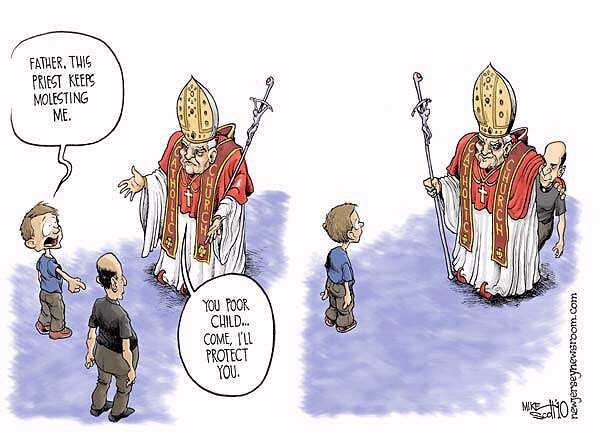
As for the lists you finish with, all the wonderful Catholics are responsible for, it all sounds a little desperate, and very selective. Would Jesus approve of this need for recognition? Perhaps, 'Pride goeth before destruction, and an haughty spirit before a fall' (Proverbs 16:18)
In your list, 'Catholics are responsible for...', you forgot to mention the many Crusades and the many inquisitions they organised, the many religious wars such as the Thirty Years Wars, the anti-Semitism that killed untold Jews, the thousands of witches and heretics they tortured and murdered, the millions that died when the New World was invaded, along with their participation in the Holocaust (the Nazis weren't Hindus or Muslims remember), and the thousand year delay they put on scientific and humanistic progress. Catholics are also responsible for, as we've said, child sexual (as well as physical and mental) abuse, an increase in AIDS in the world and overpopulation in poor countries, as well as creating millions of men, women and children that are not just utterly confused about sex, they are equally confused about what is real and what's make believe, eg demons and angels. And let's not forget that Catholics are also responsible for that childish belief in a silly shroud belonging to a sky fairy.
Your list merely listed aid efforts, almost with the implication that no one else does these things, whereas non-religious organisations, along with other religious groups, all provide these services, and in far greater numbers. And embarrassingly for Catholics, in NZ atheists and other non-Catholics actually help pay for all the Catholic schools and other services through compulsory taxes and charity pleas. They take our money and say, Look at what we're doing... umm... with your money.
But this list of yours raises a huge problem, since if your loving god were real we wouldn't need all the hospitals and care homes for lepers and we wouldn't have people that were hungry and homeless and threatened by war. And if he is real, remember that the Bible clearly says that god created these evils, not humans. We humans are merely working with what your god gave us. Murderers and rapists were made by god, not Microsoft. Your god made everything from killer earthquakes and tsunamis to disease and man-eating tigers. We only need homes for lepers because your god created leprosy.
I'm forever amazed at how small-minded Catholics (and Christians in general) are. They consistently underrate their god, if not forget about him altogether. I mean for Christ's sake, you have an all powerful and all-loving god as your master and overlord, there is no reason for poverty and suffering in the world. We're supposed to be his children, and his favourite children at that. There's no reason for strife in the world... well... unless your god isn't real!
In your second list, you wrote that 'In General they have, for 2000 years...', done some admirable things. However again you overlooked other things that Catholics have done for 2000 years, probably the most embarrassing being that they've waited in vain to see the return of their god. Their leaders have amassed enormous wealth which they have generally failed to redistribute. They have all failed to live up to their god's commandments and are responsible for making up a sizeable proportion of our prison populations. Catholics have consistently, for 2000 years, failed to get along with others of different beliefs, and this more often than not includes other Christians. And this intolerance went well beyond evil glances.
And again your list merely lists things for which non-religious organisations, along with other religious groups, all do these things as well, and in far greater numbers. Stop trying to take all the credit. And again if your god were real, this aid wouldn't even be needed. Also I think you're being deceptive when you claim that Catholics 'have, for 2000 years... given their lives for those the secular society have thrown in the scrape heap'. The reality is that for most of the last 2000 years there was no secular society, very little in the way of aid organisations, and yet still a great number of people landing on the proverbial scrape heap. And who was the dominant force in society for much of this time in the West: Catholics. Perhaps modern Catholics are just feeling guilty for their past?
Regarding the aid that Catholic organisations provide, you ask me, 'Do you loath them for that too?' No I don't condemn anyone for giving aid to others, for providing the succour that your sky fairy fails to deliver. What I hate is that we're expected to turn a blind eye to the debauchery and corruption in return for some purely humanistic, not divine, help in attending to the world's needy. I recently saw an interview with a Catholic nun working in Africa who said she personally hands out condoms, even though her Church says she shouldn't. This is the human helping others, not the Catholic. Expecting us to let some good work by some cancel out the evil done by others is like saying that to get good pizza we have to tolerate the Mafia, for good Chinese food we have to tolerate the Triads and to get oil we have to tolerate the butcherers that are Islamic State. Your argument is similar to those who say if the Church hadn't existed we wouldn't have got all the wonderful art, music and literature that they created. It was a necessary evil. My reply is that I would gladly give it all up if it meant that the death and suffering that the Church also created throughout history also disappeared. No matter how good a painting or a symphony is, it's not worth a single life, and for Christians who disagree, I challenge them to detail how many men, women and children they are willing to see suffer and die for their favourite piece of art.
Humans can do good deeds and achieve great things without being forced to by their church. In the last century or so as religion has retreated from our lives, our knowledge of the world and our standard of living has increased enormously, as has the number of non-religious aid organisations. We don't need the Church, we never have.
-
Comment by Anonymous-11, 07 Mar, 2015
"Oh you're not seriously arguing that the modern Church's stance on the shroud is based on what some antipope said over 600 years ago are you?" — You are now making stuff up. I never said that. This is call a "straw man" fallacy. You make something up only to knock it down. Besides, you have completely lost the point. You play both sides of this argument, which is a fallacy and bias. As an aside, there were those in the modern church who believed the shroud is a fake "the immense preponderance of opinion among learned Catholics (see the statement by P.M. Baumgarten in the "Historiches Jahrbuch", 1903, pp. 319-43) was adverse to the authenticity of the relic" -Catholic Encyclopedia. Before you go on another side track please look up the difference between an "icon", which is how Pope Francis recently described the shroud, and a "relic".
Regarding your ability to make the Church out to be wrong no matter which view they take. Again, critical thinking skills seem to be a problem here.. Me: You are Illogical (claiming both sides of the same argument) and your point should not have been in the discussion any way. You: The fact that the point should not be in the discussion makes my illogic some how OK. The fact that your illogical argument should not have even been in your paper has zero bearing on the logic (or lack there of) of your initial point. That's just basic bad thinking. Please think more clearly.
When faced with a source quote from U.S. Department of Education, the reply "I seriously doubt that" is not an intelligent response. It just isn't. (please don't start quoting now, it wouldn't help).
On condoms. Please include the whole statement in your reply. The Lancet "(looked) at evidence that suggests that the safety benefits of seat belts are offset by behavioral adaptation, and we ask whether condom promotion could also be undermined by unintended changes in sexual risk perception" In this sense (backed by science) Edward Green states that condom use have little impact the incidence of aids and may even be a hinderance, making people believe helping the problem when they are not. In 2003, Norman Hearst and Sanny Chen of the University of California conducted a condom effectiveness study for the United Nations' AIDS program and found no evidence of condoms working as a primary HIV-prevention measure in Africa. Your "loathing" of the church regarding this issue is laughable.
As far as your crusades, 30 years war stuff you leave out a very important point. The separation between religion and all other area of life is modern construct. Politics, Education, Foreign affairs and Religion were all tied together during that era. To separate religion from that milue and blame it at the very least problematic. Certainly we know that when religion was taken out of that context in modern times, wars did not stop. You say: "last century or so as religion has retreated from our lives, our knowledge of the world and our standard of living has increased enormously, as has the number of non-religious aid organisations." If you take the glory you have to take the blame. This is again you winning both sides of an argument.
"Your list merely listed aid efforts, almost with the implication that no one else does these things" — Honestly, one of the worst replys you have made. You are conjuring meaning out of mid air. I will not debate someone who sets up straw men as a tactic. Your circular arguments here are also noted. You say that non-Catholics help pay for Catholic services and this is somehow "embarrassing". But you fail to mention that the obvious fact that Catholics pay taxes for secular services. Apparently, again, for reason only known to you, you do not reference embarrassment in that case. You, yet again, win both sides of the argument.
Honestly, your reply is so full of half truths and fallacy's that they are too numerous to mention. I would sum up your arguments as totally bais. Period.
-
Comment by the 'Silly Beliefs' Team, 07 Mar, 2015
OK, let's forget about what was said and promptly dismissed about the shroud 600 years ago. What would they know, they were only there. But we also need to ignore your new claim that there are 'those in the modern church who believed the shroud is a fake', the details revealing that this claim was made in 1903. Seriously, you think an opinion written down in 1903 is modern? And do your think I care whether your Pope Francis calls the shroud a relic or an icon? This is the pope that says atheists can go to heaven! I seriously doubt he knows much about Catholicism. But he's certainly screwing with Church traditions, and that can only be good in my view. He'll be letting priests get married next, to each other.
You know our view, why don't you come out from the shadows and say whether you think the shroud is real? And explain your reasons, as we have. Isn't this why you visited the 'Silly Beliefs' website in the first place?
As for your lecture on critical thinking skills, I'm sorry but I couldn't really follow it, your final comments reflect my confusion: 'That's just basic bad thinking. Please think more clearly'.
Of course I'm allowed to doubt a report from the U.S. Department of Education. You think the US government can't make mistakes, and big ones? This is the government that said Iraq had weapons of mass destruction, and went to war over it! Also the original report was written 20 years ago and failed to distinguish between sexual harassment and sexual molestation, and what's come from this revelation? Are you saying that there's a massive conspiracy underway, that the spotlight is being unfairly placed on the Church to draw attention away from what's happening in US schools? If so, it's working! And again I remind you that your argument seems to be, 'Sure we rape kids, but not as many as those people do'. Despicable. Let the schools clean up their own act, you have huge stinking problems of your own to see to, so stop screaming, 'Nothing to see here Officer, just a priest out walking with a choir boy, but look... look over there. Look at what those dirty teachers are doing'.
You write, 'On condoms. Please include the whole statement in your reply'. None of the information you now supply was provided in your earlier comments, so I could hardly have included it. Furthermore let's drop the bullshit. Your belief isn't that condoms are harmful and actually causing AIDS or are sometimes ineffective, your belief is simply that your silly sky fairy says their use is against his imaginary wishes. Admit it, even if they were proved 100% effective against AIDS you Catholics would still deny their use.
Furthermore, there is no evidence that condoms are causing harm, the Lancet report author merely writes that 'we ask whether condom promotion could also be undermined by unintended changes in sexual risk perception'. Note that he says 'could', he has no evidence that they do. Likewise 'Green states that condom use have little impact the incidence of aids and may even be a hinderance [sic]'. Again he doesn't know that they are a hindrance, and apparently agrees that they are likely having an impact, albeit little. As for the UN study, they 'found no evidence of condoms working as a primary HIV-prevention measure in Africa'. Is this because good Catholics simply won't use them? And might they still be working as a secondary HIV-prevention measure? If as you argue, condoms are next to worthless, then why not just ignore them and let Africans do as they want? But as I say, it's not about condoms per se is it, it's all about Catholics offending your silly sex-obsessed god. You don't even want people to masturbate! If your god was so keen for humans to multiply, that every sperm is sacred, then he should stop killing foetuses by the millions. But having said that, doesn't he know that we're a tad overcrowded already, and that you good Catholics are already run off your feet sheltering the homeless, feeding the hungry and clothing the poor? Why the hell does he want still more, in countries least able to care for them? Why?? I truly don't know why you support an idiot god like this!
You then try to argue that 'As far as your crusades, 30 years war stuff you leave out a very important point... Politics, Education, Foreign affairs and Religion were all tied together... To separate religion from that milue and blame it at the very least problematic'.
OK first, they weren't my Crusades, they weren't the Atheist Crusades, they were the Catholic Crusades, as was the '30 years war stuff'. Don't give us this bullshit that Catholics went on numerous Crusades to the Middle East killing untold innocent people on the way and when they got there, all over something that wasn't motivated solely by the Bible, by religion. You're like the Nazis at Nuremberg, don't blame us, we were only following orders.
And yes, politics, education, foreign affairs and religion were all intertwined in those dark days, this is what's essentially called a theocracy, a government subject to religious authority, subject to Catholic authority. Popes forced kings off their thrones, fought wars, ran the schools and provided the only churches, what's this if not dabbling in politics, foreign affairs, education and religious observance? You bloody Catholics need to take some responsibility for what your ancestors did, for the unspeakable atrocities they committed, instead of claiming that the killing and raping and looting was all done by those bastards in the Foreign Affairs Department. And yes, possibly some of my ancestors were burning witches and killing Jews too, but if they were I'm horribly ashamed of them, and while I accept that they were ignorant fools brainwashed by the Church, I would never try and excuse what they did to their fellow humans. Unlike you I don't try to whitewash the past and blame the nasty bits on some other group.
And no, religion is not the only cause of wars, although if you look at those happening at the moment, one Muslim sect against another, Islam against the world, Jews against Muslims, Muslims against Hindus, Christians against Muslims etc, it is certainly still a very common cause for war. Wars have many causes, one of which is greed, greed for what your neighbour has, and now and in the past, a difference in religion is just the excuse that people need to attack their neighbour. If we could get rid of religion that wouldn't stop all wars, but it would stop a fair proportion of them. It would be a beginning, leaving us free to work on the other causes. But again you seem to be making the childish argument of, 'Sure we've started a lot of wars that have killed a lot of innocent people, but those people over there have started a few wars too, so don't try and stop us if you can't stop them as well'. Of course others have started wars, and I condemn them as strongly as I condemn the Church. Stop taking it so personally OK. Catholics and other Christians, Jews, Muslims, Hindus, Buddhists and others, you know who you are, you've all committed atrocious acts and I condemn you all equally. And I'm not taking any of the blame as you suggest I do, since I haven't harmed anyone, especially over religion, and the worldview that I support — atheism and humanism — hasn't gone to war with anyone. Ever. I'm not ashamed of the worldview that I support and how it has behaved now or in the past, but you should be deeply ashamed of the actions of Catholicism both now and in the past.
You objected to me commenting on your list of aid efforts provided by some Catholic organisations. Well I'm sorry that I wasn't humbled by your Church's humanity, but you try and excuse the disgusting things people in your Church do by providing lists of some of the good work that others do. It's not supposed to be a balancing act. Seriously, one does not cancel out the other! How many lepers do you have to care for to cancel the rape of a choir boy? I don't care how many good deeds you wave in my face, it doesn't excuse the evil that you aren't so willing to highlight. An evil that your god is ignoring completely. Why is that? Why aren't priests that are buggering little boys being hit by lightning?
Yes I say that Catholics should be deeply embarrassed over their schools having to go to a secular government and beg to be bailed out or else they will close. Taxes coming from mainly non-Catholics are supporting all Catholic schools in NZ, since Catholics and/or their god couldn't mange it. As an atheist I'd be embarrassed asking my Catholic church for some money to buy some atheist books. And I guarantee they wouldn't grant my request. And yes Catholics do pay for secular services, such as defence, policing, environmental, libraries, roading etc, but these are all services that Catholics want and use, so they are getting value for their taxes, whereas atheists don't want or get to use the taxes that go to Catholic schools. Not a single Catholic pays a cent in tax towards any atheist service, so I see no reason to be embarrassed. You seem to forget that secular does not mean atheist.
Since you graciously graded my arguments, I guess it's only polite I do the same for yours. I see them as relying too much on superstitious nonsense and religious arrogance. They seem to be constrained by a really old book of myths that you inexplicably think are factual and a desperation to rewrite history to match these myths. Myths such as your god forcing demons into pigs and then killing the pigs, innocent pigs, and this god walking across water to get a pizza... or something. I would suggest that you read more science, history and philosophy — make sure they're written this century — and then re-read your book of myths in a new light. After that, there are many good atheist organisations for you to join. Plus you get to have sex without the intolerable guilt. It's heaven!
-
Comment by Anonymous-12, 07 Mar, 2015
Catholics are not Christians. They are pagan sun and moon god worshippers. They are worshipping Sameramis ( Ishtar, Aphrodite, Venus, Astarte, Asteroth.... ). They worship a fake christ. This "anti-christ" is Tammuz ( the resurrected Nimrod who was deified as the first pagan sun god Baal ). Nimrod was the great grandson of Noah. All the pagan gods throughout history all came from the Babylonians. Although the names have changed throughout history, they are still the same pagan gods the Babylonians worshipped.
We Christians know that the Shroud of Turin is a fake. The Catholics are a Cult Religion. The Romans pretended to be converted to Christianity back in the time of Constantine. They changed the original sabbath from Saturday, ( which was observed by the early Jewish and nonJewish Christians ), to Sunday, the Romans pagan sabbath ( the venerable day of the sun ). They brought in their pagan holidays, ( Christmas, Easter, Valentine's Day, etc...). Churches have been practicing Christianized Paganism ever since. I would strongly suggest you do some research on the subject. I pray that God will open your eyes to his truth. Elohim bless....ðŸ™
-
Comment by the 'Silly Beliefs' Team, 07 Mar, 2015
Sorry, but I must disagree. The basic definition of a Christian is anyone that believes in Jesus Christ and follows his teachings, so in basic terms Catholics are Christians. However if I wanted to be picky, I could argue that most Christians, while they believe in Jesus, actually follow the teachings of St Paul and not Jesus. Most Christians don't know that the Gospels of Mark, Matthew, Luke and John weren't written by the apostles of Jesus, or anybody that had even met Jesus. They don't know that Christianity was really a creation of St Paul, not Jesus, and that Jesus would not recognise or agree with what is now preached under his name. Jesus was a devout Jew and a xenophobe or racist, he had no intention of permitting non-Jews into his group. Jesus told his disciples: 'Do not go among the Gentiles or enter any town of the Samaritans. Go rather to the lost sheep of Israel'. MT 10:5-6. When a non-Jew approached him he initially ignored her, explaining that only the Jews are God's children and everyone else are just dogs in comparison.
It was St Paul that, without any justification, gave Christians permission to disobey much of what God told the Jews, not Jesus. Jesus was adamant that the only religion that was acceptable was Judaism, and quite clearly said so:
"Do not think that I have come to abolish the Law or the Prophets; I have not come to abolish them but to fulfill them. I tell you the truth, until heaven and earth disappear, not the smallest letter, not the least stroke of a pen, will by any means disappear from the Law until everything is accomplished. Anyone who breaks one of the least of these commandments and teaches others to do the same will be called least in the kingdom of heaven, but whoever practices and teaches these commands will be called great in the kingdom of heaven. For I tell you that unless your righteousness surpasses that of the Pharisees and the teachers of the law, you will certainly not enter the kingdom of heaven." MT 5:17-20
Neither Jesus nor any of his disciples would recognise modern Christians as following his teaching. For a start they aren't Jewish and don't follow the law handed down by God. Christians are deluding themselves into believing they are following God's commandments, when nothing could be further from the truth. They are following a humanistic philosophy that has rejected God's barbaric, unjust and/or silly commandments, but they continue to falsely say that their moral code comes from God. Wrong.
I would agree that all the gods in the Bible have a pagan origin. The Christian god was originally just a small time tribal war god, one among many, as the Bible clearly shows by talking about multiple gods. At the start when god talks, he doesn't say 'I did this', he says 'We did this'. But you're mistaken in claiming that 'All the pagan gods throughout history all came from the Babylonians'. There were civilisations that existed before the Babylonians and they all had their own gods, eg Egyptians and Sumerians.
Of course you're right that the Shroud of Turin is a fake and that the Catholics are a cult. But in fact every denomination of Christianity is a cult. Certainly the pope is a cult leader, but the greatest cult leader of all (if he actually existed), was Jesus himself. Every characteristic or criteria one might use to identify and then condemn or criticise a 'small-time' cult can be applied equally to the mainstream religions. (See our article: Is your religion a cult?)
You're also correct in that the likes of Christmas is merely a pagan festival given a Christian makeover. Jesus was no more born on Xmas day than the Easter Bunny was. I have actually done some research on the subject, and have discovered that... surprise, surprise... there are no gods at all, Christian or pagan. Oh, and no Easter Bunny either. If there is a god somewhere, it seems that he's woefully incapable of showing anyone the truth of his existence.
-
Comment by Proctor, 08 Mar, 2015
Bravo, Bravo!!!
Just stumbled upon your wonderful web pages.
Your summary on the Shroud is especially thorough and well done.
A big thanks!
Hats off from a Yank to all the bright people in New Zealand.
Good work...really good work!
-
Comment by the 'Silly Beliefs' Team, 09 Mar, 2015
Hi Proctor, thanks for the compliment. We just tell it as we see it, and it's refreshing to hear from someone who can also recognise good evidence when they see it.
-
Comment by Anonymous-11, 09 Mar, 2015
Your replays weave trails around the points of contention with diversions into irrelevance, avoidance, ridicule and ridiculousness. In a word, they are tiresome.
"You know our view, why don't you come out from the shadows and say whether you think the shroud is real? And explain your reasons, as we have. Isn't this why you visited the 'Silly Beliefs' website in the first place?"
This question is poorly written, but whatever. The shroud is "real" in that it exists. I do not think it is the burial cloth of Christ, which is what I assume you mean by "real". The reason of visiting your site is to get perceptive. Fringe attitudes can be informative.
But your question raises an interesting point which I am sure you did not intend. You "claim objectivity" regarding the shroud. I wonder if you even know what you mean by that. If you are objective then you must be open to the shroud being "real". That must mean you are open to the "possible alternative.. that the images were created by a burst of radiant light, such as Christ might have produced at the moment of resurrection." (that is clearly to the stance you criticize and what you mean by "real") That must mean that you are not an Atheist. If you hold out the possibility of miracles you can not be. The alternative is that you are closed to that possibility before you even start. In that case, you then have reached a conclusion before your investigation, making your paper as bias as you accuse STRUP of being.
Regarding the point you were unable to understand. You are confused because you somehow think that my argument is about authenticity. It is not. My point is that the Church losses with you if they claim the shroud to be authentic and it losses if they claim it is not. Your "heads I win, tails you loss" thinking infects most of your arguments. The second point comes out of the first. Science is not the realm of the Church. It's opinion should not have been included in your piece. But that does not dismiss the fact that your thinking shows undeniable bias. Your #2 comment (114) seemed a strange attempt to link these two separate points. Hence a lack of critical thinking on your part. Get it now?
"Of course I'm allowed to doubt a report from the U.S. Department of Education. You think the US government can't make mistakes, and big ones?" Good gracious. Your lack of perception is wearisome. Of course you allowed to doubt. But to be intelligent about it you must source your doubt!!!! When the author of scholarly paper makes a statement you need to footnote your objection. "I seriously doubt that" is a high school level criticism. Your decent into the abuse scandal does nothing to do with the comment and does not help you here. Stay with the point!!!
On condoms: Lets drop the bullshit. You had no idea of the reports of from the Lancet, Edward Green and University of California all of which clearly cast doubt on the effectiveness of condoms and back the church's stance, despite your bizarre objections. Yet you bashed the church on it's stance anyway. You "reached a conclusion before your investigation". You have no right to be righteously indigent if you are intellectually lazy.
Your grasping comment "Lancet report author merely writes that 'we ask whether condom promotion could also be undermined by unintended changes in sexual risk perception' is just dreaming. The article goes on to say "condoms seem to foster disinhibition, in which people engage in risky sex"
It is simply not a question. Peer-reviewed journals such as the Lancet, Science and BMJ have confirmed that condoms have not worked as a primary intervention in the population-wide"
What has worked? "In Uganda's early, largely home-grown AIDS program, which began in 1986, the focus was on "Sticking to One Partner" and "Loving Faithfully." These simple messages worked. More recently, the two countries with the highest HIV infection rates, Swaziland and Botswana, have both launched campaigns that discourage people from having multiple and concurrent sexual partners" — Green (Harvard)
Hmmmmm...how were have I heard that before?
"As for the UN study, they 'found no evidence of condoms working as a primary HIV-prevention measure in Africa'. Is this because good Catholics simply won't use them?" You're kidding right? You know that the study was regarding condom use, not condom non use? We are on the same planet, right? In any case if you are a "good Catholic" you would not have sex before marriage and you would have one partner for life, thus preventing the epidemic in the first place.
You somehow got to God killing babies from this point. I suppose that should be expected from a fringe website but please, please, stop non sensical deviations into the ridiculous.
"Are you saying that there's a massive conspiracy underway, that the spotlight is being unfairly placed on the Church to draw attention away from what's happening in US schools?" Yet another attempt at a straw man. These are facts: The federal report said 422,000 California public-school students would be victims before graduation — a number that dwarfs the state's entiree Catholic-school enrolment of 143,000.
Yet, during the first half of 2002, the 61 largest newspapers in California ran nearly 2,000 stories about sexual abuse in Catholic institutions, mostly concerning past allegations. During the same period, those newspapers ran four stories about the federal government's discovery of the much larger — and ongoing — "abuse scandal in public schools."
There is no massive conspiracy. But the facts make it clear that the spotlight is on the church. It is a much sexier story for the media.
Regarding Taxes. Your focus on NZ is ridiculous. In many countries Catholics pay for secular services with zero tax dollars going to Catholic schools.
1. In the few countries (like some provinces in Canada and in NZ) were public Catholic school do exist, atheists are welcomed. Many secular parents look to send their kids because they want the discipline and rigour (Who's afraid of Catholic schooling?" Margaret Wente The Globe and Mail Published Saturday, Aug. 16 2014). There are more atheist and sceptic teenagers in Catholic high schools then you think. They have to opportunity to question and object to any teaching and are often exempted from religious services.
2. Many Countries do not have Public Catholic Schools, thus Catholics must send their children to learn about contraception, abortion, homosexuality etc, from a secular perspective
3. In the many counties in the modern world Catholics are forced to pay for abortion and contraceptive services.
So yes...your circular thinking is actually that. You say that non-Catholics help pay for Catholic services and this is somehow "embarrassing". But you fail to mention that the obvious fact that Catholics pay taxes for secular services. Apparently, again, for reason only known to you, you do not reference embarrassment in that case. You, yet again, win both sides of the argument.
More to the actual point. Of course everyone knows what is right and wrong. The church does not deny this: "man (as in humanity) discovers a (moral) law which he has not laid upon himself but which he must obey" (Gaudium et Spes, 16). The problem, of course, comes in the doing. Your fellow atheist Roy Hattersley has it absolutely right and you could learn from him. On Hurricane Katrina relieve:
"Notable by their absence," he says, were "teams from rationalist societies, free thinkers' clubs, and atheists' associations — the sort of people who scoff at religion's intellectual absurdity.."
"The only possible conclusion," says Hattersley, "is that faith comes with a packet of moral imperatives that, while they do not condition the attitude of all believers, influence enough of them to make [Christians] morally superior to atheists like me."
Yes, the world needs the Church.
btw way your obsession with sex is also misplaced. According to the University of Chicago's last National Health and Social Life Survey found the most enjoyable and most frequent sex occurring among married people, those who attended church weekly.
Since you again attempted a straw man and since your replays too often descend into diversion , true to my word, this is my last reply. Your set up gives you the last word but, whatever.
-
Comment by the 'Silly Beliefs' Team, 11 Mar, 2015
You start by complaining that 'Your replays... are tiresome', and yet you return and replay them yet again! Doh!
On the bright side, it's gratifying that you accept that the so-called shroud isn't the real deal, or in your words, it's not 'the burial cloth of Christ'. One down, several million to go.
You next say that 'If you are objective then you must be open to the shroud being "real". That must mean you are open to the "possible alternative... resurrection." ...That must mean that you are not an Atheist. If you hold out the possibility of miracles you can not be'. Oh rubbish. You are labouring under the old religious notion of what an atheist is. 'The fool says in his heart, "There is no God." They are corrupt, their deeds are vile; there is no one who does good.' (PS 14:1) I wish you guys would stop getting your answers from the Bible or your priest. No informed atheist says we aren't open to a 'possible alternative', such as miracles. What we say is we see no evidence of these alternative explanations, but if evidence is provided then we will change our view. I can say I don't believe I will ever travel to Mars, just as I say I don't believe there is a god. But I won't deny that there is an astronomically remote possibility that I could travel to Mars, it's certainly not physically impossible, and it's even possible that gods, fairies and leprechauns might be real and will stop hiding. Me writing this reply might all be a dream, I'm open to that possibility, but at the moment I see no evidence for it, so like the shroud I choose not to believe in the shroud or that I'm dreaming. I am utterly objective in that I'm relying on material evidence to guide me and I'm not letting my emotions cloud my judgement. If that evidence changes I will likewise change.
I am objective, open to accepting error and to adopting new views on new evidence, good Catholics cannot say the same, you are forced to believe in what the Bible says regardless of new evidence. The Twentieth Century Encyclopedia of Catholicism informs us that 'however the science of cosmology should develop in the future, a person's belief in the truth or falsity of the Genesis account of initial creation, properly understood, will be unaffected'. In other words it's always going to be a 6 day creation with Adam and Eve and a talking snake, no matter what new evidence arises. That's not objective, that's blind dogma.
You say that 'My point is that the Church losses with you if they claim the shroud to be authentic and it losses if they claim it is not. Your "heads I win, tails you loss" thinking infects most of your arguments' [sic].
OK let me explain what I meant. The Church has three options regarding the authenticity of the shroud. Say it's authentic, say it's not, or say they don't really know.
If the Church loudly and confidently proclaims the shroud as authentic then it loses all credibility, since most of the world, bar a few Catholics, knows that the evidence clearly says otherwise, and thus the Church is lying. Just as the Church lost out when the sex abuse scandal broke, its reputation would suffer again if they proclaimed the shroud as authentic.
If, based on the evidence, the Church loudly and confidently proclaimed the shroud as a fake, as a curiosity, as a piece of medieval art, then the Church effectively destroys the last and only physical link to Jesus still in existence. Centuries ago there were countless items held by the Church that were connected with Jesus, from the crucifixion nails and between 26 and 40 'authentic' burial shrouds, right down to the corpse of Mary Magdalene and even Jesus' foreskin. Now all that's left is the Shroud of Turin, the rest all exposed as fakes. Science has increasingly eroded the faith of believers over the last century or so, can the psyche of good Catholics withstand yet another defeat? I say that the unambiguous admission that the shroud is a fake can only be a loss for the Church, one because it shows that they were wrong yet again (remember Galileo?), wrong to have venerated it in the first place, and two because untold good Catholics will sense the loss of the shroud as a real spiritual loss. I can think of no way that the Church could describe finally exposing the shroud as fake as a positive move for the Church, rather than a loss.
And contrary to what you suggest, if the Church openly, consistently and unambiguously proclaimed that the shroud was a medieval forgery, then I would acknowledge this as an honest and honourable stance. The Church will not do this however, because while they might go up in my estimation, they will lose big time in the eyes of their flock.
So yes, whether the Church claims the shroud is authentic or not, either way they lose.
So this leaves the third option, say they don't really know if it's authentic or not. And this is the stance the Church has taken, they're hedging their bets, and taking an unjustified stance to protect their market share. Sure they can say that scientists say their tests indicate the 14th century, but this is like me saying that the pope says god is real. I can say this without saying whether I actually agree with that claim. The Church can acknowledge the evidence against the shroud, as they do, but they don't loudly and confidently say they support it, leaving the only obvious conclusion that the Church thinks the jury is still out, that more investigation needs to be done. And until that happens (never), the Church continues to treat the shroud as if it is real, just in case.
This is why I say the Church is duplicitous. Even if the pope and all his bishops think or know the shroud is a fake, they want to hang onto it because they know that many, many Catholics believe, rightly or wrongly, that it is genuine. Bursting their bubble would only shake their faith, so let them keep their shiny toys if it makes them happy. It is not in the Church's best interest to aggressively denounce the shroud, so sneaky priests say to the faithful, 'Yes my child, some scientists say it's a fake, nudge, nudge, wink, wink, but what do they know, they don't even believe in God'.
And let's remember that the 'I don't know' option is not an honest option for the Church, since for centuries popes, bishops, priests and nuns have all claimed that they have been talking to God and/or Jesus (I always get confused between the two!). Hundreds of years, all this debate, and not one bloody pope has thought to ask, 'Oh, by the way, we have this old stained cloth out the back, does it belong to you, or should we just toss it?' If god exists, the Church has no excuse for not knowing about the shroud's authenticity. Since they clearly don't know, then god doesn't exist. Centuries ago they would have lied, but now they're scared of what science will reveal.
You say that 'Science is not the realm of the Church. It's opinion should not have been included in your piece'. Our article is not about science, it's about the authenticity of the so-called shroud. As such it looks at scientific, historical and Biblical evidence to reach a conclusion. The views of the Church need to be considered along with the opinions of scientists, historians and Biblical scholars. The world's opinion on whether the shroud is genuine is swayed not just by what scientists say but also the Church.
You insist that I have to source my doubts about your quotes — 'you need to footnote your objection' — but yet you don't have to even link to the actual article that you quote from? And frankly, the source of my doubts is between my ears. You claim that my doubts have 'nothing to do with the comment and does not help you here. Stay with the point!!!'. Stay with the point? Seriously, you deviously divert talk away from sex abuse in the Church to sex abuse in schools and you accuse me of not staying on topic? Stop trying to hide what the Church is doing by pointing fingers at the schools. Stay with the point!!!
'On condoms'. Why are we replaying all this? I thought it was tiresome? But anyway, you quote from two reports, but again refuse to link to the actual reports that merely 'cast doubt on the effectiveness of condoms', and doubt is not proof that's condoms are ineffective. Please link to the reports that prove that condoms are ineffective. And again, even if condoms were utterly useless that is no reason for the Church to have a worldwide campaign against them. The Church isn't paying for them, so just forget about them. But you can't can you, because you don't care whether they're effective or not at stopping AIDS, because you know they ARE effective at stopping sperm, and your imaginary fairy won't have any of that will he? Explain this, there is no threat of my Catholic friend in a monogamous relationship in NZ contracting AIDS, so why won't the Church let him use a condom? The Church doesn't give a shit that condoms might not be effective against AIDS, they're banned because they're a contraceptive. You and the Church are merely trolling the scientific literature, like creationists battling evolution, looking for any obscure report that expresses some DOUBT and you ignore all the reports that don't. Think about it, your implication is that there is only 2 or 3 scientific reports in the entire world that have bothered to look at the effectiveness of condoms, and they all express doubt, but no real evidence. If you say, well of course there are other reports on the effectiveness of condoms, then they must logically support the use of condoms, since you don't want to mention them. Either way, your concentrating on a couple of reports expressing doubt is weak in the extreme.
And of course you might also want to explain why the Church was against condoms before AIDS even existed. Why was that?
Regarding AIDS, you ask 'What has worked?... "Sticking to One Partner" and "Loving Faithfully." I agree that this would help, but please explain why the Church still prohibits an African couple in a monogamous relationship from using a condom when one has HIV, contracted not through adultery but a blood transfusion? Why can't they use a condom, or other forms of contraception for that matter? If it's all about effectiveness on AIDS transmission (or lack of), and nothing to do with contraception, why can't this couple use a condom?
You naively argue that 'if you are a "good Catholic" you would not have sex before marriage and you would have one partner for life, thus preventing the epidemic in the first place'. Oh come on, that's like saying 'if you are a "good Catholic" you would not have sex' with children against their will, and no one took any notice of that, not even arguably the most knowledgable and devout Catholics on the planet, ie priests, bishops and popes. And clearly there is an AIDS epidemic in Africa, and Asia, South America etc. So is there even such a thing as a 'good Catholic' on this planet? Apparently not, for as you correctly say, if there were then there would have been no 'epidemic in the first place'. Your 'good Catholic' is a figment of your imagination, and none exist in today's world. I know many Catholics, and some of them like you would describe themselves as a 'good Catholic', and yet they break more of your silly rules than you could shake a stick at. Professing one thing and doing another, are Catholics the biggest group of hypocrites on the planet? They're certainly in the running. And they break the rules mainly because they recognise that they are quite silly. I mean, what sort of screwed up Church would once rule that married couples were not allowed to have sex while completely naked or during daylight hours? Truly sick minds.
OK, I mentioned that your god, if he existed, was killing foetuses by the millions, not that he was 'killing babies'. You Catholics really do need to learn the difference. And I mentioned this because you are arguing against the use of contraception (condoms) in Africa which will (AIDS aside) cause a population increase, and thus fulfilling your god's order to go forth and multiply. But I then pointed out that if your god is so concerned in creating more babies in Africa, why is he killing millions of foetuses before they can become babies? It doesn't make sense. What do I mean by this? If your god exists, it's easy to show that he is continuously performing direct abortions. It's well known medically that most pregnancies result in a natural abortion, often before the woman even realises she is pregnant. And in a Catholic worldview who would cause these natural abortions? Why God of course! You can't claim that your god is responsible for all life, that he allows a pregnancy to go to full term and yet claim that he has nothing whatsoever to do with the majority of lives that don't make it. He deliberately breathed life into the embryo then chose to abort it later down the track. So throughout history god has been aborting foetuses left, right and centre. The babies that have been born are only a tiny fraction of those that your god has aborted. The most prolific abortionist of all time is God himself. So you see my comments are not 'non sensical deviations into the ridiculous', they are actually insights into the nonsense that is Catholicism.
You harp back to sexual abuse in US schools, complaining that 'the spotlight is on the church. It is a much sexier story for the media'. OK, as a Catholic you may think child sex abuse is a 'sexier story', but the rest of us don't see it that way, we see it as a disgusting story. And of course there will be sex abuse in your schools, just like your Scout groups, your military and your orphanages. Let the authorities focus on them, you and I are discussing what's happening in the Catholic Church. Stop trying to divert attention away from the priests, bishops and popes. Yet again I remind you that your argument seems to be, 'Sure we rape kids, but not as many as those people do'.
You say that 'Regarding Taxes. Your focus on NZ is ridiculous'. No it's not. I live in NZ, these are the Catholics I'm familiar with most. You were trying to show what a great job the Church was doing to help everyone with their schools and such, I simply said that here in NZ the Church and their schools can't even help themselves. I clearly wasn't talking about other countries, nor was I talking about the quality of the schools. You also say that 'Many Countries do not have Public Catholic Schools [Lucky them I say!], thus Catholics must send their children to learn about contraception, abortion, homosexuality etc, from a secular perspective'. So what's wrong with that? It's all quite simple surely? From a secular perspective contraception is about having children when you want to, abortion is about not having children when you don't want to, like when your priest has raped you, and homosexuality is a natural sex act that happens throughout the animal kingdom. From a Catholic perspective, the explanation is even quicker; contraception is evil and forbidden, abortion is evil and forbidden, and homosexuality is evil and forbidden, unless you're a priest. Surely their parents and the priests will have drummed that into them long before they reach puberty?
You also gripe that 'In the many counties in the modern world Catholics are forced to pay for abortion and contraceptive services'. The reality is that abortion and contraceptive services are what is offered in humane and caring societies. Abortion and contraception are nothing new, they have been with us throughout history, and untold Catholics have covertly used them, and still do. Even the most devout Catholics I know use contraception. The only difference is that now we have agreed that people shouldn't have to break primitive laws forced upon us by the Church to obtain them.
You go on to say that I 'fail to mention that the obvious fact that Catholics pay taxes for secular services. Apparently, again, for reason only known to you, you do not reference embarrassment in that case'. Re-read my reply, I clearly said:
'And yes Catholics do pay for secular services, such as defence, policing, environmental, libraries, roading etc, but these are all services that Catholics want and use, so they are getting value for their taxes, whereas atheists don't want or get to use the taxes that go to Catholic schools. Not a single Catholic pays a cent in tax towards any atheist service, so I see no reason to be embarrassed. You seem to forget that secular does not mean atheist.'
As for your silly story from 'atheist Roy Hattersley' [who??] and Hurricane Katrina, and his assertion that atheists were 'Notable by their absence' at the relief effort, how the hell would he know that? Are he and you saying that the only groups that turned up to help were official Christian groups, such as 'The Catholic Search and Rescue Group'? Did no governmental organisations turn up? What about the police and the military? And of these groups, which will have far outnumbered Christian groups, were there no atheists in their number? Did Hattersley ask? Of course the local atheist club didn't turn up, American's generally abhor atheists, do you really think they would have been welcomed with open arms? They probably would have been stoned, with Christians saying it was their blasphemy that brought down your god's anger on New Orleans. (Since they kept low I heard that it was the homosexuals that eventually got the blame.) And anyway, these small organisations, with the great majority of atheists not even being members, are not groups designed or equipped to help in natural disasters. But I can almost guarantee that there were many atheists helping in the relief effort as part of secular organisations, military, police etc. Unlike Catholics and your need to list who you help, atheists just want to help their fellow humans, they don't turn up and say, 'Hi, I'm an atheist, how can I help?' If a disaster happened locally, I wouldn't call some NZ atheist group and put on an atheist T-shirt and organise that we all turn up as a group. I would simply turn up at the disaster and offer my help, I wouldn't insist that they tell the media that I was an atheist. And what about all the other unbelievers, for example those that don't believe in fairies or aliens, were they also notable by their absence after Katrirna? Or were they there helping but just not under their 'We don't believe in fairies' banner? It's only religious groups like Catholics (and Scientologists) that advertise their presence and insist on everyone knowing about their good deeds — Look at how we're helping because our God won't. The rest of us are simply trying to assist, not gain brownie points.
This Roy Hattersley sounds like a right idiot. He argues that apparently 'faith... makes [Christians] morally superior to atheists like me'. He shouldn't judge other atheists by his lack strong morals. Hitler never renounced being a Catholic, and all those priests and bishops fleeing justice on child sex abuse charges are supposedly good Catholics, so what happened to their 'a packet of moral imperatives'?
You reckon that 'Yes, the world needs the Church'. This reminds me of those masked men I see on the TV news who say 'Yes, the world needs the Islamic State' and 'Yes, the world needs Boko Haram'. The world certainly does not need any group whose ideology is based on ignorant, primitive superstition, who want to rule the world under laws that treat women as second class citizens and demand dominion over their bodies, and who see themselves as obsequious slaves to their invisible master, a vicious and barbaric sky fairy. You see what I've done here, how you can't tell whether I'm talking about Islamists or Catholics?
And returning yet again to sex, you say, 'btw way your obsession with sex is also misplaced'. I'm going to be generous here and assume you're referring to the well-known Church obsession with sex, rather than 'my' obsession, since you then go on to mention a survey that you suggest shows you Catholics aren't at all paranoid about sex (or unnecessarily obsessed that you might be breaking some rule), in fact you lot are having sex more often than anyone, and having more fun while you're doing it. The trouble is that the survey merely talks about church goers, and not Catholics specifically. We have no idea where Catholics scored. And I again remind you that it is Catholics that are most obsessed with sexual matters: no masturbation, no sex before marriage, remember the no sex while completely naked or during daylight hours that I've already mentioned, Catholic theologians have written libraries on the topic, and in this reply you worry greatly about what good Catholics might learn in secular schools when it comes to contraception, abortion and homosexuality, all topics concerning... that's right, sex.
You believe in a god who insists that males chop off part of their penis, arguably so he can identify his followers by putting a hand down our pants and copping a feel, and you argue that your god hasn't got an obsession with our genitals? No doubt you'll respond by saying god is all-knowing, he doesn't need to handle our genitals to recognise us, and yet he does it anyway! No wonder your priests think it's OK to check out young boys, they're just following god's example. And before you say that Christians don't have to be circumcised, the reality is that many are, and Jesus never rescinded god's demand, only St Paul did, against the wishes of Jesus.
You finish by saying, 'true to my word, this is my last reply. Your set up gives you the last word but, whatever'.
If there was a god, then surely I wouldn't get the last word. But here I am, getting the last word. This one right here.
-
Comment by Anonymous-11, 15 Mar, 2015
One comment does need to be made.
"'the spotlight is on the church. It is a much sexier story for the media'. OK, as a Catholic you may think child sex abuse is a 'sexier story', but the rest of us don't see it that way, we see it as a disgusting story."
We may argue passionately about facts and interpretations, religion and secularism but when you make revolting insinuations that I (and Catholics in general) somehow find child abuse anything other "disgusting" , well, that makes you, John, a certified bigoted asshole.
-
Comment by the 'Silly Beliefs' Team, 16 Mar, 2015
Firstly, what happened to the promise you made in your last reply? — '...true to my word, this is my last reply'.
Secondly, I was only quoting you, it was you that thought that child sex abuse in the Church, as opposed to schools, was a 'much sexier story for the media'. If you actually thought it was a more shocking or disturbing or disgusting story, then why did you describe it as a 'much sexier story'? Did you not think it might be in bad taste to talk of child sex abuse and sexy in the same sentence? To me it suggests someone trivialising child sex abuse in the Church and working hard to swing the media spotlight onto the schools instead.
You imply that you find what the Church has done and is still doing is disgusting, and yet I suspect that priests raping children and being hidden by others is not behaviour disgusting enough to make you walk away.
-
Comment by Dorian, 16 Mar, 2015
Can you please debunk this garbage?
New experiments on Shroud show it's not medieval
How do we know the fibers given to the lab were from the shroud?
Apparently, "The tests were carried out using tiny fibres of material extracted from the Shroud by micro-analyst Giovanni Riggi di Numana who passed away in 2008 but had participated in the 1988 research project and gave the material to Fanti through the cultural institute Fondazione 3M."
-
Comment by the 'Silly Beliefs' Team, 16 Mar, 2015
Hi Dorian. These experiments are not new, we first became aware of them back in 2013, and they weren't new then either. Rather than repeat our comments, please go here, but before you do, some extra comments.
I feel that there is no way that it can be proven that the fibres came from the shroud. There is no accepted record that extra fibres were removed from the shroud as souvenirs, and yet now two people, Giulio Fanti and the late Ray Rogers, both claim to have been given fibres that the scientists at the time evidently didn't want or didn't know about. For a new date to be believable, there must be a verified sampling of the shroud and those fibres tested, not some anonymous fibres that someone donated.
I think that if the scientific community took these new experiments seriously then the results would, several years later, be world news by now, Fanti's book would have been translated into English, and we wouldn't have to go to the 'Vatican Insider' website to read about them. The experiments may give true believers something to cling excitedly to, but they are little more than a blurry photo of the Loch Ness monster taken on a stormy day by a cheap camera.
-
Comment by Anonymous-11, 16 Mar, 2015
First my comment clearly characterized the medias attitude to sensational stories. This is beyond dispute. In fact Obama recently used the same characterization: "Media hypes terrorism stories over less 'sexy' ones like infant mortality: Obama" - NY daily news. Only an idiot would think that Obama believes infant mortality is "sexy", and only a bigot would interpret my comment in that way. You needed to be called out about that despite my previous promise. And yes John, you are a bigot.
We can make choices. I could easily have said "wow, your obsessive focus on the church makes you show little care for children being abused at a more frequent level in other institutions. I can only conclude you don't care about these kids". Ya, I could have said that but I didn't because I don't think that is true. I don't believe normal human being think that. You, however, "went there". Therefore your last reply did zero to repudiate you "asshole" status.
-
Comment by the 'Silly Beliefs' Team, 17 Mar, 2015
First, you made your point, and yet you've now made another reply, even though two replies ago, hand on heart, you said, '...true to my word, this is my last reply'. Please stop getting my hopes up.
Second, Obama did not use the same characterisation as you. You said that child sex abuse in the Church was a 'much sexier story for the media', and in a similar vein you now claim that Obama said that the media views stories on the likes of infant mortality as 'less 'sexy'', the clear implication being that all these stories have an element of sexiness about them, some more than others. You are wrong, since Obama actually said, 'It's not a sexy story', he never said one story was more or less sexier than the another. I'm sticking with my view that it was wholly inappropriate and insensitive for you to describe priestly sex abuse as a 'much sexier story for the media'. To quote Obama, 'It's not a sexy story'!
Your entire reply is yet again apparently saying (begging), 'Why, why, why won't you talk about sex abuse in American schools and help me draw attention away from sex abuse in my Church? The poor priests have suffered enough!'
But as I've already said, I'm happy to let your justice system focus on the problems in your schools, I can't fight all your battles for you. And unlike American teachers sexually abusing children in the US, and by abuse they mean actual physical sexual abuse and mere verbal abuse (like 'slut' and 'asshole'), Catholic priests are sexually abusing children the world over, and it's all actual physical sexual abuse. Me highlighting sexual abuse in US schools does nothing to keep children safe in my neighbourhood. And in case you hadn't noticed, this website is about exposing silly beliefs, like Christianity in general and the Shroud of Turin in particular, it's not our focus to determine why America churches and schools are both infested with pedophiles.
I suppose I should be thankful that this is the 21st century, in earlier times it wouldn't have just been insults like bigot and asshole thrown at me, I would likely now be tied to a stake with a flaming torch being thrown at me.
-
Comment by Anonymous-13, 19 Mar, 2015
I got some very intriguing information last year, when I was reading about the new research in Italy and I came across this American how was also doing his own research on the photographs of the Shroud.
He said to me by email how that he sat in front the full frontal side of the shroud and stared at it for well over a year. That's when he said he noticed something very odd and weird about the feet. The man in the shroud could not have been lying down flat, when the image was made, because the feet were loosely and freely dangling as a man's feet would if the man was suspended by a hangman's noose.
In other words, the man in the shroud was actually suspended in mid-air and covered by the Shroud, when the image was made!
Well, after I looked at all his data that he seemed eager to email me at the time, it made the hairs on the back of my neck stand up, recalling the peculiar phrase of the accounts in the Gospels "He has RISEN from the dead".
-
Comment by the 'Silly Beliefs' Team, 20 Mar, 2015
It took this person well over a year of staring at the shroud to realise there was a problem with the body, and he only came up with one problem? As we noted in our article, it's been found that 'There are serious anatomical problems with the image. Jesus' face, body, arms, and fingers were unnaturally thin and elongated (like figures in Gothic art), his left forearm was longer than his right, and his right hand is too long. The man is impossibly tall, being 6ft 8in (2.03m). The head is disproportionately small for the body, the face unnaturally narrow and the forehead foreshortened, and ears lost. The front and back images, in particular of the head, do not match up precisely, and the back image is around 2 inches (5cm) longer than the front. The back of the head is wider than the front of the head'. Also, 'The hair hangs as for a standing, rather than reclining figure, and the imprint of a bloody foot is incompatible with the outstretched leg to which it belongs'.
Of course the body could have been lying flat and his feet dangling if they were hanging over the edge of whatever he was lying on. Your suggestion seems to be that Jesus was floating vertically when he was beamed up to heaven, or Valhalla, or wherever, and his feet would thus hang down freely due to gravity. But why was his hair also hanging down, since clearly the cloth should have held it has it was when he was wrapped, that is, falling towards the back of his head? And if the cloth was loose enough to let his feet and hair fall down when he floated up, why didn't his far heavier arms fall to his side? Did god hold them in place to avoid Jesus exposing his genitals? But the cloth was seemingly tight enough to capture a clear imprint of the body, since a loose cloth would have created only a very rough body image.
I think your correspondent needs to go back to the drawing board, and try something beyond just staring at a photo.
-
Comment by Rob, 20 Apr, 2015
Thank you for an excellent review.
My main thoughts when I looked at the image is that it 'wrong'.
As you mentioned this in two different places, firstly that the face is narrow and secondly there is no image that relates to the side of the head or body (the wrap around effect).
If you took a photograph of a Globe of the Earth it would not be so narrow, and if the Globe was unwound into a World Atlas it would be broad and distorted.
Yet the image of 'Jesus' is narrow and long, which is 'wrong'. It is neither a view of the body above and below, nor is it a view of an impression of a body on a tightly bound shroud then laid out flat.
In addition, I do not recall any mention in the Bible of the Two Cloths mention in the tomb being packed away by the followers of Jesus.
One final point, if Jesus was 'Beamed Up' leaving this imprint on the shroud why did he need to roll away the stone at the entrance of the tomb to get out?
Thanks again.
-
Comment by the 'Silly Beliefs' Team, 20 Apr, 2015
Thanks Rob. And yes, there are lot of problems with the shroud story. The stone at the entrance of the tomb being rolled out of the way suggests to me that real humans were involved, not some all-powerful god. Christians consistently fail to grasp what their god would be capable of, he wouldn't need to shift a big rock to get in or out.
-
Comment by Patrick, 18 Jun, 2015
... Sometimes a single image is worth thousands of words and I think that we have an excellent example with this photo.

This photo was taken in 1978 , when the STURP team analyzed the shroud.
On the right side we have John Jackson. Jackson was not only a mere member of the STURP team, he was also it's founder and guru. Now, let's look at the photo and admire the large wooden cross hanging around his neck. I don't know about New Zealand, but in my country only religious cleric like priests, monks, nuns, et al, wear this kind of large wooden cross. Even laypersons who go to church as often as they can don't wear it. Should we therefore consider that STURP told the truth when it said that it was objective and impartial, with no hidden religious agenda, and that it's conclusion was not biased towards authenticity?? Or would it not be better to conclude that STURP started with a desired authenticity conclusion and worked backward to the evidence?
One word about the guy on the left side. It's Max Frei. He proclaimed after examining the shroud that he had found pollens from Jerusalem area. But, wait a minute, didn't he also proclaim that Hitler's diaries were authentic after examining them?
In a less famous but more tragic case, back in 1958, a man called Walter Gross was jailed for 12 years as a consequence of Frei's false proofs. Here's the link to an article that relates the tragic event. It's in Italian but can be easily translated on google. I copy-paste two paragraphs of the Google English Translation.
"For a murder committed in 1958 in Baden in Switzerland, some Walter Gross was sentenced to life imprisonment on the basis of a report made by Frei, in which you put the murder weapon in connection with the accused due to some fibers found on it and coming, according to Frei, his trousers of the accused. But a critical review of this expertise did reopen the process and appoint other experts, who concluded that the fibers described by Frei not found themselves on the trousers of Gross indeed were not at all on the market (in the meantime preparations Frei with the fibers were went mysteriously lost). Walter Gross was then acquitted after 12 years in prison. The fact caused a sensation in Switzerland and the Government of Zurich then established a commission to verify the work of the scholar. The commission came to the following conclusion: "Dr. Frei was not very critical in assessing the results of its examinations and conclusions has gone even further. The expert could give the impression that someone had to be guilty of that at all costs, "adding:" The committee considers cases of rash conclusions so many serious, that can not be due to chance alone. " Frei, however, anticipated the conclusions of the Committee and in 1972 he resigned from the police (B. Lüscher, M. Bosonnet; G. Mauz 1971)."
-
Comment by the 'Silly Beliefs' Team, 19 Jun, 2015
Yes, it does indeed look as though that's a wooden cross around his neck, which would confirm where he falls on the belief spectrum. As we've noted, Jackson is a devoted Roman Catholic, that he is was one of the leaders of the now disbanded Shroud of Turin Research Project (STURP), that the scientists of this group were all selected by the Holy Shroud Guild, and that Jackson served on the Executive Council of this Guild, which was a Catholic organisation that advocated the "cause" of the shroud. There is certainly a huge amount of religious bias that must be controlled for.
As for people wearing crosses in NZ, most people that wear crosses are Christians, but confusingly I've met several women that wear crosses as necklaces, brooches or earrings, and yet they later claimed that they weren't religious, they just liked the design of the jewellery. But surely you know that the cross is a Christian symbol I would say, don't you think you might be offending Christians by appropriating their sacred symbol as fashion? They'd say they just liked the shape of the cross and couldn't see why I might think it had any religious meaning. I wonder if they'd wear a Jewish skull cap or an Islamic veil just as a fashion accessory? My guess is that they are wishy-washy Christians that hide their belief (especially from inquiring atheists), and see no problem with wearing a cross as a fashion accessory since they do have a bit of a god belief lying around somewhere.
-
Comment by Patrick, 19 Jun, 2015
Hi John, thanks for your reply. I know what you mean by "women who wear crosses as necklaces, brooches, earrings", women (and also some men) wear these small crosses decorations in my country too, but as you say, it's just a decoration and it has nothing to do with the large wooden cross than was hanging around Jackson's neck. Please find below an extract of Harry E Gove's book published in 1996, 'Relic, Icon or Hoax?: Carbon Dating the Turin Shroud' (Page 53)
"Throughout the whole of the day's discussions I kept wondering to myself why Jackson, Jumper and another member of the STURP team were all wearing crosses around their necks. Hardly evidence of the dispassionate scientists they professed to be. So far as I know, they were neither priests, nor ministers ..."
-
Comment by the 'Silly Beliefs' Team, 20 Jun, 2015
Thanks for quoting that passage Patrick, and like Gove, I too would have little confidence in the integrity of cross wearing scientists. Of course Christians would argue that an atheistic scientist is likewise biased to a certain view, but I'd disagree. Genuine scientists, atheistic or whatever, will change their mind and reject their initial view if the evidence is against it, but fundamentalist Christians are on record as stating that nothing could make them change their view. They have blind faith in their stance, which is holding a belief with no supporting evidence and holding it even with evidence against it. I'm actually stunned at the arrogance of Jackson, Jumper etc, that they deliberately and openly flouted their belief in Jesus, when they should have at least pretended to be open minded and ambivalent as to the authenticity of the shroud. As Gove said, they're not priests, so the cross is not part of their uniform and they had no reason to wear such ostentatious examples, except to show where their blind loyalties lay.
-
Comment by Markku, 14 Feb, 2016
Hello! Would you kindly correct your listing of "evidence" as it is not true.
For instance
They found out that the radiocarbon testing gave the right result for the new part of the cloth. It was the later repaired part of the cloth.
Professionals have studied the possibility that the shroud was painted. They found that it is not possible. You can't paint images to a linen cloth without any paint.
Study the Jewish burial customs and you will understand the wrapping of the shroud better. Also ... Joseph had to hurry because of the Sabbath.
The shroud's herringbone twill weave was very common in the 1st century in the better circles.. Where do you get your data?
The man of the shroud was flogged, head was bruised, hands and feet nailed - he was crucified. Specialists have proven this.
There in the shroud is a lot of blood stains. The blood is AB type of blood.
I think your evolution of brain is hindered by your preconceived atheist orientation.
-
Comment by the 'Silly Beliefs' Team, 14 Feb, 2016
Hi Markku. I'm sorry, but we won't be correcting our evidence since you have given us no evidence that proves that it is flawed. Let's look at your claims:
'They found out that the radiocarbon testing gave the right result for the new part of the cloth. It was the later repaired part of the cloth.'
Who exactly is 'they'? You don't say. A group of annoyed nuns, a cabal of Catholic scientists? The myth that the silly scientists, overseen by the Vatican's representatives, deliberately selected and tested a more recent patch of cloth is as false as the myth that Jesus rose from the dead in the first place. The Vatican had no problem with the cloth selected for testing, until the wrong date, for them, turned up.
'Professionals have studied the possibility that the shroud was painted. They found that it is not possible. You can't paint images to a linen cloth without any paint.'
As we mentioned in our article, 'microscopic analysis shows significant traces of what could be paint pigment on image areas', but let's assume you're correct; the image wasn't painted on. Let's also assume that scientists aren't sure how the image formed. Where does that leave us? Simply with an image on an old cloth that hasn't, as yet, been explained. There is no good reason to jump to a magical explanation, that your god did it. Let's say some natives deep in the Amazon jungle come across something strange, say, a holographic image of Luke Skywalker in a magazine that fell from the sky, and they have no idea how it was made. Would they be justified in claiming that their god must have made it? They might say yes, but we would know better. My point is that if the shroud image truly wasn't painted on, all that this tells us is the image wasn't painted on. It reveals no information as to how it was formed or by whom. It simly remains a mystery, not a religious relic.
'Study the Jewish burial customs and you will understand the wrapping of the shroud better. Also ... Joseph had to hurry because of the Sabbath.'
Jewish burial customs are secondary to the shroud. First and foremost it is about what the shroud reveals and how this compares to how the Bible says Jesus was killed and what happened to his body after his death. Without the accounts in the Bible we would have nothing, we wouldn't even know he had existed. And since Christians believe that what the Bible says is true, the word of god, then logically the Biblical description of the death of Jesus must be accurate. If not then it's just a fantasy. Unfortunately, for believers, the shroud and the image of the crucified man does not match the Biblical account. The Bible claims that Jesus' burial cloth was linen strips and a separate cloth for the head, whereas the shroud is one large rectangular piece of cloth. The Bible described spices being wrapped in the burial cloth, yet no traces of spices have been found on the shroud. The Bible quotes Jesus as saying there were nail holes in his hands from the crucifixion, yet the shroud image has no wounds in his hands, but one in his wrist. And while we're at it, why could god bring Jesus back from the dead, repairing all the bodily damage except the holes in his hands? And moving now to Jewish burial customs, the Bible indicates that Jesus' burial followed Jewish customs. Thus, Joseph of Arimethea would have washed the body. Since he had time to wrap in the spices, he would have had time to wash it. Yet the body shown in the shroud was not washed. So clearly, if there was a crucified man in the shroud, it certainly wasn't Jesus, unless all the details in the Bible about his death are lies. And if they found the need to lie about his death, which they apparently did witness, then they most surely lied about his resurrection, which they didn't witness.
'The shroud's herringbone twill weave was very common in the 1st century in the better circles.. Where do you get your data?'
What we said was that no examples of the shroud's complex herringbone twill weave date from the first century. And you provide no link to evidence that it didn't just exist then, but was very common. However the weave was used in Europe in the Middle Ages, coincidentally when the shroud first appeared. If this weave was so common in the 1st century, why could the scientists find no examples of it to use as controls when they did their radiocarbon dating? And why did the Vatican not offer to provide one of their many samples of this weave?
'The man of the shroud was flogged, head was bruised, hands and feet nailed - he was crucified. Specialists have proven this.'
No, they haven't, all they've shown is that the image apparently shows a crucified man. Look at many Hollywood movies, there are untold images of dead men, even some crucified men, but they were all pretend. No one actually died, or even bled, to make those images. And even if the cloth truly did wrap a 1st century crucified man, there is no evidence whatsoever that that man was Jesus, and if we believe the Bible's account, much evidence that it clearly wasn't.
'There in the shroud is a lot of blood stains. The blood is AB type of blood.'
Wrong. There are depictions of blood stains on the image, blood stains that behave very strangely, but there is no good evidence of real blood, and certainly not type AB. And even if there was type AB blood on the cloth, please could you point me to the verse in the Bible where it states that Jesus had type AB blood. Again, even if blood from a real crucified man was on the cloth, that in no way proves that man was Jesus. You really are clutching at straws here, imaginary straws.
You finish by saying that 'I think your evolution of brain is hindered by your preconceived atheist orientation'. For a start, this shows that you don't understand evolution, but by believing in god, I guess you don't need to. Species evolve, but my brain is not evolving. It was formed, it grew and it will eventually die, but it hasn't evolved one little bit. It began as a human brain and it will end as a human brain, I'm quite confident it won't suddenly evolve into something else.
And yes, one could argue that my atheism might bias my view of claims of the supernatural, causing me to quickly dismiss them out of hand. But remember, if my lack of belief in gods automatically discredits me, because perhaps I'm willing to lie and cheat and misrepresent the evidence to carry my view, then your belief in gods must automatically discredit you too, because perhaps you're also willing to lie and cheat and misrepresent the evidence to carry your view? And I would argue that the theist, being god-fearing and desperate to book a spot in Heaven, has much more reason to fudge the facts and thus keep his dream of an afterlife alive, than does the atheist to whom the shroud is just an old piece of stained cloth, and always will be. It's not important to us, not in the slightest, so we're not going to waste time or our reputations to concoct a huge web of deception. Even if proof was found that someone called Jesus was indeed crucified and wrapped in that shroud, that's all it would prove. It would go nowhere in proving that Jesus, out of sight of everyone, was consequently beamed up to heaven, alive and well. So Markku, are you hindered by your preconceived theist orientation? Or do you think your god protects you from that bias?
I admit the possibility of bias, that's why I took the time to examine as much evidence as I could for and against the shroud, and then weighted it up rationally. I explained my reasons for deciding that the shroud wasn't the burial cloth of Jesus, and thus if I'm biased, unconsciously or not, people should be able to expose my bias. None have so far.
And seriously, you lot are the ones that argue we should all believe on faith, belief without evidence and even against the evidence. Believing what you desperately want to be true. So if you think one of us might be biased, seeing what they want to see rather than what's really there, I suggest you look in the mirror.
-
Comment by Anonymous-14, 10 Apr, 2016
According to John 19:40 says they took the body of Jesus and wound it in linen clothes with the spices, as the manner of the Jews is to bury. In John 20:6,7, it says they came to the sepulcher and seeth the linen clothes lie, And the napkin that was about his head, not lying with the linen clothes, but wrapped together in a place by itself.
As anyone can plainly see the linen clothes and the napkin that was around his head were 2 separate pieces, and the Jewish custom of burial was to wrap the linen clothes around the body like a mummy. So the shroud is totally fake used to deceive the public, which is what the catholic church is all about. How can you believe such garbage?
-
Comment by the 'Silly Beliefs' Team, 10 Apr, 2016
What I want to know is how you can believe that we believe such garbage? We write a long article debunking the shroud as fake, including the argument you mention, then you come along and apparently accuse us of promoting belief in the shroud? I'm confused.
-
Comment by Anonymous-15, 15 Nov, 2016
I read your post hoping you actually used science. Wow was I wrong.
-
Comment by the 'Silly Beliefs' Team, 16 Nov, 2016
And I read your comment hoping you might actually have made an intelligent argument. Wow was I wrong.
I'm not sure that you did read our article, or if you did, you clearly didn't understand it. Probably the strongest evidence against the shroud being genuine is the radiocarbon dating. What do you think that is if not science? But even if we ignored the scientific evidence, the historical and biblical evidence also clearly shows the shroud to be a fake. Try taking off your Jesus blinkers and look at the evidence objectively. Or conversely, send us your evidence rather than your insults.
-
Comment by Anonymous-15, 16 Nov, 2016
I read what you had written. Pure banality. Nothing new. Same old same old. Trite cliches and circular reasoning.
You say you follow science, yet it's just a mask or shall I say it's a masquerade and a facade.
Surprisingly many people just go along with your trite and dull viewpoints, or shall I say your silly beliefs.
The evidence speaks for itself. You just need to open your eyes.
-
Comment by the 'Silly Beliefs' Team, 16 Nov, 2016
OK, so now you've changed your argument. You said we hadn't used science, but now you admit that we did use science, but that science is just a 'masquerade and a façade'. So if science is just a pretence, a falsehood, a fake belief system, then how is it that your silly iPhone (based on science) managed to send us your criticism after you read our article on the Internet (also based on science)? How did you use a façade to communicate with us? Or is it that the only science you have a problem with is the science that shows your religious beliefs to be fantasies? Is that it, do you pick and choose your science based on what it says about your invisible god?
We agree that our article of the shroud could be viewed as banal and nothing new, and that many people, most people actually, will agree with our 'trite and dull viewpoints'. Our viewpoint that the shroud is a fake is indeed predictable and trite and dull, because informed, intelligent people have known this fact for some time now. It is nothing new, and we shouldn't need to remind people. People will indeed read our viewpoint and realise that they learnt nothing new, all we did was to reconfirm their view, that the shroud is a silly prop for fearful, superstitious people.
We asked for your evidence that the world is wrong about the shroud, and you now hint that such evidence exists, but typical of all those that hold silly beliefs, you refuse to provide it. You lot have been gathering this evidence for some 2,000 years now, just how much longer are you going to make us wait before you find the courage to present it? My eyes are open and waiting, but they can't see what you seem eager to keep hidden.
So stop playing games, you're not in church now with your amorous priest. If you truly want to open our eyes regarding your sky fairy, then present the evidence you have, don't just mention its existence and run away. That doesn't fool anybody.
-
Comment by Anonymous-15, 16 Nov, 2016
I wasn't even looking to argue about the Shroud when I sent you the email. I just thought that it would grab your attention. Open your eyes.
I find most atheists to be unintelligent, very argumentative and boring. Lots to say about nothing.
Atheists describe what they do not believe in but never posit any explanation for anything. Believe in science, they say--what does that mean to you? What philosophical foundation is your thinking as an atheist built upon?
To paraphrase the late great Billy Preston:
Nothin' from nothin' leaves nothin'
You gotta have somethin' if you want to talk to me.
In your view, you came from Nothing and you return to Nothing. There is no meaning. If your past and future are nothing, why are you now Someone with Something meaningful to say in the present? Why should people not consider you to be a Nobody with Nothing to say?
That is the deeper point of my first email to you. I'm surprised you didn't catch it. Why you have a website at all is beyond me. Surely proselytizing is beneath both you and me. What you are doing is pure banality, all meaningless. This is why I called your beliefs more silly than a belief in a Shroud.
You use your science to provide rational meaning when you should just use a pure form of existentialism to fully embrace your complete isolation in an irrational universe. Let's face it You, your team on Silly Beliefs website, and your ideas are a waste of time. In fact your ideas are more a waste of time than "religious folk" because they seek converts to something. You also seek converts, to nothing. This is so beneath you. Pointless. Embrace your existentialism fully. Live now because soon you will die. No one will remember you or your website. It's all meaningless, all blather. Why spend your time saying something about nothing?
You are wasting the little time you have left. Just enjoy your life brother. You'll be dead soon enough. A downer for people like you who are seeking converts and all others who are seeking converts.
Here is what is amazing and you don't even see it. You are trying to find meaning and purpose through your website. Your website is the meaningless pursuit of nothing that in the end doesn't matter. This is the truth. Face it and embrace it.
You need to open your eyes. You see, both Religion and Science will not provide any meaning. Your thinking in circles and your beliefs are more silly than those you seek to refute.
Vanity of vanities all is vanity.
Have a good day.
[P.S.]
Here is what I find ironic.
You thought I was one of "them." I'm not. I'm just a pure existentialist along the lines of John Paul Sartre and Albert Camus.
You don't even see it is my point. You are worse than all of them. You are more preoccupied with god because you created your own religion--an anti religion. Science is your facade for your religion. All your time is preoccupied with a god you say does not exist.
I am not preoccupied with Peter Pan nor do I create an anti Peter Pan Website.
My point is you don't even see yourself for who you have become. You are no different than other religious Zealots. Each are busy looking for non thinking converts. You are doing the same.
That was my point. Religion and Science provide no meaning. At all.
That is why I pointed you to a pure philosophy.
Think about it, you spend more time on god than anyone I know
I only sent you the email to wake you up. No insults intended.
-
Comment by the 'Silly Beliefs' Team, 19 Nov, 2016
OK, so you've changed your argument yet again. Now it's apparently all about existentialism. You now claim that,
'I wasn't even looking to argue about the Shroud when I sent you the email. I just thought that it would grab your attention. Open your eyes.'
So let's look again at your email:
Subject: Shroud of Turin
I read your post hoping you actually used science. Wow was I wrong.'
The obvious implication is that you were commenting on the authenticity of the shroud after reading our article on it. And if you weren't talking about the shroud, how the hell were we expected to guess what you were talking about? The philosophy of existentialism ... really? Perhaps we could assume by your statement that you value science, since you hoped we used it, but in your latest email you deride science, telling us that, 'Science will not provide any meaning'. So if you weren't arguing in support of the shroud (which is good) or science, then your email is quite mystifying. Just how did you think your misleading comment would open our eyes about ... what ... existentialism?
You immediately get our attention by revealing that you 'find most atheists to be unintelligent, very argumentative and boring. Lots to say about nothing'. So now I'm confused again. Why did you waste you time searching for our atheist site, then reading what we'd written, then sending us an email with your hidden insult, when clearly you already knew we would be too unintelligent to grasp its true meaning? Since you have deliberately sought out us atheists, argued that our views are meaningless, and claimed that 'The evidence speaks for itself. You just need to open your eyes', then perhaps it is you who is being argumentative? And perhaps it is you that is being boring and that has 'Lots to say about nothing', because you consistently refuse to provide this evidence you talk of. You claim that it exists, like others say evidence for gods, fairies and leprechauns exists, and yet you never feel compelled to actually show it to anyone. Why the reluctance? Does your evidence not exist? Why should we bother opening our eyes if you refuse to give us anything see?
You also hold many falsehoods concerning atheists. You claim that, 'Atheists describe what they do not believe in but never posit any explanation for anything'. That's nonsense, and clearly so. Atheists don't describe that which we don't believe in, ie gods. It's the religious, the silly god believers, that describe their gods, not us atheists. We merely consider their claims and say we don't believe them. It's not atheists that describe God as all-powerful and the creator of the universe, it's Christians, Jews and Muslims. Furthermore, it's not the responsibility of atheists to explain how the universe arose or how lightning works. We have scientists for that. We're not claiming that we have the explanation for anything, therefore we don't need to explain things. God believers on the other hand are claiming that they have the explanation for everything, ie their god did it, so they do have a responsibility to provide evidence for their claims. Make a claim, provide evidence to back up that claim, that's how things work in the real world. Atheists aren't making any claims, we're merely choosing not to believe the claims people make about gods. Nothing more.
But that said, after dismissing the silly beliefs of the god believers many atheists have wondered how the world works, and many look to science for answers, because science has proved so reliable. So when asked, many do recount the explanations offered by science. We explain that it's the refraction of light that creates a rainbow, that it's not a sign from God concerning floods. That mental illness is caused by the brain, not by the possession of demons sent by God. That the Earth is a sphere and floats in space, it's not flat and sitting on pillars as the Bible claims. Have you never heard an atheist mention the scientific explanations put forward by the likes of evolution and the big bang? I'm sure you have, so for you to childishly claim that atheists 'never posit any explanation for anything', just beggars belief. We can understand that you might not accept the many explanations that atheists offer, but to argue that we don't even try makes you look quite deceptive.
You ask, 'Believe in science, they [atheists] say--what does that mean to you?' A fuller argument is to believe in the scientific method, in scientific evidence, to believe in the proven reliability that science has delivered. Science hasn't just made unsubstantiated claims and left it at that, like religion, and philosophy, has over the centuries, it's demonstrated that its claims are true with repeatable experiments, robust evidence and amazing technology based on scientific theories. To us, 'believe in science' means that we all have good reason to trust that the scientific method can deliver on its goal of explaining the world. There are still a lot of mysteries left to explain, but science is clearly the only thing making any headway in understanding the universe. What would you suggest people do to better understand the world, meditate perhaps?
You then go on to argue,
'In your view, you came from Nothing and you return to Nothing. There is no meaning. If your past and future are nothing, why are you now Someone with Something meaningful to say in the present? Why should people not consider you to be a Nobody with Nothing to say?'
Your argument immediately fails because we've never claimed such a view, you've simply made it up. You concoct an argument that makes it sound as though atheists believe in a sort of magic. On top of that, it just doesn't make sense. Atheists don't claim that we came from nothing, we came from our parents, we came from male and female genetic material that united in a single cell and grew to be a unique human being. And when we die, we don't return to nothing, our cells and atoms return to nature. Certainly we believe that we didn't exist as sentient beings before we were conceived, but it's deceptive on your part to argue that we therefore claim to have come from nothing, or that we return to nothing when our brain ceases to function. You seem to have been mislead by the bogus religious belief that humans couldn't simply "suddenly" appear on Earth, as if we came from nothing, but nothing comes from nothing, so either we were always here or we were created by God. Or, in the scientific view, the universe and life evolves, and a species that wasn't human evolves into one that is. At one point in history we don't exist, then "suddenly" we do. But the answer is not that we came from nothing.
And even if we did come from and will then return to nothing, how can you then argue that our intervening life has no meaning? No one, except a few deluded souls who believe in past lives, has any knowledge of an existence before they were born, and no one has any evidence that they will continue to have an existence after they die, so no one can argue or prove that they didn't actually come from nothing and won't return to nothing. And yet bordered by nothing at both ends of our lives, most everyone still thinks their life has meaning and that they have something meaningful to say. Your silly argument is a little like looking at an orphan that has a bleak outlook for their future and who doesn't know who their parents were or where they came from, and saying that we should just dismiss them as 'a Nobody with Nothing to say'. Not knowing where they came from or where they're going is a little like nothing, so can we ignore them?
Anyway, after asking, 'Why should people not consider you to be a Nobody with Nothing to say?', you then write:
'That is the deeper point of my first email to you. I'm surprised you didn't catch it.'
Sorry, what? You really need to work on your communication skills. I know this is the age of Twitter and texts, but seriously ... Let's reiterate, your first email simply said: 'I read your post hoping you actually used science. Wow was I wrong'. I fear you buried your point just a little too deep, which was a little silly on your part when you had already identified us as unintelligent atheists.
Your hostility towards atheists would suggest that you're not an atheist, meaning by definition that you believe gods exist or might exist, and you do say that the path taken by "religious folk" makes more sense than atheism. However you also reveal that you're 'just a pure existentialist along the lines of John Paul Sartre and Albert Camus', and yet both Sarte and Camus were atheists. I read in the book 'Existentialism for Dummies' that 'Atheistic existentialism has come to be seen as the dominant strain, largely because it was the orientation of Sartre and the other French existentialists who popularized it. But from the time of Kierkegaard, there has always been a persistent and important strain of existentialism that embraces the existence of God'. So your comments yet again confuse us. Since you 'find most atheists to be unintelligent, very argumentative and boring. Lots to say about nothing', people that 'never posit any explanation for anything', then surely you can't be an atheist, even though your heroes Sarte and Camus were. But you're almost as dismissive of religion, of belief in gods, so surely you can't be in the religion camp either. So Mr. Pure Existentialist, by shunning both theism and atheism, gods and no gods, where does that leave you? Floating in a bubble of 'nothing' perhaps, sealed off from reality?
You write, 'Why you have a website at all is beyond me. Surely proselytising is beneath both you and me'. You go on to argue that we 'should just use a pure form of existentialism to fully embrace your complete isolation in an irrational universe'. You state that we're wasting our time by seeking converts, that it's pointless, and you tell us to, 'Embrace your existentialism fully. Live now because soon you will die. No one will remember you or your website. It's all meaningless, all blather'. Sounding like God himself, or maybe the Devil, you advise us that we're 'wasting the little time you have left. Just enjoy your life brother. You'll be dead soon enough'. What a cheerful soul you are. You must be a real joy at parties.
But proselytising is clearly not beneath you at all. Look at what you've been preaching. Every one of your emails has been an attempt to convert us from atheism to existentialism. You've said you want to grab our attention, to wake us up, to point us to a pure philosophy, to open our eyes to the evidence that speaks for itself. Sounding just like a sanctimonious priest in his pulpit, you inform us that our 'website is the meaningless pursuit of nothing that in the end doesn't matter. This is the truth. Face it and embrace it'. I almost feel I should shout, 'Hallelujah brother!'
How is what you're doing any different to what the door-knocking evangelists are doing? You're seeking out non-believers and attempting to convert them to your beliefs. It's sounds a little hypocritical that you should condemn us for also trying to get our beliefs across to others.
Let's also consider your belief that we live in 'complete isolation in an irrational universe'. Does that mean I'm imagining this conversation with you? We look around and we don't see 'complete isolation', let alone 'an irrational universe'. We see and interact with a populous planet, where true isolation is difficult to achieve, and where cause and effect suggests that the universe can be understood through rational thought. As for claim that 'we'll be dead soon enough', that's stating the rational argument that we'll die like everyone else, but if you're right and we do live in an 'irrational universe', then maybe we won't die at all, maybe we'll live forever. And surely unexpected things like that is what we should expect in an 'irrational universe'. And yet irrational events generally aren't occurring all around us, we can make sense of the universe, so clearly we don't live in an 'irrational universe'.
My dictionary defines existentialism as, 'A philosophy that emphasizes the uniqueness and isolation of the individual experience in a hostile or indifferent universe, regards human existence as unexplainable, and stresses freedom of choice and responsibility for the consequences of one's acts'.
We do actually agree with and accept much of that definition. An individual's experience is unique and isolated in that no one else can experience the world exactly as I do, since they're filtering it through their mind and not mine. Most of the universe is certainly hostile to life, most of it being empty space, and the universe, not being sentient, is certainly indifferent to our presence. And it's up to humans, since there are no gods running the show, to make our own choices and take responsibility for them. The only bit we might have a problem with is the belief that 'human existence as unexplainable'. If it means that we don't know or can't know why humans exist, and fairies don't and dinosaurs no longer do, then we disagree. Theories like the big bang and evolution can explain why humans exist. But if by 'human existence' they're referring to the meaning behind our existence, wondering about the greater purpose of human existence, then yes, our existence is unexplainable. It's unexplainable because purpose and meaning of life only makes sense if we were created by some intelligent being with a purpose in mind. But since we arose essentially by chance in an unthinking universe, we have the free will to give our lives whatever meaning we choose, to pursue whatever goals we choose. Our purpose in life is whatever we want to make it.
But as for those other ideas that existentialists talk of, that life and the universe is absurd and irrational, and their negative fixation on anxiety, dread and their approaching death, well, it all just sounds too depressing, and, well, absurd. And as you say, why waste the little time we have left suffering anxiety attacks over what, in an irrational universe, may never happen.
And here's something else we don't understand with your philosophy and your attack on our website and our atheism. Here's another two descriptions of existentialism:
'Existentialists believe that our human 'essence' or 'nature' ... is really just what we choose to make it. This means that the only nature we as humans have is the nature we make for ourselves. As a result of this, existentialists think that the actions or choices that a person makes are very important. They believe that every person has to decide for themselves what is right and wrong, and what is good and bad.'
'A philosophy concerned with finding self and the meaning of life through free will, choice, and personal responsibility. The belief is that people are searching to find out who and what they are throughout life as they make choices based on their experiences, beliefs, and outlook.'
And we largely agree with that philosophy, and while you imply that you do too, your actions say something quite different. Existentialism argues that we here at Silly Beliefs, as individuals, should freely decide for ourselves, based on our experiences and beliefs, what actions we should take in life. Apparently this is very important, that we all independently choose the path we will follow and take responsibility for that choice. So, with that in mind, we have decided to become atheists and that one of purposes in life is to use a website to explain our worldview to others. This outreach has given a new meaning to our lives. We would have assumed that a pure existentialist like yourself would support the free choices we've made as humans, even if you don't personally agree with them, but no, you write to inform us that we're made the completely wrong life choices:
'Let's face it You, your team on Silly Beliefs website, and your ideas are a waste of time ... This is so beneath you. Pointless ... Why spend your time saying something about nothing? ... What you are doing is pure banality, all meaningless ... your beliefs are more silly than those you seek to refute ... the meaningless pursuit of nothing that in the end doesn't matter. This is the truth.'
But surely existentialism isn't about telling people what choices to make, as you're clearly trying to do, but simply in making our own free choices, regardless of what they are? Are you the rogue Existentialism police that gets to take away some of the beliefs that give our lives meaning? Perhaps you don't understand existentialism as well as you think you do.
But let's say your warped view of existentialism is correct, and that atheistic, scientific and religious views of the universe are all wrong. Disregard those worldviews and what are we left with? Does the universe even exist? After all, it's science that tells us about galaxies and viruses, not philosophy. As an existentialist, when you think about the universe do you ignore all the things that science has revealed about it size and age etc? Are you viewing the world like a caveman would have? And if the universe is irrational, why does it appear to be rational, why does the Sun keep rising and why do toasters keep toasting? What does your armchair philosophy from the late 19th and early 20th centuries tell us about the world, how does us it help us have meaningful lives and make the world a safer, happier place, especially if we are encouraged to view science as a 'masquerade and a facade'? Should you even be using the Internet, a product of science, or should you be shunning it like the Amish?
You say that, 'Religion and Science provide no meaning '. Well, yes and no. Most religions clearly believe they do provide meaning to human existence — we were specifically created by God to serve and worship God. That's your purpose, deal with it. The religious tell us that he has a plan for all of us, we only have to open our eyes to the obvious evidence. Which strangely is the exact phrasing you use for your stance, making you sound rather religious. You may not accept the meaning that religions place on human existence, but clearly they do provide meaning to those that believe. But you're right that science doesn't provide any meaning for human existence, it doesn't try and tell us what we should be doing with our lives, it doesn't argue that we were each born to fulfil a specific purpose. Religion provides meaning, albeit the wrong one in our view, but science merely explains the world, it doesn't pretend to try and dictate the choices we should make as we go about our lives. Philosophy and ethics can give us an insight into how we might live a good life, relate to others and view the future and our inevitable demise, but the specific philosophy of existentialism seems to run into a depressing dead end, and it's no wonder that existentialists are racked with anxiety and dread.
Clearly you don't know any of us, and haven't looked through our posts when you claim that, 'All your time is preoccupied with a god you say does not exist ... you spend more time on god than anyone I know'. What a ridiculous and clearly bogus statement. Do you seriously expect anyone to believe that we 'spend more time on god', than the likes of the pope and his bishops, or any religious person for that matter? And your choice of wording again suggests that you do believe god exists; that it's only us, and not you, that says he doesn't exist.
You also say, 'I am not preoccupied with Peter Pan nor do I create an anti Peter Pan Website'. Well, we'll have to take your word for that, but we're sure that if teachers were telling your children that Peter Pan and fairies were real, that governments were giving movie theatres tax-exemptions that screened Peter Pan movies, that parents were terrorising kids by telling them that Captain Hook would kidnap them if they didn't behave, then we're sure that you would become preoccupied with the myth of Peter Pan and the harm it was doing to society. It's rather devious of you to suggest that the harmless fantasy of Peter Pan is somehow the same as a priest raping a child behind the altar. You rightly ignore Peter Pan because the fantasy does no harm, we don't ignore a belief in god because that fantasy does enormous harm worldwide. It's a shame that you can't see that.
And just because we're atheists saying this, it doesn't mean that when we condemn a radical Muslim detonating a bomb in a crowded marketplace, a radical Jew shooting a Muslim farmer, or a radical Christian attacking an abortion clinic, that our condemnations can be dismissed as simply nothing from a nobody.
-
Comment by Mandy, 28 Dec, 2016
Well, I don't know if half a year counts as recent, but...
I recently left the Christian faith, and I'm sure you know a common problem is the recurring fear of hell and all that... so I was looking for everything I could to debunk everything about it and thankfully I found a lot.
One of the things that kept being brought up and scared me, though, was the Shroud of Turin. My family kept bringing it up after I proclaimed myself an atheist and before that point I didn't even know the thing existed! But when I came across your very detailed article debunking it, I was thrilled and felt a wave of relief, and I thank you very much for all the work and research you put into it.
However, if you wouldn't mind, I was obviously looking into other things about the shroud to debunk it and came across a lot of Christians defending it and-- y'know, some fears aren't the most rational, but I was hoping you could continue to debunk their arguments for me, if that's okay?
Thank you.
-
Comment by the 'Silly Beliefs' Team, 29 Dec, 2016
Hi Mandy. First, congratulations on joining the rational minority, an elite group that has had the courage to peek behind the curtain and glimpse reality as it really is.
And yes, I know that a recurring fear of hell and all is a problem for those giving up belief, but it's similar to children giving up belief in Santa Claus. For some time they'll wonder if they did the right thing, since most of their friends still believe, their family still encourages belief, and if they were wrong then they'll be placed on his naughty list and get no more presents. But eventually, as they learn more about how the world works and how adults that they trusted lied to them, they realise that blind belief in some invisible being that spies on you and will reward you if you're good and punish you if you're bad, is something only childish minds can believe. Whether it's Santa or God doing the spying and judging, the reality is that there's no evidence for either of them, and both can be dismissed with no fear that you're going on the naughty list. No such lists exist.
I've never understood how Christians can go on incessantly about their all-loving god, but if anyone expresses doubt in his existence, they remind us — threaten us — that he will gleefully torture us over and over again for all eternity because we refused to believe in something that no one has ever seen. If we should believe in an invisible being that deliberately hides from us, then by that logic we should also believe in Santa Claus, gremlins, leprechauns, the many gods of the ancient Greeks, Romans, Vikings and Egyptians etc, and the Tooth Fairy. Supposedly God made Hell and the devil, but that was merely a sadistic fantasy invented by ignorant man, so once God disappears in a puff of logic and evidence, his torture chamber disappears as well. I'm sure you don't fear retribution from any of the ancient Egyptian gods for not believing in them, or even the Muslim god Allah, because of course they're not real. It makes no more sense to fear imaginary gods than it does to fear Harry Potter's evil nemesis.
I'm surprised though that the Shroud of Turin is being used as an argument designed to make you question your disbelief. As you said, you'd never even heard of it, and the reality is that most people haven't, and only a minute handful that have heard of it actually believe it's real. Even the Vatican won't say it real, and if anyone should know it should be them. The shroud is nothing but a curiosity, dismissed by the great majority of Christians as a fake, or at the very least, irrelevant. If I were a Christian debating an atheist, there would be a dozen or more arguments I'd raise before I even thought of raising the Shroud of Turin. All those arguments would fail, but they would all have more chance of instilling doubt than does a piece of cloth scientifically proven to be a medieval artefact, and that clearly contradicts the description in the Bible. Arguing that the shroud is the genuine burial cloth of Jesus is to argue that the Bible was quite wrong in its description of the death of Jesus. And if the Bible can't be believed, then there's no good reason to believe that Jesus ever existed, let alone was crucified. And of course the Bible can't be believed, no more that the Koran or the Viking sagas concerning Odin and Thor can be believed.
The reality is that if the Shroud of Turin was a good argument for belief, then most if not all Christians would believe it was real, which most don't. Yes, a few shroud fanatics will raise obscure scientific or historical or Biblical criticisms, but until the scientists, historians and Biblical scholars start taking them seriously, then there's no reason for us to take them seriously either. For some believer to argue that science hasn't proved that some unknown form of "divine" radiation didn't make the image on the shroud when Jesus ascended to heaven, is as silly as young children arguing that science hasn't proved that Santa's special reindeer can't fly. At the end of the day I have to admit that I can't prove Santa isn't real, but all the evidence argues that he's not, and so it makes rational sense not to believe. It's the same with the shroud, I can't prove it's not real, and just as God buried the fossils at certain levels to fool us into thinking the world was much older than it apparently is, he could have had some reason for manipulating the carbon dating and making us think the shroud's a medieval fake, but again all the evidence argues that it's not real. If we're back to believing something against all the evidence, then we're back to admitting that Santa and the Tooth Fairy might be real too. Where does the nonsense end?
Frankly I'm amazed that a handful of zealots even bother trying to defend the shroud. It's as childish as arguing that since reindeer exist, then flying reindeer might exist somewhere, so that proves Santa Claus is real.
-
Comment by Mandy, 13 Jan, 2017
Thanks for responding!
Yeah, I get what you mean. I've been obsessing over this thing ever since I've learned about it and I admit, I'm very embarrassed by how much it freaks me out. Still, knowledge is power, and I'm trying to remind myself that everything in history that's ever been investigated turned out to be, huh, not a miracle.
And yet I still get scared. I think it's because even though the general consensus is that it's fake, everyone seems to offer different answers for it -- that's silly, I know, I need to stop.
And while some of the defenses for the shroud worry me a bit (if only because I'm still recovering from magical thinking), there are others I've heard that just confused me. You know the letter claiming that the forger behind it was found and confessed? Apparently he "might've been lying", one of those people who looks for fame in strange ways but really.. I feel like that's just a really desperate excuse.
-
Comment by the 'Silly Beliefs' Team, 14 Jan, 2017
Hi Mandy. I hadn't heard the Christian argument that the man that reportedly confessed to forging the shroud 'might've been lying' and merely looking for fame. But that makes no sense since we don't know what his name was, thus he never became famous or even infamous. Also faking the shroud back then would have been an extremely sacrilegious thing to do, one that could have likely got you tortured and killed (remember the inquisitions?), or at the very least saw you ostracised from your devoutly Christian community. I can believe that someone might fake the shroud and then lie, claiming that it was real, but I can't believe the opposite, that some medieval artisan, who knew he had played no part in the creation of the shroud, would pretend to have faked it when asked by some bishop. That would have been an extremely stupid thing to do, like admitting to the police that you were a murderer when you weren't. But of course Catholics will now say he 'might've been lying' because his confession conflicts with their cherished belief that the shroud is real, just as they're forced to argue that the scientific carbon dating results might (must) be wrong. They are backed into a corner, and without any evidence to argue with they are compelled to make, as you say, desperate excuses.
One important thing that atheists (and skeptics) must remember is that it's not our job to prove the shroud is a fake, or that God doesn't exist and that he didn't have his son tortured and murdered. All we need say is that we see no evidence for any god or any need for any god. What evidence we do see posits a natural world, not a supernatural one, and events we see around us from lightning to earthquakes can be explained naturally without the need to say a god must be responsible. It is the Christians (and Muslims, Jews, Hindus etc) that are claiming that something else exists, something invisible, something supernatural, and so the burden of proof rests with them. They are making a claim, eg that God is real or that the shroud is real, so they must prove their claim, they can't simply demand that people that doubt their claim must do all the work to disprove it. When someone says that aliens abducted them or that they have an invisible elephant in their garage, they are making an extraordinary claim, so the onus is on them to provide evidence that their claim is true. It would be ridiculous for the world to assume that their claim is true until we skeptics can conclusively prove they're lying or deluded. The sensible and rational stance is to assume that unseen beings, eg God, Santa, the Tooth Fairy, Zeus, gremlins, leprechauns etc, don't exist until someone provides convincing evidence that they do. It's impossible to prove that they don't exist, so even after centuries of fruitless research atheists will be no closer to finding absolute proof that God isn't real. Think about it, how could you prove that an invisible god or gremlin isn't standing next to you right now? You can't prove a negative, but of course if God (or gremlins) were real then believers could provide proof, since there actually is something there to detect.
So while it's not possible for atheists to prove our stance, that we disbelieve what religious folk claim, it is perfectly possible for the religious to prove their claims, that god is real, as is the shroud. So don't accept the bogus challenge from shroud believers or religious believers in general that we atheists must disprove their claims. They're making these silly claims, so it's their responsibility to prove to the world that their particular silly beliefs are true. There are over 44,000 different Christian denominations in the world today, so Christians can't even agree among themselves as to what the true Christian beliefs are. Even if atheists managed to convince Catholics that the shroud was a fake, and that their view of God was wrong, there would still be over 44,000 other denominations that we would have to prove wrong too, one by one. And then we'd have to challenge the Muslims, Jews, Hindus etc that push quite different god beliefs onto the world. Clearly it makes no sense for atheists to challenge and disproof the individual claims made by thousands of religions. We could demolish the claims made by a thousand different religions, but people could simply claim that religion #1049, one that we hadn't looked at yet, was the one true religion. Debunking religions one by one is a fool's errand, since it takes too long and you'd never know if you'd looked at them all, so the easiest and most logical way to find the truth is for those that claim to have found the one true religion to stand up and prove it. The ball is their court, and we can enjoy life and assume God doesn't exist until they prove otherwise, just as we do for gremlins and fairies.
-
Comment by Anonymous-16, 10 Apr, 2017
One note on your article on the shroud.
You say, "Proponents conveniently ignore the fact that the shroud had existed for a hundred years before Leonardo was even born (1452 CE)."
This is inaccurate, as the image, itself, has never been dated. Only the linen has been dated, to between 1260 and 1390.
There is no reason to believe that the image has always been on the linen. The forger -- whoever he may be -- might have chosen this piece of linen precisely because it WAS already old. If the linen had looked fresh and new, the shroud would never have been mistaken for a real relic.
Whoever created this image went to some effort and took some care with his details. There are clearly things he missed, or which he thought would not be noticed by gullible believers. But just about anyone could have spotted a new length of cloth. A smart forger would have used an old one.
-
Comment by the 'Silly Beliefs' Team, 10 Apr, 2017
Sorry, but we disagree. There is good evidence that the shroud existed before Leonardo da Vinci was in any position to have faked it. For example, as Wikipedia states, 'In 1453 Margaret de Charny deeded the Shroud to the House of Savoy'. Leonardo was only born the previous year. It is true that the image has not been dated, only the linen has, but clearly the image already existed on the shroud prior to Leonardo, that's why it was already revered at that time. People weren't claiming in the 14th and 15th centuries that they had a plain piece of linen with absolutely nothing on it. It would be ridiculous for people back then to argue that the shroud was an important religious relic if it didn't already have an image on it. It was only the fact that it appeared to have an image of a crucified man that allowed them to claim that it was the burial cloth of Jesus, some blank linen wouldn't have worked. The shroud has always had its image, the image was its claim to fame. Also back then forgers would have had no idea how to tell the difference between linen that was a couple of hundred years old and linen that was 1300 years old (1st century), nor would they think that in the future we would have the technology to find out (or care). Furthermore, it could be argued that if the shroud was genuine, then contact with the body of Jesus could have kept the linen as fresh as the day it was woven, so the forger could have used a reasonably new piece of linen. Of course they were wrong, but believers argued that the shroud couldn't be damaged or burnt, so why wouldn't they also argue that it wouldn't age like ordinary linen does?
-
Comment by Anonymous-17, 17 Apr, 2017
You're a tool and you need to believe that the S.O.T. [Shroud of Turin] is not the burial cloth of Jesus. I've never read such a bunch of utter bologna, as what you posit in this Skeptic's comic book.
You knee will bend. You'll face your Creator and be judged like the rest of humanity. Repent whilst there's still time. Repent!
-
Comment by the 'Silly Beliefs' Team, 19 Apr, 2017
Oh please, grow up for Christ's sake, read a book that isn't called the 'Holy Bible', one from the non-fiction section, listen to someone that isn't a priest, might we suggest a scientist, and try thinking instead of just blindly believing in primitive superstition. This is the 21st century, not the dim, ignorant past when people thought the world was flat and angels and demons watched over them from the clouds. It's embarrassing enough that you lot still believe in invisible sky fairies, but to also believe that you possess a badly stained piece of discarded clothing from one of these unseen fairies is quite laughable. It's as childish as me claiming that I have an old sports bra that once belonged to the Tooth Fairy.
You accuse us of being 'a tool' and say that you've 'never read such a bunch of utter bologna, as what you posit in this Skeptic's comic book'. Since our article debunking the silly shroud is not a comic book in any shape or form, that suggests that you haven't even read it, you're just mouthing off at anyone who refuses to believe in your fairy tales. Furthermore, you imply that you found untold bogus claims in our argument, and yet strangely you can't be bothered exposing our errors, not even a single one. This is typical for deluded believers, you obviously have no real idea why we might be wrong, you're just blindly convinced that we are wrong, for reasons that your god in his wisdom won't reveal to you. Likewise your silence regarding any evidence supporting your belief in the old cloth suggests that you know of none, again you fall back on that old religious nonsense, blind faith. Any fool can throw out insults and say we're wrong, what you need to work on is the sophisticated adult method of politely explaining why we're wrong. And yes, we're sorry, but it will require some thinking.
And why are you threatening us with your cries of "Repent!"? You may think you're merely warning us, but it's clearly a threat, a reminder of the enduring, unspeakable violence that you believe your loving God has waiting for us if we don't submit to his will. You hope that thoughts of this unjust, disgusting and despicable torture will make us tremble and bow down before your vicious God, fearful of his plan for us if we don't. Perhaps you genuinely wish us to see the light and forgo this horrible punishment, but do you never give a thought to what sort of god it is that you worship that would torture even innocent children for simply not knowing that he existed? If the Christian God is real then every Hindu, Muslim and Buddhist child who dies will be tortured because their parents innocently and mistakenly told them about the wrong god. Is that one of the reasons you love him, because he tortures innocent children?
Any creator that would embrace and reward anyone that repents, from priests that rape children to evil dictators and serial killers, while gleefully torturing good, innocent, decent people that refused to submit to a god they couldn't see, is quite frankly not a god we would want to submit to. Any god that rewards evil and stupidity and submissiveness while punishing intelligence, independence, integrity, rationality and ethical behaviour is a god that deserves to be called a demon.
You claim that in the end we will bow down in submission before your imaginary creator, that our capitulation is inevitable, and therefore you suggest that we should, 'Repent whilst there's still time. Repent!' What is it with you spineless, obsequious Christians and your master/slave mentality? Why do you so readily give up your independence of both thought and action and prostrate yourself in front of an unseen master and monster? We could understand you fearing and cowering before a real evil dictator that is demanding your obedience, one that is not only threatening you and your children and their children, but that has slaughtered millions in his quest to stamp out dissent and demonstrate his resolve, but we can't understand why you wet your pants in fear over an imaginary master that was dreamt up by ignorant Bronze Age goat herders. You don't fear Anubis, the jackal-headed god of the ancient Egyptians, or the bloodthirsty Aztec god Quetzalcoatl, so why do you fear the equally fanciful god of the ancient Hebrews? You can apparently grasp that the gods of the ancient Egyptians, Aztec, Babylonians, Romans, Norse, Greeks, Hindu, Maya and thousands of other cultures are just far-fetched creations of ignorant times, and yet you tremble in fear of a god imagined by some ancient Middle Eastern tent dwellers, a people whose technology and knowledge of the world was quite inferior to all those cultures we've just mentioned. It really is quite pathetic.
If you truly want us to repent, then get serious and provide us with the arguments and evidence that will get us down on our knees, quaking in fear and begging for forgiveness. Even runaway slaves need convincing reasons before they'll return to their master. So why should we give up our joyous freedom to return to a cruel master we've forgotten even exists?
-
Comment by Anonymous-18, 17 Oct, 2017
I thoroughly enjoyed your article on the Shroud of Turin. It was obviously an ambitious endeavor. Many of your points were well taken and logical. I honestly feel, however that the authenticity of the shroud has nothing to do with the authenticity of Jesus. That would have been better presented as two separate articles. By questioning the very existence of Jesus in the same pages, it scattered the main idea of your article enough to show some obvious biased motive, which many Christians have a right to be suspicious of in the "new atheist" circles. I believe this compromised the integrity of your article.
-
Comment by the 'Silly Beliefs' Team, 18 Oct, 2017
Thanks for your comments. You're quite correct that, in one sense. the authenticity of the shroud has nothing to do with the authenticity of Jesus, but in another sense it can be crucial. Let's see if we can explain.
If the shroud was somehow proven authentic, and by authentic we mean it was shown to have wrapped the body of Jesus just prior to him magically returning to life and ascending to heaven, then demonstrating the authenticity of the shroud has everything to do with the authenticity of Jesus. For example, if I have a toga that I can prove was worn by Julius Caesar, then by extension it must mean that Julius Caesar was real. If the toga is accepted as authentic, then it speaks volumes about the authenticity of Julius Caesar, since Caesar must exist before the toga could be worn by him. Likewise if the shroud is accepted as authentic, then it logically argues for the authenticity of Jesus Christ. So again, the proven authenticity of the shroud would have everything to do with the authenticity of Jesus.
However if the shroud is proven inauthentic, a medieval forgery, then you're correct that the now dismissed authenticity of the shroud would have nothing to do with the authenticity of Jesus. To use Julius Caesar again, if it was proven that my toga never belonged to him, since it was found to be made of modern nylon, that fact does not prove that Julius Caesar wasn't a real person, only that he couldn't have worn the toga I have in my possession. Just as it would be utterly irrational to claim that since the toga isn't real, then Julius Caesar can't be real either, showing the shroud to be a fake doesn't provide any real evidence that Jesus was also faked.
But we must remember that while a fake shroud doesn't go anywhere towards disproving Jesus, it doesn't go anywhere towards proving his existence either. Imagine if a red suit I claimed belonged to Santa Claus was proven a fake. Believers in Santa would still be able to insist that one forgery didn't in any way prove that Santa wasn't real. This would be true, but a rather foolish stance all the same. Think of all the stories and paraphernalia that have been associated with hundreds of religions over the centuries, all of which have been shown to be false. Think of gods such as Zeus, Osiris, Thor, Baal etc. And yet we don't see anyone arguing that just because we've dismissed various ancient religious artefacts as fakes, it says nothing about the authenticity of these gods, they might still be real, even though that old hammer didn't actually belong to Thor.
In our article we don't believe that we argued or even implied that since we feel the shroud isn't real, then consequently Jesus isn't real either. We do doubt that Jesus was real, but based on other evidence, not the inauthenticity of the shroud. That said, we do feel that the authenticity of Jesus is up for debate, not just the authenticity of the shroud. Let's remember that the majority of people on the planet refuse to believe that Jesus Christ was real, ie the guy that rose from the dead, and even more people (including most Christians), refuse to believe that the shroud is real. Jesus and the shroud are entwined, and independent evidence that suggests that Jesus wasn't real is one more piece of evidence that, if true, would mean that the shroud must logically be a fake. Going back to our Julius Caesar example, if we could prove that he was a fictional character, then we wouldn't need to check the authenticity of any togas or swords etc that people claimed had belonged to him. If Julius Caesar wasn't real, then all artefacts reputedly connected to him immediately become worthless.
Ditto with Jesus. Rather than waste our time examining every one of the thousands of relics held in various churches worldwide that are claimed to have a connection to Jesus, or considering all the evidence for the shroud, if we could show that Jesus was a fictional character, then straight away we can dismiss the shroud and all the relics as fakes. It makes good sense to consider whether Jesus was real, since if he wasn't then all investigations into the shroud are a complete waste of time. If I said I had some sandals worn by the Greek god Zeus, would you check their design and construction for historical authenticity, and arrange some radio carbon dating tests on them, or would you simply present me with the evidence that Zeus wasn't real, and ergo the sandals must be fake? I suspect that the perceived authenticity of Zeus would play a huge part in how you approached the authenticity of the sandals. It's the same with Jesus, his authenticity must be considered alongside the authenticity of the shroud. Just as it would be foolish to blindly assume Zeus was real and concentrate solely on the sandals, it is foolish to make the assumption that Jesus was real and concentrate solely on the shroud. Thus the authenticity of Jesus is a crucial element to the shroud debate, and should in our view be considered first, before the shroud claims are even looked at. Again, if Jesus didn't exist, then the shroud is obviously a fake, and anyone that refuses to consider this possibility is the one that has a biased outlook.
As for the perception that we have 'some obvious biased motive', simply because we mentioned the possibility that Jesus didn't exist, we make no secret of the fact that we are atheists. However, biased usually means to influence in an unfair way, which is something we challenge has occurred. We briefly mentioned some reasons why we thought Jesus might have been fictional, and we don't see that revealing this information is somehow being unfair or misleading. Facts are facts, no matter how disconcerting they may be to believers. And if it's true that 'many Christians have a right to be suspicious' of our claims simply because we are atheists, then by the same logic we have a right to be equally suspicious of the claims emanating from Christian circles. If we might be suppressing inconvenient facts or constructing misleading arguments because we don't believe in Jesus, then might not Christians be doing the same because they do believe in Jesus? Surely it works both ways? And shouldn't we be even more suspicious of those in the God circles rather than the atheist circles? Don't those that actively promote belief in Jesus usually work for Christian organisations, earn an income from Christian organisations, live in houses provided by those Christian organisations, and with their reputation utterly reliant on continued public belief in those Christian organisations? Don't they have a lot to lose if belief waned, and thus might they not be tempted to be unfair and misleading when they explain what evidence supports their belief in Jesus? Doesn't the Church have a vested interest in maintaining the view that the shroud is a true relic, regardless of what the evidence says? Would Catholics still revere the shroud and flock to see it if the Vatican acknowledged that it was a fake? The potential for bias certainly exists, but we'd argue that if bias occurs then it's far, far more likely to come from those that desperately need the shroud to be real, not from atheists that couldn't really care less.
-
Comment by Zlatko, 20 May, 2018
Hello, I do realise I am reacting late, but I only just discovered your site and the page about the Turin shroud. Excellent work. Powerful rebuttals and responses on questions. Please continue and keep in mind that there are many more atheists and friends of science than what it may appear on the surface. Many, many more. We are surrounded by those schizophrenics (I am psycholog in a secondary school) and need to fight their disturbed delusions. After all, it is them who are causing the wars and death every year, every century and every millenia.
Congratulations on your work.
-
Comment by the 'Silly Beliefs' Team, 21 May, 2018
Thanks for your comments. You're right, you never see atheists going to war with those holding differing views about invisible gods.
-
Comment by Dave, 15 Jun, 2019
I hold no theistic beliefs at the current moment of typing this comment and from my perspective this article seems to have refuted most superstition/claims pretty well.
But I want to express some doubt on one of the explanations about the shroud. You see on the section of the article where it states "Why don't you believe it's the burial cloth of Jesus Christ?", one of the strong evidence regarding the wrist injury found on the shroud states that: "The Bible quotes Jesus as saying there are nail holes in his hands from the crucifixion. By contrast the shroud image has no wounds in his hands but one in wrist. [Jn 20:24-27]". You've acknowledged (later on) that research wise this would be correct (if it were done on a cross), but that in a religious sense this would make the Bible false. And I want to express some doubt on why that could not be the case, because in the linguistic sense of the New Testament, it was originally written in Greek (from my research), and some people would state that the Greek word for "hand" also referred to "wrist" back in those biblical times. Now the case on why this statement convinced me, is because they've used the word "cheir" in the Greek Bible to refer to both Jesus's hands on [John 20:25-27], and to refer to the chains falling off of Peter's wrists in [Acts 12:7].
Now if you've encountered any statements of mine as false, I'll like you to reference me to some sources on why it's false.
But I have another doubt regarding on the same topic of the wrist injury found on the shroud. In the section of "What about the detail seen in the image?", in the fifth paragraph of that section, it stated somewhere around there that: "they lived a lot closer to crucifixion times than we did, so it's quite possible that some people still remembered how it was really done.", and I doubt that statement due to the fact that the Roman crucifixion practice was abolished around the 4th century, way before the 14th century, so I highly doubt that any group of people would even carry on such an unpleasant illegal practice or even remember anything about that time period (due to the fact that no human being would even scientifically live for that along). But again, one of my other reasons for expressing why I doubt anyone would think/know where a nail would go in a Roman crucifixion is because I struggle to even find any recorded instances of a crucifixion event occurring in Europe (medieval times). The only instances of crucifixions occurring from that time that I found was somewhere in Japan in the 1500's, and a rumor of crucifixions occurring somewhere within the Middle East during the Crusades; but even that has some issues because Europeans are way too far way from Japan to begin with (not to mention not even allowed in there), and Japan doesn't even do crucifixions in the same manner that the Romans did, and the same doubt goes for how the Ottomans did it from my perspective.
But what I wanted to state is that, I think ya'll should put some bit of emphasis and effort into figuring out how someone could've came up with the idea of inserting nails into someone's wrist. Because I think this article needs some bit of detail on that subject, and not just some "perhaps" erroneous statement like "because the Bible said so", as a main response for that argument.
-
Comment by the 'Silly Beliefs' Team, 16 Jun, 2019
Hi Dave. You say that, 'some people would state that the Greek word for "hand" also referred to "wrist" back in those biblical times'. Well, I don't know any ancient Greek nor do I have access to the original. I did read a comment on another website that makes a similar claim,
'It's arguable that the underlying Greek word for "hands" can on rare occasion refer to a wider area around the hands including the wrists but the dominant Christian understanding of the verse (including their prohibited graven images) has always been that "hands" meant "hands".'
I'd agree with his conclusion, that even if the word could on rare occasions mean more than just the hand, there is no good reason to believe it meant the wrist on this occasion. If we look at Jn 20:24-27, the word hand is used four times, and while wrist would still make sense if substituted for the first and third use of the word hand, it doesn't make sense the other two times the word hand is used.
24. Now Thomas (also known as Didymus[a]), one of the Twelve, was not with the disciples when Jesus came.
25. So the other disciples told him, "We have seen the Lord!" But he said to them, "Unless I see the nail marks in his hands and put my finger where the nails were, and put my hand into his side, I will not believe."
26. A week later his disciples were in the house again, and Thomas was with them. Though the doors were locked, Jesus came and stood among them and said, "Peace be with you!"
27. Then he said to Thomas, "Put your finger here; see my hands. Reach out your hand and put it into my side. Stop doubting and believe."
Why would someone reach out their wrist? To me it seems unlikely that the writer would use the same word to mean two different things in the same sentence. And even if he couldn't see the confusion this would create later on, God being God surely would, and yet he didn't suggest a change either, which suggests that hand was the intended word, not wrist. Mostly it seems that 'cheir' means hand, not wrist, as in when they talk about the hand of God, meaning the power of God. The wrist of God would sound very weird, as would sitting on the right wrist of God.
Of course I do agree with you that there are lots of mistranslations in the Bible, where they've gone from Aramaic and Hebrew and Greek and Latin and Old English and eventually to modern English. Even the many modern English translations can't agree on the same text. For example, the Hebrew word now written as virgin — almah — and applied to Mary mother of Jesus, just meant 'a young woman of childbearing age' and had nothing to do with virginity. Although most young girls would have been virgins (Mary could have been betrothed at about age 12), it did not mean ALL young girls were virgins, or that they were still a virgin after they got pregnant. Every time another mistranslation is revealed it's just further proof that the Bible was the work of superstitious, fallible men, and not some god that couldn't make mistakes.
Regarding the nature of the crucifixion, you say that, 'I highly doubt that any group of people would ... even remember anything about that time period'. And yet, Christians insist that they remember being told about a carpenter being executed by a method called crucifixion, that he had nails driven through his hands, that it was ordered by a man called Pontius Pilate, that he was stabbed in the side by a Roman spear, that he was offered a drink of vinegar on the cross, that they know what his last words were, that he worn a crown of thorns, that two men were crucified next to him and what they said, how long it took Jesus to die, the appeal to Pilate, who turned up to collect the body, etc etc. And this is just about the crucifixion. They also say they know about many other details of the life of Jesus from this time period that you highly doubt anyone should remember anything about. We also have historians saying that they know a lot about that time period (although nothing about Jesus), based on what people remembered and wrote down over the centuries. If people didn't remember anything from the time period of Jesus, then they shouldn't have remembered that Jesus even existed, let alone was crucified. But they did remember that he was crucified, so it's not implausible that some might also have remembered how he was crucified, that the nails went through the wrists rather than the hands.
The biggest problem for me is that if the Jesus that Christians believe in is real, then the accounts found in the Bible are true, because without the Bible no one would have ever heard of Jesus. But if we start saying that science or history shows that some claims made in the Bible are clearly false, eg it must have been wrists and not hands, then all that does is make us doubt the entire Bible. If we've mistranslated some parts, then we may have mistranslated other parts. For example, when it said Jesus died, someone might argue that the word 'died' could also mean 'went unconscious' in ancient Greek, or that the word 'resurrected' could also mean 'rescued'. Once some claims in the Bible are shown to be quite false, and so many are it's not funny, then there can be no good reason to accept it as the literal word of a perfect god. Once people have to start making excuses to keep their belief alive — well, they must have meant wrist and not hand — then the Bible becomes a flawed document, and just like the Book of the Dead that the ancient Egyptians believed was true, it all just becomes another fantasy written by primitive, ignorant men. There can't, by definition, be mistakes in a book written by a prefect god. And even if man had introduced mistakes by making translations, again, no perfect god would allow them to stand.
Regarding knowledge of crucifixion in the 14th century, I didn't suggest anyone from the time of Jesus was still alive or that crucifixion was still used. It wasn't. I merely raised the possibly that some knowledge of such a barbaric execution method hadn't been completely forgotten. Remember that most people of those times didn't have books, TV, movies, travel or the million other distractions that we have to think about. They had less stories to tell each other than we do. Remember also that while the Western Roman Empire fell in the 5th century, the Eastern Roman Empire didn't fall until the 15th century, so scholars may have had access to historical documents that have now been lost. And as I said above, we know Christians were obsessed with keeping the memory of Jesus alive, so why wouldn't that include the manner of his death? You're right that there were crucifixions in Japan in the 1500s. I read here that crucifixion 'resurfaced as a way of killing Christians in Japan. In 1597, 26 Christians were crucified in Nagasaki and over the following century, hundreds more were executed in the same way'. Clearly crucifixion was used because that's how Jesus was (supposedly) executed by the Romans and it was seen as a fitting way to kill Christians, the first Europeans having arrived in Japan in 1543. It was an idea that came from Europe, not one that the Japanese just happened to think up.
We have to remember that, compared to today, the shroud would have been viewed by a very small audience, almost no one, when we consider the population of Europe at the time. Today we are so used to knowing what the Mona Lisa or Stonehenge or the space shuttle looks like that we assume that it was the same back then. But it wasn't. This was a time before photography or newspapers and when most people never ventured more than a few miles from their home. Only a lucky few would have ever got to see the shroud, and they wouldn't have been looking at it with a critical eye (and it wasn't until it was photographed centuries later that certain details were even discernible). Most people back then couldn't read and would have never read the Bible and probably weren't up on all the details concerning the death of Jesus. Even today with a Bible in every home, Christians are widely ignorant about the details, they would have been even more so back then. My point is that the artist could have created the shroud with silly details, such as bullets holes and three nipples, and no one would have noticed, just as they didn't notice the things that should have been on the shroud and weren't, like his ears and his genitals. It apparently didn't matter that the wound was in the wrist and not the hand, because back then for the few times it was displayed, no one noticed. If God wanted us to believe that the shroud was the cloth he (disguised as Jesus with a fake beard) got wrapped in before doing his disappearing act, then he should have done one of two things. Either put the bloody wounds on the shroud in the hand to match his Bible account, or change the Bible to match the shroud. I can detect a big problem with the two not matching, surely an all-knowing god could too, right back when it happened. I think it speaks volumes that no changes have been made, even though it would have been child's play.
The reality is that there are many unanswered questions concerning the shroud, and focusing on just one mystery can create doubt, but when we consider the scientific, historical and Biblical evidence that is clear cut, and that all suggests that the shroud is a fake, then we can ignore small anomalies that won't change the big picture. For example, regardless of whether nails went through the wrist or hand, and who got it right, the shroud or the Bible, neither answer would discredit the radio carbon dating of the shroud to the 14th century.
-
Comment by Anonymous-19, 11 Jun, 2020
Hello, I absolutely loved your essay as it lifted much weight off my shoulders, although I have a couple questions im hoping you can give an answer to :-)
a scientist by the name Dr. Baima Bollone has supposedly found "enough potassium, chlorine, etc." for the shroud to be blood in this study https://shroudofturin.files.wordpress.com/2013/12/bbk-7.pdf
he also is said to have found myrrh and aloes. https://shroudstory.com/2012/07/06/an-image-in-myrrh-resin-do-the-math/
http://epistle.us/articles/shroudofturin2.html
are these claims true? I appreciate any reply thank you.
-
Comment by the 'Silly Beliefs' Team, 11 Jun, 2020
Hi. I'm glad you enjoyed our essay and found it helpful. The short answer to your question is that the claims that blood and spices have been found on the shroud are very likely untrue. And even if there were some truth to the claims, the presence of these substances is irrelevant.
First, a single test that claims to detect blood or spices means little when numerous other scientific tests over the years have found no such traces. It's been at least two and a half decades and no other independent tests have since verified those results. Science demands that experimental results are repeatable, that other scientists can achieve the same outcome, that it wasn't the result of a flawed experiment or fraud or simply a fluke. No other scientists have found blood or spices, and in fact the scientific community haven't even found the claims compelling enough to take seriously.
Second, the claim is irrelevant, since as I said in our essay, blood and spices have commonly been found on cloths throughout history. What's important to Catholics is not that a grubby old cloth has traces of blood and spices on it, or even that a divine/human hybrid called Jesus was once wrapped in it. What's important to them is that this artefact called the shroud proves that Jesus was a sacrificial lamb, murdered by his father to forgive my sin of eating that last piece of cheesecake from the fridge and blaming my brother, and whatever sins you may have committed. And after dying and then decaying in a cave for three days, God then remembered Jesus was still there and magically resurrected him, leaving the stained burial cloth behind. But of course a grubby old cloth, even one with traces of blood and spices on it, doesn't prove this apparently mythical hybrid called Jesus was wrapped in it, let alone that he rose from the dead. Not even close. I have a genuine piece of stone from an ancient Greek temple that was dedicated to the god Apollo. That old piece of carved stone does not prove Apollo was real. It merely proves old temples were real, and likewise the shroud could do no more than prove that blood, spices and crucified Jewish men were common in 1st century Palestine. As it is, being a 14th century fake, it doesn't even do that.
Presently only a few fanatical Catholics worry about the shroud, even the Pope isn't fussed, so until such a time as the scientific community starts taking the shroud seriously, and are backed by historians and Biblical scholars, you can happily forget about it. Yes, it may remain a mystery as to how it was made, but then how magicians pull rabbits from hats is also a mystery to me.
-
Comment by Anonymous-19, 17 Jun, 2020
Thank you, for the response. It was helpful. Their really is no real reason to think about it but my paranoia keeps on, thank you. Last question where can I learn about 1st century jewish traditions on burial?
-
Comment by Anonymous-19, 17 Jun, 2020
Actually 1 more comment. What about the blood type AB on the shroud and sudarium? I know rogers said its nonsense but many others said it is. Is their any skeptical research I can look into on this and what is your thoughts?
-
Comment by the 'Silly Beliefs' Team, 18 Jun, 2020
Hi. No, I can't personally recommend any source on Jewish burials, but putting "1st century Jewish burial traditions" into Google brought up nearly 39 million search results. Of course the trick is in finding a reputable source. My advice would be to seek information from Jewish historians rather than Christian websites, since many Christians want to relate a version of history that matches their Bible, not a version that might contradict it. You wouldn't ask Muslims about Christian customs, so don't ask Christians about Jewish customs.
As for the claim that there is blood on the shroud and sudarium and they are both type AB, that is a highly contentious claim, but again, even if it were true it is absolutely worthless as evidence that — and this is the crucial thing that Catholics are trying to prove — the shroud and sudarium were wrapped around a 1st century carpenter called Jesus on his death by crucifixion, and that said carpenter then rose from the dead, and immediately went into hiding. Saying that Jesus had type AB blood is as fanciful as saying that he had a bunny-shaped mole on his left buttock. The Bible, the only old book that mentions Jesus, makes no mention of what Jesus even looked like, let alone notes what blood type he was. Furthermore, if Jesus was a hybrid as the Bible claims, half-human and half-god, then why would his blood (and genes) be fully human? If scientific tests detect blood or DNA then they should also reveal that they came from someone not fully human. Plus, while it is locked away in a climate-controlled case these days, for most of its history the shroud was treated no better than we would handle an old towel; untold people handled it and shed tears and skin cells over it, laid flowers on it, dropped all manner of dirt on it, and could well have bled over it. In other words, it was severely contaminated by the blood, sweat and tears — the DNA — of untold popes, priests, nuns, kings and peasants, so if someone says they have found faint traces of blood or DNA on the shroud, then that wouldn't be surprising in the least. But it would be childish in the extreme to then claim that whatever material was found on that old cloth must have come from some magical being that people had read about in some ancient book. Imagine if a trace of lipstick was found on the shroud, or the DNA was shown to be female, would Catholics continue to claim that the latest test results proved Jesus worn lipstick or was actually a woman? Again, we have no idea what Jesus looked like, what blood type he was (if any) and what proportion of his DNA was human and what was divine DNA, or if he had DNA at all.
So it doesn't matter what, if anything, is found on the shroud. There is no way anyone can connect blood or DNA or lipstick to a magical being in the Bible. I can't point you to skeptical — scientific — research into the shroud because no mainstream scientists are wasting their time on such nonsense. Can you imagine someone going to a scientist with a grubby old handkerchief and asking him to check it for Hobbit DNA, as the monogram on it resembles one mentioned in 'The Lord of the Rings' books. First, the scientist would laugh him out of the room. Second, even if DNA was found, and it likely would be, and that DNA was weird looking, since we have no idea what Hobbit DNA would look like we could never say the handkerchief belonged to a Hobbit. And thirdly, they should not waste their time looking for evidence of fantasy beings that they've merely read about in books of fiction.
The onus is not on the scientific community to investigate religious myths, there are far more important things to investigate that are actually real. Catholics believe in a magical being called God and his transgenic son, so the onus is on them to provide cogent reasons for why scientists should ignore their work on pandemics and climate change and focus on an old cloth instead. Sincere people have said they were abducted by aliens and given anal probes, that they've seen fairies at the bottom of their gardens, that the world is flat, that waving their hands over people can cure cancer, that dead people are talking to them, but their sincerity is no reason to believe them. They need to produce evidence. Until that happens, we can safely ignore them and write them off as deluded — sincere — but deluded. It's the same with the shroud. As I've said, as an atheist I already accept that 1st century Jews, possibly even some called Jesus (actually Yeshua), were crucified and wrapped in cloth, so verifying this with the shroud wouldn't do anything to change my mind about gods mentioned in the Bible. Catholics are really missing the point with this strange shroud obsession, focusing all their efforts on a stained cloth rather than simply revealing the evidence for God's existence. Isn't that actually what we're in disagreement over, whether God is real, not over whether the Romans crucified Jews?
Surely there must be something — anything — that better argues their claim that God is real than a grubby cloth that Jesus may have left behind? With impressive ingenuity scientists in the last century have discovered evidence for the likes of quarks and quasars, all invisible to human senses, and yet Catholics, toiling for some 2,000 years, haven't discovered a single piece of evidence for God's existence. No one, neither Catholic nor scientist, has found any evidence for God, so the question becomes, if God is real, why is he hiding? If he is real then clearly he doesn't want evidence for his existence to be discovered, thus he is never going to let Catholics prove the authenticity of the shroud and his involvement in the death of Jesus. Thus it is quite futile for Catholics to continue with investigations into the shroud. If it's authentic, and God wanted the world to know that, then he would have already revealed evidence that no one could deny. Hell, Jesus himself could have just floated down and asked for it back, or signed it as being authentic. But no. Nothing.
So again, any evidence that merely shows that the shroud has blood or DNA or spices or yogurt stains on it from some unknown person or persons is absolutely worthless as far as going anywhere towards proving Jesus rose from the dead and is now walking around as a zombie. And if God is real (yeah, right) then clearly he's been distancing himself from the shroud for some 2,000 years, and he's not going to allow new evidence to change that view now. So seriously, people should forget about it and do something more important with their lives.
-
Comment by Anonymous-19, 19 Jun, 2020
Thank you for the long reply. I loved it. What are your thoughts on the sudarium of Oviedo though? And the claim that "it matches perfectly with the shroud when overlayed" theirs also "70 points of congruence" and theirs even "a little blood spot on the corner that's found exactly on the shroud"? I promise that is the last question lol. https://shroudstory.com/2012/08/02/how-good-is-the-match-up-between-the-sudarium-and-the-shroud/
Many many people find this to be "the nail in the coffin the shroud is authentic" basically they say its too much of a coincidence that theirs 70 spot on blood marks when overlayed, the blood is AB, and it matches up perfectly with dimensions. As I said my last question, but what are your thoughts?
-
Comment by Anonymous-19, 19 Jun, 2020
Also what about the "ferrins and enzymes" produced supposedly on the shroud that matcch someone under crazy duress? What are your thoughts on that?
-
Comment by the 'Silly Beliefs' Team, 20 Jun, 2020
What are my thoughts? I fear we are talking at cross-purposes. I have told you my thoughts around the shroud and all the other silly relics believers have claimed are connected to zombie Jesus and the invisible sky wizard that is his father. The wizard that raped his mother to create him, and then after decades of silence, returned to have him tortured and murdered, supposedly making the shroud in the process. These relics are nothing but obvious fakes designed to fool gullible Christians. You can keep saying that 'Many many people' find unsupported claims surrounding these stained cloths convincing, but that's really as worthless as someone saying that many, many people think the world is flat. If you just frequent shroud websites then it might seem that there is a lot of evidence supporting the authenticity of the shroud, with 'Many many people' believing that evidence, but in reality the numbers of believers are really tiny, mainly due to the evidence being really crap. As I've said, even the Catholic Church doesn't believe it's authentic, or if it does, hasn't got the guts to say so publicly. If you visit Flat Earth websites and don't think critically, you'll come away thinking the world is flat and that scientists are conspiring to hide the fact. Likewise, a visit to Muslim websites will have you convinced that Allah is the one true god (or wizard), and a visit to alien abduction websites will soon have you thinking that a new scar on your arm is due to an alien implant, put there when you thought you were sleeping, when of course you had actually been drugged by aliens.
The reality is that no matter what silly thing you want to believe is true, you will always find a handful or people that already believe and want to help you believe too. The shroud is undeniably real, in the sense that everyone agrees that a stained cloth called the Shroud of Turin exists. But this is as far as the agreement goes. Without doubt most of the world believes the shroud has no connection with Jesus, beyond being a faked relic. Even among Catholics, only a handful believe it wrapped the body of Jesus. The majority either believe science has convincingly shown the shroud to be a fake, or they believe it clearly must be a bogus relic because they don't believe the Christian god is real, eg they are Jews, Muslims, Hindus or atheists etc, or they simply don't care. For these disbelievers, listening to someone argue for the authenticity of the shroud is as silly as someone arguing that an old cloak they found belonged to Harry Potter, since small traces of blood, DNA and holly (likely from his wand) have been detected on it. Hopefully you wouldn't accept the argument that an old cloak (even one with blood on it) proves that Harry Potter wore it, or that Harry Potter is even real. Likewise an old stained cloth, even if it once wrapped a crucified 1st century Jew, in no way proves that a fictional character from a book was that Jew. You can't just leap from a single fact — I've found an old cloak or cloth — and assert that it was worn by Harry Potter or Jesus Christ respectively. And again, no matter what blood or DNA or semen stains you find on the items, you can never claim that analysis of those stains prove who the wearer was, unless you have the original, undisputed DNA records of Harry Potter or Jesus Christ with which to compare the new samples with. And to my knowledge, we don't have the DNA records of either Harry Potter or Jesus Christ, although we do have video of Harry which offers some clues as to his appearance. For Jesus we have nothing whatsoever. This is something shroud proponents can't seem to grasp. It is absolutely impossible to compare an image on the shroud to see if it matches what Jesus looked liked, since no one knows what Jesus looked like. Likewise, whatever blood or other stains might be found on the shroud, they can never be compared to the bodily fluids of Jesus to see if they match, until such a time that God fronts up with the medical records of Jesus.
So you can keep asking about 'blood type AB, myrrh and aloes, ferrins and enzymes', or about Roman coins on the eyes, spear wounds, crowns of thorns, pollen etc, and how they might match with other relics, but none of these things can ever reveal that Jesus was ever connected to these items. To claim such a connection is as ridiculous as me saying I've found a sock on my lawn, and since we know from the book that Harry Potter worn socks, clearly this sock belonged to Harry Potter. That conclusion would be laughable, and yet it is the same thoughtless conclusion shroud proponents have reached — an old cloth that appears to have wrapped a crucified man has been found. According to an old book, one of its characters was crucified and wrapped in cloth, so obviously this must be the cloth they mention. Even though scientists have shown the cloth to be from the 14th century, not the 1st century, and even though historians have shown there was no record of the cloth before the 14th century, and even though Biblical scholars have shown that the cloth doesn't match the description in the Bible, shroud proponents still insist that everyone must be wrong, even those who wrote the Bible, and the shroud design, image and blood stains do match the body of someone they know absolutely nothing about. This is utter arrogance and blind stupidity. It's what Christians call faith, blind belief in something for which there is no evidence for, and much evidence against.
So, in case you haven't got my argument, the clear existence of one thing does not automatically prove the existence of a connected thing, especially if that second thing is only ever mentioned in works of obvious fiction. So, teeth are real, the Tooth Fairy is not. Xmas presents are real, Santa Claus is not. Chocolate Easter eggs are real, the Easter Bunny is not. Ancient Greek temples are real, Greek gods are not. The Shroud of Turin is real, Jesus Christ, the dead half-breed son of an invisible sky wizard is not. This is not rocket science. These are not the superstitious, ignorant dark ages that we live in. All this should be obvious. We shouldn't still be debating whether gods, demons, angels, fairies, ghosts and heavenly cities lined with streets of gold actually exist. Of course they don't. And if the only argument that gods might exist is some pathetic, grubby old cloth that all the experts have dismissed, even the pope, then I think we can happily ignore it. Stop worrying about what happens after you die (nothing), which is after all the only reason Christians care about Jesus, and concentrate instead on living a good life while you're alive.
-
Comment by Anonymous-19, 22 Jun, 2020
Again, thanks for the reply. I should have been more clear on what I was saying. I get your point, I agree. But its this individual evidence that im wondering about. I agree its likely bs. But I was talking about specific claims, like ferrins, blood type, the match with the sudarium in many aspects, etc. this seems like a strong case, im just wondering if this is verifiable, and what are the counter claims to this.
-
Comment by the 'Silly Beliefs' Team, 22 Jun, 2020
Hi, and I do understand your questions concerning the claims around the likes of 'ferrins, blood type, the match with the sudarium in many aspects, etc.'
The quick answer is that none of those claims have been verified by independent scientists, not one, and most have been dismissed by the scientific tests that were performed decades ago when the Vatican allowed brief access to the shroud. Search the reputable scientific journals and you won't find a single article that confirms any of their claims. Regardless of the confidence expressed by some of the shroud bloggers as they make their claims, the scientific community hasn't accepted a single one. Furthermore, even amongst the group that argue for the authenticity of the shroud, all these claims are contested. For every claim that some shroud proponent makes, eg there is type AB blood on the shroud or the shroud and sudarium match perfectly, there will be a dozen shroud proponents that disagree. Shroud proponents can't even get their story straight, claim and counter-claim fuel their discussions, the only thing they do agree on is that the shroud is authentic. Each shroud proponent confidently makes some claim as if it's been verified by other independent researchers, but not only is that untrue, they haven't even had access to the shroud to run their tests. They're merely making guesses from their armchairs. Not only have others not verified their claims, they haven't even verified it themselves. And no one is in a position to check and verify any claim since the shroud is off-limits to all, because the last time the Vatican let scientists examine the shroud they were given an answer supported by science that they didn't like. The Vatican won't risk science producing even more evidence that it's a fake, so it remains locked away.
However, you are breaking the shroud debate into three distinct questions. You're wanting to stick with the first question, but in reality most everyone only uses it as a stepping stone to the questions that follow.
First question. Does the shroud contain type AB blood, spices, pollen, DNA and an image that proves it was wrapped around a crucified Jewish male in the 1st century?
Second question. If the answer to the first question is yes, can we say that dead person was Jesus of Nazareth, the guy mentioned in the Bible?
Third question. If the answer is again yes, did this Jesus actually rise from the dead to walk the Earth as a zombie?
It should be clear that a positive answer to the first question provides no information that can help answer the second or third question. If the evidence did indeed suggest that the shroud wrapped a crucified Jewish male in the 1st century, with type AB blood and male DNA, that is all that it tells us. It in no way identifies who that person was. There is no reason, beyond wishful thinking, to jump to the conclusion that it must be Jesus, as untold Jewish males were crucified in the 1st century. If verified as a genuine burial cloth, none of this information would be new or surprising. It would simply be an old cloth that wrapped an unknown person, nothing more.
You're wanting to focus on specific claims about the shroud, meaning the most you could ever hope to answer was whether some unknown 1st century person was wrapped in it. Current scientific and historical evidence says no, but even if this conclusion was overturned, the most you could say is that it was a 1st century burial cloth with some weird stains, but who it wrapped would forever remain a mystery.
If it was shown to be a genuine burial cloth, you could ask the second question. Can we say that dead person was Jesus of Nazareth, the guy mentioned in the Bible? Since we have no idea what Jesus looked like — short or tall, skinny or fat, bald or hairy, big nose or small genitals — and we have no knowledge of what his blood type was or what his genome looked like, the faint image on the shroud and any blood or DNA found on it would be worthless as we have nothing to compare it to. Whatever information might be obtained from the shroud that could narrow down who was wrapped in it, eg their blood type, sex, ethnicity, age and physical attributes, would never be enough to identify the body as belonging to Jesus. Remember that while the Bible gives no description of Jesus, this lack of information suggests that Jesus was an average Jewish male, he wasn't freakishly tall for a Jew, he didn't have red hair or wear a three-piece suit, he wouldn't have stood out in a crowd, apparently nothing about him was unusual enough to mention. Even if there was something rare found on the shroud that would help identify the person, eg he suffered from hirsutism (excessive hairiness), this would only exclude Jesus since no one mentioned that Jesus was as hairy as an ape, and I think someone would have. After all, the Bible's authors thought it important to mention that Esau was a hairy man (Gen 27:11), a less important character in the book than Jesus. I hope we can agree that the Bible appears to present Jesus as being quite normal in appearance, that he looked like most other Jews, therefore there is nothing about Jesus that we can use to tie him to the person in the shroud. So, answering the second question, can we say that dead person was Jesus, clearly the answer must be no.
Because question two fails, there is no rational justification to ask the third question, but let's ask it anyway. If some unexpected and robust evidence surfaced that indicated that the shroud did indeed wrap the crucified body of Jesus, perhaps a name tag that said, 'Property of Jesus of Nazareth', did this Jesus actually rise from the dead to walk the Earth as a zombie? Let's assume in answering questions one and two we somehow proved that the shroud wrapped a crucified Jewish male in the 1st century and that person was Jesus. Let's also assume we find a really old Bible that has an appendix that includes a photo of Jesus and his medical records. We now know that the image on the shroud matches his actual appearance and the blood and DNA is also a match. Now that all this has been verified, the dead body really was that of Jesus, what is there in this information that proves or even suggests that this body suddenly rose from the dead and did a runner? Let's ignore what the Bible says, looking just at the shroud, what indicates that the dead body it once wrapped came back to life? Nothing. Nothing at all.
In reality the answer to all three questions about the shroud is no, no and no. There is no good evidence that the shroud wrapped a crucified Jewish male in the 1st century, that that person was Jesus, or that Jesus then rose from the dead. While it's remotely possible the answer to the first question could be reversed, the hurdle that needs to be cleared to accept the next assumption, that the shroud belonged to Jesus, is Mt Everest high, and the third assumption, that Jesus rose from the dead, can only be accepted on blind faith, as nothing obtained from the shroud could ever support that belief. It's impossible to prove God exists with stains on an old cloth.
This is why I don't understand why people waste time investigating the shroud, why they try to answer all three questions, not just the first. The pursuit is futile as nothing can answer the question they're really trying to answer — is God real? Even if every physical claim they're making about the shroud was proved true, that it did wrap a man called Jesus, that knowledge can never allow them to answer the question that truly torments them — is God real? The Bible says people should believe in God on faith rather than seeking evidence and should not worship false idols, and yet these shroud proponents spend their lives seeking evidence and worship a grubby cloth which they believes contains an image of the son of God. For them the investigation into the shroud cannot be divorced from the need to prove God's existence, and yet that proof is impossible, no matter what the shroud reveals it will never lead them to God.
The shroud is only of intellectual interest in so far as determining how it was made. Merely detecting traces of blood or spices or pollen is worthless as we already know about that stuff. The shroud is a historical curiosity, nothing more — who made it, how and why? Catholics can waste time investigating the shroud, but no matter what they think they've found, none of it will actually prove the very thing they are desperate to prove, that Jesus rose from the dead and is beavering away up in heaven preparing a luxury condo for them for when they die.
-
Comment by Anonymous-19, 23 Jun, 2020
I mostly agree. The only reason I believe its jesus or fraud is simply because of the crown of thorns. No other character in real recorded history had it. So when strong evidence is presented this image with a crown of thorns has a high likeness of being fraud or jesus.
-
Comment by the 'Silly Beliefs' Team, 26 Jun, 2020
Sorry for the delay in replying, but you know how it is, more important things to do first.
You seem to be saying that the reason, the only reason, that you believe the shroud could well be the real thing is that the faint image on the cloth appears to show a man that once worn a crown of thorns. OK, so let's consider those three questions I mentioned in my last reply and see if your view is justified. Just how much, or how little, does the existence of a crown of thorns support the claim that Jesus was real, was crucified and rose from the dead.
First question. Does the shroud contain your so-called 'strong evidence' (or even weak evidence) that it was wrapped around a crucified Jewish male in the 1st century who had worn a crown of thorns?
No, not in the slightest. The contested claims that there is blood and puncture marks on the head caused by a crown of thorns only came about because the Bible had already said such a thing was on the head of Jesus. It's not as though the crown was still there or that specific thorns were shown to be the only thing that could have caused such wounds. Shroud proponents merely saw what they took to be blood and assumed it must have been caused by the missing crown from the Bible story. It's like me seeing hoofprints in my lawn and assuming it was a unicorn. Furthermore, the whole issue of blood anywhere on the body has many problems, as I mentioned in our article. For example, dead bodies don't bleed, and since the body of Jesus was prepared in traditional ways for burial, his body would have been washed before the spices were applied and the body wrapped in cloth. So there shouldn't have been any blood on the body to transfer to the shroud, or certainly not as much as proponents claim to find, which suspiciously all match the wounds that Jesus apparently received. Even if not washed, dried blood would not stain the cloth the way fresh blood does. Also real blood spreads in cloth and mats on hair, which it doesn't do on the shroud, and it does not form perfect rivulets and spiral flows, which it does do on the shroud, or so it's claimed.
But let's imagine some new evidence showed that the body in the shroud did indeed wear a crown of thorns before it was wrapped in the shroud. Does the existence of wounds from such a crown go anyway to providing identifying details about the body? Does the pattern of the puncture marks from the thorns indicate ethnicity? No. Do they reveal the date the death occurred? No. Do they pinpoint Jerusalem or even Palestine as the place of death? No. Does the presence of the thorns prove that the man died from being crucified? Again, no. Making any of those assumptions is what they call an unjustified leap of faith. So the crown of thorns, even if verified, would tell us nothing new about the body image on the shroud. It would still be a mystery. This is where the attempt to use the shroud to prove Jesus rose from the dead shudders to a stop.
Second question. If the answer to the first question was yes rather than no, if somehow it was proven that the body, wearing a crown of thorns, was indeed a crucified 1st century Jewish male, can we say that dead person was Jesus of Nazareth, the guy mentioned in the Bible?
Obviously, no. Adding the crown of thorns to the mix would do nothing to prove that the victim was Jesus, crucified by the Romans on the order of Pilate. Even if it was a crucified 1st century Jewish male, the reality is that many males could have been crucified wearing a crown of thorns, the idea might have really caught on with Roman guards after the crucifixion of Jesus, but just as no one wrote about who those real crucifixion victims were, they also didn't mention the crown of thorns. Thousands were crucified, it's grasping at straws to say that if the body of one of the severely beaten and tortured victims also had head wounds, then clearly that must have been Jesus, because, you know, it would be impossible for the Romans to have given any other condemned man they were torturing a head wound. By itself, a crown of thorns could never prove the victim was Jesus of Nazareth. I've seen similar claims where shroud proponents seriously argue that it must be Jesus because he has long hair, a moustache and a beard, as if no other person in history looked like that.
Furthermore, if the shroud is a deliberate fake, then of course it would try and show wounds mentioned in the Bible, such as a crown of thorns and spear wound. If wounds from a crown of thorns were verified on the shroud, it would do nothing to prove the shroud was authentic, as a good forger could have easily added them.
And did you know that Catholics claim that the real crown of thorns still exists and until last year was stored at Notre Dame Cathedral in Paris? Like the shroud and sudarium, do you believe this is the real thing, or a simple fake? Why would one of Jesus's followers have even kept the crown as a treasured relic, something that caused Jesus great pain and humiliation? Can you imagine the family of a young black man lynched by a white mob in the US keeping the noose that killed their son and proudly displaying it? Or would they have destroyed it? Actually there are over 500 crowns of thorns in existence today, all claiming to be the actual one that Jesus wore. How can they all be the real thing, doesn't this prove that many, many Catholics must be gullible and deluded or outright liars? Did you know that the foreskin of Jesus was preserved in at least six churches, and the 'Holy Foreskin' was still being paraded through the streets during the Feast of the Circumcision until 1983, when it was stolen? Do you believe Catholics were being truthful or was it a fake? If it was his real foreskin, it also must be explained why someone bothered to keep it, since when Jesus was circumcised as a baby almost no one knew he was the son of God, and even his mother apparently forgot who his father was. As a child Jesus was a nobody, so no one would have kept his bloody foreskin thinking that it would be important one day. Maybe it could be argued that the followers of Jesus had a (sick) reason to keep the crown of thorns, but no one had a reason to keep his foreskin. That untold Catholics have been fooled over the centuries into thinking that they were actually viewing the 'Holy Foreskin' is unbelievable. They have been suckered into believing that thousands of items were connected to Jesus, when clearly they were fakes, and yet strangely no one bothered to save ordinary items that Jesus touched, like his spoon or his sandals or his favourite blanket. Today most Catholics accept that the thousands of relics stamped with the name of Jesus were obvious fakes, but even with this long, long history of lie after lie and fake after fake, many still can't accept that the likes of the shroud and sudarium are by all probability also fakes.
Third question. And let's note that the previous two questions are only important as stepping stones leading up to this question. If ... somehow ... new evidence did show the body in the shroud was Jesus, did this Jesus, a simple carpenter turned itinerant preacher, actually rise from the dead to walk the Earth as a zombie? This is after all the only thing Catholics are really interested in proving. That the shroud wrapped an unknown 1st century crucified man is worthless information. That Jesus was that man and he was killed by the Romans isn't much better; the Romans killed lots of criminals. The only thing that makes Jesus stand out from all the rest is the story that he didn't stay dead. So, by adding the crown of thorns to the image, does the shroud now provide evidence that a dead Jesus is actually alive and well and hiding in Heaven?
Again, no. Every piece of evidence that shroud proponents claim to get from the shroud involves perfectly natural things, such as blood and pollen and wounds and the image of a man. All this evidence could possibly do is show that the shroud wrapped a man that was crucified in 1st century Palestine, and that the image bears some resemblance to the crucifixion of Jesus. At most all they could talk about, and potentially prove, was that the man was Jesus and he died. With or without the crown of thorns, not a single piece of the shroud takes evidence to the next level, showing that what was a dead body has now come back to life.
We know that many 1st century Jewish males were crucified. That really happened, and we have good evidence for that, from independent sources outside the Bible, both from Roman and Jewish writers who were making no comment about Jesus or the Bible. We also know that there were carpenters and itinerant preachers in 1st century Palestine. Again, nothing controversial there. Contrary to available evidence, even if the shroud really did wrap around Jesus, shroud proponents have not provided one iota of evidence to show that the dead body magically came back to life. Proving that a cloth once held the dead body of a specific person goes nowhere towards proving that dead body came back to life when no one was looking.
So, where does that leave us? I've shown that any attempt to prove the shroud was wrapped around Jesus as he rose from the dead fails at the first hurdle, since it can't even be shown that the shroud contained a crucified 1st century Jew. We don't even get to the second hurdle, that of proving the crucified 1st century Jew was actually Jesus of Nazareth. And since we haven't cleared even the first hurdle, let alone the higher second hurdle, we obviously never get to the third, which is much higher still, where we would attempt to prove that Jesus of Nazareth rose from the dead.
To be able to take a rational stance on some controversial claim, we need to weigh up the evidence both for and against the claim being true. Does the conflicting evidence balance out, meaning we currently have insufficient evidence to make a call either way, or does the evidence supporting a particular conclusion vastly outweigh the evidence arguing for the alternative conclusion.
Let's look at your contention that the crown of thorns appearing on the shroud is strong evidence that the shroud wrapped Jesus when he rose from the dead, or perhaps it should be rephrased in the way that Catholics actually view the shroud — Jesus died and rose from the dead, and the mysterious image on the shroud proves that. Jesus rising from the dead is the all-important message Catholics want us to take from this debate, the shroud itself is secondary. The shroud is simply a tool being used to try and prove his ascension.
First let's list the main evidence that dismisses the shroud as the burial cloth of Jesus. (1) Science has radiocarbon dated the cloth of the shroud as originating in the 14th century, meaning it didn't exist in the 1st century. (2) While Christians made untold claims concerning Jesus following his death, historians have shown that no one bothered to mention that the burial shroud of Jesus still existed until the 14th century, a time when the manufacture of fake relics was rampant. (3) Biblical scholars have problems with the shroud. You are arguing that the crown of thorns is a vital piece of evidence, but can we believe the Gospel accounts in the Bible when they talk of the Roman guards and the crown of thorns? If the answer is yes, of course we can trust what the Bible says, then why don't shroud proponents trust the Bible when it says that the burial cloth consisted of multiple strips of linen, not one large piece like the shroud? Surely they can't just pick details from the Bible account that match up and ignore those they don't. As the Word of God, surely the Bible is telling the whole truth, and not just some of it. And if the Bible story about a simple burial cloth is false as shroud proponents claim, why should we believe the far more fantastical story about his resurrection? (4) Modern science has given us an amazing and highly reliable account on how the world works, and has effectively and convincingly dismissed ancient stories of gods creating the world in six days, of talking snakes, of virgin births and of men rising from the dead as nothing but superstitious nonsense thought up by ignorant men. After successfully debunking thousands of gods and religions, it would be quite irrational to suddenly, without any new evidence, start thinking that a god your grandparents believed in might actually be real. What's next, fairies, leprechauns?
Now let's list what you view as strong evidence for the authenticity of the shroud — 'The only reason I believe its jesus or fraud is simply because of the crown of thorns. No other character in real recorded history had it'. I fail to see how that argument goes anywhere near cancelling out the convincing evidence from scientists, historians or Biblical scholars, or even balances the debate. As I've argued, the existence of the crown of thorns in the shroud image has not been widely accepted, and even if it was, it wouldn't even help to prove the image was of a crucified 1st century Jew from Palestine, let alone somehow prove that it was Jesus and he rose from the dead. Even with a crown of thorns, this is where the argument grinds to a halt. The cloth remains a curiosity, nothing more. There is no evidence based reason to believe the shroud is authentic, belief can only be due to blind faith.
No doubt you might not accept any of that, so let me try another approach. How rational is it, in this information age, to dismiss belief in wizards and dragons but to still believe in gods and demons?
Let's imagine the following scenario. A hiker and his dog find human skeletal remains buried in a shallow grave. Hoping that the public might be able to help with identification, police reveal that the body is of a teenage male, that round glasses were found next to the skull which had a wound on the forehead, that the right hand grasped a smooth stick and the body lay on a thick cape-like cloth. A person comes forward and claims that obviously the body is that of Harry Potter, boy wizard, arguing that, 'No other character in real recorded history' had all those identifying characteristics — teenage male, round glasses, forehead wound and the stick and cloth, which are clearly his magic wand and invisibility cloak. Do you think the police should take this information seriously? Would you? What if there was a further item recovered from the grave, an old book of medieval magic spells with the words, 'Property of Hermione Granger' written inside the front cover, would you take the claim seriously now? Or would you still argue that there is no good evidence that Harry Potter was a real person, that he was merely a character from a fictional book? Would you also argue that there is no evidence whatsoever that magic and wizards actually exist? Would you point out that it is far more reasonable to assume that the similarities to Harry Potter are merely coincidental, that many teenage males who aren't wizards wear glasses and a probable murder victim could well have a head wound. Also the stick is almost certainly just a stick, and the cloth just an innocent piece of clothing, since there is no evidence that magic wands and invisibility cloaks are real. Even if the stick had strange inscriptions engraved on it and we add Hermione's book into the mix, wouldn't you reason that it was still far more likely that the victim was just a serious Harry Potter fan, or that the murderer had deliberately planted artefacts to make it look like the victim was Harry Potter?
I'm hoping you wouldn't even begin to consider that the victim in the grave might be Harry Potter. Because magic isn't real, wizards aren't real, and a teenage wizard called Harry Potter is only ever mentioned in one place, a book that is obviously fictional because of all the magical (read 'bullshit') stuff it talks about.
For the same reason, I don't understand why people are prepared to consider that the image on the shroud might be Jesus. Because supernatural magic isn't real, gods and demons aren't real, and some god's half-breed son called Jesus Christ is only ever mentioned in one place, an old book that is obviously fictional because of all the supernatural (read 'bullshit') stuff it talks about.
There is no scientific evidence that shows either Harry Potter or Jesus Christ are real people. There is no historical evidence that shows either Harry Potter or Jesus Christ ever existed. There is no scientific or historical evidence that shows magic or the supernatural exists. Yes, there are books that talk about magic and books that talk about gods as if they are real things, and there are sincere people that, against all the evidence, do believe in magic and others that do believe in gods, but a sincere person grasping a book does not mean that the wacky beliefs expressed in that book are true.
So let's think about these two people, Harry and Jesus, who are both, it is said, able to perform magic. There is no rational reason why someone would quickly dismiss the Harry Potter story and then just as quickly accept the equally ridiculous Jesus Christ story. They are essentially the same story, just with different names. If you can see why it's silly to believe that Harry Potter might be real, then you should be able to see why it's equally silly to believe that Jesus Christ might be real. What evidence demonstrates that the magic of Jesus is real but the magic of Harry isn't, that the unbelievable stories in the Bible clearly happened but those in the Harry Potter books obviously couldn't have? Why are the dragons in the Bible real but not those in Harry Potter? How can dragons exist and also not exist? The same goes for unicorns, because yes, there are unicorns in the Bible, or at least there were in early versions of the BIble. They were later edited out when Catholics stopped believing in them.
This is the unfortunate position Catholics have put themselves in, that by claiming magic and dragons are real, they can't seriously claim that wizards like Harry Potter are just make believe. If snakes and donkeys can talk, if Moses can divide the Red Sea by waving his arms, if the Sun can be stopped in its tracks, if Jesus can drive out demons, cure the blind and raise the dead with mere words, then why can't wizards like Harry Potter be real too?
When any argument claims that there is good reason to believe that Jesus Christ was real and performed magic, then that argument must also support the argument that Harry Potter and his dragons might also be real, as well as thousands of gods proposed by untold religions. Once you prove one magical being is possible, you've opened the floodgates to the possible existence of untold magical beings. And if you think an argument using Harry Potter is too ridiculous for words, then replace him with one of the gods that were contemporary with Jesus, say the Egyptian god Anubis who had a human body and the head of a jackal. Imagine an archaeologist finding a burial crypt in a pyramid that contained the jumbled bones of a human skeleton, but the only skull present was that of a jackal, not a human. Using the same sort of argument as the shroud proponents, are these bones clear evidence that the Egyptian god Anubis was real, since 'No other character in real recorded history' had a human body and a jackal's head? Or when confronted with such silly notions, should we opt for the simplest and most likely explanation, that it was just a freak coincidence, or that the superstitious Egyptians constructed a fake burial to give the appearance of Anubis for the benefit of the ignorant peasants?
Whether someone is making claims about finding burial evidence for Jesus Christ or Harry Potter or Anubis, we can safely ignore all of them as being bogus.
-
Comment by Anonymous-19, 28 Jun, 2020
Thanks for the detailed reply. My biggest evidence against it is the cloth itself, the back literally touches the front. Was jesus 2D? even if we grant the cloth didn't touch the top of the head AND it was re-stitched to make the heads connected. the shroud must have only lightly touched the top and bottom of jesus to prevent wrap around distortions, but that doesn't make any sense, lay a sheet on you no matter the thickness it will touch your sides, so why don't we see the side profile? Its like it slightly touched the top and bottom of jesus by floating. That's honestly my biggest evidence against it, besides maybe the hair looking like he is standing up. I think you should add this into your post :-)
But as I said, im just so confused about all these "conclusive studies" and claims I found everywhere, blogs, etc. claiming that myrrh was found, ferrins, blood which happens to match the sudarium, etc. im just wondering if any of this is verifiable, have you been able to verify any of this? Its like the evidence is overwhelming against the shroud but you spend 5 minutes in the shroud rabbit hole all this magical evidence appears nobody mentions. Like creation.com has an article saying "no myrrhs were found" then all the comments are like "yes it was" then link a bunch of blogs and institutes like the "shroud research academy" or some bs like that and it messes with my head lol.
-
Comment by the 'Silly Beliefs' Team, 29 Jun, 2020
I agree, the image on the shroud doesn't make sense. There are many problems with the image on the shroud and the way the image of a real body lying on their back would imprint onto a cloth wrapped around it. Throughout history there have been innumerable bloody bodies covered or wrapped in cloths, as in burials or in hospitals or dying at home in bed from some horrific battle wound. And not once has any dead (or living) body left an image of their body, not even a vague one. The shroud comes across more like a piece of artwork than a genuine burial cloth. The religious argument is that some sort of supernatural radiation caused the image when Jesus ascended, which of course is just a guess that can never be verified, but even if that were true, why didn't it create a flawless image, rather than one with elements that clearly suggest that it was faked and mistakes were made, like as you said, the hair has the appearance of a man standing, not a dead man on his back. And let's remember that we're talking about God here, who in knowing everything would know that we would end up dismissing his son's burial cloth as a cheap fake. Knowing how angry God can get over the smallest of things, is that sort of blasphemous talk something God would want? As God he could have easily created an image that was perfect, and the argument is that it's impossible for God to make anything that isn't perfect, so why is the shroud so flawed?
As for the wild claims that, 'myrrh was found, ferrins, blood which happens to match the sudarium, etc.', to my knowledge none of that, or numerous other claims that support authenticity, have been verified. One obvious reason why verification isn't possible is that no one has been granted access to the actual shroud to search for spices or blood etc. Every claim being made is mere speculation based on some old photograph or some cursory examination performed decades ago. It's just ridiculous for shroud proponents to talk of "conclusive studies" when not even a single study has proved their claims, let alone multiple studies. Plus, the fact that shroud proponents disagree wildly amongst themselves means that obviously none of the claims are conclusive, since conclusive means to have put an end to all doubt. Furthermore, even if shroud proponents agreed as a group regarding claims around spices and blood and the embarrassing radiocarbon date, the scientific community still rejects all the claims outright. So again, if "conclusive studies" actually existed then the scientific community would (by definition) have accepted them. They have not. In my view, at the very least it's naïve and disingenuous for shroud proponents to talk about "conclusive studies", to suggest that revolutionary new evidence has been found when it hasn't, and at worst it's outright lying. Even if in the future the Vatican allowed access to the shroud and new experiments did find traces of spices and blood, even type AB blood, as I keep arguing, that would in no way support their greater claim that the blood belonged to Jesus and he magically rose from the dead. This is a further example of them being deceptively misleading in their claims, that even if the scientific community agreed that spices and blood was present, that would in no way justify their implication that scientists now agree that Jesus rose from the dead. If in the future "conclusive studies" did indeed verify spices and blood on a 1st century cloth, that's where the claims must stop! They would have proved it was an old cloth with spices and blood on it, nothing more. However, buried within their claims around spices and blood is their obvious argument that if these traces are found, then clearly that proves Jesus existed, when it does nothing of the sort. People must look at these claims made by shroud proponents and ask this question: Their claims haven't been verified, but even if they were, would mere traces of spices and blood from an unidentified person justify the leap to the claim that Jesus rose from the dead? In my view, of course not. This would be as silly as me finding blood on a really old toga that I found in Italy and arguing that it therefore belonged to Julius Caesar. Well, not quite as silly actually, since we know Caesar was real and I'm not claiming he did anything magical while wearing the toga.
It is of course easy to become confused when people, sometimes waving fancy qualifications about, make confident claims and talk of "conclusive studies", and then other people, sometimes within the same group, dismiss those claims and studies as nonsense. I like how you describe this situation as 'the shroud rabbit hole'. My advice would be to sidestep the rabbit hole. If you do find yourself taking a brief tour of said rabbit hole, ask yourself, and it appears you already have, why the scientific and historical evidence against the shroud is overwhelming out in the real world, and all this amazing 'magical evidence' is only found deep within the rabbit hole, it's never verified by real scientists. Think about this. UFO believers insist aliens crashed at Roswell, New Mexico, and that their craft and bodies were secretly taken to Area 51. Some even believe Britain's Queen Elizabeth is a shape-shifting reptilian alien. Believers in chemtrails argue that devious governments worldwide are secretly spraying everyone with toxic chemicals for reasons that are unclear, some, for example, argue it is for population reduction, others that it is for mind control. Another group believe the Earth is flat, another that it is hollow. Many Christians and Muslims believe the world is only around 10,000 years old, not the nearly 14 billion years that science has revealed. Some people insist that dead people talk to them. All these silly beliefs have their own rabbit holes, and if you stumble down one, you'll quickly find sincere believers all insisting that they have conclusive evidence that their particular belief is true, even though none of their conclusive evidence has been verified by outside experts. In fact their so-called evidence is widely dismissed and debunked by the world outside the rabbit hole, and even within the rabbit hole, there is wide disagreement as to what evidence is actually valid. However, if you listen just to the voices within any specific rabbit hole, then it appears that the crucial matter has been resolved, and the question is simply why won't a stubborn world accept the new found truth? Their confidence is infectious, their evidence is apparently conclusive, so it's confusing why no one takes them seriously. Whether it's UFOs or chemtrails or psychics or shroud proponents, the message is the same, some insignificant little group with a wacky view of the world has discovered some profound truth, and even though they insist they have verified this truth, they are horribly pissed off that the world at large won't believe them. That's because their evidence, as amazing as they think it is, just doesn't stack up when teams of real experts look at it.
These encounters can be confusing if you take them at face value, if you simply believe their claims that their "conclusive studies" show their evidence to be robust, that untold experts have verified their conclusions, that there is no other rational explanation available. How could it not be confusing if opposing sides both claim to have evidence that debunks the opposing arguments? Robust evidence should settle a debate, it should direct one towards the truth, so how can two pieces of evidence point down opposite paths? This confusion disappears when it's discovered that the evidence presented by one side is not robust evidence at all, it's merely wishful thinking wearing funny glasses and a fake moustache. Time and time again the evidence produced by religious believers (or believers in UFOs, psychics etc,) has been shown to be worthless, and the evidence produced by science has been shown to be valid. While science has made mistakes of course, overall the reliability of its evidence concerning how the world works has been wildly impressive. However, not once over many centuries has a scientific explanation been dismissed and replaced with an explanation put forward by any religion. Ditto with UFOs and psychics etc. Not once has some evidence emerged from one of these rabbit holes and shown science to be in error. With such a miserable history of unending failure, there is no reason to treat rabbit hole evidence and scientific evidence as being opponents of equal merit, no reason to wonder which is likely correct, and no reason to be confused as to why evidence can even be in opposition. That's because rabbit hole evidence isn't evidence, it's just bullshit being used to try and suck morons into swallowing some silly belief.
The reality is that facts can't hide, even from people that might not want to see them, so if those in the shroud rabbit hole had real evidence, they would present it and the scientific community would be forced to accept it. The shroud proponents would radically change the way we view the world, and win a Nobel Prize. That they are unable to produce evidence that stands up to any sort of scientific scrutiny clearly indicates that what they describe as evidence is nothing of the sort. So until the scientific community starts to take these rabbit hole communities seriously, I think the rest of us can happily ignore them.
-
Comment by Anonymous-19, 30 Jun, 2020
Thanks for the reply, I enjoyed it.
Actually have you heard the claim that "the paint is only 1/1000th of the fiber and is impossible for it to be the source of the image" or that the "blood hit the image first" is there any skeptical resources I can look into this? Many of the former sturp members say this and im wondering if its true.
-
Comment by the 'Silly Beliefs' Team, 30 Jun, 2020
Yes, I've heard those claims, but remember that people on both sides of the debate disagree as to whether there is actually any paint or blood on the shroud. None of those claims have been verified, there is no consensus. Before wasting time arguing over how thick the paint is, or when the blood hit the shroud, experts have to first convincingly show that there is actually paint or blood on the shroud. This has not been done. Don't even bother looking, since every claim will be quickly dismissed by the other side, and since the tests performed by STURP were very limited, due to Vatican restrictions, and completed over 40 years ago with the Vatican approving only one further test (the radiocarbon dating), there is no way to resolve the conflict. It's like an endless game of ping pong. So no, we can't say those claims are true. Note that I'm not saying they're definitely not true, I'm saying they haven't been shown to be true. Although scientific tests have advanced greatly over the intervening decades, since the shroud has been placed off-limits by a Vatican fearful of more embarrassing tests, there is currently no way anyone can verify or debunk those early claims. It's all just armchair conjecture from people, usually unqualified, using old photos they found on the Internet, and a much older book they found in a church.
When trapped down some rabbit hole, people often lose focus, and are tricked by rabid believers into arguing over some minor detail, even though resolving that detail to everyone's satisfaction still wouldn't settle the main claim of the rabbit hole, eg Jesus rose from the dead, or aliens are abducting people, or psychics can talk to dead people. It's a bit like a young boy arguing that Santa Claus only wears his red suit at Xmas, the rest of the year he wears a comfy black tracksuit. Any sensible adult would say to the child that he first needs to show Santa actually exists before they'll waste time arguing about his choice in attire. Even if the adult accepted the child's argument that Santa would surely wear different outfits depending on what he was doing, that agreement doesn't advance the argument that Santa is real in the first place. It's like what I say to Christians wanting to talk to me about Jesus and his love for me: First convince me that God is real, and then we'll talk about Jesus. Because if God isn't real, then how could his son be real? Let's settle the really big question first before we discuss the plans Jesus has for me. And normally I go back one step more. Do any gods exist at all; Christian, Greek, Roman, Muslim, Hindu etc? If there is no evidence for any gods of any description, then that quickly rules out one specific god that spells his name with a capital G. We don't even have to bother looking.
That's the main reason I don't get trapped down the shroud rabbit hole, or any god-related rabbit hole. Since gods aren't real, then logically God can't be real, and thus any claim that a fictional god had a real son, who was murdered by his fictional father and then rose from the dead, must be utterly bogus. It's not rocket science. At the very most, all shroud proponents can do is convince me that the shroud is a cloth with a mysterious image on it. My interest stops at wondering who made it and how. And by who I mean a real human. I don't believe an imaginary God created the shroud by resurrecting Jesus anymore than I think the Greek god Zeus created it as a joke on gullible Christians.
My advice for navigating the rabbit hole is to step back. Don't waste time arguing over the equivalent of Santa's outfits, don't let them drag you into petty debates, insist that shroud proponents answer the big question, the important question, the only question that is really driving this controversy — does the shroud prove God resurrected his son Jesus? Proving the shroud is authentic is not a scientific or secular quest, it's not even a Christian quest, it's specifically a quest of Catholics. None are trying to prove they have found a 1st century cloth, or that blood and spices existed in the 1st century, or even that crucified men left strange stains on burial cloths. Catholics are trying to prove nothing less than God caused Jesus to rise from the dead.
Shroud arguments that muck around with trivial aspects of the shroud and refuse to tackle the big question are nothing but time wasters, designed to divert attention from their abject failure to make any progress on their true goal. As I've said, I'll willingly concede that it's possible (although highly unlikely) that the shroud wrapped a real man called Jesus after he was crucified, but how does that concession advance the claim that Jesus then rose from the dead? That question is what shroud proponents must continually be brought back to, don't let them sidetrack you with spices or blood or crowns of thorns. If they can't, or won't, show how the shroud proves the resurrection of Jesus, then they are no different to that child arguing over Santa's red suit while refusing to discuss Santa's actual existence.
It can be fun and intellectually rewarding to look into rabbit holes and understand why people can get trapped down them spouting nonsense, but you don't want to get trapped yourself, running around in circles and chasing ghosts, worrying needlessly over flawed arguments and jumping through hoops that lead nowhere. There's a reason why silly beliefs only flourish in dark rabbit holes — they fear the penetrating glare of science and critical reflection, preferring instead to remain in the safe company of other believers. When visiting these warrens you must refuse to be sidetracked by their misleading claims that try and hide the fact that they haven't been able to prove that their core belief is true. Focus on asking crucial questions — can you prove that gods (or ghosts, or aliens) are even real? If they can't prove that, why should you believe that one of those gods (who they have no evidence for) had a son that rose from the dead, or that they can talk to granny's ghost, or that a grey alien gave them an anal probe? All of those claims require an unstated but necessary belief to be true first; that gods, ghosts and aliens are real. Make them prove the basics first, then, and only then, move to the fiddly details of what these gods, ghosts and aliens did. Keep bringing them back to the basics, and if they want to waste time arguing about disputed traces of type AB blood, then ... walk away. If they really have conclusive proof of their claim, you'll soon hear about it on the TV news and in reputable science magazines like 'Nature' and 'Scientific American'. Trust me, real proof of gods, ghosts or aliens will be big news. Rather than crawling down rabbit holes, wait for them to come to us with their evidence. If it exists, that is, and so far it's not looking good.
-
Comment by Anonymous-19, 01 Jul, 2020
Thanks again for the reply.
Lol I found a very nice photo proving beyond doubt the source of the image is paint — 'A Skeptic's View of the Shroud of Turin' (scroll down to photo of paint on shroud)
-
Comment by the 'Silly Beliefs' Team, 02 Jul, 2020
Yes, I read Steven D. Schafersman's views on the shroud when researching our article and found them very informative and useful. Of course, as compelling as his arguments might be to you and me, shroud proponents will still quickly dismiss them and your suggestion of 'proving beyond doubt'. They have faith that the shroud is real, so even if some evidence appears to show otherwise, they know in their hearts that the evidence must somehow be wrong, even if they can't explain why. For them the debate will continue. Even after the shroud has disintegrated, they will still revere that small box of dust and petition the Vatican to let them sift it for traces of blood, DNA and spices. Instead, they should think about getting a life.
-
Comment by Anonymous-19, 02 Jul, 2020
Hello, ive recently been active on your shroud of turin section. I have some essay recommendations
- Psyops, yes weird and vague but still a very interesting widespread conspiracy involving some specific events.
- Flat earth.
- Pizzagate. Yes old but still extremely widespread.
- Creation vs evolution
- New world order, illuminati, freemasons, etc.
- Christianty, maybe an essay providing the best arguments against it.
I don't really know why I wanted to do this but I enjoy these essays probably the most out of any skeptic website, there extremely researched and fun to read and thought I might help with some content
-
Comment by the 'Silly Beliefs' Team, 03 Jul, 2020
Thanks for the essay recommendations, I'm currently busy with other projects, but I'll keep them in mind.
If you're looking for something to read, we have already written quite a bit on Christianity, such as debunking the claims of a Christian fundamentalist, and more essays can be found on our homepage here, such 'Bible in Schools', 'Is your religion a cult?', and 'Sex, women and the Catholic Church'. Also, if you scroll through our Blog Index you'll find many posts on the flaws of religion and creationism. We've also written a post on Flat Earth and Freemasons.
-
Comment by Patrick, 01 Aug, 2020
Hi John. I was recently surfing on the web and came upon the underneath sentence from a pro-authenticity Shroud of Turin website.
"Since either the Shroud is authentic, the very burial sheet of Jesus, or it is a forgery, with no realistic third alternative, it follows that evidence and arguments against the Shroud being a forgery are evidence and arguments for the Shroud being authentic."
I read the above sentence again and again and admit that I cannot understand the logic or rationality behind it. Maybe that I am not intelligent enough to understand Mr. Jones' sentence. What about you?
If Stephen Jones' sentence is correct then all the hard work that you undertook to demonstrate that the shroud of Turin is fake only proves that it is in fact authentic. But is Jones (who by the way promises eternal damnation to all those who deny the shroud authenticity) correct or is he a damn fool?
-
Comment by the 'Silly Beliefs' Team, 01 Aug, 2020
Hi Patrick. The way I see it, Jones is presenting an argument known as a false dilemma or the false dichotomy fallacy. He argues that there is no third alternative concerning what the shroud is, that people only have an "either/or" choice. Either it's authentic, meaning it wrapped Jesus as he rose from the dead, or it's a forgery, and if you rule out forgery then logically that means the shroud must be authentic. This is a false argument because it hides the fact that there are other options available. To support his argument, on his website Jones says that skeptics Steven Schafersman and Joe Nickell also make this argument. The problem is that Jones seems to imply that Schafersman and Nickell are admitting that there is 'evidence and arguments against the Shroud being a forgery', when clearly they are not. Even if the argument was valid, the fact remains that there is no good evidence that the shroud isn't a forgery. I believe there are a handful of people that argue that the shroud is not a medieval forgery, but it's important to note that these same people still do not believe that dismissing it as a forgery proves the resurrection of Jesus. That statement by Jones falsely argues that there is evidence that the shroud isn't a forgery, and if you reject the forgery argument, for whatever reason, then you are left with only one alternative, the shroud must be authentic. Jones hides the fact that there is no such evidence and that there are other alternatives even if there was.
Imagine I produced an old jacket and argued that it was an authentic piece of clothing worn by Napoleon Bonaparte in 1815. My cousin insists it is just a later forgery. Several scientist investigate and show that the fabric, design, stitching, dye etc are all consistent with the early 1800s. Likewise radiocarbon dating of the fabric match the period and paintings of Napoleon match the jacket. The expert consensus is that it is not a modern forgery. Does that mean it must be Napoleon's jacket, that there are only two options, genuine or a forgery? No, of course not. There is an obvious third option, that it is merely an old jacket that belonged to someone other than Napoleon, perhaps my great-great-grandfather Jean Claude back in 1820. While the jacket could have belonged to Napoleon, there is no provenance that connects it to Napoleon, nothing that suggests he actually owned it. So it's not either/or, it's not Napoleon's and it's not a forgery either, it's just an old jacket of no historic importance.
Just as the scientists in my example argued that the jacket was not a later forgery, there are some people who argue that the shroud is not a medieval forgery, but like my scientists, this does not mean that they are arguing that it belonged to Jesus. Like the old jacket, even if someone argued that the shroud fabric was indeed 1st century cloth, that it contained human blood, and that it wrapped a male crucified by the Romans in Palestine, none of that proves that the body was that of Jesus. So contrary to what Jones says, that it is either the shroud of Jesus or a forgery — that no other alternative exists — other options are available. Perhaps the shroud is just an old burial cloth of some unknown victim. A real crucified victim, but not Jesus. Or perhaps it's not a burial cloth at all, just a cloth (1st century or medieval) that by a weird coincidence contains a dirty stain that resembles a human figure. Or perhaps it was merely a religious icon, a piece of art styled after the death of Jesus. It was never meant to be seen as the authentic burial cloth, just as crosses in modern churches are not meant to be seen as the actual cross that Jesus died on. However its origins and purpose were forgotten and later Christians came to believe it was the real thing. If the shroud was not created to deceive, then it cannot be labelled a forgery.
Regardless of whether you accept any of these alternatives to explain the shroud, the fact remains that they exist. You can argue that the shroud is not a forgery, but that in no way forces you to accept that the shroud must therefore be the burial cloth of Jesus. You could even make the unjustified leap and accept that the shroud wrapped Jesus, a man from Nazareth crucified by the Romans. But even accepting that scenario (for which there is no evidence), there is nothing that would justify you to claim that this Jesus was actually the son of God and that he rose from the dead and floated up to Heaven. This is why you could accept that the shroud was the genuine burial cloth of Jesus the man, that it wasn't a forgery, but the rest of the story is just magical thinking, and it's that supernatural bullshit that's important to Christians. They don't care about the shroud or Jesus the man or that he lay "dead" in his own blood for three days in that dark cave, before fleeing under the cover of darkness. They only care that he escaped death at the hands of the Romans and is hiding out in Heaven, still too afraid to show his face on Earth. And why did it take an all-powerful god three days before he finally resurrected Jesus? Had he forgotten about him?
I accept that if strong evidence proved the shroud wasn't a forgery, then it would make our skeptical arguments much weaker, but we must remember that no such evidence actually exists. What Jones is talking about is a 'what if?' scenario, what if there was evidence that the shroud wasn't a forgery? But there isn't. It's like saying what if we found some evidence for the Greek god Zeus? So Jones' argument fails, and he is a fool if he 'promises eternal damnation to all those who deny the shroud authenticity'. That's like a child telling me to be good or else Santa will put me on his bad boy's list. It's a shame I don't believe in possession by demons, because that would explain why people like Jones say such stupid things.
-
Comment by Hugh, 08 Sep, 2020
Hi there,
It's been a while since I looked in on this discussion and had thought it had gone dormant, so I'm delighted to see Anonymous-19 keeping it on the boil, as it were. I am currently the leading active 'Shroud Medievalist', but, like all good scientist, enjoy having my beliefs challenged, as being made to find responses either helps to confirm, or to modify, the hypotheses I currently work with.
In general I think you answer Anonymous-19 very well but I'd like to add to a few of your replies, if I may.
1) Baima Bolllone. Not many people seem aware that in 1978, before the STuRP team were allowed to get to work with their cameras and X-ray machines and UV-detectors and what-not, and especially their sticky tape sampling machine, an Italian team, consisting mostly of Pierluigi Baima-Bollone, were allowed to dig out some whole threads (very small lengths, but whole threads rather than the superficial fibres extracted by Ray Rogers), which is why Baima-Bollone's findings should be taken seriously, although his work has largely remained in Italian and anyway, lacks the same analytical clarity of the American scientists.
His detection of potassium, a component of blood that had not been found during spectroscopic analysis of the Shroud in situ, was confirmed by the Shroud team 'back at base' and so by and large it appears that all the elements one expect to find if the blood-stains were blood are present, and none of the elements one might expect to find if the blood-stains are not blood. The position of iron is a bit of a problem, as there appears to be too much, which has made one very determined authenticist (Giulio Fanti) conclude that the blood was at least reinforced by paint at a later stage.
Almost all the 'tests for blood' actually test for components such as porphyrins, which are also found in other biological material, but on the whole I have concluded that really, using real blood would have been less of a problem that assembling the correct components from other material. Similarly, recent studies have suggested that the blood can be reasonably demonstrated as primate, but not specifically human, giving rise to the possibility that the blood of a chimp or gorilla was used. In fact, of course, human blood has been much more readily available than that of any other primate throughout history.
Baima-Bollone claimed to have identified the blood-group of the Shroud blood marks as AB by immunological tests, which has at least been considered possible by more recent researchers such as Kelly Kearse, but efforts to identify myrrh and aloes by similar methods are very vaguely recorded and unconfirmed. They are denied by the STuRP team, but it must be remembered that the fibres they studied had been thoroughly washed clean by the time they were looked at, so it is hardly surprising they found so little.
Needless to say, I agree that the presence of blood, or any other biblically justified material, does not demonstrate, or even indicate, authenticity, as a Medieval reproducer of the biblical description could easily have acquired the things he needed for his reproduction and used them himself.
2) The blood type AB. It seems possible, from the battery of tests Baima-Bollone carried out, that the Shroud blood type really is AB. However, reports that other relics and miracles are also of blood type AB are considerably more suspect. AB blood contains no antibodies, so any blood test designed to test for antibodies ('reverse typing') will return an 'AB' result for any liquid with no antibodies, including whisky and soda. Old blood corpuscles may be too degraded for 'forward' typing. I suspect that this, or something very similar, accounts for reports of AB blood in most Christian relics.
3) The sudarium of Oviedo is covered with two main bloodstains, one very large, consisting of several overlapping layers, and corresponding to the face, and another smaller, darker and more concentrated, consisting of a few well-defined blood marks, which could correspond to the crown-of-thorns puncture wounds in the back of the head. The Shroud face is almost free of blood, so it is not true to say that the sudarium matches in it any way. Although the patterns of very specific stains on both the back of the Shroud image and the Sudarium are superficially similar, in detail they do not match at all.
4) Points of congruence. These are often mentioned but never ever is it described how they are achieved. So try this: scribble randomly on two sheets of transparent plastic (pieces of poly pocket, for example). Place the two sheets on top of each other and count the number of "points of congruence". According to most pro-points-of-congruence enthusiasts, more than twenty mean that the two scribbles are identical. This is a) patently absurd, b) genuinely how these 'points of congruence' are achieved — cover pictures of the Shroud and sudarium with plastic, draw over whatever features on them seem significant, superimpose the two drawings and count the points where they cross.
5) First century Jewish burials. Try: "Jewish Funerary Customs During the Second Temple Period, in the Light of the Excavations at the Jericho Necropolis" or "Jewish Funerary Customs, Practices and Rites in the Second Temple Period" both by Rachel Hachlili. The topic is discussed at shroudstory.com/2014/09/29/hello-mr-zias/
5) Ferrins. Some highly questionable indications have been found that there may be features of the bloodstains associated with trauma. This is true. Blood of any kind is associated with trauma, just as much as it is associated with peaceful sleep. In answer to the question, is there blood on the Shroud associated exclusively with trauma but not with peaceful sleep, the answer is no, and such evidence as has convinced some people (mostly Giulio Fanti) that 'trauma blood' has been identified (creatinine and ferritin) is actually only associated with any liver disorder, which is only occasionally brought on by violence.
6) We do not know that nobody else was flogged before crucifixion, crowned with thorns or pierced with a spear. We know next to nothing about crucifixion, and having only one detailed account does not enable us to say that it was either typical or atypical. Any number of high ranking Jewish nationalists could have been 'crowned' or 'helmeted' with thorns while being crucified. Absence of evidence (here, at least) is certainly not evidence of absence.
7) The back literally touches the front? I've no idea what this means, but I think its untrue. My back literally touches my front if you follow it round…. The distance from the tip of my nose over the top of my head to the occiput of my skull matches the distance from the tip of the Shroud's nose in a straight line to the blood stains on the back of the head. I'm not sure what the point of this comment was.
8) The thinness of paint. Get a pencil (or ball point, or piece of chalk, or even a fibre tipped pen), scribble on a piece of cloth. Determine the depth of cloth marked by the pencil. Answer, the top few fibrils of each thread. Job done!
7) Blood first. This is based on entirely unrepresentative evidence Get a pencil (or ball point, or piece of chalk, or even a fibre tipped pen), scribble on a piece of cloth. Spread blood on top. Wait to dry. Rub lightly a few times to erode away the uppermost fibres. Extract fibres for examination. Nearly all the fibres show blood but no pencil, as so few fibres are marked with the pencil in the first place, but the blood soaks everywhere. Conclude that where there is blood it has inhibited the pencil? I don't think so.
8) Stephen Jones's logic is impeccable. If a coin can only land heads or tails, and you have some evidence that it is not heads, then that is indeed evidence that it is tails. However, Jones's premises are flawed, and his evidence even flaweder. The Shroud is not "either Authentic or a Forgery" and, as there is no evidence against it being a forgery, there is no argument that it is thus more likely to be authentic. Incidentally I am one of the very few individuals personally condemned to Hell by Stephen. What a surprise he's going to get!
-
Comment by the 'Silly Beliefs' Team, 08 Sep, 2020
Hi Hugh. Thanks for your comments, all very interesting. This discussion around the shroud's authenticity should have gone dormant long ago. I can understand the intellectual challenge to discern how the shroud was made, but not the futile task of continuing to argue, without evidence, that it was magically created by a sky fairy calling his son home, the illegitimate son he had tortured and murdered three days earlier. This is little different to adults childishly arguing that the Tooth Fairy is real. This irrational behaviour may have been understandable when they were ignorant peasants in the Middle Ages, but not from informed citizens in the 21st century. It's high time they grew up and accepted the world as it is, not as superstitious Hebrews imagined it might be like thousands of years ago, if gods were real.
-
Comment by Anonymous-20, 01 Nov, 2020
Could I ask you a few questions about the shroud of turin and some alleged proofs of its authenticity.
-
Comment by the 'Silly Beliefs' Team, 01 Nov, 2020
Yes, you're quite welcome. However to ensure we're on the same page and not talking at cross purposes, for any alleged proof you wish to discuss, I'd like you to state what you think the validation of that proof would indicate. For example, proving that there was human blood on the shroud would only prove that there was human blood on the shroud, it would say nothing whatsoever about whose blood it was or when or how it got there. Proof of blood on the shroud would not allow anyone to make a connection with Jesus Christ rising from the dead, such a link would be mere wishful thinking. When you talk of authenticity you clearly mean the claim that the shroud wrapped Jesus when he was resurrected, so any alleged proof must validate that specific claim, not some irrelevant claim like the image looks like a man we have no description of.
-
Comment by Anonymous-20, 01 Nov, 2020
Thank you for the clarification. Also who familiar are you with so called shroud science?
-
Comment by the 'Silly Beliefs' Team, 01 Nov, 2020
Sorry, but I've never heard of 'so called shroud science'. My understanding is that science is science, its methodology and the validity of the evidence doesn't change depending on the topic being investigated. For example, there is no so-called Bigfoot science or ghost science.
If you are asking whether I'm an expert in some or any of the science disciplines that have investigated the shroud, such as radio carbon dating, then no, I am only familiar with the general conclusions they have drawn from their investigations.
-
Comment by Anonymous-20, 02 Nov, 2020
That was the a little vague wording I mean't to say claims that allegedly support authencity. For example I have heard it claimed bas relifef can't explain the 3d information because part of the face that has 3d information wouldn't be in contact with the shroud
-
Comment by the 'Silly Beliefs' Team, 02 Nov, 2020
I've also heard the discussion around bas-relief and 3D information, but where does that get us regards authenticity, which after all is what this debate is all about? That's why I asked you to state, in addition to your question, what you think the validation of that proof would indicate.
Let me try and explain why I request this information. You want to use science to investigate the shroud, but any scientific investigation must first set forth what exactly is being investigated and what results are being sought. In this case, we'd be looking to see whether creating an image on a cloth using a bas-relief might encode the sort of 3D information that can apparently be detected on the shroud. If the results were yes, then this would support the claim that the shroud image may have been created using a bas-relief method. If no, then the image was likely created by something other than a bas-relief. Was a bas-relief used, yes or no, this is the only question that might be resolved with that investigation.
So what do the possible results of this investigation then indicate as regards the authenticity of the shroud? Absolutely nothing. All they can say is whether a bas-relief might have been used to form the image. If we discount the use of a bas-relief, we have still learnt nothing about how the image was made, when it was made, where it was made, who made it and why. In other words, we started with a mystery and we are left with a mystery. We may have discounted one possible cause — the bas-relief — but we haven't got any closer to how the image was created, let alone any closer to evidence that the shroud wrapped Jesus Christ. Of course shroud proponents do argue that if it wasn't a bas-relief then it must have been Jesus rising from the dead, but there is no logical reason to make that leap, from missing sculpture to a magical God. I could equally claim that if it wasn't a bas-relief then it must have been mischievous aliens from Alpha Centauri playing a joke on superstitious Hebrews.
Again, we can all agree that the image on the shroud is mysterious, in that it is unknown as to how it came about. There are some strong beliefs about its origin, but there is no good evidence that explains its origin. Those that argue for the authenticity of the shroud must not only demonstrate that natural explanations can be excluded, eg forgery using bas-relief or natural staining on a cloth wrapped around a real body that wasn't Jesus, they must also produce evidence that convincingly makes the link to Jesus Christ. Proving that a bas-relief wouldn't make the image is one thing, but it makes no link to Jesus. Likewise proving that the cloth wrapped a real body, or that it contains human blood, or pollen from Palestine, none of that evidence, if produced, would make any link to Jesus.
Why are shroud proponents so focused on discrediting scientific evidence that dismiss the shroud as a forgery? Why aren't they instead producing scientific evidence that proves the shroud is authentic? Shroud proponents can dismiss a hundred possible explanations put forward by scientists as to how the image may have been created by natural means, put it won't get them any closer to proving the image was created by God. Shroud proponents seem obsessed with keeping the shroud's origin as a mystery, when surely they could reveal their God's majesty in all his glory by simply solving the mystery of the shroud, by producing the evidence that conclusively links it to Jesus Christ.
The question all shroud proponents must ask themselves is this. If they were able to dismiss the various scientific, historical and religious evidence that rejects the shroud as being authentic, for example they show the radio carbon dating is flawed and the Bible translations incorrect, would any of those negative results provide positive evidence for the shroud wrapping Jesus? If the radio carbon dating is flawed then you're back to not knowing how old the cloth is, and if the Bible is unreliable then its claim that Jesus rose from the dead is also unreliable. Even if they manage to dismiss all the current scientific ideas on how the shroud was made, how does that dismissal aid their argument that the shroud is authentic? Are they improving their case in any constructive way, showing how the shroud was made, or are they merely helping scientists demonstrate how the shroud wasn't made?
So maybe the shroud wasn't made with a bas-relief. So what? It's back to being mysterious, where no one can show how or when it was made, not the skeptic or the Catholic. But based on what we know about this world, from science and not some old holy book, it almost certainly has a natural explanation and not a spooky one.
By all means ask more questions, but are they leading to authenticating the shroud or merely keeping it as a mystery?
-
Comment by Anonymous-20, 03 Nov, 2020
I was hoping for a more technical response. But your right it would not prove a supernatural origin per say.
Also are you familiar with its alleged photonegative properties. The argument goes since photography was not known back then their would be no way for people to create such a thing. I have heard its a optical illusion but am very confused by it.
this articles goes into detail about this argument.
http://theshroudofturin.blogspot.com/2016/12/negative-19-man-on-shroud-evidence-is.html
-
Comment by the 'Silly Beliefs' Team, 05 Nov, 2020
First, as regards the bas-relief and the 3D information found on the image on the shroud, I can't give you a technical response regarding the arguments for and against, since as I said I'm not an expert in that field. And it's important to note that there are arguments for and against there being relevant and important 3D information in the image and whether a bas-relief also contains 3D information, so who do you believe if you don't have the necessary expertise? You can evidently produce a 3D image from some 2D photographs by simply choosing to assign specific values to differing contrast pixels, but that doesn't mean that the photograph actually contains 3D information. For example, imagine a photograph of a chess board with it's alternating black and white squares, each one inch by one inch. In real life the surface of the board is completely flat, or 2 dimensional. However if a computer programmer, in addition to allocating a 1 inch value to each side of each black and white square, also allocated the colour black with a vertical value of 1 inch, and the colour white with a vertical value of zero, then a 3D scan of the chessboard would reveal a flat white surface covered by black 1 inch high cubes, each cube 1 inch distant from every adjacent cube. The image would be a weird and false 3D representation of a 2D object, simply because of the values that the programmer chose to allocate to various colours. 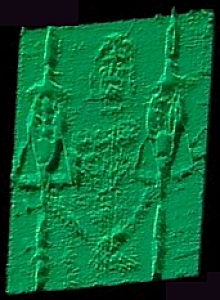 The same must happen with the shroud image, the programmer must arbitrarily allocate the 3D values to produce a 3D image. If he had chosen different values the face might have sunk into the cloth rather than extend above the surface. Look at this 3D image of the shroud from a pro-shroud website. The body clearly rises from the cloth, but then strangely, so too do the burn marks from the 1532 CE fire and the vertical crease marks on the shroud. They are even more pronounced 3D-wise than the body, when surely they should at be flat, and in fact perfectly flat, because they weren't on the cloth when Jesus allegedly rose from the dead. So when the resurrection of Jesus allegedly occurred, shroud proponents claim some magical energy apparently encoded 3D information into the cloth, but that energy wasn't present during the 1532 CE fire. So why do the burn marks show 3D characteristics along with the body? Overall I think the 3D claims create more questions than answers, and again they lead us nowhere. This is what is called an argument from ignorance, where proponents note that they can't explain what might have caused some strange phenomenon, in this case the 3D information, therefore nobody can, and if it's so mysterious that no one can explain it, then it must have been caused by God. Of course even if we were to accept the first part of the argument, that no one has an answer (yet), there is no justification to leap to God. Let's not forget those mischievous aliens from Alpha Centauri. The same must happen with the shroud image, the programmer must arbitrarily allocate the 3D values to produce a 3D image. If he had chosen different values the face might have sunk into the cloth rather than extend above the surface. Look at this 3D image of the shroud from a pro-shroud website. The body clearly rises from the cloth, but then strangely, so too do the burn marks from the 1532 CE fire and the vertical crease marks on the shroud. They are even more pronounced 3D-wise than the body, when surely they should at be flat, and in fact perfectly flat, because they weren't on the cloth when Jesus allegedly rose from the dead. So when the resurrection of Jesus allegedly occurred, shroud proponents claim some magical energy apparently encoded 3D information into the cloth, but that energy wasn't present during the 1532 CE fire. So why do the burn marks show 3D characteristics along with the body? Overall I think the 3D claims create more questions than answers, and again they lead us nowhere. This is what is called an argument from ignorance, where proponents note that they can't explain what might have caused some strange phenomenon, in this case the 3D information, therefore nobody can, and if it's so mysterious that no one can explain it, then it must have been caused by God. Of course even if we were to accept the first part of the argument, that no one has an answer (yet), there is no justification to leap to God. Let's not forget those mischievous aliens from Alpha Centauri.
Yes, I have read about the shroud's 'alleged photonegative properties', and it can be confusing when they start insisting that the negative image is actually the positive, and the shroud image is not a positive image but a negative and ... well, let me try to explain with some graphics. This is what I believe the shroud proponents are arguing when they talk of the properties of the negative versus the positive photo. Rather than use the real Jesus, since no one has a photo of him, I'll use a a photo of an actor playing Jesus in a CNN TV documentary. If I saw the actor on set and I took a photo of him with a camera that uses film (not a digital camera), then the camera would form an image on a strip of film that has the colours reversed. That image is called a negative, negative in the sense that it's opposite to what the real world subject looks like. When I develop that film, that process would reverse the colours back to what the real world subject — the actor — looks like, and we call that a positive image, or simply the normal photo.
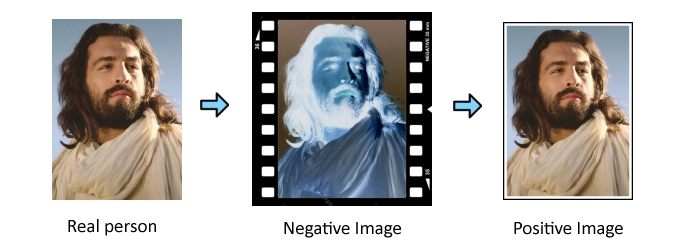
Now let's assume I have never seen that actor in person, or even seen photos of him, all I have is a T-shirt which has an image printed on it, and I've been told it's of the actor who played Jesus on TV. The T-shirt is my version of the shroud which has an image of Jesus printed on it. Now, unbeknown to me, the image that appears on the T-shirt is actually a negative image of the actor. I want to show others what the actor looks like so I photograph the image on the T-shirt. This two-step process first produces a negative of the T-shirt image, which you'll note now exactly matches what the actor really looks like, but I don't know that and I continue with the process and reverse the image to make a positive print. I'm happy with this positive photo because it looks just like the image on the T-shirt.
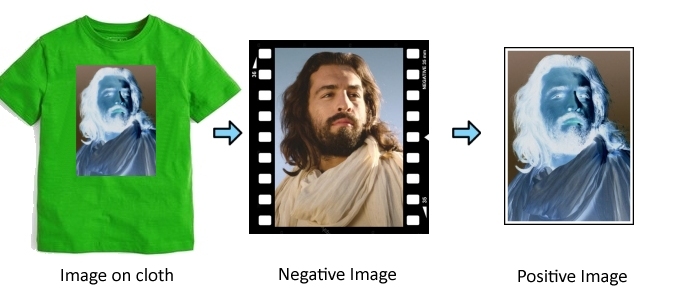
But others note that the negative I produced actually looks more realistic than the final photo. They argue that I didn't photograph a positive image of the actor, but a negative image, so that image only requires one colour reversal, not two as per normal. I apparently started midway through the photographic process, so I should have stopped with what I'm thinking is the negative image, and not carried on and produced that weird looking positive image.
As I explained above, normally we photograph a real subject, which creates a negative image, then we reverse that image by creating a positive image as the final photo. But with the shroud it's argued that the first step — photographing the real body and creating a negative image — has already been performed (somehow) and we've screwed things up by treating the image on the shroud as representing the real subject when in fact we're already dealing with a negative image, so all that is needed is just one image reversal. That's why the negative image of the shroud image looks more realistic than the final positive image, because what we call the negative image is actually the positive image, what the body would have looked like with our naked eyes.
So here is the process that is followed in photographing the image on the shroud:
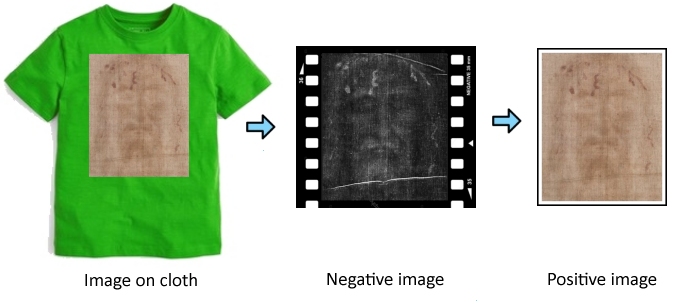
Now the obvious question is why would my T-shirt have a negative image printed on it, rather than the true image? Who knows, maybe someone thought it looked more artistic, but the thing is that today we understand photography and have the ability to easily print a negative image if we so choose. The image can be readily explained by the science of physics and chemistry. OK, but the same can't be said for the shroud, why might it have a negative image on it? When I took the photo of the actor with my camera, that process recorded a negative image on a film strip, and the shroud proponent argument seems to be that when Jesus rose from the dead, that supernatural process acted like the photographic process and also recorded a negative image, not on a film strip, but on the cloth that wrapped the body. They argue that when the shroud was created nobody had knowledge of photography, so how could they have faked a negative image? Ergo it must have been created magically when Jesus was resurrected, it is not something that could have been manufactured. This is the spooky argument required to explain a negative image on the shroud, but of course no such fanciful explanation is required if the shroud image is simply what it appears to be, a normal 'positive' image.
First, I'm not convinced that people couldn't create what we now call a negative image just because photography was unknown back then, because clearly they did create such an image, or so the argument goes. A negative image is merely an image that has had its colours reversed when compared to an original image. Light is replaced with dark and vice versa. Here is a simple example, and it's child's play, something that someone living in the Middle Ages with no knowledge of photography could easily do:
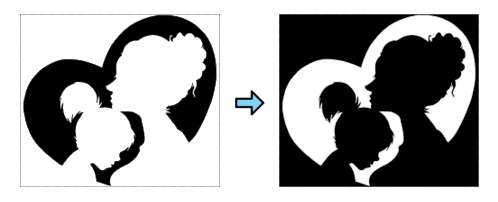
But having said that, I can see no good reason why anyone would go to the bother of creating a negative image on the shroud. Christians wanted to promote belief in Jesus, so any faker in the thriving medieval business of creating holy relics would naturally create a realistic image on the shroud that resembled what Christians thought Jesus looked like. They wouldn't have created a negative image that distorted the real image of Jesus and that required believers to wait for nearly 2,000 years until the invention of the camera to see the true image of Jesus. I don't accept that the visible image on the shroud is a negative image created by magical radiation as Jesus was beamed up to Heaven.
My second concern is this, does the negative image obtained from the film strip actually represent the most realistic real world image, meaning an image of a man that actually looks like what we believe Jesus would have most likely looked like, you know, if he was actually real? Look at these larger images of the shroud image and the negative image.
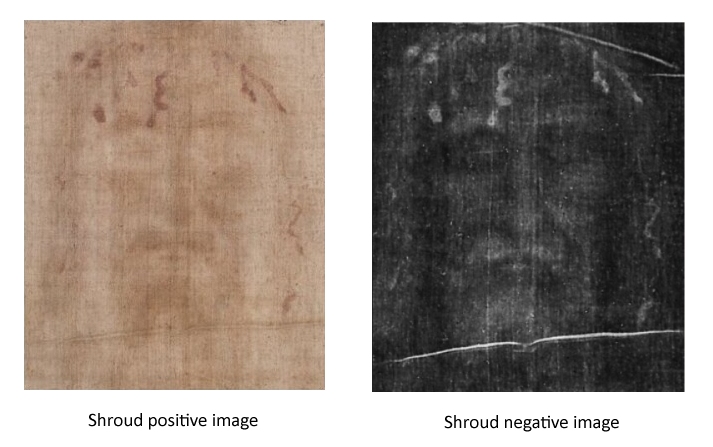
Now here's a real problem, one that skeptics like Joe Nickell and Steven Schafersman have highlighted. If you time-travelled and took a photograph of Jesus when he was alive, that photo would surely show him as a typical Hebrew of the 1st Century CE, with dark hair and light skin, which is exactly what the shroud image, the positive image, appears to show. But the negative image, the one that shroud proponents claim show the real Jesus, show a man with light hair and dark skin. His moustache and beard are clearly white or blond, the opposite to what we would expect Jesus to have. Also the blood on his forehead is white in the negative, yet we all know blood should be a dark colour if this is the real image, as it is on the shroud image, which points to the image on the shroud being the true image. In the negative image Jesus looks as though he has semen on his face and in his hair, not blood.
So yes, you can apparently discern more detail in the negative image in that the body looks more realistic, but at the same time the negative image gives Jesus an appearance that he would not have had, eg a blond moustache and white blood. Plus scientists have discovered that photography using different wavelengths and lighting can reveal details unseen by the human eye, but that doesn't mean that the likes of Egyptian hieroglyphics and Norse burial mounds were deliberately constructed in such a way as to make investigations easier for us thousands of years later once we had invented photography.
The fact that the negative image looks better than the badly faded image on the shroud is just a fluke, I don't for a moment think the shroud image was deliberately or accidentally created on the shroud as a negative image of the body it was wrapped around. There is no known event that would cause such an image to form naturally on the cloth, and if there was, as I've said, if a negative image was created in the process then the hair and blood should be light in colour, not dark. If a negative image was created artificially and deliberately, what would be the purpose, since no one would be able to see it until the 19th century, and then by the 20th century it had been dismissed as a medieval hoax, ending its fifteen minutes of fame. A lot of work for nothing. It can't be argued that God magically created the negative image on the cloth as a sign for a handful of superstitious people in the 19th century, because clearly it didn't work, even the Pope won't commit to it being real.
But again, as I said at the start, even if we had clear evidence that someone had deliberately manipulated the image on the shroud, we would still have no idea whatsoever as to who they were, when they did it and why they did it. OK, not quite true, because of the radio carbon dating we'd know it was done sometime around the 14th century. But we would be back to having a mystery, with nothing pointing to angels on clouds or barbaric gods killing their children.
 Return to Article
Add a Comment

|

 Support Science Not Superstition