|
Comments:
-
Comment by Suzy, 23 Jun, 2007
Hi, I just found your website and I loved the piece you did on Ian Wishart, I can not see how anyone can look at the Bible the same way, it really got me thinking. The great part about me is, I had always been around alternative religions, but, your article clicked something in my brain and I emailed the link to a number of my friends. We have had many discussions about it.
The funny part of all this is, at one time in my life, I did know Ian Wishart (quite well), so that made the article even more surprising he would think that a "story" book or a book that has taken bits and pieces from different cultures would be the "word of God". If you do your own "investigating" you would find that most of these stories predate God/Jesus, thousands of years and he calls himself "an investigating journalist", that is scary!! I will visit your site again, keep up the great work by making us think for ourselves.
-
Comment by Carmelo, 26 Aug, 2007
Great site. really enjoyed it! It is a pleasure to read rational scientific points of view so robustly defended. I browsed through one of Ian Wishart's books at Auckland airport (Eve's bite or some other drivel) and was appalled. I googled his name and found your site which made me realise that there are people like me out here. Power to your pixels!
-
Comment by Liz, 21 Sep, 2007
Cool website, have sent the link to my friends. Hope to see it grow.
-
Comment by M, 14 Oct, 2007
Thankyou for your insightful, thorough and humorous criticism of Wishart's rantings and of the Bible in the general. I struggle to find any basis for having faith in orthodox religion and insightful essay's such as yours are indeed reassuring.
Although, one point I feel I should raise is regarding your reference to Luke 19:27:
"But those enemies of mine who did not want me to be king over them — bring them here and kill them in front of me." (LK 19:27).
I think you'll find that Jesus says this in the course of a parable that he was telling. The words are actually those of the parable's protagonist and not Jesus'. It begins at Luke 19:11:
"While they were listening to these things, Jesus went on to tell a parable, because He was near Jerusalem, and they supposed that the kingdom of God was going to appear immediately." (LK 19:11).
-
Comment by the 'Silly Beliefs' Team, 14 Oct, 2007
Thanks for your email and comments re our essay on Wishart and the Bible. We're glad you enjoyed it. You are quite right that the words in Luke 19:27, though spoken by Jesus, are part of a parable. However we believe that the message that Wishart was pushing, and the quote from Jesus, is still valid. We agree though that readers could dismiss our argument on the grounds that Jesus didn't 'really' say that, the protagonist did. Therefore we have expanded that section to hopefully show that it doesn't matter whether Jesus said it directly or via a parable. The message readers of that Gospel should take from it is the same. Wishart certainly saw it as a message from Jesus, a message justifying killing in the name of god. Thanks for pointing that possible confusion out. We don't want to change minds by deception.
-
Comment by Graeme, 23 Oct, 2007
Thank you thank you thank you. Tremendous website. Eloquent, funny and sharp.
I especially love the Wishart demolition and the Sensing Murder shite.
Keep up the good work.
-
Comment by Graeme, 26 Oct, 2007
I have a nice bit for consideration for your Bible inerrancy section. It's to do with natural history.
Matthew 6:26
"Look at the birds of the air, for they neither sow nor reap nor gather into
barns; yet your heavenly Father feeds them."
Sheeesh! No he doesn't!! If Jesus had looked at the birds for more than 5 minutes he would have found that these birds never rely on gifts from any heavenly Father. They actually work fucking hard for every scrap, and plenty come up short every day, and die. Silly silly Jesus. Bad analogy.
Still loving your site. Many thanks.
-
Comment by the 'Silly Beliefs' Team, 27 Oct, 2007
Hey Graeme, thanks for the bit about the carefree birds. I'll add it to the Wishart article. I hadn't heard that one before but then people have written entire books on Biblical errors.
It's also amazing that no matter where you seem to dip into the Bible you can find silly passages. For example, near your passage Matthew 6:22 says "If your eyes are good, your whole body will be full of light. But if your eyes are bad, your whole body will be full of darkness". Does this mean that the blind are evil or merely depressed? MT 6:24 says "No one can serve two masters. Either he will hate the one and love the other, or he will be devoted to the one and despise the other. You cannot serve both God and Money". Technically I'd think it was impossible to have two masters, since if you don't have complete control then you aren't a true master. But if we assume that parents are "equal masters" of their children, then Jesus believes that children must hate/despise one and must love or be devoted to the other. Seemingly it's impossible to love both. This is hardly what I'd call good parenting advice!
On the other side of your example following on from your carefree birds we have: MT 6:28 "And why do you worry about clothes?" So is Jesus suggesting we all just set off naked and only wear clothes if God offers us some? From my perspective, while this may be acceptable if one lived next to a girl's high school, imagine if you lived next to an old folk's home? My eyes, my eyes!!! And to think it's the Christians — who usually have a major problem with nudity — who are suggesting we forgo clothes.
-
Comment by Graeme, 28 Oct, 2007
The carefree birds thing came to my attention (i felt like kicking myself!) via CK Stead. His book "My Name Was Judas" is outstanding. Go get a copy at once! I have an abiding interest in theology and for my money, he's done a perfectly credible wrap of Jesus' ministry.
While the shedding of clothes may easily be drawn to be an analogy for an ascetic life, the birds thing is just plain wrong, as is your perceptive analysis of the Master/Servant problem. That cracked me up.
-
Comment by the 'Silly Beliefs' Team, 28 Oct, 2007
Hi Graeme, I agree your take on the clothes bit could be right, but that is a major flaw with the Bible and holy books in general, in that the reader can easily come up with different meanings. Any decent God wouldn't write an instruction book that is open to different interpretations.
-
Comment by Luke, 23 Nov, 2007
Hi John,just curious as to where you got the magazine cover art from? Not sure where you are based, but Investigate as you probably know is a New Zealand publication and I haven't seen the cover in question. I assumed at first that it was just a mock up but your disclaimer says that you attempt to portray factual information wherever possible? Look forward to your response.
-
Comment by the 'Silly Beliefs' Team, 24 Nov, 2007
Hi Luke,thanks for your comment. We're pretty sure the Investigate cover is a spoof. And for the record, the picture of Jesus, Noah's Ark and Adam and Eve aren't of the real thing either. The one of the priest and altar boy is probably a joke, but who knows, this could well be a real stained glass window from a Catholic Church somewhere. (The pictures were found on the Internet).
We thought it would be pretty obvious that the cover was a spoof considering the titles of the articles it mentioned, but after reading Wishart's other articles on religion I guess people really could expect him to have written them. We certainly do attempt to portray factual information wherever possible, but we also try and include a little humour. Since some people may be misled by the cover we'll add a comment to the effect that it's a spoof.
-
Comment by Bob, 24 Nov, 2007
Hullo John, I have just read part of your article on Ian Wishart and his religious beliefs. I didn't know he was a fundamentalist Christian. I have only heard of him through his political articles. I would have thought he was too intelligent to be a fundamentalist. It just goes to show. It depresses me to see hard facts and evidence rejected for vacuous beliefs. I can't understand why every intelligent person can't see that Genesis is a compilation of ancient Middle Eastern myths at a time when human imagination took the place of real knowledge. If I live to be 150 I will never understand people.
I have come to the conclusion that debating with bible fundamentalists is a waste of time. A logical thinking person, atheist or otherwise, will look at evidence and facts and draw conclusions, the scientific way of thinking. Fundamentalists and even non fundamentalists like the Catholic Church start off with conclusions and make the facts fit. They will argue black is white if necessary. Humans have a strong tendency to believe what they want to believe. If they didn't those psychics would have been laughed off the stage long ago. I have argued with fundamentalists over the internet. They never bend. I have found some to be abusive when they can't win or you refuse to see things their way. The ordinary fundamentalists are led by the nose by the leaders and simply parrot what they are told. I am however heartened when I hear the views of church people such as Lloyd Geering, Bishop Spong and recently Archbishop Randerson. Their intelligence has led them to doubt their previous beliefs. Religious belief has been declining in the advanced societies. Whether there is any connection I don't know but it has coincided with a long period of European peace among countries which have warred with each other for centuries.
-
Comment by Paul, 08 Apr, 2007
Gidday there John, Hey, I've enjoyed your site for some time mate.
Your article on the Investigate mag is outstanding...
-
Comment by Bob, 29 Jul, 2008
In today's Herald there is a story about a lady whose heart stopped while attending a Seventh Day Adventist service. She had a history of heart trouble. Apparently a skilled cardiac nurse happened to be in the congregation. He applied CPR and got her heart started again. The lady would have died without him. Now while I don't know the lady it is one of those good heart warming stories. I am glad for the woman and her family.
What does dismay me is the delusional attitude of believers. It appears she had just praised God speaking of her love for him. However God got the credit for bringing a medical specialist into the church just when he was needed. Nothing is said of the fact her heart stopped just after praising God. Why would God allow her to be struck down at that moment then perform a miracle to save her? Was he organising a stunt or was it just coincidence? It is the usual thing that when things go right for believers God gets the credit but little is said when things go wrong.
What bothers me about religion is the lack of logic in beliefs. Fortuitous coincidences are God's work while the opposite are glossed over or explained as God deciding not to help. God works in mysterious ways so no explanation is needed. Just as well thinking people pulled away from the idea the world works on God's whim or science would nevev had gotten off the ground.
-
Comment by the 'Silly Beliefs' Team, 30 Jul, 2008
I agree entirely with your view Bob. I've also long thought it was delusional that believers could praise God for what they saw as miracles and even ordinary things like a sunrise, yet disasters and evil in general are put down to nature.
A plane crashes killing hundreds but a baby survives. Believers proclaim a miracle, but what sort of god would slaughter hundreds just so he could show off by saving a baby, while killing its parents in the process? And just think of the number of believers that have been killed while on religious pilgrimages, especially Muslims at the Haj and busloads of Hindus plunging into ravines while on pilgrimages. Christians would no doubt say that these non-Christians are being punished for worshipping the wrong god, but there are plenty of examples of Christians being smitten, your woman with heart problems for example. Remember the three children killed in a river by a collapsing cliff face in 2006? They were at the Highland Home Christian Camp. Then we have the seven Christians from the Elim Christian Collage drowned in that river tragedy. And how about this one that I recently saw on the Internet:
"Two soon-to-be-married Christian camp counselors died almost instantly when they were shot in their heads in their sleeping bags on a remote [California] beach... Clenching hands in a Baptist church, cloaked in their faith, the families were "grateful to God for taking our children home," said the slain woman's father, the Rev. Chris Cutshall, an evangelical minister."
Their children have been murdered but these morons are only "grateful to God for taking our children home," no hint of anger that he didn't stop them from being murdered in the first place.
How can believers come to terms with the situation where their fellow believers are being struck down in equal numbers to atheists and believers in false religions? Why doesn't their god offer them some sort of greater protection? Even if there were a god, doesn't it occur to them — due to all the deaths — that they may be backing the wrong one? A friend of mine, raised a Catholic but now irreligious, when seeing an item on the news where believers suffer a misfortune, now sarcastically asks, "Why would God do that?" It's a shame that believers won't ask that question and seriously consider its implications. My friend has long been indifferent to religion, but I think my explicit atheism has forced her to consider whether there even is a god, rather than just ignoring the topic as many agnostics do.
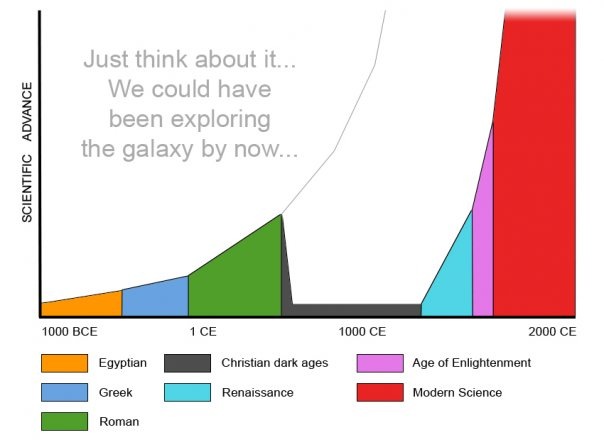
As you say, we are extremely fortunate that thinking people turned their backs on religious answers or else we wouldn't have the modern world. It's scary to think that civilisations have collapsed in the past and the world retreated once again into superstition. Imagine where we might be now technologically if the ancient Greek civilisation had continued to progress? And there are many believers today that would be quite happy if our society went back to simpler times, where their god provided all the answers and was shown his due respect.
It's good that you can debate religion in public these days, openly denying god exists or challenging a religious interpretation of some event. Science and reason is on the ascendancy these days but we must continue to challenge those with other views, whether it is on religion, homeopathy or alien abduction. No doubt the ancient Greeks thought their new ways of examining the world — science, philosophy and democracy — would have lasted longer than it did. We can't be complacent. There are still plenty of people knocking on my door telling me evolution is false and that a long dead carpenter called Jesus is who I should be reading about.
-
Comment by David, 27 Sep, 2008
Hi John, well, I don't intend to cause any offence, as I too don't really support Ian Wishart, and actually came across one of your articles while doing my own 'Investigation' of Wishart. However, having said that, I did find it a bit annoying really reading through parts of your article as you seemed to continually switch logic and by the end it just seemed to be an argument that was as hole filled as our opponents!
The problem is this, I think, it's great to see someone who truly believes they're an 'atheist', or so it seemed to be the case (correct me if I'm wrong!), however, isn't the 'not believing' in a deity essentially stating he exists?!!? How can one say "I am lactose intolerant, but I don't believe lactose or milk exists!" To be intolerant do we not first have to acknowledge the existence of something, and if we're denying the existence of a deity, isn't that in itself to some degree suggesting we really believe in it, just we're not entirely happy with who it is?!?!
To deny something, is in essence to acknowledge the possibility of its existence, and that is a fatal mistake many make with out even realizing. I think when its all boiled down, we believe what we've experienced. It seems to be human nature really, we cannot believe, what we have not experienced.
All that aside, I felt it was a fairly alright article and point of view, however, 'factual' issues would fail I think if put under scrutiny! For instance, and this is just one example of a number, you mentioned that the sea was made flat and quoted a verse from 1Kings 7:23 You're absolutely correct stating that it was flat, BUT, take it in context!! It wasn't at all saying that the ocean was flat, rather, a small sea that King Solomon had built in his temple was flat, which is totally acceptable as even today the sea would often be made flat if we were to make it as a fountain!
Incidentally, I thought you were trying to DISPROVE the bible?!?!? And yet that verse there could be used to PROVE it instead by some! How? Well simple really. If you read through the measurements given there, it says it was 10 cubits in diameter, and approximately 30 around. What's that tell us? Check it out if you don't believe me, but there in lies the approximate value of Pi!! Pi was supposedly invented latter on, like a good 500 years or more latter on, and yet all you've done is prove that the Jewish civilization had Pi an awful long time before hand!
Anyway, I'm not out to prove that at all, although if you're truly open to constantly improving things then you may want to take 5000 years of experience, on which all modern computation is largely based, on board!! For instance, you may well have heard of 'checksums' in computing, well, that's a fairly ancient Hebrew practice for ensuring constancy when copying documents.
Honestly, I think at times its hard to see through the mud, but I do usually catch on when someone's a tad of a scam! (which I suspect Wishart is, albeit a little or a lot, brings back memories of a bloke named 'Julian Bachelor' really!). Anyway, look forward to hearing your response.
-
Comment by the 'Silly Beliefs' Team, 27 Sep, 2008
Hi David, thanks for your comments. First — you're right — I am truly an atheist. Related to this position, you ask "isn't the 'not believing' in a deity essentially stating he exists?!!?"
No, not at all. All you have to do is replace the word "deity" with a truly fictional being to see that this view is flawed. Let me now ask you, "Isn't the 'not believing' in "Santa Claus, the Tooth Fairy, the Greek god Zeus and Captain Kirk of the Starship Enterprise" essentially stating they exist?!!?"
Hopefully you'll agree that none of these beings actually exist, and have never existed except in our imagination. I'm sure you would argue that these beings are all pure fantasy, and that you see no evidence whatsoever that they are or were ever real. If you can deny the existence of these beings without contradicting logic or evidence, then an atheist can equally do it for a similar fantasy character.
The problem that I see with this view is that many believers find it inconceivable that their god doesn't exist, and simply can't understand that atheists — or followers of other gods — don't feel the same way. To them, me denying that their god exists seems as ridiculous as if I was to deny that the sun exists. Christians for example, have no problem denying that the Greek god Zeus exists, that the Islamic god Allah exists or that the Hindu gods exist. They are experts at denying all manner of gods. Yet when an atheist wants to add one more to their list of fictional gods, they say that this is illogical. Even though they have denied thousands of gods themselves, they ask in a surprised tone — How can you atheists deny a god exists?
I'm afraid the "lactose intolerant" argument doesn't work either, since it's debating something that isn't real. Atheists are not "god intolerant". We are tolerant — or not — of religion and it's followers, not its fictional gods. I agree that if I said I couldn't tolerate what God does, then I would seem to believe in him. But an atheist would never say this, only a believer angry at his or her god would say this. God denial is completely different from god intolerance.
You also wonder that if "To deny something, is in essence to acknowledge the possibility of its existence, and that is a fatal mistake many make with out even realizing." There are two problems here. First as we've already said, it's perfectly reasonable to deny things without ever acknowledging that they might actually exist — Zeus, Captain Kirk, unicorns and apes the size of King Kong for example. Second, an atheist and skeptic who has truly thought about these things will always acknowledge that it is "possible" that gods — and unicorns and leprechauns — might exist. We do not — as we are usually portrayed — insist that we can prove categorically that these gods don't exist. We merely say that all the evidence available to date suggests very, very, very strongly that they don't. Likewise no adult can prove categorically that the Tooth Fairy doesn't exist, yet no sane adult says when discussing the Tooth Fairy that she might possibly exist, but it's not very likely. They simply say she doesn't exist. They believe the chance of them being wrong is so minute that it's not worth mentioning. It's the same with thoughtful atheists, we accept that of course it's possible that gods really exist, but it's so bloody unlikely that it's not worth qualifying our denial with legal small print. Think about it. You never hear the Pope say "Praise the Lord — but remember my children, it's possible he doesn't exist". If atheists are to be forced to continually acknowledge that there is an astronomically slight chance that they may be wrong, then so too must believers add this statement.
You go on to say "I think when its all boiled down, we believe what we've experienced. It seems to be human nature really, we cannot believe, what we have not experienced."
Then why do people believe in gods since almost no one has ever experienced them? Almost every civilisation that has invented gods throughout history have been shown to be wrong, and accepted as being wrong by Christians and atheists alike. The Egyptians, Romans, Greeks, Maya, Aztec, Vikings, Celts, Maori all believed in gods that we know they never experienced since we all agree that these gods never existed. They believed even though they didn't experience. Likewise I believe that dinosaurs once existed, that it's extremely hot inside a star and that rape would be traumatic. Yet I have not experienced any of these things. This demonstrates that it's perfectly reasonable to form beliefs about things that you have never experienced, and never will.
Regarding one of our claims, you say that we "mentioned that the sea was made flat and quoted a verse from 1Kings 7:23." No, we didn't actually. We mentioned that the writers of the Bible thought the "world" was flat and this remark referred to our previous Bible quote MT 4:8. Sorry if this wasn't clear. We've added the following sentence to avoid confusion: "In the next example we have an error in mathematics".
The quote from 1Kings 7:23 was to show that fundamentalists believe that the ratio of a circle's circumference to its diameter — pi — is "exactly" equal to 3 — not approximately — but exactly! As we mentioned, this is born out by the fact that fundamentalists in the US have tried to legally change the value of pi from 3.141592654... to exactly 3. You write that the Bible says "it was 10 cubits in diameter, and approximately 30 around" and that this is "the approximate value of Pi" However you have introduced the word approximately, the Bible does not say "approximately" or even hint that the value is only approximate. I agree with you, that this is probably what it means — approximate — but we are arguing against people that take the Bible literally, that what it says is exactly what it means. You and I and most Christians know that it is only an approximation and that a rim 10 cubits in diameter can't have been 30 cubits around. Yet many fundamentalists insist that it was — exactly. It wasn't 31.4 cubits, it was 30. This is an error of fact if you take the Bible literally.
You also say "all you've done is prove that the Jewish civilization had Pi... " Actually I'm not so sure that we can say that. All the Bible says is that they measured the diameter and the circumference. We don't know from this that they knew of the mathematical relationship between them. They may have, but then why did they say "It took a line of thirty cubits to measure around it." They knew the diameter, so if they knew about pi, why didn't they just calculate the circumference rather than physically looping a line around it?
When we hear this argument from believers — about pi, checksums and open star clusters being in the Bible — it is always to impress on us the amazing knowledge that ancient Hebrews supposedly had, knowledge that no other civilisation had at that time. It was "impossible" knowledge that could only have come from God. So we need ask believers, what's it going to be? Intelligent Hebrews working things out for themselves, or stupid Hebrews being told all the answers by their God? Either way their religion suffers. If the Hebrews had be continually given the answers while other civilisations like the Egyptians, Greeks, Romans, Babylonians etc worked it out for themselves, then God's chosen people are the dunces of the world. If the Bible is the work of the Hebrews themselves, then their god didn't exist. Furthermore, our article clearly showed that much of what fundamentalists claim matches modern scientific knowledge is wishful thinking, very debatable interpretations — and more often than not — just plain wrong.
To support your view of the origin of pi, you claim "Pi was supposedly invented latter on, like a good 500 years or more latter on, and yet all you've done is prove that the Jewish civilization had Pi an awful long time before hand!"
In fact this is another myth. Here's what one of many sites say about pi: "The earliest known approximations date from around 1900 BC; they are Babylonia (3.125) and Egypt (3.162), both within 1% of the true value. The Indian text Shatapatha Brahmana gives pi as 3.139. The Jewish Tanakh appears to suggest, in the Book of Kings, that pi = 3, which is notably worse than other estimates available at the time of writing (600 BC)."
That said, we're picking on Christian fundamentalists, not the ancient Hebrews. We would be the first to agree that ancient man wasn't stupid. That's why it annoys us when people claim that ancient man couldn't have done this or that and therefore it must have been gods or aliens helping him. It's frustrating to hear people claim that up until last Tuesday European sailors thought the world was flat or that the Egyptians couldn't have built the pyramids. Of course a lot were, and still are, ignorant of how things work, but many were brilliant, and as you say, only by building on the knowledge obtained in the past have we reached where we are today. As Sir Isaac Newton said, "If I have seen further it is by standing on the shoulders of giants".
You asked, "Incidentally, I thought you were trying to DISPROVE the bible?!?!?" No, not disprove the Bible per se, merely to show that it is not the inerrant work of an all powerful, all knowing, all benevolent god. That it is merely the work of many different human authors expressing the knowledge, culture and superstitious beliefs of their time. There are certainly many facts expressed in the Bible. The Hebrews did exist in the Middle East, so did the Romans, the Egyptians, Babylonians etc. Some of their descriptions of the world and history are factual, but a great many are purely mythical. Most Christians now accept that many events described in the Bible never happened — Adam and Eve, the talking serpent, the Flood of Noah — well all of Genesis actually — and numerous other magical events that wouldn't be out of place in a Harry Potter book, plus other episodes that seem better suited to a Steven King horror novel. As most Christians acknowledge that more and more of the Bible is being overtaken by science, history and ethics, fundamentalists unfortunately become more entrenched. Every single word of the Bible is true. It is at fundamentalists like Ian Wishart that our article is aimed.
You also said that our 'factual' issues would fail I think if put under scrutiny! For instance, and this is just one example of a number... " If you have time, please let us know what other claims we have made that you think are erroneous. We may indeed have got something wrong or perhaps expressed it poorly. We will happily correct any mistakes that can be shown to exist.
-
Comment by David, 29 Sep, 2008
Hi John, thanks for your in-depth reply. I do always find it good when people are able to back up their points of view, or at the very least openly debate and contend differing perspectives.
So, where shall I begin, I'll just be totally open on everything. I grew up in the lower Himalayas, and I guess as a result was largely beyond the grasps of dead religion, as being a 'white guy' I knew for certain Islam wasn't for me or culturally compatible, and the various other options didn't really stack up either. I guess as a result most of my thoughts are maybe somewhat still naive and not as hugely developed as other people my age. Maybe. I have however spent a great deal of time over the past few years both reading up on various beliefs, as well as traveling and experiencing different situations.
I actually do largely agree with your comments about Santa etc not existing, and how we shouldn't have to have a disclaimer for the minute chances of something existing (such as god's, spirits etc) and I do think it's wrong the way in which fundamentalist Christians, or anything, tend to apply one set of rules to their own beliefs and yet quickly change things for others (such as the issue with forcing atheists to acknowledge the possibility of 'gods' or a 'god' etc etc). That's pretty childish in my view and I'll try not to be hypocritical with anything that I say either!
I think having read through you're answers I can see more where you were probably coming from when you wrote the article. I hadn't been aware of the issue of hardliners in the US trying to change the value of Pi, and I for one will vouch it's correct at 3.14... as I actually personally 'discovered' pi by myself one day while playing around with a piece of string, a circle, a calculator and a somewhat creative feeling mind! At the end of the day, I really don't think people can argue now as to what it is! A piece of string will really only stretch so far, and math's is math's! I guess that's why I do rather like mathematics, its just so undeniably correct!
With regard to the comment about 'Christians' being good at denying all other 'gods' I do agree. I think really, while it'd be nice to utterly deny the existence of some things in life, to me that's not really having an open mind. We may not believe in certain creatures existence, but as I said, most people do base their beliefs on their levels of experience or marginally higher (ie if it's higher than their experience then I'd view that as a higher level of 'faith' or plain stupidity!!).
Those who say they believe in a 'god', of any sort, usually believe for a reason, either an experience of the 'deity'/'spirit' or a lack of experience. Most people born into a religion seem to stay in it, purely because that's all they've experienced. Although some few, who I think are the smarter ones, will start to question things they haven't experienced, and those are the ones who go on to make bigger discoveries in life. And then, we seem to have a remote few who both question things, but also have unquestionably felt, and experienced things that are beyond our current 'scientific' explanation, and it is these people, who have an unshakeable 'faith' or 'belief' in the things that are unseen, or 'supernatural' (ie deities/gods etc).
As for what we view as 'evidence', that's a whole different debate I guess. I mean in any court of law, an 'eye witness' usually counts for something right? So why doesn't an 'eye witness' who's physically, spiritually, or otherwise 'felt' something, 'heard a voice' or something else, why would they not be considered 'evidence'?!? After all, there are literally millions of people who either claim to 'speak' to 'god' every day, or have at some point 'spoken' to him, or have felt other 'gods' or 'spirits' etc etc.
And what do we use in 'evidence' to 'disprove' a 'super natural aspect' to our planet and universe??!? It's really all only either 'eye witnesses' or seeming 'flaws' in some 'book' that was apparently 'written' by a 'divinity' (although I think its fairly widely accepted that while being 'inspired by G-d' it wasn't actually physically 'written' by him, aside from maybe the ten commandments!).
Some might argue 'evolution' disproves a deity, I would beg to differ though, and would suggest that no matter how great or powerful the deity may be, if a deity were to 'command' the earth to 'be' then there would most definitely be a HUGE bang!!! So I don't really think it 'disproves' or diminishes the existence of it at all.
I also find some of the things we humans argue over are really so ridiculous, it's no wonder we can't agree on much! I do admit that the bible may well seem to or may well be 'wrong' but seriously, if you put yourself in a prophets shoes, would you have ever thought that people would argue about the way you wrote down the diameter or circumference of a pool of water?!?!? Yes I do agree he could've stated something like "we then calculated that based on the diameter of the pool being ten cubits the circumference was therefore 31.4 cubits!" That would've been better, but I doubt it crossed their minds at all that it'd be such a big deal the way they wrote it.
Anyway, I probably haven't answered all your comments very concisely, I do largely agree with most of what you've said, however, I think as humans we do maybe need to be more open, either to a potential 'spiritual' aspect/dimension or at least to seeking out a more 'scientific' method or way of 'explaining' so called 'spiritual' experiences! It may well be that more people suffer from huge mental disorders then we currently think!!!
Look forward to hearing your thoughts, and thanks heaps for all your time too, it is definitely interesting sharing.
PS Out of curiosity, are you guys based in the US or New Zealand? Just was a little curious as I've been learning more of US 'Christianity' lately, and the more I learn, the more absurd a lot of it seems, and the more I find peoples choices to have different opinions/beliefs make very good sense really! A lot of even 'mainstream' 'Christianity' there seems rather obscure to me, and far too 'literal' and pedantic on the whole 'word of god' etc etc that they seem to go on about, so I'd definitely be interested in any insight you may have on that as well.
-
Comment by the 'Silly Beliefs' Team, 30 Sep, 2008
Hi David, you're right, open debate is a positive thing and it's always fun trying to defend one's viewpoint. Sorry about the length of our reply but it's not easy to refute the beliefs of billions and millennia in a couple of sentences.
I'd like to comment on a few things you mentioned. To start with you said, "I think really, while it'd be nice to utterly deny the existence of some things in life, to me that's not really having an open mind." Sorry David but I'm not impressed with the open-mind/closed-mind argument that is bandied around in these sorts of discussions. I'm not suggesting that you're calling me close-minded, merely that some do use it this way. It's all too often pulled out when someone is faced with a mountain of evidence demonstrating that their particular claim is false. I see it as an attempt to embarrass one's opponent, to make them think that they are being unfair or unjust in their criticism of some claim. To make them relent and acknowledge, "Oh well, maybe you are right. Only time will tell." People are not being close-minded when they present overwhelming scientific evidence and their opponent presents nothing but stories, anecdotes and testimonials.
I'm sure I could give you an enormous list of things that you would utterly deny. Again the obvious things like Santa Claus, the Tooth Fairy, Zeus and leprechauns. Religious types get annoyed when I give these examples because they insist that obviously no one believes in those silly, childish things any more. The fact is they hate to think that their god is on a similar standing to the Tooth Fairy. But they are equal — they are all supernatural beings — and I would answer that no one in my family or close group of friends believes in God either. I see no difference between gods and leprechauns. They are both imaginary supernatural beings invented by ignorant humans in a time when we were primitive and superstitious. I see no reason or need to believe in leprechauns. Likewise I see no reason or need to believe in gods. No one calls me close-minded because I don't believe in leprechauns. If it was a valid argument they should.
To me being close-minded means to refuse to consider some claim out of hand, without looking at the evidence, to reject a claim that may have a reasonable chance of being correct. Imagine if someone insisted that planes couldn't fly, and you utterly rejected this claim, offering a stack of conflicting evidence, as I hope you would. Imagine if this person then said that by denying his claim outright you were being close-minded. Would you then admit that you are being close-minded, biased, unreasonable? Would you recant and say, "I believe I have an open mind, so maybe you're right. Maybe planes can't fly." I suspect not. I would reply with the word bullshit. I'd say that there is an enormous amount of evidence that say planes can and do fly and none that say they don't. Believing this is not being close-minded, it's being rational. Accepting this unsupported belief, even provisionally, would not make me open-minded, it would make me delusional.
I could be wishy-washy and not take a stance on anything — maybe astrology works, maybe aliens have abducted me, maybe the world is only 6,000 years old, maybe science has got it all wrong — but if this is what some people think it means to be open-minded, then count me out. I'm going where the evidence points.
You said that "most people born into a religion seem to stay in it, purely because that's all they've experienced."
Exactly. Most people in the USA are Christian. Most in the Middle East are Muslim. Most in India are Hindu. It's not that Jesus actually lives in the US, or that in India the Hindu gods really do exist, it's just that children in each country are only told about the things that their parents believe in, whether they are true or not. These children, and their parents, and their parent's parents haven't actually experienced their god or gods, they've only experienced the stories and rituals that older people told them. As a child I experienced stories of Little Red Riding Hood, of talking pigs that experimented with different house construction methods, and a wacky duck called Donald who for some reason worn a top but no pants. The only difference is that as I matured and learnt more about the world I stopped believing these stories my parents had told me were real. And that includes the god one. A Christian child in the US is convinced that the story his parents told him is true and that the parents in all those other countries are — unknowingly — lying to their children. And the same is believed in the Middle East and India. Once an adult realizes that the majority of parents around the world must be misleading their children, why can't they ask, "Why couldn't it have been my parents that misled me? Have I been born in the right country?"
Explaining why people 'believe' you say "Those who say they believe in a 'god', of any sort, usually believe for a reason, either an experience of the 'deity'/'spirit'..." and that some "have unquestionably felt, and experienced things that are beyond our current 'scientific' explanation, and it is these people, who have an unshakeable 'faith' or 'belief' in the things that are unseen, or 'supernatural' (ie deities/gods etc)."
Yes many people have "unquestionably felt" something, but remember that everything we sense or perceive, everything we experience, is presented to us by our mind. Some things we feel or experience are via our senses relaying impulses to the mind. These "things" exist in the real world. Other feelings and experiences are purely imaginary, as in dreams. The brain also creates other experiences — like delusions resulting from mental illness. Having an unshakable belief that you are Napoleon or that you are communicating with aliens from another galaxy doesn't mean you are. Having an overwhelming positive feeling of God doesn't mean that God exists or that he's chatting with you. I have felt love, does that mean Cupid exists? I have unquestionably felt lust, does that mean the god Eros exists? And these "religious" experiences that people claim to have are not "beyond our current 'scientific' explanation". A condition called 'Temporal Lobe Epilepsy' for example can create the extremely powerful and realistic feeling of religious euphoria. Sufferers often swear they are communicating with God or Jesus or whatever god they believe in. They sometimes even think they are God. Neuroscientists can even stimulate the temporal lobe of the brain of perfectly healthy people and they too report this religious feeling that is indistinguishable from reality. Likewise things such as Near Death Experiences (NDE) and Out Of Body Experiences (OBE) that religious people claim as interacting with god are perfectly explained by neuroscience. They're all caused by the brain malfunctioning. When someone says they have felt God, or a ghost, many people believe them. Yet if they were to claim feeling a leprechaun or a monster under the bed, we immediately say they must have imagined it. Why do we give religious people the benefit of the doubt, especially when there's no more evidence for gods and ghosts than there is for leprechauns? I think the problem is that most people don't realize that gods, ghosts and leprechauns are all in the same boat evidence wise.
You go on to ask "So why doesn't an 'eye witness' who's physically, spiritually, or otherwise 'felt' something, 'heard a voice' or something else, why would they not be considered 'evidence'?!? After all, there are literally millions of people who either claim to 'speak' to 'god' every day, or have at some point 'spoken' to him, or have felt other 'gods' or 'spirits' etc etc."
First these people are not real "eye witnesses". They don't see, hear or feel anything that would be accepted in a court of law. And it has been scientifically proven of late that eyewitness testimony is not as reliable as people thought it once was. Also nearly every person who speaks to God will admit that he doesn't actually talk back. You ask kids saying their prayers at night if they're actually having a two-way conversation with God — like they do with Mum and Dad — or are they merely talking out loud, hoping that an invisible person is listening. Prince Charles speaks to his plants. Speaking to plants doesn't mean they are listening or are even capable of listening, or in the case of gods and ghosts etc, even exist to be able to listen.
Many Christians would insist that talking to God is a real experience for them, in that that they can sense God's presence. It's more than just an active imagination. Yet they would immediately discount the same claim from a Hindu or a Muslim. They would insist that these people are just imagining these feelings of a divine presence, that it's all in their mind. Why should we believe that a Christian can recognize a real encounter with the divine but the rest of the world are just having psychotic episodes? Why should we accept the testimony of a Christian but not a Hindu? And they can't both be right. One is mistaken. If we know that one is mistaken, isn't it likely that both are? If brain chemistry produces delusions in humans who are Hindus, why shouldn't it do the same in Christians?
Remember also that of the millions who insist they are talking to God, the majority are NOT talking to the god you might believe in. No matter what religion you believe in, the majority of people on the planet say yours is a false religion and your god doesn't exist. For example, only around 2 billion people are Christians, so that means 4 billion people think Christianity is false. This means that even if one religion is true, the great majority of people who believe they have spoken to god or had a religious experience are plainly wrong. For example, if Hinduism is the correct religion, then 2 million Christians have been deluding themselves when they thought their god was interacting with them. It is an obvious conclusion that most people having a conversation with god are deluded. If no god exists, they are all deluded. The very fact that humans — be they Christians, Muslims or Hindus — can get the feeling of talking with god — and we know that the majority must be deluded — means that the human mind can create the delusion without there needing to be a god. Also remember that society only accepts this claim of god talking to people when god supposedly says positive things — like love one another or go and be a missionary in Africa. If someone claims god told them to kill people or abuse children, we lock them up, either in prisons or mental hospitals. Why don't we believe these people, and remember God is on record asking Abraham to kill his son? The fact is that few people really believe others when they say god spoke to them. They're just being polite.
You also ask "And what do we use in 'evidence' to 'disprove' a 'super natural aspect' to our planet and universe??!? It's really all only either 'eye witnesses' or seeming 'flaws' in some 'book' that was apparently 'written' by a 'divinity'".
There are two steps here as I see it. First we come to the realization that our ancient "holy books" are badly flawed, that what they tell us goes against everything we now know about the world. Humans have rejected thousands of religions through the ages and it's time to finally reject them all since they all rest on the same mythical foundations. The second step is to find a new way of examining the world, one that can be tested and thus give us answers we can rely on. Unfortunately, after rejecting the religion their parents gave them, many people just stumble in to another. Christians become Buddhists and Muslims become Christians and yet others adopt New Age beliefs. They just swap one error-ridden religion for another. None has any evidence supporting them so people come to the decision that they'll just have to believe what ever they choose on faith. People need to realize that the fatal flaws they can detect in other people's religions are found in all religions.
The correct second step is to choose science, reason and critical thinking, methods that can give us well supported reasons and evidence to defend their version of events. No longer do we have to believe on faith. And science doesn't just demolish Christianity or Hinduism, it demolishes all religion. All gods are out of a job. Finally we can explain "life, the universe and everything" (to quote Douglas Adams) without having to resort to gods or magic. And the fact is that we don't have to disprove gods or the supernatural aspect anymore than science has to disprove leprechauns or unicorns. We simply ignore them. We don't need them. We don't need to explain how or why they don't exist. If science had to disprove god before it could advance, then it would have to disprove mermaids before it could understand whales. Science simply ignores innumerable beasts and beings and strange powers said to exist throughout history because its understanding of the universe says they don't exist. And never existed. Dinosaurs did, fairies didn't. Only religious people think science is actively trying to disprove god. There are no scientists setting up experiments to disprove god, or leprechauns or unicorns. All science does is investigate and explain the natural universe. Science has long learnt to ignore religion, to treat its fanciful explanations as similar to a 3 year child saying "Maybe Peter Rabbit made the world Daddy".
We need to remember that while science and religion are certainly alternative and competing explanations, they are not equal and opposite theories. Christianity and Islam and Hinduism are certainly equal in that they all offer the same explanation — God did it. But science and religion are not like Beta and VHS video recorders for example, where one works as well as the other. To continue with this video analogy, science would be a VHS recorder and religion, rather than being a Beta recorder, would be a brick. The science "recorder" works amazingly well and leads us to new advances like DVDs, while religion does nothing. We can't figure out how to switch the brick on or even envisage a way it could even work. We can't categorically "prove" that the brick can't record our favorite TV programs, but we have no reason to believe it could, so we ignore it and stick with what has been demonstrated to work. And not only does science work amazingly well, we know why it works. Religion on the other hand doesn't seem to work, nor do we have any understanding why it should work. Saying "God did it" explains nothing. This is just as empty as saying "I don't know".
You also note that "Some might argue 'evolution' disproves a deity, I would beg to differ though." I agree. Evolution doesn't and never can disprove a deity. It can certainly disprove many things that are claimed in the Bible, but it can't categorically dispatch god. And as I've said, it doesn't need to. Science simply makes gods superfluous. We don't need gremlins to explain missing keys or sea monsters to sink ships or demons to explain mental illness. Likewise we don't need gods to make lightning or to create fluffy kittens or tell us who to have sex with. We can't categorically disprove gods, but we can forget about them the same way we have forgotten about fairies and witches. It's not just the increasing absurdities we find in religious claims that make us disbelieve the existence of gods, it's the fact that science explains reality perfectly well without any need of mentioning them. And we know science is the better answer because that is what causes societies to advance, while religion only drags it back to ignorance, brutality and superstition. It was science that landed rovers on Mars, mapped the human genome and invented antibiotics, not men wearing flocks and silly hats in churches, synagogues, mosques or temples.
You wondered how the prophets that wrote in the Bible would view our debates. They obviously believed that what they wrote was true. However think of all the other books on science, medicine, history, ethics etc that we have thrown out over the years, simply because we have discovered that their claims were wrong. The question is why do some of us refuse to throw out a few remaining "holy books" that are equally flawed? They may have been the best attempt for knowledge at the time, but now they are so wrong it's not funny. Scientists, doctors, engineers, rulers from more primitive times if presented with our modern knowledge would immediately throw out their old theories and tools and adopt modern ways. Why won't theologians presented with our modern knowledge do the same?
You say "I think... we... need to be more open, either to a potential 'spiritual' aspect/dimension or at least seeking out a more 'scientific' method or way of 'explaining' so called 'spiritual' experiences!"
Personally I don't think we need to be any more open to the possibility of a "spiritual dimension" (meaning supernatural) than we need to be open to the possibility of the Tooth fairy. There is simply no evidence that either exist. Also, as we've said, we do have scientific explanations for people's "spiritual experiences". Some are mental disorders, but many are just the natural way the brain functions.
As for our location, we all live in New Zealand, but I think Christian churches everywhere are facing a crisis. More and more people are realizing that a lot of their religion is false. The stories they grew up with are just that, stories. In NZ many people are simply rejecting religion and living their lives as if god doesn't exist. Many still believe in some fuzzy sort of god, but see it as a minor aspect of their lives. Traditional churches are simply closing down as their elderly parishioners die, but new churches are opening up that offer a watered down version of Christianity, one they hope might attract the youth. No mention of the horrors of the Old Testament, no need to believe in Adam and Eve or Noah's Ark. Acceptance of homosexuals, abortion, divorce and sex before marriage. Acceptance of evolution, the Big Bang and science in general and loud rock bands to rave to. We even have Christian churches that deny the resurrection of Jesus. But to counter this move we also have some churches retreating into fundamentalism. The US fundamentalist churches have of course been NZ's model for this move. All the propaganda pushing Creationism and Intelligent Design originates from the US. While these fundamentalist churches in NZ have gained converts, it is mostly from the poor and uneducated. They have as much chance of gaining any sort of real following as does the Flat Earth Society. Unfortunately that is not the case in the US.
Thanks again for your comments.
-
Comment by Lynn, 17 Jan, 2009
If Ian Wishart and his so-called religious ravings, is nothing but a fluffhead, PRAY tell me why you would be bothered to go to such UNHOLY lengths to discredit him. Me thinks you protest too much.... If what he is saying is so irrelevant why in GODS name would you bother?.... It really speaks volumes that you are sooooooo interested in him and those like him. If you are so safe and secure in your screwy belief system, why are you trying to justify yourself?
-
Comment by the 'Silly Beliefs' Team, 23 Jan, 2009
Lynn, you seem to adopt a common Christian argument that since we go out of our way to show the world that Wishart and other fundamentalist Christians like him are deluded, this is because we are in fact closet Christians in denial. We are so afraid that Christianity might be true and that god might exist that we hide our misgivings and anxiety by making a show of attacking that which we fear. Would you also suggest that police officers that try and expose pedophiles are actually afraid that they might also be pedophiles? Wishart writes article after article in his magazine and has written at least two books — The Divinity Code and Eve's Bite — where he pushes Christianity and attempts to highlight the flaws in the scientific worldview. He has been on TV decrying evolution. He has written considerably more than us on the subject, so if the amount one writes challenging an opposing view indicates how insecure one is in their belief, then Wishart must be one of the most atheistic people on the planet. Why aren't you accusing him of protesting too much?
And for the record, we do feel perfectly safe and secure in our scientific worldview because it is based on reason and evidence, not blind faith like religion. We're not trying to justify our view that we are right (and that religion is silly) but rather show that Wishart is wrong. And you provide no examples of where we might have failed in our debunking of Wishart.
I don't believe we ever said that what Wishart says is irrelevant, at least not in the sense of being unimportant, insignificant or uninfluential. On the contrary, we think it's very important that people living in the 21st century understand how the world really works, and to that end Wishart does everyone a disservice by trying to promote fairy tale explanations. We challenge his views simply because he is misleading too many gullible people and a society made up of ignorant, superstitious people will never live up to its potential. Rational, decent, moral people naturally try and limit the influence and spread of anything that has a negative effect on society and its citizens, such as criminals, sexual deviants, illegal drugs, racism, illiteracy etc and passing off fairy tales as the truth is another movement that we must oppose. Citizens can not make the informed decisions necessary in a complicated, technological world if they continue to view the world as it was imagined to be in ancient times, where the world was flat and the Sun went around us, where there were talking animals and world wide floods caused by a vengeful god, where stars rained down and imaginary souls floated from body to body. Nor can we have a just society if we blindly accept commandments to slaughter non-believers, homosexuals and disobedient children. We challenge Wishart because he wants to drag us back to these primitive, ignorant beliefs. Just as some Muslims are being dragged back to the myths in their holy books and turning into vicious, cold-blooded terrorists, if too many of our citizens begin to fall for the fantasies and fairy tales in the Bible, we too will suffer ignorance, persecution and intolerance. Progress will slow, grind to a halt or even reverse, as the devout pray to their god for assistance and deliverance rather than helping themselves. We live in a technologically advanced world today in spite of religion, not because of it. If anything, religion has hindered our advance by centuries at the very least. We can't let people like Wishart cause our society to stagnate for another millennium. If he wants to live in Biblical times and make sacrifices to his imaginary god, then fine, go off to an island somewhere and call it Waco II, but leave the rest of us to discover and enjoy the universe as it really is. As even the Bible says, "When I was a child, I talked like a child, I thought like a child, I reasoned like a child. When I became a man, I put childish ways behind me." (1Co 13:11)
-
Comment by Thomas, 20 Apr, 2009
Fantastic. I was horrified reading extracts of Wishart's "Eve's Bite" today — his Dawkins refutations were so facile, yet presented with such mad conviction (a common trait in extremists).
I came home wanting to post madly online about what a fanatic Ian was, and to beware — but your rational breakdown does it far better than I ever could. I'll simply post links to your stuff.
BTW "Eve's Bite" was listed as a "top 10" book at Whitcoulls Upper Hutt (although the top 100 on the Whitcoulls website doesn't have it) — go small town NZ.
-
Comment by Bob, 12 Jun, 2009
It really amazes me that supposedly intelligent people will insist Genesis is literally true. Many fundamentalists especially in America are highly capable with good jobs even owning large businesses yet insist Noah and his flood are true events. If the bible had been centred on New Zealand instead of Israel we would have had fundamentalists insisting Maui really did fish the North Island up from the sea. No doubt they would have had pseudo scientific explanations such as the ocean rising and the Island floating on it. There must be a psychological explanation for it. I suspect that doubting their religion might bring them to a realisation that there is nothing but themselves in life and that is scary.
If you have quoted Wishart correctly saying some atheists might say child abuse is OK I would like him to stand in front of me and tell me I excuse child abuse. My attitude to child abuse is total outrage. I would like to take child abusers and remove parts of their anatomies. It annoys me when Christians take the attitude that atheists can't be moral because they don't get their morals from their good book. Morals and principles come from indoctrinating young children and reinforcing them as they grow up. You tell a 3-year-old not to touch other peoples' things and it will sink in as they grow older. But then non-religious adults can work out logically that dishonesty does no one any good. They get along better in life and with people by being principled.
Regarding Noah's Ark, I saw painting in an art book of the animals boarding the ark. The picture dated from the 17th or 18th century. It was a very good painting. It showed animals walking up the gangplank into the boat. However the animals were all common farm animals ducks, geese, sheep etc. I have read a story from the Middle East area which said that goods for trade were carried down one of the major rivers by rafts. At a time when a major flood was due one man had the foresight to keep a couple of these rafts handy. When the flood struck he got his family and as many farm animals as he could manage onto the rafts. Others were caught losing livestock and their own lives. That story became legend. It might well be that the Noah story started from a true event as usual blown out of all proportion. That does fall into my idea that most myths have a germ of truth behind them. Of course it might not be. The story might be totally pure fiction.
After the exodus the people who wandered around the desert were short of food and water. Food was supposed to have dropped from heaven. Water gushed out of rocks when the leader obeyed God's command to tap the rock. Now I was watching a travel documentary one day on TV when a travel guide was taking a group of tourists around Israel. He took them into a desert area and up to a rock face. He told then the rocks contained water. The rocks were porous riddled with holes. When it rained water permeated through cracks and filled the holes. To demonstrate he chipped away at the rock with a rock pick and produced a small amount of water, about half a cupful. It's not hard to see how that became the Israelites' gushing water. It demonstrates my view of the germ of truth in a myth.
-
Comment by the 'Silly Beliefs' Team, 13 Jun, 2009
I think you're right Bob regarding belief in Genesis etc. Some people just can't stand the thought that there isn't someone watching over them and preparing a bed for them in the afterlife in some mansion.
That quote from Wishart re some atheists condoning child abuse is correct, but he didn't go in to details as to which atheists say this or what their arguments were (although that's not surprising).
Re Noah's Ark, I agree that devastating floods were probably the germ behind all the floods myths in different religions. As for the animals, the only ones the Bible mentions are the ones the Hebrews were familiar with, mainly domesticated animals, and no mention of kiwis, penguins or polar bears.
Interesting story about the water in the rocks. What really surprises me about that desert wandering story is that they spent 40 years to complete a journey that should have only taken a few weeks. It's not that big a place, I did it by ferry and bus in a few hours. Even by trial and error they should have been able to find their way out within a few months. Obviously their god didn't have something as reliable as our primitive GPS.
-
Comment by Alan, 25 Jul, 2009
Hello. I happened upon this site while doing some searching on this Wishart person. I had recently purchased a recent Investigate magazine, admittedly after a brief skim through. I'm looking into a variety of things at the moment, particularly some of the ideas some have put forth in terms of replacement sources of usable power. In some sources of purported 'inconvenient truth' sites I'm seeing the denial of global warming. So I made it a practise of checking into sources, in general they have questionable ties/sources of funding which make me doubt their claims.
So, where does Wishart tie in? He's written a new book called 'Air Con' that claims to debunk global warming. I have yet to read it and would look for it at a library in due course. In the mean time I thought I'd look into him. The name sounded familiar, however, I had not read any of his works in journalism. My first check yielded a terse Wikipaedia link which mentioned a right-wing stance, born-again status and a support of so-called Intelligent Design. I won't bore you with my thoughts on I.D. other than to say Humans really aren't that intelligently designed as just one example.
What all this means is that, admittedly without yet reading the book, I have distinct doubts that this new book of his would be anything other than cherry-picked 'facts' from questionable sources to match his own viewpoint. One only has to look through the so-called 'petitionproject' with thousands of signatories. Many of whom have no actual qualifications in climatology.
But I digress. I wanted to thank you for a well-written skewering. Organised religion should be resigned to nothing more than a step in our cultural evolution that is well past it's use-by date. I too wonder where we would be now had the dark ages not occurred and firmly reject any notions that we should go back to the 'good old days'; sharply reduced lifespans, lack of sanitation, persecution and the triumph of ignorance to name but a few concerns.
Far be it for me to say that we know everything, we don't. However, we know so much more now than we did. What would an ancient Athenian think should he have seen a 747 fly over him at altitude?
"Any sufficiently advanced technology is indistinguishable from magic"
I am also repulsed by the supremely arrogant notion that one can only be a good, moral and just person by wrapping your head in 'the good book', especially considering the OT. There have been a number of studies to show how 'morals' or, perhaps more accurately, ethics developed and not only in Humans.
It saddens me that there are still people in this day and age that are so fundamentally doped on this drug. It worries me when I see people in the States and here in NZ try almost perpetually to inject creationism into the school curriculum and to deny that evolution be taught. 'God did it' is a cop out of the highest order and does nothing but hold society back. I'm not sure where this is written exactly but it bothered me ever since I heard it; 'He who increases knowledge increases sorrow'. That to me says 'don't grow intellectually, stay ignorant!' How onerous.
That's enough of a ramble, thanks again for the site.
-
Comment by the 'Silly Beliefs' Team, 26 Jul, 2009
Hi Alan, thanks for your comments on our Wishart article. Of course I agree completely that religion should have vanished from this enlightened age, and I don't understand why many still pull down their blinkers and blindly push their particular fantasy. It is worrying that Intelligent Design is trying to gain a foothold in NZ, and those that push it are quite ignorant of how things really work. I'm always surprised when seemingly intelligent and rational people reveal, often accidentally, that they believe in creationism/ID. As you say, the human body alone, while it may be complex, contains numerous examples of incompetent design. Glasses, hearing aids, walking sticks, heart valves, false teeth etc. are all perfectly obvious examples of devices that wouldn't be needed if our bodies had been designed rather than evolved.
I haven't read Wishart's latest book on global warming. Having read many of Wishart's magazine articles on religion, Intelligent Design and his book The Divinity Code, I discovered that he often failed to mention powerful arguments or evidence that contradicted his stance, or if he did mention them, he misrepresented them. Whether this is due to deliberate deception or ignorance is immaterial. Either way, his view can not be trusted. Like you Alan, once I lose confidence in an author's ability to write objectively on one subject, then all their work is suspect.
-
Comment by Damian, 13 Aug, 2009
Ian Wishart obviously believes in the literal accuracy of the bible as fervently as a paranoid schizophrenic believes that his toaster is conspiring against him.
That said, if the manufacturer of your toaster wrote its instruction manual with the same degree of ambiguity and metaphor as is in the bible, you'd end up burning your bloody house down.
-
Comment by the 'Silly Beliefs' Team, 14 Aug, 2009
Unfortunately Damian, there are millions out there of various religions that are looking sideways at their toasters.
-
Comment by Russell, 14 Aug, 2009
As someone who stumbled across your essay while deciding if I should spend on Wishart's book on climate change it has given me second thoughts. I gave up reading the bible after God told the Israelites to slaughter their neighbours, but I have one question to ask you.
Why is Wishart taking the stand against mankind's involvement in climate change? I would have thought the opposite would apply to a fundamentalist, or perhaps that is not in God's script.
That is an epic essay you have written. I am going to have to revisit it to take it all in. Perhaps a little vitriolic but I guess that is what you have to expect from an atheist. Me, I am from the sitting on the fence variety. The jury is still out. Perhaps we should not pigeon hole "God". He may not be what we expect.
-
Comment by the 'Silly Beliefs' Team, 15 Aug, 2009
Russell, I guess the generous answer would be that Wishart has honestly and objectively viewed the evidence of mankind's involvement in climate change and, rightly or wrongly, come to the conclusion that it's all natural.
That said, I guess we can ask what stance would a Christian fundamentalist be expected to take on climate change? To be honest, I'm not sure, and it's not something I've considered.
There are so many fundamentalist nutters out there with different beliefs. You get those that refuse medical treatment, saying that what happens is God's will. Fate. Destiny. Some might argue that if God wants to wipe us out with climate change then so be it. Many are looking forward to the apocalypse, and any sign of disaster and calamity is not something they want to fight or postpone. You will have noticed that many Christians in the US are very protective of Israel and go out of their way to let Jews return to their homeland. After centuries of anti-Semitism, one might think that Christians have a guilty conscience, but no. Evidently God has prophesied that Armageddon and the Second Coming won't happen until all Jews return to their homeland. When this task is completed God will slaughter all the Jews and the chosen Christians will rise in the Rapture to meet up with Jesus for coffee and a muffin. So perhaps for Wishart, some little publicised prophecy revolving around climate change must happen before God will rain down his destruction on all us heathens. Perhaps if mankind prevents global warming, then Wishart believes the Second Coming will be postponed for another millennium. Perhaps we must all die so that he may live, again.
However Wishart also seems to be a bit of a conspiracy theorist, with a distrust of governments and authority in general, and of science and history if it doesn't match the Bible version. Since he is convinced that the world's scientists are lying to him about how life and the universe came about — the really big questions — and all seemingly due to some atheistic agenda, then it's probably a sensible assumption on his part that man-made climate change is just the latest lie.
His public opposition to evolution and strong support of Intelligent Design, aka creationism in drag, shows that he has no problem in dismissing strong scientific evidence and replacing it with fantasy if it suits his agenda. Likewise he will manipulate archaeological and historical evidence to elevate vague claims in his Bible to factual status. In Wishart's view, facts of science and history and the world in general must be publicised, altered, misinterpreted or suppressed to match the fairytale found in his Bible.
Perhaps the cause of climate change doesn't have any connection with God's plan for us all, but Wishart is just so mistrustful of a group of experts — scientists — that is made up of far more atheists than Christians, that he just can't help himself. He just must assume that they're lying to him, and must alert the rest of us to Satan's deception. I guess you could always ask him, but if he did have religious reasons to oppose the consensus view on climate change, I doubt if he would reveal it. It's like his support of ID, he tries to claim it's all about science and not connected to religion.
As I said in a previous comment, with regard to Wishart's books, once I lose confidence in an author's ability to write objectively, then all their work is suspect.
You go on to say that 'Perhaps we should not pigeon hole "God". He may not be what we expect.' I'm not sure I understand what you mean by this. However, if you're interested, I'll explain what others I've spoken to mean when they say similar things, and why I don't think it leads to anything productive.
To talk intelligently about 'God', we must both agree on a definition. Here is how my dictionary defines God:
- A being conceived as the perfect, omnipotent, omniscient originator and ruler of the universe, the principal object of faith and worship in monotheistic religions.
- A being of supernatural powers or attributes, believed in and worshiped by a people, especially a male deity thought to control some part of nature or reality.
The first definition is what most people mean when they talk about god, while the second is a more general description which gives you a lot more leeway in what your 'god' is like. At the very least a god must fit some of the second description. If what you mean by 'God' doesn't match up with these general attributes then by definition you're not talking about God. If we both decide that we are talking about the origin of the universe, and we both agree that some sort of natural explanation will be the answer, then neither of us are talking about god. However if you believe that something, some being, spirit or whatever, deliberately had a part in creating the universe then you are talking about a god, no matter how removed you might believe it to be to the god that the pope believes in.
I don't just dismiss the popular Christian, Jewish, Islamic type of god, but every type of god conceivable, be they Hindu, Maori, Roman, animist or deist. Even the deist god who supposedly created the universe and then buggered off never to return, can be imagined to have a mind and purpose. While all the many problems raised by the Bible, Koran etc may disappear if one believes in a deist god, there are still enormous scientific and philosophical problems that a deist god creates. This deist god, be it a spirit or some unimagined type of gooey plasma, must have an intellect and sense of purpose, not to mention enormous knowledge and power to have created our universe, even if he or it did nothing else. Even if this very 'simple' god was what you meant by 'god', this still fits my definition of a god and so it is what I expected. A Christian may not 'expect' people to define god this way, but a true atheist would not be surprised. If you were to describe a 'god' that I wouldn't expect, then I suspect that you would have described something other than a god. You may have described an highly advanced alien or an unknown force of nature, like dark energy, but you wouldn't by definition have described a god. If in the future we decide that the origin of the universe came about by something no one expected, then neither scientist nor priest can claim to be correct.
While we've spent time debunking Wishart's version of god, we did this because this is the 'God' that most people believe in, be they Christian, Jew or Muslim. However, the most powerful arguments for atheism dismiss the very notion of god, not just the popular ones. If you develop arguments that say gods don't exist, then it applies to all gods, whether it's the well-known Christian god or a little known ancient Norse god. You don't have to address each god or religion individually. For example, throughout history each tribe or civilisation thought one of their gods caused lightning. When it was discovered that lighting was a natural phenomenon, that explanation automatically destroyed every lightning god in every country, civilisation, religion and period of history. Nobody can now rationally claim that lightning in their country is different, that it could still be caused by something we might not expect.
I find the argument that god 'may not be what we expect' is just a way to make 'god' so vague that it can't be challenged or tested. Up until now religious types have been all too happy to describe their god, what he can do and what he's done, but one primitive and superstitious claim after another has been shown to be false. Now religious people are saying, 'I'm not going to tell you what god is really like because you'll just pick holes in him'. And of course one can never definitively dismiss a claim that is kept secret. But if this is the only way that people can keep the idea of 'god' alive, then I think they need to accept that they have already lost the debate.
I've found that most agnostics are people that don't place much importance on religion, as others have said, they live their lives as if they were atheists. But while they've heard and accepted many of the arguments against angels on clouds and unbaptised babies going to Hell, they usually haven't heard the scientific and philosophical arguments that dismiss gods completely. Thus they dismiss mainstream religion but hang on to the vague belief that there's something out there that we wouldn't expect. In a sense they're right. What we didn't expect is the likes of quantum mechanics and relativity, superstring theories and dark energy.
Of course Russell I may have misunderstood what you specifically were saying about 'God', so please feel free to explain your stance. As an atheist I'm always interested in the reasons why agnostics feel that they are unable to make an informed choice, or as you say, for sitting on the fence.
-
Comment by William, 28 Aug, 2009
Just read your article on Ian Wishart's belief in an error free bible. Should be required reading for the nutty quarter of the USA that believes the world was created five and a half thousand years ago by an old gent in a nightie that resides up in the clouds. Is that the same Wishart that runs Investigate magazine. Surely not. Wishart is a logical man. I have just started reading his book on climate change and if it is the same chap you are talking about, it explains a lot. The first chapter was a diatribe that played very fast and loose with the science and I'm having trouble wading through the second chapter which seems to be more of the same. I hoped he would get down to cases. Perhaps before the end of the book. Shows how one can compartment the mind. A couple of years ago, I was invited to go on a geology expedition up the Waipara River. I was warned by the inviter to be good as the geology professor taking us was (is) a fundamental Christian. Teaches geology at Uni and believes the gentleman in a nightie legend.!!! I restrained myself and only asked him about one formation of sand gravel mud that repeated itself a few hundred times in the bank of the gorge. You guessed it. Created by the flood. I see you apply a healthy dose of scepticism to what you write. You might enjoy this.
Great commentary (on the bible)
-
Comment by William, 29 Aug, 2009
Hi John, I finally got through the whole text of your piece on the "minor" glitches in the bible. You leave me gob smacked just considering the amount of research and amount of work that went into that piece. You also left me chuckling and reading out snippets to my wife. I take your point that a "religion" by definition has to involve belief in a chap in a nightie or a multi armed elephant. In other words, belief in a god, so I am not disagreeing with you, but I tend to use a different working definition.
To me a religion is a belief system which is dogmatic (can not be changed by evidence to the contrary) and which predicates all other actions and beliefs. I have been in research most of my life (mariculture) and under the above definition, I have seen many scientists who have made their work into a religion. Once convinced of something their minds closed to contrary evidence. In fact the history of science is full of them. Look at any discovery over the past three centuries and see how many "scientists" refused to believe in a new paradigm despite overwhelming evidence.
Our present climate change is a good example. For a while, everyone was a sceptic and only believed in the status quo. Now the consensus is that climate change is a fact and most people believe in that. In both cases most people make a religion of their opinion and once convinced, refused to consider any evidence to the contrary. Not useful for getting at the truth.
This is hardly surprising from an evolutionary perspective. If we had to re-examine all our learning every time we did something, we would get nothing done. We assume when we go down a flight of stairs that the stairs are spaced evenly and we can easily run down them. We assume we can walk on a sidewalk but not on water (some of us at least) and so forth. We are built to learn something, sublimate it into our subconscious and then get on with noticing new things. All in all a pretty good evolutionary adaptation but not serviceable in all circumstances.
You might even make the case that religion was an early form of science You had a parable of a spirit inhabiting a volcano for instance and to the spirit you attached a story of how when he began to growl, he would soon send out a fiery cloud. If your story had predictive power and helped to keep your tribe safe, it survived because you and your tribe survived. Un-useful religions likely went extinct with those that believed in them while useful ones survived. What a pile of baggage to have to carry around with us.
By the by, are you a Kiwi? If so you might get a kick out of this [on KiwiSaver] (very short).
-
Comment by the 'Silly Beliefs' Team, 31 Aug, 2009
Hi William, thanks very much for you positive comments. I completely understand your 'working definition' of religion, although I personally would probably call them ideologies rather than religions. I agree that people with all manners of 'beliefs' from science to politics to conspiracy theories can become dogmatic and this has to be guarded against. There certainly are examples from history of scientists refusing to accept new paradigms, and I guess this is just human nature. I think it is probably a rare and valuable trait to be able to totally discard a theory that has been your life's work or a belief that has guided your actions and adopt a new way of thinking. But it is a trait that people with integrity and a desire to simply know the truth should strive for.
-
Comment by Michael, 07 Sep, 2009
Dear John, I've only just read the page on Wishart (no idea who this particular nut is) but loved it; thanks for taking the time to put out something this witty. The quotes in the boxes are priceless.
Best wishes and many thanks for numerous laughs.
-
Comment by the 'Silly Beliefs' Team, 07 Sep, 2009
Hi Michael, thanks for the positive comments. We're glad we could brighten up your day. Most of those 'quotes in boxes' come from the many magnets I have my refrigerator. They keep visitors amused.
-
Comment by Peter, 30 Oct, 2009
Hi. Just looked at this site and found it useful for furthering my own thoughts.
Just to expand on the Noah story, many people, including most Christians, forget that according to Genesis 7 there were 7 pairs of most animals.
Gen.7
[1] Then the LORD said to Noah, "Go into the ark, you and all your household, for I have seen that you are righteous before me in this generation.
[2] Take with you seven pairs of all clean animals, the male and his mate; and a pair of the animals that are not clean, the male and his mate;
[3] and seven pairs of the birds of the air also, male and female, to keep their kind alive upon the face of all the earth.
Clean animals meaning those that were kosher of course.
This seems to me to somewhat exacerbate the problem.
Cheers
-
Comment by the 'Silly Beliefs' Team, 31 Oct, 2009
You're right of course Peter. I've found that the more you think about claims made in the Bible, the worse the problem gets. Most Christians can only believe in the likes of Noah's Ark if they think of it in very simplistic and childish terms.
-
Comment by Wanda, 30 Nov, 2009
Great article, GREAT site.
I see Wishart in the news lately DEMANDING evidence and proof of climate change ..... seems he has high standards in some areas of his life and not others huh?
-
Comment by the 'Silly Beliefs' Team, 01 Dec, 2009
Thanks for the comment Wanda. Yes, Wishart is a strange fish alright. Like you I have little confidence in someone who claims to embrace evidence, reason and science one moment and argues against it the next.
-
Comment by Ian Wishart, 17 Dec, 2009
Don't have the guts to allow unmoderated comments John, unlike TBR.cc? Isn't it ironic that I allow peer review and you don't.
What a crock of the proverbial you have written here. Thirty three thousand words of spittle flecked dross that are barely distinguishable from common or garden variety raving.
For the sake of readers who've had to wade through your 'essay', I'll make a few brief points.
Your thesis is based on strawman arguments of my position. Instead of properly quoting my comments in context you cherry pick them with little or no context at all, then build up a head of steam ranting about what you'd like your readers to think they mean.
You can't get basic facts right, for example I had a talkback show on Radio Pacific, I've never worked for Newstalk ZB or Rhema.
Your thesis is littered with errors of logic on your part, hardly surprising given you find it difficult to maintain coherence through an entire paragraph let alone the mini-book this turned into.
You set up strawman arguments about errors in the Old Testament. What you don't explain to your readers, possibly because you are merely an idiot but perhaps instead because it was inconvenient, is that many disputes hinge on archaic uses of Hebrew, a language whose written form contained no vowels and hence scholars have to guess which word is intended.
I gave some excellent examples of precisely this problem in The Divinity Code, a book which you tried to claim added nothing new to what you'd written. That was a lie on your part, you just don't have the mental nous to take on Divinity Code. Readers are welcome to check out Divinity Code and Eve's Bite for themselves, and see if what you have written is an accurate reflection of my arguments or indeed a rebuttal in any accepted sense of the word.
Truly, mate, your scholarship is hopeless. This stuff you've written is worse than what passes for analysis at The Rational Response Squad, and that's pretty bad. I have debated in the heart of Richard Dawkins' website, I have engaged with atheist scientists who remain avid readers of Investigate because they enjoy the debates. You, in contrast, and your work here, would be better categorized as the rantings of an intellectual midget who is out of his depth on the subject but trying to impress his friends.
Anyone reading this, including my old colleague Suzy, don't be fooled. Borrow my books from a library and see for yourself.
My basic position, and reason for ultimately ditching the atheist stance, is that the evidence for the existence of Jesus Christ is rock solid. Evidence that Christ performed supernatural acts consistent with his claim to be God is extremely strong.
Regardless of what we know or don't know about older events in the Bible, the New Testament period is much better documented than any other event in ancient history.
If you really want to attack Christianity, THAT is the foundation you have to hit. Many have tried, all have failed, and readers can see that for themselves in The Divinity Code.
Wake me up when you actually write something intelligent, and based on a genuine reasoned argument not merely ad hominem attack.
-
Comment by the 'Silly Beliefs' Team, 19 Dec, 2009
In reply to Ian Wishart's comments, since our understanding of logic and reason hasn't changed, and nor has our intelligence level increased, then one assumes we are still only capable of writing 'spittle flecked dross'. Since he isn't interested in considering any argument from us until these things change, then I guess I will address my comments to the readers. It would be a shame to disappoint Mr Wishart by not having a good rant.
Wishart begins his comments with an insult, accusing us of not having the guts to allow unmoderated comments and peer review, as if we deliberately disabled this feature fearful of the future possibility that he might one day wish to comment and expose our many fabrications. That's one problem with Intelligent Design proponents, thinking that my guts have somehow been designed to control computer systems. The simple fact is that our website server doesn't offer this automated comment feature. Also Wishart makes it abundantly clear that he doesn't consider pond scum like us his peers anyway.
He accuses us of inventing 'strawman arguments', although he provides no examples. I guess he's making some reference to one of the three little pigs and his house of straw, but my understanding is that that story, like those in the Bible, is pure fantasy. Seriously though, I think Christians often fail to realise just how weak their arguments really are, and when viewed in simple language and stripped of all the smoke and mirrors added by pious Christians over the centuries, they are shocked to discover just how fragile these Biblical claims are, and that they really are made of a very weak type of straw. There is no need for atheists to deviously create strawman arguments since silly stories of carpenters being born of a virgin, walking on water, raising people from the dead and driving demons into pigs are already so weak and childish that it is testament to man's stupidity and gullibility that they have survived so long.
Wishart correctly mentioned that ancient Hebrew was written minus the vowels, and that this has consequently created a lot of confusion as to what the Old Testament really said. However this raises an interesting and revealing point, one either missed entirely or else deliberately ignored by Christian fundamentalists. He and other apologists go to great lengths to try and cut through the confusion caused by this omission and determine what the texts most likely said. This is what historians and linguists have to do with any ancient text. It is quite reasonable to surmise that the ancient Hebrews had a good reason for omitting the vowels. After all, they probably knew the verses by heart, and believing that they would soon rule the world, believed that soon everyone would be familiar with what the text actually said. They had no idea that their religion and culture was about to be decimated. After all they were only fallible humans. They didn't know they were creating a literary nightmare for future generations.
But what fundamentalists like Wishart need to first explain is why God didn't know that they needed to write down the vowels!
The more articles and books written and research performed on this interpretation problem, the more logic and common sense dictates that these texts were not written, dictated or even overseen by an all-knowing God that was desperate to get a clear message to his minions in the centuries to come. This entire problem just screams the-hand-of-man rather than the knowledge and foresight of God. Wishart waffling on about this word verses that word is just a smoke screen designed to stop the reader from suddenly realising that a perfect God wouldn't have produced an ambiguous and confusing text. Only primitive man could do that. Does Wishart want us to believe that his God is really that incompetent?
Wishart criticises the coherence of our essay, calling it worthless, and yet he writes entire books trying to defend and explain the incoherence of the Bible, a book that any all-powerful, all-knowing, perfect god would be ashamed to put his name to. Why are our supposedly shabby writing skills worthy of ridicule and yet those of his God worthy of praise and devotion?
Wishart doesn't find it surprising that he, a towering intellect, and I, a mere idiot evidently, both recognise what a major mistake this omission was, and yet his all-powerful, all-knowing God didn't have a bloody clue as to the problems it would cause. And still doesn't it seems, since he could easily covertly plant a second version of the Dead Seas Scrolls for us to find that had all the vowels and would clear up all the confusion. Either his God wants us to be confused, doesn't understand the problem or simply doesn't exist to be able to correct this major blunder. The only option available to Christians is to claim that God wants us to be confused, quoting that old favourite that shuts down debate, and that is that God works in mysterious ways.
So why is God seemingly content that we are confused about what the Bible says? Remember that the Bible was God's chosen way to get his vitally important message to his minions. Not a TV documentary or pod cast or catchy musical, but a book. While some might argue that a book was the best option for those primitive times, remember that most people couldn't read, and when eventually more and more were learning to read, the Church actually made it illegal to read the Bible. This is because it didn't take the early Church Fathers long to realise how many problems there were in the Bible. So God would know that his minions wouldn't have easy access to his message, and even those that did were confused as to what it said. So did he attempt to put out an updated version (as modern human authors easily do), one with vowels or one designed to appeal to the modern TV generation? No, he seemingly just wiped his hands of the whole publishing thing and moved on to something else, perhaps in a galaxy far, far away. And he has a history of this type of behaviour. When he makes mistakes or his minions don't behave as his computer simulations predicted, he flies into a rage and either wrecks havoc on his creations or simply withdraws and becomes more remote. Remember his unjustified punishment on the extremely naive Adam and Eve for being tricked by a talking serpent? (and he designed them that way). Worse still, to justify their expulsion and future suffering this all-knowing God then claimed that he didn't know that this event would happen. Even worse was yet to come. When things go wrong in yet another poorly designed experiment, a surprised and disappointed God deliberately destroys nearly all life on the planet with a massive flood and then tries again with Plan C. Unfortunately things still don't go to plan, which is surprising in itself if one is all-powerful and all-knowing. New plans are made, new friendships and alliances are formed, old covenants are torn up and new ones signed, yet still most of God's potential minions carry on their lives oblivious to his existence or their need to worship him. Eventually resigned to the fact that only the desperately poor and the intellectually challenged were still following him, he dejectedly faded from the scene. In the Old Testament God is a real hands-on type of god, even walking with Adam and Eve in the Garden of Eden, yet he is never seen or heard from in the New Testament. People talk about God and his angels make occasional appearances, but God himself has long since lost interest. Is he dead or has he created and moved to another universe where he can start afresh, his past failures behind him? Or was he just a fantasy in the first place, fading from our memories like thousands of other gods that ancient peoples once believed were real?
Ian Wishart states that the basic reason for his Christian fundamentalist is that the evidence for the existence of Jesus, that he performed supernatural acts and that he was actually God is 'rock solid' and 'extremely strong'. But of course every religious nutter from modern day Mormon, Muslim, Jew, Hindu and Scientologist back to ancient Egyptians, Greeks and Aztecs insists that their particular holy book provides 'rock solid' evidence that their beliefs are true. Christians insist that their God is real simply because he is mentioned in the Bible as being real. Yet in the same breath they will insist that the many other gods that the Bible also said were real, such as Baal, were in fact just figments of a primitive and ignorant peoples' imagination. How each religious person can recognise and explain the many flaws in opposing religions and yet not see the same fatal errors in their own beliefs astounds me. It demonstrates the lengths that the insecure human mind will go to, creating delusions just so that its owner can feel that some invisible being that continually hides from them, will nevertheless in the distant future offer them love and horribly punish those that giggled at them in life.
Wishart also claims that 'the New Testament period is much better documented than any other event in ancient history'. I would dispute this. We have far more information, and reliable information to boot, from the likes of Roman and Greek documents and even the Jewish writer Josephus than we do about the life of Jesus. The only stories we have about Jesus that Christians accept are in the New Testament, and these are extremely vague, often contradictory and plainly false in many of their claims. Someone saying that they heard from their cousin's, neighbour's old grandfather that some guy called Jesus walked on water is not evidence that he actually did. It's as ridiculous as someone in the future insisting that magic and wizards existed in the 20th century because they found an old copy of a Harry Potter book.
And if we should simply believe what is written in the Bible, then should we not also believe what is written in the Egyptian Book of the Dead? Was the Egyptian civilisation, far more impressive and long lasting than that of the Hebrews, just another failed experiment by God? What about the Babylonians, Persians, Greeks and Romans, they all built impressive civilisations and empires seemingly without the help of Wishart's God? Yet the Hebrews had an all-powerful, all-knowing God on their side and just what did they achieve? Zilch. Nada. Nothing of note. For the brief times they weren't under foreign domination the Hebrews even spent their time fighting each other. If having God on your side gets your temple razed to the ground, your people exiled and your cult leaders tortured and crucified, then I think it's time to accept that you've picked a very third-rate god.
We are just the opposite of Ian Wishart. We can see no evidence for God, and not just his god, any evidence for any god. Wishart claims that many have attacked Christianity but all have failed to shake its foundations. Bullshit. There are more atheists worldwide now as a proportion of the population than there have ever been. This is a direct consequence of people finally recognising that the stories that shore up Christianity were actually fairytales. The very fact that we are having these public discussions shows just how much ground Christianity and religion in general has lost. In Britain in the early 19th century it was evidently even illegal not to believe that Jesus was the Son of God. I suspect that Wishart wishes that we could return to those times. Our books, movies and TV shows are increasing expressing atheistic themes, and an Auckland church just this week put up a humorous Xmas billboard regarding the virgin birth of Jesus. The minister said on the TV news that most Christians don't believe these days that the virgin birth actually happened. Of course the Catholic Church vehemently disagreed and a pious Christian later defaced it with paint, obviously forgetting those Christian values of loving your enemy and turning the other cheek. Also, Wishart's books are a direct result of the exposure of Christianity's shonky foundations, desperately trying to paper over the cracks and placate the worried faithful that they might be basing their lives on a lie, just as the Egyptians, Romans, Greeks and Maya did. Wishart is speaking out, not because Christianity is secure and its adherents confident, but simply because Christianity's foundations are crumbling.
If ill-informed people read Wishart's books then they may well adopt his views, just as ill-informed people become Christians after reading the Bible, ill-informed people become Muslims after reading the Koran and ill-informed people become Scientologists after reading Dianetics. By all means read these silly books, but give equal time to reading the books of their opponents. If you have a query about religion, don't just ask your local priest, ask your local atheist as well. Remember that when you were a child people that you trusted told you that Santa Claus and the Tooth Fairy existed. While they had harmless motives, they still lied. Priests that people trusted are now in courts charged with sexual abuse of children. Christian ministers that people trusted that used to say that Adam and Eve, the virgin birth and even God himself were real are now admitting that they are just myths. Mankind has embraced and then rejected thousands of religions throughout history. They all did this because they discovered that as knowledge increased, they realised that their religious leaders had ill informed them about the world and its origins. The modern batch of religious fundamentalists, blindly repeating the mistakes of their ancestors, has yet to reach this realisation.
And did you notice that pretentious comment, 'I have debated in the heart of Richard Dawkins' website'. Wow, isn't he so brave, entering the den of those evil atheists? He sounds like a pimply adolescent on a Dungeons and Dragons quest. But what does this debate claim actually tell us? It's deceptive and meaningless unless he can show that his debate caused intelligent, rational atheists to come over to his side. Many door-knocking evangelists can rightly claim to have debated religion with me, but they are only lying to themselves and their friends if they think they have caused me to doubt my views.
As for which radio stations Wishart worked for, we never said he worked for them necessarily, merely that he had expressed his views on their stations. However I've changed Newstalk ZB and Rhema to Radio Pacific, although even
Wishart's own posts on his own website imply that he did have a radio 'soapbox' on Radio Rhema in 2003 at least. Nevertheless, if this is the only 'basic fact' that he feels he needs to correct in our essay, then we don't feel that our arguments need reviewing. In fact merely claiming that our spittle flecked dross is a hopeless pile of shit which lacks any understanding of reasoned argument and logic and appears to come from a stunted intellect doesn't seem to us to be such a powerful argument in itself. But then what do we know, we don't have an all-powerful, all-knowing god guiding our thoughts.
-
Comment by Ian Wishart, 27 Dec, 2009
ROFLMAO!!!
Yep, like I said, "spittle flecked dross". I'd be surprised to find there was anything more sophisticated "guiding our thoughts" in your case John than a wind-up version of the Energizer Bunny! So many words you write, but so little content.
Do you actually read what you post, or is English a second language and logic a foreign belief system? There are so many errors in your post and responses I can't even begin to start to address them individually, it would waste a large chunk of my time.
Like I said before to your readers, they are welcome to borrow a copy of Divinity Code from their library and see for themselves what I've written, and then they can judge for themselves whether you are in fact Southland's resident raving loon.
Meanwhile, as an illustration of the problems presented by ancient Hebrew, this extract from Divinity should suffice:
Often, disputes over the accuracy of the Bible swing on the meanings of obscure words, and the Micah prophecy is a perfect example. You'll recall in the paragraphs above the significance of the word 'lp, translated as "thousands" or "clans". Adding to the problem of translating ancient Hebrew is the fact that the Jews did not have any written vowels or commas before 700AD. Ths vryn vn schlrs hv t gss th mssng vwl nfrmtn s th mnng s vbl.
Kenneth Kitchen, a Professor Emeritus of Egyptology and expert on the ancient Near East, sets out a clear example of how this small Hebrew word can confuse:[1]
"In Hebrew, as in English, words that look alike can be confused when found without a clear context. On its own, 'bark' in English can mean the skin of a tree, the sound of a dog, and an early ship or ancient ceremonial boat. Only the context tells us which meaning is intended.
"The same applies to the word(s) 'lp in Hebrew. 1) we have 'eleph, 'thousand', which has clear contexts like Gen. 20:16 (price) or Num. 3:50 (amount). But 2) there is 'eleph for a group - be it a clan/family, a (military) squad, a rota of Levites or priests etc...And 3) there is 'lp, a leader, chief, or officer."[2]
Kitchen then spells out the obvious kinds of problems, many of which are cited as "errors" in the Bible:
"The question has been asked by many: Are not the 'six hundred three thousand five hundred fifty people' in such passages as Num. 2:32 actually 603 families/squads/clans, or leaders with 550 members or squads commanded? Or some such analogous interpretation of the text?
"It is plain that in other passages in the Hebrew Bible there are clear examples where 'eleph makes no sense if translated 'thousand' but good sense if rendered otherwise, e.g., as 'leader' or the like. So in 1 Kings 20:30, in Ahab's time a wall falling in Aphek could hardly have killed 27,000 men; but 27 officers might well have perished that way. In the previous verse (29) we may equally have record of the Aramean loss of 100 infantry officers in one day (with concomitant other losses?), rather than the loss of 100,000 troops overall."[3]
Makes sense, really. And it illustrates the dangers of shouting "Eureka! I have found an error!" prematurely, when in fact you may be relying on the vagueness of a very ancient language written for a culture now dead.
Then there's this from archaeologist William Dever, cited in Divinity Code:
There has been enormous debate about whether the Old Testament books of the bible are historically authentic, or whether they are merely myths written between 600 and 400 BC and projected backwards in time to give the Jewish people a "backstory" that they could believe in.
This came to the fore earlier this decade with the publication of archaeologist Israel Finkelstein's book, The Bible Unearthed. In it, he claimed that a review of the archaeological evidence led him to believe that ancient Israel did not, in fact, exist, and that most of the OT was therefore entirely myth.
This led William Dever, another leading archaeologist and agnostic, to deliver a stinging rebuke of this theory in his own book, What Did The Biblical Writers Know? In it, Dever points out massive errors made by what he calls "the revisionists". They include that the Hebrew used in the Old Testament is genuine Iron Age Hebrew, not the later dialects in use closer to the time of Christ.
"Finally," says Dever, "we must confront the dilemma that the revisionists pose, but have never acknowledged. If the writers of the Hebrew Bible living in the 4th to 1st centuries BC, and they succeeded in producing a 'story' that was artificially and deliberately projected back into the Iron Age, several conclusions must be drawn.
a) They did so without trace of any anachronisms that would have given them away, that is, implicit or explicit references to conditions of their own day.
b) They wrote this purportedly historical account without any of the historical records that we take for granted, since most of these had disappeared with the end of the Iron Age (i.e., Assyrian, Babylonian and Egyptian records) and were not recovered until the 19th-20th centuries AD. The biblical writers simply 'invented' the story of an ancient Israel in the Iron Age and got right virtually every detail that we can now confirm.
c) Finally, if the revisionists' view of the nature and origins of the literary traditions of the Hebrew Bible were correct, the biblical 'fiction story' of an ancient Israel would constitute the most astonishing literary hoax of all time and the most successful, too, since it fooled almost everyone for 2000 years. Possible? Yes: but not very likely." - WDTBWK?, p. 276-277
Don't be chumps, folks. John at SillyBeliefs wouldn't know the Bible from a Budgie, and if you seriously think his 'essay' deals in any substantive way with debunking Christianity you've probably been a glue-sniffer in your youth. Take my challenge, read Divinity, judge for yourself.
And if you want a more intelligent debate about origins of life, you can read this thread discussing one theme of Divinity Code:
http://statehighwayone.blogspot.com/2008/01/life-on-earth.html
[1] On The Reliability Of The Old Testament, K A Kitchen, Eerdmans, 2003, p. 264
[2] It is this last translation that may be why Matthew's version of the Micah prophecy differs slightly from Micah's, substituting "small among the clans" with "least among the rulers [chiefs] of Judah".
[3] Whoops, there go 50% of the postings on skeptic websites, where critics understandably have rubbished some of the seemingly ridiculous numbers in the Old Testament. I think we can consign that problem to history and move on
-
Comment by the 'Silly Beliefs' Team, 29 Dec, 2009
Ian, I'm surprised you wasted your time reading our comments, let alone replying, especially since our 'spittle flecked dross' has only gotten worse apparently.
Are the foundations of Christianity so shaky that all dissenters must be challenged, even 'raving loons' with the intellect of a wind-up soft toy? Are you fearful that your God is not going to endow the rest of humanity with your intelligence, knowledge and faith to allow them to see through the 'many errors' in our post? Oh, and thanks for not pointing out what those 'many errors' were. With luck our readers won't notice them and our devious plan to destroy religion will come to fruition. [insert 'evil laugh' here]
I'm not sure why you spent your entire reply commenting only on the translation problem with the Old Testament, especially when we said that we agree with you. Biblical accuracy is hugely compromised since no consensus can be reached as to what it actually said. However you didn't even attempt to explain why an all-powerful, all-knowing God desperate to transmit a clear, unambiguous message that would be our guide throughout the ages would produce such a piece of confusing crap. He can create the vast universe in all its intricacy right down to disgusting flesh-eating bacteria, but vowels are seemingly beyond his powers or comprehension. Yeah right!
And even your attempts to make the Bible more plausible to modern readers are laughable. You claim that 'a wall falling ... could hardly have killed 27,000 men'. In a naturalistic world and in a book of real history I would agree, but this is a verse in a book of fantasy where God has promised to destroy this army. I'm always amazed that fundamentalists insist that God could stop the entire planet spinning and turn a woman into salt but couldn't kill 27,000 men by pushing an enormous wall on them. God might be able to kill perhaps 27 men, but 27,000, simply unbelievable! You evidently imply that reinterpreting ancient Hebrew text to reduce God's power to that of natural events 'Makes sense, really'. No it doesn't. This is as silly as removing all the magic from Harry Potter books since they surely can't have meant people could fly on broomsticks. They must have meant Boeings.
Ian's closing argument seems to be that if you think you can see problems with the Bible, with Christianity or with religious belief in general, then you are simply stupid. No matter how much reason, evidence, sense and logic you might believe you can detect in our argument, you're only seeing it because you're stupid.
Again, on reflection, we don't actually feel this is such a great argument. For one it is a based on a false premise. It is a religious myth that atheists like myself are unable to pick a Bible from a budgie. I also suspect that most of our readers could also pass this cognitive test. But perhaps I was fortunate as a child, since my parents gave me a budgie in lieu of a Bible.
The weird thing is that from the perspective of a Christian fundamentalist, Creationist and Intelligent Design proponent like Ian Wishart, if I am actually stupid, and having never been a glue-sniffer, it can only be because his loving God fitted me out with a 'stupid' soul. Why would his God deliberately 'design' me to be stupid and deny me sufficient intellect to realise he exists? Does he deliberately produce 'stupid' atheists solely to make his sycophants feel superior or perhaps simply as a Christian sport, someone to persecute? In a naturalistic world we could blame my genes or the environment for my stupidity, but if Ian is right about his God, then my stupidity rests solely on God's wispy shoulders or tentacles or whatever. I think Ian as a mere mortal is being a little arrogant if he thinks he can make me see the light when his all-powerful God has willed otherwise.
I'm also glad that you're at least recommending readers borrow your book from the library rather than forking out good money on it. For this I commend you. Anyway, if readers choose to take Ian's challenge and read his book, take our challenge also and read one or more of these books which will probably also be in your library: 'The God Delusion' by Richard Dawkins, 'The End of Faith' by Sam Harris, and 'God is Not Great' by Christopher Hitchens.
-
Comment by Ian Wishart, 02 Jan, 2010
Alright John, let's try something a little different.
You would argue that belief in God (or any supernatural entity) is irrational. That would actually put you substantially in the minority, as the majority of the world's citizens believe in the supernatural, so at one level it would in fact be atheists who are making the "irrational" claim as most people find the concept of the supernatural perfectly reasonable. Leave that aside however, and let's take your claim at face value.
All of your posturing about the Old Testament is a side issue, in many respects, to the core question of whether a rational argument for the existence of a Deity can be made.
If it can, then the next issue is which deity, and in that sense the arguing about the points you've made becomes relevant to that discussion. But let's deal with the core issue first.
Rather than put words in your mouth, explain to me your best naturalistic argument for the existence of the universe, remembering that your argument cannot rest upon a 'science of the gaps' foundation, as that would make it faith-based (you have faith that science will find the answer at some unspecified future date).
I await your explanation and the evidence that supports it, with interest.
-
Comment by Ken Ring, 03 Jan, 2010
Ian
Here in SillyBeliefsLand there is only one truth; negativism. Their personalities are so negative, when they walk into a crowded room people ask "who just left?"
Ken Ring
-
Comment by the 'Silly Beliefs' Team, 04 Jan, 2010
Thanks for your words of wisdom Ken, and I'm sure Ian appreciates your support in this scary land of skepticism and reason. And I'm not trying to be negative, but 'negativism' is not a form of truth, it is merely an attitude. As for your 'crowded room' gibe, you're assuming we actually get invited places.
-
Comment by the 'Silly Beliefs' Team, 04 Jan, 2010
Ian, first I want to look at your 'atheism is irrational' claim. You can't present to readers of this forum what you believe is a valid argument that makes atheists appear irrational and then request that we don't comment on it. Thus I will give some examples to try and expose the flaws with it, since it was the same bogus argument that was used at the end of the otherwise excellent movie 'Contact', and it annoyed me then too.
Also, since you've said you have a great deal of trouble understanding our writing style and arguments, you'll notice that I'm typing this slowly for your benefit. If all else fails, perhaps you could ask Jehovah to translate it for you, as I believe he speaks my 'raving loon' dialect.
Yes, the world's majority does believe in the supernatural, but they do so because of 'faith' or ignorance, not reason, or at least not well-thought-out and well-supported reason. Christians and Hindus don't say they believe in God or gods because it is the rational thing to do.
Let's image a household with two parents and five young children. The parents would argue, privately anyway, that belief in Santa Claus is irrational. Yet the majority of those in the household find the concept of Santa perfectly reasonable. Does this mean that Santa does indeed exist simply because the naïve majority that make up the household believe he exists, and indeed, desperately want him to exist?
Let's also for a moment assume that all religious people did adopt their beliefs through reason, and that simply adding up the number of believers determines who is correct. Remember that the majority of the worlds' population also believes that the Christian God is false, so if your argument were true then not only are atheists wrong, so are Christians. Should we both meet for a drink to drown our sorrows?
If you went to India on holiday Ian, would you become a Hindu for the duration of your stay? After all, the majority there believes being a Hindu is 'perfectly reasonable' and by your reasoning remaining a Christian would therefore be 'irrational'. And if your holiday also included a stint in the Middle East, then 'logically' you would covert to Islam while there, that being the 'rational' thing to do.
Of course this highlights a flaw in your argument. If converting to Islam is the rational thing to do, how can it also be rational to convert to Hinduism and then back to Christianity on your return to NZ? The fact is that choosing the 'rational option' is not determined by a vote or a head count. You confuse a majority belief with a rational belief. A belief is 'rational' or 'perfectly reasonable' only if it based on reason. You say that the majority of the world find their supernatural beliefs perfectly reasonable, and yet I know you would argue that the majority are wrong and that they are not reasonable beliefs at all. It is disingenuous to pretend that the beliefs of your religious opponents are 'perfectly reasonable' in order to debate with an atheist.
Finally, from a logic perspective, it is easy to prove that your argument as you present it reaches the wrong conclusion. Let's set out your two premises as you present them, and which I agree with:
1) Belief in God is irrational
2) The majority believe in God
therefore, the logical conclusion to your argument is:
The belief of the majority is irrational.
And so, when correctly stated, we actually agree with your argument.
Right, now on to your second point regarding the 'core question', and how I would explain, with evidence, the existence of the universe.
To me your question smacks of a typical creationist ploy. When challenged to explain their position or justify a claim they've made regarding creationism they instead ask their questioner to justify evolution. They go from defence to offence, from the accused to the accuser. What began as a discussion on creationism has turned into a discussion on evolution.
You clearly said that the 'core question' was 'whether a rational argument for the existence of a Deity can be made' and that we should 'deal with the core issue first'. But then, like someone with Alzheimer's, this core issue is forgotten and suddenly you want to know how I would explain, with evidence, the existence of the universe.
I'll forgive your lapse in concentration and get your thoughts back on track, to your core question of 'whether a rational argument for the existence of a Deity can be made'.
To my knowledge no rational argument exists, and if it does it is languishing in a dusty vault in the Vatican and will require an Indiana Jones character to find and retrieve it. There is obviously no widely accepted argument for gods or else we wouldn't be having this discussion. Of course many religious believers on the street and many clergy, especially in the past, believe there are good arguments, but the fact that there are and have been thousands of different religions demonstrates that no one can convince others that their arguments work. Supposedly powerful arguments from theologians and philosophers in past centuries have all been shown to be flawed with the advent of new knowledge. As secular knowledge expands, religion retreats. Even if an argument existed that merely supported the probable existence of gods, but was vague and noncommittal on which, if any, specific religion they belonged to, all religious believers would refer to it. They don't. No doubt you will say that the argument from 'Intelligent Design' fits this description, but again, the scientific community, the secular world in general, and the majority of mainstream religions don't accept it as a rational argument for gods. ID proponents claiming that they have made a rational argument for gods is little different to Scientologists insisting that they have made a rational argument for Xenu the alien.
My favourite answer of late as to why I don't believe in gods comes from the book 'Natural Atheism' by David Eller:
"Atheism is nothing more and nothing less than a lack of belief in god(s). ... It does not say, 'There is certainly no such thing' but rather, 'I see no evidence or need for any such thing'.
While this stance — 'I see no evidence or need for any such thing' — is bolstered by the little I know of science and philosophy and history, it is not absolutely dependant on them. Even if I knew nothing about science, what I do know about religion and its history would still lead me to be an atheist. I would simply and honestly say, 'I have no alternative explanations as to how the universe and life arose, but I am quite sure that gods are not the answer'.
If you've read our entire article and glanced at some of the other topics we've covered then you'll have a good idea on how we view 'life, the universe and everything'. As our banner says 'Support Science Not Superstition'. Your moral supporter Ken Ring can vouch for this. You may be able to show that my grasp of Big Bang cosmology, evolutionary biology and quantum mechanics is confused at best, and compared to scientists it certainly is elementary, but it is not me who is building gravity wave detectors or sequencing DNA. Finding holes in my understanding of how scientists view the natural world will not shake the foundations of science one iota. If you managed to convince me that science was flawed and yet still couldn't convince the scientists, I should logically and rationally conclude that it was in fact me that was in error. I would have been hoodwinked, arrogantly believing that a layperson could detect flaws in science that all the experts couldn't.
While I have no problem with discussing the strengths and weaknesses of how science views the universe (or at least as I understand it), in this instance I view your question as a diversionary tactic. Proving elements of science wrong doesn't prove religion right. You could spend years finally convincing me that science was wrong, but then you would have to spend years more convincing me that religion was right. Why not just start with religion in the first place? Why switch the debate to science when we both know that it is religion that you want me to believe in?
-
Comment by Ian Wishart, 05 Jan, 2010
John, to deal with your first issue regarding the rationality of belief in the supernatural, you are conflating "rationalism" with "truth". The fact that the vast majority of the world believes in the supernatural makes their viewpoint rational (reasonable), it does not necessarily make it true.
In your particular worldview (atheism), such belief is "irrational" because you, in contrast, believe it to be untrue, and hence you make an assumptive leap in your argument not actually supported by anything other than mere declaration on your part:
"but they [believe] because of 'faith' or ignorance, not reason, or at least not well thought out and well supported reason. Christians and Hindus don't say they believe in God or gods because it is the rational thing to do"
Can you actually prove their beliefs are not well-reasoned, or is that assumed for the purposes of your argument? I'm pretty sure you have never studied a systematic theology text or detailed philosophical debate about the existence of God (the authors you cited, Dawkins, Harris, Hitchens etc are populist like me, not philosophers). Are your own views about the strength of atheism based on a genuine philosophical construction of the problem, or merely someone's raw and often inaccurate rhetoric (Dawkins, Hitchens, as deconstructed in Divinity Code).
In a court of law, prosecutor and defence attorney will argue from opposite ends of the spectrum. Both arguments are usually cogent and rational, but only one will be chosen to be true. Yet we know from bitter experience that sometimes the untrue argument wins the verdict.
Just because someone is objectively wrong about something does not of itself make their argument unreasonable.
Atheist philosopher Kai Neilsen recognized as much when he asserted that belief in God was irrational (he accepts, by the way, that the burden of proof for that claim rests with the atheist):
"Strong, tendentious philosophical claims require, to have any reasonable force, strong arguments. My claim that belief in God is in our time irrational for a scientifically and philosophically sophisticated person is just such a strong and, to put it minimally, contentious claim...
"However, I should first make a disclaimer...I am not claiming that all, or even most, Jews, Christians or Muslims are irrational. That is just too grossly parti pris [an opinion formed beforehand without adequate evidence] and too absurd to be even worth considering. Indeed, it would be a silly form of hubris."
Nielsen also concedes that "rationalism" is not the sole determinant, as he recognizes that something true may indeed be non-rational:
"This is not, by the way, a closet rationalism. It is not to make reason sovereign — whatever that means — for it may be the case that nonrational — not irrational — factors will, and indeed even should, be decisive here."
Neilsen has been described as one of the 20th century's leading atheist philosophers, and is certainly recognized in this area at Wikipedia. Are you suggesting that your own take on rationalism is better grounded than his? That's fine if you are, but I'd want you to pony up a little bit more substance in your argument than you have so far hidden with hand-waving.
Turning now to "the main course", you state that David Eller's book has guided you. I note a review on atheism.about.com of Eller's book felt he had some fundamental misunderstandings:
"The one issue where I really disagree — and quite strenuously, I might add — is with Eller's arguments about the nature of truth, knowledge, and belief. I think that he is completely out of step with contemporary epistemology and is bending the concepts into unnecessary pretzels.
"This isn't the place for a full-scale critique of every point, so it will have to suffice for me to note that justification is not the same as verification (a belief can be justified without also having been verified) and direct observation is not the only rational and sound means for acquiring knowledge (this is actually a caricature that many theists have of atheists).
"I believe that Eller is very much mistaken in his ideas about epistemology."
The reviewer quite liked Eller overall, but you'll note his comments about rationality and truth echo mine, and I wonder if your own understanding rests too much on Eller's.
You make the point that you do indeed have a blind faith in a naturalistic explanation of origins:
"While this stance — 'I see no evidence or need for any such thing' — is bolstered by the little I know of science and philosophy and history, it is not absolutely dependant on them. Even if I knew nothing about science, what I do know about religion and its history would still lead me to be an atheist. I would simply and honestly say, 'I have no alternative explanations as to how the universe and life arose, but I am quite sure that gods are not the answer'."
I don't want to burst your bubble, but you are making a positive assertion of the non-existence of God[s] here in the firm knowledge that you may have no hard evidence to back it up aside from your own hunch. This is not a mere "lack of belief", the supposed neutrality of a considered agnostic. Your atheism, in your own words, is a definitive stance predicated by your views of "religion and its history".
Whilst I welcome your courage in nailing your colours to the mast, I would also strongly suggest that this is a good example of why I call hard atheism, such as yours, a faith belief. You have no alternative naturalistic explanation [rational, empirical proof] of origins, yet you are "quite sure" that "gods are not the answer".
By definition, you have indeed appealed to science of the gaps, the idea that there must be a natural explanation if only we could find it. Kai Nielsen had this to say on this blind-faith side of atheism:
"It is simply uncritical thinking to just believe that there must be, or even likely is, explanations or theories of such type available to us...That there must be such a principle of sufficient reason operating here is certainly a very questionable and question-begging thing to believe. This may be another sign of what Fredrich Waismann called the irrational heart of rationalism."
Finally, as an example of why people can come to have a rational belief in the supernatural, consider this extract from The Divinity Code:
How then would Spong, Hitchens or Dawkins rationalize the following extract from left-wing preacher, Tony Campolo's book [1]:
When it comes to being led by the Spirit, sometimes there's a lot of fun to be had.
Several years ago I was invited to speak at a small Pentecostal college located near Eastern college where I teach, I love going to this little school because the people there seem to be so much in touch with the power of the Holy Spirit.
Before the chapel service, several of the faculty members took me into a side room to pray with me, I got down on my knees and the six of them put their hands on my head and prayed for me asking the Holy Spirit to fill me up and use me effectively as I spoke to the students. Pentecostals seem to pray longer and with more dynamism than we Baptists do. These men prayed long, and the longer they prayed, the more they leaned on my head. They prayed on and on and leaned harder and harder. One of them said "do you feel the Spirit, do you feel the Spirit"? To tell the truth I felt something right at the base of my neck, but I wasn't sure it was the Spirit.
One of the faculty members prayed at length about a particular man named Charlie Stoltzfus. That kind of ticked me off and I thought to myself, - if you're going to lean on my head, the least that you can do is pray for me! He prayed on and on for this guy who was about to abandon his wife and three children. I can still hear him calling out "Lord! Lord! Don't let that man leave his wife and children! Send an angel to bring that man back to his family. Don't let that family be destroyed! You know who I am talking about ... Charlie Stoltzfus. He lives down the road about half a mile on the right-hand side in a silver house trailer!"
I thought to myself with some degree of exasperation, God knows where he lives... What do you think God's doing, sitting up there in heaven saying, 'give me that address again'?
Following the chapel talk I got in my car and headed home. I was getting on the Pennsylvania turnpike when I saw a young man hitchhiking on the side of the road. I picked him up. (I know you are not supposed to, but I'm a Baptist preacher and whenever I can get someone locked in to where I can preach to him, I do it) As we pulled back onto the highway I introduced myself. I said, "Hi my name's Tony Campolo. What's your name?"
He said, "My name's Charlie Stoltzfus...."!
I didn't say a word. I drove down the turnpike, got off at the next exit and turned around and headed back. When I did that he looked at me and said, "Hey, mister! Where are you taking me?!"
I said, "I'm taking you HOME!"
He said, "why?"
And I said, "Because you just left your wife and three children RIGHT?"
He said "RIGHT! RIGHT!"
He leaned against the passenger door the rest of the way staring at me. I drove off the turnpike and onto a side road - Straight to his silver house trailer. When I pulled into the drive he looked at me with astonishment and said "How'd you know I lived here?"
I said "God told me!"
Well. I believe that God did tell me. I think that God may set up things like that, just for fun. I mean if you're God, you're probably having a pretty sad time of it looking down on all the things that are going on in the world. I can just imagine God nudging Peter and saying, "Hey Pete, Watch this".
I told Charlie. "You get into that house trailer because I want to talk to you and your wife."
He ran into that mobile home ahead of me. I don't know what he said to his wife, but when I got in the house trailer her eyes were as wide as saucers. I sat them down and said, "I'm going to talk, and you're going to listen."
Man did they listen! And during that next hour I led both of them into a personal relationship with Jesus. Today that guy is a Pentecostal preacher down South.
When the Spirit leads, there are all sorts of surprises in store for us.
Is Spong going to call Campolo, a Democrat-voting liberal with a degree in sociology, a liar? Does he suggest that things like this are just made up? In fact, Spong ignores modern miracles for the same reasons he rejects the gospel miracles — he doesn't want them to be true because it offends his worldview.
But as Richard Dawkins reminds us, being offended by something does not make it untrue, and the scientific test, 'did it happen, yes or no?' is the only valid test to apply.
Christopher Hitchens appeals to Ockham's Razor, the law devised by a Franciscan monk in the Middle Ages which says that the simplest explanation for something is usually the best, and the more cartwheels you have to perform to prove your story, the less rational it is.
So, which is more rational and easier to believe? That God spoke to Tony Campolo through a prayer session? Or that a bunch of men praying coincidentally recited the name, circumstances and address of a man they knew, and that the same man coincidentally just happened to be hitchhiking and that coincidentally Campolo later just happened to pick him up? It wasn't a set-up because the man given the pseudonym "Stoltzfus" had not yet become a Christian, and the "coincidences" were what encouraged him and his wife to convert — this after he had just left her — and Campolo attests that the man went on to become a preacher.
If the above events happened, and they did, then Spong, Dawkins and Hitchens have some explaining to do, because according to their theories things like this don't happen.
[end of extract]
I am interested in your thoughts on these points.
[1] Let Me Tell You A Story, Tony Campolo, Thos. Nelson Publishing, 2000, p. 61
-
Comment by the 'Silly Beliefs' Team, 07 Jan, 2010
Ian, you claim that 'The fact that the vast majority of the world believes in the supernatural makes their viewpoint rational (reasonable), it does not necessarily make it true.' Simply because the majority of the world holds a belief in the supernatural, that does not make it rational. Only if all these people individually reached and supported their belief through reason would it be rational. And just as philospher Kai Nielson says he has no evidence that the majority is 'irrational', he equally has no evidence that they are rational either. But I agree that even if a viewpoint is supported by reason, that doesn't necessarily make it true. There could still be other arguments and evidence that one is unaware of. I don't conflate 'rationalism' with 'truth', however I believe the use of rationalism puts one on the path to the truth. If a belief is well supported by reason it has a higher likelihood of being true than one that isn't.
You also explain that just because the majority believes in the supernatural, that doesn't mean they're right. I feel that this argument about the belief of the world's majority, as it was used in the movie 'Contact', tends to falsely suggest to those hearing it that the majority is in fact right merely because they are the majority. How could so many people all be wrong, they ask themselves? However, you are now going out of your way to explain that they could well be wrong, meaning that the minority, the atheists, could well be right. Which of course I agree with.
However, I'm sure the world's majority would argue that their 'rational' belief in the supernatural is more than just a 'reasonable' belief, it is also a true belief. This is another element of this argument, that people are to infer that if the world's majority hold a 'rational and perfectly reasonable belief' in the supernatural, then they also hold a true belief in the supernatural. No one maintains rational beliefs that they suspect are false. But it's not really about rational and irrational, it's about true and false. The argument is trying to instil this thought in the listener: If the majority view is true, and it must be since rational people hold it, then the minority view must be false. But at no time has anyone proven that the majority view is rational, or reasonable, or true.
Along these lines, let's consider one of your key statements:
The fact that the vast majority of the world believes in the supernatural makes their viewpoint rational (reasonable) ...
I think this statement paints a misleading picture of the 'vast majority' and encourages us to identify with them. We may not necessarily agree with them, but we are encouraged to respect their views since they have evidently been reached by 'rational' and 'reasonable' means. But imagine saying this: 'The fact that the vast majority of Islamists believe in slaughtering the innocent makes their viewpoint rational (reasonable)'. Would you ever use the word 'reasonable' to describe their viewpoint, as in 'I think the actions of Islamists are very reasonable'? I suspect not. You would no doubt say that while they may believe they have used reason to form their beliefs on how they should treat non-believers, you believe their beliefs are false. You wouldn't confuse the issue by calling their beliefs 'rational' and reasonable', you would clearly call them false. So whether the beliefs of the vast majority on the supernatural can on one level be called be 'rational' and reasonable' is immaterial, it is a subterfuge designed to stopping us thinking about the important question: are their beliefs true or false?
And no, I don't think belief in the supernatural is irrational because I believe it to be untrue. I think belief in the supernatural is false because I believe it to be irrational. I believe it to be irrational, against reason, and therefore as a consequence of this I believe it to be untrue. The way you say it implies that my gut feeling simply says it must be untrue, and therefore, without even needing to apply reason to the problem, it must be irrational by default.
And no, of course I can't prove the supernatural beliefs of the masses are not 'well-reasoned', but my experience with friends, family, associates and the 'person on the street' would suggest to me that the majority hold their belief in the supernatural for no other reason than that they were given it as a child. Most, while often believing in gods, ghosts and souls, usually have scant knowledge of the subjects and no real interest in learning more. If pressed they argue with 'powerful' statements such as 'Well, there's got to be something out there doesn't there?', and even those apparently knowledgeable evangelists that knock on our doors are soon floundering, and end their visit with, 'Well, you've just got to have faith'. The devoutly religious members of my extended family wouldn't recognise reason if it knocked on their door with a free pizza, and their knowledge of Christianity and science is little better than that of a medieval peasant. They believe because they were told to believe, and contrary to your suggestion about well-reasoned belief, they continue to believe solely because they have never bothered to question their belief. Some even believe it is offensive or blasphemous to question belief in God. So, are the masses well-reasoned regarding their religious beliefs? No, I don't think so. And if the likes of philosopher Kai Nielson thinks they are, then he really needs to leave his ivory tower (or based on his age, rest home) and actually talk to the masses.
You seem to be suggesting that if I 'have never studied a systematic theology text or detailed philosophical debate about the existence of God', then my 'views about the strength of atheism' aren't 'based on a genuine philosophical construction of the problem' but merely on 'someone's raw and often inaccurate rhetoric'. This seems to imply that atheists who have only read books from authors such as David Eller, Richard Dawkins, Sam Harris, Christopher Hitchens etc are ill equipped and ill informed to claim confidence in their atheist stance. These atheists may be right, but they don't really have the reasons and evidence to support their stance. To be truly honest they should just say they don't have all the facts to comment on the existence of God. To a degree this may be true, since there is much that these authors don't cover. So is it presumptuous, rash, unjustified and even arrogant to become an atheist — to say that you no longer believe in gods — after merely reading about atheism in books for the layperson? No, I don't think so. If it is then religion itself is a farce.
One book, the Bible, is in the most perfect sense a book written for the layperson. Written by an ancient, primitive tribe of desert nomads, and full of fanciful tales about angels and miracles and men walking on water, it seemingly provides enough reasons and evidence for millions of Christians to confidently claim, 'God exists, of that there can be no doubt.' And so strong is this confidence that an untold number of people have been persecuted, tortured and killed for daring to express some doubt.
And yet when a modern citizen equipped with a basic knowledge of science, philosophy, history and numerous religions, reads not just one but several books written for the layperson, and written not by primitive nomads but by scientists and philosophers, and they then proclaim, 'God doesn't exist', what happens? Christians insist that these books simply couldn't give them the necessary reasons and evidence to make such a bold claim. Clutching their one book, a book they have probably only read part of, and often understood even less, they say, 'Come back after you've engaged theologians and philosophers and scientists in debate and are a more worthy adversary'.
If my modern knowledge of the universe combined with the arguments in these books on atheism is still insufficient to permit me to voice a rational view on the existence of gods, then it is simply laughable that any Christian is qualified to do so. You may still believe that only academics can truly debate and make pronouncements on gods, that popular authors don't do the topic justice. But if that is the case, you should also be clearly pointing out to every Christian you meet that simply reading a single book written for the layperson — the Bible — is in no way sufficient to allow them to assert God's existence. That to boldly and confidently claim that God exists is arrogant and naive based on their relative ignorance.
I don't buy this argument that until you've read all the academic texts, holy books and philosophical debates you can't really form an opinion. I haven't read all that has been written on Santa Claus or the Tooth Fairy either, but I have read enough to know they are bogus ideas. And no doubt you say the same about the thousands of religions and supernatural beings that you have rejected as being true. How many Christians have read the Islamic Koran or the Hindu Vedas, and yet without reading either, they have rejected them. I think it is a little hypocritical for anyone, be they Christian or Muslim, Creationist or evolutionist, to insist that until their critics have studied and researched at an academic level they must withhold an opinion and simply defer to the experts. I believe it is perfectly rational to claim 'God doesn't exist', in the same sense that I say 'Santa Claus and the Egyptian god Osiris don't exist'. And especially when I believe I can present valid reasons for this disbelief. I am amazed when Christians insist that I am being arrogant and ignorant to claim that 'God doesn't exist', that I just don't have the reasons or evidence to make such a bold claim, when they are busy shouting 'God does exist' from the rooftops.
You have spent a lot of time talking about 'rational' and reasonable' and 'irrational' and the belief of the majority. You state that 'atheist philosopher Kai Neilsen [sic] ... asserted that belief in God was irrational [and] he accepts, by the way, that the burden of proof for that claim rests with the atheist'. You go on to add, 'I'd want you to pony up a little bit more substance in your argument than you have so far hidden with hand-waving.' I assume you mean the argument that belief in God is irrational. But let's remember that you stated that, not me, thus the burden of proof does not rest with me since I did not make that claim, even though I mostly agree with it. I don't see why I should spend more time defending an argument that you raised, and one that seems to divert us from whether gods exist. You have made a claim, falsely attributed it to me and now insist that I defend it. However, I say again, the argument that has so far been hidden with 'hand-waving' is the one you introduced as the 'core issue': 'whether a rational argument for the existence of a Deity can be made'.
You also say Nielson is a leading philosopher, and imply that I might seem a little arrogant if I were to suggest that I can see flaws in his reasoning. And yet you believe you can, otherwise you would agree with his arguments for atheism, and be an atheist like the both of us.
I didn't say Eller had guided me necessarily, although I enjoyed his book and would thoroughly recommend it. I merely liked his concise statement regarding gods: 'I see no evidence or need for any such thing', and acknowledged him as the source.
And no, I don't have a blind faith in naturalistic explanations, since as you said, my stance would be predicated by my knowledge of religion and history. I would base my view on the evidence and reasons obtained by studying religion and history. Faith wouldn't come into it, and certainly not blind faith. And by 'faith' I mean the faith religious people speak of when the use the phrase 'blind faith'. But this stance is moot since I do have knowledge of science and philosophy in addition to religion and history, so blind faith has left the building and is already half way back to its hotel.
And as I've already said, I believe atheists have just as much right to positively assert that gods don't exist as Christians do to say that God does exist. You can't get annoyed when an atheist asserts gods definitely don't exist, when you and millions of Christians like you publicly assert he does.
My atheism is certainly not a 'faith belief'. I do in fact know of possible naturalistic explanations for the origin of the universe and life, as do you Ian, but my point was that even if I didn't have any suggestions, this would be no reason to run to a church. Imagine the following conversation:
Bob: What causes AIDS, might it be gremlins?
Me: No, it's definitely not gremlins.
Bob: Then what is it then?
Me: I don't know.
Bob: Well, if you don't know, how can you be sure it's not gremlins then?
Bob is insisting that if I have no 'alternative naturalistic explanation [rational, empirical proof]' for AIDS, then my dismissal of gremlins is unwarranted. Rubbish. I know the cause of hundreds of diseases and they are all naturalistic, not one is caused by gremlins. Furthermore there is no evidence that gremlins even exist, and very good evidence that they do not. Thus, even though I don't know the cause of AIDS, there is no reason to suspect gremlins, and every reason to expect a naturalistic cause. It's the same with atheism and the origin of the universe. Even if I have no strong theory as to its evolution, everything else that used to be attributed to gods has now been shown to have a naturalistic cause, and nothing has had a supernatural cause. There is no reason to suspect this will change. This stance is based on scientific theories and evidence, not blind faith. There is nothing 'blind' about theories on the Big Bang, superstrings, quantum mechanics and relativity, and none of their predictions are accepted on 'faith'.
As for your 'Charlie Stoltzfus' story, your 'example of why people can come to have a rational belief in the supernatural', I give it as much credence as I give the testimony of psychics and those mediums talking to someone's long dead granny. They may not be outright lies, these people may sincerely believe that gods and spirits are talking to them, but to accept such a silly and flimsy story with no evidential support is being overcredulous, even the guy's name is false.
You say that 'the "coincidences" were what encouraged him and his wife to convert', and yet there weren't multiple coincidences, only one, that of Campolo coming across Stoltzfus after hearing his story. Hearing his story wasn't a coincidence anymore than hearing about Tiger Woods' indiscretions is a coincidence. Picking him up wasn't a coincidence since Campolo always picks up hitchhikers, even if it means breaking the law. To claim that you have converted to Christianity based on a single coincidence is a million miles from a rational decision.
You also mislead your readers by claiming 'If the above events happened, and they did, ... ', since you have no evidence that those events actually happened, beyond the word of a Baptist preacher. It's just as empty as a child saying, 'If Santa really delivers toys, and he does, ... '. And historically religious people are well known for fabricating tall tales to impress some message on their followers. Remember the story about a hungry man that curses not a person, but a fig tree for failing to produce fruit out of season. What person would believe a silly story like this really happened, or even worse, worship a man that would curse a fig tree. As you'll know Ian, that man was Jesus and the book was the Bible. The writers obviously had a reason for inventing it, but that story is obviously a fiction, as is that of Campolo.
Another interesting way of judging these types of stories is to change the main characters slightly while maintaining the theme and seeing if you are still as accepting of their validity. Instead of a Baptist preacher, let's make him a Hindu preacher, and instead of God, let's make him Vishnu. Would you have put that story in your book Ian? If not, why not? It's essentially the same story, except that it 'proves' the existence of a different god. If you wouldn't believe a Hindu preacher, you shouldn't believe the same story from a Baptist preacher either.
I've found that people that believe they have a 'rational' belief in the supernatural, be that gods, ghosts or mediums, usually have a poor grasp of critical thinking, logic and scientific evidence. They are medieval peasants trapped in the 21st century.
-
Comment by Dave, 19 Feb, 2010
Hi. I read your article with great interest. I am anti-religion and will quite happily debate the subject with Christians (I'm a bit of a troublemaker sometimes) but, while its fair enough to comment on Wisharts views of religion and the fact they don't really add up, I don't think its fair to give people the impression everything he says is rubbish, which is what many readers have taken from it. I have read many of his books and, until recently, had no idea of his views on the 'church'. His books are usually well researched and presented in a coherent manner, ie,
AirCon. The same argument goes for his Paradise Conspiracy and several others. They are not written to present his view on a subject, they are presenting actual facts. I don't have an issue with your site but please don't offer his work up as cannon fodder when his journalism is actually of the highest standard, despite his religious beliefs.
-
Comment by Keri, 20 Feb, 2010
Dave — Wishart's journalism is not of a high (let alone "highest") standard, and *is* biased by his anti-science pro-fundamentalist christianity. 'Actual facts' do not loom large in his work and he panders to the ignorant & ill-informed who gain most of their information from talkback radio, "Nexus", "Uncensored" and his own vile magazine.
-
Comment by the 'Silly Beliefs' Team, 20 Feb, 2010
Hi Dave. We have, as you correctly state, commented on Wishart's views of religion, and only religion. In the article we make no mention of other books written by Wishart. I don't believe that anywhere do we try and 'give people the impression everything he says is rubbish'.
Like you, many people who have read Wishart's books on politics, climate change etc are completely unaware of his books on religion. They often hold his investigative journalism skills in high regard, impressed by his apparent research, arguments and his willingness to challenge authority. They feel they can trust his conclusions. Then they discover his views on religion, and suddenly his research seems biased, his arguments badly flawed, and the authority he is challenging is reason and science.
If readers can clearly see the flaws in Wishart's articles and books on religion — as you say his views on religion 'don't really add up' — then it is only natural that they might view his other books in a new light. Wishart himself has caused this doubt to creep into people's minds, leaving them wondering how he could be so right on one topic and so wrong on another. Any rational person should raise this question. While we don't debate Wishart's other books, we are certainly not going to make the argument that even though Wishart's research and arguments on religion are flawed, he can nevertheless be trusted implicitly on every other controversial topic he chooses to write about. Even you say that 'His books are usually well researched', and from this I infer that you also realise that his journalism is not always of the 'highest standard'. Why has he made so many mistakes and presented so many bogus arguments in his writing on religion, and yet we are to believe that his many claims and arguments presented in his non-religious writing are all impeccable? Why the difference in standards between his books? Or is there a difference? Might not all his books contain flaws and false arguments that just haven't been widely exposed? Climate scientists would say that his Aircon book is just as flawed as atheists claim his The Divinity Code to be. While we don't explicitly advise readers to be skeptical of his claims on other topics, we aren't surprised that many are.
As I mentioned in another post comment, having read many of Wishart's magazine articles on religion, Intelligent Design and his book The Divinity Code, I discovered that he often failed to mention powerful arguments or evidence that contradicted his stance, or if he did mention them, he misrepresented them. Whether this is due to deliberate deception or ignorance is immaterial. Either way, his view can not be trusted. Once I lose confidence in an author's ability to write objectively on one subject, then all their work is suspect. Wishart's view on climate change, politics etc may be correct, but based on his flawed attempts to investigate and explain religion, I can't automatically assume this, nor can any reader.
Furthermore, contrary to your view, I believe Wishart would argue that his books and articles on religion are indeed presenting actual facts. You are anti-religion and so label Wishart's religious works as merely a personal view on a subject, and yet because you perhaps concur with Wishart's view on politics and climate change, you label them as 'actual facts' and 'journalism... of the highest standard'. But again, if Wishart is capable of writing with 'journalism... of the highest standard' when he investigates politics, why can't he maintain this standard when he investigates religion? Why should he be taken seriously when he is skeptical of climate change and not when he is skeptical of evolution? Perhaps it is just that you have a superior knowledge of religion and can see the mistakes he makes, whereas your knowledge of climate science is insufficient to expose his false arguments. Let's remember that Wishart didn't decide that Aircon would be a serious, factual look at climate change and the The Divinity Code merely a frivolous bit of guesswork on religion. He would be disappointed that you can't see that all his books and articles are serious, factual, well researched and well argued, or so he believes. The very fact that you disagree with his views on religion means that it cannot be claimed that 'his journalism is actually of the highest standard, despite his religious beliefs'. You in fact seem to imply that his religious beliefs have indeed affected his journalistic standards, at least when it comes to investigating religion itself. And I agree. So why should I automatically believe him when he talks about politics and Muslims, or marriage and homosexuals, or climate change and God's plan for the world? It can be very revealing how religious fundamentalists let their beliefs influence topics that on the surface seem to have nothing to do with religion.
We 'don't offer his work up as cannon fodder', our article only exposes his silly views on religion. If after reading it people become suspicious of his other controversial opinions, then this is something that Wishart needs to address. If Wishart presents false arguments and claims regarding one topic that interests him, then it is only natural that readers should at least be initially skeptical of claims that he makes regarding other topics.
-
Comment by Dave, 22 Feb, 2010
Keri
I would say, from your reply, that you have probably not read any of his other books as they would all offend you. I am not stupid. I researched all the main points of AirCon/Paradise Conspiracy and other books myself before telling others about them. What I found in those instances was that 99% of his claims were borne out by facts which have since been confirmed by other journalists and, in the case of AirCon, many acclaimed scientists. And please don't
say to me "who says they are acclaimed scientists or that they don't know what they're talking about, or that they may be christians too". Though I suppose you would not consider
any of them to be credible either as they agree with Wishart.
I'm not looking for an argument. I just feel that people allow their views to be coloured by the fact he's a Christian. I'll admit I have not read any of his books on that subject but why would I? I have no interest in religion so I'm not going to waste my time reading when I can just
watch a comedy on TV for a laugh. I'm interested in the Global Warming scam and our seedy politicianss, hence my choice of book. If we are to think that because he has odd views on one thing, then everything he says must be warped, does the same rule not apply to everybody elses views?
John
I didn't put a comment up so it could be picked apart for semantics and so you can tell me that because I wrote X + Z, that I must mean Y. I may not be as articulate as some or as wise about the words I choose but I only wanted to comment that I have found his writing on SOME SUBJECTs to be interesting, informative and backed by facts. Just because the guy is deeply religious, doesn't make him a liar or a halfwit. It just means you take what you want from his writing or you take nothing. Its pretty simple.
I think your site is great. It might be coloured by your
views but it's your site. Ian has his own site. If he chooses to use it to lambast others, thats his perogative. However I think we will all lose if we decide one aspect of an authors life defines every word that comes out of his mouth. We can all filter these things can't we? Otherwise you are then questioning the integrity of every person who believes or has sought solice in religion aren't you? I don't believe but I can't discount what others have gained from their beliefs. Real or imagined.
I believe sites like this are good for us. I have instilled a 'question everything' ethic in my children and free speech is an integral part of that ideal, but different views are
human nature. Who wants to be a sheeple?
-
Comment by Ian Wishart, 04 Apr, 2010
The Easter Challenge
John's original post provided a once-over-lightly misapprehension of my arguments surrounding the resurrection and attacking my comments about it as unsubstantiated. Seeing as it's Easter, I've decided to release this chapter from The Divinity Code dealing with the death and resurrection of Christ, so readers can make up their own minds about whether my arguments are reasonable or not, and whether I merely gave my own 'rant' or whether in fact I dealt with the skeptic arguments (bearing in mind that if a particular argument doesn't appear here it may do elsewhere in The Divinity Code or I may not have come across it).
Please excuse apparent typos, they are a symptom of converting from PDF back to Word.
CHAPTER 14
Resurrection: Fact or Figment?
"That within a few weeks after the crucifixion Jesus' disciples came to believe this, is one of the indisputable facts of history"
Reginald Fuller, scholar
Of all the stories in the Bible, the question of whether one man transcended death is arguably the most hotly-debated issue of all time. Court cases have been fought over it, civilizations have been built on it, wars have taken place because of it. Because it all comes down to one thing: most of us agree that a supernatural something created our universe and created life. The evidence in The Divinity Code shows even the world's most outspoken atheists, when backed into a corner, come up with creation stories that mimic the necessity for God to have flicked the switch.
...
Note: the next 29 plus pages of this comment have not been displayed. See next comment by Silly Beliefs.
-
Comment by the 'Silly Beliefs' Team, 06 Apr, 2010
Hi Ian, thanks for your offer to publicise your book The Divinity Code on our website but we must decline. In the past others have requested that we publish their articles and excerpts of their work on our website but we have turned them down. If we now accept your 29 plus pages we expose ourselves to the claim that perhaps we didn't publish their work because we were unable to answer their criticisms. To be fair to everyone, we would also be obliged in the future to publish the work of anyone who summits it.
For the same reasons, we don't let others add to our Recommended Book & TV List as we would soon find ourselves 'recommending' the Bible, the Koran, Ken Ring's Weather Almanac, your books, and numerous others that some readers believe are informative.
The public has a clear and free choice. They can come to our website for criticism of religion and they can go to your website, books and magazine articles for support. Let's not confuse the two by us appearing as another arm of your publishing company. We shiver at the thought that Born Again Christians, fundamentalists and believers in general might flock to our site solely to get a free excerpt from your book, or that we might be listed on some Christian sites as a 'Resource' for the resurrection of Jesus argument.
And please don't think our refusal is because we can find no fault with your argument. Bogus claims arise in the very first paragraph: 'The evidence in The Divinity Code shows even the world's most outspoken atheists, when backed into a corner, come up with creation stories that mimic the necessity for God to have flicked the switch.'
Yeah right! I know when I'm forced to agree that we don't have all the scientific answers we'd like, I always admit that the god Zeus probably flicked the switch. What can I say? I am a closet believer. Hallelujah and Amen!
-
Comment by Clifford, 03 Aug, 2010
Hi John! I was just conned by the cover blurb into borrowing Mr Wishart's latest book from our local library. It took about half an hour of speed reading to show its true colours. The errors of fact are absolutely amazing, but what finally got me to reject the book as a whole was the absolute rubbish about Buddhism being influenced by Christianity. For Mr Wishart's information Buddhism is not 600 years older than its later competitor, but over 900 years. The "official" party line of Xtianity wasn't set until the late 4th century CE.
Also the idea of the exclusivity of Christian beliefs. I myself follow a modern version of the old Scandinavian traditions of my ancestors. However I REALLY don't have to believe in the literal truth of Asa Thor making thunder with his chariot for example. To me our gods are personifications of the forces of nature and beyond them, there was a "first cause" so I guess I am NOT an atheist. I also have a lot of respect for Jeshua bar Joseph ( the Xtians prophet), but I am still of the opinion that he borrowed many of his ideas from the East and probably went back there after his staged crucifixion. He was of course married, Rabbi's always were, and he is often called "Rabbi" in the New Testament.
However humans were given brains to find things out NOT to switch them off with dogma.
The MOST annoying thing about all Fundamentalists, of whatever religion is that they ALL without exception insult the concept of God, a "First Cause", or whatever you want to call it. I am also an Astronomer and I don't need someone else to tell me about the vastness of the Universe, I can see it for myself. I bet Ian Wishart hasn't seen much through a large telescope! If he had he might have a more genuinely humble attitude to his place in the universes and stop believing in an old white bearded Jewish guy floating somewhere near the crystal spheres.
-
Comment by Anonymous-1, 19 Sep, 2010
Fantastic comments, I too stumbled across your site as i likewsie stumbled through most of my early life until my mid twenties when i was expelled from my Church for my errant behaviour (Go figure, at the time I guess God had stopped loving me, or i was un-saveable or some other illogical conclusion). I embarked on an agonising and relentless pschoyological journey's to find sense of a world so foriegn to the sheltered coral of a staunchly christian home where I was raised without TV ("principalities and powers of the air" reasoning), but with High quality beatings (spare the rod spoil the child justifications). It's been a rocky road but with help from friends and professional help i have moved on from the abuse and resultant self abuse that followed from my upbringing of torturous drumming tones of my eternal unworthiness (one pshycological low point was where as a fully committed christain i felt "sinfull" for breathing as i felt i was contributing to global warming, an entirely unscientific conclusion i am aware, but indicative of how the saturation brainwashing made one feel so "unmeritable" yet completely loved... yeah right"). I now am firmly a converted or born again atheist (i have to chuckle at that), such is the empahsis on words to the christian. God's holy word and the still small voice, and other various inner voices, it is suprising there is not more mental disorders and dsyfunction in the church than is already apparent. But then they are seasoned historical experts at cover ups and quashing or eliminating contray voices. Sites like yours truly give hope to people like me who can see there is a way to think, to learn, and to grow that is valid, verifiable and does not demand one's devotion. Only that one question, examine and think and evaluate our existance in a reasoned manner. Coming to conclusions only that stack up after repeated scrutiny. Yah for the undoubtedly labled False prophets like Dawkins, Hitchens and co. Keep up the good work, it's refreshing!
-
Comment by the 'Silly Beliefs' Team, 19 Sep, 2010
We're glad that some of our observations may have helped in a small way. To examine the world and our place in it using reason and evidence, rather than dogma and faith, is truly the only way to be free and to have confidence in the answers.
Your account also gave us a revealing insight into the torturous path that some must tread to throw off the shackles and blinders of religion, so thank you. It is always motivating and rewarding to learn that reasoned argument can convince even those with religious convictions if they are indeed seeking the truth.
-
Comment by Chris, 15 Jan, 2011
Loved the Wishart article, though seriously, isn't it a bit like shooting sitting ducks? Never mind, serve him right for name-dropping Dawkins
(search for 'Dawkins' on Trademe and, surprise surprise, more Creationist books turn up than evolutionary ones. Does this mean that Dawkins is considered more likely to sell books than God? :).
Anyway, your section on the Flood intrigued me. The volume of the earth's oceans is 1.3 billion cubic km (Wikipedia). By my calculation, a shell of water of 9km depth (to just cover the highest mountains) would add a further 1.8 billion cubic km i.e. it would more than double the ocean's volume. Hardly negligible as Wishart suggests. If that all fell as rain (which is fresh water) then the salinity would drop to 40% of its previous value. Though of course, since God had to create all this water (there being nowhere else he could get it from) then I suppose he could make salt rain if he wanted to, heck, he could make it rain vodka if he wanted to. Temperature-wise, I don't think the odd deep-ocean hot spring has much effect on ocean temperature, and proportionately even less on the super-Flood-mega-ocean. The temperature of the rain would have a major
influence though. Also, as we know, ocean current patterns have major effects on temperatures (e.g. the Gulf Stream); the Flood would utterly swamp these and temperatures would be disrupted accordingly. It probably wouldn't kill all life in the oceans but it would certainly, I imagine, cause a mass extinction of probably a majority of species.
Oh, and then at the end of the Flood, what did God do with all the water? Put it back where he got it from, presumably. Oddly enough, Pluto is
actually about the right size and it's composed of rock and ice, and its orbit is quite anomalous.... oops, I feel a touch of the Velikovsky's coming
on.
-
Comment by the 'Silly Beliefs' Team, 15 Jan, 2011
Yes Chris, there are innumerable problems with the flood story, and it only makes 'sense' if all you know is that God flooded the world and the animals went into Noah's Ark in pairs. Start thinking and reading about how this might have come about and you're in deep trouble, and the flood story fast turns into fantasy. Challenging Wishart's beliefs may seem like shooting sitting ducks, but it only seems that way to those of us, like yourself, that have read a little about science, history and philosophy etc. As they say, anything is easy once you know what you're doing. But to fundamentalists Wishart's beliefs are bulletproof and many would be surprised how flimsy they are if they would only get their hands on books other than the Bible. Most wouldn't have the foggiest what your reference to Velikovsky would mean.
-
Comment by Bob, 16 Jan, 2011
The flood story is just old myth. The present Queensland floods would have looked like a world wide flood 3,000 years ago when people rarely travelled more than a hundred miles from home in their entire lives. Also without modern communications they would have had no idea where the flood began and ended. With no understanding of the mechanics of rainfall what else could be the cause than a great deity inflicting punishment on wicked people. The ark was a way of explaining how some life still existed after the flood.
I have no problem with that. Various ancient cultures all had their myths to explain what they couldn't understand. What really gets me is the stupidity of any modern people trying to justify the story as truth. If Wishart backs that story then he is a bigger idiot then I thought he was.
-
Comment by Malcolm, 13 Mar, 2011
While I totally agree with your premise, I think that the bible including bats as birds is technically more a case of us subsequently changing the definition of bird. I would imagine that in ancient times bats were included in the generic term 'bird'. We now have a scientific definition of bird that has a different meaning from the ancient one so it's not a fair comparison.
You have god referring to him/her self in the plural. Hey, the queen does the same and she's real. Maybe the Hebrews had a royal 'we'. :-) But you're right about multiple gods elsewhere. Even the first commandment which is roughly 'Thou shalt have no other gods before me' does not state there is only one god: merely that other gods are lesser gods and that YHVH should get better treatment that the others.
You have plenty of valid errors; you don't need one that could be argued against by the nutters.
-
Comment by the 'Silly Beliefs' Team, 14 Mar, 2011
Hi Malcolm. If the bible was written by man and not written, dictated or inspired by a god, then we agree with your point about birds and bats. However fundamentalists are not arguing that the bible was correct for the time it was written, they are arguing that it is correct for all time. This is clearly false. The bible clearly still says — today — that bats are birds, and so would mislead anyone that consults no other books.
We all know that ancient documents must be judged on the knowledge of the times, and allowance given for their errors. But the fundamentalist argument is that the bible is not the work of ancient man but of an all-knowing god. In the same section, this god talks of 'creatures in the seas' rather than simply fish, acknowledging that there were different types, so why didn't he say 'creatures of the sky'? And if he did and man mistranslated this as 'birds', why didn't god correct them? He had untold opportunities.
Jehovah: I see you've written 'birds' where I said 'creatures of the sky'?
Rabbi: Well 'birds' seem to flow better, and frankly 'creatures of the sky' seemed a little over the top.
Jehovah: Well yes, but that phrase gets around a technical aspect that you guys aren't yet aware of. You lot aren't the only ones that this message is going out to. Trust me, you'll save me a lot of grief in a few millennium if you make the change.
Rabbi: What do mean lord when you talk of others? I thought we were your chosen people?
Jehovah: Well... umm... it's complicated, and I've probably said too much already. OK, fine, stick with birds.
We make changes to what we've written if there is a mistake, or if it is being misinterpreted. Indeed, you are suggesting we make a change now. But every time they print a new bible translation they keep writing that bats are birds. And books on the bible have to keep explaining that this is not actually true. In 'The Bible Book: A User's Guide', Nick Page notes that the bible lists bats under birds in clean and unclean foods and states: 'I know it's not a bird, but they didn't know that'.
We agree with you Malcolm that this bat thing is a minor quibble, but we still see it as an error, as do most Christians. That passage in Leviticus may have been seen as error free when written in Aramaic three thousand years ago and by applying their interpretation, but that same passage is not error free when read by a citizen in the 21st century.
As for multiple gods and the queen, our guess is that when she says 'We are deeply saddened... blah blah blah', that by 'we' she means herself and the entire royal family. She is acknowledging that there are others besides herself — on a royal level — that share her sentiments.
-
Comment by David, 22 Mar, 2011
Hi, I came across Ian Wishart's story about the Crewe murders while browsing in Whitcouls and I thoroughly enjoyed it, thought it was (for the most part) well written and convincing. I was interested enough to go back and buy David Yallop's book and read that too. Apart from one point (the identity of the woman who fed Rochelle) the stories seemed to tally and I think Ian's ideas on the Crewe case have some merit. I didn't know anything about Wishart but felt he made a good case. I looked at the cover and saw blurb about his book AirCon and felt quite positive, being still on the sceptical side myself. But when I saw blurb about his supposed demolition of the writings of Richard Dawkins, I am afraid doubt set in. (Even to wondering whether some of the Crewe book was plagiarism). So when I read your stuff on Ken Ring and saw the link to Ian Wishart, I followed it with interest. I certainly enjoyed your piece, although it was 'preaching to the converted'. My father was a science teacher, and he would only ever describe himself as agnostic, but truly he was as much an atheist as I am. I would like to spend time suggesting improvements to your piece. While I don't have the knowledge you clearly have, I felt the point could have been made more sharply on occasions. One point you make a number of times is that there are many other gods — Allah, the indian gods, etc. My niece is a born again Christian (which is such a shame as she is an otherwise intelligent girl) but she does accept that Allah may be a different interpretation of the same god and that all Muslims are not necessarily destined for hell. Her views may be tempered by living in Muscat where the people are all very kind and friendly and not the sort you would wish to see in hell. I did feel that you might have been building a straw man when saying that there are many different gods. Put it this way, I agree with what you say, but I think the argument would be stronger if you assumed that the different gods were different interpretations of the same deity. Otherwise demolition of the Christian viewpoint is just too easy.
You say that all the evidence is based on the bible and that this is a circular argument. Ok. But is there any independent historical evidence? You imply that there isn't, and maybe I have been conned by the spin machine into thinking there might have been. Since you are obviously well read on the subject I would have appreciated some comment on whether any events can be validated by other sources. For example there are theories that the myth of the great flood might have been based on a local flood caused by the mediterranean breaching the gap and flooding the black sea. There are supposedly independent historical references to the time of Jesus. I don't know if Wishart refers to this, I don't know if anything that has survived 2000 years has any credence, but I did expect you to mention such possible sources as collaborating or otherwise the biblical story.
Anyway keep up the good work, I enjoyed your articles.
-
Comment by the 'Silly Beliefs' Team, 22 Mar, 2011
Thanks for your comments David. Like you we sometimes agree with Wishart's insights on certain matters, but we can't understand why his reason deserts him when it comes to religion, turning him into a vocal fundamentalist and supporter of Intelligent Design.
You suggest that our 'argument would be stronger if you assumed that the different gods were different interpretations of the same deity'. Of course we may have misinterpreted what you meant by this, so please let us know if we have. We don't subscribe to the modern view of some that all religions are just different paths to the same god. Different religions only exist because their proponents are convinced that they alone have the facts and everyone else is wrong. Jews, Christians, Muslims, Hindus, Buddhists etc have persecuted and slaughtered each other over the centuries because they 'know' that there is only one true belief — theirs — and that all others are not only wrong, they are the path to damnation.
We agree that all religions might say that like the pursuit of science they are all searching for the truth, but we don't agree that when that truth is arrived at it will be equally embraced by all as exactly what they'd all been saying all these years. How can Jews find a god that has no son, that demands males mutilate their genitals and keep Saturday holy, while Christians find a god that has a son, that doesn't demand males mutilate their genitals (although strangely many still do) and wants them to keep Sunday holy instead, while Muslims find a god that has no son, that does encourage both males and females to mutilate their genitals, that insists they pray five times a day and that they should keep Friday holy? How could they all say that they have found the god that their holy books describe? How can Hindus find thousands of gods and Buddhists none and yet along with the Jews, Christians and Muslims still all say they have all found the same answer to their search?
In our 'Respect My Religion!' article we wrote that: 'Devout Christians, Muslims, Jews, Hindus etc are all utterly convinced that every religion but their own is false. Each would be ecstatic if the secular world would help them probe, analyse and convincingly debunk the false beliefs of other religions, relegating them to history. But at the same time they all realise that having eventually discredited all other religions, reason and science would turn its spotlight on them, and their foundations are just as weak and rotten as the others were. Once started, the search for the truth wouldn't stop. Science and reason would destroy all religion... Realising that if they openly encourage criticism of other religions then this will eventually come back to haunt them, religions have tried to hold off their inevitable demise by forming a coalition with those that follow 'false' religions. They all recognise that free inquiry is a far greater threat to their existence than other 'false gods'. Thus the leaders of these many religions, but certainly not all their followers, have reached a fragile truce. They have agreed not to publicly challenge, ridicule or criticise the beliefs of other faiths. They have agreed to 'respect' each other's religion. They have agreed to 'respect' the lies and falsehoods of other religions, all in the name of self-preservation. But this is only the first step. The crucial step now is to stop the penetrating gaze of science and reason, thus the secular world must be convinced to abide by a treaty it was not a party to. The secular world must accept that if religions have agreed to effectively ignore each other, then science and reason must do likewise'.
The only thing common to all these religions is the world that they are trying to explain. We don't believe they are all seeing the same god through different glasses. In fact, as David Eller in 'Atheism Advanced' said: 'Most religions that have been identified and recorded by anthropologists... do not include gods, and those that do include gods usually do not include just one god. The belief in only one god (monotheism) is actually fairly rare, and it is also fairly recent'. So many religions would never expect to find a god in their search, and some that have many gods allocated to various functions, eg fertility, war etc, don't have a creator god at all. The world has always existed and doesn't need one in their view. From the thousands of religions that people have believed in throughout history, we can only think of four religions that believe in only one god: Judaism, Christianity, Islam and a religion invented by Akhenaton, a Pharaoh of ancient Egypt. Every other religion would be shocked to find a single god running the show.
That said, you mentioned your born again Christian niece and that she thinks ' that Allah may be a different interpretation of the same god', so maybe you're just thinking of monotheistic religions, although you did mention Indian gods. We'll repeat what we said in another comment: It is true 'that followers of all three Abrahamic religions — Judaism, Christianity and Islam — do 'in one sense' all believe in the same god. But in a strict sense we don't believe they do, this shared belief is an illusion. What they share is a belief in the same origins, in that they all trace their common origin back to Abraham, and the god that Abraham foolishly got involved with. In those ancient stories much of their belief is the same, but as soon as the next religion was created, that common belief ceased. That's why we have Christianity and Islam, because Christians and Muslims don't believe in the God of the Jews.
The God that Christians believe in claims that Jesus, who was either God's bastard son or God in disguise, is the way to salvation. However the God that Muslims believe in claims that Jesus was merely a prophet, and no relation to God himself, and that Mohammed is the prophet that people should be following. But the God that Jews believe in claims that both Jesus and Mohammed are frauds. Since these three 'Gods' all hold and push different beliefs then logically they can not be the same God. Unless he's running an enormous scam, the same god can not be the head of all three religions. Christians do not believe their God wants them to pray five times a day, therefore the God they believe in is not the same God that Muslims believe in.
It's a little like two people taking a cutting off a friend's plant and growing their own, genetically identical plant in their own gardens. We now have three different plants that all have the same origin. These three gardeners can not all claim that they are watering and tending to the same plant, only that their plants are related by their origins.
This relativistic crap that all religions lead to the same god via different paths is merely a ploy to get weakened religions to form a fragile alliance against the onslaught of atheism'.
Our article was written to debunk Wishart's fundamentalist Christianity, although anything that debunks the Jewish god of the Old Testament — the Abrahamic god — automatically debunks Judaism, Christianity and Islam. Destroy the foundation and they all crumble. We haven't spent any time debunking Hinduism, Buddhism or New Age religions or the religions of the ancient Egyptians or Maya because almost no one in the society that we live in believes in these religions. Although it is obvious to us from the little that we have read about them that they are just as mythical and flawed as the more popular modern religions. Specific arguments around specific claims can only demolish specific religions. Proving Jesus never existed for example wouldn't have any negative affect on Judaism, Hinduism, Islam or Wicca. Likewise showing that Noah's Ark never existed doesn't concern Buddhism. While Christianity is pervasive where we live, we don't say to door knocking evangelists that we don't believe in their God or their bible, we say that we simply see no evidence of gods or need for gods. We dismiss all gods no matter what religion and all superstitious, supernatural attempts to explain the world. This argument works on all religions, whether a Christian or a Viking knocks on our door.
You ask about independent historical evidence for Biblical claims. We don't believe there is any, although as you point out, this is not the popular belief. But let's remember that until very, very recently Christians thought there was evidence for Adam and Eve being real, and yet now only fundamentalists believe this. While most Christians no longer believe in Eve, most still believe that the Bible says she ate an apple and that three wise men turned up at the birth of Jesus. The bible says no such things. It doesn't name the fruit or say how many wise men there were. Christians have been told myths for so many centuries that now many simply believe that there is a lot of physical and historical evidence supporting the bible. There isn't. Like Adam and Eve, few people believe in Noah's Ark and a young earth. Yes, some catastrophic floods in ancient times most likely were the germ for these myths. There is evidence for massive, localised flooding, but there is no evidence for a world-covering flood caused by a god, where representatives of all the world's life forms, including plants and bacteria, travelled to the middle east and boarded a gigantic ocean liner built by an old man. Floods did happen, as did wars. The Hebrews did exist, as did the Egyptians and Babylonians, and people were crucified by the Romans, but the religious can't claim that just because the bible uses real peoples and real locations and real historical events that it is therefore a history book. Apart from the magic bits, much of what happens in Harry Potter books describes the real world, eg London, schools full of children, owls and Ford Anglia cars. But there is no reason to believe the magical bits in either Harry Potter or the bible are true.
There are indeed 'independent historical references to the time of Jesus', but there are no independent historical references from this time that talk about Jesus. The only book from the time of Jesus that mentions Jesus is the bible, contrary to what many Christians believe. And most Christians believe that the Gospels were written by disciples of Jesus. They weren't. The Gospels that describe his life and death were not written during his lifetime. They were not written by anyone that had ever met Jesus and in some cases they were written by people that weren't even familiar with Palestine of the 1st century or with Jewish custom. Originally they had no titles and only in later years were the Gospels called Mark, Matthew, Luke and John to imply that his disciples wrote them. The disciples of Jesus were long dead before the gospels were written. Worse still, from an historical perspective, many scholars have shown that there is no evidence that Jesus of Nazareth ever existed. Other than the New Testament of the Bible, there exists no other written document that mentions Jesus as an historical figure. The writings of Josephus and Tacitus that many Christians say mention Jesus have been shown to be clear forgeries by the early church. At the end of an article by Frank R. Zindler — 'Did Jesus Exist?' — he lists 38 other Jewish and pagan historians and writers who lived during the time, or within a century after the time that Jesus is supposed to have lived. None mentioned him. If Jesus really did do all these miraculous things that the Bible attributed to him, it's surprising that they didn't.
Well, that's out view anyway. Since you were curious about these points David, then perhaps others were too, so we'll try and add them to our Wishart article.
-
Comment by Simon, 23 Mar, 2011
Loved Chris's (post 60) parting comment: 'an attack of the Velikovsky's coming on'. Reminds me of some of the questions I had when I was a teenager (two decades into the last millenium), and stumbled across these works in, of all places, the high school library! While much of Velikovsky's theorising is scientifically undermined, the alternative interpretations he proposed and the historical perspectives he compared gave me a far more sceptical outlook on the accepted wisdom of mainstream Christian teachings. Thinking about it now, it was certainly one of the catalysts that accelerated my discontent with the Christian worldview over the next few years, culminating in my adopting a moderate atheistic position.
Silly Beliefs has been a wonderful attack of procrastination for me - my own educational priorities got shelved for a couple days while I recharged my sceptical batteries. I shall return with a little more time to follow up on some of your arguments in depth. Like a whipped dog still returning to it's master, I find it interesting to observe that Mr Wishart continues to engage in the debate, without solid rebuttal to your major points, rather trying to obfuscate and filibuster on semantics, whilst railing with unjustified invective. I did not read the original article before Silly Beliefs edited the comment on his radio appearances: however, I note he still has post on 'Creationism and the War' stating it was on a Radio Rhema soap-box: he may not have 'worked' for them, but he can't have it both ways. (I won't even begin to comment on his post, there.) It seems spittle flecked dross still has an appeal he can't resist.
I don't fully agree with all the points that Silly Beliefs use to refute the inerrancy of the Bible: for me, the most telling point without needing to revert to scientific 'facts' and interpretations, is the wild variance between the two genealogies given in Luke and Matthew. If Mr Wishart wants to prove the infallible correctness of the bible by further engaging with another half-baked, misguided, uneducated nincompoop, I look forward to his explanation of this little discrepancy. If we are to take the Bible literally, this should be an interesting exercise. (One possibility I already see: there must have been two separate people called Jesus. How else can the same person have different fathers depending on who was recording the facts?)
In brief, it seems straight-forward to me: IF gods exist, what gives any one religion exclusive truth? If any particular god is deemed an omnipotent being, then why do believers continue to feel threatened by or with 'false' gods? An omnipotent, omniscient god shows a severe lack of power and knowledge if the situation continues unabated, and in the Judaeo-christian scheme, as I understand it, is actually responsible for this confusion, and has yet to prove supremacy by removing the opposition. Ergo, all religions, and all gods, are 'created' equal, and social conditioning determines the god created more equal than the others. However, the use of god(s) to explain the world we live in is as necessary as the use of phlogiston to explain breathing, or aether to transmit the electromagnetic spectrum through space. It indicates a lack of understanding, working on a superficial level to explain the observations, but without exploring the mechanism.
The belief that morals and ethics must come from a religious/spiritual background seems ungrounded when one considers societal behaviour in other primate species, showing many similarities to human interactions; both in positive, altruistic terms and in negative, cheating, free-loading and abusive terms. Do apes have gods? Can we even comment on it?
-
Comment by the 'Silly Beliefs' Team, 24 Mar, 2011
Thanks for the interesting comments Simon. You're right that the two genealogies for Jesus by itself should be enough to convince people that the bible has errors. And to show the bible is not inerrant you only need find one error. But fundamentalists go to great lengths to show that these genealogies are both different and still both true. One of the popular answers seems to be that one line is via Joseph and the other is actually via Mary. Of course none of these explanations stand up.
You hit the nail on the head when you say that 'the use of god(s) to explain the world... indicates a lack of understanding'. And you're right about ethics and societal behaviour in other primates. Are there ape gods dictating their behaviour? We don't think so.
-
Comment by MikeC, 24 Mar, 2011
"The Skeptic's Bible" has a page on obvious biblical inconsistencies — there's an awful lot of them — http://www.skepticsannotatedbible.com/contra/index.htm
I'm sure all good Christians know about these and forgive the authors for them tho'....
-
Comment by the 'Silly Beliefs' Team, 24 Mar, 2011
Thanks for the link Mike. We've added it to the list at the bottom of our article. All good Christians know about the problems in the bible? Yeah right!
-
Comment by David, 26 Mar, 2011
John, I guess I don't really care what other people believe and I don't think the people who should are going to read your article, well-argued though it is. So I haven't spent the time I would like explaining what I mean. But just two points. On the historical perspective you say that the evidence is in the bible how do we know its true, it says so in the bible, circular argument therefore not proven, qed. John that doesn't get us anywhere. Better to say "where's the evidence? There are accounts in the bible but looking there would be a circular argument, is there any independent evidence from that time? Yes but not much and even that looks like it's a forgery." Oh and the historical evidence suggests the gospels were written well after the supposed death of JC and by people who were not familiar with Palestine so they are not eye witness accounts anyway. By the way the references you gave are excellent. I suggest you use them.
On the question of multiple gods basically you say that Allah makes people pray 5 times a day and didn't have a son or whatever so he is a different god to the God of the Christians. So its not much point believing in any of them, you chance of choosing the right one is low. Ok, and all very glib. And I agree about the truce between the religious hierarchy etc. But I don't find it convincing. If I were to postulate that there is one god, and it was omnipotent and all that, then I would see it looking at the earth and seeing people prostrating themselves and I think it would be amused how different people interpreted it in different ways. And if it were a judgemental god, I think it would nevertheless (being omnipotent) judge peoples actions in terms of what they had been taught. Put it another way, I don't think there being multiple visions of what constitutes god necessarily invalidates the concept god. It invalidates the bible, but not god. The visions of god may differ between religions, but the central theme is generally the same. Now I don't happen to believe the is a god at all, but if I were to try to convince someone of the fallacy, I think your argument is too glib - you need to set a stronger test to be convincing.
-
Comment by the 'Silly Beliefs' Team, 27 Mar, 2011
David, you say that pointing to evidence found in the bible is a circular argument that 'doesn't get us anywhere'. We agree, we never suggested it did. We were pointing out this exact problem, that Wishart keeps referring people back to the bible for evidence to support the bible. We never asked 'where's the evidence?' because Wishart had already told us where the evidence was: in the bible. It was Wishart's argument that we were debunking. We never mentioned any supporting evidence independent of the bible that Wishart could have used instead, because in our view there is none. We want people to realise that quoting the bible to support the bible gets you no where and is a sign that no real evidence exists.
You also say that you 'don't think there being multiple visions of what constitutes god necessarily invalidates the concept god. It invalidates the bible, but not god'. We agree that having different religions with contradictory visions of gods doesn't destroy the concept of gods. Of course different religions can't all be right since you can't have multiple creator gods, but it does still leave the possibility that one religion might have got it right. Even if none have, the concept of gods still remains. And of course concepts can exist even while the object itself doesn't, eg the Tooth Fairy. But we don't see that 'multiple visions of what constitutes god... invalidates the bible'. Christianity might have been the one that got it right. And if Christianity's vision of god is correct then Hinduism is false, and vice versa. Once you settle on one vision as being correct then for you the multiple visions disappear, or at least are shown as being invalid. Or in the popular lingo: false gods.
This is where we have problems with true believers suggesting that other religions might be flawed interpretations of the one true god, their true god. They are in fact implying that their god is an incompetent god, a god unable to get his message across to everyone. Or perhaps an uncaring god, a god unconcerned that people are suffering in rituals that aren't even required. Or a diabolical god, a god that deliberately creates disharmony, intolerance and hatred causing religious wars and persecution. And of course many religions would have no problems with these less than perfect gods, but for the likes of Christianity, Judaism and Islam this paradox is a problem. If their god is as they believe him to be, why do other religions and other visions of gods exist? The mere existence of other religions implies that there isn't an all-powerful, all-loving god running the show.
But the existence of other religions and the possibility of other gods is beside the point. Our article was aimed squarely at a Christian fundamentalist and his claims that the bible is true. We argued that the bible is bogus and that the god the bible promotes is bogus, we were not suggesting that this means all flavours of gods are bogus. We do believe that every holy book and every god contained therein is bogus, but each religion would require a separate set of arguments to demonstrate this. There are thousands of religions, and no matter how many one debunks, people can still say that the gods they envisage don't fit those particular arguments. Just as you did by postulating yet another vision of god with attributes just different enough so that debunking any well know religion wouldn't apply to your god.
We think it is futile considering visions of ill-defined gods. We need to listen to the people who claim to have actually communicated with a god, and see whether their claims make sense, eg Wishart. We can't decide how their god acts and appears, they must tell us. They must tell us if he is omnipotent or amused at our behaviour or judgemental and where their supporting evidence is. Only then can we decide if their claims make sense. Until then we'll stick with our favourite observation: we simply see no evidence of gods or need for gods. Believers can have a million interpretations or visions of god, yet we still don't see a single one.
-
Comment by Chris-2, 28 Jun, 2011
Man those Christians must have really pissed you off, you have spent a great amount of your precious time thinking about and writing about it. I enjoyed reading what you wrote, and there is far more that you could have written no doubt, especially on the histories.
The world is a pretty sad place to live with people blindly following this religion or the next that tells people need to qualify in some manner in order to be worthy of something, the judgemental thing is pretty sick. I am of the opinion that religion has almost nothing to do with the spirit of human beings.
-
Comment by the 'Silly Beliefs' Team, 28 Jun, 2011
No Chris, Christians haven't really pissed us off at all, well no more than anyone who spouts silly beliefs and expects us to believe them. Some people have obviously had traumatic experiences with religion, but not us. We're just interested in why some people claim to believe in things, like gods, aliens, ghosts, auras, ESP etc, when there is no good evidence for them. And some of our thoughts we've written down. And you're right, there is mountains more that we could have written on the problems with religion.
We also believe that what human beings are capable of, their spirit if you will, is within each of us, and it has nothing to do with the thousands of religions that have been invented or with souls or gods and dead people watching us in the shower. We're on our own, and only we can make a difference and give our lives meaning.
-
Comment by Anonymous-2, 28 Jun, 2011
Wow, who was the smug and incredibly superficially informed half-wit that wrote this article? why would you allow someone who has clearly waded into this area of debate in the last 5 minutes to jeopardize the credibility of your forum by allowing him to contribute? Apart from having an appalling yet understandably weak grasp of the position held by those he disagrees with, It is clear by their inclusion in his list of academic authorities in his abysmal attempt at 'appeal to authority', He has barely more of a grip on the current state of his own position, unaware, as he appears to be, of the embarrassment that any informed atheist should feel by their association. You might consider contacting the writer of this (ahem) essay, and suggesting he do some serious background work on his references before undertaking, what I imagine will be, a rather sweeping revision. Hope this helps.
-
Comment by the 'Silly Beliefs' Team, 29 Jun, 2011
No sorry, your comments don't help in the least. Since our essay is evidently just one error after another, surely you could be a little more precise by at least giving some examples? We can't revise anything unless you tell us what needs revision and why.
Also, why is it 'understandable' that we have a weak grasp of the views held by those we disagree with, and who might they be, apart form Wishart himself? Which references are you referring to? And why, if we disagree with them, would we use them in an "abysmal attempt at 'appeal to authority' "?
Since you no doubt are not a 'smug and incredibly superficially informed half-wit', we look forward to a clearer explanation of why we should be embarrassed for thinking that Adam and Eve is just a fairy story.
-
Comment by Graham, 29 Jun, 2011
The ranting's of sillybeliefs is by someone with a lot of time on their hands and hatred in their heart — how sad
-
Comment by the 'Silly Beliefs' Team, 29 Jun, 2011
Why is it Graham, that many Christians, and we assume you are a Christian, insist that those that won't blindly accept their beliefs are full of hatred? It's little wonder that history is full of religious intolerance and violence when true believers always associate a difference of opinion with an evil that needs to be combated.
And God did say: 'I will be an enemy to your enemies and will oppose those who oppose you. My angel will go ahead of you... and I will wipe them out. Do not bow down before their gods or worship them or follow their practices. You must utterly destroy them; you shall make no covenant with them, and show them no mercy. Worship the LORD your God...' [Ex 23:22-25]
And you say that we are full of hatred! Please look in the mirror while reading your holy book, and contemplate what is in your own heart.
-
Comment by sarah, 29 Jun, 2011
Hi John. A more comprehensive analysis of fundamentalism can be found here: http://en.wikipedia.org/wiki/Fundamentalism
I think what Ian Wishart is trying to say is that whatever you don't believe in (and for you as an atheist, non-belief in a deity etc) you have a fundamental (Of or relating to the foundation or base; elementary ) belief in another theory. I would be interested to know what that is as opposed to simply arguing God doesn't exist. Clearly you must have another belief.
OR/ you don't know what it is you believe. — which is stating we don't have all the answers, that we can discover things — but we are not all knowing and all powerful.
People I know that argue God doesn't exist with rationale like "It's impossible to have a Virgin Birth" will still hold to an equally if not more implausible explanation for why we are here. Arguing over opposing beliefs usually never comes to anything because both parties are holding to their 'fundamental beliefs' — and therefore it becomes almost pointless.
-
Comment by the 'Silly Beliefs' Team, 30 Jun, 2011
Hi Sarah. First we want to touch on fundamentalism. We were not attempting to write a history of fundamentalism, but to see whether the claims of Ian Wishart, a man who describes himself as a religious fundamentalist, could stand up to scrutiny. I clearly stated that 'by religious fundamentalist I mean someone who takes literally the passages written in their holy books. They are convinced that these books are infallible, that they contain no errors whatsoever... and that no amount of evidence could convince them that parts of them were in error'. This also agrees with the article you referred to: 'The term usually has a religious connotation indicating unwavering attachment to a set of irreducible beliefs' and 'The movement's purpose was to reaffirm key theological tenets and zealously defend them against the challenges of liberal theology and higher criticism'.
Let's remember that Wishart claims that 'every single one of us is a religious fundamentalist'. Not a fundamentalist, but a 'religious' fundamentalist. Again, the fundamentalist Wishart is referring to is someone that is, like him, completely unwilling to reject or change age-old fundamental beliefs. And normally this accusation refers to the war between religion and science. Yet the religious keep gleefully pointing out that science keeps changing its mind, that scientific knowledge has changed considerably over the centuries, so really the last thing the religious can claim is that science is dogmatic and unwilling to change when new evidence emerges. Religion is based on books that haven't changed since they were written hundreds and thousands of years ago. That's fundamentalism. Science is based on views that have changed radically over the last few thousand years, and especially the last hundred years. By definition that can't be fundamentalism. No one can honestly say that both religion and science, and their adherents, are both fundamentalists.
As Richard Dawkins said in the article you referred to: '...Maybe scientists are fundamentalist when it comes to defining in some abstract way what is meant by 'truth'. But so is everybody else. I am no more fundamentalist when I say evolution is true than when I say it is true that New Zealand is in the southern hemisphere. We believe in evolution because the evidence supports it, and we would abandon it overnight if new evidence arose to dispute it. No real fundamentalist would ever say anything like that...' It is disingenuous to suggest that science is a fundamentalist ideology.
Secondly, while we're happy to say what our views are, you realise of course that it doesn't matter if we think the universe was created by a quantum fluctuation or pink aliens from a parallel universe. Our worldview could be as groundless and as flawed as Wishart's, but it's not our worldview we are trying to defend in this essay, it is whether Wishart's worldview makes sense. It doesn't, and whether our alternative view does is irrelevant.
You say that you would be interested to know what our alternative theory is, and that 'Clearly you must have another belief'. Well actually no, it's not clear that we must have another belief. We do, but it's not necessary that we do. If we asked you how a Positron Emission Tomography scanner worked, and added that we believe that apprentice tooth fairies are the reason, you might say that you don't know how it works, but that you don't believe for a minute that tooth fairies are involved. You can disbelieve a claim without having to provide what is the real answer. It's perfectly acceptable to simply say 'I don't know how it works, but I'm pretty sure it's not fairies'. The argument that you should stick with fairies simply because you might not know of positrons is a terrible argument. Likewise we don't have to accept gods until we can come up with the real answer.
OK, our worldview is based on scientific and philosophical inquiry. We see the universe and life as being completely naturalistic. We see no evidence of gods, and importantly, no need for gods. There is no supernatural realm that is needed to keep tinkering with the universe. For much of history mankind believed that gods were needed to keep the sun moving and the planets in orbit, to create lightning, snow, floods and disease, to create humans to be different to animals, to reward and punish human behaviour etc. Now, thanks to science, we know that gods have nothing to do with these things. And we don't simply believe it, we know it, as science is not a belief, it is knowledge. There is a difference. A belief is another form of faith, something accepted without evidence. Knowledge is supported with evidence. Of course we aren't even close to having all the answers. As we said in our essay, scientists 'are confident that they understand a lot about the world and our place in it, certainly not everything, or anything near it, but a lot'. We don't know exactly how life began, although we have ideas, and we don't know how the universe arose, although again we are a lot closer than we were 2,000 years ago.
Following on from this, you also suggest that we might say that 'you don't know what it is you believe. — which is stating we don't have all the answers, that we can discover things — but we are not all knowing and all powerful'. This implies that if we support scientific theories then we are saying that science has claimed that it has all the answers and there is nothing more to discover. As we've said, this patently false. We can honestly say we 'believe' in the scientific method and reason and evidence and the views it puts forward without subscribing to the silly notion that science has all the answers. Religion is the one that is continually saying that it has all the answers, and has had them for thousands of years. It amazes us that the religious can accuse scientists of being arrogant for claiming that they think they know when the Big Bang happened or how humans evolved, but then the religious confidently claim that they alone know the real answer: God. Scientists with tentative answers are arrogant, and yet the religious with unassailable answers aren't?
You go on to say that 'Arguing over opposing beliefs usually never comes to anything because both parties are holding to their 'fundamental beliefs' - and therefore it becomes almost pointless'. We agree that arguing over some opposing beliefs is pointless, for example did the Christian god create the universe or the Mayan gods? This argument goes nowhere because the evidence supporting both sides is equal. There is zero evidence for both sides, or perhaps one holy book on each side of the debate, so they balance out and produce a stalemate. However if the debate was that one side claimed that man could breathe underwater and the other disagreed, this debate is not pointless since there is clear evidence that man can't breathe underwater and no evidence that he can. The weighing of the evidence is not equal, and thus the debate can be resolved. It is likewise misleading and disingenuous to suggest that religious and scientific views have equal evidence and reason to support their claims, and that any claim that religion or science might make is balanced and countered by the opposing side.
The fundamentalist claim that 10,000 years ago God created the universe and life in six days does not have the same evidence supporting it as does Big Bang cosmology, evolution, geology, genetics or palaeontology. Not even close. The claim that Noah bobbed about on a flooded Earth with his tub load of animals, or that the Sun stood still or that the stars fell to Earth has no more support than does gremlins and ghosts.
You might say that the debate can't be resolved because both sides hold on to their 'fundamental beliefs', for example fundamentalists insist the Bible says the world is flat, whereas scientists say it is spherical. But these 'fundamental beliefs' are not equal, since the Bible is just an old book written by ignorant desert nomads, with no evidence whatsoever supporting it, whereas there is a wealth of evidence supporting the 'fundamental beliefs' of science.
Ian Wishart certainly doesn't believe that religious and scientific views are balanced with equal support, and neither do we. We also agree that the argument that 'God doesn't exist because it's impossible to have a Virgin Birth' is poor. One could argue that human virgin births are impossible on biological grounds, but you can't jump from this to god. You could also argue that it is impossible for man to fly, but this fact has nothing to do with gods. Most scientific theories don't assert that gods don't exist, they merely explain a natural cause for events, from which we can infer that gods aren't necessary. They are superfluous.
As to why we are here, you say there are explanations, presumably scientific ones, that are more implausible than gods raping virgins. Perhaps Sarah you could tell what they might be to see if there are explanations that we hadn't considered, explanations that might shake our confidence?
-
Comment by Anonymous-3, 08 Jul, 2011
How on earth could a man such as yourself having read and studied all the learned men reduce yourself and the vast level of thinkers to even think about replying to one such as Ian Wishart!!!? Why this idiotic twit could'nt even reply to a simple letter of mine about a gross injustice meted out to me and my family by Police! Dawkins and men like the late Sagan whom I had the honor to correspond with many years back would merely have been too busy to entertain this Wishart, a gutless, cowardly wimp of a man who uses his mag Investigate for the rich. I find much of his twaddle in Salvation Army throw-out boxes a nonsense_maker
-
Comment by the 'Silly Beliefs' Team, 09 Jul, 2011
Well, we wouldn't say we have 'read and studied all the learned men', merely that we have responded to Wishart's religious claims because many in NZ do believe he knows what he's talking about, and if no one challenges him then he is given a free ride. As you say, even though Wishart publicly criticises that likes of Dawkins, Dawkins is not going to waste his time responding to such a small fish, but we found it an interesting exercise to debunk his nonsense. For us it's just a fun hobby.
-
Comment by Mikaere, 09 Jul, 2011
Hi John, seems to me that many of the contributors who take exception to your arguments have little understanding of scientific methodology. Reasoning with them must be problematic, as they have nothing but faith-based on a literal belief in a work of fiction-on which to form their arguments. Primitive cause and effect paradigms, or superstition seem to be so ingrained that logical reasoning is pointless.
-
Comment by the 'Silly Beliefs' Team, 09 Jul, 2011
You're right Mikaere, that our debating with true believers does often appear pointless. There's a well-known quote from an unknown source that expresses your comments: 'You can't reason someone out of a position they didn't reason themselves into'. However, when we debate with believers on our website or through letters to newspapers, we are really trying to influence those interested readers that are undecided or open minded enough to change their views if good reasons are presented. While we address our comments to the true believer, it's those on the sidelines that we really hope will use reason to consider our arguments. We know that the devout will not be swayed, and if we had to debate them in private, where others couldn't view our arguments, we wouldn't waste our time.
-
Comment by Andrew, 12 Nov, 2011
I read with scepticism your debunking of Ian Wishart's views on the inerrancy of the Bible.
With all due repect how can you claim his views are all a scam?
Outside the Bible, prominent first century Roman writers such as Tacitus, Josephus and Suetonius wrote about Yeshua describing Him as a healer and a teacher. Josephus was a Jew who became a Roman citizen.
In Mel Gibson's 2004 epic movie the 'Passion of the Christ' there is a scene in the movie where
Pilate asks Yeshua "Quid est Veritus?' What is truth? That question is as relevant today as it was 2000 years ago. Surely truth has to be universal or there is no truth! Can you define truth? Surely if someting is true it doesn't need to be defended, it stands for itself.!
Unlike many figures throughout history, such as Genghis Khan, Attila the Hun, and Hitler and Stalin, Yeshua changed the world by His message of hope, love and forgiveness, rather than by violence, and for His efforts people crucified Him.
-
Comment by the 'Silly Beliefs' Team, 13 Nov, 2011
Hi Andrew. We guess you won't be surprised that we have a couple problems with your comments, not least that you don't highlight any of the mistakes we've evidently made in debunking Christianity. We view Wishart's claim that the Bible is without error as a scam because he is promoting a falsehood, and this allows Christianity to survive and profit from the gullible.
As for the short passages attributed to Tacitus, Josephus and Suetonius, these offer no support for Christianity. Independent scholars that aren't true believers and desperate to find non-Biblical evidence of Jesus have concluded that the passages are fabricated and/or provide no evidence that Jesus existed. It is laughable to believe that Josephus, a Jew not a Christian, wrote that Jesus was the Son of God. Or that these writers believed that a man really rose from the dead and yet didn't think it was worth writing more than a sentence or two about it, even though they wrote volumes on other far less amazing events. Early Christians had no problem with editing and adding new passages to their holy books and the books of others, making them say what they wish the original writers had actually said. Also the likes of Tacitus simply writing what some believer told him about Jesus is no different to you or Wishart writing about Jesus. It's just hearsay. No one today believes that the Egyptian gods existed simply because the Romans and Greeks mentioned them in their literature, so why should we believe them when they mentioned the Jews and their god? What's the difference, why should we accept claims about one god and not another?
As for Mel Gibson's sadistic, anti-Semitic movie and the question, 'What is truth?', you'll know from your Bible that Jesus didn't answer it. As relevant as you believe it is, and was, Jesus didn't think Pilate needed an answer, nor did he think that future readers needed an answer either. Evidently we have to decide ourselves. Can we define truth? Our dictionary defines truth as: 'Conformity to fact or actuality, A statement proven to be or accepted as true, Reality; actuality'. As our article explained, many claims in the Bible and beliefs of Christians do not conform to fact or reality. Belief that humans descend from the world's first nudists, Adam and Eve, has not been proven true, nor has the world been found to rest on pillars. Nor did the promise of Jesus to return before all his disciples had died match reality. In fact there is little in the Bible that matches what we consider the truth. We agree that truth is universal, but not that it need not be defended. If it need not be defended, as you claim, then this suggests that claims of truth need not be justified or shown factual by reason and evidence. But claims of truth cannot simply stand for themselves as you say, since Christians, many different denominations of Christians in fact, as well as Muslims, Jews, Hindus, Buddhists and untold other religions all make contradictory claims of truth. The fact that all religions refuse and/or fail to defend their truth claims, means that choosing one over another usually comes down to sticking with what your parents indoctrinated you with as a child. Christians have no better claim to truth than do Muslims or Hindus. You say the truth of Christianity doesn't need defending (and no doubt Muslims say that about Islam), but by writing to us you appear to be making a defence.
Further to your belief that the truth doesn't need to be defended, if this is the case, then why does Ian Wishart, and numerous other apologists, write books and articles that do attempt to defend Christianity? It is only because of Wishart's very public defence of Jesus that we were aware of his argument, and went on to debunk it. Every week we see adverts in our local paper for lectures on the authenticity of Bible truth by local and itinerant evangelists, not to mention the thankfully infrequent evangelists that even come to our doors to defend their Bible. To us it appears that Christianity has spent the last 2,000 years trying to defend the truthfulness of the Bible to the world. The truth of the Bible doesn't stand for itself, and in recent decades has been increasingly re-labelled as fantasy.
You claim that 'Yeshua changed the world by His message of hope, love and forgiveness, rather than by violence, and for His efforts people crucified Him'. In fact Jesus, if he even existed, was not crucified because of the changes he made to the world, since he made none. The greater world was ignorant of his very existence. Even in the Middle East, most Jews and Romans would never have heard of him, and his turning water into wine at a wedding or walking on water would have had no effect on their world and their life. When, if, he was crucified, most people would have asked, 'Who the hell is this Jesus you speak of?' Furthermore Jesus, like Genghis Khan, Attila the Hun, Hitler and Stalin did in fact support conquest through violence, stating in MT 10:34 that, 'Do not suppose that I have come to bring peace to the earth. I did not come to bring peace, but a sword'. Of course Christians ignore the violent, uncaring and intolerant side of Jesus, quoting only the fluffy, feel good bits, but they are part of his story, and if the Bible is true, then so are they.
When it comes to truth, we don't rely on faith or Mel Gibson, so perhaps you could explain why our criticisms of Wishart's arguments are flawed? If they are the truth, why does reason and evidence suggest that they are fictions?
-
Comment by Phill, 13 Nov, 2011
Hi guys! If you haven't come across it could I recommend Kenneth Humphrey's www.jesusneverexisted.com. Humphrey's site and also a book are based on the argument that contrary to what most Christians would have us believe, there is no evidence for an historical Jesus. In a number of articles, all found on his site, he examines the slow development of Christianity as we know it and the variety of sources and individuals which feed in the ideas and concepts to its development. He looks at the evidence for the historical Jesus and examines how this character was created and evolved over time. As a side note he examines how Christianity impacted on America and why some of the wackier versions originated there.
I don't recommend many sites (yours has been one) but I have found this one to be both interesting and very informative. Its especially good when dealing with Christians who keep telling me that Christ was an historical figure.
-
Comment by the 'Silly Beliefs' Team, 14 Nov, 2011
Thanks for the link Phill. Yes we are aware of Humphrey's arguments against an historical Jesus. We think most people would be surprised at just how little evidence there is that Jesus actually existed. We are always surprised by the number of people that say that they don't believe in god or that Jesus was his son, but they still believe that Jesus the man existed. Their main argument, which is really quite silly, is that a religion followed by the masses wouldn't have arisen and flourished if Jesus the man hadn't existed. There had to be a real person for people to build the religion around, even if they later elevated this person to supernatural status. And yet if they thought about it for a moment, every other major religion in history developed around beings that no one now suggests ever existed. No one says Jehovah must have once been a real person, or how else could Judaism have arisen? In fact Christianity is unique in the way that most non-believers insist that religion can only be constructed around real people. Every other religion throughout history, from the Jews, Muslims and Hindus to the Greeks, Egyptians, Romans, Vikings and Aztec invented a religion that was followed by the masses and not one needed a real person to be its focus. If Christianity couldn't have arisen without a real person being involved, then how did every other religion on the planet manage to get off the ground? Most every religion originated and grew by insisting that their objects of worship were supernatural and had never existed as ordinary mortals. Since 99.99% of religions managed to succeed without needing a real human to start them, we don't understand why non-Christians insist that Christianity needed a real Jesus. We suspect it is just people's unwillingness to completely cut their ties with the religion they grew up with. While they don't believe in Jesus the Son of God, they still need Jesus the man to have existed to be moral.
-
Comment by Ron, 16 Jan, 2012
Recently read your comments on the contradictions etc found in the bible.
Did you know that in Exodus 20,4-5 it says "for I the lord, your god am a jealous god".
How can this be? Jealousy is one of the 7 deadly sins. How could a holy, loving god claim he is jealous?
Maybe in those times the word jealous had a different meaning!
Geez it can be a difficult book to understand, so cryptic.
-
Comment by the 'Silly Beliefs' Team, 16 Jan, 2012
Your problem Ron, is that you're using your intellect and reason to understand the Bible, which is not how Christians recommend you proceed. Remember Luther said, 'Reason is the greatest enemy that faith has... [it] should be destroyed in all Christians'. But seriously, you're quite right, the Bible doesn't make sense, but then fictional books don't have to make sense.
-
Comment by Ken, 17 May, 2012
Hello John, on reading your page [on Ian Wisahart], my first question is, if religion is such a silly subject why are you so obsessed with it?
My second thought is a modified version of a comment I posted to the NZ Herald a few days ago.
Physics can prove the development of the universe, but has no idea as to ~origins~ Evolution can trace the development (evolution) of life, but has no idea on origins, not least because life (DNA) appeared as a fully working & diverse system in a very short time frame.
It seems first the universe & then later life, were both created ex nilhus (out of nothing) each to some intelligent design that would evolve & develop along pre-planned lines.
Perfection can only exist as a frozen stasis or eternal death which would not host the messes (imperfections) of life. It seems life is intentionally imperfect in order that we can live at all. Given a choice between perfection & life, the creator chose a ~living~ creation.
All of the above we can verify through science & life; yes there is a God (creator) In exactly what form he exists is unknown.
Another question is whether God ~talks~ to human beings. Obviously anything that did all the above could, but if we are pre-equipped to find our own way back home, why would He abrogate his own design? Yet as I say in the attached ~made in His image~ necessity is a given, therefore humans communicating with God is a given.
This I do know, religion & science are both legitimate endeavors in fields that really matter; secular society self serving sinful ingrates.
John. I do not see why you are determined to expend so much effort in a bid to destroy something as necessary to man as science is. If religion had not safeguarded man over time, we would not have lived long enough to develop science.
I have attached, ~made in His image~ 2 pages, & ~nature of God~ 1 page; both are posted to my Webb-site welcome page.
~SIN & redemption by Grace~ 5 pages, is posted under Christianity tab.
-
Comment by the 'Silly Beliefs' Team, 20 May, 2012
Hi Ken. I'm not obsessed with religion. If it disappeared over night I wouldn't mourn its loss or wonder how to fill in my days. But if by obsessed you mean, that rather than just shrugging it off, I continually speak out loudly when ever I'm reminded that Christians are routinely raping little boys and getting away with it, or that Muslims are blowing up innocent people in markets, or that Christians are trolling our schools teaching children primitive, superstitious nonsense, then perhaps you're right to a degree. But I don't see it as an obsession per se, merely a calling to free people from harmful delusions. More of a hobby really. You say we view religion as a silly subject. Not so. The idea behind religion is very silly, and to believe in it is very silly, but the impact religion has on the world isn't silly, it's dangerous. That is why we speak out. Belief in Santa Claus and the Tooth Fairy is equally silly, but it's not harmful. Religion is.
I repeat, just because a belief is silly doesn't mean it can't be extremely harmful. Some Africans believe that raping virgins can cure Aids. This is not just silly, it's harmful to the victim. A while back some Christians in NZ thought a family member was possessed by a demon. This belief was very silly. While performing a silly exorcism they killed her.
What else might I mean by harmful? Elsewhere I've mentioned that religion gives people a false worldview, misleading them as to how the universe and life really works. It leads them to terrorise children with stories of demons and eternal torture. It causes them to reject lifesaving medical interventions such as embryonic stem cells and abortion, not just for themselves, but for everyone. On extreme levels it provokes followers to persecute women, homosexuals and those of other sects, hide priests that rape children, kill abortion doctors and apostates. I can see no value in religion, it has given the world nothing but misery and has made no contribution to our knowledge of the universe. We've all read about the crusades, the inquisitions, the witch burnings, the Jewish pogroms, Christian supported slavery, the untold religious wars and the Dark Ages that held back progress for a thousand years. And the horrors that Christians inflicted on the world are now being replayed by Muslims who march through our streets with placards reading 'Butcher the infidel'. On a minor level of harm, it was Christians that tried to stop me watching an episode of South Park and tried to get The Da Vinci Code and the Monty Python Life of Brian movies banned. I speak out because the religious keep speaking out. The other day there were more Christian evangelists knocking on my door. I wouldn't bother challenging religion if religion didn't keep pushing its false beliefs in my face. And molesting children and killing non-believers. Did I mention that?
If you can convince me that religion does no harm then I will stop pointing out its flaws. You could also convince me that it is actually true, but this realisation unfortunately wouldn't remove the harm element. Whether or not God exists, little boys still don't like getting buggered by priests.
You claim that 'Physics can prove the development of the universe, but has no idea as to ~origins~'. Theoretical physics does indeed have ideas regarding the origin of the observable universe. For example see cosmologist Lawrence M Krauss's recent book, 'A Universe from Nothing: Why There is Something Rather Than Nothing'. But this aside, I can throw the same challenge at you: 'Religion can imagine a God, but has no idea as to ~origins~'. Can you recommend a book that explains the origin of God? Rather than what caused the universe, what caused God? If a simple universe needs a cause, an origin, why doesn't a complex God?
You're correct that evolution can trace the development of life, and it's perfectly natural, but it's untrue that science has no idea on origins. Also 'life (DNA)' did not appear as a fully working & diverse system in a very short time frame. You're thinking of Adam and Eve. Science can not yet explain abiogenesis, just as it once couldn't explain lightning or what powered the Sun, but it has ideas and is doing research. Just wait.
Regarding divine creation ex nihilo, good evidence shows that the universe and life both evolved naturally. Sorry, no evidence of gods. There's nothing intelligent in creating the human eye backwards or a spine that isn't ideally suited for walking upright. There's nothing intelligent in creating an unimaginably vast universe that is almost entirely extremely hostile to life and which we can never explore. There's nothing intelligent in creating viruses and pathogens that prey on your favoured life form. And if life evolved along 'pre-planned lines', why the need to destroy nearly all life in the flood of Noah and start again?
If 'Perfection can only exist as a frozen stasis or eternal death', then you've just noted that God, whom Christians claim is perfect, is either dead or as good as. If God is neither then he can't be perfect after all.
OK, it seems God isn't perfect, but surely if God is all-powerful and all-knowing as also claimed, then he could still have created perfect life? If there's something you can't do or don't know how to do then you're not all-powerful and all-knowing. Oh dear. But weren't Adam and Eve supposedly perfect until they sinned and were punished, with imperfections inserted to kill them and make them suffer?
To explain a reality that doesn't look like what a nice god would create, Christians claim that God couldn't create perfect, sinless, everlasting life on Earth for humans, and yet evidently they forget that Heaven offers perfect, sinless, everlasting life for humans. So it seems that God can create perfection and life together, unless like Earthly perfection & life, Heaven isn't possible either. And let's remember that imperfect life on Earth occupies but an instant compared to one's existence in Heaven. Why does God bother with imperfect life when he can't wait to get us to Heaven? And don't say it's to learn life's lessons. Babies and toddlers that die very young don't have a chance to learn anything. Since God went out of his way to create life, it seems as if he views it as the optimum state of existence, so why does he only give us a brief taste and then downgrade us to Heaven? And it appears that Heaven is a downgrade, since for example the Bible tells us that marriage and sex don't exist in Heaven. So no rejoining loved partners as many hope to do. And how does that work, does God zap our brain and make us forget we loved someone or is there the equivalent of the Muslim Religious Police that stop any sexual liaisons? Any answers Ken?
You say that 'yes there is a God (creator)', and that this can all be verified 'through science & life'. I'm sorry, but science has no more verified God than it has found Smurfs on Mars. The reason that science drives the modern world and not religion is that science shows us the universe as it is, while religion shows us the universe as a primitive, ignorant Bronze Age tribe imagined it might be. And they were wrong. And you are seemingly no closer to correcting their errors about God, as your statement admits: 'In exactly what form he exists is unknown'.
I'm not sure why you asked us whether God talks to people. If the Bible is to be believed, then of course God talks to humans, but for some reason hasn't bothered to for thousands of years. Didn't he walk and talk with a naked Adam and Eve in the Garden of Eden? And if serpents, donkeys and burning bushes can talk to humans, then certainly God can. The question is why did God lose interest in conversing with his creation? You couldn't shut him up at the beginning of the Old Testament, but this tapered off, with God not even making a single appearance in the New Testament. But back to the real world, and since God is just a fictional character, any human that thinks God's talking to them needs to take his medication.
I'm sorry, but I can't agree with your assertion that religion is a field that really matters. Science yes, but not religion. We've had thousands of religions throughout history, without exception every one of them false, so you'd think that would tell the religious something important: given time, every religion, no matter how many people believed in it, is eventually seen as false and thrown out with the trash.
You go on to say that 'If religion had not safeguarded man over time, we would not have lived long enough to develop science'. How you reach this conclusion escapes me. As I said above, I'm very familiar with the impact religion has had on society throughout history, and overall it is nothing to be proud of. Was it not Christians that burned the temples and books of pagans, destroying what they saw as arrogant, pagan knowledge? Thankfully the Arabs managed to secure a little of this ancient knowledge, until they too rejected reason and sunk back into religious dogma. The Dark Ages weren't called that because they didn't have electric lights. People have often wondered what the world would be like today if the science and philosophy of the Greeks had continued and the tolerant pagan religions of the Romans hadn't been replaced by the intolerant religion of Christianity. (Click on the image to view one possible answer.) As it says, 'Just think, we could have been exploring the galaxy by now'. The church slaughtering the pagan philosopher Hypatia, burning Giordano Bruno at the stake for theorising about alien worlds, and threatening the same to Galileo, is not my idea of safeguarding mankind and encouraging the development of science. (Click on the image to view one possible answer.) As it says, 'Just think, we could have been exploring the galaxy by now'. The church slaughtering the pagan philosopher Hypatia, burning Giordano Bruno at the stake for theorising about alien worlds, and threatening the same to Galileo, is not my idea of safeguarding mankind and encouraging the development of science.
Again, I can see no value in religion. Christianity took us down the wrong path and only now are we're setting off in a new direction, guided by science, philosophy and our own humanity, not some god's whims.
Yes some people might find comfort in believing that a god on a cloud, or hiding behind a proton, is watching over them, but I refuse to partake in their delusion. Just as I wouldn't try and let an adult believe in Santa Claus and crystal healing, even though it might give them false comfort, I think it's the same with gods. Adults deserve the truth. A rare gem of truth from your Bible is this: 'When I was a child, I talked like a child, I thought like a child, I reasoned like a child. When I became a man, I put childish ways behind me'.
-
Comment by Anonymous-4, 13 Aug, 2013
Sorry John but you are in for a terrible shock when you die !!
-
Comment by the 'Silly Beliefs' Team, 13 Aug, 2013
You don't seem to understand what it means to die. Once my brain ceases to function I will be incapable of being shocked or amused or irked. It's a little annoying that religious believers would actually be the ones that, were it possible, would receive a terrible shock on dying: Oh my God! You don't exist! The atheists were right after all! Religious believers will never get to know that they are wrong and have wasted their life following a fantasy, whereas atheists, if we are wrong, will get to meet an all-loving God and realise that we aren't really dead. How could that be a terrible shock?
If I'm then sent to Hell for eternal torture, that wouldn't be a shock either, since religious believers have always threatened atheists with that. On the bright side, I would get to ask this loving and caring God why he never made an effort to contact me and point out the error of my ways? Thankfully my biological father wasn't so uncaring about my wellbeing. I would ask God why he deliberately constructed the Universe in such a way as to hide his existence, and to allow untold evil apparently just so we could have free will. He would of course know that his gifts of free will and reason, coupled with his invisibility, would lead me to conclude that he didn't exist, so I would ask why he blames me for reaching a conclusion that he actually forced on me.
You, a mere human, can find the time to send me a quick message in an attempt to scare me into begging a sky fairy to forgive me for not believing in fairies, but an all-powerful, all-knowing, all-loving god can't find the time or can't even be bothered to do the same. Why are you apparently more caring, more knowing, more powerful and perhaps even more judgmental than the god that you are pimping for? If what you say is true, why am I hearing from you and not God? And why do I only get an apparent threat from you (ie you're going to Hell), rather than a rational argument to change my view? Rather than actually caring about my spiritual wellbeing, you merely appear to be gloating about the torturous eternity you believe I have to look forward to.
Typical of believers, you've done nothing to shake my view of religion.
-
Comment by Anonymous-5, 14 Aug, 2013
Great comments and analysis John. Those "Christians" who gloat about me not going to heaven just astound me; have they not read their holy book and what it says about love and humility. Does that then mean then that they won't go to heaven and they will end up in hell with me? Logic would suggest so. But then logic is not part of the deal; it is all about demand and acquiescence to that demand. Which is problematic as the demands on followers are quite contradictory — love, but despise; forgive, but kill; follow, but exercise personal choice. So my conclusion — heaven is full so their god made it impossible to get in there. It's only for those already there; very exclusive. Tough luck on all believers.
-
Comment by the 'Silly Beliefs' Team, 15 Aug, 2013
You're quite right, logic dictates that heaven is a very exclusive club, one nigh on impossible to gain entrance to. And of course some Christians even freely admit that the Bible states that heaven's membership list is unbelievably small, something like 144,000, from a planet that has seen something around 110 billion people born throughout its history. And evidently if your name was or is on this exclusive list, it was placed there long before you were even born, meaning that it doesn't matter whether you are good or evil, you are guaranteed entry. If you're not on the guest list, and almost no one is, you can lead the life of a proverbial saint and you'll still be going to hell. You can believe all you want but you're most likely destined for an eternity of torture, so what the hell, you might as well try masturbation and sleeping in on Sundays, since you're already screwed.
-
Comment by Ben, 31 Dec, 2013
I have just finished reading Ian Wishart's book Totalitaria. Fortunately I did not buy it but happened to chance on it in the library.
I rather resent that part of my life has been spent wading through IW's turgid prose to no great purpose. The book appears to be another expose of the New World Order under a guise of having being written by someone called an investigative journalist. It appears to be drivel from start to finish and what infuriates me is that because no sensible book reviewer will waste their life looking at this it is left to the 'believers' who heap praise on the revelatory nature of the book.
If you have nothing better to do with your time in 2014 perhaps you might care to read the book and critique the content.
Incidentally, and this is where I ruin my credentials in your eyes, I regard myself as Christian. However I do not accept the bible as authoritative; it was written by man and is man's interpretation on the word of God. As you say it is full of contradictions.
Irrational though it is, and it is why I never argue with those who do not believe, I firmly believe in a loving God and a loving Jesus that is largely shown in the gospels (even with contradictions) and I also believe that jesus' injunction, "love one another as I have loved you" is not a bad way of living whatever your beliefs or lack thereof.
I however repudiate those like Wishart who in my view distort Christianity as much as those who have used Christianity as justification for killing.
Sorry if it disappoints you that you should have an avid reader who still clings to weird beliefs. Whatever my beliefs I enjoy your arguments and the way you present them.
I enjoy your site and look forward to more debunking of the likes of Wishart and Ring.
-
Comment by the 'Silly Beliefs' Team, 01 Jan, 2014
Hi Ben. Wishart certainly pumps out the books doesn't he? I hadn't even heard of 'Totalitaria'. Repeating what I wrote in a previous comment, having read many of Wishart's magazine articles on religion, Intelligent Design and his book 'The Divinity Code', I discovered that he often failed to mention powerful arguments or evidence that contradicted his stance, or if he did mention them, he misrepresented them. Whether this is due to deliberate deception or ignorance is immaterial. Either way, I feel his view can not be trusted, and once I lose confidence in an author's ability to write objectively on one subject, then all their work is suspect. No doubt he does make some valid points in parts of his books, but if I can't separate them from the bogus points, then I'm wasting my time reading them.
As for having a reader with weird beliefs, frankly I wish the believers in the likes of gods, Ken Ring, psychic mediums, chemtrails and alien abductions would read skeptical sites like ours. Too often I find that committed believers read very little about their particular belief, and what they do read is strictly supportive of their belief. I've lost count of the Christians who criticise Richard Dawkins but haven't read his books, or those that support Ken Ring, but who, strangely, have never bought any of his almanacs. I have more respect for people that disagree with some view if they have at least attempted to understand both sides of the debate.
I have no problem with Christians as people, some of my closest friends are committed Christians, as are some of my family. I believe this relationship works, and I'm sure you will disagree, because they are, unknowingly, living their lives as humanists, acting in ways that see them leading a good life, respecting others, loving others and trying to do no harm. Because there are also references to these actions towards others in the Bible, Christians feel they are doing God's will. (Of course Jews and Muslims feel reading their holy book also instructs one on how to live well.) But Christians must at the same time utterly ignore and reject the contradictions from God and even Jesus, where they are instructed to do evil, such as executing homosexuals and atheists. Let's also remember the parable that a loving Jesus offered as to how Christians should behave when he returns at the second coming: 'But those enemies of mine who did not want me to be king over them — bring them here and kill them in front of me.' (LK 19:27) I completely agree when you say that Jesus allegedly said 'love one another as I have loved you' and that this 'is not a bad way of living whatever your beliefs or lack thereof'. But as many atheists and humanists have said, I can love my fellow human and strive to do no harm to others without having to follow commandments from a long dead carpenter. Even if I had never heard of Jesus, I would like to think that I would still refrain from torturing kittens. My argument is that I only like the great majority of Christians (and Muslims) that I know because they deliberately go out of their way to reject much of what their god demands of them. You jokingly describe yourself as someone 'who still clings to weird beliefs', but the weird beliefs you cling to are only a small fraction of those presented in the Bible, beliefs that even given thousands of years God has never felt the need to correct. I put it to you that devout Christians from the Middle Ages and even Jesus himself would not see you as one of them. Let's remember that Jesus wouldn't even contemplate non-Jews as worthy of being one of his followers. It was St Paul that made those changes after Jesus had died and couldn't object. In my view, modern run-of-the-mill Christians are much closer to humanists in their ethics and worldview than they are to fundamentalist Christians, and this is why you and I can find common ground.
-
Comment by John, 21 Dec, 2014
I take it John if the statement you stand by your published statement
|
Any idiot can invent a religion
|
|
It takes a real fool to believe in one
|
Then you would disagree with the new Religion "Climate Change" and those UN perpetrators of the new religion? The only truth their rhetoric contains is a small part of the scientific picture which is aimed to create emotional fear in the idiot unwashed and children who have no perception of research, study or truth.
Or are you another who regurgitates what you hear without Research and study?
What is your belief? - careful! Why/ Would it not be your religion? Is not religion a belief system just like believing father xmas, cold & flue are caused by being in a draft and many, many more.
Individual choice is not a crime unless it impinges on the right of others - even liberals Believe?
-
Comment by the 'Silly Beliefs' Team, 22 Dec, 2014
Hi John. I'm not sure how you take that quote from our article exposing Ian Wishart's silly beliefs regarding religion and then unexpectedly leap sideways to climate change. Of course Wishart has also written a book denying climate change, but someone that thinks Adam and Eve were real and that climate change can't be happening because God has other plans for Earth is not someone I would be going to for advice. If you can grasp Wishart's delusions and unscientific thinking regarding religion, this should give you little confidence that his thinking has somehow improved regarding climate change.
But yes, I do indeed agree with the quote: 'Any idiot can invent a religion — It takes a real fool to believe in one'. I see evidence of it all around me, fools on the TV, in my newspaper and my inbox, fools to the left and right, I'm tripping over them everywhere I go, and even if I stay home they come knocking with proclamations that the end is nigh.
But that said, if you had read the section following that quote — Atheism is a religion — then you would know that I view your suggestion that climate change science is actually a 'new religion' as pure nonsense. As I wrote, religion in its everyday use means a belief in gods and the supernatural. End of story. Neither gods nor the supernatural feature in the science around climate change, so not a religion. You are mistaken when you ask, 'Is not religion a belief system just like believing father xmas, cold & flue are caused by being in a draft and many, many more'? If any and all beliefs we might hold are a religion, then every belief is a religion and the word becomes meaningless. I have a strong belief that chocolate ice cream is far more delicious than spinach, and will argue the point, but I don't see myself as the perpetrator of a new religion. Science is not a religion, its claims are based on evidence and reason, whereas religion bases its claims on ignorance, blind faith and dreams. This is why people talk of the conflict between religion and science, and not as a conflict between two religions.
But this nonsense of science being a religion aside, if as you say, we are all focused on the 'small part of the scientific picture', then you need to explain why the much, much larger part of the scientific picture is wilfully being ignored, as are the large proportion of scientists, not to mention politicians and other interested parties. After all, no government or scientist wants to spend billions on measures to combat a climate change that isn't happening and that could be spent elsewhere, so why are politicians and scientists all focused on the 'small part of the scientific picture' and ignoring the large part that screams NO! and that could save them money and focus them on more important issues? You can evidently see where the scientific evidence points and where the truth lies, probably even without a PhD in the relevant scientific field or having done any research, so why can't the experts see what you can see? The overwhelming majority view by experts world wide is that human activity is likely contributing to climate change that could impact negatively on society. Might this scientific consensus be mistaken? Most definitely, and if convincing new evidence surfaces scientists will admit they were wrong. Which is another example of how science differs from religion, since while science textbooks are continually updated to reflect new evidence, holy books never are.
Almost nobody wants climate change to be real, considering the havoc, disruption and huge financial costs that might ensue. So if all the experts know it isn't real, as you imply, then why are they still willing to waste huge amounts of time, money and resources to combat a fantasy? What is their motivation to scam the world? Sure a handful of disreputable climate scientists might get their research grants extended by fudging the data, but they would be a minority in the sphere of climate scientists, all of whom would speak out and expose the dishonest few. Even if the majority believed climate change was real (and they do), there would be a Nobel Prize waiting for the scientist who overturned the accepted wisdom and proved that climate change was a myth. This is how science works, with scientists actively looking for flaws in the theories and hoping to spark a revolution with some new revelation. Proving that climate change wasn't happening would make a scientist's career, not discredit it. Scientists are deeply curious about how the world works, and will tell us where the evidence points, they don't care which side of the line it falls, they just want the truth. I know of no scientist who deliberately works day to day falsifying data 'to create emotional fear in the idiot unwashed and children who have no perception of research, study or truth'. Perhaps John you could explain (with supporting evidence) why (almost) all of the worlds' scientists are deliberately conspiring to terrify the children and force the adults to waste untold billions on a fiction? And how have they convinced the world's politicians and other authorities to (reluctantly and hesitantly) support them in their evil plot? Are they holding their children hostage to force compliance?
This is the main problem I have with climate change deniers, it's not the debates about the science, it's why decent, caring scientists that wouldn't harm a kitten apparently have no problem spending their days inventing stories specifically designed to 'create emotional fear in the idiot unwashed and children', even their own children.
Like Jesus rising from the dead, it's just not something I can believe, at least not without evidence.
-
Comment by David, 25 Dec, 2014
John, I have asked your views on climate change before, so your reply to John is no surprise. I agree with you that believing something that we are told 97% of scientists believe is true could hardly be called a 'silly belief'. I respect your trust in the scientists and the scientific method. What worries me however is the rise in what could be termed 'science advocacy' where scientists are increasingly becoming involved in the public policy domain. Nothing wrong with that you might think, but it carries a risk. Whereas scientists might be willing to change their mind given new evidence when amongst like thinking colleagues, it becomes a lot harder to do a u-turn when you have become a media guru and advocate on the subject. Although there is argument both ways, the University of Anglia e-mails appear to show that some of the leading scientists were more concerned with their role as advocates than whether the research actually backed their claims. Not all scientists have adopted an advocacy role of course. But the author of the paper claiming the 97% figure appears to be an advocate and some claim that this has resulted in selection bias. Of course the website that makes these claims is unashamedly biased in the other direction so I am not sure what to believe. But if you asked a sincere scientist who's work seemed to suggest (say) that the temperature variations were primarily caused by sun spot activity whether he could rule out an anthropogenic influence he would probably say no, for the very reasons we trust scientists. So it would be quite possible (if you were an advocate) to frame a question such that many scientist would support your view. It is claimed that the vast majority of papers/scientists didn't actually express a view at all and that the 97% is of only those who did express a view. In which case 97% is very misleading. 'Global warming' as it was when it started, started small. A small number of scientists came up with results that obviously startled them. They went public with the results before the science was confirmed. Probably quite rightly given the enormity of the findings. It was picked up by the environmentalists because it fitted their agenda, most everyone else were sceptics initially. But since then it has got a life of its own. Politicians (except Tony Abbott) don't think there are votes in being sceptics any more. So they commission research into the effects of climate change. There isn't any money being offered for people who don't believe. I have just been offered a job in a research project on policy options to mitigate climate change in developing countries. I think it's a nonsense, if I accept it I will be trying to make sure that the initiative leads to policies that help the countries whether or not the dire predictions eventuate.
-
Comment by the 'Silly Beliefs' Team, 25 Dec, 2014
Hi David. First let me admit that while I have an opinion, I don't know a lot about climate change, compared to say whether gods are real, although the religious would argue that I don't know much about that subject either.
You mention a paper whose author claims that 97% of scientists believe in anthropogenic climate change, but then you explain that this claim is specious, since evidently 'the vast majority of papers/scientists didn't actually express a view at all and that the 97% is of only those who did express a view. In which case 97% is very misleading'. If this is the case then I would agree. However, why is there this apparent reluctance from the vast majority of scientists to express a view on so important a topic?
If the vast majority of experts are not absolutely convinced anthropogenic climate change is happening, and so don't express that view in their papers, then surely their silence, their reluctance to express any view, suggests that they also aren't convinced that it isn't happening either. Their unwillingness to express a view either way means they are either utterly disinterested in the topic or they are sitting on the fence waiting for more evidence to come in. I suspect that it's the latter option. If this is the true state of affairs, that the vast majority of experts are indeed still undecided, then we should all ignore both rabid climate change deniers and 'the end is nigh' advocates. But what happens when the evidence for or against climate change eventually becomes irrefutable? Let's remember that if real, the negative outcomes of climate change are extreme, thus the cost of doing nothing could be dire. If we have done nothing in the intervening decades and the answer is no, then nothing is lost, but if it is yes then perhaps it is then too late to affect change, and the end truly is nigh for many. I'm like you and I think we need to introduce 'policies that help the countries whether or not the dire predictions eventuate'.
You say that 'it becomes a lot harder to do a u-turn when you have become a media guru and advocate on the subject'. Agreed, but let's remember that the vast majority of experts are not media gurus or advocates on the subject, we've never heard of them or from them, so why are they so hesitant in voicing their opinion? Your out-spoken climate change denier and your skeptical 'man on the street' is convinced that the science and evidence (or lack of it) is clear enough to speak out, you for example think that the claims for climate change are a 'nonsense', so what troubles me is why the vast majority of scientists, the experts, can't see this. And if they can, what are they afraid of? Are they really all a butch of wimps that would prefer to waste their careers and integrity on bogus science than do real science and perhaps accept a Nobel Prize in the process?
In the past we've had experts deny that acid rain and ozone depletion were real, that cigarettes were harmful, or that priests were abusing children, but in the end their denials were shown to be ill-founded and steps were taken, some difficult and expensive and resisted by many, to try and reverse the real harm that some humans were causing. I feel we should ere on the side of caution. When someone says that uranium is dangerous or that a priest abused them, we should at least investigate these claims and not just dismiss them as outrageous nonsense. Climate science is horrendously complex, with untold disparate elements coming into play, and it may be that human activity is having little or no impact, and that our climate will change regardless of whether we do something or nothing. It has certainly done so in Earth's deep past, but there is no doubt in my mind that humans have in the last century or so reached a stage in both technology and coverage of the Earth that we plausibly now have the potential of influencing and upsetting natural cycles and balances to our detriment. There is clear evidence of our potential to screw things up. Some scientists say we are into the sixth great extinction of life on Earth, and that this one is caused not by nature, such as a comet or asteroid impact causing the extinction of the dinosaurs, but by the impact of man on the environment. But most of us don't care if some frog in the Amazon disappears or even if the mountain gorilla goes extinct, as long as the local pizza shop is still open and our Twitter feed still works so we can keep track of what Beyonce and Taylor Swift are wearing to the latest award show and whether twerking is still fashionable.
You say that politicians 'commission research into the effects of climate change. There isn't any money being offered for people who don't believe'. Again, I just can't believe that the vast majority of scientists worldwide are so meekly compliant, so obsequious, that they are willing to keep quiet and ditch their own treasured research projects and hop on board the money train that is climate change research, even though they are convinced that it is, or likely is, wrong and a complete waste of their time, expertise and ultimately their career. Scientists aren't intimidated by some fellow scientist who the public see as a 'media guru', they spend their lives fiercely debating their various theories with each other, and wouldn't let some politician ignorant of the science tell them what conclusions they should draw. And let's again remind ourselves that politicians, governments and scientists are evidently fighting to get the public to accept something that almost one wants, not least the politicians and scientists! If governments got a whiff that the vast majority of scientists rejected climate change, and that accepting this view would save them having to commit huge resources and finances towards something that wasn't real, then governments would immediately dismiss anthropogenic climate change and move on to other concerns. Likewise disadvantaged scientists angry that research funds were being diverted from their research to bogus climate change research would speak out en masse and force governments and the public in general to see the truth. It's not as if climate change were to disappear then scientists would be out of a job, they would simply move on to other research, and the research money would move sideways to fund other projects. But strangely, if climate change deniers are correct, both politicians and scientists, neither of whom want climate change to be real, are the very ones who are embracing it and lying to us. It just doesn't make sense to me.
The vast majority of scientists that you believe are refusing to express a view on climate change really need to study ethics and understand what the right thing to do is. Stop kowtowing to some media guru scientist, stop trying to please politicians, stop choosing money over honesty, and start telling the truth about climate change as they see it. Contrary to Jack Nicholson's claim from the movie 'A Few Good Men', we can handle the truth.
-
Comment by David, 05 Jan, 2015
John, try looking at http://wattsupwiththat.com/ You find a good range of scientific opinion reported there. Plenty of diversity of views, which is good fodder for critics but probably more healthy than believing that anyone who disagrees with the "consensus" view must be a liar. While most seem to agree that the earth is warming (but not as much as the alarmists claim) there is plenty of scientific evidence refuting any causal relationship between CO2 and temperature and some, such as an analysis of results from NASA's orbiting observatory, refuting a link between human activity and CO2 concentrations. It seems most of the media has bought into the climate alarmist view but I am not so sure that politicians have. Being politicians they say the right things, but they are not committing huge amounts of money to it: putting some money into climate change research shows they are being responsible but they are, as you say, largely moving on to other things.
The thing that gives me pause is the fact that many "sceptics" are mad Christians like Wishart. That does worry me. However the Pope has now redressed the balance, Popes having a good history of supporting the consensus against emerging scientific thought.
-
Comment by the 'Silly Beliefs' Team, 06 Jan, 2015
Thanks for the link David, I'm on holiday at the moment skinny dipping my way around sunny Central Otago (global warming perhaps or just a typical summer?), so I'll try and have a look at it later.
As for popes, I wouldn't form an opinion based on what one of them thinks, no matter which side they take, since they are not experts and they have a clear agenda to defend an ancient dogma no matter what the facts reveal. And as for the latest pope, while he has said a lot of things that have shocked the Catholic hierarchy, mainly because they contradict Catholic belief, I often wonder whose side he's on. It's a little like those conspiracy theorists that argue that President Barack Obama is really a secret Muslim trying to destroy American from within, so why isn't anyone making similar accusations against the pope?
-
Comment by Anonymous-7, 07 Jan, 2015
I was interested in the book you were promoting so I followed the links to amazon but then they come to an end. I remembered, you can't access amazon books here in Pakistan. You can't access you tube either. The state bans them, as well as several atheist sites I sometimes visit. It wouldn't do to have the faithful exposed to other views now would it. Shows how much faith they have in the persuasive power of their religion. Oh actually they have none, they force conversions and kill blasphemers and apostates.
-
Comment by the 'Silly Beliefs' Team, 08 Jan, 2015
Pakistan has never sounded like a fun place to me, and history has shown that as soon as a religion gains control over a country and its people then numerous freedoms disappear. I like how you say that their censorship 'Shows how much faith they have in the persuasive power of their religion'.
It has always amazed me that true believers argue that they have an all-knowing, all-powerful god behind them who wants to help and reward his devout followers, and yet they are terrified to let their religious stories come up against any sort of questioning. Alternative views must be hidden from the populace and opposition made illegal. But surely if their stories are true then why aren't they confident that the truth will shine through? Do I have to repeat that they have an all-knowing, all-powerful god on their side? Do they not know what that means? Who could beat this god in an argument? It's like religious folk saying that I'm an atheist simply because God, who is indeed real, couldn't counter my intellectual arguments! Really? Their unwillingness to let the best argument and evidence win the debate clearly shows to me (and you) that regardless of how devout they say they are and how sure they are that their god is real, they are actually sniffling cowards that are hiding the embarrassing fact that they know their god doesn't exist, and even if he does, he doesn't care what happens to them. Hence these religious despots intent on running a country if not the world must resort to human methods of censorship, terrorism and the removal of human rights to keep belief in their god alive.
As I write this I hear on the news of Muslim butchers storming a media office in Paris and shooting 12 people dead, their only crime being the audacity to expose, often in the form of a cartoon, the nonsense behind Islam and the injustices its zealous followers perpetrate. We don't need to dream up Satan and his minions, Darth Vader and the Death Star, Star Trek's Borg or an army of Orcs to have something to fear, humans have always had the reality of religious fundamentalists that have told us that 'Resistance is futile' and that have methodically tortured and/or slaughtered us for begging to disagree. And now once again it is Muslims armed with 21st century weapons and primitive ignorance deciding to visit barbarism onto their fellow humans.
-
Comment by Miles, 09 Jan, 2015
Hi, John. Happy New Year. Good to see you're back in harness (as we might say) for the new year.
I saw that you have a reader from Pakistan who has his internet access controlled. This link How to Bypass Internet Censorship might provide some help, and feel free to publicise it.
-
Comment by the 'Silly Beliefs' Team, 09 Jan, 2015
Hi Miles, happy New Year to you too. Thanks for that link, I must have a read through it myself. There are always ways around censorship I guess, which is why I support openness in the first place.
-
Comment by Brian, 13 Jan, 2015
Hi John, just writing in response to David's comment on 5 Jan regarding the blog by Anthony Watts on climate change. David needs to appreciate that pretty much every blog on the web (including Silly Beliefs) is written by someone who has a particular agenda to push (I happen to agree with yours). This is, for the most part, true of wattsupwiththat. If David wishes to believe all he reads on wattsupwiththat, he should also read the likes of http://www.realclimate.org/, or http://www.desmogblog.com/, or http://www.skepticalscience.com/, each of which offer alternate views. Personally, I like to ignore all the global warming blogs and instead go to the actual research done by the people who are actively working on climate change, read them, and make up my own mind. Such papers are easy enough to find, but if anyone wants to take a shortcut, a list of pretty much every paper published on global warming since 2010 is available here: https://agwobserver.wordpress.com/articles/
-
Comment by the 'Silly Beliefs' Team, 14 Jan, 2015
Hi Brian. You're quite right that it is crucial, and not just re climate change, but in any debate, to read and consider views from both sides, not just the side that you've taken a shine to. And where you can you should read the papers and books written by the experts so you can be better informed to judge the debate. And one shouldn't just side with a well known expert and not bother to read the arguments. Remember that even Einstein took stances on several scientific debates where he was later shown to be utterly wrong. Brilliance and celebrity is no guarantee that you are right, neither is following the majority opinion. If one is going to argue intelligently about climate change, it requires being well informed about both sides of the debate. Otherwise it's not a true debate but merely an ill-informed rant.
-
Comment by David, 15 Jan, 2015
John — agree with both you and Brian. I mentioned Watts to draw attention to the fact that there are contrary views, not necessarily to agree with them. And as to the more general point about blogs, post exactly the same political comment on Whaleoil and the Daily Blog and see the different reactions you get from followers! It is a bit scary.
P.S. By the way without wishing to cast aspersions, just looking at the home menu for the site Brian recommends might raise a suspicion that the site was promoting one side of the debate.

Of course there is something to be said for sites that do nail their colours to the mast. You have at least been warned.
-
Comment by Brian, 19 Jan, 2015
I absolutely agree with David re AGW observer. I merely posted that link because the originator of that blog, Ari Jokimäki, has done much of the legwork in amassing a very comprehensive database of climate related papers, including many that do not conform to his viewpoint, for those who wish to explore further.
-
Comment by the 'Silly Beliefs' Team, 19 Jan, 2015
Thanks Brian, and that's how I read your comments. David is correct that AWG Observer has taken a stance in the debate, but this doesn't preclude him from linking to papers from both sides.
-
Comment by Anonymous-8, 16 Mar, 2015
What a silly site this is.
-
Comment by the 'Silly Beliefs' Team, 16 Mar, 2015
Wow... that's it? Nothing more? Quite clearly your god didn't plant any witty or challenging comments in your head to make you appear a little more erudite. You seriously don't think that your comment might cause me to rethink my view of Christian fundamentalists do you? I fear you probably do.
-
Comment by Patrick, 02 Jun, 2015
Why I don't believe in gospels.
I have lots of reasons, but will concentrate on two main reasons:
To start with, Gospels narrate a story that has no place in the real-world. If someone tells me , for example, that a road accident occurred near my house, I won't have any special reason to doubt that person's account. But if that same person tells me something like "a polar bear has just been found wandering on the nearby street" I will have serious doubts and would have to see it by myself to form an opinion, specially if there's no polar bears where I live. To believe in the Gospels, (or at least, give it a symbolic chance) I must obtain confirmed scientific and historical approval from reliable experts. The only thing that's confirmed is that they were written decades after the supposed events. So, no witnesses, just hearsay. "He told me that his uncle had a friend who knew someone..." A catastrophic start.
As I wrote above, if someone tells me that a road accident occurred near my house, I will believe that person, but if I know that this person is mentally disabled or is a mythomaniac or may have a reason to lie to me, I will not believe him or her. I will have to see by myself. People who lived 2000 years ago were not all dishonest or crazy, but they were certainly in several ways very inferior to us. Superstition was the norm, most people were illiterate, people were officially put to death for reasons that would nowadays be considered crazy, the list would be endless. I am in no way being disrespectful towards our ancestors, or suggesting that they were stupid. I am just being objective and say that these people lived in accordance with what they knew and believed. And we know much, much more nowadays. Should we therefore believe supernatural stories written by these people decades after events that they didn't even witness?
I sometimes read accounts of celebrities complaining about all the falseness that people say about them. That's how myths are born, develop, prosper and are ultimately considered as absolute truth.
-
Comment by the 'Silly Beliefs' Team, 03 Jun, 2015
Hi Patrick. Well we agree completely with your stance, there simply aren't any rational reasons for believing that the four Gospels that are found in the Bible are true. Although they're called the Gospels of Mark, Matthew, Luke and John, these names are bogus and no one knows who the true authors were, and these anonymous authors were, as you say, not witnesses to the events they wrote about; they wrote their accounts somewhere between 40 and 70 years after the events. In fact there is not a single book in the New Testament that was written by someone that had actually met the real Jesus. Paul lived and wrote his bits before the Gospels were written, that is he lived closer to the time that Jesus lived, and yet much of what is found in the later Gospels is never mentioned by Paul, eg the virgin birth. Details of events get lost over time as people that experienced them die and forget, and yet the later Gospel writers somehow knew more about the life of Jesus than Paul did. And these weren't minor details that Paul simply couldn't be bothered mentioning. If Jesus was born of a virgin, I think Paul would have written about it, so why didn't he? The rational answer is that Paul didn't mention it, while still mentioning other spooky stuff, because the virgin story had not yet been attributed to the life of Jesus. The Jesus that Paul wrote about had had a normal birth. It was only much later that the gospel writers took stories that had long been connected to some gods of other religions and decided that Jesus was important enough to also have a virgin birth and to be killed and then rise from the dead. But even then there are huge problems, since there are many contradictions between the four Gospels, and some important things that are mentioned by one are ignored by the others. If they are all describing the life of a single person then why aren't they all relating the same events? Why couldn't they get their stories straight? And it gets worse, since there were more than just these four Gospels written about the life of Jesus, a lot more. I recently read in 'The End of Christianity' (edited by John W. Loftus), where Dr. Hector Avalos wrote that:
'Charles W. Hedrick, who discovered a "lost Gospel," placed the number of Gospels at thirty-four in 2002. According to him, we have four canonical Gospels, four complete noncanonical Gospels, seven fragmentary Gospels, four Gospels known only from early quotations, two hypothetical Gospels (Q and the Signs Gospels), and thirteen known only by a name mentioned in some ancient source.'
So some 34 gospels were written that would all throw light on the life and work of Jesus, and yet the early Church hid them all bar four, and even those four still don't relate exactly what their authors intended because of editing through the centuries to make them more acceptable to modern readers. In any other historical research historians gather, examine and report as many different sources as they can find in their attempt to get a more accurate view of some historical event, and yet the Church clearly didn't want believers to get the full story. What were they hiding? Clearly they thought that adding other gospels would throw up yet more contradictions and unbelievable nonsense, so they went with just the four, not realising that to people in the future even those four Gospels will be seen by the majority of people on the planet as nothing but unbelievable nonsense.
As you say Patrick, superstition was the norm back then, but not so much today. Intelligent, educated people today go with the view that extraordinary claims require extraordinary evidence. We have no evidence that gods have ever existed or that miracles have ever happened, so any claim to the contrary must be backed by a wealth of evidence. Of course none has been forthcoming, and rather than support the miraculous actions of Jesus, the evidence has, in our view, put forward a strong argument that Jesus never even existed, let alone walked on water.
Of course this is where Christians argue rather naively that Jesus must have existed since it is inconceivable that so many people would have believed in him, followed his teachings and even fought and died in his name through the years if he wasn't real. But this in my view is just Christian arrogance and ignorance. The ancient Egyptians believed in their gods, created monuments to them, died for them and wrote about them. The ancient Romans, Greeks, Babylonians, Sumerians, Aztec, Maya and Vikings likewise wrote about the gods they believed in. If we are expected to blindly believe what the ancient Jews wrote about their god(s), then why shouldn't we believe what other ancient people wrote? If all these other gods are clearly false and accounts of their exploits clearly made up, then surely reason would argue that the old Jewish stories are equally bogus. If on the other hand there is some evidence that the Bible's talk of gods is genuine, then this clearly means that we have to start taking the ancient Egyptian stories of their gods seriously too. Let's remember that even the Bible claims that the Egyptian gods were real, along with Assyrian, Canaanite gods etc., but argued that that they were not as powerful as the god of the Jews.
For centuries untold numbers of people believed in the ancient Egyptian gods or the Aztec gods, just as Christians now believe in their god. Clearly the Egyptian and Aztec gods weren't real, even the most devout Christian accepts this, so clearly huge numbers of people will sincerely believe in fantasies for hundreds of years. History has shown this over and over again, since humans have invented thousands of religions, all of them false. Clearly Christians are no different to the ancient Egyptians and Aztec, they are believing in gods that aren't real, and in the future the god of Christianity will join the likes of Osiris and Quetzalcoatl in the fantasy box. For us he already has.
We simply can't understand how Christians can sincerely argue that their god is real, and yet the gods of every other religion are just silly nonsense invented by primitive minds. If Christians can argue that the notion of a god is real, that they can exist, then this means that if one god is possible then surely it's possible that there can be more elsewhere? Christians are like a person that believes that black bears are quite real, but laughs out loud when some foreigner says that in their country there are white bears. If we are to take Christians seriously, that maybe gods are playing around with the world, then why shouldn't we believe those other cultures that also saw gods that went by different names?
And of course we must remember that Christianity isn't just based on four Gospels, the Bible is made up of some 66 books written by numerous authors over centuries. Taken as a whole, the reasons to reject the Gospels are simply repeated and magnified, the entire Bible is chock full of superstitious nonsense, contradictions, scientific and historical errors and obscene commandments that should have seen it thrown into the rubbish centuries ago. Even if the four Gospels made sense, and even if Jesus the man existed and was executed by the Romans, the Gospels inclusion and support for the rest of the Bible would still be a woefully insufficient reason to believe all the other crap in the Bible.
And from what I've seen in recent movies, the Norse god Thor is more my sort of god, and if forced to choose, he'll be getting my vote, not the Christian god who has evidently been plotting for an eternity to send me to Hell, simply because I won't have sex with his priests.
-
Comment by Patrick, 04 Jun, 2015
Thanks a lot for your long and excellent reply. I guess that it must have taken you quite a lot of time to write it and I do sincerely appreciate it.
-
Comment by the 'Silly Beliefs' Team, 05 Jun, 2015
You're welcome Patrick, and no, it didn't take long to write. It was actually enjoyable to have a bit of a go at the silly belief that so many have in the Gospels. I'm forever surprised that believers claim to live their lives based on ancient stories that they know so little about. But I guess the ancient Egyptians and Maya were the same, they simply believed what their priests told them and concentrated mainly on finding food, shelter and security.
-
Comment by Patrick, 24 Jun, 2015
Nessie saves the day.
Hi John, we know from experience that we should always expect the worst from religious bigots and we have an excellent example with the creationist theory that the Loch Ness Monster (Nessie) scientifically demonstrates that evolution never happened.
"For the 2012-2013 school year, thousands of Louisiana students will receive state-funded vouchers to attend private schools, many of which hold religious affiliations.
One of these schools — Eternity Christian Academy, in Westlake, Louisiana — utilizes the A.C.E. Curriculum Program, a Christian fundamentalist course of study that teaches students to "see life from God's point of view." And unbeknownst to most theologians, scientists, and amateur monster hunters, the Lord's viewpoint apparently incorporates Scotland's favorite cryptid.
Herald Scotland reports that a certain textbook in the A.C.E. curriculum transcends standard Creationist teachings and instead informs students that the Loch Ness Monster is proof positive that evolution never happened." [Christian fundamentalist textbooks...]
Louisiana Private Schools Teach Loch Ness Monster Is Real In Effort To Disprove Evolution Theory
This scientific and intellectual travesty was fortunately short-lived and a year later (in 2013)
the Christian education publisher based in Tennessee removed references to the existence of the Loch Ness Monster from it's biology textbook.
-
Comment by the 'Silly Beliefs' Team, 25 Jun, 2015
Hey Patrick. Thanks for the info. I love how the Herald Scotland starts their article:
'It sounds like a plot dreamed up by the creators of Southpark, but it's all true... '
It's astounding that in the 21st century so many people can still believe such silly stuff. It shows how isolated these children must be to grow up believing this nonsense, at home or school the brainwashing probably never stops. And by the time they reach adulthood, clearly the neurological damage has been done and no amount of new found facts and revelations will dislodge their fantasy. And they in turn go on to indoctrinate the next generation of vulnerable children. As some people, like Richard Dawkins, have said, this should be viewed as a form of child abuse. I often notice a small mini bus picking up kids and delivering them to a local fundamentalist school, their parents clearly fearful of letting them ever hear what real science and history has discovered. And I've heard that these schools and the 'Bible in Schools' group that infests many of our state schools also use ACE resources.
I note that their textbook — Biology 1099 — used to ask: 'Are dinosaurs alive today? Scientists are becoming more convinced of their existence. Have you heard of the 'Loch Ness Monster' in Scotland?' If these ignorant morons knew anything about dinosaurs they would know that, real or not, Nessie would not be a dinosaur. The animals described as dinosaurs only ever lived on the land. While there were of course animals in the skies and seas back then, they were not dinosaurs. The animal that Nessie apparently resembles is most likely a plesiosaur, a large extinct marine reptile. It's the same way that Christian fundamentalists show a picture of a chimp and say, 'We didn't come from monkeys!', when in fact chimps are apes, not monkeys. And even if they correctly identified chimps as apes, they'd still be wrong since evolution doesn't claim that humans evolved from chimps. This ignorant belief leads fundamentalists to ask, 'If we evolved from apes, then why are there still apes around?' The reality is that humans and present day apes both evolved from a common ancestor. The way fundamentalists understand evolution, they see apes as our great, great, great grandparents and thus they should all be dead and gone by now, whereas in that sense apes should really be viewed as our cousins, and that's why we're still both around.
I also read that one of the books also claims 'dinosaurs were fire-breathing dragons' and another praises the Ku Klux Klan, saying that they were 'fighting the decline in morality and using the symbol of the cross ... In some communities it achieved a certain respectability...'
The Nessie reference has been removed, not because they think it was erroneous, but as Mark Looy from 'Answers in Genesis' says, 'because the claim has become such a distraction'. Defending the original reference, he goes on to say that 'There are just so many of these legends, like the dragon mentioned in Beowulf, the numerous accounts of St. George and the dragon, and so on, that they can't be dismissed... Job describes a real creature, called Leviathan, that appears to have been a sea monster... that can't be ignored'. Having said this, he also defends Nessie's removal 'because the Loch Ness monster is a questionable example to use'.
Seriously? Nessie 'is a questionable example to use' but St. George and the dragon is a tale that 'can't be dismissed'? We actually have good evidence that large marine reptiles such as plesiosaurs existed millions of years ago, so it's not impossible, although highly unlikely, that a small group still survives today in a single lake in Scotland. I say small group since a single individual couldn't exist for eons, it would require a breeding group, and even a small group would likely have gone extinct, or increased in numbers and been very obvious frolicking and hunting in the lake. But there is no evidence whatsoever that flying, fire-breathing dragons that kidnapped damsels for knights to rescue have ever existed, or that dinosaurs mistakenly labelled as dragons ever pestered the villages of our ancestors. So if Nessie is correctly recognised as 'a questionable example to use', then the likes of St. George and his pesky dragon should be seen as far, far more questionable examples. It's like admitting that Bigfoot's existence is questionable, even though we know large primates are possible, but then arguing that magical woodland fairies, for which we have no evidence, might still be real.
All their Biblical claims sound so childish, primitive and superstitious, that you'd think ignorant children must be spreading them, so it's quite depressing to see that they're all adults with ready access to 21st century knowledge. But as they say, you can lead a horse to water, but you can't make it drink. Or should that be 'think'?
-
Comment by BOB, 27 Jun, 2015
Last week I had a visit from our friendly neighbourhood Jehovah's. Now normally I just get rid of them. This time a young man and woman probably both in their early 20s were at the door. The young man started off wanting to talk about God. Rather facetiously I asked if he had brought God with him. Then when he looked confused I became serious. I then pointed out that God can't be seen and there is no physical manifestation of him. It is just a matter of what you want to believe. Surprisingly he agreed with me. As they usually do he then changed tack and told me evolution wasn't true. I corrected him telling him that it certainly was. He then told me dogs don't change into cats. I said they don't because dogs and cats each evolve along a straight line, given time each evolve into something else. He then claimed there is no evidence for evolution. I assured him there was and suggested he get some books out of the library or search the Internet. He ended seeming unsure of himself. At this stage the girl piped up. She wasn't to be outdone. She claimed the bible had predicted all the things that science has subsequently discovered and that the bible is full of predictions which have come true. By this time she was shouting over me. I was getting irritated at her nonsense. Going any further was a waste of time so I close down the conversation. I would have loved to have a 2 hour conversation with the young man on his own.
I was angry when I went inside. I was angry that the Jehovah's leaders take gullible young people and fill their heads with nonsense. From what I have read Jehovah's witnesses have a large publishing organisation in America. Their followers are sent door to door to sell their publications, unpaid salesmen who make a lot of money for head office.
I was doubly angry to think what all religions do to societies. In our democracies the power of the religions has been curbed. In NZ I am sure the Catholic Church is spitting chips knowing our society takes little notice of them anymore. Then we get the extremism of Islam. Islam not only pushes its religion it destroys its societies economically and holds back its people many of whom are poverty stricken. Their bitter enemy Israel is way ahead of them all economically, scientifically and in the number of Nobel prizes gained. The sooner religion disappears from the world the better.
-
Comment by the 'Silly Beliefs' Team, 28 Jun, 2015
Hey Bob. I like your quip about whether your visiting god believers had brought God along. I must remember that for my next encounter. Isn't it amazing that this question would confuse them? They are so used to God never ever making an appearance or ever talking to anyone or even sending a text, not even to the most devout among them, that it doesn't even occur to them that God might come along to help them as they go door to door. After all, they are working for God, so like a good employer, why wouldn't he, at least occasionally, make the odd promotional appearance to help out his employees? Look at what happens in politics or science and even a book or movie promotion. They may not enjoy it, but presidential candidates, scientists, authors and movie producers all travel widely to promote their views and gain supporters. Even with religion, there is not a single example of where the leader of some sect remains hidden and is never seen or heard from. Even Osama bin Laden managed to issue motivational videos while on the run. And look at how the pope travels and makes speeches in an attempt to sway world opinion. So why does God feel that he should deliberately hide, not only from those he wants to convince, but even from his own followers? Surely he must have realised by now that the hands-off approach is failing?
And let's also remember that if their god Jehovah were real, then he most certainly did tag along with those ignorant evangelists, since God is omnipresent, he's everywhere at once. So why didn't he make his presence known and offer some help to his witless followers? Since he's watching these evangelists stumble and fail to achieve their objectives, why doesn't he intervene and turn the tide of the discussion? And even if he felt that he wasn't up to a personal appearance, perhaps he was unshaven and in a tatty old robe, he could easily have planted some convincing arguments in the minds of his evangelists without them even knowing. But no, he just floats there and says and does nothing. It's almost as if he wants his venture to fail, since he won't even lift a wispy tentacle to help his floundering servants.
And not only does God's absence not trouble his servants, they don't even realise that it should trouble them.
As for the old 'dogs don't change into cats' argument against evolution being true, as you say Bob these morons should seek out scientific explanations of evolution, and not blindly believe what their ignorant leaders tell them. They simply don't understand how childish their arguments are, it's akin to listening to an adult explain why Santa Claus is real. It's the same with the claim that 'the bible had predicted all the things that science has subsequently discovered', how deluded must you be to assert that? Does the Earth really sit on pillars, is snow and hail kept in storerooms, are the seas kept back by doors and bars, do the stars really sing, does God toss lightning bolts? What enormous blinkers these people must employ to keep them ignorant of the real world and loyal to an old book of fantasy.
My favourite visit by evangelists happened a few years ago, and while I've mentioned it before, I'll repeat it since it shows exactly how typical Christians behave when their beliefs are challenged. To my sincere and polite queries about god they replied, 'Well, we'd be happy to answer your questions but we can see you're busy'. I said, 'No, I'm not busy. Explain away'. They responded, 'No, no, we don't want to hold you up, we'll show you the evidence some other time'. I replied, 'No, I've got nothing else on. Please show me your evidence'. To which they replied, 'Look it's obvious that you don't want to listen, so we'll just go'. And I said, 'Do you actually have any answers or evidence? Why won't you at least try and convince me that you're right?' Their answer: 'Well, we'll be off then, our friends will be worried where we got to'. And they turned and left. I'm not making this up, that is a verbatim account of our closing conversation. It was laughable.
As frustrating as my numerous encounters have been with evangelists, I don't go away angry, I go away ever more confident that my worldview is correct and that another debate has been won hands down. Like you Bob, I'm sure I could sway a few of these believers if we had an honest, extended discussion, and I'm sure a few would have had to have gone back in for realignment even after a short visit with me. We should be pleased that reason is slowly winning the war against superstitious religious nonsense. Look at how movies and TV shows ignore religious beliefs these days, and when religion is mentioned, it's usually to ridicule it or condemn it. As you say, the opinion of the Catholic Church carries no more weight these days than does that of some homeless alcoholic.
What angers me at the moment are the murderous acts of radical Muslims. Radical Christians are simply annoying, whereas radical Muslims are truly dangerous. Just yesterday a Islamist slaughtered at least 39 innocent tourists on a beach in Tunisia, another decapitated his boss in France, and the Islamic State group butchered at least 27 people in Kuwait with a suicide bomb. A few years ago some cartoonists made fun of Mohammed, and offended and disgusted by this action, thousands of Muslims took to the streets worldwide in noisy and angry protests, even in NZ. But where are the protests by ordinary Muslims angry at what their radical brothers and sisters are doing now in the name of Allah and Islam? Which is the worst atrocity, a silly cartoon of their prophet or the murder of innocent people? The silence of the majority of Muslims implies some support for their murderous kin that are willing to kill infidels wherever they find them, as the Koran commands them to do. And let's not forget that the holy books of Muslims, Jews and Christians all include commandments from their god demanding that his followers slaughter unbelievers. And in modern times a few Jews and Christians still do, but Muslims, with the help of weapons from the infidels, have in their thousands taken to the slaughter of innocents with a relish. Ordinary Muslims worldwide, by their silence, by embracing the Koran, by their belief that Allah is in charge, lend support to the horrific actions of their fellow Muslims.
Where are the Muslims (and Christians and Jews) that recognise the evil and inhumanity, not to mention the absurdity, in their holy book and walk away from their religion? Why are there still billions of devout believers in a vicious, barbaric, jealous god that makes the likes of Hitler, Stalin, Pol Pot and Genghis Khan look like caring boy scouts? Are they really all stupid and subservient, or do they just choose not to think?
-
Comment by Zafir, 30 Jun, 2015
Hi John. When visited by Jehovah Witness salespeople, I try to examine the goods.
A Jehovah Witness will likely state (when asked), that they believe the Bible in its entirety to be the inspired word of God, as in II Timothy 3:16.
They are also are conscientious objectors, they might state (when questioned why), 'that God (and Jesus) does not approve of war.' Fair enough there are plenty of verses that biblically support this stance.
I then ask how the two positions are recognisable in the light of the Book of Joshua. You know where Joshua and the Israelite's enter the Promised Land and attempt Genocide because God told them to. I've had two responses to that.
One is along the lines of, "Because that was part of God's plan then and does not apply to us now." Which opens a can of worms as to what else in the Bible doesn't apply. The other response is stunned silence. Where you can almost see the cogs in their head turning.
Arguing about the facts of evolution will not help much because they don't believe it. It doesn't warrant serious consideration to them.
Asking for the evidence is even close to pointless because you and a true believer have a different understanding of what constitutes evidence.
Showing how what they believe is in conflict with other things they believe might just force them to think.
Well that's my hypothesis. Very hard to test.
-
Comment by the 'Silly Beliefs' Team, 30 Jun, 2015
Hi Zafir. Truth be told, I haven't spent any time formulating a tactic for dealing with evangelists. If I'm busy I'll quickly dismiss them, only if I feel mischievous do I let them begin their spiel. And then I usually play it by ear, basing my responses on their questions. If I have a goal, I guess it would be to shake up their confidence any way I can. Usually their opening spiel reveals what's important to them and what they think are killer arguments, so throwing a spanner in the works quickly sees them searching for backup arguments. I'm forever amazed at how quickly evangelists can change the subject, ditching a topic that was so important to them just a moment ago.
Unlike friends, family and colleagues, my view is that evangelists are some of the least likely folk that might honestly reconsider their faith and admit to errors. My experience is that the people that probably could be swayed in their religious views are those that can't be bothered talking, or even thinking, about it, and those few that do ask my opinion of god are dyed-in-the-wool fundamentalists. Like winning Lotto, I think it highly improbable that my arguments will ever succeed, so I just play for fun, for the pure joy of seeing them squirm.
I do often highlight the many contradictions and errors in their Bible. Almost any quote from the Bible pushing one view can be embarrassingly contradicted by another pushing the opposite view. While I can't quote passages like the evangelists, I do know enough to trip them up, which they never expect from an atheist. And strangely, most even expect that they'll know more about science than me, and try and tell me what scientists believe about the Big Bang, fossils, evolution and the laws of thermodynamics.
I agree that they don't believe in evolution, and much of science when it comes down to it, but many think that they can expose what they see as obvious flaws in evolution etc, and so many can be tripped up by explaining how their view of science is clearly wrong. I know their idea of what counts as evidence is different to that of science, but contrary to their claim that they should believe through faith alone, the reality is that religious folk are desperate to find evidence and reasons to believe. The evidence and reasons they provide are pathetic, but they certainly make real attempts to provide what they see as evidence, they understand the concept of trying to prove their claims. They often fall back on faith, but they always start out by offering what they see as evidence and reasons to believe in their god.
I think that they know that believing on faith alone is pretty weak, so they know they're going to have produce evidence and argue against evolution if their door knocking is going to convert anyone. In my encounter above with evangelists, it was them that told me they had evidence they could show me... at some other time. I only asked for their evidence because they first assured me that they had some.
I know I've made door knocking evangelists think about their beliefs when they jump from topic to topic, when one of them starts agreeing with me clearly to the annoyance of their companion, and then rather than continuing to badger me, they make their excuses and flee. They had God on their side, I only had reason on mine.
-
Comment by Zafir, 30 Jun, 2015
Hi John. As always our motives and starting points are the difference between us.
I actually was an evangelist. Mostly I encountered people that were too polite to tell me to piss off.
Sometimes I was confronted by people that wanted to argue.
Rarely (maybe once a month) I encountered someone that bought the shit I was selling.
What I never encountered was someone that said 'O.K., tell me what it is you believe... Cool let's examine that now.'
I really wish someone did.
I've spent some time thinking about how I would reason with someone who believes what I used to believe. I have decided the best approach is to point out inconsistences in the belief (without hostility) and allow them to try and reconcile. Generally a religious person is no less intelligent than the average person; they just have never thought to consider why they believe what they do. Like most people really.
-
Comment by the 'Silly Beliefs' Team, 01 Jul, 2015
Hi Zafir. It's interesting that in your past life as an evangelist you say you rarely (maybe once a month) encountered someone that agreed with your view of the world. I could never see how door knocking evangelists could ever make much of a difference. Most people, even the religious, can't be bothered with their spiel, a few want to convert the evangelists, and those that are already believers, while they might broadly agree with the evangelists, are usually perfectly content with whatever sect they already belong to. I gather that there are passages in the Bible that some sects interpret as requiring good Christians to actively evangelise, but I seriously can't see how they get a good return on their time and resources. But maybe it's like that old saying, If I can save just one soul, then it will all be worthwhile.
Speaking as someone on the receiving end, I too really wish that I could encounter evangelists willing to honestly examine the debate. I've often seen glimmers of hope, when one of the evangelists starts to seriously consider what I've said, but then the more dogmatic of the pair always takes over the conversation and effectively says, We're not here to debate, we're here to convert, if you won't accept that particular argument, we have plenty of others, let's move on.
I remember one encounter a few months ago when one of the JWs mentioned (I think) that those that are saved will live forever on Earth. Anyway, whatever the reason, it led to me to explaining that the Sun will eventually expire and thus life cannot survive on Earth forever. This peaked the curiosity of one of the women, and she asked me to explain why the Sun would stop shining, which I did. She understood and believed my explanation, saying several times, 'Wow, I didn't know that!' We chatted for some time, with this woman seeking explanations on most every argument I raised, much to the annoyance of her companion who just wanted to jump to some other religious argument. Eventually she dragged her inquisitive companion away, who said that she had really enjoyed our chat and would I mind if they came back again? Yeah, like that's going to happen! Her leaders wouldn't risk letting her come back and being further exposed to alternative explanations. Her belief in god didn't noticeably waver during her chat, but clearly she was willing to consider all the arguments, not just those from her church.
I also remember from years ago, where the youngest of a couple of Mormons said to the one doing all the talking, 'You know, he makes some good points'. Clearly the brainwashing was wearing off, so he would have been scheduled for an emergency session on returning to the church.
My recent JWs also said that JWs would never put a date on when the world would end, and never have, saying that those that have predicted dates in the past have only made fools of themselves. They appeared sincere, so clearly their church lies to them, since the JWs are infamous for their failed 'end of the world' predictions. They have finally learnt their lesson and don't give dates anymore, but they certainly have in the past, contrary to what these two evangelists believed. The JWs main claim is that the Earth is in its final days, that the end is nigh and that the Bible can be trusted implicitly in this matter. Of course what they fail to mention, and apparently hide from their members, is that their church predicted that the world would end in 1874. Obviously it didn't. They changed this to 1878. Still nothing. Undeterred they revised this date to 1881, then 1910, 1914, 1918, 1920, 1925, 1975, 1984, 1994 and several others. According to Michael Shermer in his book 'How We Believe': 'Jehovah's Witnesses must hold the record for the most failed dates of doom'.
I agree that 'Generally a religious person is no less intelligent than the average person; they just have never thought to consider why they believe what they do'. It's the same with people that believe in the likes of mediums, alien abductions and crystal healing, in that beyond simply believing, they don't think much about their beliefs. And I'm afraid to say that it is the rare person that is willing to seriously, and calmly, discuss their beliefs. Most simply say that it will likely only turn into a quarrel so let's simply agree to disagree. And my experience is that the more religious a person is, the more reluctant they are to discuss their beliefs. They clearly want me to know that they believe God is real, and often quickly throw out a couple of reasons to believe, but then say they're not willing to discuss it further. If someone wanted to discuss religious belief with me then you couldn't shut me up, but strangely for those that place great importance on religious belief, the last thing they want is to really consider where they stand.
To me the truth is more important than the church. If the search for the truth leads me to the church, then that's fine, but if it leads me elsewhere then that's fine too. I doubt if any Christian can say that.
-
Comment by Zafir, 07 Jul, 2015
Hi John. I've been thinking about Baye's Theorem recently.
This made me think of our resent correspondence regarding evangelists and our not so recent correspondence regarding theists, agnostics and atheists.
Simplest explanation of Baye's Theorem that I have read can be found here.
One statement of the theorem could be; if something is usually unlikely it requires very good evidence to make a given event likely.
It follows that if something is given a likelihood of either 0% or 100% then new evidence is irrelevant.
A level of uncertainly is vital to critical thinking.
Generally an Evangelist will not acknowledge uncertainly in their belief. If this was true then it is pointless to reason with them, unless you wish to further align your beliefs with theirs.
Fortunately I have inside knowledge that at least some evangelists have at least some uncertainty. They just don't admit it to the customers. It is much harder to sell a product that you don't appear to have complete confidence in.
So what I'm suggesting is, try selling them uncertainty, not what they believe is wrong due to evidence they are unlikely to rate highly.
Try asking how can this thing that you say you believe be true if this other thing you say is also true.
God is Love (100% confidence) God asks his followers to practice genocide (100% confidence). This means that genocide is a manifestation of love, or one of the things they believe is false.
Try it, it might just force a little critical thinking.
-
Comment by the 'Silly Beliefs' Team, 08 Jul, 2015
Hi Zafir. Hmmm... Bayes' theorem you say? By coincidence, last month I read the 'The End of Christianity' (edited by John W. Loftus), and one chapter was by Richard Carrier entitled: 'Neither Life nor the Universe Appear Intelligently Designed: Testing Claims with Bayes' theorem'. While I'd like to think I got the gist of what he was arguing, and I accept his conclusion, its inherent complexity would certainly put it way down my list of favourite arguments that I would trot out for a visiting evangelist.
But I certainly see your point, try to sow uncertainty by asking how God can be both all-encompassing Love and a genocidal psychopath at the same time. As the old movie robots would say, 'That does not compute! Error, error!'
However that particular problem is really just one example of theodicy, the problem of manifest evil existing in a world created by a loving god. And even before Jesus was born, made, designed or whatever, intelligent people had exposed the flaw in this sort of thinking. As the Greek philosopher Epicurus (341-270 BCE) wrote,
"Is God willing to prevent evil, but not able?
Then he is not omnipotent.
Is he able, but not willing?
Then he is malevolent.
Is he both able and willing?
Then whence cometh evil?
Is he neither able nor willing?
Then why call him God?"
Unfortunately, to counter these annoying realists, Christian apologists long ago devised silly answers to these sorts of questions. Of course they don't in any rational way address the real problem, but evangelists embrace them and at least pretend to believe them.
Over the years I have pointed out the glaring contradiction between a god that is love and one that slaughters the innocent with gay abandon. And this worried the evangelists not a jot. The typical reply was that all that nasty stuff happened in the Old Testament, and good Christians follow the New Testament. That's evidently why there is a New Testament, it was God's attempt to show that we flawed humans had gotten off-track and he was having a second go at explaining how he wanted us to behave; more with the love and much less with the killing. There is little doubt that most evangelists are sincerely embarrassed at what they read in the Old Testament concerning genocide, and hate when it's brought up. But at the same time they have all — somehow — come to terms with the fact that the god in the Old Testament is an in-your-face, nasty son-of-a-bitch and the god in the New Testament is all love and light, even though he is never seen or heard from. Even though they know that these two diametrically opposed gods are the same god, they refuse to accept that it doesn't make sense, and that it is in fact impossible for them to be one and the same.
Even when they insist that the New Testament negates the Old Testament horror stories (which is another problem in itself), I've then pointed out similar contradictions with Jesus, with him pushing both love and hate. Let's remember that Jesus said: 'If anyone comes to me and does not hate his father and mother, his wife and children, his brothers and sisters — yes, even his own life — he cannot be my disciple.' (LK 14:26) Why don't Christians tell us that 'Jesus is Hate'? Let's also recall the parable Jesus told in Luke 19:27: 'But those enemies of mine who did not want me to be king over them — bring them here and kill them in front of me'. He may say it in a parable, but this is Jesus clearly saying that killing people like atheists and Buddhists who refuse to accept him as their king when he returns will not be murder, it will be divine justice. But again, in my experience evangelists apparently have no problem reconciling this contradiction, that Jesus loves us all and is at the same time a cold-blooded killer that holds a grudge.
I've noticed that no matter what embarrassing, contradictory, nonsensical or immoral statement is clearly recorded in the Bible, apologists will calmly explain that what it clearly says is clearly not what it means. These apologists are the sort of people that could take this statement: 'I've just bought a gun, and I'm on my way to kill you, you atheist bastard!', and explain that I shouldn't be worried. 'No, no, no... ', they'd say, 'What he means is that he's coming around later to defrag your computer's hard disk, and he's bringing muffins, blueberry muffins. Seriously, can you not see that?'
I've got a few apologist books and the outlandish explanations they wring from perceived problems with Biblical text is astounding, and laughable. Devout Christians have little trouble believing that what is clearly written in the Bible is very often misleading and often completely wrong, and that they must seek out other books to explain what God really meant to say. They see no problem that while you and I easy could, an all-powerful and all-knowing god was apparently incapable of saying what he meant. They are unconcerned that God's message to mankind must be reinterpreted over many centuries by an army of theologians. They aren't worried that an ordinary reader of the Bible that has no access to apologists and theologians will quite naturally come away with a completely false message and view of God.
I agree Zafir that evangelists will not generally acknowledge uncertainly in their belief, like any good salesman, but I suspect that they will all harbour some uncertainty. They are after all human. You can't live in our modern society and not be exposed to the arguments that would raise some doubt. And evangelists by the nature of door-knocking might well be exposed to more than most people, especially if they knocked on my door. Even the characters in the Bible were often racked with doubt, and these were people that experienced miracles, conversed with angels and who didn't have the alternative worldview provided by science to niggle them.
I've had many an evangelist wander off clearly in turmoil after our discussion, and while I doubt if any later gave up their faith, although I live in hope, some new piece of knowledge had clearly rattled them. I've found that whether the belief is in gods, ghosts, aliens, homeopathy or the Moon landing hoax, if I can spend some time discussing that belief with a believer that is willing to sincerely consider the available evidence, then they will more often than not leave a disbeliever. Most people hold these beliefs simply because they haven't considered all the facts, and when they do, they can never go back, as much as they might wish they could. When you discover the reasons that debunk Santa Claus, you can never choose to start believing in him again. Unfortunately evangelists never knock on my door seeking the truth, never stay long enough to discuss something meaningful, and never return to risk further exposure to new ideas. Even though several have promised to, which was clearly just a ploy, or perhaps their leaders deemed it too dangerous, as the wrong people were being influenced.
But as I've said, all I can hope to do with evangelists in the limited time I have is unsettle them a little. As an ex-evangelist Zafir you have an insight that I don't, you'll know how you and your associates handled a meeting with a knowledgeable atheist, or TV documentaries arguing for evolution and the Big Bang, or the media discussing Richard Dawkins' book 'The God Delusion'. On encountering an uncomfortable claim, did you later discuss why it must be wrong, did you mention it to your church leaders, or did you all just suppress it, hoping to forget it? Of course, something did clearly cause you to question your vocation, so was this something that worried your associates as well, although to a lesser degree? What started you on the road to a new worldview? And if the germ of that can be found in your typical evangelist, then that is what you should use on them.
-
Comment by Zafir, 10 Jul, 2015
Hi John. It is not easy or pleasant to go up to strangers and potentially invite ridicule. I've been told to fuck off, that I was an idiot, and various other gems.
An evangelist's guard is up before anyone even opens their mouth. There is a stigma that goes with evangelists. They are spoken about as if they are weirdo pests to be rid of.
I think few people realised that we were not that much different from anybody else. In the context of our life experiences, what we believed was obvious and it was frustrating that very few others could see what was obvious to us.
We encountered plenty of atheist, some even knowledgeable. Their effect was generally less than a biblically knowledgeable theist from a different sect. The reason for this is they were talking in our terms.
We were encouraged to talk to each other and the church leadership about what we came up against, or any doubts that we might be having. The standard response to doubt was to read your bible and pray.
The argument why does God allow evil was ineffective.
I used to counter, "Why do you? Murder, rape, poverty, genocide are all things that humans could do something about. As most people don't. Does that mean that most people are evil or don't exist?" (At the time I thought that was a valid argument.)
The reason that I am no longer a Christian was simple in the end. I was brought up to believe the bible was the truth. When I started memorizing large chunks of the gospels I realized they didn't gel on some of the basics of Christianity.
I think I would have turned from Christianity much earlier if a non-hostile person had asked me to explain how John's account of the resurrection is so radically different from the other 3 accounts, given that the bible is the truth and that the resurrection is the key point of Christianity.
I wouldn't have changed my beliefs on the spot, but I would have had to check it out and then either lie to myself or alter at least something about my beliefs.
There are points of difference between every splinter group and things that the members of a group are supposed to believe. But this is too simplistic; the members of each sect have their own reasons for being there.
So therefore I suggest to anyone that can be bothered to talk to an evangelist is to actually listen to what they believe and then ask for clarification on the things that seem contradictory.
-
Comment by the 'Silly Beliefs' Team, 10 Jul, 2015
Hi Zafir. Thanks for your frank reply. They say public speaking is one of the scariest things for most people to do, and for evangelists, assuming that your audience probably won't agree with your topic or even want to hear it, must make it even worse. It's not something I'd do for fun.
I've never been insulting towards evangelists, since I've always felt sorry for them, especially the kids that are sometimes dragged along on visits and who clearly don't want to be there. But you're right that evangelists are generally seen in a bad light, and it's not that they're really different, just annoying. It's like a barking dog, you don't really blame the dog, you just want him to stop. And while evangelists may feel a stigma, the reality is that most people hate visits from nearly all door-knocking people, whether they're pushing religion or Sky TV subscriptions. Of course if I lived in the USA it would be reversed, there the stigma rests on the reviled atheist, not the beloved evangelist.
And I can relate when you say that 'what we believed was obvious and it was frustrating that very few others could see what was obvious to us'. I feel the same way when I encounter religious folk in general.
I think that I perhaps (finally) understand your suggested tack with evangelists Zafir. You believe evangelists might be swayed if we 'listen to what they believe and then ask for clarification on the things that seem contradictory'. That we should avoid highlighting contradictions between the Bible and science, and perhaps even history and philosophy, since as you've said, 'Arguing about the facts of evolution will not help much because they don't believe it. It doesn't warrant serious consideration to them'. We should concentrate on Biblical contradictions since 'Showing how what they believe is in conflict with other things they believe might just force them to think'. You suggest that we 'try selling them uncertainty [over Biblical claims], not what they believe is wrong due to [scientific] evidence they are unlikely to rate highly'.
Let me try an analogy. What would I do if I were to imagine someone challenging my view on where babies comes from, with the claim that it's not down to sex and biology, in fact the stork brings them? I'd dismiss that challenge in a nanosecond. As someone who believes wholeheartedly in a naturalistic world described by science, the stork theory simply doesn't warrant serious consideration. No matter what they say in their defence, it wouldn't register with me, rather than honestly considering their stork claims I would likely be thinking, Who is this fool, that they would entertain such a clearly bogus belief that is convincingly demolished by science?
So I'm thinking that my utter confidence in science means that talk of storks and babies is laughable, and this is analogous to the evangelists' utter confidence in the Bible which allows them to giggle at my silly 'stork theory', which I call science. For the stork believers to get my interest they would have to stop talking primitive superstitions and start talking scientific evidence, start talking about things I believe are true. And in the same vein, for me to get the interest of evangelists I need to stop talking about ridiculous 'unproven theories' and start talking Biblical claims, things that they believe are true.
I'm thinking that if someone wanted to convince me that some god existed they would first have to demonstrate that my trust in science was ill-founded. Only then should they move onto talk of gods. To me, the religious waffling on about some holy book is no different to a witch quoting from 'Harry Potter'. I'm a naturalist because I trust the scientific method, and people throwing up god claims or witchcraft claims don't shake that belief one iota. So I'm guessing the religious are equally committed, and arguments that don't deal specifically with what they trust, what's in their holy books, are also summarily dismissed. They dismiss science in the same easy way that I dismiss witches: Oh don't make me laugh! Really, that's what you're going with?
I've read a few books written by evangelists that turned to atheism, such Dan Barker, John W. Loftus, Michael Shermer, William Lobdell, and for all of them it was a gradual process that for some took years, there was no sudden epiphany or one convincing argument that won them over on the spot. And it was generally conflicts with Biblical claims that troubled them. They changed their stance because they rejected the Bible, not because they accepted science. That came later. You mentioned the argument of 'how John's account of the resurrection is so radically different from the other 3 accounts, given that the bible is the truth...', but while that might have worked for you, I've heard many dismiss the worrying contradictions between the gospels without a second thought. I guess everyone will have a different trigger point that will set them off down the road of critical thinking.
But the problem now is that even though we might decide to confine our discussions to the Bible, the reality is that this soul-searching discussion isn't likely to happen. A number of years ago I was accosted by an evangelist on the street, I listened and then, because of a comment he made, I asked why there were two different creation stories in Genesis, where one has God making man and woman together, the other has God making man then later making woman from one of his ribs. Clearly one contradicts the other (there are actually at least 4 different creation stories in the Bible). The evangelist denied point blank that there were two stories, and since he had a Bible under his arm, I politely offered to show him the passage. He steadfastly refused, insisting that Genesis didn't have the passage I described. I persisted and said, Then why don't you show me in your Bible that no such passage exists then? Still he refused. Clearly he knew or at least suspected that what I said was true, and so I thought it was very childish on his part to act the way he did. And in a similar way, door-knocking evangelists quickly terminate any discussion that exposes problems with Biblical claims and take their leave.
My point is that when evangelists discuss their beliefs like this, they're not being honest or rational, so this is why reasonable people generally refuse to engage with them. Normal people only continue with a discussion if they feel that everyone involved is being honest and genuine, that information exchanged is believed to be true rather than knowingly false, and that people are willing to make concessions and even change their minds if the evidence warrants it. When evangelists, time after time, demonstrate that they don't what to discuss their beliefs, that what they really want is for you to simply accept their beliefs at any cost, then reasonable people quickly realise the discussion is futile, that what they're hearing is unthinking indoctrination. You and I can discuss what might make an evangelist reconsider their beliefs, but I seriously doubt that a single brief encounter with a knowledgable atheist will make an evangelist give up their faith, and it always is a single encounter too, they never risk returning.
Of course there could be a tipping point, how many different encounters with atheists and TV documentaries etc that present worrying questions might it take to force an honest evangelist to finally decide to have a lengthy and serious discussion with a 'non-hostile', knowledgeable non-believer, or simply read a good book on atheism or popular science? An observation I make with my next evangelist just might be the straw that breaks the camel's back. So I'll keep chipping away at their beliefs rather than simply telling them to fuck off.
-
Comment by Zafir, 11 Jul, 2015
Hi John. Thanks for the always comprehensive reply.
Regarding your analogy —
Bingo.
To the second part of your reply —
I agree and that is why I thought Bayes Theorem was relevant. If someone has 100% confidence in a belief then any evidence regardless of its quality will not alter the belief.
But then they are not there to fine tune their beliefs, they are there to sell you salvation, for only 10% of your gross income till the day you die, plus a few other terms and conditions.
I would like to think that if I was the guy, you asked about the two creations, I would have let you show me the verses. If not I definitely would have had a look later. It is possible that the reason he didn't let you show him is he had a lack confidence that he was right.
There are evangelist who are not the least bit engaged and don't want to enter into any kind of serious discussion. They are simply evangelising because the man/men that developed the doctrine of their sect told them they had to.
More than a few of my conversations with Christians (more often when I was an insider) have ended up with them acknowledging that they didn't want it not to be true, be it due to keeping the peace with a spouse or needing to feel loved etc.
"but I seriously doubt that a single brief encounter with a knowledgable atheist will make an evangelist give up their faith, and it always is a single encounter too, they never risk returning. Of course there could be a tipping point..."
I agree that we are unlikely to get them to give up their faith from a single encounter. But I would also add that if you can get, say a Christian who thinks "God is Love" to read the book of Joshua, you will give their beliefs a bloody good shake. You might do more damage (I mean good) than you realise.
-
Comment by the 'Silly Beliefs' Team, 12 Jul, 2015
Hmmm... salvation for only 10% of my gross income you say? That sounds like a bargain. Tell me more. But seriously, my comprehensive reply was my way of sorting out my thoughts, and I've long realised that if I keep them to myself I'll never know if I've reached a valid conclusion.
And I agree that there are many evangelists who 'don't want to enter into any kind of serious discussion', I've certainly never encountered one. They only ever wanted to sell their product, they weren't at all interested in gaining a better understanding of why I was a non-believer. Well perhaps that's not quite true, some inquisitive evangelists did ask sensible questions, but a 5 minute discussion that flits from topic to topic is not my idea of a serious discussion. Now if they had returned for a longer chat over coffee then that might count, but of course they never do, even though I suspect one or two would have liked to.
I think that you're right that many evangelists are just going through the motions, it's their job, and they no doubt hope that their goods works will at least get them into heaven. Also for many evangelists, as you say they likely 'didn't want it not to be true', and this covers most Christians I suspect. And if you desperately want something to be true, then you're not motivated to dig too deeply. It's called wilful blindness.
On the bright side, I haven't seen any evangelists wandering around for sometime. Being winter, maybe they're hibernating?
-
Comment by Zafir, 12 Jul, 2015
Hi John. Final thing to add. A quote from what I'm reading at the moment. Thinking Fast and Slow, by Daniel Kahneman
"We know that people can maintain an unshakeable faith in any proposition, however absurd, when they are sustained by a community of like-minded believers."
-
Comment by mike, 30 Jul, 2015
The Jehovah's Witnesses are under the microscope at the Royal Commission into Institutional Child Sexual Abuse in Australia at the moment
Child sex abuse royal commission hears Jehovah's Witness Church did not sanction self-confessed paedophile
Amongst the stunning revelations
1) Of more than 1000 complaints of abuse made to the church there were ZERO reports made to the police
2) One of the offenders confessed, and that still wasn't enough evidence to convince them to contact the police.
3) They claim that in order for the claims to be believed there have to be "witnesses". The nature of this type of abuse is that there rarely are witnesses, but the irony of this group called the Jehovah's "Witnesses" is profound. In any event, if there is no corroborating witnesses the accuser is punished for making a false accusation. The punishment is called "de-fellowshipping" and it forbids any JW, even their parents, from speaking to or associating with the "false accuser".
Utterly daft, completely inhuman, and so obviously wrong both morally and illegal. It has been SOP for them for at least 65 years.
-
Comment by the 'Silly Beliefs' Team, 30 Jul, 2015
Hi mike. As you say, their behaviour is daft, inhuman, immoral and illegal. But that's religious people for you, they're completely screwed up. And it's not just Christians that act like stupid animals incapable of reason, Muslims are the same. If raped, a Muslim woman must produce four adult male witnesses of good repute who witnessed the actual rape. And not from a distance, they all must have clearly seen the penis enter her vagina. Of course four men that were that close and yet still did nothing to help the woman are unlikely to tell what they saw, they likely participated in the rape. If she complains without four witnesses (and female witnesses don't count), she goes to prison for illicit sex. If she keeps quiet but unfortunately becomes pregnant, she also goes to prison for illicit sex, since the morons believe you can't get pregnant through unwilling sex.
We can all be fooled and harmed by others, especially those we thought we could trust, but what I don't understand is how the religious can suffer sexual abuse or learn of it happening in their midst, often committed or excused by their 'priests', and yet it seldom causes them to reject their loving god that clearly watched the abuse and did nothing. The abused may accuse their abuser and those in their church that protect them, but there it stops, they never accuse the big boss of failing them, the very person that knew everything and had the power to keep them from harm. The abused may reject their specific church but they normally check into a similar one down the road, one run by the same apathetic (or perhaps utterly evil) god that ignored them in their last church. Even those in the church that learn that abuse has occurred, committed and hidden by their leaders, generally stay and try and forget it happened. They also don't ask why their god deserted them and allowed the abuse to happen in his house, or why he allows the abusers to remain while it is the abused that are forced to leave. I have nothing but scorn for these gutless sycophants.
It's bad enough that people fail to recognise signs of sexual abuse or refuse to believe that members of their church could commit sexual abuse, but it's utterly deplorable that even when people in their church confess to having sexually abused children, the flock rallies behind the sexual deviants and drives the abused from their church. You'd expect this reaction from a group of Satan worshippers, but God worshippers?
I have no respect for sanctimonious believers, be they Christians (JWs or Catholics or whatever), Muslims, Hindus etc, that are apparently not concerned in the least that their fellow believers can commit atrocities under the watchful eye of their god who does nothing. Perhaps they're thinking, If my god can ignore it, why can't I? This may make them good servants in God's view, but it makes them contemptible humans in my view.
-
Comment by Mikaere, 30 Jul, 2015
Hi John. Comments by Mike and yourself identify a truly malignant aspect of religion.
I'm left wondering how many of these people truly believe that their god has sanctioned the abuses they perform on children (and others) or that they just cynically use religion as a 'heaven-sent licence' to rape, maim or kill. It must be so intoxicating for these monsters to know that they can get away with virtually any atrocity.
If this is the case, then the people who allow them to behave in such a way are equally culpable.
It seems that some people in authority are so afraid of being called a racist that they tolerate or turn a blind eye to behaviour that would not be accepted in a civilised society; all in the name of 'tolerance' and 'diversity'. An egregious example is what occurred in Rotherham in England. It is alleged that police and social services for years did nothing to protect hundreds of girls who were raped and threatened with death if they complained. This account makes chilling reading:
Life in an English Town Where Abuse of Young Girls Flourished
In Rotherham, England, at least 1,400 children were lured into a network of sexual exploitation while the authorities looked the other way.
Genital mutilation of thousands of girls in the western world is another example where authorities turn a blind eye for the sake of tolerance. The list goes on. Fundamental religion has fueled atrocities to children, women, gays and animals.
What is it that makes our 'protectors' do nothing until the outcry becomes too loud to ignore? Could it be that there is still a strong belief in the validity of religion? Or is it just that if they are accused of racism, then their jobs could be threatened?
I've just read that an orthodox Jew has attacked several gays in Jerusalem. He was immediately arrested. It's a disgrace that less-obvious crimes are not dealt with so quickly in our 'civilised' world.
-
Comment by the 'Silly Beliefs' Team, 31 Jul, 2015
Hi Mikaere. I suspect that many religious deviants that abuse children in large numbers, eg Catholics, or behead nonbelievers, eg Muslims, or murder their Arab neighbours, eg Jews, do indeed believe that their god has sanctioned their actions. They're not doing what they do because they love action movies or Elizabethan poetry, but because they love their god. They absolutely believe that their god's wishes trump any law made by man. Of course the majority of religious fools wouldn't commit these abuses, but quite shamefully, no matter how many atrocities are committed by others in the name of their god, the rest remain silent and continue to worship their lazy god. I know if I belonged to a group whose leader was wanted on crimes against humanity and not surprisingly had since disappeared, and his upper management group was then found to be committing atrocities in his memory, I'd immediately resign my membership and offer whatever assistance I could to the authorities to have them all arrested and jailed. But the religious meekly turn a blind eye to the horrors committed by their fellow believers and in doing so allow the abuse to continue.
I think many do (falsely) use the word 'racist' to silence people, and gutless authorities don't want to be seen as being intolerant of other cultures. Thus they ignore acts that appear harmful, or are at the very least disconcerting, arguing that different cultures and religions have different ideas on right and wrong, and authorities shouldn't force the views of one culture onto another. This is known as relativism, and it's bullshit. Raping children (or adults) is wrong, no ifs, ands or buts, whether you are Christian, Muslim, Scientologist, Arab, Swedish or atheist. Genital mutilation is wrong no matter what your religion or ethnicity. The honour killing of innocent young women by their own families is wrong. Sacrificing animals to some god in inhumane ways is wrong. Making women wear veils, persecuting homosexuals and killing apostates is wrong. Telling young children that they will burn in Hell for all eternity is wrong. And yet far too many authorities, including politicians, police and social services, ignore these wrongs in the name of tolerance and cultural diversity. Many do so because they fear that if they support making certain practices in Islam, Judaism or Scientology illegal, then next the authorities will likely be forced to put restrictions on certain practices in their own Christian belief too. Once you start to clamp down on harmful religious practices then all religions get hit, not just the ones you don't like. To protect the unjust elements of their own religion they need to turn a blind eye to the unjust elements of other religions.
And of course some of our perceived 'protectors' outside the church, such as police, judges, politicians, doctors, teachers, lawyers, newspaper editors etc, do still have 'a strong belief in the validity of religion', and thus the victim that comes to them for help is sacrificed for the good name of the Church. I've been disgusted to read of the huge number of police and teachers etc that sided with the Catholic priests against the children that came to them with stories of rape. It's like those stupid religious Americans that say their priorities in life are: God first, Country next, then family. And look at our politicians that won't remove the prayer to Jesus in the opening of Parliament. We either have people running this country that believe in sky fairies, or they're too scared of upsetting Christian voters. Either way they shouldn't be in the job. This is not the Middle Ages.
These atrocities committed by religious believers will continue to happen as long as a multitude of people from all walks of life keep quietly reassuring the fanatics that their god is real and his commandments must be followed. Every time there is a Christian, Muslim, Hindu or Jewish atrocity, believers just meekly defend their faith for a while and then continue as if nothing had happened. No one flees their faith or even questions it. As horrific as it appears, God must have a good reason to allow his priests to rape little children and for jihadists to behead infidels, and that's reason enough for them to ignore it all. These superstitious idiots think that their god is running the universe, that they're merely his servants on Earth to do his bidding, and as unjust as life often appears, there's no sense fighting it, since everything happens for a reason. God's reason. The religious gave up trying to make the world a better place long ago.
-
Comment by Marie, 28 May, 2016
John, I wonder if you will put my comment on your site as my view does not agree with yours. To all of you critisizing Ian Wishart here on your 'silly beliefs' site, I have just a very brief message for you all - Acts 9:5b - 'I am Jesus whom thou persecutest'. Go and think about this on so many levels. Is God, Jesus and the Holy Spirit not aware of every word you speak or write? Be careful! It is indeed 'Jesus whom thou persecutest' with your negative and mocking comments, shame on you.
-
Comment by the 'Silly Beliefs' Team, 28 May, 2016
Of course we'll put your comment on our site Marie, why wouldn't we? We're not the Catholic Church, we have nothing to hide, nor do we view your comment as an inconvenient argument that we have no answer for. In fact it just makes us more confident, as we wonder why you are writing to us and not Jesus. How busy can he be?
You ask, 'Is God, Jesus and the Holy Spirit not aware of every word you speak or write?' Well ... no, no they're not. That's a little like me making fun of Santa Claus and a child warning me to be careful, for 'Is Santa not aware of every word you speak or write?' Again ... no. On reading our criticisms of Wishart's claims, and Christianity in general, did you not notice that I'm an atheist, and if you did, do you not realise that we atheists no more believe that your ghostly trio is real than we believe Santa is real? Seriously, why should I fear offending fantasy characters from an old book of fiction? Next you'll be saying I shouldn't speak ill of vampires and werewolves, lest they come a visiting. I no more feel shame for not believing in God and Christianity than you feel shame for not believing in Allah and Islam. Do you worry about hearing a voice from the clouds that says, 'I am Allah whom thou persecutest'? I suspect not, and I don't worry about any voices from the clouds.
But let's assume for the moment that your Jewish carpenter is busy surfing the Internet and has read our negative comments. So why hasn't he left a comment? You found the time to share your thoughts, as did even Ian Wishart, so why hasn't Jesus? Maybe he isn't offended and doesn't feel any enmity towards me. Didn't he say, 'Love your enemies', and, 'If someone strikes you on the right cheek, turn to him the other also'? And maybe he's also feeling very guilty, realising that my rational disbelief is all his fault, since he and his father and their friend the ghost have all gone to great lengths to hide from, not just me, but the entire world. So like you, if Jesus has read our criticisms and understands our problems with Christianity, understands why we don't believe, why can neither of you be bothered to clear up our confusion and make us repentant believers? Why are you only prepared to say that we're wrong, and Jesus won't say anything at all? I don't understand why you're both reluctant to tell me things that might change my mind.
Also, let's think of the billions upon billions of people that throughout history have criticised the stories about Jesus and God and dismissed them both as fairy tales, and ask how many times has Jesus got annoyed and turned up to confront his accuser? Only once, when he confronted Saul (the quote you mention), and even then Saul didn't see him, and no one else present saw or even heard him. Clearly Saul had a delusional episode, perhaps brought about by being struck by lightning. But let's pretend that Saul did speak with Jesus, what did Jesus do to him for persecuting and murdering those early Christians? Did he torture and execute him for all the grief he had caused and the innocent lives he had taken? No. He brought him on board as one of his disciples, as one of the team, and renamed him Paul, who the Church later named Saint Paul. You may not believe this, but I haven't murdered a single Christian, or even caused one to feel threatened. So based on how Jesus treated Saul, someone who actually murdered Christians, I doubt Jesus will harm me over an Internet website.
But again, why has Jesus, after Saul, never again confronted those that brought Christianity into disrespect? Why didn't he confront Hitler (German soldiers wore belt buckles inscribed with: 'God is with us'), or all those priests sexually abusing children and the bishops that hid them from the authorities? I seriously don't see why you have no problem with Jesus ignoring real monsters doing great harm under his name, and yet you expect him to rain hellfire down on me for honestly saying that I've thought long and hard about it, and I think Jesus, and God, and Allah and Zeus and Osiris and a thousand other gods are only make believe. If your Jesus exists and he has such hatred for me, simply because of my honest disbelief that he brought about by his deliberate absence, and by planting fossils to lead me astray, then he's not a god I'd want to even call friend, let alone worship.
-
Comment by Mikaere, 29 May, 2016
Hi John — some great writing, thanks. Enjoyed reading it. Here's a little response to Marie.
Marie — We atheists deny the existence of all gods. We are not deliberately dismissing only your deity. As John mentioned, there have been thousands of gods invented by humans but not one has provided the slightest evidence of having existed. Doesn't it seem obvious that if there were one true god, then he, she or whatever, would manifest and therefore consign all these other imposters to the ethereal recycling bin? Am I being cynical to suggest that religions are invented for more cynical reasons, such as controlling the masses, providing opportunities for paedophiles, or obtaining money and power for an elite few? Yes, some churches help the poor and provide relief for people in crises but that is not the sole domain of the believer. It is possible to be good and moral and an atheist.
It is not convincing to cherry-pick a sentence from your Bible and expect me to believe its message. I could do the same from any number of fiction books I possess. Being written down does not make something true. There needs to be corroborative evidence. Expecting me to believe something that was written nearly two millennia ago is stretching things. I don't expect the newspaper to report today's news correctly! To say that the Bible is God's word is not convincing.
All my life, I have been subjected to mainly Christian propaganda. I can accept the basic message of the golden rule but that's about all. John has articulated some of the atrocities committed by Christians which have not been 'seen' by the Christian trinity. If your god actually witnessed these abominations, then can you explain his/her inaction? Why would my denials incur your god's wrath, when Hitler's genocide was ignored?
Why can't religious people just keep their faith and leave it at that? As soon as they try to argue what is beyond argument, they lose me. Trying to use threats, false reasoning or spurious science to defend the indefensible, just reinforces my atheism.
-
Comment by the 'Silly Beliefs' Team, 30 May, 2016
Thanks for your comments Mikaere, but I doubt if Marie will respond. Unfortunately your typical Christian flits in with a Biblical quote they naively think will cause atheists to renounce our disbelief, and then they flee. Even if they furtively read our responses, debate is seemingly beyond them, although I wish one or two of them would try and prove me wrong. After all, they've committed their lives to their belief, they're the so-called experts, so you'd expect them to have good arguments for holding the view that they do. But apparently not.
Like you I don't understand why Christians expect me to blindly 'believe something that was written nearly two millennia ago', when there is no evidence whatsoever that it's true, and much evidence that it's clearly not true. Christians have no problem seeing the untold flaws in religious texts written before the Bible, eg the religions of the ancient Egyptians and Sumerians, or the texts written after the Bible, eg the Koran, but they are blind to similar flaws in their own ancient text. The mental gymnastics that must go on in their heads to allow them to believe the nonsense in the Bible while easily dismissing and even giggling at similar nonsense in other religious texts must be monumental. I mean, a god with a jackal's head and man's body, who could believe that? This from people who believe in talking snakes.
Why do people like Marie think I should fear Jesus? What evidence does she see that Jesus is policing the world? Let's look at a real world scenario. Someone could be told that if they keep openly using illegal drugs then eventually the authorities will learn of it and punish them. This advice is believable because we all have good evidence that these so-called authorities are very real, and we've all witnessed them arresting drug users, albeit via the media. No one would stop their drug use simply because someone said that they'll be in big trouble if either Batman or Spiderman finds out about their drug use. For the same reason, I simply can't comprehend why Christians think I'll be worried when they threaten me with their superhero. Because let's be honest here, just like Batman and Spiderman, Jesus is just as fictional, and has never turned up to rescue a damsel in distress or to stop a madman just before he explodes his bomb. Why does this not worry Christians? Why can their god fail them time after time and yet they still believe that he's real, and what ... he's too busy surfing the Internet to help out these days? We all know why the likes of Abraham Lincoln and Zeus aren't seen wandering around these days, they're either long dead or never existed at all, so what will it take for Christians to finally realise that's why Jesus is also noticeably absent? Christians are like some dullard that you owe money to, and on requesting payment, he believes you when you tell him that the cheque is in the mail, even though you've been telling him that for 50 years now. How many thousands of years will Christians wait before they finally realise that they've been conned?
They also can't seem to grasp that they are Christians, almost exclusively, because their parents and community were Christian. They're not Christian because Christianity makes sense and the other religions don't, they're Christian solely because of an accident of birth. If they had been born in Iraq they would have become Muslim, in India, Hindu. Why does this embarrassing reality not worry Christians, or Muslims and Hindus for that matter? They all have this blinkered view, that they are right and everyone else is wrong, must be wrong. They focus on the truthfulness of a fairytale that their parents told them, and make no attempt to verify it. While they did eventually ditch Santa Claus, the Tooth Fairy, the Easter Bunny and the Bogeyman, they steadfastly hold on to a single fantasy that is just as childish, just as stupid, just as impossible.
And they maintain this fantasy because they refuse to discuss it with people that aren't in their book group. Ignorance is bliss.
 Return to Article
Add a Comment

|


 Support Science Not Superstition